Ball pythons are often recommended as beginner-friendly snakes, and for good reason. They’re generally manageable in size, don’t require daily feeding, and can adapt well to life in captivity when their needs are met.
But “beginner-friendly” doesn’t mean impossible to care for incorrectly.
Many common ball python care mistakes come from seemingly small husbandry problems: temperatures that are slightly off, humidity that’s consistently too low, an enclosure that feels too exposed, or prey that’s the wrong size. Over time, those issues can affect feeding, shedding, behavior, and overall health.
The good news is that most husbandry mistakes are preventable.
Whether you’re preparing for your first ball python or already have one at home, understanding what can go wrong makes it much easier to build a safe, stable environment.
Here are some of the most common ball python care mistakes and what to do instead.
1. Keeping the Enclosure Too Cold
Ball pythons are ectothermic, which means they depend on external heat sources to regulate their body temperature.
A common mistake is keeping the entire enclosure at ordinary room temperature.
While your home may feel comfortable to you, it may not provide the temperatures a ball python needs for normal activity, digestion, and thermoregulation.
The enclosure should provide a thermal gradient, allowing the snake to move between warmer and cooler areas.
Depending on the enclosure and heating method, owners may use equipment such as:
- Overhead heat sources
- Radiant heat panels
- Other reptile-appropriate heating systems
- Thermostats
- Digital thermometers
The exact setup matters less than providing appropriate temperatures safely and consistently.
How to Avoid This Mistake
Measure temperatures instead of guessing.
Use reliable digital thermometers or probes to monitor different areas of the enclosure.
Your ball python should be able to choose between a warmer area and a cooler retreat rather than being forced to remain at one temperature.
2. Using Heat Without a Thermostat
Providing heat is important.
Providing uncontrolled heat is dangerous.
Heating equipment can reach temperatures much higher than expected, potentially overheating the enclosure or burning the snake.
A thermostat regulates compatible heating equipment based on temperature readings from a properly positioned probe.
This is one piece of equipment that shouldn’t be treated as an optional upgrade.
How to Avoid This Mistake
Use an appropriate thermostat with heat sources that require temperature regulation.
Regularly check:
- Thermostat settings
- Probe placement
- Actual enclosure temperatures
- Heating equipment condition
Don’t assume everything is working correctly simply because the equipment is switched on.
3. Keeping Humidity Too Low
Ball pythons originate from regions of West and Central Africa where they experience conditions very different from the dry air found inside many homes.
Chronically low humidity can contribute to dehydration and shedding difficulties.
One obvious warning sign is retained shed.
A healthy shed often comes off largely intact, while a dehydrated snake may shed in patches.
However, you shouldn’t wait for a bad shed before paying attention to humidity.
How to Avoid This Mistake
Use a reliable digital hygrometer to monitor humidity.
You can help maintain appropriate moisture levels through:
- Suitable substrate
- An adequately sized water dish
- Adjusting enclosure ventilation when appropriate
- Adding water to moisture-retaining substrate
- Providing a humid hide when useful
Avoid relying solely on occasional misting if humidity immediately drops again.
Stable environmental conditions are generally more useful than repeatedly creating short humidity spikes.
4. Making the Enclosure Constantly Wet
Low humidity is a problem, but turning the enclosure into a swamp isn’t the solution.
Constantly wet substrate can create unsanitary conditions and may contribute to skin problems and microbial growth.
Humidity refers to moisture in the air. It doesn’t mean your snake should spend its life sitting on soaking-wet bedding.
How to Avoid This Mistake
Aim for appropriate humidity while keeping the enclosure clean and avoiding persistently saturated surfaces.
Moisture-retaining substrate can help maintain humidity without leaving the entire habitat waterlogged.
If condensation is excessive or the substrate remains soaked, reassess how you’re adding moisture and how the enclosure is ventilated.
5. Providing Only One Hide
A single hide forces a ball python to choose between security and temperature.
Imagine that the only secure hiding place is on the warm side of the enclosure.
What happens when the snake wants to cool down?
It either stays too warm or leaves the safety of its hide.
That’s unnecessary.
How to Avoid This Mistake
Provide at least:
- A secure hide on the warm side
- A secure hide on the cool side
Additional hiding opportunities and clutter can make the enclosure even more usable.
Ideally, the main warm and cool hides should be reasonably similar so your snake doesn’t strongly prefer one simply because it feels more secure.
6. Using Hides That Are Too Large
Humans often assume bigger means more comfortable.
Ball pythons don’t necessarily agree.
A giant cave with lots of empty space around the snake may not feel particularly secure.
Ball pythons often prefer snug hiding spaces where their body can make contact with the sides.
How to Avoid This Mistake
Choose hides that allow the snake to fit comfortably without leaving excessive open space.
The snake should still be able to enter, exit, turn, and rest naturally.
As your ball python grows, replace hides that become too small.
7. Leaving the Enclosure Too Empty
A water bowl, two hides, and an empty floor technically provide some necessities, but they don’t create a particularly complex or secure environment.
Ball pythons naturally spend a lot of time concealed.
An enclosure with large open spaces can leave a snake reluctant to move between different areas.
How to Avoid This Mistake
Add safe environmental cover such as:
- Artificial plants
- Cork bark
- Branches
- Additional hides
- Reptile-safe décor
- Visual barriers
The enclosure doesn’t need to look like an impenetrable jungle.
The goal is to provide enough cover that your snake can move around without feeling completely exposed.
8. Assuming Ball Pythons Don’t Need Space
Because ball pythons often spend hours resting in hides, some people assume they don’t benefit from larger enclosures.
Resting isn’t the same as being incapable of activity.
Given the opportunity, ball pythons may explore, climb, investigate objects, and move between different environmental zones.
How to Avoid This Mistake
Provide an appropriately sized enclosure that allows the snake to:
- Fully stretch out
- Thermoregulate
- Explore
- Access multiple hides
- Move comfortably
- Interact with enrichment
For adult ball pythons, many modern husbandry recommendations favor enclosures around 4 feet long or larger, depending on the individual snake.
Larger individuals may benefit from additional space.
9. Not Securing the Enclosure
Ball pythons are remarkably good at finding weaknesses in enclosure doors and lids.
A small gap that looks insignificant to you may become an exit route.
Escaped snakes can become trapped behind appliances, furniture, walls, or other dangerous areas.
How to Avoid This Mistake
Use a properly secured reptile enclosure with reliable doors, latches, or locks.
Check:
- Sliding doors
- Cable openings
- Screen lids
- Ventilation openings
- Locks and latches
Never rely on placing a heavy object on top of an insecure screen lid.
A purpose-built locking mechanism is safer.
10. Choosing Substrate Based Only on Appearance
Substrate affects more than the way an enclosure looks.
It can influence humidity, cleanliness, comfort, and maintenance.
Some materials retain moisture much better than others.
A substrate that works perfectly in one climate may perform poorly in another.
How to Avoid This Mistake
Choose substrate based on your enclosure conditions and husbandry needs.
Common options used by keepers include moisture-retaining reptile substrates and appropriate soil-based mixtures.
Monitor the actual environment after introducing a substrate.
If humidity becomes difficult to maintain or the bedding remains excessively wet, adjustments may be necessary.
11. Using Cedar or Other Unsafe Materials
Not every type of wood bedding is appropriate for reptiles.
Cedar and certain aromatic woods should be avoided because their oils can be harmful.
Just because a bedding product is sold for animals doesn’t mean it’s suitable for every species.
How to Avoid This Mistake
Use substrates with an established history of safe use with ball pythons.
Research unfamiliar materials before putting them into the enclosure.
When in doubt, ask a reptile veterinarian or other qualified reptile-care professional.
12. Guessing Temperature and Humidity
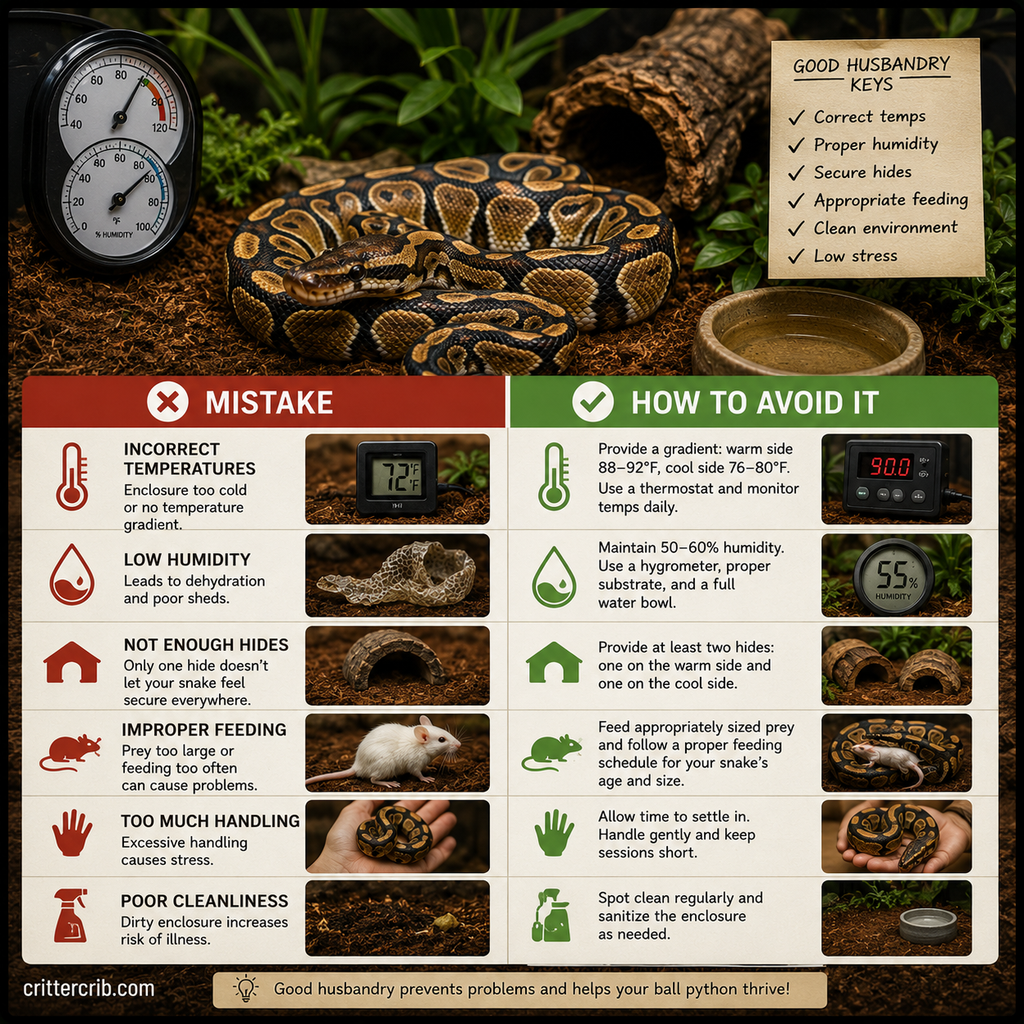
Your hand isn’t a thermometer.
Your eyes aren’t a hygrometer.
An enclosure can look perfectly normal while its environmental conditions are completely inappropriate.
This is one of the easiest husbandry mistakes to prevent.
How to Avoid This Mistake
Use digital monitoring equipment.
At minimum, you should be able to reliably monitor:
- Warm-side temperature
- Cool-side temperature
- Humidity
Check the readings regularly.
Environmental monitoring is especially important when seasons change and your home’s temperature or humidity shifts.
13. Feeding Prey That’s Too Large
Ball pythons can swallow surprisingly large prey, but that doesn’t mean bigger meals are better.
Oversized prey may be difficult to consume and can increase the likelihood of regurgitation or other problems.
Repeatedly overfeeding can also contribute to obesity.
How to Avoid This Mistake
Choose prey that’s appropriately sized for your snake’s body size and life stage.
Feeding schedules should also change as the snake matures.
A growing juvenile generally has different nutritional requirements from an established adult.
If you’re unsure about prey size or feeding frequency, consult an experienced reptile veterinarian.
14. Feeding Too Frequently
Ball pythons don’t need to eat every day.
Adult snakes can go substantial periods between meals compared with mammals.
Feeding too frequently can gradually produce an overweight snake, especially when large prey items are offered.
Obesity can be difficult for inexperienced owners to recognize because snakes naturally have very different body shapes from mammals.
How to Avoid This Mistake
Use an age- and size-appropriate feeding schedule rather than feeding whenever the snake appears interested.
Track your snake’s weight and body condition over time.
Growth should be steady rather than driven by the goal of making the snake as large as possible as quickly as possible.
15. Handling Immediately After Feeding
Handling a ball python shortly after a meal can disturb digestion and may increase the risk of regurgitation.
It’s tempting to pick up your snake when it’s already out and active, but feeding should generally be followed by a period of quiet.
How to Avoid This Mistake
Give your ball python adequate time to digest before handling it.
Avoid unnecessary disturbances after meals and make sure enclosure temperatures remain appropriate for digestion.
16. Moving the Snake to a Separate Container for Every Meal
Some owners are taught that ball pythons must be removed from their enclosure and placed into a separate feeding container.
This isn’t generally necessary.
Moving the snake immediately before and after feeding adds handling and can create unnecessary disturbance.
How to Avoid This Mistake
Ball pythons can normally be fed inside their regular enclosure.
Use feeding tongs when appropriate and maintain normal enclosure hygiene.
A snake isn’t automatically going to associate every opening of the enclosure with food simply because it’s fed there.
Consistent handling practices can help distinguish routine interaction from feeding.
17. Leaving Live Prey Unattended
A live rodent can injure a snake.
If the snake isn’t interested in eating, the prey animal may bite or scratch it.
These injuries can be serious.
How to Avoid This Mistake
Frozen-thawed prey is commonly used and eliminates the risk of a live rodent fighting back.
If live prey is used under appropriate circumstances, it should never simply be left unattended with the snake.
Remove uneaten prey rather than allowing it to remain in the enclosure.
18. Panicking When a Ball Python Refuses Food
Ball pythons have a reputation for occasionally refusing meals.
That can be alarming for a new owner.
But immediately changing everything in the enclosure, repeatedly offering food, or handling the snake excessively can make the situation worse.
Appetite may be influenced by:
- Seasonal changes
- Stress
- Shedding
- Reproductive behavior
- Improper temperatures
- Inadequate hiding opportunities
- Illness
- Feeding frequency
How to Avoid This Mistake
Look at the entire picture.
Check temperatures, humidity, behavior, body condition, and weight.
If your snake maintains a healthy body condition and otherwise behaves normally, a missed meal isn’t necessarily an emergency.
Persistent food refusal accompanied by significant weight loss, unusual behavior, breathing problems, or other symptoms warrants veterinary attention.
19. Handling a New Ball Python Too Soon
Bringing home a new snake is exciting.
Naturally, you want to hold it.
From the snake’s perspective, however, everything just changed.
It has been transported into an unfamiliar enclosure filled with new smells, sights, and environmental conditions.
Immediate frequent handling can add unnecessary stress.
How to Avoid This Mistake
Give a new ball python time to settle into its enclosure.
Keep interactions minimal initially while ensuring temperatures, humidity, hides, and water are appropriate.
Once the snake is settled and feeding reliably, handling can be introduced gradually.
20. Handling Too Frequently
Ball pythons can often become accustomed to gentle handling, but they aren’t social animals that require daily physical affection.
More handling isn’t automatically better.
How to Avoid This Mistake
Keep handling sessions reasonable and pay attention to the snake’s behavior.
Avoid handling:
- Immediately after feeding
- When the snake appears highly stressed
- During certain stages of shedding when disturbance may be unwelcome
- When the snake is sick or recovering unless necessary
Allow your ball python plenty of uninterrupted time in its enclosure.
21. Ignoring Signs of a Difficult Shed
A few pieces of stuck shed may look like a cosmetic issue.
They can indicate that environmental conditions need attention.
Retained shed around the eyes or tail deserves particular care.
Never aggressively peel skin from your snake.
How to Avoid This Mistake
Maintain appropriate hydration and humidity before shedding problems occur.
A humid hide can provide an additional moisture-rich retreat.
If retained shed persists or involves the eyes, tail, or other sensitive areas, contact a reptile veterinarian for guidance.
22. Ignoring Respiratory Symptoms
Snakes don’t cough and complain in the same way people do.
Respiratory illness may initially appear subtle.
Possible warning signs include:
- Wheezing
- Clicking or unusual breathing sounds
- Mucus
- Bubbles around the mouth or nostrils
- Open-mouth breathing
- Holding the head unusually elevated
- Reduced activity or appetite
These aren’t symptoms to treat by simply increasing the enclosure temperature and hoping for the best.
How to Avoid This Mistake
Maintain appropriate husbandry and seek veterinary care when respiratory illness is suspected.
A veterinarian experienced with reptiles can determine whether treatment is necessary.
23. Never Weighing Your Ball Python
Because snakes can go relatively long periods without eating, visual observation alone may not tell you whether food refusal is becoming a problem.
A digital scale gives you objective information.
How to Avoid This Mistake
Weigh your snake periodically and keep a simple record.
You can track:
- Date
- Weight
- Meals
- Prey size
- Shedding
- Food refusals
- Unusual behavior
You don’t need an elaborate spreadsheet.
A note on your phone can be enough.
The value comes from recognizing trends over time.
24. Cleaning Too Little—or Too Aggressively
Poor enclosure hygiene allows waste and contaminated substrate to accumulate.
But constantly stripping and disinfecting the entire habitat can also create unnecessary disturbance.
How to Avoid This Mistake
Use a sensible cleaning routine.
Remove:
- Feces
- Urates
- Shed skin
- Contaminated substrate
- Dirty water
Wash the water dish regularly and perform deeper cleaning when needed.
The enclosure should be sanitary without requiring a complete reset every few days.
25. Keeping Multiple Ball Pythons Together
Ball pythons don’t need roommates.
Cohabitation can create competition for preferred hides and temperature zones while making it harder to monitor each animal’s feeding, waste, health, and behavior.
Even if two snakes appear to be “cuddling,” they may simply be competing for the same desirable location.
How to Avoid This Mistake
House ball pythons individually under normal pet-keeping circumstances.
Each snake should have its own properly equipped enclosure.
26. Assuming a Ball Python Is “Happy” Because It Never Moves
A snake spending all day inside a hide isn’t necessarily a sign that everything is perfect.
Ball pythons naturally spend substantial time concealed and resting, but they may also explore when conditions are appropriate, particularly during their more active periods.
How to Avoid This Mistake
Provide opportunities for natural behavior rather than trying to force activity.
An enriching enclosure might include:
- Branches
- Cork bark
- Multiple hides
- Different textures
- Low climbing opportunities
- Visual barriers
- Appropriate space
Your snake can decide when to use them.
27. Ignoring Enrichment
Ball python care isn’t only about keeping the animal alive.
A well-designed enclosure can provide opportunities to explore, climb, hide, investigate, and choose between different microenvironments.
You don’t need colorful snake toys.
Environmental complexity is more useful.
How to Avoid This Mistake
Create a habitat rather than an empty container.
Add secure, appropriately sized structures and occasionally make small changes without constantly disrupting the snake’s entire environment.
Keep enrichment safe and voluntary.
28. Waiting Too Long to Find a Reptile Veterinarian
One of the worst times to search for an exotic veterinarian is when your snake is already sick.
Not every veterinary clinic treats snakes.
You may discover that the nearest reptile veterinarian is much farther away than expected.
How to Avoid This Mistake
Locate an experienced reptile veterinarian before you need one.
Save the clinic’s:
- Phone number
- Address
- Normal hours
- Emergency instructions
Consider scheduling a routine wellness examination for a new snake, particularly if its previous health history is uncertain.
Signs Your Ball Python’s Husbandry May Need Attention
A single unusual behavior doesn’t automatically indicate poor care.
Patterns are more useful.
Take a closer look at your setup if you repeatedly notice:
- Incomplete sheds
- Persistent food refusal
- Significant weight changes
- Constant attempts to escape
- Excessive soaking
- Wheezing or unusual breathing
- Repeated regurgitation
- Skin abnormalities
- Unusual inactivity
- Difficulty moving normally
Some of these signs can indicate illness rather than husbandry alone.
When you’re unsure, veterinary evaluation is safer than repeatedly experimenting with home remedies.
A Simple Ball Python Care Checklist
Good husbandry doesn’t need to be complicated.
Regularly check that your ball python has:
- An appropriately sized, secure enclosure.
- A proper warm-to-cool temperature gradient.
- Thermostatically controlled heating where appropriate.
- Reliable digital temperature monitoring.
- Appropriate humidity.
- Clean drinking water.
- Secure warm and cool hides.
- Enough cover to feel protected.
- Safe substrate.
- Appropriately sized prey.
- A sensible feeding schedule.
- Opportunities to explore and climb.
- A clean enclosure.
- Minimal unnecessary stress.
- Access to an experienced reptile veterinarian.
Consistency matters more than constantly changing the setup in pursuit of perfection.
Frequently Asked Questions About Ball Python Care Mistakes
What Is the Most Common Ball Python Care Mistake?
Temperature and humidity problems are among the most common husbandry issues.
Both should be measured with reliable equipment rather than estimated by touch or appearance.
Do Ball Pythons Need Two Hides?
Providing at least one secure hide in the warmer area and another in the cooler area allows the snake to thermoregulate without sacrificing security.
Additional cover and hiding opportunities can make the habitat even more usable.
Is It Normal for a Ball Python to Hide All Day?
Yes, spending significant amounts of time hiding is normal ball python behavior.
Many become more active during evening and nighttime hours.
Sudden behavioral changes accompanied by other symptoms should still be investigated.
Why Is My Ball Python Not Eating?
Food refusal can occur for many reasons, including shedding, stress, seasonal changes, husbandry problems, or illness.
Check temperatures, humidity, body condition, weight, and overall behavior.
Persistent food refusal accompanied by weight loss or other symptoms should be discussed with a reptile veterinarian.
Should I Mist My Ball Python Every Day?
Not necessarily.
The goal is to maintain appropriate humidity rather than follow a specific misting schedule.
Depending on your enclosure, ventilation, substrate, and climate, there may be more effective ways to maintain stable humidity.
Should I Feed My Ball Python in a Separate Tank?
Routine feeding in a separate enclosure generally isn’t necessary.
Ball pythons can normally be fed inside their regular habitat, avoiding the extra handling associated with moving them immediately before and after a meal.
Can Ball Pythons Live Together?
Ball pythons are generally best housed individually as pets.
Separate enclosures allow each snake unrestricted access to its own resources and make feeding, waste, weight, shedding, and health easier to monitor.
Final Thoughts
Most common ball python care mistakes aren’t caused by owners deliberately neglecting their snakes.
They’re often the result of outdated advice, assumptions, or simply not realizing how important seemingly small environmental details can be.
Fortunately, ball python husbandry becomes much easier once you focus on the fundamentals.
Provide an appropriate temperature gradient, regulate heating equipment safely, maintain suitable humidity, offer secure hides, use an appropriately sized enclosure, feed sensible meals, and give your snake enough environmental complexity to choose where it wants to spend its time.
Then measure rather than guess.
A thermometer tells you more than your hand. A hygrometer tells you more than looking at the substrate. A scale tells you more than trying to remember whether your snake looked thinner three months ago.
And when something genuinely seems wrong, don’t assume every problem can be fixed by adjusting the enclosure.
Having an experienced reptile veterinarian available gives you somewhere to turn when husbandry adjustments aren’t enough.
Avoiding ball python care mistakes isn’t about creating a perfect enclosure overnight. It’s about providing stable, appropriate conditions and paying enough attention to notice when something needs to change.