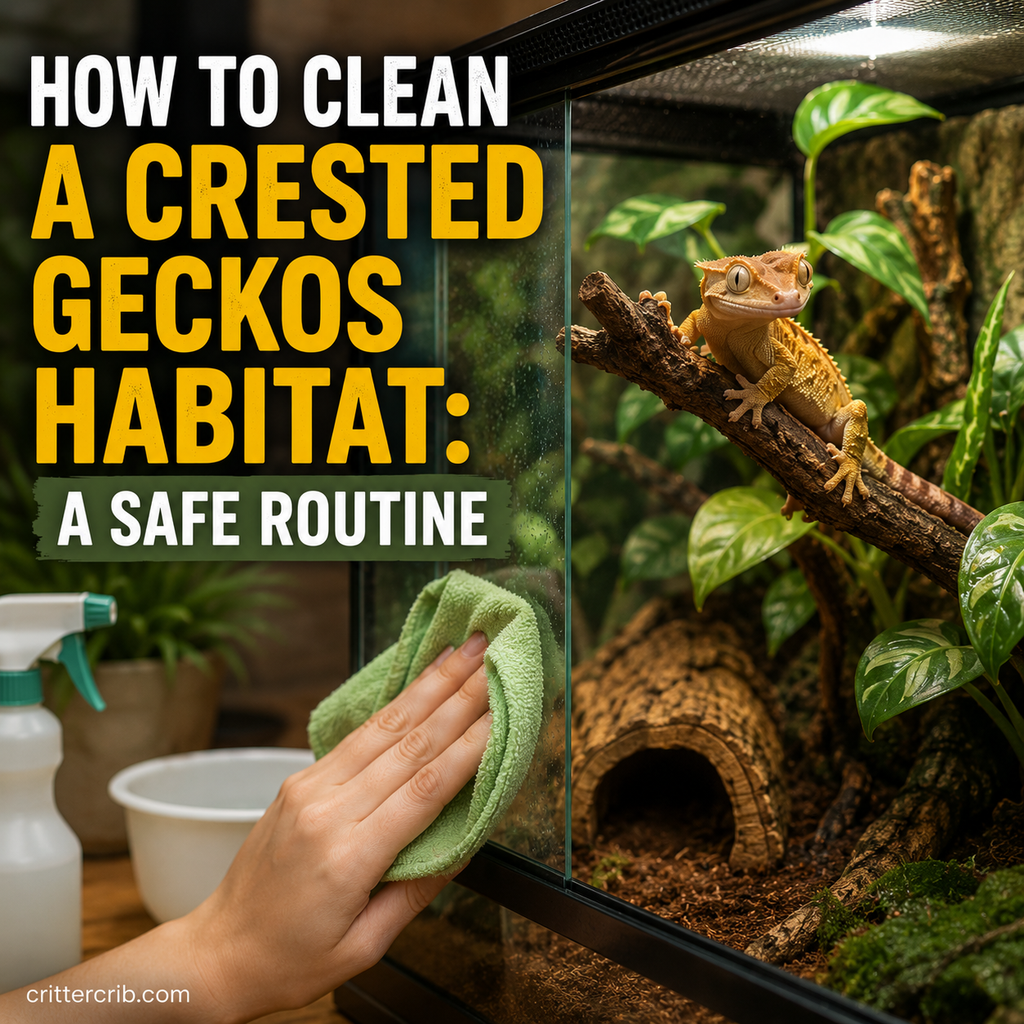
A clean crested gecko habitat isn’t supposed to look sterile. In fact, a healthy enclosure will usually contain plants, branches, hides, substrate, and plenty of places where your gecko can climb and explore.
The goal is to keep that environment sanitary without constantly tearing it apart.
For most crested gecko enclosures, a combination of quick daily maintenance, regular cleaning of food and water dishes, and occasional deeper cleaning works much better than waiting until the habitat looks dirty.
The routine also depends on your setup. A traditional enclosure with replaceable substrate requires different maintenance than a bioactive habitat containing live plants and a cleanup crew.
Here’s how to clean a crested gecko habitat safely while keeping disruption to your gecko to a minimum.
How Often Should You Clean a Crested Gecko Habitat?
There isn’t one cleaning schedule that works for every enclosure.
A habitat with one adult crested gecko, good ventilation, and properly managed humidity may stay cleaner than a smaller enclosure with poor airflow or consistently wet substrate.
As a general routine, think of cleaning in three levels:
- Daily or near-daily spot cleaning
- Regular cleaning of dishes and frequently soiled surfaces
- Periodic deeper cleaning when needed
You don’t necessarily need to dismantle the entire enclosure every week.
Frequent spot cleaning prevents waste and leftover food from accumulating, which makes larger cleaning sessions much easier.
Daily Crested Gecko Habitat Cleaning
Daily maintenance usually takes only a few minutes.
Check the enclosure when you feed your gecko or perform your regular care routine.
Remove Droppings
Crested geckos may leave droppings on:
- Glass
- Leaves
- Branches
- Cork bark
- Substrate
- Decorations
Remove visible feces as soon as you find them.
For waste sitting on loose substrate, scoop out the droppings along with a small amount of the surrounding substrate.
If waste is stuck to a hard surface, wipe or wash the area rather than simply removing the solid portion.
Remove Uneaten Food
Commercial crested gecko diets shouldn’t sit in the enclosure indefinitely.
Remove old food according to the feeding routine you’re following, and don’t simply add fresh food on top of leftovers.
Fruit-based prepared diets can spoil, attract insects, and become an unsanitary mess if forgotten in a warm, humid enclosure.
Feeder insects should also be monitored.
Remove uneaten insects rather than allowing large numbers to remain loose in the habitat.
Check the Water Dish
If you provide a water dish, check it daily.
Replace the water when it becomes dirty, and don’t allow droppings, substrate, or old food to remain in it.
Even if the water looks clean, regularly replacing it is a good habit.
Look for Mold and Spoiled Material
Humidity is important for crested geckos, but a damp enclosure can also encourage unwanted mold if organic material is left to decay.
Look for:
- Moldy food
- Decaying leaves
- Dead feeder insects
- Soggy substrate
- Unusual fungal growth
- Areas that remain excessively wet
A small amount of fungal activity can occur in naturalistic and bioactive environments, but recurring mold may indicate excessive moisture, inadequate airflow, or too much decaying material.
Cleaning Crested Gecko Food and Water Dishes
Food and water dishes deserve more attention than many other parts of the enclosure because they’re directly involved in feeding and hydration.
Don’t continuously refill a dirty dish.
Remove the dish and wash away all food residue before using it again.
A simple routine is:
- Remove leftover food or water.
- Rinse away loose debris.
- Wash the dish thoroughly.
- Rinse it well.
- Allow it to dry or refill it appropriately.
Having several feeding cups or reusable dishes can make this easier. You can replace a dirty one immediately and clean it separately.
Disposable feeding cups are another option when used with compatible feeding ledges.
How to Spot Clean a Crested Gecko Enclosure
Spot cleaning should be your main defense against a dirty habitat.
Rather than removing all the substrate because of one dropping, clean the affected area.
For a traditional enclosure:
- Locate feces, spilled food, or other waste.
- Remove the waste.
- Scoop out contaminated loose substrate around it if necessary.
- Wipe contaminated hard surfaces.
- Check nearby decorations for additional residue.
- Replace substrate locally if enough was removed.
This keeps the habitat cleaner while preserving much of the familiar environment.
Spot cleaning is especially useful in heavily decorated enclosures where complete disassembly would be stressful for both you and the gecko.
When Does a Crested Gecko Enclosure Need a Deep Clean?
A deep clean is more extensive than everyday maintenance.
How frequently it’s necessary depends on the substrate, enclosure design, humidity, and how effectively you spot clean.
Signs that deeper cleaning may be needed include:
- Persistent odors
- Repeated mold growth
- Heavily soiled substrate
- Waste accumulating in inaccessible areas
- Dirty decorations
- Food residue in crevices
- An enclosure that remains excessively wet
- A pest problem
You may also perform a more thorough cleaning when replacing substrate or significantly rearranging the habitat.
Bioactive enclosures are different and generally shouldn’t be completely stripped on a routine schedule.
Where Should Your Crested Gecko Go While You Clean?
For a significant cleaning, it’s usually easier and safer to temporarily move your crested gecko out of the enclosure.
Use a secure temporary container with adequate ventilation.
The container should:
- Close securely
- Have appropriate ventilation
- Prevent escape
- Be kept at a safe temperature
- Provide temporary cover if cleaning will take a while
Keep the container somewhere calm and away from other pets.
Crested geckos can jump suddenly, so don’t leave one sitting unattended in an open container while you work.
For a quick spot clean, removing the gecko may not be necessary if you can clean safely without disturbing it.
Supplies for Cleaning a Crested Gecko Habitat
It’s useful to keep reptile-cleaning supplies separate from general household cleaning equipment.
Your basic kit might include:
- Paper towels
- Reusable cleaning cloths dedicated to reptile care
- Small scrub brush
- Spare food dishes or feeding cups
- Waste scoop
- Bucket or container used only for reptile supplies
- Reptile-appropriate disinfectant when needed
- Clean replacement substrate
Labeling reptile-specific equipment can prevent it from accidentally being used for household cleaning.
Wash your hands thoroughly after handling the gecko, substrate, waste, food dishes, or enclosure equipment.
How to Deep Clean a Crested Gecko Habitat
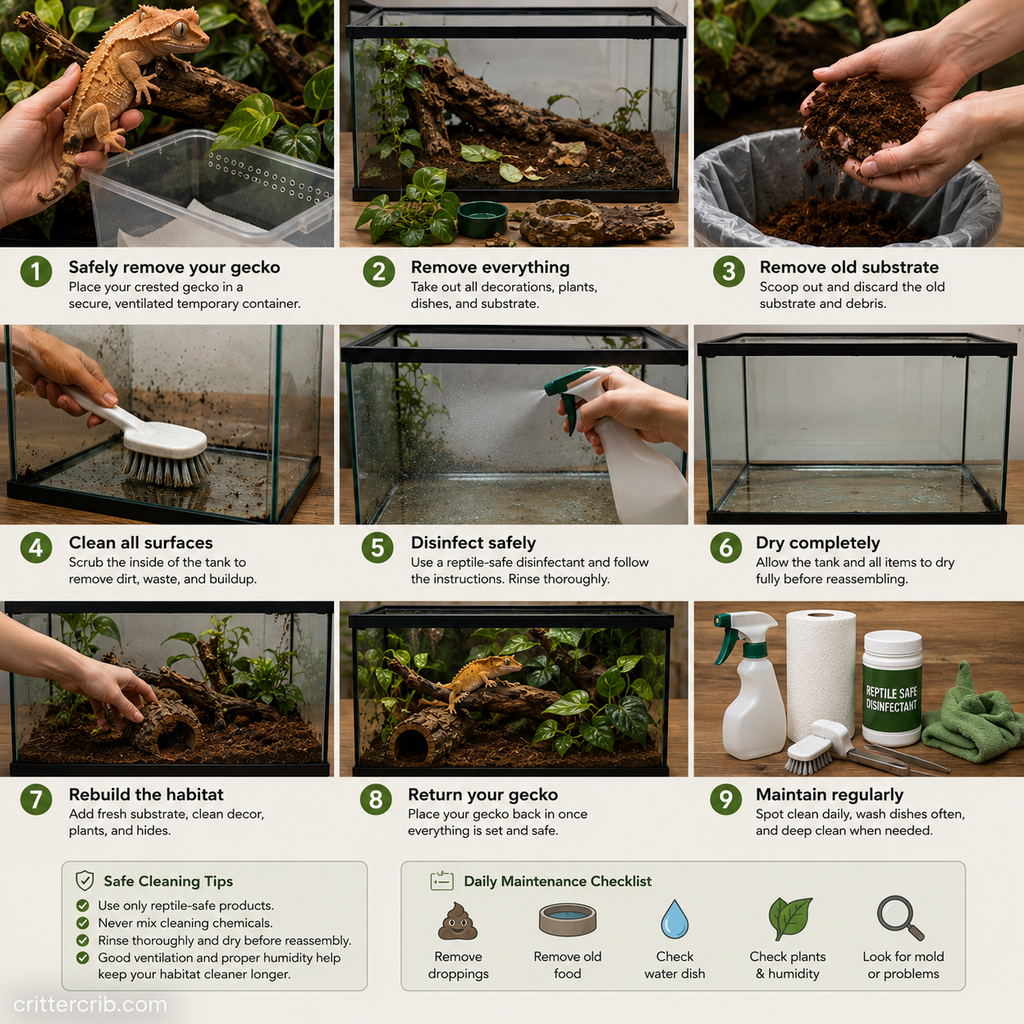
A traditional non-bioactive habitat can occasionally be cleaned more thoroughly.
Here’s a practical process.
1. Move Your Gecko to a Secure Container
Secure your crested gecko before you begin dismantling anything.
This prevents accidental escapes and keeps the animal away from cleaning products.
2. Remove Food, Water, and Loose Items
Take out:
- Food dishes
- Water dishes
- Artificial plants
- Removable branches
- Hides
- Feeding ledges
- Other removable decorations
Keep track of how everything was arranged if your gecko seems comfortable with the current setup.
Taking a quick photo beforehand can make reassembly easier.
3. Remove Old Substrate
Discard substrate that needs replacement.
Pay particular attention to damp material and areas where waste or food has accumulated.
If you’re using paper towels or another disposable liner, remove the entire liner.
4. Remove Organic Debris Before Disinfecting
This step matters.
A disinfectant shouldn’t be expected to work effectively through layers of feces, substrate, dried food, and other debris.
Clean visible material from surfaces first.
Think of cleaning and disinfecting as two different jobs:
Cleaning removes dirt and organic material.
Disinfecting reduces microorganisms on an already-clean surface.
5. Clean the Enclosure
Wash contaminated surfaces thoroughly.
Pay attention to:
- Corners
- Door tracks
- Ventilation areas
- Feeding ledges
- Glass
- Floor seams
- Areas behind decorations
Dried crested gecko diet can become surprisingly stubborn once it hardens.
6. Disinfect When Appropriate
Use a disinfectant that is appropriate for reptile enclosures and follow the product’s instructions exactly.
More disinfectant isn’t better.
Correct dilution, contact time, and rinsing requirements vary by product, so don’t guess.
Never mix cleaning chemicals.
7. Rinse and Dry
If the product requires rinsing, rinse surfaces thoroughly.
Allow the enclosure and cleaned accessories to dry appropriately before your gecko returns.
Don’t put the animal back into an enclosure containing wet disinfectant or strong chemical residue.
8. Add Fresh Substrate
Once everything is clean and ready, add the appropriate substrate.
How much you use depends on the type of enclosure and whether you’re growing live plants.
9. Reassemble the Habitat
Return branches, plants, hides, ledges, and other furnishings.
Make sure climbing structures are secure.
Crested geckos spend much of their time above ground, so the habitat should provide plenty of stable vertical structure.
10. Return Your Gecko
Once the enclosure is completely ready and conditions are appropriate, return your crested gecko.
Give it time to settle back in.
A gecko may explore more than usual after a major cleaning because familiar scents and surroundings have changed.
How to Clean Branches, Hides, and Decorations
Different enclosure materials require different cleaning methods.
Plastic and Resin Decorations
These are usually relatively easy to clean because they aren’t highly porous.
Remove visible debris, wash thoroughly, and disinfect when appropriate.
Pay attention to small crevices where food and waste can accumulate.
Artificial Plants
Artificial leaves are magnets for droppings and dried food.
Remove them when necessary and clean both sides of the leaves as well as the stems.
Check the plant for damaged plastic, exposed wire, or sharp edges before returning it to the enclosure.
Cork Bark and Wood
Porous natural materials are more difficult to sanitize than smooth plastic.
Waste and liquids can soak into cracks and pores.
Minor surface contamination may sometimes be cleaned, but heavily contaminated, deteriorating, or mold-infested porous materials may be better replaced.
Avoid applying random household chemicals to porous wood and immediately returning it to your gecko’s enclosure.
Cleaning the Glass
Crested gecko glass rarely stays spotless for long.
Between misting, climbing, food, and droppings, you’ll probably notice spots and streaks regularly.
For routine cleaning, wipe the glass as needed.
If you’re cleaning the inside surface, avoid leaving chemical residues that the gecko could contact or lick.
Mineral deposits from misting water can also build up over time, particularly if your water is hard.
Regular light cleaning is easier than waiting until deposits become thick and difficult to remove.
What Cleaning Products Are Safe for Crested Gecko Enclosures?
This is one area where it’s worth being cautious.
Don’t assume a household cleaner is safe simply because it’s marketed as “natural” or has a pleasant scent.
Products designed specifically for animal or reptile environments can be easier to use safely because they provide relevant dilution and contact-time instructions.
Whatever product you choose:
- Read the label
- Follow dilution instructions
- Observe the required contact time
- Rinse when instructed
- Keep the gecko away during cleaning
- Never mix chemicals
- Don’t return the gecko until the enclosure is safe
Strong fragrance isn’t a sign that something is cleaner.
For everyday spot cleaning, you may not need to disinfect the entire enclosure at all.
Cleaning a Bioactive Crested Gecko Enclosure
A bioactive enclosure works differently from a traditional setup.
The substrate contains a living ecosystem that may include beneficial microorganisms and cleanup crew organisms such as springtails and isopods.
Completely removing and disinfecting everything would defeat much of the purpose.
What Should You Clean in a Bioactive Habitat?
You still need to remove:
- Uneaten prepared food
- Heavily concentrated waste
- Dead feeder insects
- Moldy food
- Problematic decaying material
- Waste on glass and decorations
Food and water dishes still need normal cleaning.
What Does the Cleanup Crew Do?
Springtails and isopods help break down organic material, but they don’t eliminate your responsibilities.
A bioactive enclosure isn’t self-cleaning.
You still need to monitor moisture, plant health, waste accumulation, airflow, and the overall condition of the habitat.
When Does Bioactive Substrate Need Attention?
Healthy bioactive substrate can remain in place much longer than ordinary disposable substrate.
However, investigate if you notice:
- Persistent foul odors
- Major mold outbreaks
- Saturated substrate
- Large pest populations
- Plant die-off
- Cleanup crew collapse
- Significant drainage problems
These signs may indicate that the enclosure’s biological balance or moisture management needs attention.
Don’t Keep the Habitat Constantly Wet
Cleaning and humidity management are closely connected.
Crested geckos need appropriate humidity, but that doesn’t mean every surface should stay wet around the clock.
A habitat that never has an opportunity to dry appropriately can encourage:
- Mold
- Bacterial growth
- Substrate problems
- Persistent odors
- Poor environmental conditions
Ventilation matters just as much as misting.
Monitor the actual enclosure conditions instead of misting automatically without checking whether the habitat needs it.
Should You Clean While Your Crested Gecko Is Sleeping?
Crested geckos are generally most active during the evening and nighttime.
You can perform small maintenance tasks during the day, but try not to repeatedly disturb a sleeping gecko for unnecessary cleaning.
If a dropping is sitting on the opposite side of the enclosure, you can usually remove it without dismantling your gecko’s sleeping area.
Save disruptive rearranging for when it’s actually needed.
Common Crested Gecko Cleaning Mistakes
Cleaning isn’t complicated, but a few habits can create unnecessary problems.
Deep Cleaning Too Often
Constantly stripping and disinfecting an enclosure isn’t automatically healthier.
Good spot cleaning can reduce how often major cleaning is necessary.
Waiting Until the Enclosure Smells
A strong odor is a reason to investigate, not a cleaning reminder.
Waste and spoiled food should be removed before they create persistent smells.
Leaving Old Food Overnight for Too Long
Prepared crested gecko diet is moist and nutrient-rich.
Don’t allow old food to accumulate from one feeding to the next.
Using Strong Household Cleaners Without Research
Products intended for kitchens and bathrooms aren’t automatically appropriate for reptile habitats.
Use suitable products and follow instructions carefully.
Mixing Cleaning Chemicals
Never mix cleaning products.
Certain combinations can produce dangerous fumes or reactions.
Disinfecting Before Removing Dirt
Clean first.
Disinfection is most effective on a surface that has already had organic debris removed.
Forgetting Door Tracks and Crevices
Food, substrate, shed skin, and waste can collect in places that aren’t immediately visible.
Check tracks, corners, ledges, and areas behind decorations during deeper cleaning.
Returning the Gecko Too Soon
Make sure cleaning products have been handled according to their instructions and the habitat is ready before returning your gecko.
A Simple Crested Gecko Cleaning Schedule
You don’t need to make habitat cleaning complicated.
A practical routine might look like this:
Daily or Near-Daily
- Remove visible droppings
- Remove old food
- Check water
- Remove dead feeder insects
- Look for mold or unusual moisture
- Check general enclosure condition
Regularly
- Wash food dishes
- Clean the water dish
- Wipe dirty glass
- Clean heavily soiled leaves and decorations
- Replace contaminated substrate as needed
Periodically
- Replace substrate in traditional setups when necessary
- Clean removable furnishings thoroughly
- Clean difficult-to-reach areas
- Inspect branches and decorations for deterioration
- Perform deeper cleaning or disinfection when warranted
Bioactive setups should be maintained according to the health of the ecosystem rather than completely stripped on a routine timetable.
Frequently Asked Questions About Cleaning a Crested Gecko Habitat
How Often Should I Completely Clean My Crested Gecko’s Enclosure?
There’s no universal number of weeks that applies to every setup.
Traditional enclosures require periodic substrate replacement and deeper cleaning, but effective spot cleaning can reduce how often the entire habitat needs to be dismantled.
Bioactive habitats follow a different maintenance routine and generally aren’t completely stripped and disinfected regularly.
Should I Remove My Crested Gecko While Cleaning?
For major cleaning, yes. Place your gecko in a secure, ventilated temporary container.
For quick spot cleaning, removal may not be necessary if you can clean without putting the gecko at risk or causing excessive disturbance.
Can I Use Household Cleaner on a Crested Gecko Tank?
Don’t assume a general household product is appropriate for reptile housing. Check the product’s intended use and safety instructions carefully.
When disinfecting, a product appropriate for animal or reptile environments with clear dilution and contact-time directions is preferable.
Why Does My Crested Gecko Enclosure Smell?
Persistent odors can result from hidden feces, old food, dead insects, oversaturated substrate, poor ventilation, or decaying organic material.
A healthy, well-maintained enclosure shouldn’t rely on fragrances to cover odors.
Find and correct the source.
Do Bioactive Crested Gecko Enclosures Need Cleaning?
Yes.
The cleanup crew helps process organic matter, but you’ll still need to remove old food, clean dishes and glass, monitor waste, manage moisture, and maintain the plants and ecosystem.
Should I Disinfect the Enclosure Every Time I Spot Clean?
Usually, no.
Routine removal of small amounts of waste doesn’t necessarily require disinfecting the entire habitat. Save more extensive sanitation for situations where it’s actually warranted.
Final Thoughts
Keeping a crested gecko habitat clean is much easier when you don’t allow messes to accumulate in the first place.
Remove droppings and leftover food regularly, keep feeding equipment clean, monitor moisture, and deal with contaminated areas when you notice them. Those small habits can prevent many of the problems that lead to major cleaning sessions.
When deeper cleaning is necessary, move your gecko somewhere secure, remove organic debris first, and only then disinfect when appropriate. Follow cleaning-product directions carefully and make sure the enclosure is safe before putting your gecko back.
Bioactive habitats need a different approach. Rather than repeatedly stripping the enclosure, you’ll maintain the living system while still cleaning dishes, glass, concentrated waste, and spoiled food.
Ultimately, a good crested gecko cleaning routine isn’t about making the enclosure spotless. It’s about maintaining a healthy environment while allowing the habitat to remain functional, enriching, and comfortable for the animal living in it.