
Rabbits are often pictured living in small hutches, but their actual space requirements are much greater than many first-time owners expect.
A rabbit needs enough room to stand upright, stretch out completely, hop several times in a row, explore, play, eat, rest, and get away from a companion when it wants some privacy. And because rabbits are active animals, that space needs to be available consistently—not just during an occasional trip outside the enclosure.
So, how much space does a rabbit really need?
There isn’t one perfect measurement for every rabbit. Breed, body size, number of rabbits, housing arrangement, and access to an exercise area all matter. The better way to think about rabbit housing is to provide a spacious home base connected to an even larger area where normal movement and exercise can happen every day.
This guide explains how much room rabbits need, how to evaluate an enclosure, and how to create a comfortable indoor or outdoor living space.
Why Rabbits Need More Space Than You Might Think
Rabbits aren’t built to spend their lives sitting still.
Watch a comfortable rabbit with enough room and you’ll see a surprising range of movement. Rabbits hop, sprint, stand on their hind legs, stretch out, investigate objects, dig, jump onto platforms, and sometimes race around in sudden bursts of energy.
They may also perform a joyful jump and twist known as a “binky.”
A small cage limits many of these natural behaviors.
Adequate space gives rabbits room to:
- Hop and run
- Stand fully upright
- Stretch out
- Explore
- Forage
- Play
- Dig
- Rest comfortably
- Use a litter box
- Eat hay away from sleeping areas
- Interact with a companion
- Move away from another rabbit when desired
Space isn’t simply a luxury. It’s part of creating an environment where a rabbit can behave normally.
How Much Space Does a Rabbit Need?
A commonly recommended starting point for a pair of medium-sized rabbits is a living area of approximately 3 meters by 2 meters (about 10 feet by 6.5 feet), with enough height for the rabbits to stand upright comfortably.
That works out to roughly 60–65 square feet of accessible space.
However, you shouldn’t treat a particular measurement as a finish line.
Bigger rabbits need more room, and even smaller rabbits benefit from additional space.
The enclosure also needs to be arranged in a way that leaves usable floor area. A space may sound large on paper but become cramped after adding litter boxes, hides, food dishes, water, toys, and other accessories.
Think in Terms of a Living Area, Not a Cage
One of the easiest ways to improve rabbit housing is to stop thinking about finding a sufficiently large “cage.”
Instead, think about creating a rabbit living area.
That might consist of:
- A large exercise pen
- A rabbit-proofed room
- A dedicated section of a room
- A large enclosure connected to an exercise area
- A secure outdoor shelter connected to a large run
The rabbit’s smaller sheltered area can provide somewhere to sleep, hide, and feel secure.
The larger space allows actual movement.
Can a Rabbit Live in a Cage?
A traditional small rabbit cage shouldn’t be the rabbit’s entire living environment.
Even if a rabbit is allowed out periodically, spending most of the day and night inside a cramped cage provides very little opportunity for normal activity.
A larger exercise pen is often a more practical indoor housing solution.
Pens can provide substantially more usable floor space while still creating a defined rabbit area.
They also make it easier to include:
- A large litter box
- Hay
- Water
- Hides
- Toys
- Chewable items
- Comfortable resting areas
For some households, the pen eventually becomes a home base while the rabbit receives access to an entire rabbit-proofed room.
How to Tell If a Rabbit Enclosure Is Large Enough
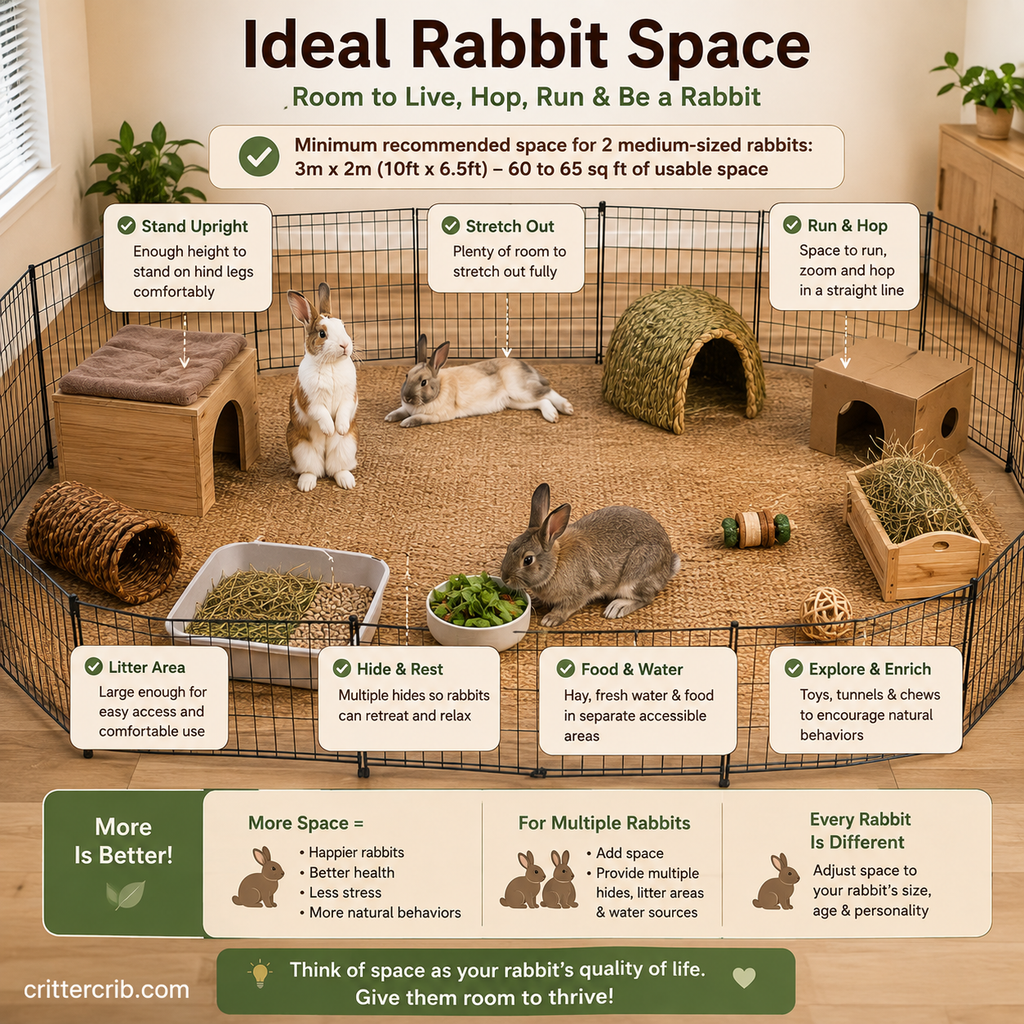
Measurements are helpful, but your rabbit can tell you quite a bit about the space too.
Stand back and look at what the rabbit can actually do.
Your rabbit should be able to:
- Stand upright on its hind legs without its ears touching the top.
- Stretch completely flat on the floor.
- Make several full hops in succession.
- Turn around easily.
- Run and play.
- Access food, water, and litter without squeezing between objects.
- Retreat into a hide.
- Move away from a companion when desired.
If the rabbit has to carefully maneuver around everything in the enclosure, you probably need more usable floor space.
Rabbit Size Matters
Not all rabbits require exactly the same amount of space.
A Netherland Dwarf and a Flemish Giant obviously have very different body sizes.
A large rabbit needs enough room to stretch out fully and move comfortably without constantly encountering walls or enclosure furniture.
Small Rabbits Still Need Exercise Space
It’s easy to assume that a dwarf rabbit can live happily in a tiny enclosure because the animal itself is small.
But physical size isn’t the only consideration.
Small rabbits still run, hop, explore, forage, and play.
A smaller body doesn’t eliminate the need for exercise.
Large Rabbits Need Considerably More Room
Large and giant rabbit breeds need housing scaled appropriately to their bodies.
Everything becomes larger:
- Floor space
- Litter boxes
- Hides
- Resting areas
- Door openings
- Exercise areas
A setup designed around an average-sized rabbit may simply be too cramped for a giant breed.
When choosing an enclosure, plan around the rabbit’s expected adult size rather than its size as a baby.
How Much Space Do Two Rabbits Need?
A bonded pair needs enough room to live together without being forced to remain directly beside each other.
Rabbits are social animals, but even closely bonded companions need personal space occasionally.
The enclosure should allow both rabbits to:
- Eat comfortably
- Rest separately
- Stretch out
- Use hiding areas
- Explore
- Move past each other
- Access water
- Use litter areas
Providing duplicate or oversized resources can help reduce competition.
For example, you may need multiple water bowls, several hides, and a litter box large enough for both rabbits.
Don’t Simply Double Everything
Housing two rabbits doesn’t necessarily mean you need exactly twice the floor area.
What matters is whether the space comfortably accommodates both animals and their resources while leaving plenty of room for movement.
When possible, provide more space rather than calculating the absolute minimum.
Extra room is rarely wasted with rabbits.
What About Three or More Rabbits?
Each additional rabbit increases the need for space and resources.
Larger groups require enough room for individuals to move away from each other, especially when social dynamics change.
You’ll also need to account for additional:
- Litter areas
- Hiding places
- Feeding locations
- Water sources
- Resting areas
- Enrichment
A setup that feels spacious for two rabbits may become crowded surprisingly quickly with three or four.
Observe how the rabbits actually use the environment rather than relying entirely on measurements.
Indoor Rabbit Housing
Keeping rabbits indoors makes it easier to include them in everyday household life and monitor changes in behavior, appetite, and health.
There are several ways to create a good indoor rabbit setup.
Exercise Pen Housing
An exercise pen is one of the simplest options.
It creates a defined rabbit area without confining the animal to a traditional cage.
Inside the pen, provide:
- Litter box
- Unlimited hay
- Fresh water
- Comfortable resting surface
- Hide
- Chew toys
- Enrichment
- Open movement space
Choose a pen tall enough that your rabbit can’t simply jump over it.
Some rabbits are much more talented jumpers than their owners initially expect.
Dedicated Rabbit Room
If you have the space, a rabbit-proofed room can make an excellent living environment.
A spare bedroom, office, or another suitable area can provide plenty of floor space.
You’ll still want a secure hide or home base where the rabbit can retreat.
A large room doesn’t replace the need for shelter.
Free-Roaming Rabbits
Some owners eventually allow rabbits to roam freely through much of the home.
This can provide excellent space, but it requires serious rabbit-proofing.
A free-roaming rabbit can potentially access:
- Electrical cords
- Houseplants
- Baseboards
- Carpet
- Furniture
- Books
- Small objects
- Cleaning products
- Unsafe foods
- Open doors
If something can be chewed, assume your rabbit may eventually investigate it.
Rabbit-Proofing an Indoor Space
Rabbit-proofing isn’t optional when rabbits have access to a room or house.
Chewing and digging are normal rabbit behaviors.
The goal isn’t to teach a rabbit never to chew. It’s to prevent access to dangerous objects while providing appropriate alternatives.
Protect Electrical Cords
Electrical cords are one of the most serious household hazards.
Keep cords completely inaccessible or protect them using appropriate hard barriers.
Simply pushing a cord behind a piece of furniture may not be enough. Rabbits can squeeze into surprisingly narrow spaces.
Check Houseplants
Some common houseplants can be unsafe for rabbits.
Move plants completely out of reach rather than assuming the rabbit won’t bother them.
Remember that leaves can fall.
Protect Baseboards and Furniture
Some rabbits ignore baseboards.
Others apparently consider them a home-improvement project.
Safe barriers can protect walls, furniture legs, and other tempting surfaces.
Providing acceptable chewing materials also gives your rabbit somewhere appropriate to direct that behavior.
Watch Flooring
Rabbits can struggle on extremely slippery floors.
If your rabbit slides when trying to move, provide rugs, mats, or another safe surface that offers traction.
Make sure any flooring material is safe if chewed.
Outdoor Rabbit Housing
Rabbits can also live in carefully designed outdoor setups, but outdoor housing introduces additional challenges.
An outdoor enclosure must protect rabbits from:
- Predators
- Extreme heat
- Cold
- Rain
- Wind
- Direct sun
- Escape
- Insects
- Toxic plants
- Wild animals
A small wooden hutch by itself isn’t enough.
The rabbit needs a sheltered area connected to a secure exercise space.
Predator-Proofing an Outdoor Rabbit Enclosure
Outdoor rabbit housing needs protection from predators even if you don’t regularly see them.
Potential threats vary by location but may include:
- Coyotes
- Foxes
- Raccoons
- Dogs
- Cats
- Birds of prey
- Snakes
- Other wildlife
Predators may attempt to dig underneath an enclosure, reach through openings, or manipulate weak latches.
Use sturdy materials and secure closures.
Chicken wire alone may not provide adequate protection against determined predators.
The enclosure should also prevent rabbits from digging their way out.
Rabbits and Hot Weather
Heat is particularly dangerous for rabbits.
An outdoor enclosure needs reliable shade and ventilation, but shade alone doesn’t guarantee safe temperatures.
A shaded structure can still become dangerously hot during warm weather.
Never place rabbit housing where direct sunlight can turn the enclosure into a heat trap.
During hot conditions, monitor rabbits closely and have a plan for moving them somewhere cooler when necessary.
Rabbits and Cold Weather
Healthy rabbits can tolerate cooler temperatures better than extreme heat when they’re properly acclimated and have appropriate shelter, but outdoor rabbits still need protection from cold, dampness, and wind.
Their sleeping area should remain:
- Dry
- Sheltered
- Well ventilated
- Protected from drafts
- Secure
Wet bedding should be replaced promptly.
Weather conditions can change quickly, so outdoor housing requires regular monitoring.
Does a Rabbit Need Exercise Outside Its Enclosure?
If your rabbit’s permanent living area is already large enough to run, hop, explore, and play freely, a separate exercise session becomes less critical.
That’s one advantage of creating a large permanent living environment.
If your rabbit lives in a smaller home base, however, it needs frequent access to a substantially larger exercise area.
Exercise shouldn’t be viewed as a rare bonus.
Movement is part of normal rabbit behavior.
How Much Exercise Do Rabbits Need?
Rabbits should have opportunities for activity every day.
Rather than thinking only in terms of scheduled exercise minutes, aim to create an environment where movement is available for long periods.
Rabbits often choose when they want to be active.
You may find that your rabbit spends part of the day resting and suddenly becomes energetic in the morning or evening.
A permanently accessible exercise area allows the rabbit to follow its own activity rhythm.
What Should Be Inside a Rabbit’s Living Space?
A large empty enclosure is better than a tiny cage, but space becomes much more useful when it’s thoughtfully arranged.
Your rabbit’s environment should include several functional areas.
Litter Area
Provide an appropriately sized litter box that your rabbit can enter comfortably.
Many owners place hay near or directly above one end of the litter area because rabbits often enjoy eating while using the box.
Hay and Feeding Area
Rabbits should have constant access to appropriate grass hay.
Position hay somewhere clean and easy to access.
Food shouldn’t be difficult to reach or located where another rabbit can easily guard it.
Water
Fresh water should always be available.
Heavy ceramic bowls are commonly useful because they’re difficult to tip.
For multiple rabbits, consider providing more than one water source.
Hiding Areas
Every rabbit needs somewhere to retreat.
A hide should be large enough for the rabbit to enter, turn around, and rest comfortably.
When housing multiple rabbits, provide multiple hiding options.
Hides with more than one entrance can help prevent one rabbit from trapping another.
Comfortable Resting Areas
Rabbits spend plenty of time resting.
Provide clean, dry surfaces where they can stretch out.
Some rabbits enjoy soft mats, while others prefer cooler solid surfaces.
Giving them options allows them to choose.
Enrichment Uses Space Too
Don’t forget that toys and enrichment take up room.
Rabbit enrichment can include:
- Cardboard boxes
- Tunnels
- Digging boxes
- Hay-filled toys
- Safe chewing materials
- Platforms
- Foraging activities
- Paper bags filled with hay
- Cardboard tubes
The enclosure should remain spacious after these items are added.
If you’ve created an obstacle course simply because there’s nowhere else to put everything, the rabbit needs more room or fewer objects.
Give Rabbits Places to Explore
Rabbits are curious.
A completely predictable environment can become boring, even if it’s large.
You can occasionally change safe enrichment items, introduce new cardboard structures, or create simple foraging activities.
Try hiding small portions of appropriate food around the living area.
A cardboard box with multiple entrances can become a hide one week and a chewable renovation project the next.
That’s part of the fun.
Don’t Forget Vertical Space
Floor space should be the priority, but height matters too.
Your rabbit needs enough overhead clearance to stand upright naturally on its hind legs.
Some rabbits also enjoy safely jumping onto low platforms.
If you provide elevated surfaces, make sure they are:
- Stable
- Easy to access
- Large enough to stand on
- Not dangerously high
- Made from safe materials
Don’t try to compensate for inadequate floor space by adding multiple levels.
Rabbits aren’t cage-climbing animals.
Horizontal movement should remain the priority.
How High Should a Rabbit Pen Be?
There’s no single height that works for every rabbit.
Some rabbits rarely attempt to jump over barriers.
Others seem to regard every fence as a personal challenge.
Choose a pen tall enough for your rabbit’s size and jumping ability.
If you discover that your rabbit can escape, increase the height or add an appropriate secure cover rather than assuming it won’t happen again.
Also keep nearby furniture in mind.
A rabbit may use a box, hide, or platform as a launching point.
Flooring for Rabbit Housing
Good flooring provides traction while remaining comfortable and easy to maintain.
Wire flooring should be avoided as the primary walking surface.
Rabbits need solid flooring where their feet can rest naturally.
Indoor options may include suitable:
- Rugs
- Mats
- Washable floor coverings
- Carpeted areas
- Other solid, nonslip surfaces
Watch your individual rabbit.
If it hesitates to cross a particular surface or repeatedly slips, improve the traction.
How Much Room Does a Rabbit Need to Sleep?
Rabbits don’t necessarily need a separate bedroom, but they should have a quiet place where they can rest comfortably.
A resting area should allow the rabbit to:
- Stretch out fully
- Turn around
- Change sleeping positions
- Retreat from activity
Bonded rabbits may sleep pressed together one minute and on opposite sides of the enclosure the next.
Give them enough space to choose.
Should Rabbits Be Locked in a Hutch at Night?
A rabbit’s need for movement doesn’t disappear when you go to bed.
Rabbits are often active during the early morning and evening and may also move around during the night.
If an outdoor rabbit has a secure shelter connected to a predator-proof exercise area, it can choose whether to rest or explore.
Locking a rabbit into a tiny sleeping compartment for long periods significantly reduces its usable living space.
Security is essential, but ideally security should come from making the entire living area safe rather than drastically restricting movement.
Signs Your Rabbit May Need More Space
Some behaviors may suggest that the environment needs improvement.
Watch for:
- Repeatedly chewing enclosure bars
- Constantly trying to escape
- Excessive digging at barriers
- Limited ability to run
- Difficulty stretching out
- Frequent conflicts over resources
- One rabbit blocking another
- Lack of room around the litter box
- Accessories occupying nearly all available floor space
Not every unwanted behavior is caused by insufficient space, but the enclosure is always worth evaluating.
Ask yourself a simple question:
Can my rabbit actually behave like a rabbit here?
If the answer is “not really,” the setup needs work.
Common Rabbit Housing Mistakes
Even well-meaning owners can underestimate how much room rabbits require.
Using a Pet-Store Cage as Permanent Housing
Many commercially sold cages are better suited as temporary holding areas or home bases than complete living environments.
Check the actual dimensions rather than relying on a product being labeled “rabbit cage.”
Choosing Height Instead of Floor Space
Several small levels don’t replace a large running area.
Prioritize horizontal space.
Filling Every Inch With Accessories
Toys are great.
So is being able to move.
Leave open pathways for running and hopping.
Not Providing Enough Hides
Rabbits should have somewhere to retreat when they want privacy.
Multiple rabbits need enough shelter options to prevent unnecessary competition.
Ignoring Adult Size
That tiny baby rabbit may become considerably larger.
Build the enclosure for the rabbit you’re going to have, not just the rabbit you have today.
Providing Exercise Only Occasionally
A rabbit shouldn’t spend almost all week confined and then receive a short exercise session on the weekend.
Regular movement should be part of everyday life.
A Simple Rabbit Housing Checklist
Before considering your rabbit’s living area complete, walk through this checklist.
Space
- Can the rabbit make several hops in succession?
- Can it run?
- Can it stand fully upright?
- Can it stretch completely flat?
- Is there open floor space after accessories are added?
Comfort
- Is the flooring solid and nonslip?
- Is there a comfortable resting area?
- Are there places to hide?
- Is the environment dry and well ventilated?
Food and Water
- Is hay always accessible?
- Is fresh water available?
- Can multiple rabbits access resources without conflict?
Enrichment
- Are there safe items to chew?
- Are there tunnels or hiding areas?
- Can the rabbit forage?
- Is there something to explore?
Safety
- Are electrical cords inaccessible?
- Are toxic plants out of reach?
- Are escape routes secured?
- Are outdoor rabbits protected from predators?
- Is the enclosure protected from temperature extremes?
If you’re answering “no” repeatedly, improving the environment should be a priority.
Frequently Asked Questions About Rabbit Housing
Is a 4-Foot Cage Big Enough for a Rabbit?
A four-foot cage may be useful as part of a larger setup, but it generally shouldn’t represent the rabbit’s entire living environment.
Connect smaller home-base areas to a much larger exercise space whenever possible.
Can a Rabbit Live in an Exercise Pen?
Yes. A properly sized and securely arranged exercise pen can make a practical indoor rabbit home.
Make sure it provides enough space after adding litter boxes, hay, water, hides, and other essentials.
Can Rabbits Live Free-Roam?
Some rabbits do very well with free-roam living.
However, the home must be carefully rabbit-proofed, and the rabbit should still have a secure area where it can retreat.
Start with a controlled area and gradually expand access as you learn your rabbit’s habits.
Do Dwarf Rabbits Need Less Space?
Their accessories can sometimes be smaller, but dwarf rabbits still need plenty of room to run, hop, explore, and exercise.
Don’t use their small body size as a reason to provide an extremely small enclosure.
How Much Space Does a Giant Rabbit Need?
Giant breeds require substantially more room than small rabbits.
The rabbit should be able to stretch fully, stand upright, move freely, and perform several hops without encountering barriers.
For very large rabbits, a dedicated room or large pen arrangement may be more practical than conventional rabbit enclosures.
Do Two Rabbits Need More Space Than One?
Yes.
Two rabbits need enough room to move independently and access resources without constantly competing.
A bonded pair may enjoy spending time together, but each rabbit should still be able to retreat or rest separately.
Do Rabbits Need a Hide?
Yes.
Hiding is a natural behavior that helps rabbits feel secure.
Provide at least one appropriate shelter, and ideally multiple options when housing more than one rabbit.
Can Rabbits Stay Outside All Year?
Outdoor housing requires careful planning for local temperatures, weather, predators, insects, and seasonal changes.
A setup that’s comfortable during mild spring weather may become dangerous during summer heat or winter storms.
Outdoor rabbits need secure shelter, a large protected exercise area, and regular monitoring.
Bigger Is Usually Better
If you’re deciding between two safe rabbit enclosures and have enough room for the larger option, the rabbit is unlikely to complain about the extra space.
Minimum measurements can be useful starting points, but they shouldn’t become a goal.
What matters is what your rabbit can actually do inside the environment.
Can it run?
Can it make several hops?
Can it stand tall?
Can it stretch completely across the floor?
Can it explore, forage, hide, play, and rest?
Can two rabbits move away from each other when they want to?
Those questions tell you far more than the word “rabbit” printed on the side of a cage box.
A spacious home won’t replace good nutrition, companionship, enrichment, or veterinary care. But it creates the physical foundation that allows many other parts of good rabbit care to happen.
Give rabbits enough room to move and choices about how they use that space, and you’ll begin seeing behaviors that a small cage simply can’t accommodate—from energetic sprints and binkies to long, relaxed stretches across the floor.
That’s when a rabbit enclosure starts feeling less like a cage and more like a home.