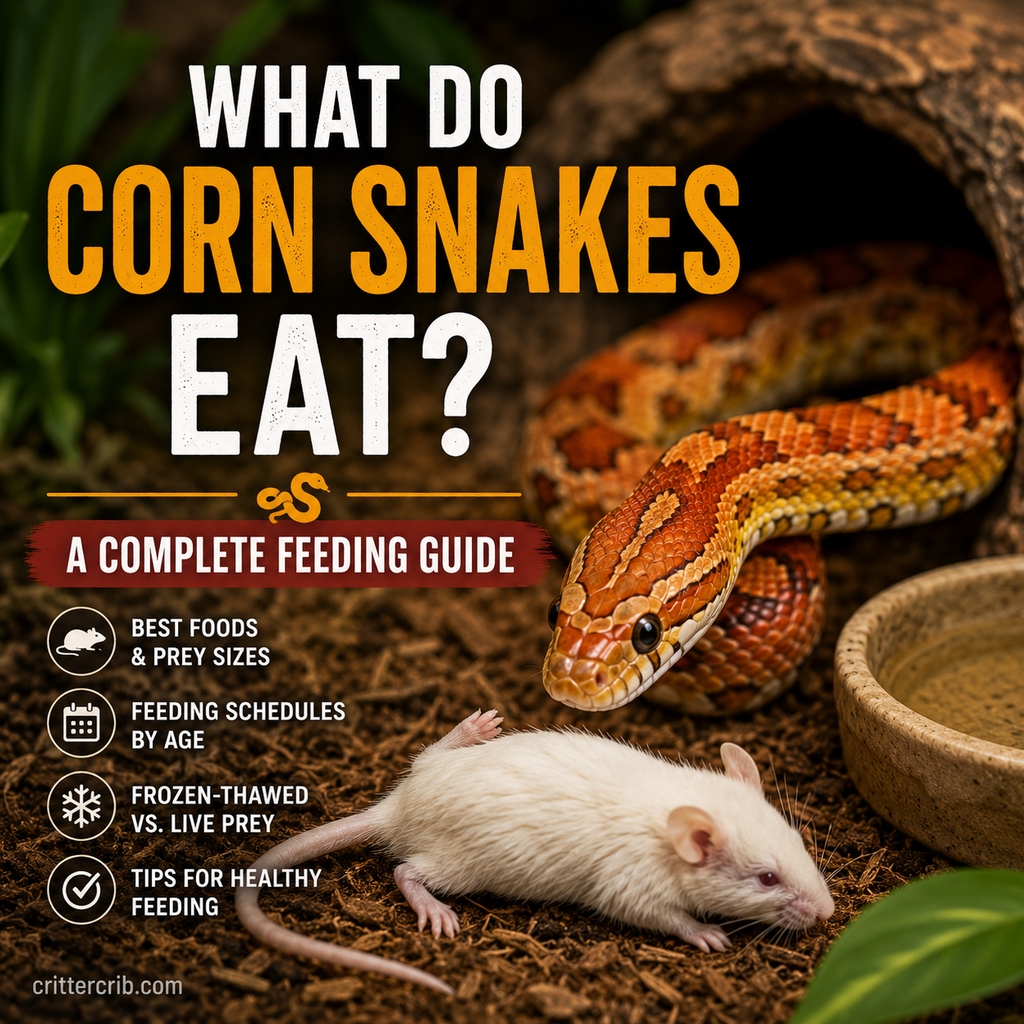
Corn snakes aren’t complicated eaters, but feeding them correctly involves more than dropping a mouse into the enclosure every so often.
So, what do corn snakes eat?
Pet corn snakes primarily eat appropriately sized rodents, with mice forming the staple diet for most individuals. Hatchlings typically start with very small mice and gradually move to larger prey as they grow. Large adults may eventually need larger mice or appropriately sized rats, depending on the snake’s size and body condition.
The important part isn’t providing lots of variety. It’s choosing prey of the right size and feeding it at intervals appropriate for your snake’s age, growth, and body condition.
Most captive corn snakes can also be successfully fed frozen-thawed rodents, which eliminates the risk of a live rodent injuring the snake.
Whether you’ve just brought home your first hatchling or you’re trying to fine-tune an adult’s feeding schedule, here’s what you should know about feeding a corn snake.
What Do Corn Snakes Eat in Captivity?
For most pet corn snakes, mice are the primary food.
They’re nutritionally appropriate when fed as whole prey, widely available from reptile suppliers, and sold in sizes that can accommodate a snake from hatchling to adulthood.
Depending on the size of the snake, prey may progress through stages such as:
- Very small newborn mice
- Larger newborn mice
- Fuzzy mice
- Hopper mice
- Juvenile mice
- Adult mice
The terminology used by rodent suppliers isn’t always identical, so don’t choose prey based solely on the label on the package.
The actual size of the prey relative to your snake matters more.
What Do Corn Snakes Eat in the Wild?
Wild corn snakes have a more varied diet because they eat whatever suitable prey they can capture.
Depending on their age, size, habitat, and opportunity, wild corn snakes may consume animals such as:
- Small rodents
- Young rats
- Birds
- Bird eggs
- Lizards
- Frogs
- Other appropriately sized vertebrate prey
Young corn snakes may consume smaller prey than adults.
As they grow, rodents become increasingly important.
Captive corn snakes don’t need their wild diet recreated item by item. A properly sized whole-prey rodent diet can provide the nutrition most pet corn snakes need.
Why Are Mice Such a Good Food for Corn Snakes?
A mouse isn’t just a piece of meat.
When a snake consumes whole prey, it eats muscle, organs, bones, connective tissue, and other components.
That provides a much more complete nutritional package than feeding isolated pieces of meat.
Whole rodents naturally provide nutrients such as:
- Protein
- Fat
- Calcium
- Phosphorus
- Vitamins
- Minerals
That’s why you generally don’t need to sprinkle supplements onto a properly balanced whole-prey diet in the way you might supplement insects for certain lizards.
Feeding chicken breast, ground beef, or other pieces of meat isn’t an appropriate replacement for whole prey.
How Often Should You Feed a Corn Snake?
Corn snake feeding frequency changes as the snake grows.
Hatchlings and juveniles need to eat more frequently because they’re actively growing. Adults can generally go longer between meals.
A general starting point might look something like this:
Hatchling Corn Snakes
Young hatchlings may eat approximately every 5 to 7 days.
Their prey should be appropriately small.
Juvenile Corn Snakes
Growing juveniles may eat approximately every 7 to 10 days, depending on their size, prey size, growth rate, and body condition.
Adult Corn Snakes
Many healthy adults may eat approximately every 10 to 14 days.
Some individuals may do well with longer intervals, particularly if they’re prone to gaining excessive weight.
These aren’t rigid rules.
Two adult corn snakes of the same age can have different feeding needs because of differences in size, metabolism, activity, prey size, and body condition.
Corn Snake Feeding Chart
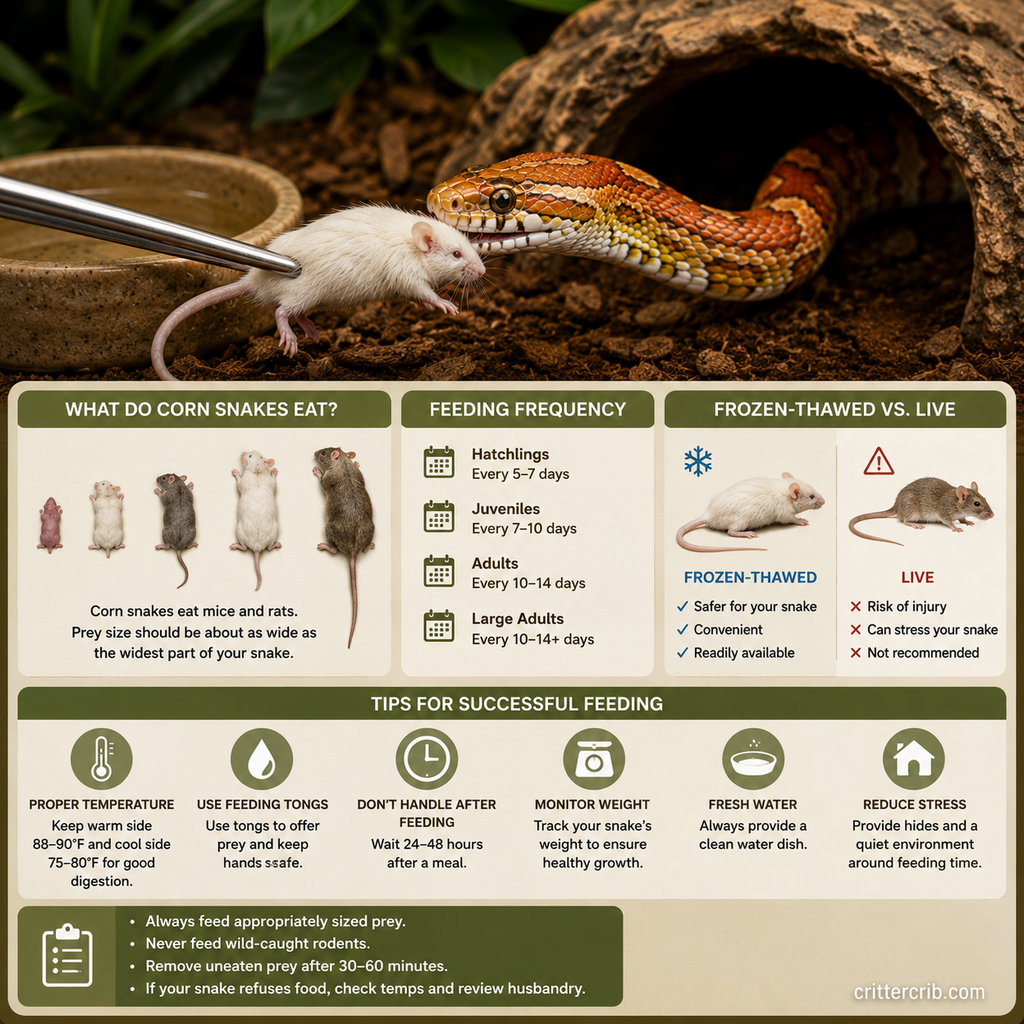
A simple feeding schedule can provide a useful starting point.
| Life Stage | General Feeding Frequency | Typical Prey |
|---|---|---|
| Hatchling | Every 5–7 days | Very small mouse |
| Young juvenile | Every 7 days | Appropriately sized small mouse |
| Older juvenile | Every 7–10 days | Increasing mouse sizes |
| Adult | Every 10–14 days | Appropriately sized adult mouse |
| Large adult | Every 10–14+ days | Large mouse or other appropriately sized rodent |
This chart is only a general guide.
Prey should be selected according to the individual snake rather than age alone.
How Big Should a Corn Snake’s Food Be?
Prey size is one of the most important parts of feeding correctly.
An appropriately sized meal should create a noticeable but reasonable bulge after feeding without looking dramatically oversized.
A commonly used guideline is to offer prey approximately as wide as, or slightly wider than, the widest part of the snake’s body.
However, visual estimation isn’t perfect.
Tracking your snake’s weight and body condition can help you make better feeding decisions over time.
Signs Prey May Be Too Small
If prey is consistently undersized, you may notice:
- Slow growth in a young snake
- Poor body condition
- A need for unusually frequent meals
Don’t automatically solve this by feeding multiple prey items.
Moving to one appropriately sized prey item is often simpler.
Signs Prey May Be Too Large
Oversized meals may be difficult to swallow and can increase the likelihood of regurgitation or other digestive problems.
If you’re uncertain between two prey sizes, being slightly conservative is generally safer than offering something dramatically oversized.
Should Corn Snakes Eat Frozen-Thawed or Live Mice?
Frozen-thawed rodents are generally the preferred option for pet corn snakes that accept them.
The prey is humanely euthanized before freezing, stored frozen, and thawed before feeding.
There are several advantages.
Frozen-Thawed Prey Is Safer
A live rodent has teeth and claws.
If the snake doesn’t immediately capture it, the rodent can bite or scratch the snake.
In severe cases, live prey can cause significant injuries.
Frozen-thawed prey can’t fight back.
Frozen Rodents Are Convenient
You can keep appropriately sized prey in the freezer and thaw individual meals as needed.
That eliminates the need to maintain live rodents between feedings or make frequent trips to purchase them.
Feeding Is Easier to Control
Frozen rodents make it simple to track exactly what prey size your snake is eating.
You can purchase several meals at once and keep the feeding routine consistent.
How to Thaw Frozen Mice for a Corn Snake
Frozen rodents should be completely thawed before feeding.
Never offer partially frozen prey.
A simple approach is:
- Remove the rodent from the freezer.
- Allow it to thaw safely while contained in a sealed bag or container.
- Warm it appropriately before feeding.
- Confirm that the prey is fully thawed.
- Offer it using feeding tongs.
Avoid cooking the rodent.
You’re warming previously frozen prey, not preparing dinner for yourself.
Don’t use boiling water or other methods that could cook portions of the prey.
How Warm Should the Mouse Be?
Corn snakes locate prey partly through scent and heat cues.
A frozen-thawed mouse that’s slightly warmed can be more appealing than one that’s still cool.
The prey should feel warm rather than hot.
You can warm a thawed rodent while it’s sealed in a bag by placing the bag in warm water.
Never microwave frozen rodents.
Microwaving can heat them unevenly, create dangerously hot areas, or cause the prey to rupture.
How to Offer Food to a Corn Snake
Feeding doesn’t need to be complicated.
Use appropriately sized feeding tongs to hold the prey in front of the snake while keeping your fingers away from the feeding response.
A little movement can sometimes make frozen-thawed prey more interesting.
You can gently imitate the movements of prey.
Don’t violently shake the mouse around the enclosure.
Once the snake strikes and constricts, release the prey and allow it to eat without unnecessary disturbance.
Should You Feed a Corn Snake Inside Its Enclosure?
Yes, corn snakes can normally be fed inside their regular enclosure.
The old idea that snakes must always be moved into a separate feeding container isn’t necessary for most pets.
Moving a snake before feeding and then handling it again immediately afterward can create unnecessary disturbance.
Feeding inside the enclosure also allows the snake to remain in familiar surroundings.
Will Feeding in the Enclosure Make My Corn Snake Aggressive?
Feeding inside the enclosure doesn’t automatically make a corn snake aggressive.
Snakes can learn to recognize patterns and may become interested when the enclosure opens around feeding time, but that doesn’t mean every interaction will become a feeding response.
Using feeding tongs and maintaining consistent handling practices can help keep feeding routines predictable.
How Long Should You Wait to Handle a Corn Snake After Feeding?
After eating, a corn snake needs time to digest.
Handling too soon can stress the snake and potentially increase the risk of regurgitation.
As a general practice, leave the snake undisturbed for at least 24 to 48 hours after a meal.
Larger meals may justify additional time.
During digestion, make sure the enclosure continues to provide appropriate temperatures so the snake can thermoregulate.
Do Corn Snakes Need Water?
Yes.
Even though corn snakes get some moisture from their prey, they should always have access to fresh drinking water.
Provide a stable bowl that the snake can’t easily tip over.
The dish should be:
- Easy to access
- Regularly cleaned
- Filled with fresh water
- Large enough for normal drinking behavior
Some corn snakes may occasionally soak.
If your snake begins soaking excessively or constantly, check enclosure conditions and watch for possible health problems rather than assuming it’s normal.
Do Corn Snakes Need Vitamins or Calcium?
Healthy corn snakes eating an appropriate whole-prey diet generally don’t require routine vitamin or calcium powder added to their meals.
Whole prey already contains bones, organs, and other tissues that provide a broad range of nutrients.
Adding supplements without a specific reason can potentially disrupt nutritional balance.
If your snake has a medical condition or unusual dietary requirement, follow the advice of a veterinarian experienced with reptiles.
Can Corn Snakes Eat Rats?
Yes, appropriately sized rats can be used for some corn snakes.
However, many corn snakes can spend most or all of their lives eating appropriately sized mice.
Large adult snakes may eventually require prey larger than the mice available from a particular supplier.
If you switch between prey types, continue paying attention to overall prey size and body condition.
Don’t assume a rat is automatically equivalent to a mouse simply because both are rodents.
Can Corn Snakes Eat More Than One Mouse?
They can physically eat multiple prey items, but one appropriately sized meal is often preferable to routinely feeding several smaller rodents.
There are situations where smaller prey items may temporarily be useful, such as transitioning between sizes.
For routine feeding, selecting a single prey item appropriate for the snake is generally simpler.
Can Corn Snakes Eat Chicks?
Larger corn snakes may be capable of eating appropriately sized chicks.
Birds can form part of a corn snake’s natural diet.
However, there’s usually no nutritional necessity to regularly offer chicks when the snake is thriving on an appropriate whole-rodent diet.
Occasional prey variety can be offered when done safely and appropriately.
Can Corn Snakes Eat Eggs?
Wild corn snakes may occasionally eat bird eggs.
That doesn’t mean chicken eggs from your refrigerator should become a regular part of your pet’s diet.
Most captive corn snakes don’t need eggs when they’re already receiving nutritionally complete whole prey.
Rodents are generally easier to size, source, and incorporate into a consistent feeding schedule.
Can Corn Snakes Eat Insects?
Young corn snakes may consume small animals such as lizards and frogs in the wild, but insects aren’t an appropriate staple diet for captive corn snakes.
Unlike insect-eating reptiles, corn snakes are adapted to consume vertebrate prey.
Crickets, mealworms, and similar feeder insects shouldn’t replace rodents.
Can Corn Snakes Eat Fish?
Fish aren’t a normal staple food for corn snakes.
While a snake may physically be capable of consuming certain fish, there’s little reason to use them when appropriately sized whole rodents are readily available.
Some fish also contain compounds that can create nutritional concerns when fed regularly.
Stick with established whole-prey options.
Foods Corn Snakes Shouldn’t Eat
A corn snake’s diet is much simpler than a human diet.
There’s no need to experiment with random foods.
Avoid feeding things such as:
- Processed meat
- Deli meat
- Cooked chicken
- Raw chicken pieces
- Ground beef
- Dog food
- Cat food
- Insects as a staple
- Wild-caught prey
- Human snacks
Whole prey is important because it provides nutritional components that plain muscle meat doesn’t.
Why Won’t My Corn Snake Eat?
Corn snakes are often enthusiastic feeders, so food refusal can be concerning.
One missed meal isn’t necessarily an emergency.
There are several reasons a corn snake may temporarily stop eating.
Your Corn Snake Is About to Shed
Snakes often become less interested in food during the shedding process.
You may notice:
- Duller coloration
- Cloudy or bluish eyes
- Increased hiding
- Reduced activity
Appetite often returns after shedding.
The Enclosure Is Too Cold
Digestion depends on appropriate environmental temperatures.
A snake kept too cold may have reduced appetite.
Check actual temperatures with reliable digital equipment rather than guessing.
The Snake Is Stressed
Recent transportation, frequent handling, an exposed enclosure, or other environmental disturbances can reduce appetite.
Newly acquired corn snakes may need time to settle into their habitat.
The Prey Isn’t Appealing
Some snakes may refuse prey that’s too cool or presented differently from what they’re accustomed to.
Properly warming frozen-thawed prey and offering it with tongs may help.
The Snake Isn’t Hungry
Adult corn snakes don’t need constant feeding.
If an adult repeatedly refuses meals while maintaining or gaining weight, you may simply be offering food too frequently.
What Should You Do if a Corn Snake Refuses Food?
Don’t immediately panic or offer food repeatedly throughout the day.
Instead:
- Remove the uneaten prey.
- Check enclosure temperatures.
- Look for signs of shedding.
- Consider whether the snake has recently been handled or disturbed.
- Review the feeding schedule.
- Check the snake’s weight and body condition.
- Wait an appropriate interval before offering another meal.
Repeated feeding attempts can create additional stress.
If food refusal continues and the snake begins losing significant weight or develops other symptoms, contact a reptile veterinarian.
How to Tell if a Corn Snake Is Overweight
Overfeeding is one of the more overlooked problems in captive snakes.
Because people associate a strong feeding response with hunger, it’s easy to assume a snake needs food whenever it appears interested.
That’s not necessarily true.
A healthy corn snake should have a proportionate, muscular body rather than appearing excessively round or developing obvious fat deposits.
Possible signs of excess weight may include:
- An overly rounded body
- Visible fat deposits
- Poor definition between body and tail
- Reduced activity
Body condition can be difficult to judge when you’re inexperienced.
Periodic weight records and veterinary examinations can help.
How to Tell if a Corn Snake Is Underweight
An underweight snake may have an unusually prominent spine or a noticeably thin, angular appearance.
Unexpected weight loss deserves attention, particularly if the snake has also stopped eating.
Potential causes include:
- Insufficient food
- Inappropriate prey size
- Parasites
- Digestive problems
- Other illness
Don’t simply increase feeding dramatically without determining why the snake is losing weight.
A reptile veterinarian can help evaluate unexplained weight loss.
What Causes Regurgitation in Corn Snakes?
Regurgitation means the snake brings a meal back up after swallowing it.
This isn’t something to ignore.
Possible contributing factors include:
- Handling too soon after feeding
- Enclosure temperatures that are too low
- Excessively large prey
- Stress
- Illness
- Feeding again too soon
Regurgitation is physically stressful for the snake.
Don’t immediately offer another meal.
Repeated regurgitation requires veterinary attention.
Keep a Corn Snake Feeding Record
You don’t need sophisticated software to keep track of feeding.
A simple record can be extremely useful.
Record information such as:
- Date
- Snake’s weight
- Prey type
- Prey size
- Whether the meal was accepted
- Shedding dates
- Regurgitation
- Food refusals
Over time, you’ll develop a clear picture of what’s normal for your individual snake.
This becomes especially helpful if you ever need to discuss a feeding problem with a veterinarian.
Common Corn Snake Feeding Mistakes
Most feeding problems can be prevented with a few basic habits.
Common mistakes include:
- Feeding prey that’s too large
- Feeding adults too frequently
- Handling immediately after meals
- Leaving live prey unattended
- Feeding random pieces of meat
- Using wild-caught prey
- Panicking after one refused meal
- Feeding again immediately after regurgitation
- Ignoring unexplained weight loss
- Guessing prey size without monitoring body condition
Corn snakes are generally straightforward feeders when the basics are handled correctly.
Frequently Asked Questions About Feeding Corn Snakes
What Is the Best Food for a Corn Snake?
Appropriately sized whole rodents, particularly mice, are the staple food for most captive corn snakes.
Frozen-thawed rodents are widely used because they’re convenient and eliminate the risk of prey injuring the snake.
How Often Do Corn Snakes Eat?
Hatchlings may eat approximately every 5 to 7 days, juveniles roughly every 7 to 10 days, and many adults approximately every 10 to 14 days.
Individual needs vary based on prey size, body condition, age, growth, and activity.
How Long Can a Corn Snake Go Without Eating?
Healthy snakes can sometimes go considerably longer between meals than new owners expect.
However, intentionally testing how long a snake can survive without food isn’t appropriate husbandry.
Food refusal should be evaluated in context, with particular attention to weight and overall health.
Should I Feed My Corn Snake Live Mice?
Frozen-thawed prey is generally safer because a live rodent can’t bite or scratch the snake.
Live prey should never be left unattended with a corn snake.
Can Corn Snakes Eat Chicken?
Whole appropriately sized prey is preferable to pieces of chicken meat.
Plain chicken doesn’t provide the same nutritional balance as an entire rodent containing bones, organs, and other tissues.
Do Corn Snakes Need Supplements?
A healthy corn snake eating an appropriate whole-prey diet generally doesn’t need routine calcium or vitamin supplementation.
Follow veterinary guidance if your snake has special nutritional or medical needs.
Should I Feed My Corn Snake in a Separate Container?
Usually not.
Corn snakes can generally be fed safely inside their normal enclosure, avoiding the unnecessary handling involved in moving them immediately before and after eating.
Final Thoughts
So, what do corn snakes eat?
For most pet corn snakes, the answer is refreshingly simple: appropriately sized whole rodents, with mice serving as the primary food throughout much or all of the snake’s life.
The details matter more than providing a huge menu.
Hatchlings need smaller meals more frequently. As the snake grows, prey size increases while feeding frequency generally decreases. Adults should be fed according to their body condition rather than simply because they enthusiastically accept food.
Frozen-thawed rodents are usually the most practical option because they’re convenient, easy to store, and can’t injure the snake.
From there, successful feeding comes down to a few basic habits: choose appropriately sized prey, maintain proper enclosure temperatures, provide fresh water, avoid handling immediately after meals, and keep an eye on your snake’s weight.
Most importantly, learn what’s normal for your individual corn snake.
Keeping a simple record of meals, weight, sheds, and food refusals takes only a few minutes and can tell you far more about your snake’s health than trying to remember what happened several months ago.
With an appropriate whole-prey diet and sensible feeding schedule, keeping a corn snake properly fed is one of the more straightforward parts of caring for this popular reptile.