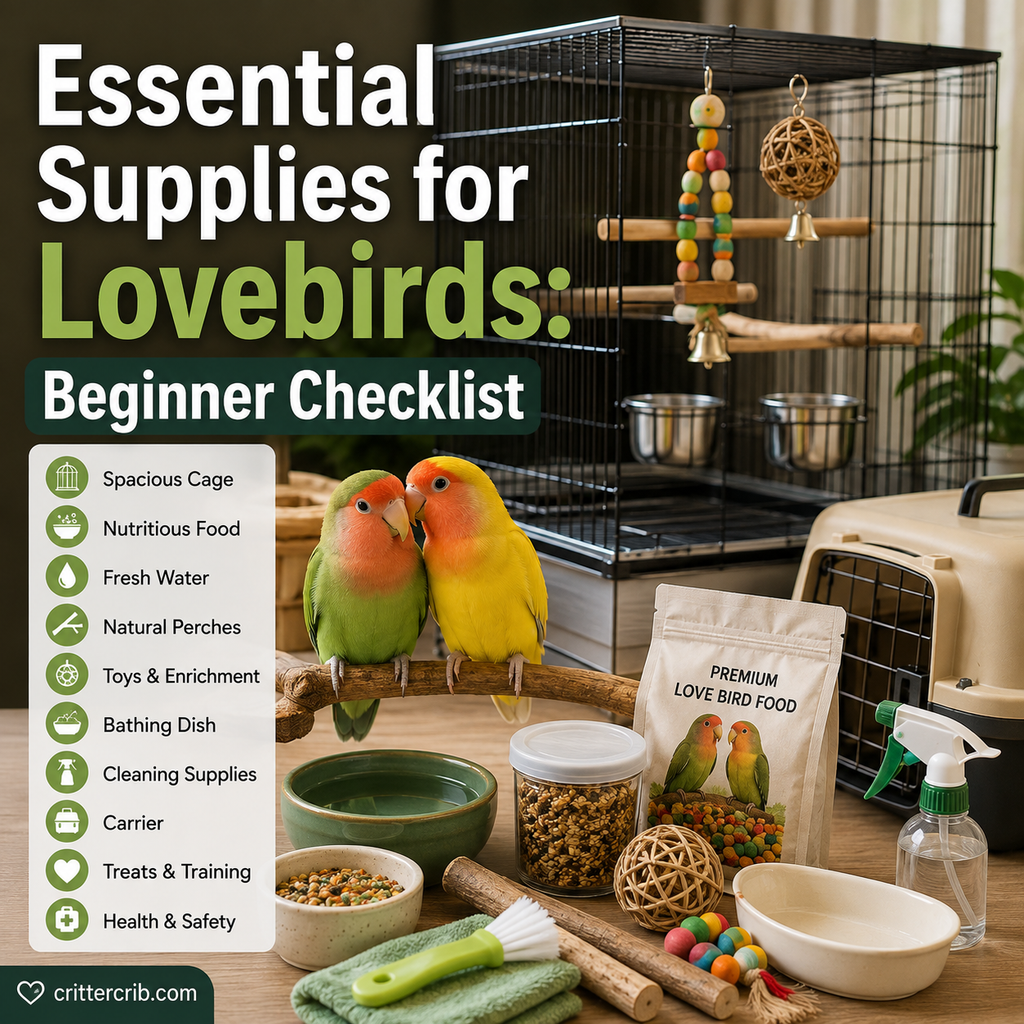
Bringing home a lovebird is exciting, and it’s surprisingly easy to end up with a shopping cart full of colorful toys, treats, perches, and accessories before you’ve figured out what your bird actually needs.
The good news is that the essential lovebird supply list is fairly straightforward.
Your new bird needs a spacious and secure cage, appropriate food, clean water, varied perches, safe toys, cleaning supplies, a carrier, and a few other basics that support everyday care. After those essentials are covered, you can gradually add enrichment based on what your individual lovebird enjoys.
Lovebirds are small parrots, but they’re active, curious, social, and enthusiastic chewers. Their setup should reflect that.
Use this beginner checklist to prepare your lovebird’s habitat before bringing your new bird home.
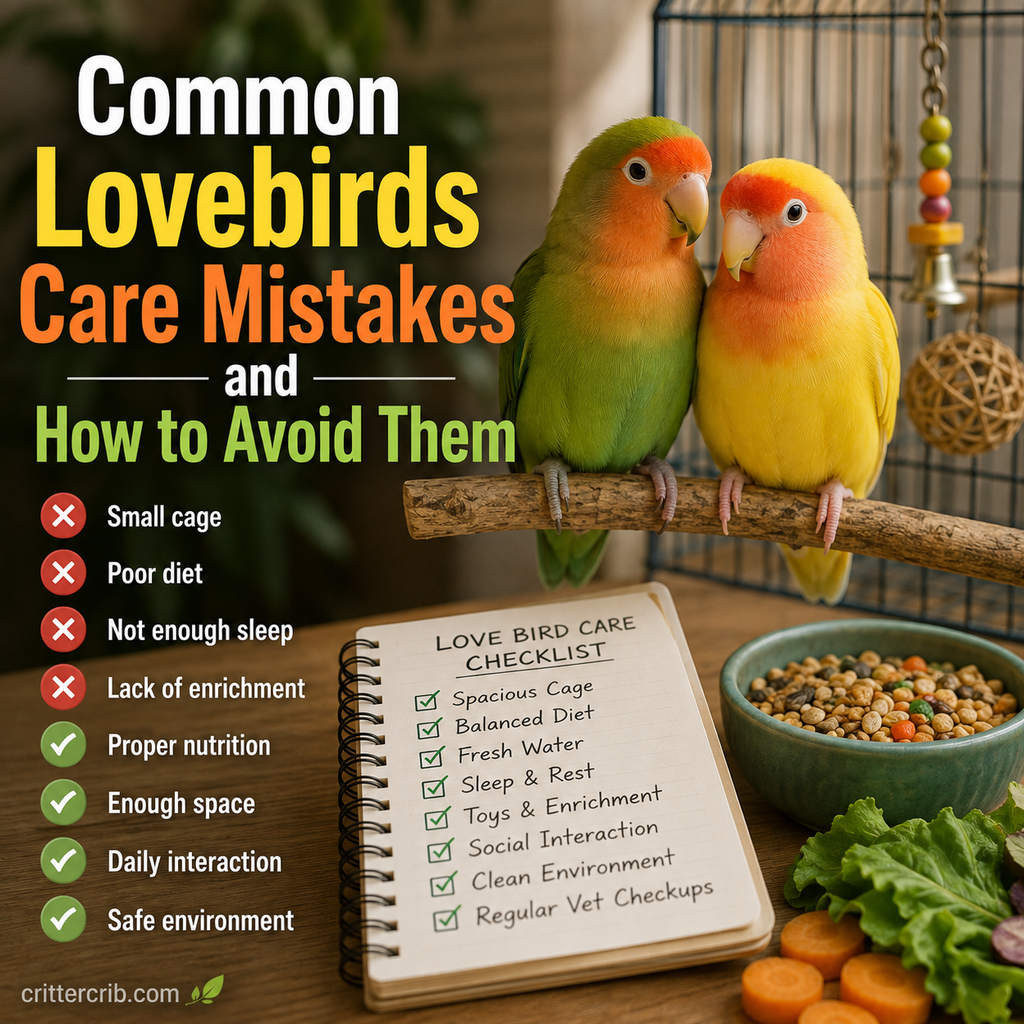
Lovebird Supplies Checklist
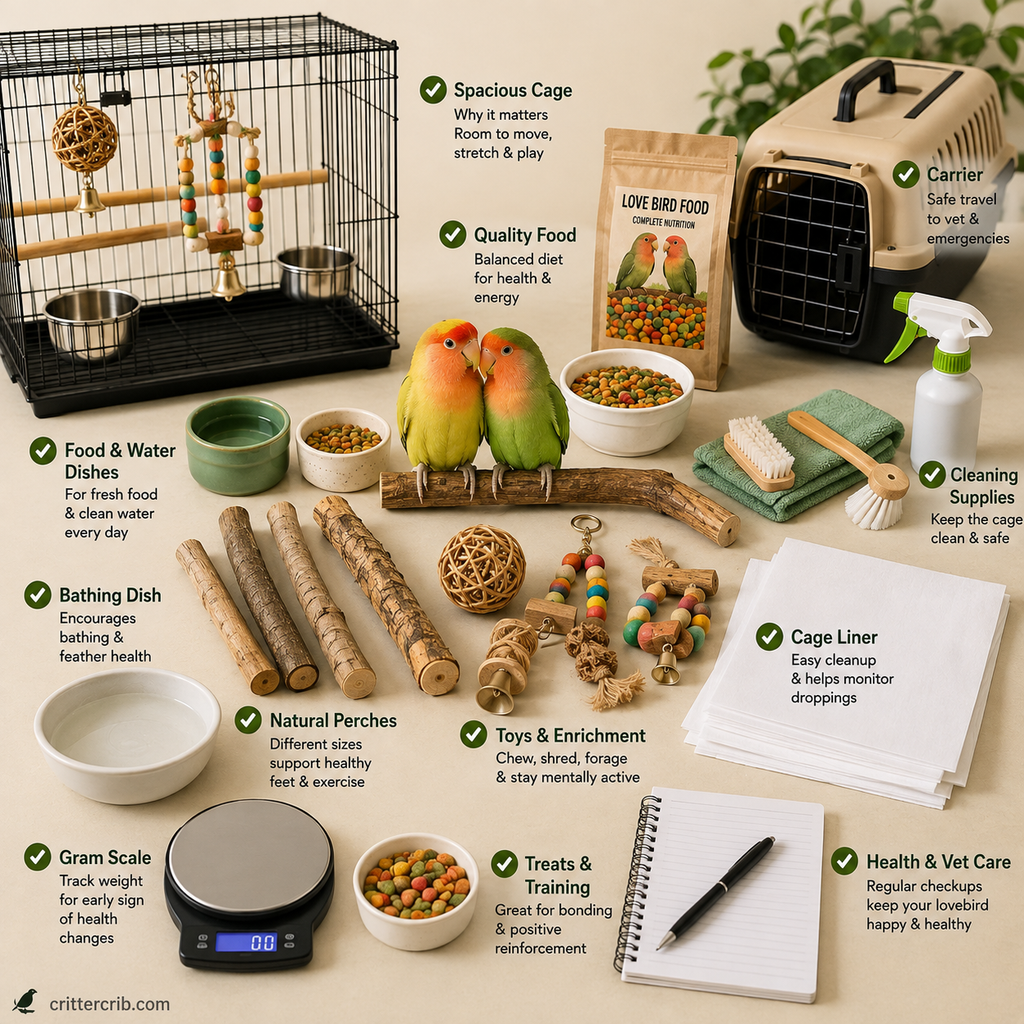
If you want the quick version, start with these essentials:
- Spacious rectangular bird cage
- Food dishes
- Water dish or appropriate water system
- Quality food formulated for small parrots
- Fresh vegetables
- Several natural perches
- Bird-safe chew toys
- Shredding toys
- Foraging toys
- Cage liner
- Bird-safe cleaning supplies
- Bird bath or bathing dish
- Secure bird carrier
- Small gram scale
- Treats for training
- Access to an avian veterinarian
You don’t need to buy every available bird accessory on day one.
Start with a safe, functional setup and learn what your lovebird likes.
1. A Spacious Lovebird Cage
The cage is the most important purchase you’ll make.
Lovebirds are energetic parrots that climb, hop, flap, chew, and fly. A tiny decorative cage doesn’t provide enough usable space for all that activity.
For a single lovebird, a cage around 24 inches wide, 18 inches deep, and 24 inches high is a reasonable minimum starting point, although larger is preferable whenever practical.
If you’re housing two compatible lovebirds, provide substantially more space.
Choose Width Over Excessive Height
A tall, narrow cage may look impressive, but horizontal space is generally more useful.
Your lovebird should be able to move comfortably between perches and stretch its wings without immediately hitting toys or cage bars.
Look for a cage that is:
- Rectangular
- Wide enough for movement
- Securely constructed
- Easy to clean
- Made from bird-safe materials
- Equipped with secure doors
- Large enough for perches and toys without becoming crowded
Check the Bar Spacing
Lovebirds are small enough that bar spacing matters.
Approximately 1/2-inch spacing is commonly suitable for lovebirds.
Avoid cages with gaps large enough for the bird to push its head through.
Also inspect doors and feeder openings carefully. Lovebirds are parrots, and parrots can be remarkably persistent when they decide a cage latch deserves investigation.
2. Food and Water Dishes
You’ll need separate containers for food and drinking water.
Stainless steel bowls are popular because they’re durable and relatively easy to clean.
You may want several dishes for:
- Pellets or formulated food
- Fresh vegetables
- Water
- Occasional treats
Having spare bowls makes daily cleaning much easier.
Instead of washing a dirty dish and immediately returning it, you can swap in a clean one and wash the other later.
Position Dishes Carefully
Don’t place a favorite perch directly above a food or water container.
Otherwise, droppings can quickly contaminate what’s below.
Your future self will appreciate thoughtful bowl placement.
3. A Balanced Lovebird Food
Don’t assume a bag of seeds is everything your lovebird needs.
Pet lovebirds benefit from a varied, nutritionally appropriate diet.
A balanced formulated pellet designed for small parrots can form a major part of the diet, supplemented with suitable fresh vegetables and controlled amounts of other foods.
Seeds can still be offered, but they shouldn’t automatically make up the entire diet.
Fresh Foods to Keep Available
Depending on what your individual bird accepts, suitable vegetables may include:
- Bell peppers
- Broccoli
- Carrots
- Kale
- Bok choy
- Romaine lettuce
- Squash
- Peas
- Cilantro
Fruit can be offered in smaller quantities.
Always research a food before giving it to your bird if you’re unsure whether it’s safe.
Foods Lovebirds Should Avoid
Never intentionally feed your lovebird:
- Avocado
- Chocolate
- Alcohol
- Caffeine
- Fruit pits
- Apple seeds
- Foods containing excessive salt
- Heavily processed foods
- Moldy or spoiled food
A veterinarian experienced with birds can help you develop an appropriate diet for your individual lovebird.
4. Several Types of Perches
The smooth wooden dowel included with a cage shouldn’t be your bird’s only perch.
Lovebird feet benefit from standing on surfaces with different shapes and diameters.
Natural bird-safe branches are particularly useful.
Your perch collection might include:
- Natural wood branches
- Perches of different diameters
- A comfortable sleeping perch
- A platform perch if your bird likes one
- A swing
Avoid filling every inch of the cage.
Your lovebird still needs room to move.
Be Careful With Abrasive Perches
Some products are marketed as nail-trimming perches.
Constant contact with very rough surfaces can irritate a bird’s feet.
It’s better to provide appropriate natural variation and have nail concerns addressed properly when necessary.
5. Bird-Safe Chew Toys
If there’s one thing many lovebirds take seriously, it’s chewing.
Providing safe things to destroy isn’t optional enrichment so much as a practical strategy for living with a small parrot.
Good chewable materials can include:
- Bird-safe wood
- Palm leaf
- Paper
- Cardboard intended for bird enrichment
- Natural fibers designed for bird toys
Check toys regularly.
Remove anything that develops:
- Sharp edges
- Dangerous loops
- Loose threads
- Exposed wires
- Broken components
- Entrapment hazards
A toy that was safe when you purchased it can become unsafe after your lovebird spends a week enthusiastically dismantling it.
6. Shredding Toys
Chewing and shredding overlap, but many lovebirds particularly enjoy tearing things apart.
Paper-based and other bird-safe shreddable toys can provide an appropriate outlet.
This can help keep your bird occupied and encourage natural exploratory behavior.
However, pay attention to how your bird interacts with shredded material.
Lovebirds can become hormonally stimulated by nesting opportunities. If your bird begins collecting shredded material, guarding dark areas, or showing nesting behavior, you may need to adjust the environment.
7. Foraging Toys
In the wild, parrots don’t spend their entire day walking over to a bowl containing unlimited food.
They search, explore, manipulate objects, and work to obtain food.
Foraging toys bring some of that challenge into captivity.
Start simple.
You can use:
- Easy food puzzles
- Treats wrapped in bird-safe paper
- Foraging cups
- Toys with hidden food compartments
- Safe materials that require exploration
Don’t begin with an elaborate puzzle your bird can’t possibly understand.
Make the reward easy to find at first. Once your lovebird understands the concept, gradually increase the difficulty.
8. A Bird Bath
Lovebirds should have opportunities to bathe.
Some birds enthusiastically jump into a shallow dish the moment it’s offered. Others prefer wet greens or a gentle mist.
A basic bird bath can be:
- A shallow dish
- A cage-mounted bird bath
- Another appropriately sized container your bird can safely enter and exit
Use plain, clean water.
Don’t add shampoo, soap, fragrances, or human bathing products.
Remove dirty bath water promptly.
9. Cage Liner
You don’t need fancy bedding to line the bottom of a lovebird cage.
Plain paper works extremely well.
Options include:
- Plain paper
- Paper towels
- Appropriate paper cage liners
Paper is inexpensive, easy to replace, and allows you to see droppings.
That’s useful because changes in droppings can sometimes alert you to changes in diet or health.
Replace the liner whenever it becomes significantly soiled or wet.
10. Bird-Safe Cleaning Supplies
Lovebirds are messy.
Expect:
- Food scattered around the cage
- Shredded toy pieces
- Droppings
- Feathers
- Water splashes
- Bits of vegetables in unexpected places
Keeping a dedicated bird-cleaning kit makes everyday maintenance easier.
Useful supplies include:
- Paper towels
- Dedicated scrub brush
- Cleaning cloths
- Bottle brush
- Spare cage liners
- Bird-appropriate cleaning products when needed
Avoid using strong fumes and aerosol cleaners around birds.
Birds have sensitive respiratory systems.
When using any cleaning product, follow its instructions and make sure surfaces are appropriately rinsed and dried before your lovebird comes into contact with them.
11. A Secure Bird Carrier
A carrier isn’t something you should wait to buy until there’s an emergency.
You may need it for:
- Veterinary visits
- Emergencies
- Evacuations
- Moving
- Safe transportation
Choose a carrier that’s appropriately sized for a lovebird and can be securely closed.
It should have enough room for the bird to position itself comfortably without being so enormous that transportation becomes unsafe.
Introduce the Carrier Before You Need It
Don’t let the first time your lovebird sees its carrier be during a stressful emergency.
Leave it somewhere safe for exploration occasionally.
Use treats and positive reinforcement to help your bird become comfortable entering it.
Carrier training can make veterinary visits significantly easier.
12. A Small Gram Scale
A digital gram scale is one of the most useful supplies that new bird owners often overlook.
Birds are covered in feathers, making changes in body condition difficult to notice visually.
Regular weighing can help you establish your lovebird’s normal weight.
Use a scale that measures in grams and provides enough precision for small birds.
You can place a small perch or safe container on top if your bird won’t comfortably stand on the platform.
Keep a record of the measurements.
Sudden or persistent unexplained weight changes should be discussed with an avian veterinarian.
13. Training Treats
Small rewards make training much easier.
Many lovebirds are highly motivated by favorite seeds or other foods.
Training treats should be:
- Small
- Easy to eat quickly
- Highly desirable
- Appropriate for birds
The reward doesn’t need to be huge.
A tiny piece is enough.
You can use treats to teach useful behaviors such as:
- Step up
- Step down
- Target training
- Coming when called
- Entering a carrier
- Returning to the cage
Training isn’t just about tricks. It provides mental stimulation and can make everyday care easier.
14. A Bird-Safe Play Area
Your lovebird shouldn’t spend its entire life inside a cage.
Supervised out-of-cage exercise gives the bird opportunities to fly, climb, explore, and interact.
A play area might include:
- Tabletop play stand
- Freestanding bird tree
- Natural perches
- Bird-safe climbing structures
- Toys
- Foraging activities
You don’t necessarily need to purchase an elaborate play gym immediately.
The important thing is providing safe places outside the cage where your lovebird is allowed to spend time.
15. Bird-Proofing Supplies
Once a lovebird is flying around your home, ordinary household objects suddenly look very different.
Before letting your bird out, check for hazards.
You may need to secure:
- Windows
- Exterior doors
- Electrical cords
- Mirrors
- Large windows
- Open toilets
- Containers of water
- Toxic houseplants
- Small gaps
- Hot surfaces
Turn ceiling fans completely off whenever your lovebird is loose.
Keep cats and dogs physically separated from the bird during out-of-cage time.
Even a calm pet can react unpredictably to a small flying animal.
16. Safe Sleep Setup
Lovebirds benefit from a predictable nighttime routine and approximately 10–12 hours of quiet, darkness, and uninterrupted rest.
You don’t necessarily need a separate sleeping cage.
What you do need is an environment that becomes calm and dark at night.
If you use a cage cover, choose something:
- Breathable
- Securely positioned
- Appropriate for the cage
- Unlikely to cause overheating
A cover isn’t mandatory if the room already provides suitable sleeping conditions.
17. An Avian Veterinarian
This isn’t something you’ll put inside your lovebird’s cage, but it belongs on the essential checklist.
Find an avian veterinarian before you need one.
Not every general dog-and-cat veterinary practice has extensive experience treating birds.
Keep the veterinarian’s:
- Name
- Phone number
- Address
- Emergency instructions
somewhere easy to access.
It’s also useful to identify the nearest emergency facility that treats birds.
When your bird is sick isn’t the time you want to start searching.
Supplies You Don’t Necessarily Need Right Away
Pet stores are full of bird products, and many are optional.
You don’t automatically need:
- Dozens of toys
- Multiple play gyms
- Decorative cage furniture
- Fancy food containers
- Electronic bird gadgets
- Large collections of treats
- Nest boxes
- Mirrors
Spend your initial budget on a good cage, quality diet, safe perches, useful enrichment, a carrier, and veterinary care.
You can add extras later.
Should You Give a Lovebird a Mirror?
Mirrors are commonly sold as bird toys, but they’re not always a great choice.
Some lovebirds may become overly focused on their reflection.
A bird may:
- Court the mirror
- Regurgitate toward it
- Guard it
- Become territorial
- Spend excessive time interacting with it
If your lovebird develops obsessive or hormonal behavior around a mirror, remove it.
Real enrichment through toys, training, foraging, exercise, and appropriate social interaction is generally more valuable.
Do Lovebirds Need a Nest or Hut?
A healthy pet lovebird doesn’t need a nest simply to sleep.
Dark, enclosed spaces can encourage nesting and hormonal behavior.
Be cautious with:
- Nest boxes
- Fabric huts
- Tents
- Coconut shelters
- Dark boxes
- Access to cabinets or drawers
Fabric huts can also become dangerous if chewing creates loose fibers or loops.
Unless there’s a specific, appropriate reason for providing nesting equipment, a normal perch is sufficient for sleeping.
Do Lovebirds Need Cuttlebone or Mineral Blocks?
A cuttlebone can provide a source of calcium and something for some birds to chew, but it shouldn’t be treated as a substitute for balanced nutrition.
Mineral requirements depend on the bird’s overall diet and individual circumstances.
Don’t automatically add supplements to food or water because a package claims they’re good for birds.
Excessive supplementation can create problems too.
Discuss nutritional supplementation with an avian veterinarian, particularly if your bird eats a formulated diet.
How Many Toys Should Be in a Lovebird Cage?
There’s no perfect number.
A useful approach is to provide several different types without filling every open area.
For example:
- One shredding toy
- One chewing toy
- One foraging activity
- One climbing or movement-based toy
Then rotate them.
You can keep additional toys outside the cage and swap them periodically.
Rotation creates novelty without turning the cage into a storage closet.
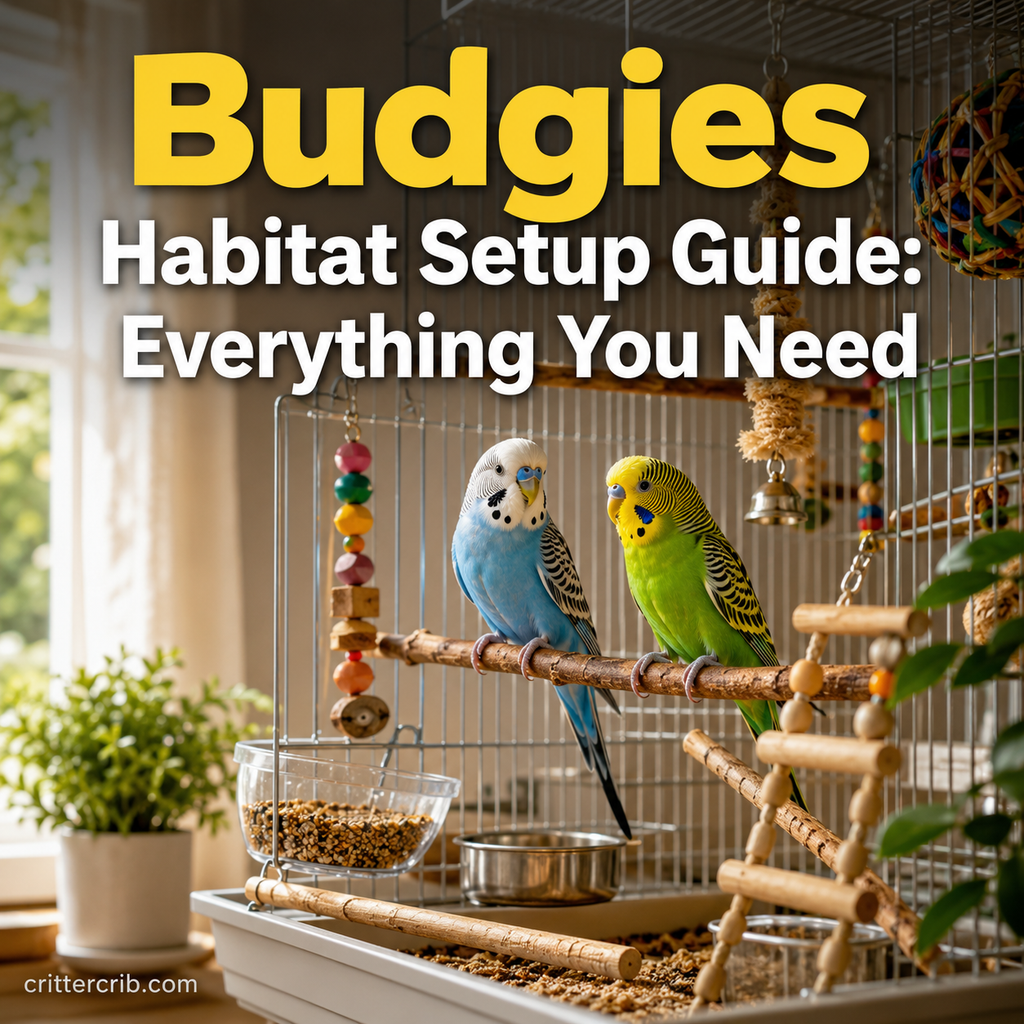
Setting Up Your Lovebird Cage
Once you’ve gathered your supplies, think carefully about placement.
A simple setup process is:
1. Install the Main Perches
Place perches at different heights while leaving open areas for movement.
2. Add Food and Water
Position dishes somewhere convenient but not directly beneath perches.
3. Add a Few Toys
Spread enrichment throughout the cage without blocking movement.
4. Create a Comfortable Sleeping Area
Provide a secure perch in a relatively high, protected area of the cage.
5. Add Fresh Cage Liner
Keep the bottom easy to inspect and clean.
6. Check Every Attachment
Make sure:
- Perches are stable
- Toys are securely attached
- Doors latch correctly
- Bowls can’t tip
- No dangerous gaps exist
- Nothing has loose threads or sharp edges
Then look at the entire setup from your bird’s perspective.
Can your lovebird actually move around comfortably?
If not, remove some accessories.
Where Should You Put a Lovebird Cage?
Choose a location where your lovebird can be part of normal household activity without being exposed to constant stress.
Avoid areas with:
- Strong drafts
- Heating or cooling vents
- Cigarette smoke
- Vape aerosols
- Scented candles
- Incense
- Aerosol sprays
- Strong cleaning fumes
- Excessive direct sunlight
The kitchen is generally a poor location.
Cooking fumes and smoke can be dangerous to birds, and overheated cookware or appliances containing certain nonstick fluoropolymer coatings can release potentially deadly fumes.
New Lovebird Shopping Checklist
Before bringing your bird home, go through this final list.
Habitat
- Spacious rectangular cage
- Safe bar spacing
- Natural perches
- Food bowls
- Water container
- Cage liner
Food
- Appropriate formulated food
- Fresh vegetables
- Small amount of suitable treats
- Training rewards
Enrichment
- Chewing toys
- Shredding toys
- Foraging toys
- Swing or climbing opportunities
- Bathing dish
- Safe out-of-cage play area
Cleaning
- Paper towels
- Cage liners
- Scrub brush
- Cleaning cloths
- Dish brush
- Bird-safe cleaning supplies
Health and Safety
- Secure carrier
- Gram scale
- Avian veterinarian contact information
- Emergency veterinary information
- Bird-proofed exercise area
If you’ve covered those categories, you’ve handled the important basics.
Common Mistakes When Buying Lovebird Supplies
It’s easy to focus on cute accessories and overlook the essentials.
Avoid these common mistakes.
Buying Too Small a Cage
Invest in the largest appropriately designed cage you can reasonably accommodate.
Filling the Cage With Toys
Enrichment is important, but so is movement.
Leave open space.
Buying Only Seed
Plan for balanced nutrition from the beginning.
Using Only Dowel Perches
Provide safe variation in perch size and texture.
Buying a Nest for Sleeping
Lovebirds don’t need a nest box or dark hut simply because it’s bedtime.
Forgetting a Carrier
Buy one before an emergency happens.
Skipping Veterinary Planning
Know where you’ll take your bird for routine and emergency care.
Frequently Asked Questions About Lovebird Supplies
What do I need before getting a lovebird?
At minimum, prepare an appropriately sized cage, food and water containers, balanced food, several safe perches, toys, cage liner, cleaning supplies, a carrier, and access to an avian veterinarian.
What size cage should I buy for a lovebird?
For one lovebird, approximately 24 inches wide by 18 inches deep by 24 inches high is a reasonable minimum starting point, with larger cages preferred whenever practical.
Two compatible birds require substantially more room.
Do lovebirds need toys?
Yes.
Lovebirds are intelligent, active parrots that benefit from chewing, shredding, foraging, climbing, training, and other forms of enrichment.
Do lovebirds need a bed?
Lovebirds don’t need a human-style bed or enclosed nest to sleep comfortably.
A secure sleeping perch and a quiet, dark nighttime environment are generally sufficient.
Do lovebirds need baths?
Provide regular opportunities to bathe.
A shallow bird bath, suitable dish, or another safe bathing method can work depending on your bird’s preference.
Should I buy one lovebird or two?
Lovebirds are social animals, but both single and compatible paired arrangements require thoughtful care.
A single bird will need substantial interaction and enrichment from its caregiver. Keeping two birds doesn’t eliminate the need for human care, exercise, observation, and appropriate housing.
Compatibility should never be assumed simply because two birds are lovebirds.
What should I put on the bottom of a lovebird cage?
Plain paper, paper towels, or appropriate paper cage liners are simple choices.
They’re easy to replace and allow you to monitor droppings.
Final Thoughts on Essential Lovebird Supplies
Preparing for a lovebird doesn’t require buying every bird product you see.
Focus on what supports the bird’s everyday needs.
Start with a spacious cage, varied perches, clean food and water containers, a balanced diet, safe toys, bathing opportunities, cleaning supplies, a secure carrier, and a bird-safe area for exercise.
Then add enrichment gradually.
Your lovebird will quickly show you what it prefers. One bird may spend hours turning a shredding toy into confetti, while another is much more interested in climbing, training, or solving food puzzles.
The goal isn’t to own the biggest collection of bird supplies.
It’s to create a safe, stimulating environment that gives your lovebird opportunities to eat well, exercise, explore, chew, play, rest, and interact every day.
Get those basics right, and you’ll have a much stronger foundation for bringing your new lovebird home.