
Corn snakes are often recommended as beginner-friendly reptiles, and for good reason. They’re generally calm, manageable in size, and easier to care for than many exotic pets.
But “beginner-friendly” doesn’t mean their care is foolproof.
Many corn snake health and behavior problems can be traced back to fairly simple husbandry mistakes: incorrect temperatures, poor humidity management, feeding too often, an insecure enclosure, or overlooking subtle signs that something isn’t right.
The good news is that most of these problems are preventable.
Whether you’re preparing for your first corn snake or trying to improve your current setup, here are some of the most common corn snake care mistakes and what to do instead.
1. Keeping the Enclosure Too Cold
Corn snakes rely on their environment to regulate their body temperature. Unlike mammals, they can’t internally maintain a constant body temperature.
One common mistake is keeping the entire enclosure around normal household room temperature.
That might feel comfortable to you, but your snake needs access to a warmer area for digestion and normal activity.
A corn snake enclosure should provide a temperature gradient, allowing the snake to move between warmer and cooler areas as needed.
In general, aim for approximately:
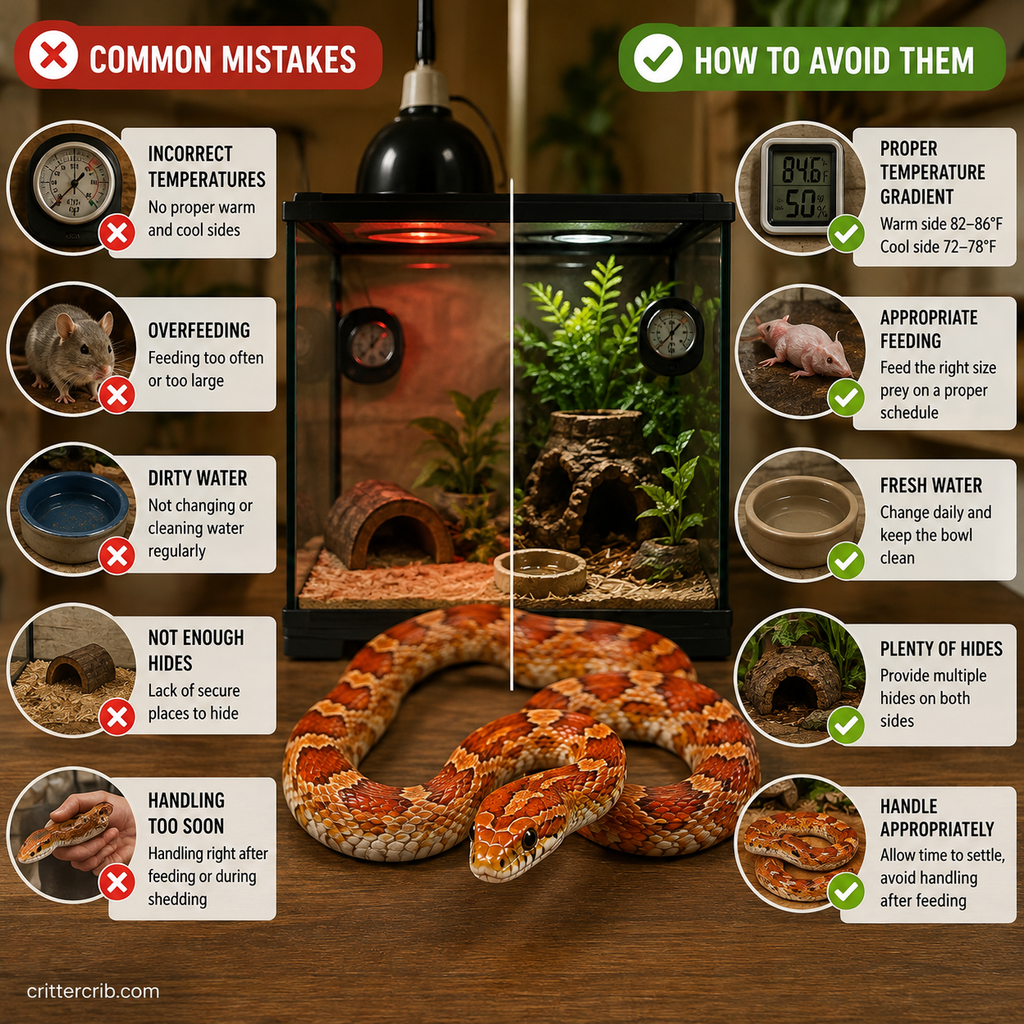
- Warm side: around 82–86°F
- Cool side: around 72–78°F
- A moderate nighttime temperature drop can be acceptable as long as temperatures don’t become excessively cold
Rather than trying to make the whole enclosure the same temperature, create distinct thermal zones.
Always Control Heat Sources With a Thermostat
Heating equipment shouldn’t simply be plugged in and allowed to run continuously.
Use an appropriate thermostat to regulate the heat source and reduce the risk of dangerous temperature spikes.
Digital thermometers with probes can also help you monitor conditions at important locations inside the enclosure.
Don’t rely on how warm the enclosure feels when you touch it. Measure the actual temperatures.
2. Making the Enclosure Too Hot
Cold temperatures aren’t the only concern. Overheating can be even more dangerous.
A heat lamp or other heating device that isn’t properly controlled can cause enclosure temperatures to climb quickly.
The snake also needs somewhere cooler to retreat.
Signs that conditions may be too warm can include:
- Constantly staying on the coolest side
- Spending unusual amounts of time in the water bowl
- Restlessness
- Repeatedly trying to escape
These behaviors don’t automatically mean overheating is the problem, but checking temperatures should be one of your first steps.
Never place an enclosure where direct sunlight can dramatically increase the internal temperature, either.
3. Using an Enclosure That Isn’t Secure
Corn snakes have an impressive ability to find tiny gaps.
A lid that seems secure can become an escape route if one corner lifts slightly. Sliding doors can also leave openings around cables or between panels.
Before bringing your snake home, inspect the enclosure carefully.
Check:
- Lid corners
- Door gaps
- Ventilation openings
- Cable ports
- Spaces around decorations
- Locks and clips
The enclosure should provide adequate ventilation without leaving openings large enough for the snake to squeeze through.
Don’t underestimate how small a space a young corn snake can investigate.
4. Not Providing Enough Hiding Places
A beautiful enclosure isn’t necessarily a comfortable enclosure.
Corn snakes naturally spend a considerable amount of time concealed. An enclosure that is mostly open space can leave a snake feeling exposed.
At minimum, provide a secure hide on both the warm and cool sides.
Ideally, the hides should be relatively snug rather than enormous caves. Many snakes feel more secure when their body can make contact with the sides of the hide.
You can also provide additional cover using:
- Cork bark
- Branches
- Artificial or reptile-safe plants
- Leaf litter
- Additional hides
- Other safe enclosure decorations
This creates more opportunities for the snake to move around without constantly feeling exposed.
5. Ignoring Humidity
Corn snakes don’t require the extremely high humidity associated with tropical reptiles, but that doesn’t mean humidity should be ignored.
Conditions that are consistently too dry can contribute to shedding difficulties. Excessively damp conditions, on the other hand, may encourage mold or bacterial growth and can contribute to health problems.
Moderate humidity is usually appropriate, often somewhere around 40–60%, although conditions can fluctuate and individual circumstances vary.
A digital hygrometer makes humidity much easier to monitor.
Provide a Humid Hide When Needed
A humid hide can be especially helpful when your snake is preparing to shed.
It can contain slightly damp sphagnum moss or another suitable moisture-retaining material.
The goal isn’t to soak the enclosure. You’re simply giving the snake access to a more humid microclimate when it wants one.
6. Using an Inappropriate Substrate
The material covering the bottom of the enclosure affects cleanliness, humidity, comfort, and your ability to spot problems.
Common substrate options for corn snakes include:
- Aspen
- Cypress mulch
- Coconut-based substrates
- Paper towels, particularly for temporary or quarantine setups
Each has advantages and disadvantages.
Aspen, for example, is popular because corn snakes can burrow through it. However, it doesn’t perform particularly well in very humid conditions.
Avoid aromatic wood products such as cedar, which aren’t appropriate reptile substrates.
Whatever you choose, keep it clean and replace contaminated areas promptly.
7. Feeding Too Much
Feeding is one area where enthusiastic new owners can accidentally create problems.
Seeing a snake eat eagerly doesn’t necessarily mean it needs more food.
Corn snakes are opportunistic feeders, and consistently providing meals that are too large or too frequent can contribute to obesity.
Feeding frequency depends heavily on the snake’s age, size, body condition, and prey size.
Young snakes generally eat more frequently than adults. As corn snakes mature, meals typically become less frequent.
Instead of following a feeding schedule blindly, monitor your snake’s growth and body condition.
A healthy corn snake should look well-proportioned rather than extremely round or heavily padded.
8. Feeding Prey That’s Too Large
Meal size matters just as much as feeding frequency.
Offering prey that’s significantly too large can increase the risk of regurgitation and other digestive problems.
Choose appropriately sized prey based on the size of your individual snake rather than simply buying mice labeled for a particular age group.
As your corn snake grows, gradually increase prey size.
If you’re unsure whether your snake should move to a larger prey size, it’s usually better to make gradual changes rather than suddenly offering a dramatically larger meal.
9. Feeding Live Prey When It Isn’t Necessary
Many captive corn snakes readily accept frozen-thawed rodents.
Using frozen-thawed prey has an important safety advantage: a live rodent can’t bite or injure your snake.
Rodents have sharp teeth, and prey left unattended with a snake can cause serious wounds.
Frozen prey should be completely thawed and appropriately warmed before offering it.
Never cook the rodent.
10. Handling the Snake Immediately After Feeding
You might want to handle your corn snake after a successful meal, especially when you’re getting used to interacting with it.
Give it some privacy instead.
Handling too soon after feeding can cause stress and may increase the likelihood of regurgitation.
A common approach is to wait roughly 48 hours after feeding before normal handling.
Providing appropriate temperatures during this period is also important because snakes rely on environmental warmth to support digestion.
11. Handling a New Corn Snake Too Much
Bringing home a new snake is exciting. Naturally, you want to hold it.
But moving into a completely unfamiliar enclosure is already stressful.
Give a newly arrived corn snake time to settle before beginning regular handling. Many keepers wait until the snake has had time to acclimate and has successfully eaten before gradually introducing handling sessions.
When you do begin, keep the first sessions short.
Let the snake move through your hands rather than tightly restraining it.
Over time, many corn snakes become quite comfortable with routine, gentle handling.
12. Handling Too Frequently During Shedding
Corn snakes periodically shed their outer layer of skin as they grow.
Before a shed, you may notice:
- Duller coloration
- Cloudy or bluish eyes
- Reduced activity
- More time spent hiding
- Reduced interest in food
During this period, it’s generally best to minimize unnecessary handling.
Their vision can be impaired during part of the shedding cycle, which may make the snake feel more vulnerable or defensive.
Once the shed is complete, inspect it and your snake.
Pay particular attention to the tail tip and eye area for signs of retained shed.
13. Not Providing Fresh Water
A corn snake should always have access to clean, fresh drinking water.
Choose a sturdy bowl that won’t easily tip over when the snake crawls around it.
Check the water every day.
Replace it whenever it becomes dirty, and regularly clean the bowl rather than simply topping off old water.
Some corn snakes may occasionally soak in their water bowls. Frequent soaking, however, deserves attention because it can sometimes be associated with enclosure conditions or external parasites.
14. Cleaning Too Little—or Too Aggressively
Good enclosure hygiene is important, but you don’t necessarily need to dismantle and disinfect everything constantly.
Spot-clean waste and contaminated substrate as soon as you notice it.
Water bowls should also be cleaned regularly.
More thorough enclosure cleaning can be performed as needed depending on the substrate, enclosure setup, and how quickly it becomes dirty.
At the same time, avoid leaving feces, shed fragments, spoiled material, or consistently damp substrate sitting in the enclosure.
The goal is a clean, dry, well-maintained habitat rather than a sterile-looking environment.
15. Creating an Enclosure With Nothing to Explore
A corn snake can technically survive in a very basic enclosure containing hides and a water bowl.
But good reptile care should go beyond simply keeping an animal alive.
Corn snakes are active explorers and capable climbers.
Consider adding:
- Sturdy climbing branches
- Cork bark
- Plants
- Tunnels
- Multiple hides
- Textured surfaces
- Areas suitable for burrowing
Make sure anything heavy is stable and can’t collapse onto the snake.
A well-designed enclosure provides opportunities to climb, hide, burrow, investigate, and choose between different environmental conditions.
16. Assuming a Bigger Enclosure Is Automatically Stressful
You may hear that young snakes must be kept in tiny enclosures because large spaces will stress them.
The issue is usually not simply the amount of space.
A large, completely empty enclosure can certainly make a small snake feel exposed. A larger enclosure with plenty of hiding places, cover, and appropriate environmental gradients is very different.
Focus on security and usable habitat rather than trying to give your snake the smallest possible enclosure.
As an adult, a corn snake should have enough room to move, explore, thermoregulate, and stretch out comfortably.
17. Using Unprotected Heating Equipment
Any heating element capable of becoming extremely hot needs to be installed with safety in mind.
A snake shouldn’t be able to make direct contact with a dangerously hot bulb or heating element.
Depending on the enclosure and heating system, protective guards may be necessary.
Heating equipment should also be:
- Properly installed
- Appropriate for the enclosure
- Controlled by a suitable thermostat
- Regularly monitored
- Positioned so the snake cannot burn itself
Burns in reptiles can be serious and aren’t always immediately obvious.
18. Assuming Every Feeding Problem Means Something Is Wrong
A corn snake refusing a meal can be concerning, but one missed feeding isn’t automatically an emergency.
Appetite can change because of:
- Shedding
- Stress
- Recent relocation
- Incorrect temperatures
- Seasonal behavior
- Excessive handling
- Illness
Start by checking your husbandry.
Are temperatures correct? Is the snake entering a shed cycle? Has something recently changed in the enclosure?
Avoid repeatedly offering food every few hours or constantly handling the snake to see whether it seems hungry.
However, repeated refusal accompanied by weight loss, abnormal behavior, respiratory symptoms, or other concerning changes should be discussed with a qualified reptile veterinarian.
19. Ignoring Small Changes in Behavior or Appearance
Snakes can be surprisingly subtle when something is wrong.
Don’t wait for dramatic symptoms before paying attention.
Get familiar with what’s normal for your individual corn snake.
Watch for changes such as:
- Unexplained weight loss
- Repeated regurgitation
- Wheezing or unusual breathing
- Mucus or bubbles around the mouth or nostrils
- Persistent soaking
- Swelling
- Skin abnormalities
- Unusual lethargy
- Repeated incomplete sheds
- Visible mites or tiny moving specks
- Sudden major behavioral changes
Some changes have harmless explanations, but persistent or significant symptoms deserve investigation.
A veterinarian experienced with reptiles is the appropriate person to diagnose medical problems.
20. Not Keeping Basic Care Records
You don’t need an elaborate spreadsheet to own a corn snake, but basic records can be surprisingly useful.
Keep track of things such as:
- Feeding dates
- Prey size
- Successful or refused meals
- Shed dates
- Weight
- Regurgitation
- Unusual behavior
- Veterinary care
Weighing your snake periodically is especially useful.
Gradual changes can be difficult to notice when you see an animal every day. Written records make trends much easier to identify.
21. Setting Up the Enclosure the Same Day You Bring the Snake Home
One of the easiest mistakes to avoid happens before you even purchase the snake.
Don’t wait until your corn snake arrives to discover that the enclosure won’t hold the correct temperature or humidity.
Set everything up beforehand.
Run the enclosure for at least a day or two and monitor conditions in different locations.
Check:
- Warm-side temperature
- Cool-side temperature
- Humidity
- Thermostat operation
- Hide placement
- Water bowl stability
- Door or lid security
This gives you time to make adjustments without a snake already living inside.
A Simple Corn Snake Care Checklist
Corn snake husbandry becomes much easier when you focus on a few fundamentals.
Before bringing one home, make sure you can provide:
- A secure, appropriately sized enclosure
- A proper warm-to-cool temperature gradient
- Thermostat-controlled heating
- Reliable digital temperature monitoring
- Appropriate humidity
- At least two secure hides
- Fresh drinking water
- Safe substrate
- Appropriately sized prey
- Opportunities for climbing, hiding, and exploring
- Regular cleaning and observation
- Access to a reptile-experienced veterinarian when needed
Getting these basics right prevents many of the problems new owners encounter.
Frequently Asked Questions About Corn Snake Care
Are corn snakes good for beginners?
Yes. Corn snakes are widely considered one of the more manageable pet snakes for beginners because of their moderate size, generally calm temperament, and relatively straightforward husbandry requirements.
That doesn’t mean they require no preparation. Owners still need to understand heating, feeding, humidity, enclosure security, shedding, and basic reptile health.
How often should you handle a corn snake?
There isn’t one perfect schedule for every snake.
Once your corn snake is settled into its enclosure, short, gentle handling sessions a few times per week can work well for many individuals.
Avoid unnecessary handling immediately after feeding and consider reducing handling when the snake is preparing to shed.
Pay attention to your snake’s behavior rather than forcing interaction.
Do corn snakes need a heat lamp?
Corn snakes need an appropriate thermal gradient, but the exact equipment used to create it can vary depending on the enclosure and household conditions.
Whatever heat source you use should be safely installed, properly regulated, and monitored.
The important part isn’t simply owning a particular type of heater. It’s creating suitable temperatures while preventing overheating and burns.
Why is my corn snake always hiding?
Hiding is normal snake behavior.
A corn snake that spends significant amounts of time concealed isn’t necessarily unhappy or unhealthy.
However, dramatic changes in behavior can sometimes indicate a husbandry or health issue. If your normally active snake suddenly hides constantly, check temperatures, humidity, shedding status, recent feeding, and other environmental factors.
Why is my corn snake trying to escape?
Occasional exploration around the enclosure is normal.
Persistent escape behavior may warrant checking the enclosure conditions. Temperatures that are too high or low, insufficient hiding opportunities, breeding-season activity, hunger, or other environmental factors may contribute.
First make sure the enclosure is securely closed, then review your husbandry.
Final Thoughts
Most corn snake care mistakes don’t happen because owners don’t care. They happen because reptile husbandry can be less intuitive than caring for a dog or cat.
A room that feels warm to you might still be too cool for proper digestion. An enclosure that looks clean and minimalist might feel exposed to a snake. And an enthusiastic feeding response doesn’t necessarily mean your corn snake needs another meal.
That’s why monitoring matters.
Provide a secure enclosure with appropriate temperatures, humidity, hiding places, fresh water, safe heating, and properly sized meals. Then pay attention to your snake’s behavior and body condition.
Once those fundamentals become routine, corn snake care is relatively straightforward—and you’ll be much better equipped to notice when something isn’t quite right.