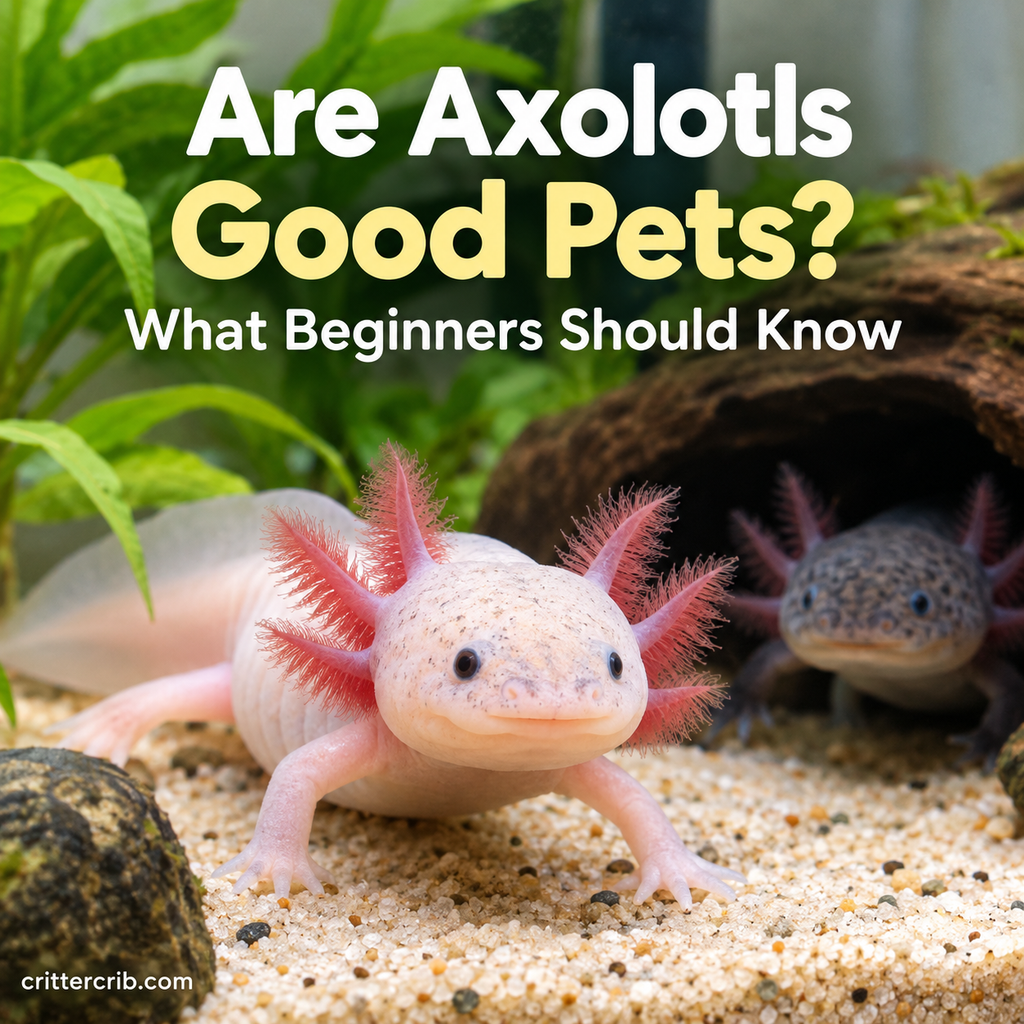
Axolotls are unusual pets even by amphibian standards. With their feathery external gills, wide mouths, and almost permanent-looking smiles, they have an appearance that makes them hard to forget.
But being cute and fascinating doesn’t automatically make an animal easy to care for.
So, are axolotls good pets?
For the right owner, absolutely. Axolotls are quiet, interesting to watch, and don’t require walks, training, or daily social interaction. However, they have some very specific care requirements, particularly when it comes to water quality and temperature. They’re also very different from pets you can regularly pick up and interact with.
If you’re considering your first axolotl, here’s what you should know before bringing one home.
Are Axolotls Good Pets for Beginners?
Axolotls can be good pets for beginners, but there’s an important catch: you need to be willing to learn basic aquarium care.
The axolotl itself isn’t particularly demanding socially. You don’t need to entertain it for hours or worry about it becoming lonely while you’re at work.
The aquarium is where most of the work comes in.
Axolotls live entirely underwater, so their health depends heavily on the environment you create for them. You’ll need to understand things like:
- Aquarium cycling
- Ammonia, nitrite, and nitrate
- Water testing
- Filtration
- Water changes
- Safe water temperature
- Appropriate substrate
- Feeding and waste removal
That list can sound intimidating if you’ve never maintained an aquarium before, but these skills are learnable.
The bigger mistake is assuming you can simply fill a tank with tap water, add an axolotl, and figure everything out later. Preparing the aquarium properly before the animal arrives makes axolotl ownership much easier.
What Makes Axolotls Appealing as Pets?
Axolotls aren’t interactive in the same way as dogs, cats, or even some reptiles. Their appeal comes from observing them.
They may slowly explore their aquarium, investigate movement outside the glass, rest in strange positions, or suddenly become very interested when food appears.
Some individuals also seem to learn that a person approaching the aquarium often means feeding time.
They’re Quiet
An axolotl isn’t going to bark at the mail carrier or wake you up chirping at sunrise.
For apartments, bedrooms, home offices, and other environments where noise matters, that can be a major advantage.
The aquarium equipment itself may produce some sound, but the animal won’t.
They Don’t Need Daily Social Attention
Axolotls don’t require cuddling, play sessions, or regular handling.
That makes them appealing to people who enjoy animals but don’t necessarily want a pet that demands constant interaction.
You still need to check on them every day, feed them appropriately, and maintain their aquarium, but you’re caring for their environment rather than providing social companionship.
They’re Fascinating to Observe
Few common pets look quite like an axolotl.
Those feathery structures extending from the sides of the head are external gills. Instead of undergoing the typical transformation into a land-dwelling adult seen in many salamanders, axolotls normally retain aquatic juvenile characteristics throughout life.
That alone makes them fascinating animals to observe and learn about.
Why Axolotls Aren’t the Easiest Beginner Pets
Axolotls are sometimes described as easy pets because they don’t need much attention.
That’s only partly true.
Their day-to-day routine can become fairly simple once everything is established, but creating and maintaining the correct aquatic environment takes effort.
Water Quality Matters
Waste breaks down and produces ammonia, which is dangerous to aquatic animals. In a properly cycled aquarium, beneficial bacteria help process this waste through the nitrogen cycle.
Beginners should become comfortable testing aquarium water rather than relying on appearance alone.
Clear water isn’t necessarily safe water.
You’ll generally want to monitor important parameters such as:
- Ammonia
- Nitrite
- Nitrate
- pH
Regular partial water changes are also part of normal aquarium maintenance.
Axolotls Prefer Cool Water
Temperature is one of the biggest considerations before getting an axolotl.
Axolotls are cold-water amphibians and can become stressed when their water gets too warm. A commonly targeted range is around 60–68°F (16–20°C), with cooler conditions within the safe range generally preferable to prolonged excessive warmth.
This can become challenging during summer.
If your home regularly becomes hot, simply owning an aquarium may not be enough. Depending on your climate and indoor temperatures, you may need additional cooling methods, potentially including an aquarium chiller.
That makes temperature something to investigate before buying the animal, not after the first heat wave arrives.
What Size Tank Does an Axolotl Need?
Axolotls spend their entire lives in water, and adults can reach roughly 9–12 inches in length, although individual size varies.
They need considerably more space than a small desktop aquarium.
For a single adult, many keepers choose an aquarium of at least around 20 gallons, although a larger tank—often 29 gallons or more—can make maintaining stable water conditions easier and provide additional floor space.
When choosing between tank shapes, prioritize usable horizontal floor space rather than simply looking for the tallest aquarium.
More water volume can also provide greater stability when it comes to temperature and water chemistry.
Setting Up an Axolotl Tank
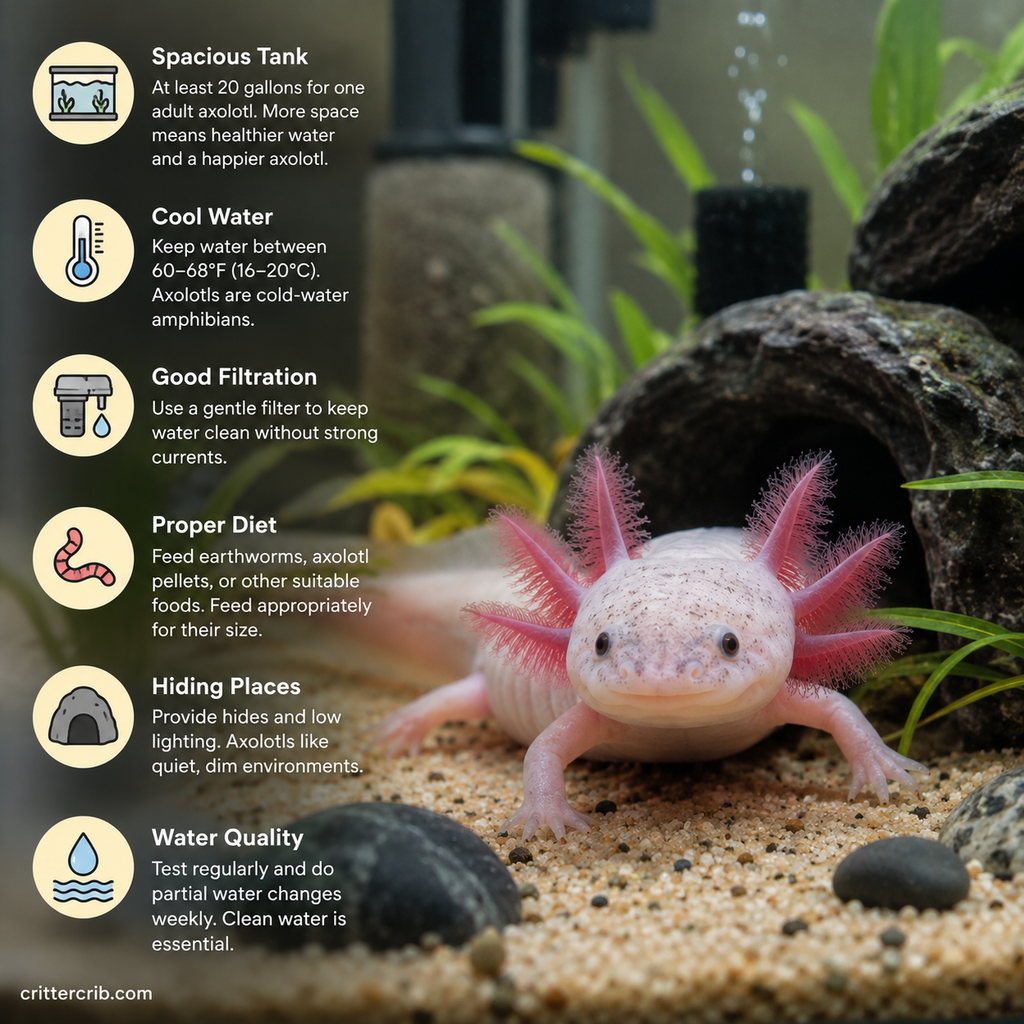
A suitable axolotl aquarium doesn’t need to look complicated, but it does need to function properly.
A basic setup may include:
- Appropriately sized aquarium
- Filter with manageable water flow
- Thermometer
- Water conditioner
- Water-testing kit
- Hides
- Axolotl-safe decorations
- Suitable substrate or a safe bare-bottom setup
- Siphon or gravel vacuum for cleaning
- Cooling equipment when necessary
The aquarium should be fully prepared and cycled before introducing the axolotl.
Axolotls Need Hiding Places
Axolotls don’t need bright, elaborate aquascapes.
In fact, intense lighting can be uncomfortable because they don’t have eyelids.
Providing darker areas and hides gives the animal somewhere to retreat.
Caves, aquarium-safe hides, and carefully selected decorations can work well as long as there aren’t sharp surfaces that could injure delicate skin.
Avoid Strong Water Flow
Powerful currents can stress axolotls.
You’ll still need adequate filtration, but the goal is good water quality without turning the aquarium into a fast-moving river.
Filters with adjustable flow can be useful, and some setups use sponge filters because they provide gentle filtration.
What Substrate Is Safe for Axolotls?
Substrate deserves special attention because axolotls can accidentally swallow material while eating.
Small gravel and loose stones can potentially become an impaction hazard if swallowed.
Depending on the animal’s age and size, keepers commonly use options such as:
- Bare-bottom tanks
- Very fine sand appropriate for sufficiently large axolotls
- Large, securely placed materials that cannot be swallowed
Juvenile axolotls may require different considerations than full-grown adults.
If you’re uncertain about a particular substrate, don’t choose it simply because it looks attractive. Safety is more important than recreating a decorative aquarium you’ve seen online.
What Do Axolotls Eat?
Axolotls are carnivorous.
Earthworms are commonly used as a staple food for appropriately sized axolotls because they provide good nutrition and are readily accepted by many individuals.
Depending on the animal’s size and situation, other foods may include:
- Appropriate worms
- High-quality sinking axolotl or carnivore pellets
- Certain frozen foods
- Other nutritionally suitable aquatic foods
Food should be appropriately sized for the axolotl.
Young axolotls generally need to eat more frequently than healthy adults, while adults may be fed several times per week depending on body condition, food type, portion size, and individual needs.
Remove uneaten food so it doesn’t decay and reduce water quality.
Can You Handle an Axolotl?
Axolotls are pets to observe rather than handle.
Their skin and protective slime coat are delicate, and unnecessary handling can cause stress or injury.
That doesn’t mean you’ll never need to move your axolotl. Occasionally, relocation may be necessary for veterinary care, emergencies, or aquarium maintenance.
But routine handling shouldn’t be part of the relationship.
If your ideal pet is something you can regularly hold on the couch, an axolotl probably isn’t the right choice.
Do Axolotls Recognize Their Owners?
You may notice your axolotl approaching the front of the aquarium when you walk over or becoming noticeably more active around feeding time.
It’s tempting to interpret that as affection.
A more cautious explanation is that axolotls can become accustomed to routines and associate certain movements or people approaching the aquarium with food.
That can still make them enjoyable pets.
Just don’t expect the same type of social bond you’d have with a dog or cat.
Can Axolotls Live Together?
Keeping multiple axolotls together is possible under some circumstances, but it adds complexity.
Axolotls may nip at one another, especially when they’re young, hungry, significantly different in size, or kept in inadequate conditions.
Multiple animals also produce more waste, which increases the biological load on the aquarium.
For beginners, keeping one axolotl is often simpler.
If multiple axolotls are housed together, you’ll need considerably more space and should make sure they’re appropriately matched in size. You’ll also need to consider their sex once they’re mature if you don’t intend to breed them.
How Long Do Axolotls Live?
Getting an axolotl shouldn’t be treated as a short-term experiment.
With appropriate care, axolotls can commonly live for around 10 years or longer, with lifespan varying according to genetics, husbandry, health, and other factors.
That means your aquarium needs to fit into your long-term plans.
Before buying one, consider what happens if you:
- Move
- Change jobs
- Go to college
- Travel frequently
- Lose power during hot weather
- Need someone to care for the animal while you’re away
A decade is a substantial commitment.
How Much Does an Axolotl Cost?
The axolotl itself may not be the most expensive part of ownership.
The aquarium setup can cost considerably more than the animal.
Your initial expenses can include:
- Aquarium and stand
- Filter
- Water conditioner
- Testing supplies
- Thermometer
- Hides and decorations
- Substrate
- Food
- Cleaning equipment
Cooling can dramatically change the budget.
If your home remains naturally cool enough, temperature management may be relatively inexpensive. If you need a dedicated aquarium chiller, your startup cost can increase substantially.
There are also ongoing expenses, including food, water treatment, replacement testing supplies, electricity, and veterinary care when needed.
It’s better to price the complete setup before purchasing the axolotl.
Are Axolotls High Maintenance?
Axolotls are best described as moderate-maintenance pets.
Once you’ve established a stable aquarium, the routine isn’t necessarily difficult. Much of your time will involve feeding, checking temperature and water conditions, removing waste, and performing regular partial water changes.
The challenge is that mistakes involving water quality or temperature can have serious consequences.
You can’t simply skip aquarium maintenance for several weeks because the water still looks clean.
A Typical Care Routine
Your routine might include:
- Checking the axolotl’s appearance and behavior.
- Monitoring water temperature.
- Feeding according to an appropriate schedule.
- Removing uneaten food and visible waste.
- Testing water parameters regularly.
- Performing partial water changes when needed.
- Checking the filter and other equipment.
Once this becomes routine, axolotl care tends to feel much more manageable.
Common Beginner Mistakes With Axolotls
A little preparation can prevent many problems.
Some common mistakes include:
- Buying the axolotl before cycling the aquarium
- Keeping the water too warm
- Using unsafe gravel
- Creating excessive filter flow
- Overfeeding
- Leaving uneaten food in the tank
- Handling the axolotl unnecessarily
- Keeping the aquarium too small
- Adding incompatible tank mates
- Assuming clear water means healthy water
- Ignoring changes in gills, skin, appetite, or behavior
Researching the complete setup beforehand is much easier than trying to correct several problems after the axolotl is already in the tank.
Do Axolotls Need a Special Veterinarian?
Ideally, you should identify a veterinarian who treats amphibians or exotic animals before you actually need one.
Not every general veterinary clinic will have experience treating axolotls.
Possible warning signs that deserve attention include major appetite changes, unusual floating, persistent skin changes, injuries, abnormal gill appearance, swelling, or sudden behavioral changes.
Some symptoms can also result from poor water conditions, which is another reason routine water testing is so important.
When an axolotl appears sick, check its environment as well as the animal.
Are Axolotls Legal to Own?
Don’t assume axolotls are legal everywhere.
Laws concerning axolotl ownership, transportation, breeding, and sale can vary by location and can change over time. Some jurisdictions restrict or prohibit private ownership.
Check current state, provincial, and local regulations before purchasing one, especially if you’re ordering an axolotl online or transporting one across state or national borders.
A reputable breeder should also be willing to discuss whether they can legally ship an animal to your location.
Where Should You Get an Axolotl?
If you’ve decided an axolotl is right for you, look for a responsible breeder or seller with healthy animals and clear husbandry practices.
Before buying, ask questions.
Find out:
- How old is the axolotl?
- What is it currently eating?
- How frequently is it being fed?
- What water conditions has it been kept in?
- Has it experienced any recent health problems?
- What substrate is it accustomed to?
- Is the seller able to provide information about its genetics or lineage?
Avoid choosing an animal based entirely on color.
Health and responsible breeding practices matter far more than getting a particular morph.
Pros and Cons of Keeping an Axolotl
Axolotls can be excellent pets, but they’re not a good match for everyone.
Pros
- Quiet
- Fascinating appearance
- Interesting behavior
- No walking or training required
- Minimal need for social interaction
- Relatively simple feeding routine once established
- Great for people who enjoy observing aquatic animals
Cons
- Sensitive to poor water quality
- Need cool water
- Aquarium must be properly cycled
- Not suitable for frequent handling
- Cooling equipment can be expensive
- Require regular aquarium maintenance
- Exotic veterinary care may be harder to find
- Can live for a decade or longer
- Ownership may be restricted in some locations
Is an Axolotl Right for You?
An axolotl may be a good pet for you if you enjoy aquarium keeping, don’t mind regular water maintenance, and prefer an animal you can observe rather than handle.
You should also be comfortable monitoring temperature and water chemistry.
An axolotl probably isn’t a good choice if you want a highly interactive pet, dislike aquarium maintenance, or live somewhere that makes keeping the water consistently cool difficult.
Before getting one, ask yourself:
- Can I maintain a properly cycled aquarium?
- Can I keep the water cool throughout the year?
- Am I comfortable testing water regularly?
- Can I afford the complete setup and ongoing care?
- Do I have access to appropriate food?
- Am I okay with a pet I shouldn’t regularly handle?
- Can I commit to caring for it for 10 years or potentially longer?
- Is axolotl ownership legal where I live?
If you can confidently answer yes, you’re much better prepared for axolotl ownership.
Final Thoughts
So, are axolotls good pets?
They certainly can be.
Axolotls are quiet, unusual, and fascinating animals that don’t demand constant attention. For someone who enjoys maintaining an aquarium and watching animal behavior, they can be incredibly rewarding.
But they aren’t effortless pets.
The biggest responsibilities are maintaining excellent water quality, keeping temperatures safely cool, providing an appropriate diet, and resisting the temptation to handle them unnecessarily.
For beginners, the best approach is to learn the aquarium side of axolotl care before bringing the animal home. Set up the tank, cycle it properly, understand your water parameters, and make sure you have a reliable plan for keeping the water cool.
Do that preparation first, and you’ll be in a much better position to give your axolotl a healthy home for years to come.