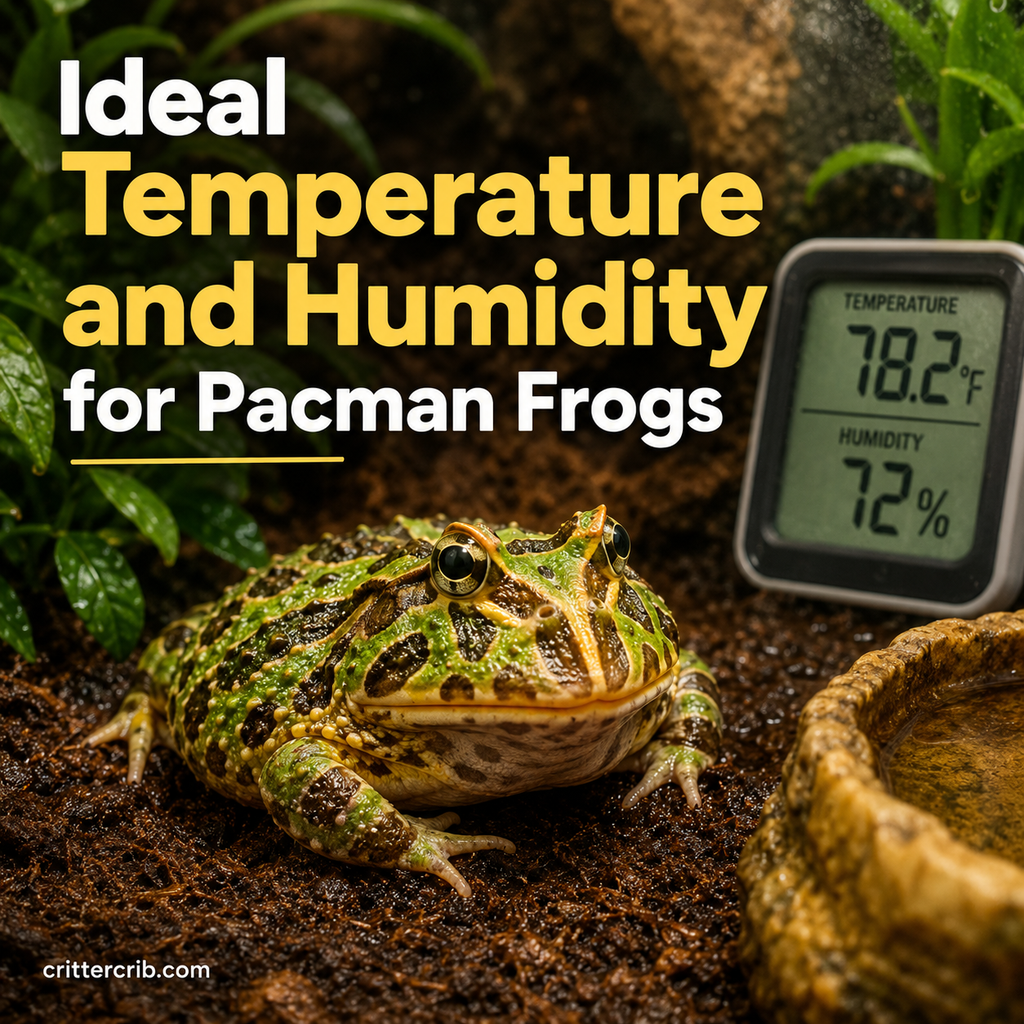
Pacman frogs may spend much of their time sitting in one spot, but the environment around them matters a lot. Temperature and humidity affect everything from hydration and appetite to digestion and overall activity.
The good news is that creating the right conditions isn’t particularly complicated once you understand what you’re aiming for.
For most pet Pacman frogs, a good general target is a temperature of about 75–82°F (24–28°C) during the day, with a modest nighttime drop, and humidity around 60–80%.
Those numbers are useful starting points, but there’s more to proper husbandry than keeping a thermometer and hygrometer within a specific range. Substrate moisture, ventilation, heating methods, and where you measure the conditions inside the enclosure all make a difference.
Here’s how to create a comfortable environment for your Pacman frog and avoid some of the most common temperature and humidity mistakes.
What Temperature Do Pacman Frogs Need?
Pacman frogs are tropical amphibians, so they generally do best in warm conditions rather than the cooler temperatures comfortable to many people.
A useful daytime range is approximately:
75–82°F (24–28°C)
Rather than heating every part of the enclosure to exactly the same temperature, providing a gentle temperature gradient allows the frog to choose a more comfortable area.
One side can be slightly warmer while the other remains cooler.
Ideal Daytime Temperature
During the day, aim for temperatures in the mid-to-upper 70s to low 80s Fahrenheit.
A warm area around 80–82°F can work well, while another part of the enclosure remains several degrees cooler.
This is particularly helpful because Pacman frogs can’t simply adjust a thermostat when they’re uncomfortable. Like other amphibians, they depend on their surroundings to regulate body temperature.
Providing some variation gives the frog options.
Ideal Nighttime Temperature
Temperatures can drop somewhat at night.
A nighttime range around 70–75°F (21–24°C) is generally suitable for many Pacman frogs.
A slight nighttime decrease helps create a natural day-and-night cycle. However, you don’t want the enclosure becoming excessively cold.
If your home remains comfortably warm overnight, additional nighttime heating may not always be necessary.
If room temperatures fall substantially, you may need a safe, thermostat-controlled heat source.
What Humidity Do Pacman Frogs Need?
Pacman frogs need a humid environment because amphibian skin is highly permeable and plays an important role in hydration.
A good general humidity target is:
60–80% relative humidity
Humidity doesn’t necessarily need to stay at one exact percentage every minute of the day. Some natural fluctuation is normal.
What matters is preventing the enclosure from becoming excessively dry for long periods while also avoiding permanently wet, stagnant conditions.
Is 80% Humidity Too High for a Pacman Frog?
Not necessarily.
Humidity approaching 80% can be appropriate, particularly after misting. The bigger concern is an enclosure that remains extremely humid with poor ventilation and saturated substrate.
Constantly wet conditions can encourage:
- Mold
- Bacterial growth
- Fungus
- Unpleasant odors
- Poor substrate conditions
Think of the enclosure as humid and moist rather than soaking wet.
That distinction is important.
Why Temperature and Humidity Matter So Much
Pacman frogs don’t drink water in quite the same way mammals do.
They can absorb moisture through their skin, particularly through an area on the underside of the body often referred to as the pelvic patch or drinking patch.
This makes environmental moisture especially important.
Temperature is equally important because it influences metabolism, digestion, appetite, and activity.
When conditions are consistently wrong, you may notice changes in your frog’s behavior.
A frog that is too cold, for example, may become less interested in food or have difficulty digesting meals normally. Excessively warm or dry conditions can contribute to dehydration and stress.
That’s why temperature and humidity should be treated as basic parts of everyday Pacman frog care rather than occasional measurements.
How to Measure Temperature Correctly
Don’t rely on how the enclosure feels to you.
Your hand isn’t an accurate thermometer, and room temperature doesn’t necessarily tell you what’s happening at substrate level.
Use a reliable digital thermometer inside the enclosure.
Ideally, monitor both the warmer and cooler areas so you understand the temperature gradient.
You may use:
- Digital thermometers with probes
- Combination thermometer/hygrometer units
- Infrared temperature guns for checking surface temperatures
Keep in mind that an infrared thermometer measures surface temperature rather than air temperature, so it shouldn’t necessarily be your only measuring tool.
Measure Where Your Frog Actually Lives
Pacman frogs are terrestrial animals.
They spend most of their time on or partially buried in the substrate, which means conditions near the bottom of the enclosure matter more than the temperature near the lid.
Place your probes or sensors where they’ll provide meaningful information without allowing the frog to damage or become tangled in them.
How to Measure Humidity
A digital hygrometer is one of the easiest ways to monitor relative humidity.
Place it inside the enclosure at a useful height rather than directly underneath a misting nozzle or pressed against soaking-wet substrate.
Otherwise, you may get readings that don’t represent the overall enclosure.
It’s also worth remembering that humidity changes throughout the day.
You might see it rise immediately after misting and gradually fall afterward.
That’s normal.
Rather than chasing an exact percentage constantly, watch the overall pattern and make sure conditions remain within an appropriate range.
How to Keep a Pacman Frog Warm
If your home stays within an appropriate temperature range, you may need relatively little supplemental heating.
Cooler homes are different.
In that situation, you’ll need to provide additional warmth without creating dangerous hot spots.
Use a Thermostat With Heating Equipment
Any supplemental heat source used for a Pacman frog enclosure should be regulated appropriately.
A thermostat helps prevent the enclosure from overheating by controlling the heating equipment according to the temperature detected by its probe.
This is especially important because small enclosures can heat up faster than you might expect.
Don’t simply plug in a powerful heat source and assume it will maintain the correct temperature on its own.
Avoid Heating the Entire Enclosure Equally
Creating one warmer area allows the frog to move away from the heat when necessary.
If the entire enclosure becomes too warm, the frog has nowhere to escape.
The same principle applies to many reptiles and amphibians: a temperature gradient provides more control over the animal’s environment.
Should You Use a Heat Mat for a Pacman Frog?
Heat mats require careful placement with Pacman frogs.
Because Pacman frogs naturally burrow into their substrate, placing a heat mat directly underneath the enclosure can create a problem. A frog attempting to escape excessive heat may instinctively burrow deeper, bringing it closer to the heat source instead.
If a heat mat is used, positioning it against the side of the enclosure rather than underneath the substrate is generally a safer approach.
It should also be regulated by a thermostat.
Always monitor the actual temperatures produced inside the enclosure rather than relying solely on the manufacturer’s wattage or packaging recommendations.
Can You Use a Heat Lamp?
Overhead heating can be used carefully, but Pacman frogs don’t need an intensely hot basking area like many reptiles.
Any lamp should provide gentle warmth rather than creating a hot, dry section of substrate.
Overhead heat can also reduce humidity more quickly.
If you use it, monitor both temperature and humidity closely and make sure the frog has shaded areas where it can retreat.
A thermostat or other appropriate temperature-control system should be used with heating equipment whenever applicable.
How to Maintain Humidity in a Pacman Frog Enclosure
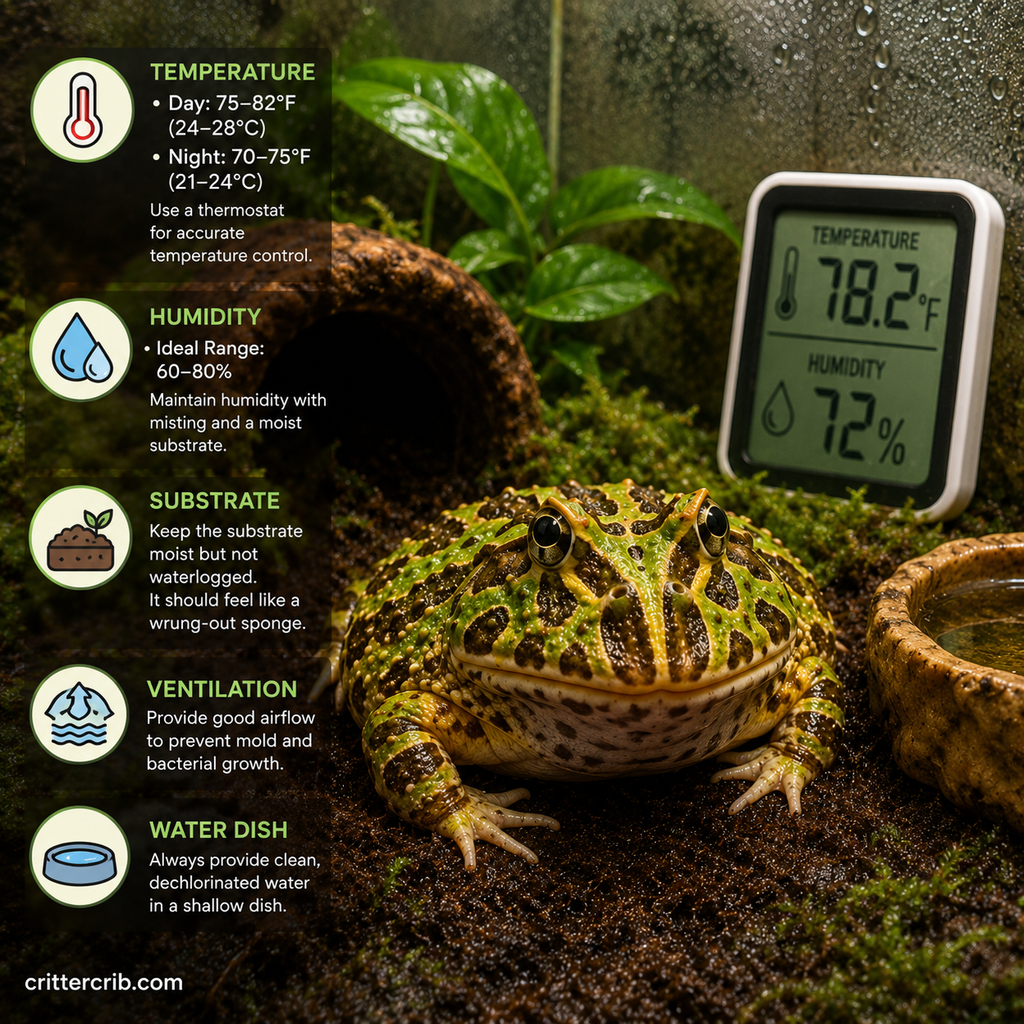
Humidity is usually maintained through a combination of moist substrate, misting, a water dish, and appropriate ventilation.
You don’t need to keep the enclosure dripping wet.
Instead, aim for consistently moist conditions with some airflow.
Mist the Enclosure as Needed
Light misting is one of the simplest ways to increase humidity.
How frequently you need to mist depends on factors such as:
- Room humidity
- Enclosure ventilation
- Substrate depth
- Heating
- Season
- Local climate
- Enclosure size
One household might need to mist more frequently than another.
That’s why measuring humidity is more useful than following a rigid rule such as “mist exactly twice every day.”
Let your hygrometer and substrate conditions guide you.
Use Dechlorinated Water
Water used for misting and soaking should be safe for amphibians.
Tap water may contain chlorine or chloramine, depending on your local water supply.
Use an appropriate water conditioner when necessary to make tap water suitable for the enclosure.
Avoid using soaps, household cleaners, fragrances, or other chemicals around your frog’s water and habitat.
Choosing Substrate That Holds Moisture
The substrate plays a major role in maintaining humidity.
Pacman frogs also like to burrow, so they need enough suitable material to partially bury themselves.
Common substrate choices include materials designed to retain moisture while remaining suitable for amphibians, such as coconut fiber or appropriate soil-based mixtures.
The substrate should generally feel damp rather than waterlogged.
A useful comparison is a wrung-out sponge: moist throughout but not sitting in pools of water.
Provide enough depth for the frog to burrow comfortably.
Don’t Let the Substrate Completely Dry Out
Dry substrate can make maintaining humidity difficult and may contribute to dehydration.
Check it regularly, including areas beneath the surface.
The top layer may appear dry while deeper substrate remains moist, or the opposite can happen near a heat source.
Don’t Keep It Saturated Either
More moisture isn’t automatically better.
If squeezing a handful of substrate would release large amounts of water, it’s probably wetter than necessary.
Constant saturation combined with warmth and poor ventilation can create an unhealthy environment.
If the enclosure smells foul or the substrate remains swampy, something needs to change.
Your Pacman Frog Still Needs a Water Dish
High humidity doesn’t replace the need for a water dish.
Provide a shallow dish large enough for the frog to sit in comfortably.
The water should be shallow enough that the frog can easily keep its head above the surface and exit without difficulty. Pacman frogs are not strong swimmers and shouldn’t be given deep water.
Keep the dish clean and replace dirty water promptly.
Use amphibian-safe, dechlorinated water.
Ventilation Is Just as Important as Humidity
One of the easiest mistakes to make is sealing an enclosure too tightly in an attempt to maintain high humidity.
Pacman frogs need humidity, but they also need fresh air.
An enclosure with almost no ventilation may maintain impressive numbers on a hygrometer while developing stagnant conditions.
Good husbandry involves balancing:
- Moisture
- Temperature
- Ventilation
If humidity disappears immediately after misting, you may have too much ventilation or insufficient moisture-retaining substrate.
If the enclosure never dries at all and condensation covers everything constantly, you may have too little airflow.
Adjust gradually until you find a balance.
How Can You Tell if a Pacman Frog Is Too Dry?
Dehydration can become serious for amphibians.
Possible signs of a Pacman frog becoming too dry may include:
- Dry-looking or unusually wrinkled skin
- Reduced activity
- Sunken appearance
- Unusual posture
- Spending excessive time in the water dish
- Changes in normal behavior
A Pacman frog may also form a protective layer of hardened skin during very dry or unfavorable conditions, a process associated with estivation.
Don’t intentionally create extreme conditions to encourage this behavior in a pet frog.
If you suspect significant dehydration or your frog appears unwell, correct environmental problems carefully and contact a veterinarian experienced with amphibians or exotic pets.
What Happens if a Pacman Frog Gets Too Hot?
Excessive heat can quickly become dangerous, especially when combined with low humidity.
Warning signs can include unusual restlessness, attempts to escape the warm area, abnormal behavior, or signs of dehydration.
If the enclosure is overheating, investigate the cause immediately.
Common causes include:
- Unregulated heating equipment
- Direct sunlight
- Heat lamps that are too powerful
- Hot summer room temperatures
- Poor enclosure placement
Never place a Pacman frog enclosure where direct sunlight can heat the glass. A glass or plastic enclosure exposed to sunlight can warm surprisingly quickly.
What if the Enclosure Is Too Cold?
A Pacman frog kept consistently too cold may become sluggish and eat less.
Digestion can also be affected because amphibian metabolism is influenced by environmental temperature.
First, verify the temperature with a reliable thermometer.
If it’s consistently below the desired range, increase warmth gradually using appropriately controlled heating equipment.
Avoid sudden temperature changes or extremely hot heat sources.
Temperature and Humidity During Winter
Winter can create a different set of problems.
Indoor heating systems often make household air considerably drier, causing enclosure humidity to fall more quickly.
At the same time, rooms may become cooler overnight.
During winter, you may need to:
- Monitor humidity more frequently
- Mist more often when necessary
- Add moisture to the substrate
- Monitor nighttime temperatures
- Adjust thermostat-controlled heating
- Check that the enclosure isn’t near a cold window or draft
Don’t assume the routine that worked in July will automatically work in January.
Seasonal adjustments are normal.
Temperature and Humidity During Summer
Summer often creates the opposite problem.
A warm room can push enclosure temperatures above the safe range, especially if you’re also using supplemental heating.
During hot weather:
- Monitor enclosure temperatures frequently
- Reduce unnecessary supplemental heat
- Keep the enclosure away from direct sunlight
- Maintain appropriate ventilation
- Watch for rapid substrate drying
- Make sure clean water is always available
Air conditioning can help control temperature, although it may also dry the air and affect humidity.
Again, measuring both conditions is the easiest way to know what adjustments are actually necessary.
Common Temperature and Humidity Mistakes
Beginners often make environmental mistakes because they’re trying too hard to hit one perfect number.
Avoid these common problems:
- Keeping the enclosure soaking wet
- Allowing the substrate to dry completely
- Using heating equipment without temperature control
- Placing heat mats underneath burrowing frogs
- Providing too little ventilation
- Using an inaccurate analog thermometer or hygrometer
- Measuring conditions only near the top of the enclosure
- Placing the enclosure in direct sunlight
- Ignoring seasonal changes
- Assuming room temperature equals enclosure temperature
- Misting on a rigid schedule without checking actual humidity
The goal isn’t perfection.
It’s stability within a healthy range.
A Simple Daily Temperature and Humidity Routine
You don’t need to spend all day adjusting your frog’s enclosure.
A simple routine can keep things on track:
- Check the temperature on both sides of the enclosure.
- Look at the humidity reading.
- Check whether the substrate still feels appropriately moist.
- Mist if humidity or substrate moisture is getting too low.
- Check and refresh the water dish when needed.
- Observe your frog for changes in appearance or behavior.
- Make sure heating and monitoring equipment is functioning properly.
These checks take very little time once they become part of your normal routine.
Ideal Pacman Frog Temperature and Humidity at a Glance
For quick reference, these are useful general targets for a typical Pacman frog enclosure:
- Daytime temperature: Approximately 75–82°F (24–28°C)
- Nighttime temperature: Approximately 70–75°F (21–24°C)
- Humidity: Approximately 60–80%
- Substrate: Moist but not waterlogged
- Ventilation: Enough airflow to prevent stagnant conditions
- Water: Clean, shallow, and appropriately treated
- Heating: Gentle and temperature-controlled when needed
Individual husbandry requirements can vary somewhat depending on the species, age, health, enclosure, and advice from an experienced exotic veterinarian.
Final Thoughts
Getting the temperature and humidity right for a Pacman frog is mostly about balance.
Aim for warm daytime conditions of roughly 75–82°F, allow a modest drop at night, and keep humidity generally around 60–80%. At the same time, provide moist substrate, clean water, adequate ventilation, and a gentle temperature gradient.
Don’t become overly focused on making your hygrometer display one exact number all day.
Instead, pay attention to the whole enclosure.
Is the substrate moist without being swampy? Does the frog have a warmer and cooler area? Is there adequate airflow? Are temperatures staying safely within range? Does your frog look and behave normally?
Once you learn how your particular enclosure responds to heating, misting, ventilation, and seasonal changes, maintaining suitable conditions becomes much easier.
A few minutes of monitoring each day can go a long way toward keeping your Pacman frog comfortable and healthy.