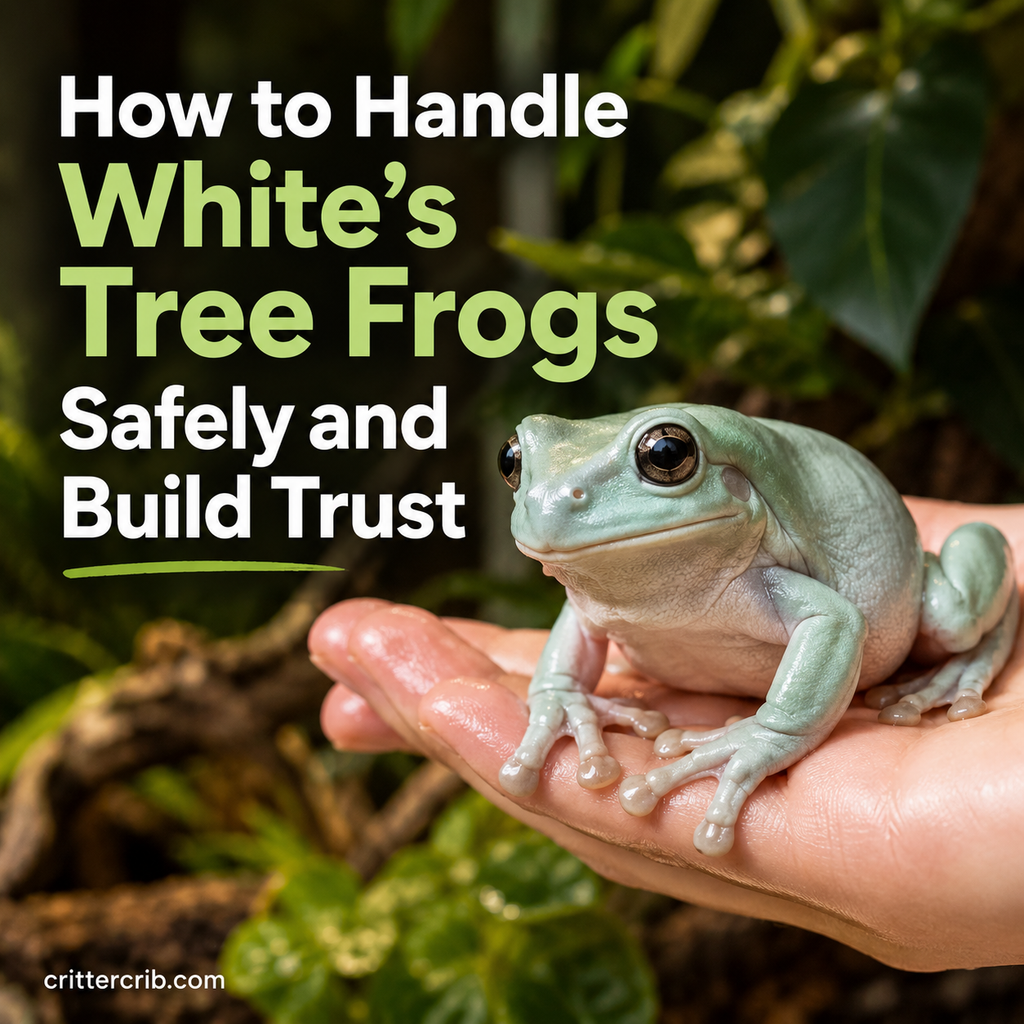
White’s tree frogs are known for their calm appearance, expressive faces, and relatively easygoing nature. That can make them seem like the kind of frog you can pick up whenever you want.
They’re still amphibians, though, and handling them requires more care than handling many reptiles or mammals.
A White’s tree frog has delicate, highly permeable skin that can absorb substances from its surroundings. Oils, lotions, soap residue, cleaning products, and other contaminants on your hands can potentially irritate or harm the frog. Frequent handling can also cause unnecessary stress.
That doesn’t mean you can never touch your frog. Occasional handling may be necessary, and some White’s tree frogs become quite accustomed to their keeper’s presence.
The key is learning how to handle them safely while recognizing that “building trust” with a frog looks different from bonding with a dog or cat.
Can You Handle a White’s Tree Frog?
Yes, White’s tree frogs can be handled occasionally when necessary, but they aren’t pets that should be regularly picked up for entertainment.
It’s better to think of them as animals you primarily observe.
Handling may sometimes be useful when you need to:
- Move the frog during enclosure maintenance
- Perform a health check
- Transfer it to a temporary container
- Visit an exotic veterinarian
- Deal with an emergency
Brief, careful interaction can also help a frog become accustomed to your presence.
However, there isn’t a health benefit to routinely holding your frog. If your White’s tree frog is comfortable in its enclosure and you simply want to enjoy watching it climb, hunt, and explore, that’s perfectly fine.
Why White’s Tree Frogs Require Careful Handling
Amphibian skin is very different from human skin.
Frogs use their skin for important biological functions, including exchanging water with their environment. Because their skin is permeable, substances that seem harmless to us may be problematic for them.
Your hands can carry:
- Natural skin oils
- Soap residue
- Hand sanitizer
- Lotion
- Sunscreen
- Perfume
- Household cleaning products
- Nicotine
- Food residue
- Other chemicals
This is why preparing your hands properly is one of the most important parts of handling a White’s tree frog.
Their skin also has a protective mucus layer. Excessive or rough handling can interfere with that protective surface.
Should You Wear Gloves When Handling a White’s Tree Frog?
For necessary handling, clean disposable powder-free gloves are often the safest option.
Nitrile gloves are commonly used.
Before touching the frog, lightly moisten the gloves with clean, amphibian-safe water. Dry gloves can create unnecessary friction against delicate skin.
Avoid gloves containing powder, fragrances, or other additives.
If gloves aren’t available and you absolutely need to handle the frog, thoroughly clean your hands, rinse away all soap residue, and wet them with safe water before contact.
Gloves are particularly useful when:
- Performing health checks
- Moving a sick or injured frog
- Administering veterinarian-directed treatment
- Handling multiple amphibians
- You recently used lotions, cleaners, or other chemicals
If you’re handling multiple frogs, changing gloves between animals can also reduce the risk of transferring pathogens.
How to Prepare Your Hands Before Handling
Preparation should happen before you open the enclosure.
If you’re using gloves:
- Put on clean, powder-free disposable gloves.
- Lightly wet them with amphibian-safe water.
- Make sure they’re free from anything that could contaminate the frog.
If you aren’t using gloves, wash your hands thoroughly with plain soap and water.
Rinse extremely well.
The goal isn’t to leave soap on your hands because they’re “clean.” You want to remove soap residue entirely.
Then wet your hands with clean, dechlorinated water before touching the frog.
Never handle a frog immediately after using hand sanitizer, lotion, perfume, household cleaners, or other chemicals.
How to Pick Up a White’s Tree Frog Safely
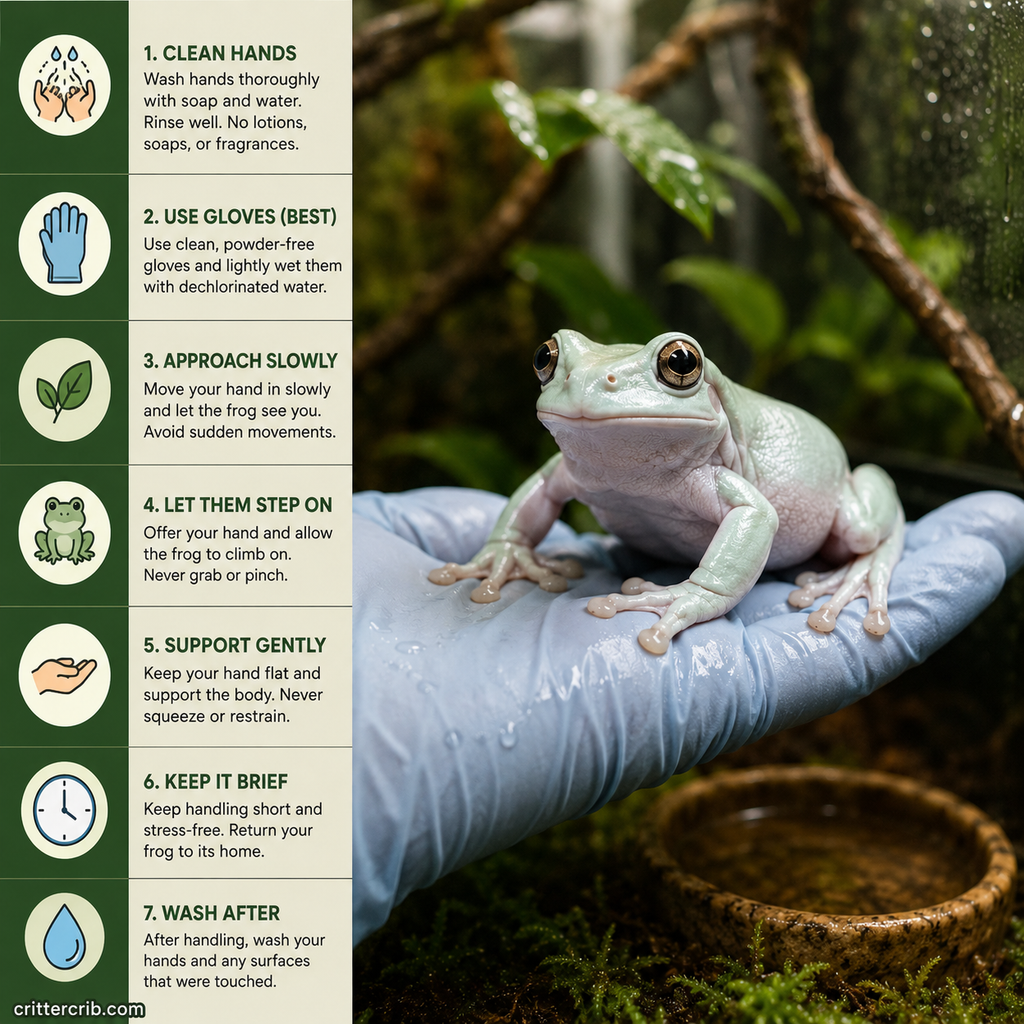
If you need to pick up your frog, move slowly.
Sudden movements can trigger an escape response, and White’s tree frogs are capable jumpers.
Whenever possible, encourage the frog to step or climb onto your hand rather than grabbing it from above.
Step 1: Approach Slowly
Move your hand into the enclosure gradually.
Don’t chase the frog around the tank.
If it repeatedly jumps away, that’s a strong indication that it doesn’t want to be handled at that moment.
Step 2: Let the Frog Step Onto You
Place your damp, gloved hand in front of or slightly beneath the frog.
You may be able to gently encourage it to move forward and climb onto your hand.
This is usually less stressful than grabbing it.
Step 3: Support the Frog
Once the frog is on your hand, keep your palm relatively flat and support its body.
Don’t squeeze.
A White’s tree frog should be able to sit naturally without having its limbs pinned or compressed.
Step 4: Keep Your Hands Low
This is important.
White’s tree frogs can suddenly jump even when they seemed perfectly relaxed a second earlier.
Keep your hands close to the enclosure, floor, bed, table, or another safe surface so the frog can’t fall a long distance.
Step 5: Keep the Interaction Brief
Don’t turn necessary handling into a long session.
Complete whatever you needed to do and return the frog gently to its enclosure.
Never Restrain a Frog Tightly
A frog isn’t something you should hold firmly in your fist.
If it starts moving, your instinct may be to tighten your grip to stop it from escaping. Resist that instinct.
White’s tree frogs have delicate bodies and limbs.
Instead, create a loose barrier with your hands if necessary while allowing the frog to maintain a natural position.
If you need to transport it somewhere, such as to a veterinarian, use an appropriate secure container rather than trying to hold it for the entire trip.
How Often Should You Handle a White’s Tree Frog?
As little as necessary is a good rule.
There’s no universal schedule where a White’s tree frog needs to be handled once a day or several times per week.
In fact, a frog that is rarely handled isn’t missing out on affection.
For routine pet ownership, focus your interaction on:
- Feeding
- Observing behavior
- Maintaining the enclosure
- Providing enrichment
- Monitoring health
Occasional brief handling when necessary is generally preferable to frequent handling sessions.
If you’re trying to help a new frog become comfortable with you, you don’t need to accomplish that by repeatedly picking it up.
There are gentler ways to build familiarity.
What Does “Trust” Mean to a White’s Tree Frog?
It’s easy to apply human emotions to pets.
A White’s tree frog probably isn’t developing trust in the same emotional way a dog learns that its owner is a close companion.
A better goal is familiarity.
Over time, your frog may learn that your presence isn’t a threat. It may become less likely to hide when you approach, remain relaxed while you perform routine enclosure maintenance, or associate your arrival with food.
That’s meaningful progress.
A comfortable frog may:
- Remain in place when you approach
- Continue normal activity while you’re nearby
- Eat readily in your presence
- Show less frantic escape behavior during maintenance
- Voluntarily approach feeding tongs or familiar routines
The goal should be a frog that feels secure around routine human activity, not a frog trained to tolerate unnecessary handling.
How to Build Trust With a White’s Tree Frog
Building familiarity is mostly about being predictable.
White’s tree frogs don’t need complicated training exercises.
They need an environment where they consistently feel safe.
Give a New Frog Time to Settle In
When you first bring your White’s tree frog home, resist the urge to immediately start handling it.
Moving to a new enclosure is already a major change.
Your frog needs time to become accustomed to:
- New surroundings
- Different sounds
- New lighting
- Feeding routines
- Your presence
- Activity around the enclosure
For the first several days, concentrate on providing correct husbandry and observing the frog from outside the enclosure.
Make sure it’s eating, behaving normally, and using its habitat.
Spend Time Near the Enclosure
One of the easiest ways to help your frog become familiar with you requires no touching at all.
Simply spend time around the enclosure.
Walk past it normally. Perform routine maintenance calmly. Sit nearby occasionally.
Over time, your presence becomes part of the frog’s normal environment rather than something unusual.
Use Predictable Feeding Routines
Food is a powerful way for many animals to become accustomed to their keeper.
Using feeding tongs can create a predictable association between your presence and something positive.
Move slowly and don’t repeatedly poke the frog with the tongs.
Eventually, some frogs become noticeably attentive when they see their keeper approaching at feeding time.
That doesn’t necessarily mean the frog is asking to be held.
It may simply know dinner is coming.
Move Slowly During Maintenance
If every enclosure cleaning turns into a frantic chase, your frog may begin associating your hands with stress.
Move deliberately.
Avoid unnecessary rearranging while the frog is resting nearby, and give it room to move away.
The less threatening routine maintenance feels, the easier future interactions tend to become.
Learn Your Frog’s Normal Behavior
Every frog is an individual.
One may remain relatively calm when you’re nearby, while another may be more cautious.
The more familiar you become with your frog’s normal behavior, the easier it is to recognize when something changes.
Pay attention to:
- Where it normally sleeps
- When it becomes active
- How eagerly it eats
- How it responds when you approach
- Typical coloration
- Normal posture
- Climbing behavior
- How often it uses different areas of the enclosure
Knowing what’s normal for your frog is useful for both handling and health monitoring.
Signs Your White’s Tree Frog Is Stressed During Handling
Your frog can’t tell you it wants to be put down, so you need to watch its behavior.
Possible signs that an interaction is becoming stressful include:
- Repeated attempts to jump away
- Frantic movement
- Trying to escape your hands
- Unusual defensive behavior
- Persistent struggling
- Sudden changes from its normal behavior
If your frog is repeatedly trying to get away, don’t continue the session in an attempt to “teach” it to tolerate handling.
Return it safely to the enclosure.
Repeated forced interactions are unlikely to create the kind of familiarity you’re trying to develop.
What if Your Frog Jumps Out of Your Hands?
Stay calm and don’t grab at it wildly.
Sudden chasing can make the situation worse.
If the frog lands somewhere safe, slowly place your damp, gloved hands in front of it and gently guide it onto your hand or into a secure container.
Be especially cautious around:
- Furniture gaps
- Open doors
- Other pets
- Stairs
- Electrical equipment
- Cleaning products
- Carpet treated with chemicals
- High surfaces
This is why it’s smart to handle a frog close to the ground and preferably within or immediately next to its enclosure.
Never allow a White’s tree frog to roam freely around your home.
Keep Other Pets Away During Handling
Dogs and cats can be dangerous to frogs even when they aren’t intentionally aggressive.
A curious paw, bite, or playful swat can cause severe injury.
Keep other pets completely separated whenever your frog is outside its enclosure.
Don’t place the frog on another animal for a photograph or allow pets to “meet.”
It’s unnecessary and creates risk for both animals.
Don’t Put Your Frog on Your Face or Clothing
Social media makes it easy to find photos of frogs sitting on someone’s shoulder, head, or clothing.
That doesn’t make it a good handling practice.
Clothing may contain detergent, fabric softener, fragrance, hair products, cosmetics, or other residues.
Your face and hair can contain skin oils, makeup, sunscreen, and personal-care products.
Keep necessary handling limited to properly prepared hands or gloves.
Wash Your Hands After Handling
Handwashing isn’t only about protecting the frog.
Amphibians can carry microorganisms, including bacteria such as Salmonella, even when they appear perfectly healthy.
After handling your frog, its enclosure, substrate, water dish, or equipment:
- Wash your hands thoroughly with soap and running water.
- Clean any surfaces that may have become contaminated.
- Keep amphibian equipment away from areas used for food preparation.
Young children, older adults, pregnant people, and individuals with weakened immune systems may face greater risks from certain animal-associated infections and should take additional precautions.
Never kiss your frog or bring it close to your mouth.
Can Children Handle White’s Tree Frogs?
White’s tree frogs may look like appealing pets for children because they’re relatively large and often appear calm.
But handling should always be closely supervised.
Children may accidentally:
- Squeeze the frog
- Drop it
- Chase it
- Touch it with dirty or contaminated hands
- Bring their hands to their mouth afterward
For younger children, observation is usually a better way to enjoy the frog.
Older children who can follow instructions may be able to participate in carefully supervised care, but adults should remain responsible for the animal’s welfare.
Should You Hand-Feed a White’s Tree Frog?
Hand-feeding with bare fingers isn’t necessary.
Feeding tongs are generally a better choice.
White’s tree frogs can strike quickly when food is nearby, and they aren’t carefully distinguishing your fingertip from an insect every time they lunge.
Tong feeding also reduces unnecessary skin contact.
Use appropriately sized feeding tongs and offer suitable prey without repeatedly pushing food into the frog’s face.
Common Handling Mistakes to Avoid
Most handling problems are preventable.
Avoid:
- Handling your frog with dry hands
- Handling immediately after using sanitizer or lotion
- Using powdered or chemically treated gloves
- Squeezing or tightly restraining the frog
- Chasing it around the enclosure
- Handling for long periods
- Passing the frog between several people
- Allowing it to roam around the house
- Letting children handle it unsupervised
- Putting it near cats or dogs
- Placing it on your face or clothing
- Handling simply because the frog appears calm
- Assuming tolerance means the frog enjoys being held
The safest interaction is usually the least intrusive one.
When Handling Is Necessary
There are times when touching your frog is unavoidable.
You may need to move it for:
- Veterinary examinations
- Enclosure repairs
- Deep cleaning
- Emergency evacuation
- Health inspections
- Temporary housing
Prepare everything before picking up the frog.
If you’re transferring it to another container, have that container ready and secure first. This keeps the handling period short and prevents you from trying to open lids or rearrange equipment while holding the frog.
When to Avoid Handling Completely
There are situations where handling should be minimized even further.
Avoid unnecessary handling if your frog:
- Has recently arrived
- Appears sick
- Has an injury
- Is shedding
- Is unusually stressed
- Has stopped eating unexpectedly
- Is undergoing veterinary treatment
A sick or injured frog may still need to be handled for medical reasons, but follow the instructions provided by an amphibian or exotic-animal veterinarian.
Creating an Environment That Builds Confidence
A frog that feels secure in its enclosure is less likely to respond fearfully to everyday activity.
Make sure your White’s tree frog has:
- Appropriate temperature and humidity
- Suitable climbing branches
- Plenty of foliage
- Hiding areas
- Clean water
- Appropriate lighting
- Enough space
- A consistent day-and-night cycle
An exposed frog with nowhere to hide may feel vulnerable regardless of how gently you approach it.
Giving the frog the choice to retreat is part of building a low-stress environment.
Safe Handling at a Glance
When you genuinely need to handle your White’s tree frog:
- Prepare everything before opening the enclosure.
- Use clean, powder-free gloves when possible.
- Moisten the gloves with amphibian-safe water.
- Approach slowly rather than chasing the frog.
- Encourage it to step onto your hand.
- Support its body without squeezing.
- Keep your hands close to a safe surface.
- Keep handling brief.
- Return the frog gently to its enclosure.
- Wash your hands thoroughly afterward.
It’s a simple routine, but following it consistently protects both you and your frog.
Final Thoughts
White’s tree frogs can become comfortable with their keepers, but building trust doesn’t require frequent handling.
In fact, one of the best ways to earn a frog’s confidence is to leave it alone when interaction isn’t necessary.
Provide a secure enclosure, approach slowly, maintain predictable feeding and cleaning routines, and give a new frog time to adjust. Eventually, it may become much less concerned about your presence.
When handling is necessary, treat the frog’s skin as the delicate surface it is. Use clean, damp, powder-free gloves when possible, support the frog gently, keep it close to a safe surface, and make the interaction brief.
Most importantly, let the frog’s behavior guide you.
A White’s tree frog that stays relaxed while you perform routine care doesn’t need to sit in your hands to prove that it trusts you. For an amphibian, feeling safe enough to behave normally around you is already a very good sign.