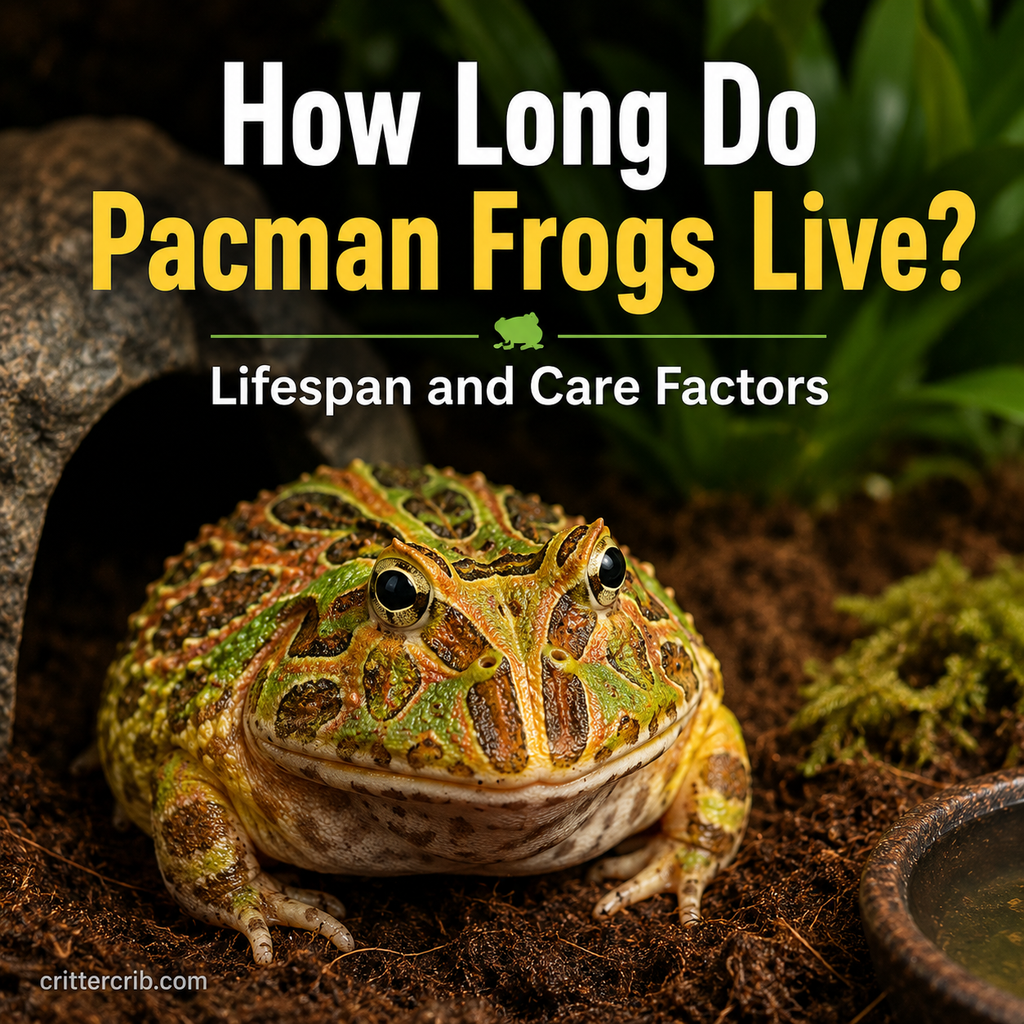
Pacman frogs are famous for their enormous mouths, round bodies, and willingness to sit in one spot waiting for dinner to appear. They’re relatively simple amphibians to keep compared with some exotic pets, but bringing one home can still be a surprisingly long commitment.
So, how long do Pacman frogs live?
In captivity, a well-cared-for Pacman frog can often live around 10 years, with some individuals potentially living longer under excellent conditions. Lifespan varies considerably, though. Genetics, diet, temperature, humidity, enclosure conditions, stress, and veterinary care can all influence how long an individual frog lives.
Wild Pacman frogs generally face more environmental threats than captive animals, including predators, food shortages, disease, habitat changes, and extreme weather.
If you’re considering a Pacman frog—or already have one—understanding the factors that affect its lifespan is an important part of providing good long-term care.
What Is the Average Lifespan of a Pacman Frog?
Pacman frogs kept as pets commonly have the potential to live for many years when their basic husbandry needs are consistently met.
A reasonable expectation for a healthy captive Pacman frog is approximately:
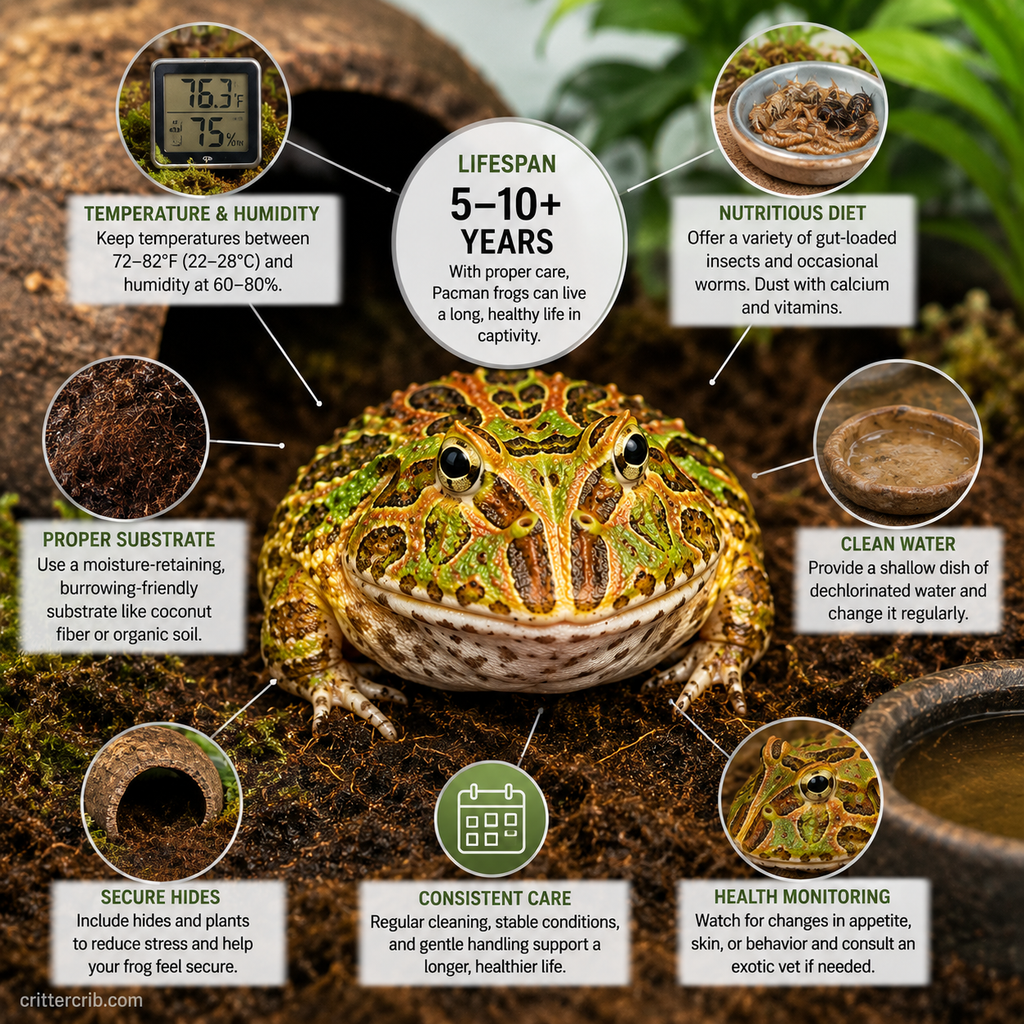
- Around 5–10 years for many captive frogs
- 10 years or longer under good conditions
- Potentially longer for some exceptionally well-cared-for individuals
These numbers should be treated as general ranges rather than guarantees.
Two frogs purchased at the same age and kept under similar conditions won’t necessarily live for exactly the same amount of time. Genetics and individual health matter, just as they do with other animals.
The important takeaway is that Pacman frogs aren’t short-term pets. Someone buying a young frog should be prepared to care for it for potentially a decade or more.
How Long Do Pacman Frogs Live in the Wild?
Determining the exact lifespan of a wild Pacman frog is more difficult.
Animals in nature aren’t being monitored from hatching through old age, and wild frogs encounter risks that captive animals don’t normally face.
These can include:
- Predators
- Parasites
- Disease
- Drought
- Flooding
- Food shortages
- Competition
- Habitat loss
- Temperature extremes
- Human activity
A frog that might have the biological potential to live for many years may never reach old age in the wild.
Captivity removes many of these threats, but only when the animal receives appropriate care. A poorly maintained enclosure can introduce an entirely different set of risks.
What Are Pacman Frogs?
“Pacman frog” is the common name used for several frogs belonging to the genus Ceratophrys.
They’re native to parts of South America and are sometimes called South American horned frogs.
Their nickname comes from their appearance. A Pacman frog has a huge mouth relative to the rest of its body, giving it a resemblance to the round, mouth-dominated video game character.
These frogs are ambush predators.
Instead of actively chasing prey around for long periods, they typically bury themselves partially in substrate and wait for something edible to move close enough to strike.
This sedentary lifestyle is normal. A Pacman frog that spends hours sitting in one location isn’t necessarily bored or unhealthy.
Understanding this natural behavior makes it easier to create an enclosure that supports the frog throughout its life.
What Affects a Pacman Frog’s Lifespan?
There’s no single trick that guarantees a Pacman frog will live for 10 or 15 years.
Long-term health comes from consistently getting several basic aspects of husbandry right.
The biggest factors include:
- Genetics
- Diet
- Appropriate supplementation
- Temperature
- Humidity
- Substrate
- Cleanliness
- Water quality
- Stress
- Handling
- Disease prevention
- Access to veterinary care when needed
Small husbandry problems may not cause obvious trouble immediately. However, chronic issues can become much more significant when they continue for months or years.
Temperature and Pacman Frog Longevity
Temperature plays an important role in a Pacman frog’s metabolism, digestion, activity, and overall health.
These frogs need a warm environment, but hotter isn’t automatically better.
An enclosure that’s consistently too cold can interfere with normal digestion and activity. Excessive heat, on the other hand, can contribute to dehydration and potentially dangerous stress.
Rather than relying on how the enclosure feels to your hand, use a reliable digital thermometer.
It’s also worth checking temperatures in more than one part of the enclosure. This helps you identify whether there are unusually hot or cold areas.
Avoid Sudden Temperature Changes
Consistency matters.
Large or rapid temperature fluctuations can be stressful, especially when they’re happening regularly.
Think about seasonal changes in your home as well. An enclosure that maintains an appropriate temperature during summer may become considerably cooler during winter.
Monitor conditions throughout the year instead of assuming that a setup that worked six months ago is still working perfectly today.
Humidity Is Just as Important
Amphibians have highly permeable skin, which makes environmental moisture particularly important.
Pacman frogs require a humid environment and access to moist substrate, but the enclosure shouldn’t simply be soaking wet all the time.
There’s an important difference between moist and waterlogged.
Excessively dry conditions can contribute to dehydration. Constantly saturated, stagnant substrate can encourage unsanitary conditions and microbial growth.
A digital hygrometer makes humidity easier to monitor instead of relying entirely on guesswork.
Depending on your enclosure and local climate, humidity may be maintained through a combination of:
- Moisture-retaining substrate
- Light misting when needed
- A suitable water dish
- Appropriate ventilation
- Monitoring with a hygrometer
Good airflow remains important even in a humid enclosure.
Choosing the Right Substrate
Pacman frogs spend a lot of time in contact with their substrate.
They also like to burrow.
That makes substrate more than an aesthetic decision—it becomes a major part of the frog’s environment.
A suitable substrate should allow natural burrowing behavior while retaining appropriate moisture.
Common choices include amphibian-safe soil-based or coconut-fiber substrates.
Whatever you choose, avoid materials that could injure the frog or create an unnecessary impaction risk if accidentally swallowed.
Loose gravel, stones, and similar materials are poor choices around an animal that attacks food with such enthusiasm.
Pacman frogs aren’t known for politely separating dinner from whatever happens to be underneath it.
Diet and Pacman Frog Lifespan
A balanced diet is one of the foundations of long-term health.
Pacman frogs are carnivores and naturally eat animal prey.
In captivity, suitable foods can include appropriately sized:
- Crickets
- Dubia roaches
- Earthworms and nightcrawlers
- Silkworms
- Hornworms
- Other properly sourced feeder insects and invertebrates
Variety can help provide a broader nutritional profile than relying indefinitely on a single feeder.
Earthworms are particularly useful because they’re soft-bodied and nutritious.
Don’t Rely on One Food Forever
It’s tempting to find one food your frog loves and simply stick with it.
That’s convenient, but variety is generally a better approach.
Different feeders have different nutritional profiles. Some are more appropriate as staple foods, while fattier options are better used occasionally.
A Pacman frog enthusiastically eating something doesn’t necessarily mean that food should become its entire diet.
Calcium and Vitamin Supplementation
Captive frogs don’t have access to the same variety of prey they might encounter in nature.
Because of this, appropriate supplementation is an important part of captive nutrition.
Feeder insects may need to be dusted with amphibian-appropriate calcium and vitamin supplements according to the frog’s age, diet, and husbandry setup.
Calcium is especially important for healthy bone development and maintenance.
Inadequate calcium balance can contribute to metabolic bone disease, a serious condition affecting captive reptiles and amphibians.
However, more supplementation isn’t automatically better. Excessive or inappropriate supplementation can create its own problems.
Follow reputable amphibian husbandry guidance or recommendations from an exotic-animal veterinarian rather than randomly adding supplements to every meal.
How Often Should Pacman Frogs Eat?
Feeding frequency changes as a Pacman frog matures.
Young frogs are growing rapidly and typically require more frequent meals than adults.
Juveniles may be fed every day or every other day depending on their size, condition, and food being offered.
Adults generally eat less frequently and may be offered substantial meals a few times per week.
The exact schedule should take into account:
- Age
- Body size
- Body condition
- Prey size
- Type of food
- Appetite
- Activity
- Health
Rather than focusing on an exact number of insects for every frog, monitor body condition over time.
Obesity Can Affect Long-Term Health
Pacman frogs are naturally round animals, which can make judging their body condition tricky.
Their appearance also makes overfeeding tempting. A frog that seems willing to eat constantly isn’t necessarily hungry.
Regularly feeding oversized portions or excessive amounts of fatty prey can contribute to obesity and other health problems.
Don’t use appetite alone as your guide.
A balanced diet and appropriate feeding schedule are more important than seeing how much your frog is willing to swallow.
Clean Water Matters
Pacman frogs should have access to a shallow dish of clean, appropriately treated water.
The dish should be easy for the frog to enter and exit without requiring it to swim.
Water quality is particularly important for amphibians because their skin is highly permeable.
Tap water may contain chlorine or chloramine depending on the local water supply. Water used for amphibians should be made safe using an appropriate treatment method.
Change the water regularly and immediately if it becomes contaminated with substrate, food, or waste.
The dish itself should also be cleaned routinely.
Keep the Enclosure Clean
A dirty enclosure exposes a Pacman frog to waste and potentially harmful microorganisms.
Spot-clean whenever you notice:
- Feces
- Uneaten food
- Shed material
- Mold
- Heavily contaminated substrate
Substrate should also be replaced as appropriate for the type of enclosure you’re maintaining.
The goal isn’t to create a sterile box. It’s to prevent waste from accumulating while maintaining stable environmental conditions.
Always use cleaning products that are safe for amphibians and rinse anything that requires rinsing thoroughly.
Handling and Stress
Pacman frogs aren’t pets that need regular handling.
In fact, they’re generally better observed than held.
Amphibian skin is delicate and permeable. Oils, lotions, soap residue, cleaning chemicals, and other substances on human hands can potentially irritate or harm them.
Handling can also be stressful.
Whenever possible, limit handling to situations where it’s actually necessary, such as enclosure maintenance, health examinations, or relocation.
If handling is unavoidable, follow safe amphibian-handling practices and keep the interaction brief.
Your frog doesn’t need to sit on the couch with you to have a good life.
Give Your Pacman Frog Somewhere to Hide
A secure environment helps reduce unnecessary stress.
Pacman frogs naturally spend considerable time partially buried, so provide enough substrate for burrowing.
Additional cover can include:
- Cork bark
- Artificial plants
- Amphibian-safe live plants
- Appropriately sized hides
- Leaf litter suitable for the enclosure
Avoid overcrowding the habitat with decorations.
Your frog should still have enough usable floor space to move, burrow, access water, and find comfortable resting spots.
Should Pacman Frogs Live Together?
Pacman frogs are best housed individually.
They’re ambush predators with large mouths, and they aren’t social animals that need companionship from another Pacman frog.
Housing frogs together creates unnecessary risks, including:
- Stress
- Competition for food
- Injury
- One frog attempting to eat another
A solitary Pacman frog isn’t lonely in the way a social mammal might be.
Providing a safe, properly maintained individual enclosure is a much better approach.
Common Health Problems That Can Affect Lifespan
Even with good care, Pacman frogs can become sick.
Some health problems associated with captive amphibians include:
Metabolic Bone Disease
Improper calcium balance, nutrition, and husbandry can contribute to metabolic bone disease.
Affected animals may develop weakness, skeletal abnormalities, difficulty moving, or problems feeding.
Prevention through appropriate nutrition and supplementation is far better than waiting until obvious symptoms appear.
Impaction
Pacman frogs strike quickly when feeding and can accidentally swallow substrate.
If inappropriate material is swallowed, it may contribute to digestive obstruction.
Using appropriate substrate and thoughtful feeding practices can reduce the risk.
Dehydration
Low humidity, excessive heat, or lack of suitable water can contribute to dehydration.
A dehydrated frog may become unusually inactive or develop changes in appearance and behavior.
Skin Problems and Infections
Unsanitary conditions, chronic stress, inappropriate humidity, or other husbandry issues can contribute to skin problems and infections.
Amphibian skin can provide important clues about overall health, so unusual discoloration, sores, redness, or lesions shouldn’t be ignored.
Parasites
Captive frogs can also be affected by internal or external parasites.
This is one reason it’s important to obtain animals and feeder insects from reputable sources.
Signs Your Pacman Frog May Be Unwell
Pacman frogs aren’t always obvious about illness.
Pay attention to changes from your frog’s normal behavior.
Potential warning signs include:
- Persistent refusal to eat
- Significant weight loss
- Unusual bloating
- Weakness
- Difficulty moving
- Abnormal posture
- Skin lesions or unusual discoloration
- Difficulty shedding
- Changes in breathing
- Persistent abnormal stool
- Inability to capture or swallow food normally
One missed meal isn’t necessarily an emergency, particularly in an adult frog.
A combination of symptoms or a persistent change is more concerning.
When something appears wrong, review temperature, humidity, water, diet, and enclosure conditions. If symptoms continue or appear serious, contact a veterinarian experienced with amphibians or exotic animals.
Does Brumation Affect Pacman Frog Lifespan?
Pacman frogs may dramatically reduce their activity under certain environmental conditions.
In nature, some Ceratophrys species can enter periods of dormancy in response to unfavorable conditions. They may burrow and form a protective layer that helps reduce moisture loss.
A captive frog becoming inactive shouldn’t automatically be assumed to be undergoing a harmless natural process.
Inactivity can also result from:
- Low temperatures
- Dehydration
- Stress
- Illness
- Poor environmental conditions
Don’t intentionally force a pet Pacman frog into dormancy without a specific husbandry reason and a solid understanding of the species’ requirements.
If a normally active and responsive frog suddenly behaves very differently, check its environment and health.
How Can You Help a Pacman Frog Live Longer?
There isn’t a secret food or special product that guarantees an unusually long life.
Good Pacman frog care is mostly about consistency.
For the best chance at a long, healthy life:
- Maintain appropriate temperature and humidity.
- Provide deep, moisture-retaining substrate suitable for burrowing.
- Feed a varied, nutritionally appropriate carnivorous diet.
- Use calcium and vitamin supplementation appropriately.
- Provide clean, amphibian-safe water.
- Remove waste and spoiled food promptly.
- Avoid unnecessary handling.
- House Pacman frogs individually.
- Monitor the frog’s weight, appetite, skin, and behavior.
- Seek veterinary care when persistent or serious symptoms appear.
None of these steps is particularly complicated on its own.
The challenge is maintaining them consistently throughout the frog’s life.
Are Pacman Frogs Good Long-Term Pets?
For the right person, absolutely.
Pacman frogs don’t require daily walks, huge enclosures, or constant social interaction. They’re fascinating animals to observe and their ambush-predator behavior makes feeding particularly interesting.
They’re also relatively sedentary, which can make them suitable for someone who enjoys creating and maintaining a naturalistic habitat rather than physically interacting with a pet.
However, “low activity” shouldn’t be confused with “no maintenance.”
Pacman frogs still require:
- Regular feeding
- Clean water
- Temperature monitoring
- Humidity monitoring
- Enclosure cleaning
- Appropriate supplementation
- Long-term commitment
A frog that potentially lives for a decade shouldn’t be treated as a temporary novelty.
Frequently Asked Questions About Pacman Frog Lifespan
How long do Pacman frogs live as pets?
Pet Pacman frogs can often live around 5–10 years, and some individuals may live beyond 10 years with excellent husbandry. Individual lifespan depends on genetics, health, diet, environmental conditions, and other factors.
Can a Pacman frog live for 15 years?
Some Pacman frogs are reported to reach their teens in captivity, although owners shouldn’t assume every frog will live that long. A lifespan around 5–10 years is a more practical general expectation, with longer lifespans possible.
Do male or female Pacman frogs live longer?
There isn’t a simple rule that guarantees one sex will live longer than the other. Husbandry, genetics, health, and individual circumstances are much more useful when thinking about a pet frog’s potential lifespan.
How can I tell how old my Pacman frog is?
Once a Pacman frog reaches adulthood, determining its exact age based only on appearance can be difficult.
Size may provide clues when the frog is young, but growth rates vary according to genetics, sex, nutrition, and husbandry.
If you purchase from a breeder, ask for the frog’s hatch date or approximate age and keep that information with your records.
What is the oldest Pacman frog?
Claims about exceptionally old Pacman frogs vary and aren’t always supported by reliable documentation. Rather than planning around a record age, it’s more useful to expect a commitment of roughly a decade and provide husbandry that gives your frog the opportunity to reach old age.
Why did my Pacman frog stop eating?
Appetite can change because of temperature, stress, environmental conditions, age, feeding frequency, or illness.
First check the enclosure’s temperature and humidity and consider when and how much the frog last ate.
Persistent appetite loss accompanied by weight loss, weakness, unusual skin changes, bloating, or other symptoms should be evaluated by an amphibian or exotic-animal veterinarian.
Do Pacman frogs need UVB lighting to live longer?
UVB recommendations for Pacman frogs can vary depending on the enclosure, species, supplementation routine, and husbandry approach. Low-level UVB may be incorporated into an appropriate setup, but lighting needs to be considered alongside calcium and vitamin D3 supplementation rather than in isolation.
If using UVB, make sure the strength, distance, enclosure materials, and available shade are appropriate for the animal.
Final Thoughts
Pacman frogs can be surprisingly long-lived pets.
While many captive Pacman frogs may live somewhere around 5–10 years, individuals receiving excellent care can potentially live for a decade or longer. That makes buying one a much bigger commitment than their small enclosure and sedentary lifestyle might initially suggest.
The best way to support a long life isn’t complicated: provide appropriate temperatures and humidity, keep the enclosure clean, offer nutritious food and proper supplementation, supply safe water, minimize unnecessary handling, and pay attention when your frog’s behavior changes.
You can’t control genetics or guarantee a particular lifespan. What you can control is the quality and consistency of the care your frog receives.
For an animal that spends much of its day buried in dirt waiting for dinner, a Pacman frog can be a companion for a surprisingly large chunk of your life.