
Fire-bellied newts can’t exactly tell you when they’re comfortable.
They won’t wag a tail when you walk into the room, and trying to judge their emotional state the same way you would a dog or cat isn’t particularly useful.
What they can show you is whether they’re behaving normally in an environment that meets their needs.
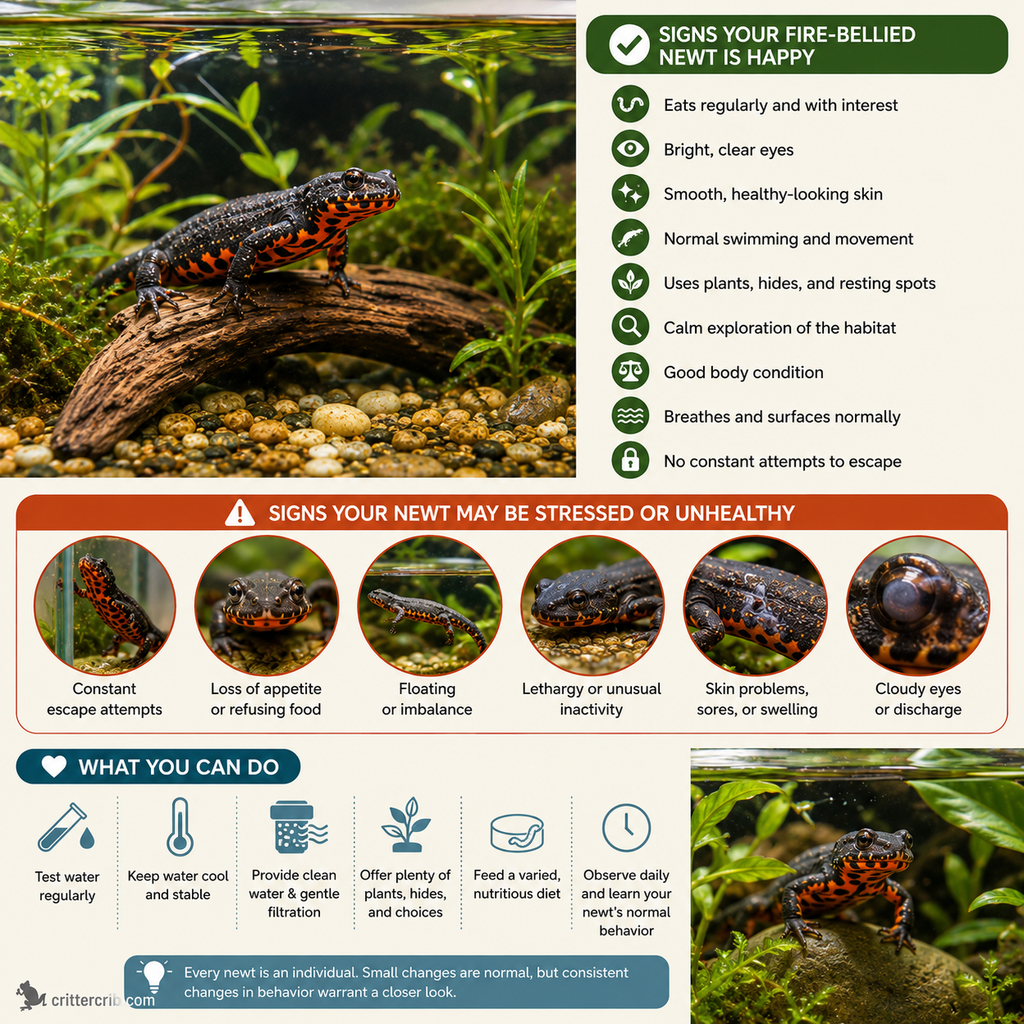
A comfortable fire-bellied newt will generally have a healthy appetite, normal body condition, clear skin, appropriate activity, and the freedom to move between different areas of its habitat. It should be able to hide when it wants, explore without constantly trying to escape, and rest without being repeatedly disturbed.
The best way to determine whether your newt is doing well is to look at the whole picture.
One unusual afternoon doesn’t necessarily mean anything is wrong.
Repeated changes in appetite, movement, appearance, or habitat use deserve more attention.
Here’s what to watch for.
What Does a Happy Fire-Bellied Newt Look Like?
“Happy” is difficult to measure scientifically in a newt.
A more useful question is:
Does the animal appear healthy, secure, and comfortable enough to perform normal behaviors?
Positive signs generally include:
- Regular appetite
- Normal swimming
- Calm exploration
- Normal resting
- Healthy body condition
- Smooth, healthy-looking skin
- Clear eyes
- Regular use of appropriate habitat areas
- Willingness to use hides
- Normal response to food
- No persistent escape behavior
Individual newts have different personalities.
One may spend considerable time exploring while another prefers sitting beneath a plant.
Look for what’s normal for your particular animal.
A Good Appetite Is Usually a Positive Sign
Feeding behavior is one of the easiest things to monitor.
A healthy fire-bellied newt will generally show interest in appropriate food.
Depending on the species, size, and individual, suitable foods may include:
- Earthworms
- Chopped nightcrawlers
- Bloodworms as part of a varied diet
- Blackworms
- Appropriate aquatic invertebrates
- Other nutritionally suitable foods
Some newts quickly learn where food appears.
You may notice your newt approaching feeding tongs or moving toward its usual feeding area when you arrive.
That’s useful information.
A strong feeding response doesn’t prove an animal is “happy,” but consistent appetite is generally reassuring.
Learn Your Newt’s Normal Feeding Routine
Don’t compare your newt too closely with videos of someone else’s animal.
Instead, learn its baseline.
Pay attention to:
- How quickly it notices food
- How aggressively or calmly it eats
- How much it normally consumes
- How frequently it eats
- Whether it has favorite foods
- Where it prefers to feed
If a normally enthusiastic eater suddenly refuses several meals, investigate.
Temperature, water quality, stress, shedding, seasonal changes, and illness can all influence appetite.
Healthy Body Condition Matters
A comfortable, appropriately fed newt should maintain a healthy body condition.
You don’t want an animal that looks dramatically thin, but you also don’t need to keep feeding until it becomes excessively heavy.
Look at the newt from above and from the side.
Its body should appear proportionate without:
- Prominent bones
- Severe thinning
- Extreme abdominal swelling
- Sudden unexplained weight changes
Taking occasional photographs from similar angles can help you notice gradual changes that are difficult to see day to day.
Normal Swimming Is a Good Sign
Fire-bellied newts are aquatic or semi-aquatic depending on species, age, season, and individual circumstances.
When swimming, a healthy newt should generally appear coordinated.
It should be able to:
- Move through the water
- Reach the surface
- Navigate around plants
- Rest underwater
- Change direction
- Reach food
Don’t expect nonstop activity.
Newts spend plenty of time resting.
What matters is whether movement looks controlled and normal when the animal decides to move.
Exploring the Habitat Can Indicate Comfort
A newt that feels secure may periodically investigate different parts of its enclosure.
You might see it:
- Walking along the bottom
- Swimming between plants
- Climbing onto decorations
- Investigating food
- Resting on leaves
- Moving into a hide
- Exploring a land or resting area when appropriate
Exploration doesn’t need to happen constantly.
Fire-bellied newts aren’t tiny underwater marathon runners.
Calm movement mixed with plenty of resting is perfectly normal.
Hiding Doesn’t Mean Your Newt Is Unhappy
New owners sometimes become concerned when their newt disappears into a hide.
Hiding is normal.
In fact, providing hiding places is part of creating a comfortable habitat.
Useful cover can include:
- Aquatic plants
- Driftwood
- Cork bark where appropriate
- Smooth caves
- Rock structures
- Leafy vegetation
- Other aquarium-safe shelters
A newt that uses a hide and later comes out to feed or explore isn’t necessarily stressed.
The ability to retreat is valuable.
A Comfortable Newt Should Have Choices
One of the best things you can provide isn’t a particular decoration.
It’s choice.
Depending on the species and setup, a good habitat may allow the newt to choose between:
- Open water
- Dense plants
- Shaded areas
- Hides
- Different water depths
- Resting near the surface
- An appropriate land or emergent resting area
An animal that can select its preferred microenvironment has more control over its surroundings.
That’s generally better than forcing it to remain in one type of environment.
Using Plants Normally Is a Positive Sign
Plants are particularly useful in fire-bellied newt habitats.
Newts may rest:
- On leaves
- Between stems
- Beneath floating plants
- Among dense vegetation
Plants provide security while also giving aquatic newts convenient resting places near the surface.
Hardy live plants can also make the aquarium feel more natural.
Don’t be surprised if your carefully arranged aquascape eventually becomes whatever arrangement your newt prefers.
Normal Resting Behavior
Newts aren’t active every minute.
A comfortable animal may spend long periods:
- Sitting on the substrate
- Resting beneath a plant
- Perching on a leaf
- Remaining inside a hide
- Floating or resting near the surface
- Sitting on an appropriate land area
Resting by itself isn’t concerning.
What matters is whether the animal can move normally when motivated and continues eating and behaving normally overall.
Healthy Skin Is Important
Amphibian skin can tell you a lot about general condition.
A healthy fire-bellied newt should generally have skin that looks normal for its species and individual.
Watch for unusual:
- Sores
- Open wounds
- Cottony growth
- Persistent white patches
- Redness
- Swelling
- Blisters
- Abnormal lumps
- Excessive peeling
Normal shedding can temporarily change the skin’s appearance.
Newts may also eat their shed skin, so you won’t necessarily find it afterward.
Persistent or worsening skin abnormalities deserve attention.
Clear Eyes Are Another Positive Sign
Healthy eyes should generally appear clear and normal for the animal.
Watch for:
- Cloudiness
- Swelling
- Injury
- Persistent closure
- Abnormal discharge
A single unusual observation isn’t enough to diagnose anything.
But eye changes combined with appetite loss or abnormal behavior are worth investigating.
The Belly Can Provide Useful Clues
Fire-bellied newts are named for their striking underside.
Depending on the species, the belly may display bright orange or red coloration with dark markings.
Color intensity varies naturally among individuals and species.
Don’t judge health solely by how bright the belly appears.
Instead, look for changes in:
- Skin texture
- Swelling
- Body condition
- Injuries
- Unusual discoloration
Knowing what your newt normally looks like makes changes easier to identify.
Comfortable Newts Usually Aren’t Constantly Trying to Escape
An occasional attempt to climb or investigate the enclosure isn’t necessarily a problem.
Persistent escape behavior is different.
If your newt repeatedly:
- Climbs the glass
- Pushes against the lid
- Tries to leave the water constantly
- Remains in unusual areas
- Appears restless for long periods
check the habitat.
Possible causes include:
- Water quality problems
- Inappropriate temperature
- Excessive current
- Lack of cover
- Poor habitat design
- Seasonal behavior
- Stress
Don’t automatically assume the newt simply “wants to explore.”
Repeated escape attempts can be useful feedback about the environment.
Water Quality Has a Huge Effect on Comfort
A beautiful aquarium isn’t necessarily a healthy aquarium.
Water can look crystal clear while containing harmful compounds.
A properly established aquatic habitat should be biologically cycled.
Regularly monitor:
- Ammonia
- Nitrite
- Nitrate
- Temperature
- pH as appropriate
In an established aquarium, ammonia and nitrite should remain at 0 ppm.
Nitrate should be controlled through appropriate maintenance and partial water changes.
Use a reliable aquarium water test kit rather than judging water quality by appearance or smell alone.
Keep the Water Cool
Many commonly kept fire-bellied newts prefer relatively cool conditions.
Exact temperature requirements depend on the species, which is particularly important because several different newts have historically been sold under the “fire-bellied newt” name.
In general, excessive heat is a bigger concern than slightly cool conditions for many commonly kept species.
Monitor water temperature with a reliable thermometer.
Avoid:
- Direct sunlight
- Hot rooms
- Unnecessary aquarium heaters
- Heat-producing lights that warm the water excessively
If you don’t know exactly which species you own, identify it before choosing a specific temperature target.
Gentle Water Movement Is Usually Better
Fire-bellied newts generally don’t need to battle a strong current all day.
Filtration should keep the aquarium clean while providing manageable water movement.
Depending on the setup, suitable filtration may include:
- Sponge filters
- Low-flow internal filters
- Filters with baffled outputs
- Carefully adjusted canister filtration
Observe how your newt uses the tank.
If it constantly avoids the area near the filter or appears to struggle against the current, reduce or diffuse the flow.
Clean Water Supports Normal Behavior
Use appropriately treated water for the aquarium.
Tap water containing chlorine or chloramine should be treated with a suitable aquarium water conditioner before being added.
Routine partial water changes help maintain water quality.
Avoid completely tearing down and sterilizing a healthy established aquarium during every cleaning.
Beneficial bacteria living in the filter and other surfaces help process waste.
Stable conditions are generally better than repeatedly resetting the habitat.
Does Spending Time on Land Mean Something Is Wrong?
Not necessarily.
This is where knowing the exact species becomes especially important.
Some fire-bellied newts may use terrestrial or emergent areas more than others, and behavior can vary with age, season, and environmental conditions.
An appropriate resting area above water can provide choice.
However, a normally aquatic newt suddenly refusing to enter the water deserves investigation.
Check:
- Water quality
- Temperature
- Current
- Skin condition
- Tankmates
- Recent changes
Behavioral changes make more sense when interpreted alongside environmental measurements.
Is Floating Normal?
Occasional floating or resting near the surface may be normal.
Plants near the surface often become favorite resting spots.
Persistent uncontrolled floating is different.
Pay attention if the newt:
- Cannot submerge
- Floats sideways
- Appears bloated
- Struggles to swim
- Has difficulty controlling buoyancy
If abnormal floating persists, review husbandry and consider consulting a veterinarian experienced with amphibians or exotic animals.
Your Newt May Learn the Feeding Routine
One of the most enjoyable signs of a settled captive newt is anticipation around feeding.
Over time, a newt may learn to associate:
- Your approach
- Feeding tongs
- A pipette
- Opening the lid
- A particular feeding location
with food.
It may swim toward you when you approach the aquarium.
That’s fun, but don’t assume it means the newt wants to be picked up.
It probably wants dinner.
Should You Handle a Fire-Bellied Newt?
Routine handling should be avoided.
Like other amphibians, fire-bellied newts have delicate, permeable skin.
Human hands may contain:
- Skin oils
- Soap residue
- Lotion
- Hand sanitizer
- Cleaning chemicals
- Other contaminants
Some newts also produce defensive skin secretions.
For both the animal’s safety and your own hygiene, enjoy your newt primarily through observation.
If handling becomes necessary for transport, veterinary care, or another legitimate reason, minimize contact and follow appropriate amphibian-handling practices.
Wash your hands thoroughly afterward.
Signs Your Fire-Bellied Newt May Be Stressed
Stress isn’t always obvious.
Possible signs include:
- Persistent escape attempts
- Sudden loss of appetite
- Constant hiding combined with other changes
- Frantic swimming
- Unusual inactivity
- Avoiding the water unexpectedly
- Abnormal floating
- Changes in skin
- Unusual body posture
None of these automatically confirms stress or illness.
They’re signals to investigate.
Start with the habitat.
Check the Environment Before Assuming Illness
If behavior changes suddenly, test the basics first.
1. Test the Water
Check ammonia, nitrite, nitrate, and other relevant parameters.
2. Check Temperature
Make sure the water hasn’t become too warm.
3. Check the Filter
Confirm that it’s operating correctly and isn’t producing excessive current.
4. Inspect the Habitat
Look for:
- Decaying food
- Dead plants
- Mold
- Sharp decorations
- Trapping hazards
- Excessive waste
5. Think About Recent Changes
Did you recently:
- Change substrate?
- Add a new animal?
- Replace the filter?
- Move the aquarium?
- Change food?
- Add medication?
- Change the lighting?
Sudden environmental changes can influence behavior.
Signs That May Indicate a Health Problem
Some changes deserve more attention than ordinary behavioral variation.
Contact an experienced amphibian or exotic-animal veterinarian if you notice serious or persistent problems such as:
- Significant appetite loss
- Rapid weight loss
- Severe bloating
- Open sores
- Abnormal skin lesions
- Persistent abnormal floating
- Inability to swim normally
- Severe lethargy
- Significant swelling
- Injury
- Difficulty reaching the surface
- Other rapidly worsening symptoms
Avoid attempting to diagnose serious conditions based entirely on photos or internet descriptions.
Amphibian health problems can look similar even when the underlying causes are different.
New Newts May Behave Differently at First
A newly introduced fire-bellied newt may not behave like a well-established animal.
Transport and relocation can be stressful.
For the first several days, it may:
- Hide more
- Eat less
- Explore frequently
- Spend time in unusual areas
- React strongly when you approach
Give it time.
Keep conditions stable and avoid unnecessary handling or habitat rearrangement.
If the newt continues refusing food or displays concerning physical symptoms, investigate further.
Can Fire-Bellied Newts Recognize Their Owners?
It’s safer to say they can learn routines.
A newt may begin associating your presence with food.
It might swim toward the front when you approach or follow feeding tongs.
That’s a form of learned behavior.
Whether the newt understands you as a particular individual in the way a social mammal might is much harder to establish.
You can enjoy the interaction without needing to interpret it as human-style affection.
Do Fire-Bellied Newts Get Bored?
We can’t measure boredom in a newt the same way we might discuss it in a highly social mammal.
What we can do is create an environment that allows natural behavior.
Provide:
- Adequate space
- Plants
- Hides
- Different resting areas
- Appropriate water depth
- Suitable land or emergent areas where relevant
- A varied, nutritious diet
A well-designed habitat provides opportunities to explore, hide, forage, swim, and rest.
There’s no need to constantly rearrange the enclosure in an attempt to entertain the animal.
Consistency can be valuable.
How to Make Your Fire-Bellied Newt More Comfortable
You don’t need complicated enrichment toys.
Focus on the fundamentals.
Maintain Excellent Water Quality
Test rather than guess.
Keep Temperatures Appropriate
Avoid overheating.
Provide Dense Plant Cover
Plants create resting places and security.
Include Hides
Your newt should be able to disappear when it wants.
Keep Water Movement Gentle
Don’t turn the aquarium into a river unless the species specifically requires strong current.
Feed a Varied Diet
Offer nutritionally appropriate foods rather than relying entirely on one treat.
Avoid Unnecessary Handling
Observation is safer.
Keep a Consistent Routine
Predictability reduces unnecessary disturbance.
A Simple Daily Comfort Check
You don’t need to perform a complete health examination every morning.
Spend a minute observing.
Ask yourself:
- Is the newt moving normally?
- Does its body look normal?
- Are the eyes and skin clear?
- Is the temperature appropriate?
- Is the filter working?
- Is there visible waste or uneaten food?
- Is the newt behaving roughly as expected?
At feeding time, pay attention to appetite.
Small observations made consistently are more useful than suddenly trying to remember what the animal looked like three months ago.
A Weekly Habitat Check
Once a week, take a broader look at the setup.
Check:
- Water parameters
- Water temperature
- Filter operation
- Plant condition
- Substrate cleanliness
- Decorations
- Hides
- Water level
- General body condition
Perform partial water changes according to water quality and your established maintenance routine.
This is also a good time to compare the newt’s current appearance with previous observations or photographs.
Frequently Asked Questions
How Do I Know if My Fire-Bellied Newt Is Happy?
Rather than trying to identify happiness directly, look for signs of good welfare.
A comfortable newt generally eats regularly, maintains healthy body condition, moves normally, uses different parts of its habitat, rests normally, and shows no persistent signs of distress.
Why Does My Fire-Bellied Newt Hide All Day?
Hiding can be completely normal.
Newts naturally use vegetation and shelters for security.
If your newt still eats and comes out periodically, hiding alone usually isn’t a reason to panic.
Why Is My Fire-Bellied Newt Not Eating?
Appetite may change because of temperature, stress, relocation, food preference, seasonal behavior, water quality, or illness.
If food refusal continues, check the environment carefully and watch for other symptoms.
Why Is My Fire-Bellied Newt Trying to Escape?
Occasional exploration may be normal.
Persistent escape attempts should prompt you to check water quality, temperature, filtration flow, habitat design, and overall health.
Why Does My Newt Swim Toward Me?
It may have learned that your arrival predicts food.
Many captive animals become familiar with feeding routines.
Is It Normal for Fire-Bellied Newts to Sit Still?
Yes.
Newts spend substantial amounts of time resting.
Inactivity becomes more concerning when accompanied by appetite loss, abnormal posture, poor body condition, skin changes, or difficulty moving.
Should My Fire-Bellied Newt Spend All Its Time in Water?
That depends on species, age, environmental conditions, and individual behavior.
Many commonly kept fire-bellied newts are highly aquatic as adults but can still benefit from access to appropriate emergent or terrestrial resting areas.
Can I Hold My Fire-Bellied Newt?
Routine handling isn’t recommended.
Their permeable skin is sensitive, and some newts produce defensive skin secretions.
Handle only when genuinely necessary and use appropriate amphibian-safe practices.
The Best Sign Is Consistency
There’s no single behavior that proves a fire-bellied newt is happy.
Instead, look for consistency.
A newt that eats regularly, maintains healthy body condition, swims normally, rests comfortably, uses its hides, explores occasionally, and shows no persistent signs of distress is giving you plenty of useful information.
Pay attention to changes.
If a frog—well, newt—that normally rushes toward food suddenly ignores several meals, that’s worth noticing. If an aquatic newt unexpectedly refuses to enter the water, test the water. If the animal begins swimming abnormally, check the environment and watch closely.
The more familiar you become with your individual newt, the easier these changes are to recognize.
And that’s really the goal.
You don’t need your fire-bellied newt to demonstrate happiness in a human way.
You need to provide a cool, clean, stable habitat where it can eat, swim, hide, explore, and rest normally.
When those pieces are in place and your newt consistently behaves like a healthy newt, that’s one of the best indications you can get that it’s comfortable in its home.