

African dwarf frogs are curious little animals, and once they become comfortable in an aquarium, they may swim toward the front when you approach or eagerly investigate feeding tongs.
That can make them seem like pets that might enjoy being picked up.
They don’t.
African dwarf frogs are fully aquatic amphibians, and routine handling should be avoided. Their delicate, permeable skin can be irritated by oils, soap residue, lotions, sanitizer, and other substances on human hands. Taking them out of the water also creates unnecessary stress and exposes them to an environment they aren’t built to spend time in.
So how do you handle an African dwarf frog safely when you actually need to?
And can you build trust without touching it?
Absolutely.
The safest relationship with an African dwarf frog is mostly hands-off. Instead of handling, trust develops through predictable feeding, gentle aquarium maintenance, and allowing the frog to become comfortable with your presence.
Here’s how to do it.
Should You Handle African Dwarf Frogs?
African dwarf frogs generally shouldn’t be handled unless there’s a genuine reason.
They’re not handling pets like some mammals or reptiles.
Handling may occasionally be necessary for:
- Moving a frog between aquariums
- Emergency tank maintenance
- Transport
- Veterinary care
- Inspecting an animal when necessary
- Removing a frog from an unsafe situation
Even then, the goal should be to minimize direct contact.
Whenever possible, transfer the frog while keeping it in water rather than picking it up with your bare hands.
Why African Dwarf Frogs Are Different From Typical Pets
African dwarf frogs spend their entire lives underwater.
They surface to breathe air, but they don’t normally climb onto land.
Their bodies are adapted for an aquatic lifestyle.
They also have permeable skin, which means substances can move through their skin much more readily than they would through human skin.
That’s one reason amphibians can be particularly sensitive to:
- Soap
- Hand sanitizer
- Lotion
- Sunscreen
- Household cleaners
- Perfume
- Oils
- Other chemicals
Something harmless to you may not be harmless to a frog.
Do African Dwarf Frogs Like Being Held?
There’s no good reason to assume an African dwarf frog enjoys being held.
Being restrained and removed from the water is more likely to be stressful than comforting.
A frog that stops moving in your hand isn’t necessarily relaxed.
It may simply be frightened or attempting to remain still.
This is an important difference between amphibians and social pets.
Your frog doesn’t need physical affection to have a positive relationship with its environment or keeper.
Can African Dwarf Frogs Recognize Their Owners?
It’s difficult to say that an African dwarf frog recognizes its owner in the same way a dog recognizes a familiar person.
However, captive frogs can become accustomed to routines.
They may learn that certain events predict food.
For example, your frog may begin swimming toward the front of the aquarium when:
- You approach at feeding time
- Feeding tongs appear
- A feeding dish is placed in the tank
- The aquarium lid opens
- You perform a familiar feeding routine
This can certainly feel like recognition.
A more cautious interpretation is that the frog has learned to associate particular sights, movements, or routines with feeding and safety.
Either way, it’s fun to experience.
What Does “Building Trust” With an African Dwarf Frog Mean?
Trust with an African dwarf frog isn’t the same as bonding with a dog or cat.
Think of it as habituation.
The frog learns that your presence doesn’t automatically mean danger.
A comfortable frog may:
- Remain visible when you approach
- Swim toward the front during feeding
- Eat while you’re nearby
- Approach feeding tongs
- Explore normally after maintenance
- Spend less time fleeing from routine movements outside the aquarium
You don’t need to touch the frog to reach that point.
In fact, repeatedly trying to catch it would probably accomplish the opposite.
How to Build Trust With an African Dwarf Frog
The best approach is simple: be predictable.
1. Give a New Frog Time to Settle In
Don’t expect a newly introduced frog to immediately behave confidently.
Moving is stressful.
The frog has experienced:
- Transport
- New water
- New surroundings
- Different lighting
- New tankmates, potentially
- Unfamiliar feeding routines
- People moving around the aquarium
Give it time to adjust.
Provide plenty of cover and avoid unnecessary disturbances during the initial adjustment period.
2. Approach the Aquarium Calmly
African dwarf frogs can react to sudden movement.
Try not to:
- Tap on the glass
- Bang equipment against the aquarium
- Make rapid movements directly in front of the frog
- Constantly rearrange decorations
Normal household activity is fine.
The goal isn’t to sneak around your aquarium.
Simply avoid deliberately startling the animals.
3. Establish a Feeding Routine
Food is one of the easiest ways to create a predictable interaction.
Feed at roughly consistent times and use similar methods.
Your frogs may eventually learn the routine.
For example:
- Approach the aquarium.
- Prepare the food.
- Use feeding tongs or a pipette where appropriate.
- Place food in a consistent feeding area.
- Allow the frogs time to locate and eat it.
- Remove uneaten food.
Over time, some frogs become remarkably enthusiastic when they realize dinner is coming.
4. Try Target Feeding
African dwarf frogs don’t have particularly impressive eyesight.
They often locate food using movement and scent.
In a community aquarium, this can put them at a disadvantage against faster fish.
Target feeding can help.
Depending on the food, you can use:
- Blunt feeding tongs
- Pipette
- Turkey baster dedicated to aquarium use
- Feeding dish
Bring the food close enough for the frog to detect it without repeatedly poking or chasing the animal.
Eventually, the frog may begin approaching the feeding tool.
That’s a much safer form of interaction than picking it up.
5. Let the Frog Approach You
Don’t force interaction.
If you’re performing maintenance and a curious frog swims over to investigate, allow it to do so while keeping your movements slow.
You may eventually find your frogs approaching equipment, feeding tools, or the front glass whenever you’re nearby.
Let that happen naturally.
Trust works better when the animal has a choice.
6. Keep the Habitat Stable
Nothing builds a sense of security like a predictable environment.
African dwarf frogs depend on stable water conditions.
Maintain:
- Appropriate water temperature
- Zero ammonia
- Zero nitrite
- Controlled nitrate
- Suitable pH
- Gentle filtration
- Clean, dechlorinated water
- Appropriate hiding areas
A frog constantly dealing with poor water quality isn’t going to behave normally regardless of how carefully you approach the tank.
Good husbandry comes first.
7. Provide Plenty of Hiding Places
This may sound backwards.
If you want to see your frog more often, why give it more places to hide?
Because an animal that knows it can retreat often feels safer coming out.
Useful cover may include:
- Aquatic plants
- Smooth caves
- Driftwood
- Aquarium-safe hides
- Broad leaves
Make sure any openings are large enough that a frog can’t become trapped.
African dwarf frogs need easy access to the surface to breathe.
How to Handle an African Dwarf Frog When Necessary
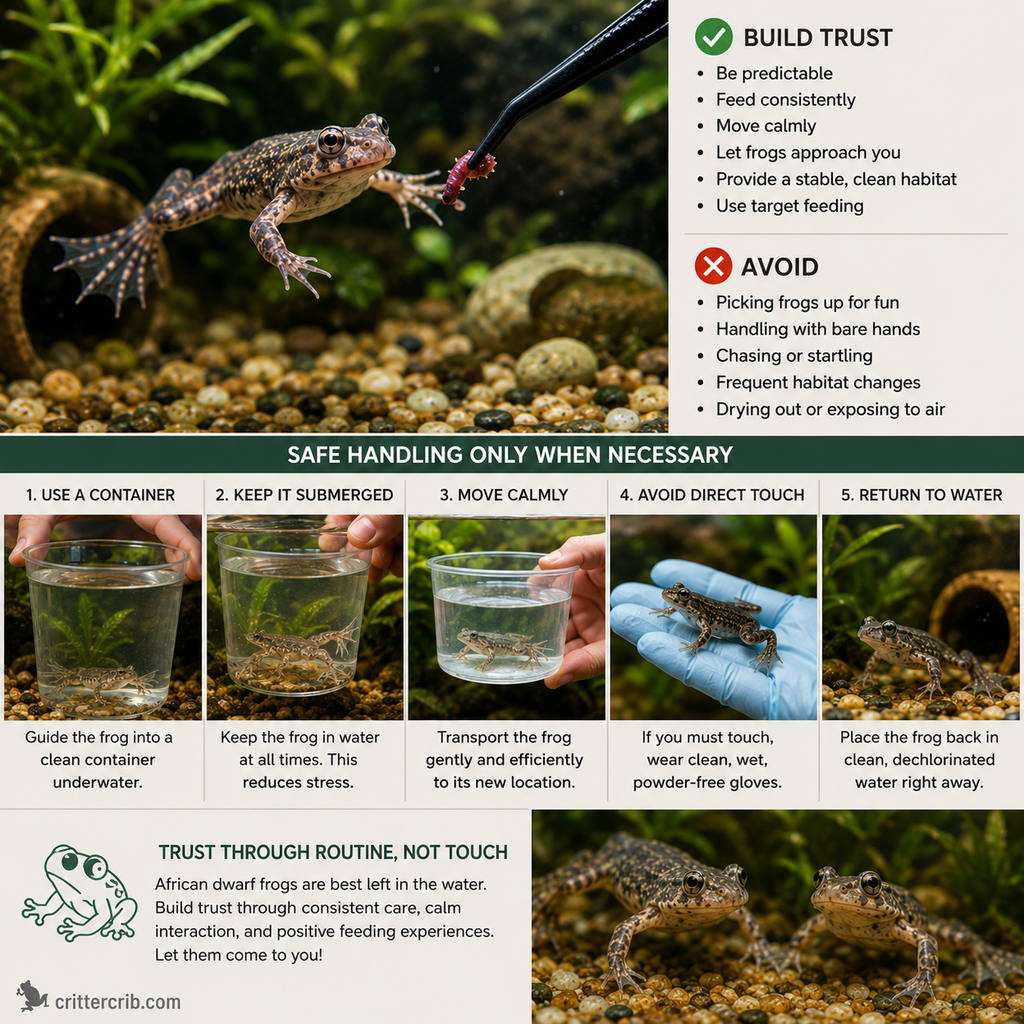
Sometimes a frog genuinely needs to be moved.
The safest approach is usually to avoid direct handling altogether.
Use a Small Container When Possible
For routine transfers, consider moving the frog using a clean aquarium-safe container.
You can:
- Place the container underwater.
- Gently guide the frog toward it.
- Allow water and frog to enter together.
- Keep the frog submerged during the transfer whenever practical.
- Move calmly and efficiently.
This reduces direct contact with the frog’s skin.
It can also be less stressful than trying to grab a slippery amphibian.
What About Using an Aquarium Net?
A soft aquarium net may sometimes be used, but it needs to be handled carefully.
African dwarf frogs have delicate limbs and toes that can potentially become caught or injured.
Don’t aggressively chase the frog around the tank with a net.
If a container transfer is practical, it may be the gentler option.
When a net is necessary, use an appropriately sized soft net and keep the transfer brief.
If You Must Touch an African Dwarf Frog
There may be situations where direct contact is unavoidable.
If you need to physically handle the frog, minimize contact and follow careful hygiene practices.
Clean, wet, powder-free disposable gloves are generally preferable to bare hands for necessary amphibian handling.
Make sure the gloves don’t contain lotions, powders, fragrances, or other potentially harmful additives.
Keep the frog wet and supported.
Never squeeze it.
Return it to appropriate water as quickly and calmly as possible.
Never Handle a Frog With Dry Hands
Dry skin can remove or damage the protective mucus coating on an amphibian’s body.
Human hands can also carry:
- Skin oils
- Soap residue
- Lotion
- Sanitizer
- Cleaning chemicals
Even hands that look clean may contain substances you can’t see.
Avoid bare-hand handling whenever possible.
Keep Handling Time Extremely Short
An African dwarf frog doesn’t benefit from being carried around outside its aquarium.
If handling is necessary, think in terms of accomplishing one specific task.
Move the frog.
Inspect what needs to be inspected.
Return it to the water.
Done.
Don’t extend the session in an attempt to make the frog “get used to” being handled.
Never Squeeze or Restrain the Frog Tightly
African dwarf frogs are small and delicate.
If direct handling becomes necessary, support the frog without applying unnecessary pressure.
Trying to hold a struggling frog tightly enough to prevent movement creates additional risk.
This is another reason container transfers are preferable whenever practical.
Keep the Frog Close to a Safe Surface
African dwarf frogs can suddenly kick or jump.
If you’re holding one above a hard floor, a fall could cause serious injury.
Keep any necessary transfer:
- Low
- Controlled
- Short
- Close to the aquarium or another safe surface
Better yet, use a container so dropping isn’t a concern.
Can African Dwarf Frogs Live Outside Water?
No.
African dwarf frogs are fully aquatic.
They breathe air at the surface, but that doesn’t make them terrestrial or semi-aquatic frogs.
Don’t place one on a table, towel, or your hand for recreational interaction.
If a frog accidentally escapes the aquarium, return it to appropriate water carefully and promptly.
Then figure out how it escaped.
Don’t Confuse African Dwarf Frogs With African Clawed Frogs
This is worth mentioning because the two are sometimes confused in pet stores.
African dwarf frogs and African clawed frogs are different animals.
African dwarf frogs remain relatively small and have webbing on their front feet.
African clawed frogs grow much larger and have different husbandry considerations.
Before following care advice, make sure you’ve correctly identified which frog you own.
Signs Your African Dwarf Frog Is Becoming Comfortable
A frog settling into its habitat may gradually display more normal activity.
Positive signs can include:
- Eating reliably
- Exploring the aquarium
- Resting normally
- Surfacing normally to breathe
- Using hides without remaining hidden constantly
- Approaching food readily
- Showing interest when feeding begins
Individual personalities vary.
One frog may boldly investigate everything.
Another may remain more cautious.
Don’t force the shy frog to behave like the bold one.
Signs Your Frog May Be Stressed
Behavioral changes deserve attention, particularly when they appear suddenly.
Possible warning signs include:
- Persistent frantic swimming
- Repeated escape attempts
- Refusing food for an unusual period
- Abnormal floating or difficulty staying submerged
- Unusual lethargy
- Skin changes
- Redness
- Bloating
- Difficulty swimming
- Trouble reaching the surface
Not every unusual behavior means the frog is sick.
Start by checking the environment.
Test:
- Ammonia
- Nitrite
- Nitrate
- Temperature
- Water quality
If symptoms are severe, persistent, or accompanied by physical changes, contact a veterinarian experienced with amphibians or exotic animals.
What Not to Do When Trying to Build Trust
Some interactions that seem harmless from a human perspective can be stressful for a frog.
Avoid:
- Picking the frog up for fun
- Petting it
- Hand-feeding with bare fingers
- Tapping on the glass
- Chasing it around the aquarium
- Frequently rearranging its habitat
- Removing it from the water for photos
- Forcing it to interact
- Repeatedly touching it so it “gets used to you”
Trust isn’t created through forced exposure.
For an African dwarf frog, predictable care is far more meaningful.
Can You Hand-Feed African Dwarf Frogs?
It’s better to use feeding tools rather than your fingers.
Blunt feeding tongs, pipettes, or similar aquarium-safe tools give you more control while keeping your hands out of the frog’s immediate feeding area.
Target feeding is especially useful if:
- The frog is young
- The frog is a slow eater
- Multiple frogs live together
- Fish compete for food
- You need to monitor how much an individual eats
A frog learning to approach feeding tongs can become one of the most enjoyable parts of keeping the species.
Do African Dwarf Frogs Bite?
African dwarf frogs have very small mouths and aren’t a meaningful bite risk to people.
They may investigate moving objects while feeding, but they aren’t animals you need to fear.
The bigger concern during interaction is protecting the frog from you—not protecting you from the frog.
Should You Put Your Hands in the Aquarium?
Sometimes aquarium maintenance requires putting your hands into the water.
When possible, use aquarium tools instead.
Useful equipment includes:
- Long aquarium tongs
- Siphon
- Algae scraper
- Turkey baster
- Planting tools
If you do need to put your hands into the aquarium, make sure they’re free from soap residue, lotion, sanitizer, perfume, household cleaners, and other contaminants.
Avoid putting your hands into the tank unnecessarily.
Wash Your Hands After Aquarium Maintenance
Good hygiene protects you as well.
Aquarium water and amphibians can carry microorganisms, including bacteria such as Salmonella.
After working in the aquarium:
- Wash your hands thoroughly with soap and water.
- Clean any equipment appropriately.
- Don’t touch your face while performing maintenance.
- Keep aquarium equipment away from food-preparation areas.
- Supervise children around the aquarium.
The important distinction is timing.
Soap is useful for washing your hands after aquarium contact, but you don’t want soap residue entering the frog’s water beforehand.
How Long Does It Take an African Dwarf Frog to Trust You?
There’s no fixed timeline.
Some frogs become comfortable with a feeding routine relatively quickly.
Others remain cautious for much longer.
Factors include:
- Individual temperament
- Previous conditions
- Tankmates
- Habitat quality
- Feeding routine
- Amount of cover
- Activity around the aquarium
Don’t measure success by whether the frog swims toward you.
A frog that’s eating well and behaving normally in a stable habitat is already doing what you want.
Can You Train an African Dwarf Frog?
“Train” may be a generous word, but they can learn predictable feeding routines.
You may be able to condition a frog to:
- Approach a feeding area
- Investigate feeding tongs
- Respond when food is introduced
- Eat from a designated dish
Consistency helps.
Use the same general location and feeding method.
Over time, the frogs may begin showing up before the food does.
A Simple Trust-Building Routine
You don’t need a complicated training program.
Try this:
Step 1: Establish a Consistent Feeding Area
Choose one part of the aquarium where food is usually offered.
Step 2: Use the Same Feeding Tool
A pipette or blunt feeding tongs can become a recognizable part of the routine.
Step 3: Move Slowly
Bring food toward the frog without chasing it.
Step 4: Let the Frog Approach
If it backs away, give it space.
Step 5: Reward the Approach With Food
Eventually, the tool itself may become associated with feeding.
Step 6: Keep Sessions Short
Once feeding is finished, remove uneaten food and leave the frogs alone.
This creates predictable interaction without unnecessary physical contact.
Frequently Asked Questions
Can I Hold My African Dwarf Frog?
You generally shouldn’t hold an African dwarf frog for recreation.
Direct handling should be reserved for situations where it’s genuinely necessary.
How Do I Pick Up an African Dwarf Frog?
Whenever possible, don’t pick it up directly.
Guide it into a small aquarium-safe container while underwater and transfer the frog with water.
If direct contact is unavoidable, use appropriate wet, powder-free gloves, support the frog gently, and keep the interaction extremely brief.
Do African Dwarf Frogs Like Being Petted?
There’s no reason to believe petting is beneficial to them.
Touching can damage their protective skin coating or expose them to contaminants.
Enjoy observing them instead.
Can African Dwarf Frogs Recognize Me?
They may learn routines and associate your presence or feeding tools with food.
Whether this should be interpreted as recognizing an individual person is less clear.
How Do I Get My African Dwarf Frog to Trust Me?
Provide a stable habitat, approach calmly, establish a predictable feeding routine, and allow the frog to interact on its own terms.
Don’t use handling as a trust-building exercise.
Why Does My African Dwarf Frog Swim Toward Me?
It may have learned that your presence predicts food.
It could also simply be investigating movement near the aquarium.
Either way, it’s a fun behavior to observe.
Can I Feed My African Dwarf Frog From My Hand?
Using feeding tongs, a pipette, or another suitable aquarium tool is safer and more practical than feeding directly from your fingers.
Should I Take My African Dwarf Frog Out When Cleaning the Tank?
Usually not for routine maintenance.
Leaving the frog in a stable aquarium during ordinary partial water changes and cleaning generally avoids unnecessary handling and transfer stress.
Work carefully around the animal.
Building Trust Without Touching
The best way to build trust with an African dwarf frog is almost the opposite of what people normally imagine when they hear the word “bonding.”
Don’t pick it up.
Don’t pet it.
Don’t repeatedly put your hands into the aquarium.
Instead, give the frog something it can actually appreciate: consistency.
Maintain clean water. Keep the temperature stable. Provide hiding places. Feed appropriately. Move calmly around the aquarium and establish a predictable feeding routine.
Over time, a cautious frog may begin swimming toward the front when you approach. It might eagerly follow the feeding tongs or wait near its usual feeding area.
Those small behaviors are much more meaningful than holding the animal.
And when handling really is necessary, keep it brief and gentle, preferably transferring the frog in a container of water rather than touching it directly.
African dwarf frogs don’t need physical affection to become fascinating pets.
Sometimes the best way to earn an animal’s trust is simply to respect the way it naturally wants to live.