

Tiger salamanders aren’t fussy-looking hunters. They spend much of their time tucked beneath substrate or hiding underground, then suddenly become very interested when something edible wanders within reach.
So, what do tiger salamanders eat?
Tiger salamanders are carnivores. In the wild, they eat a variety of small animals, including worms, insects, spiders, slugs, and other invertebrates. Larger individuals may occasionally consume small vertebrates when the opportunity arises.
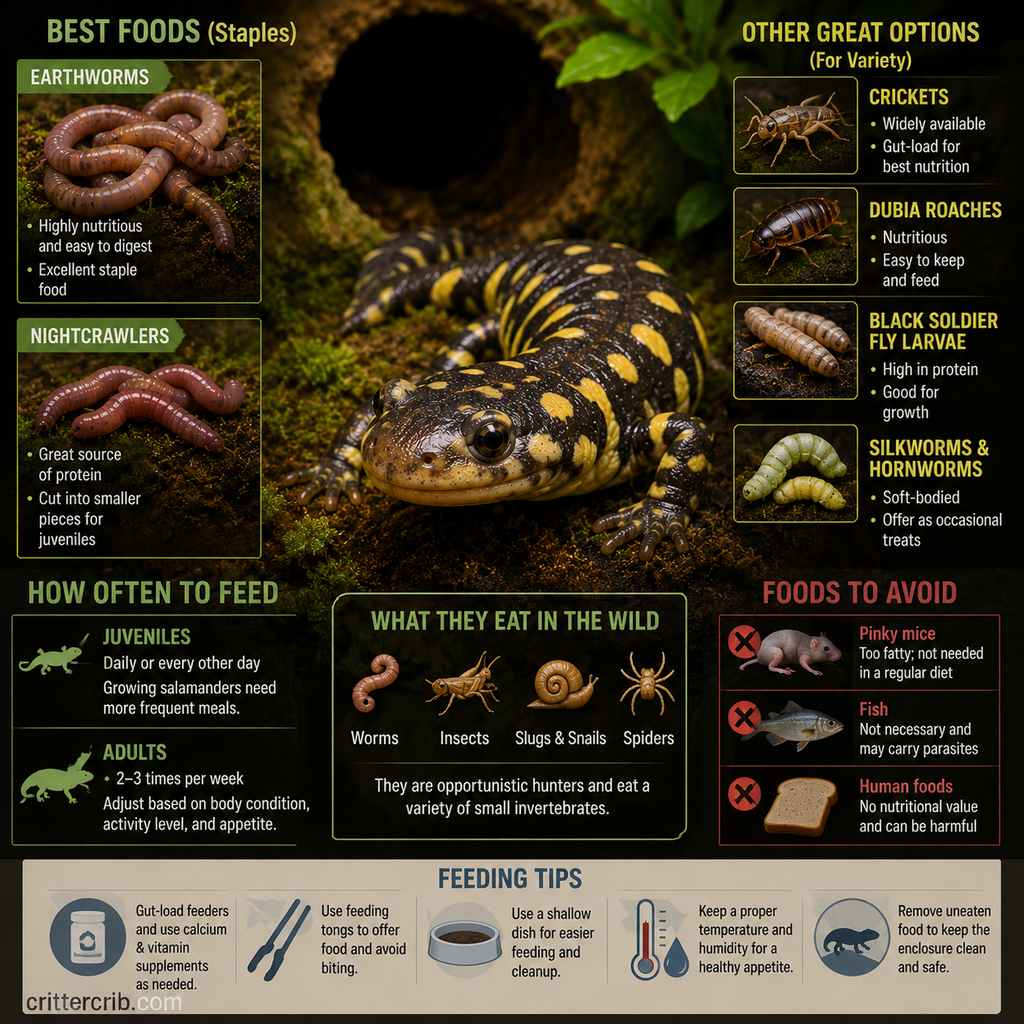
Pet tiger salamanders can thrive on a varied diet built around nutritious foods such as earthworms and nightcrawlers, supplemented with appropriately sized feeder insects like crickets, roaches, and other suitable invertebrates.
The key is offering the right foods in the right amounts. Tiger salamanders are enthusiastic eaters, and that appetite can make overfeeding surprisingly easy.
Here’s what to feed a tiger salamander, how often to offer food, which feeders make good staples, and which foods are better avoided.
What Do Tiger Salamanders Eat?
Adult tiger salamanders are opportunistic carnivores.
If something moves, fits into their mouth, and looks vaguely edible, there’s a good chance they’ll investigate it.
A captive tiger salamander’s diet may include:
- Earthworms
- Nightcrawlers
- Crickets
- Dubia roaches
- Black soldier fly larvae
- Silkworms
- Hornworms
- Other appropriately sized feeder invertebrates
Not everything on this list should necessarily be fed with the same frequency.
Some foods make excellent staples, while others are better for adding occasional variety.
For many captive tiger salamanders, earthworms and nightcrawlers are among the most useful foods to build a diet around.
What Do Tiger Salamanders Eat in the Wild?
Wild tiger salamanders spend much of their adult lives underground.
They’re fossorial animals, meaning they’re adapted for digging and living beneath the surface. They often occupy burrows and emerge to hunt when environmental conditions are favorable.
Their wild diet varies according to location, season, prey availability, and the size of the salamander.
Potential prey includes:
- Earthworms
- Insects
- Beetles
- Crickets
- Caterpillars
- Spiders
- Slugs
- Snails
- Other small invertebrates
Large tiger salamanders may also take small vertebrate prey when the opportunity arises.
They’re ambush predators rather than endurance hunters. A tiger salamander typically waits for prey to come within striking distance and then lunges forward.
This behavior is easy to observe in captivity.
Present a moving worm in front of a hungry tiger salamander and you’ll quickly see that the animal’s quiet appearance doesn’t mean it lacks a strong feeding response.
Best Foods for Pet Tiger Salamanders
Captive diets should provide adequate animal protein, appropriate minerals, and nutritional variety without excessive fat.
Several feeder options work particularly well.
Earthworms and Nightcrawlers
Earthworms are among the best foods for tiger salamanders.
They’re soft-bodied, nutritious, easy to digest, and closely resemble prey that a terrestrial salamander might naturally encounter.
Nightcrawlers are also inexpensive and widely available.
For smaller salamanders, cut large nightcrawlers into manageable pieces.
Don’t worry if the pieces continue moving. That movement can actually help stimulate the salamander’s feeding response.
Where Should You Get Earthworms?
Purchase worms from a reliable source where you can be reasonably confident they haven’t been exposed to harmful chemicals.
Avoid collecting worms from:
- Lawns treated with pesticides
- Golf courses
- Public parks
- Agricultural areas
- Gardens treated with chemicals
- Roadsides
- Other potentially contaminated locations
A worm from your backyard might seem more “natural,” but you don’t necessarily know what it has been exposed to.
Commercially raised worms from an appropriate source are a safer choice.
Crickets
Crickets are another commonly available food for tiger salamanders.
Their movement stimulates hunting behavior, and they’re easy to find at most reptile and exotic-pet stores.
However, crickets shouldn’t automatically become the only thing your salamander eats.
They benefit from proper gut-loading and may require appropriate supplementation.
Don’t release large numbers of crickets into the enclosure and leave them indefinitely. Uneaten crickets can hide in the habitat and may bother the salamander.
Offer manageable amounts and remove uneaten insects when necessary.
Dubia Roaches
Dubia roaches can provide another useful feeder option where they’re legal and available.
They have several practical advantages.
Compared with crickets, they generally:
- Make less noise
- Don’t jump
- Are relatively easy to contain
- Can be gut-loaded
- Come in different sizes
Choose roaches that are appropriately sized for your salamander.
As with other feeder insects, obtain them from a reputable source rather than collecting insects outdoors.
Black Soldier Fly Larvae
Black soldier fly larvae can add variety to a tiger salamander’s diet.
They’re widely sold as feeders for reptiles and amphibians and have a useful nutritional profile.
Because they’re available in different sizes, they can work for various life stages.
They don’t need to become the entire diet. Think of them as another tool for creating nutritional variety.
Silkworms
Silkworms are soft-bodied feeders that can be offered when available.
They’re relatively easy for salamanders to swallow and can provide variety beyond the usual worms and crickets.
The main drawback is availability.
Depending on where you live, silkworms may be more expensive or difficult to obtain than nightcrawlers or crickets.
That’s fine. A tiger salamander doesn’t need every feeder insect on the market to have a healthy diet.
Hornworms
Hornworms are large, soft-bodied caterpillars commonly sold as reptile feeders.
Many amphibians find them extremely appealing.
They contain a lot of moisture, which can make them useful as an occasional dietary addition.
However, they shouldn’t become the primary staple.
Hornworms also grow remarkably quickly. A small feeder can become far too large for your salamander in a surprisingly short time.
Always check size before feeding.
Can Tiger Salamanders Eat Mealworms?
Tiger salamanders can eat mealworms, but they’re generally better used as an occasional food rather than a primary staple.
Mealworms have a tougher exoskeleton than soft-bodied foods such as earthworms.
If you use them, choose an appropriate size and include them as part of a varied diet.
The same principle applies to many feeder insects: “can eat” and “best everyday food” aren’t necessarily the same thing.
Can Tiger Salamanders Eat Waxworms?
Waxworms are highly palatable to many amphibians, but they’re relatively fatty.
That makes them better suited to occasional use.
Think of waxworms as a treat rather than the foundation of your tiger salamander’s diet.
Regularly feeding large quantities of high-fat foods can contribute to excessive weight gain.
And tiger salamanders generally don’t need much encouragement in that department.
What Do Baby Tiger Salamanders Eat?
Tiger salamanders begin life very differently from adults.
Their larvae are aquatic and require aquatic prey.
Depending on their size and developmental stage, larval tiger salamanders may consume:
- Daphnia
- Brine shrimp
- Small aquatic invertebrates
- Blackworms
- Insect larvae
- Other appropriately sized aquatic prey
As larvae grow, they’re capable of taking increasingly larger foods.
After metamorphosis, their feeding needs shift toward terrestrial prey.
Young terrestrial tiger salamanders can be offered appropriately sized:
- Chopped earthworms
- Small crickets
- Small roaches
- Black soldier fly larvae
- Other suitable invertebrates
Food size matters considerably during this stage.
A tiny juvenile shouldn’t be expected to manage prey appropriate for a large adult.
How Often Should You Feed a Tiger Salamander?
Feeding frequency depends heavily on age.
Juvenile Tiger Salamanders
Growing juveniles generally require food more frequently than adults.
Depending on their size and condition, young salamanders may eat daily or every other day.
Watch the animal rather than following an inflexible schedule.
Growing salamanders have greater nutritional demands than mature adults.
Adult Tiger Salamanders
Adults generally need less frequent feeding.
Many healthy adult tiger salamanders can be fed approximately two or three times per week, with adjustments based on:
- Body condition
- Meal size
- Type of food
- Activity
- Temperature
- Individual appetite
- Health
An adult tiger salamander doesn’t need to eat simply because it looks enthusiastic when you open the enclosure.
These animals can be very convincing about being hungry.
How Much Should You Feed a Tiger Salamander?
There’s no perfect number of worms or insects that applies to every salamander.
A large adult and a recently metamorphosed juvenile have very different requirements.
Portion size also depends on the feeder.
One large nightcrawler is very different from one small cricket.
Instead of relying entirely on a fixed number, consider:
- Age
- Size
- Body condition
- Feeding frequency
- Prey size
- Nutritional value of the food
Observe your salamander over time.
If it’s becoming noticeably overweight, reduce portions or feeding frequency.
If it’s losing weight despite eating normally, review its diet, environment, and health.
What Size Food Should Tiger Salamanders Eat?
Prey should be appropriately sized for the salamander to capture and swallow safely.
Large earthworms can simply be cut into smaller sections.
For insects, avoid offering prey that’s obviously oversized or difficult to swallow.
Smaller pieces are particularly important for juveniles.
Tiger salamanders generally swallow prey whole rather than chewing it into manageable pieces.
When you’re unsure, offering a slightly smaller feeder is usually easier than asking the salamander to wrestle with something enormous.
Do Tiger Salamanders Need Calcium Supplements?
Supplementation depends partly on the foods being offered.
Earthworms have a useful nutritional profile, while many commonly used feeder insects may benefit from gut-loading and appropriate calcium supplementation.
Captive insect diets can be less nutritionally diverse than what an amphibian would encounter in nature.
Calcium is particularly important for maintaining healthy bones and normal physiological function.
What About Vitamins?
Vitamin supplementation may also be appropriate depending on the overall diet and husbandry.
However, more isn’t automatically better.
Excessive supplementation can create nutritional imbalances.
Rather than coating every meal in random powders, use an amphibian-appropriate supplementation routine based on the foods you’re providing.
If you’re uncertain, discuss your salamander’s diet with a veterinarian experienced in amphibians or exotic animals.
What Is Gut-Loading?
Gut-loading means feeding nutritious foods to feeder insects before they’re offered to your salamander.
Essentially, you’re improving the nutritional value of the prey.
Crickets and roaches can be gut-loaded before feeding.
Commercial gut-loading products are available, or appropriate fresh foods may be used depending on the feeder species.
Think of the insect as a nutritional delivery system.
What goes into the feeder affects what eventually goes into your salamander.
Should You Feed Tiger Salamanders Live Food?
Live invertebrates are useful because their movement naturally stimulates a tiger salamander’s hunting response.
Earthworms, crickets, roaches, and other live feeders encourage natural striking behavior.
However, live food needs to come from safe sources.
Wild-caught insects may have been exposed to:
- Pesticides
- Herbicides
- Fertilizers
- Parasites
- Environmental pollutants
Some wild invertebrates may also be toxic or otherwise inappropriate as food.
Using captive-raised feeders gives you much more control.
How to Feed a Tiger Salamander
Feeding doesn’t need to be complicated.
Some salamanders readily hunt insects moving through the enclosure. Others can be target-fed using feeding tongs.
A simple routine is:
- Choose appropriately sized prey.
- Prepare supplements if needed.
- Offer food near the salamander.
- Allow the animal to strike and swallow.
- Keep track of approximately how much it eats.
- Remove uneaten prey.
Blunt feeding tongs can be useful for offering earthworms.
Avoid repeatedly poking or chasing the salamander with food.
If it isn’t interested, give it some space.
Using a Feeding Dish
A shallow feeding dish can be helpful for certain foods.
It can:
- Keep prey away from substrate
- Make leftovers easier to remove
- Help you monitor how much was eaten
- Reduce mess
Not every feeder will stay inside a dish, of course.
Crickets rarely respect boundaries.
Still, feeding dishes can be useful for worms, larvae, and other less mobile foods.
Why Substrate Matters During Feeding
Tiger salamanders often lunge enthusiastically at food.
Sometimes they grab a mouthful of substrate along with dinner.
That’s one reason appropriate enclosure substrate is so important.
Avoid feeding directly over loose materials that could create an impaction risk if swallowed.
Suitable husbandry often involves soft, moisture-retaining substrate that supports burrowing while avoiding obviously dangerous materials such as gravel.
You can also use feeding tongs or a dish to reduce accidental substrate ingestion.
Foods Tiger Salamanders Should Avoid
A tiger salamander’s willingness to swallow something doesn’t make it healthy.
Avoid feeding:
- Processed human foods
- Seasoned meat
- Cooked table scraps
- Dairy products
- Dog or cat food as a regular diet
- Wild insects from chemically treated areas
- Fireflies
- Unknown wild-caught insects
- Oversized prey
- Foods that are spoiled or contaminated
Fireflies are particularly important to avoid because they contain defensive chemicals that can be toxic to predators.
When you’re unsure what an insect is, don’t feed it.
There are plenty of safe commercially raised feeders available.
Can Tiger Salamanders Eat Pinky Mice?
Large tiger salamanders are physically capable of eating small vertebrate prey.
That doesn’t mean pinky mice should become a routine food.
Mice are much richer and fattier than the invertebrate prey that should make up most of a captive tiger salamander’s diet.
There’s generally no nutritional reason to routinely feed rodents when earthworms and suitable feeder insects are readily available.
Stick with invertebrates for the normal diet.
Can Tiger Salamanders Eat Fish?
Larval tiger salamanders may naturally consume small aquatic animals, and large individuals can be opportunistic predators.
For terrestrial adults, however, feeder fish aren’t necessary.
Fish can introduce parasites or pathogens and don’t provide any clear advantage over safer, more appropriate staple foods.
Earthworms and captive-raised feeder invertebrates are easier to manage.
Can Tiger Salamanders Eat Slugs?
Wild tiger salamanders may consume slugs and snails.
For captive animals, wild-caught slugs are less appealing as a feeding option because you may not know what they’ve contacted or consumed.
Slugs can be exposed to:
- Pesticides
- Slug bait
- Fertilizers
- Parasites
- Other environmental contaminants
Unless you’re working with a known safe captive-raised food source, there are easier options.
Can Tiger Salamanders Overeat?
Yes.
Tiger salamanders are known for having strong appetites.
A healthy adult may continue responding to food even when it doesn’t need additional calories.
Overfeeding can contribute to obesity, which can negatively affect long-term health.
Signs You May Be Feeding Too Much
Watch for:
- Excessive weight gain
- A body becoming increasingly bulky
- Large meals being offered too frequently
- Frequent feeding of fatty foods
- Consistently uneaten food
Because tiger salamanders naturally have stocky bodies, body condition can be difficult for a new owner to judge.
Track changes over time rather than comparing your salamander to a single photograph online.
Why Isn’t My Tiger Salamander Eating?
A missed meal isn’t automatically a reason to panic.
Appetite can vary.
However, persistent food refusal deserves investigation.
Possible causes include:
- Temperature problems
- Inappropriate humidity
- Dehydration
- Stress
- Recent enclosure changes
- Overfeeding
- Impaction
- Illness
- Parasites
- Poor body condition
Start with the environment.
Check temperature, substrate moisture, water availability, cleanliness, and recent feeding history.
Tiger salamanders spend considerable time hidden, so reduced visible activity by itself isn’t necessarily concerning.
Persistent appetite loss combined with weight loss, weakness, skin abnormalities, swelling, unusual behavior, or other symptoms should be evaluated by a veterinarian experienced with amphibians.
Does Temperature Affect Appetite?
Yes.
Tiger salamanders are ectothermic, meaning their body temperature and metabolism are influenced by environmental temperature.
An enclosure that’s too warm or too cold can affect normal behavior and feeding.
Excessive heat is particularly concerning because salamanders generally prefer cool environments and can become stressed when kept too warm.
Don’t try to solve an environmental problem by simply offering more tempting food.
Monitor enclosure temperature with a reliable thermometer and provide species-appropriate conditions.
Hydration and Feeding
Tiger salamanders don’t drink from a bottle like a mammal.
Amphibians absorb water through their skin.
Maintaining appropriate substrate moisture and providing access to clean, amphibian-safe water are therefore essential parts of husbandry.
A dehydrated or stressed salamander may not behave or feed normally.
At the same time, the enclosure shouldn’t become a stagnant swamp.
The substrate should provide appropriate moisture while the enclosure maintains suitable ventilation.
Feeding is only one piece of the health puzzle.
Common Tiger Salamander Feeding Mistakes
Most feeding problems come from a handful of avoidable habits.
Common mistakes include:
- Feeding only crickets
- Feeding adults too frequently
- Offering too many fatty treats
- Using oversized prey
- Feeding wild-caught insects of unknown origin
- Forgetting to gut-load feeder insects
- Using supplements inconsistently or excessively
- Leaving uneaten insects in the enclosure
- Feeding over unsafe loose substrate
- Ignoring weight gain
- Assuming appetite loss is always caused by food preference
A varied, sensible routine is usually better than trying to make feeding complicated.
A Simple Tiger Salamander Feeding Routine
For many captive tiger salamanders, a straightforward approach works well.
Build the Diet Around Earthworms
Use earthworms or nightcrawlers as a nutritious staple when they’re available.
Cut them into appropriate pieces for smaller animals.
Add Feeder Variety
Rotate suitable feeders such as crickets, roaches, black soldier fly larvae, or silkworms.
Supplement Appropriately
Gut-load feeder insects and use amphibian-appropriate calcium and vitamin supplementation when necessary.
Feed According to Age
Juveniles generally need more frequent meals because they’re growing.
Adults can usually be fed less often.
Monitor Body Condition
Don’t allow an enthusiastic feeding response to convince you that your salamander needs unlimited food.
Remove Leftovers
Take out uneaten insects and food before they create problems in the enclosure.
This approach keeps feeding manageable while providing plenty of nutritional variety.
Frequently Asked Questions About Feeding Tiger Salamanders
What is the best food for tiger salamanders?
Earthworms and nightcrawlers are among the best staple foods for many captive tiger salamanders.
They’re nutritious, soft-bodied, easy to portion, and similar to prey terrestrial salamanders naturally consume.
Appropriate feeder insects can provide additional variety.
How often should I feed my tiger salamander?
Growing juveniles may need food daily or every other day depending on their size and development.
Healthy adults can generally be fed less frequently, often around two or three times per week.
Adjust the schedule according to meal size, body condition, temperature, health, and individual appetite.
Can tiger salamanders eat crickets every day?
Crickets can be part of a tiger salamander’s diet, but relying exclusively on one feeder isn’t ideal.
A varied diet built around nutritious foods such as earthworms, with properly gut-loaded and supplemented feeder insects, provides a better nutritional foundation.
Do tiger salamanders eat mealworms?
Yes, tiger salamanders can eat appropriately sized mealworms.
However, mealworms have a tougher exoskeleton than earthworms and are better treated as one part of a varied diet rather than the primary staple.
Can tiger salamanders eat nightcrawlers?
Yes. Nightcrawlers are one of the best foods for captive tiger salamanders.
Large worms can be cut into smaller sections for juveniles or smaller adults.
Do tiger salamanders need calcium powder?
Calcium supplementation may be appropriate when feeding insects with less favorable calcium-to-phosphorus ratios.
The exact supplementation routine depends on the overall diet.
Earthworms can provide a useful nutritional staple, while feeders such as crickets may benefit from gut-loading and supplementation.
Can I feed my tiger salamander insects from outside?
It’s generally safer to use captive-raised feeder insects.
Wild insects may have been exposed to pesticides or other contaminants, and some species may contain defensive chemicals that make them unsafe.
Never feed an insect you can’t confidently identify as safe.
Why is my tiger salamander always hungry?
Tiger salamanders can have very strong feeding responses.
An animal eagerly approaching food doesn’t necessarily need to be fed every time.
Follow an age-appropriate schedule and monitor body condition rather than using begging behavior as your only guide.
Final Thoughts
Tiger salamanders aren’t difficult animals to feed.
They’re carnivorous, opportunistic predators that naturally consume worms, insects, slugs, and other small animals. In captivity, earthworms and nightcrawlers make excellent staple foods for many tiger salamanders, while crickets, roaches, black soldier fly larvae, silkworms, and other suitable feeders can provide variety.
The bigger challenge is often resisting the urge to overfeed.
Tiger salamanders tend to have excellent appetites, and a frog-like face appearing from a burrow every time food arrives can be surprisingly persuasive.
Feed according to age and body condition rather than enthusiasm alone. Choose appropriately sized prey, use safe captive-raised feeders, gut-load and supplement insects when appropriate, and remove uneaten food.
Keep the rest of the enclosure in mind, too. Proper temperature, moisture, clean water, safe substrate, and low stress all influence appetite and digestion.
Get those basics right, and feeding your tiger salamander can be one of the simplest—and most entertaining—parts of keeping one.