
Tiger salamanders spend a surprising amount of their lives underground.
That single fact should shape almost everything about their habitat.
While it’s tempting to build an elaborate terrarium filled with decorative plants and tall branches, a tiger salamander is usually far more interested in what’s beneath its feet. Deep, moisture-retaining substrate, secure hiding places, moderate temperatures, and access to clean water matter much more than height or elaborate decorations.
A good tiger salamander habitat should feel cool, damp, sheltered, and easy to burrow into.
Fortunately, creating one isn’t especially complicated.
The key is setting up the enclosure around the salamander’s natural behavior rather than designing a habitat that simply looks attractive to us.
This guide covers everything you need to build a practical tiger salamander habitat from the ground up.
Tiger Salamander Habitat Requirements at a Glance
A basic adult tiger salamander setup should provide:
- A secure terrestrial enclosure
- Plenty of usable floor space
- Several inches of deep substrate
- Moisture-retaining soil suitable for burrowing
- A moisture gradient rather than uniformly wet conditions
- Multiple hiding places
- Leaf litter or other surface cover
- A shallow water dish
- Clean, treated water
- Moderate temperatures
- Adequate ventilation
- Low-intensity lighting
- Easy access for routine maintenance
Tiger salamanders are primarily terrestrial as adults.
Unless you’re caring for a larval or permanently aquatic individual, the enclosure shouldn’t resemble an aquarium filled with water.
Think woodland floor rather than pond.
Understanding the Natural Habitat of Tiger Salamanders
Tiger salamanders belong to the genus Ambystoma and occur across a broad portion of North America.
Exact habitat varies among species and populations, but adults are strongly associated with terrestrial environments where they can remain sheltered underground.
They may use:
- Loose soil
- Rodent burrows
- Leaf litter
- Grasslands
- Woodland edges
- Prairie environments
- Areas near seasonal wetlands
Adults often spend considerable time underground and emerge when conditions are favorable.
Breeding typically brings adults toward water, but that doesn’t mean an adult captive tiger salamander should live permanently in an aquatic enclosure.
Understanding that distinction prevents one of the biggest setup mistakes.
What Size Tank Does a Tiger Salamander Need?
Tiger salamanders don’t need a tall enclosure.
They need floor space.
For one adult, an enclosure with roughly the footprint of a 20-gallon-long aquarium or larger can serve as a practical starting point.
Larger adults benefit from additional room.
The exact gallon rating matters less than the actual dimensions.
A long, low enclosure is generally more useful than a tall aquarium with the same volume.
The habitat needs enough space for:
- Deep substrate
- At least two hiding areas
- A water dish
- Moist and slightly drier zones
- Normal movement
- Feeding
- Maintenance access
More usable floor space also makes it easier to create environmental choices.
Floor Space Matters More Than Height
Tiger salamanders aren’t tree frogs.
They don’t need tall branches, vines, or vertical climbing structures.
Most of the usable habitat is at ground level and underground.
When comparing two enclosures, prioritize the one with the larger footprint rather than extra height.
Some height is still useful because you’ll need room for deep substrate, hides, and a secure lid.
But once those needs are met, additional vertical space doesn’t provide nearly as much value as additional floor space.
Do Tiger Salamanders Need a Lid?
Yes.
Use a secure, well-fitting lid.
Tiger salamanders may look slow and chunky, but amphibians can be surprisingly capable escape artists.
A lid should:
- Prevent escape
- Allow adequate ventilation
- Fit securely
- Prevent other pets from entering the habitat
- Support lighting equipment safely if necessary
Don’t rely on the salamander’s apparent lack of interest in climbing.
An escaped amphibian can dehydrate quickly and may encounter household chemicals, pets, or other hazards.
How Deep Should Tiger Salamander Substrate Be?
Substrate depth is one of the most important parts of the habitat.
Tiger salamanders are enthusiastic burrowers.
Provide at least several inches of substrate, with around 4–6 inches or more being a useful goal for many adults when the enclosure allows it.
A larger habitat may allow even deeper substrate.
The salamander should be able to bury most or all of its body.
Shallow substrate prevents one of its most natural behaviors.
Best Substrate for Tiger Salamanders
The ideal substrate should:
- Hold moisture
- Remain loose enough for digging
- Avoid becoming compacted
- Be free of fertilizers and pesticides
- Be safe for amphibians
- Allow burrow-like retreats
Possible components include:
- Organic topsoil without fertilizers or pesticides
- Coconut fiber
- Appropriate amphibian-safe soil mixtures
- Leaf litter
A mixture often works better than relying on a single material.
For example, soil can provide a more natural digging texture while coconut fiber can contribute moisture retention.
Whatever you use, make sure it doesn’t contain chemical additives.
Substrates to Avoid
Avoid materials that are abrasive, excessively dry, difficult to burrow into, or risky if accidentally swallowed.
Generally avoid:
- Gravel
- Calcium sand
- Sharp stones
- Dry sand as the primary substrate
- Cedar
- Pine or other strongly aromatic wood products
- Fertilized potting soil
- Soil treated with pesticides
- Dyed decorative substrate
- Very dusty material
Gravel is particularly unnecessary in a terrestrial tiger salamander habitat.
It doesn’t support normal burrowing and may present ingestion risks.
Add Leaf Litter
A layer of leaf litter can make the enclosure more natural and functional.
Leaf litter provides:
- Surface cover
- Additional hiding opportunities
- Moist microclimates
- Natural texture
Use clean, appropriately sourced leaves that haven’t been exposed to pesticides or roadside contamination.
Commercial reptile and amphibian leaf litter is another option.
The salamander may rearrange it.
That’s fine.
A habitat doesn’t need to remain perfectly landscaped.
How Moist Should the Substrate Be?
Moist—but not soaked.
That’s the basic goal.
Tiger salamanders need access to moisture because amphibian skin is highly permeable.
However, turning the entire enclosure into saturated mud creates a different set of problems.
The substrate should generally feel damp enough to retain moisture while remaining aerated.
You don’t want water pooling throughout the bottom of the habitat.
Create a Moisture Gradient
Instead of trying to make every inch of substrate identical, create some variation.
One portion of the habitat can remain somewhat more moist while another is allowed to be slightly drier.
This gives the salamander choices.
A moisture gradient may include:
Moist Zone
Keep this area consistently damp without making it waterlogged.
Plants, moss used appropriately, or a hide can help retain moisture.
Moderate Zone
The substrate remains slightly moist but isn’t as damp as the wetter side.
Your salamander can move between areas depending on its preference.
Choice is one of the most useful features you can build into an amphibian habitat.
Do Tiger Salamanders Need High Humidity?
They need a moist environment, but humidity shouldn’t be managed by turning the terrarium into a sealed box.
Substrate moisture is particularly important because tiger salamanders spend so much time in direct contact with the ground.
Adequate ventilation should still be provided.
Rather than chasing one exact humidity number, monitor:
- Substrate moisture
- Ventilation
- Salamander behavior
- Temperature
- How quickly the habitat dries
If the enclosure dries rapidly, adjustments may be necessary.
If everything remains dripping wet and stagnant, you may have gone too far in the other direction.
Do You Need to Mist a Tiger Salamander Tank?
Misting can help maintain appropriate moisture, but the schedule depends on your enclosure.
Factors include:
- Substrate
- Ventilation
- Room humidity
- Temperature
- Season
- Enclosure design
You may need to mist lightly when the substrate begins drying.
Don’t automatically spray the enclosure heavily several times a day simply because the animal is an amphibian.
Monitor actual conditions and adjust.
Use amphibian-safe water.
What Water Is Safe for Tiger Salamanders?
Provide clean water free from harmful chlorine or chloramine.
If you’re using municipal tap water, an appropriate water conditioner is often necessary.
The water used for:
- The water dish
- Misting
- Moistening substrate
should be suitable for amphibians.
Don’t assume water that’s safe for you to drink is automatically ideal for a salamander’s permeable skin.
Tiger Salamander Water Dish Setup
Adult tiger salamanders don’t need a large swimming pool in their terrestrial enclosure.
Provide a shallow water dish that allows the animal to soak if it chooses.
The dish should be:
- Large enough for the salamander to enter
- Shallow enough for easy access
- Easy to climb out of
- Stable
- Easy to clean
Place it where it won’t constantly fill with substrate.
Although, realistically, your salamander may decide filling the water dish with dirt is an important daily project.
Change the water whenever it becomes dirty.
Do Tiger Salamanders Need a Pond or Aquatic Area?
Healthy terrestrial adults generally don’t require a large permanent aquatic section.
A shallow soaking dish is usually more practical.
Building a half-water, half-land enclosure can reduce valuable burrowing space and complicate maintenance.
There are exceptions depending on life stage and individual circumstances.
Larval tiger salamanders are aquatic and require completely different housing.
Make sure you’re designing the habitat for the animal’s current life stage.
Ideal Temperature for a Tiger Salamander Habitat
Tiger salamanders generally prefer moderate to cool temperatures.
For many commonly kept tiger salamanders, temperatures in approximately the mid-60s to low-70s°F provide a useful general range.
Exact requirements can vary by species and origin.
Avoid excessive heat.
Tiger salamanders aren’t tropical amphibians that need a hot terrarium.
Do Tiger Salamanders Need a Heat Lamp?
Usually not.
In many homes, normal room temperatures are already suitable.
A powerful heat lamp can make the enclosure:
- Too hot
- Too dry
- Difficult to regulate
If your home becomes unusually cold, determine the actual enclosure temperature before adding heat.
When supplemental heating is genuinely necessary, use a carefully controlled method appropriate for amphibians and regulate significant heat sources with a thermostat.
Don’t heat the enclosure simply because pet enclosures are expected to have a heat lamp.
Prevent Overheating
Heat is one of the environmental conditions worth watching carefully.
Keep the habitat away from:
- Direct sunlight
- Heating vents
- Radiators
- Space heaters
- Hot windows
- Heat-producing electronics
Monitor temperature during summer.
A room that stays comfortable throughout winter may become much warmer during a heat wave.
Do Tiger Salamanders Need UVB?
Tiger salamanders don’t need intense lighting.
They spend considerable time underground or beneath cover and are often most active during low-light periods.
Some keepers provide low-level UVB as part of a carefully designed husbandry setup.
If UVB is used, make sure the salamander has:
- Shaded areas
- Deep substrate
- Hides
- Opportunities to completely escape the light
Avoid intense lighting that heats or dries the enclosure.
Create a Normal Day-Night Cycle
Even if you don’t use specialized lighting, your salamander should experience a regular day-night cycle.
Ambient room light may be sufficient in some situations.
If you use enclosure lighting for plants or viewing, put it on a consistent schedule.
Avoid leaving bright lights on throughout the night.
Tiger salamanders are often more active during evening and nighttime hours.
Best Hides for Tiger Salamanders
Hiding places are essential.
Provide at least two secure retreats so the salamander can choose where it rests.
Good options include:
- Cork bark
- Half logs made from safe materials
- Amphibian-safe caves
- Curved pieces of bark
- Partially buried hides
Hides should feel secure without trapping the animal.
A huge open cave may look impressive but may not provide the same feeling of security as a snug, shaded retreat.
Partially Bury the Hides
One useful trick is to settle hides slightly into the substrate.
This creates a more natural transition between the hide and surrounding soil.
The salamander may then dig underneath or modify the entrance itself.
Don’t place heavy rocks or unstable structures where digging could cause them to collapse.
Remember: your salamander will excavate.
Design accordingly.
Can You Use Moss?
Moss can be used selectively to retain moisture and create natural-looking areas.
However, it shouldn’t necessarily cover the entire enclosure.
Loose pieces may be accidentally swallowed during feeding.
If you use moss, consider keeping feeding activities away from thick loose patches.
The main substrate should still allow normal digging.
Can You Use Live Plants?
Yes, although tiger salamanders aren’t particularly respectful gardeners.
Live plants can:
- Improve appearance
- Create cover
- Help maintain microclimates
- Make the enclosure feel more natural
Choose hardy, non-toxic plants that tolerate:
- Moderate light
- Moist soil
- Cool temperatures
- Being dug around
Expect some plants to be uprooted.
Your salamander has no appreciation for aquascaping awards.
Artificial Plants Can Work Too
Artificial plants can provide visual cover without requiring specialized lighting.
Choose products that are:
- Non-toxic
- Easy to clean
- Free of sharp edges
- Sturdy enough not to break apart
The goal is cover rather than decoration for decoration’s sake.
Does a Tiger Salamander Need Climbing Branches?
Not really.
Low pieces of wood can provide cover and structure, but tiger salamanders aren’t arboreal.
Avoid tall climbing arrangements that create fall risks.
Most of your enclosure budget and space should go toward the things the salamander actually uses:
- Substrate
- Hides
- Ground-level cover
- Water
- Floor space
Ventilation Matters
A humid amphibian habitat still needs fresh air exchange.
Poor ventilation combined with constantly saturated substrate can contribute to:
- Mold
- Stagnant conditions
- Persistent condensation
- Unpleasant odors
A ventilated lid or appropriately designed terrarium can provide airflow while the deep substrate retains moisture.
If the enclosure dries too quickly, adjust the balance rather than sealing it completely.
Where Should You Put the Enclosure?
Choose a stable location.
A good spot should be away from:
- Direct sunlight
- Heating vents
- Air-conditioning blasts
- Loud speakers
- Constant vibration
- Heavy foot traffic
- Household chemical sprays
Tiger salamanders don’t need to be isolated in complete silence.
They simply benefit from an environment without constant disturbance.
How to Set Up a Tiger Salamander Habitat Step by Step
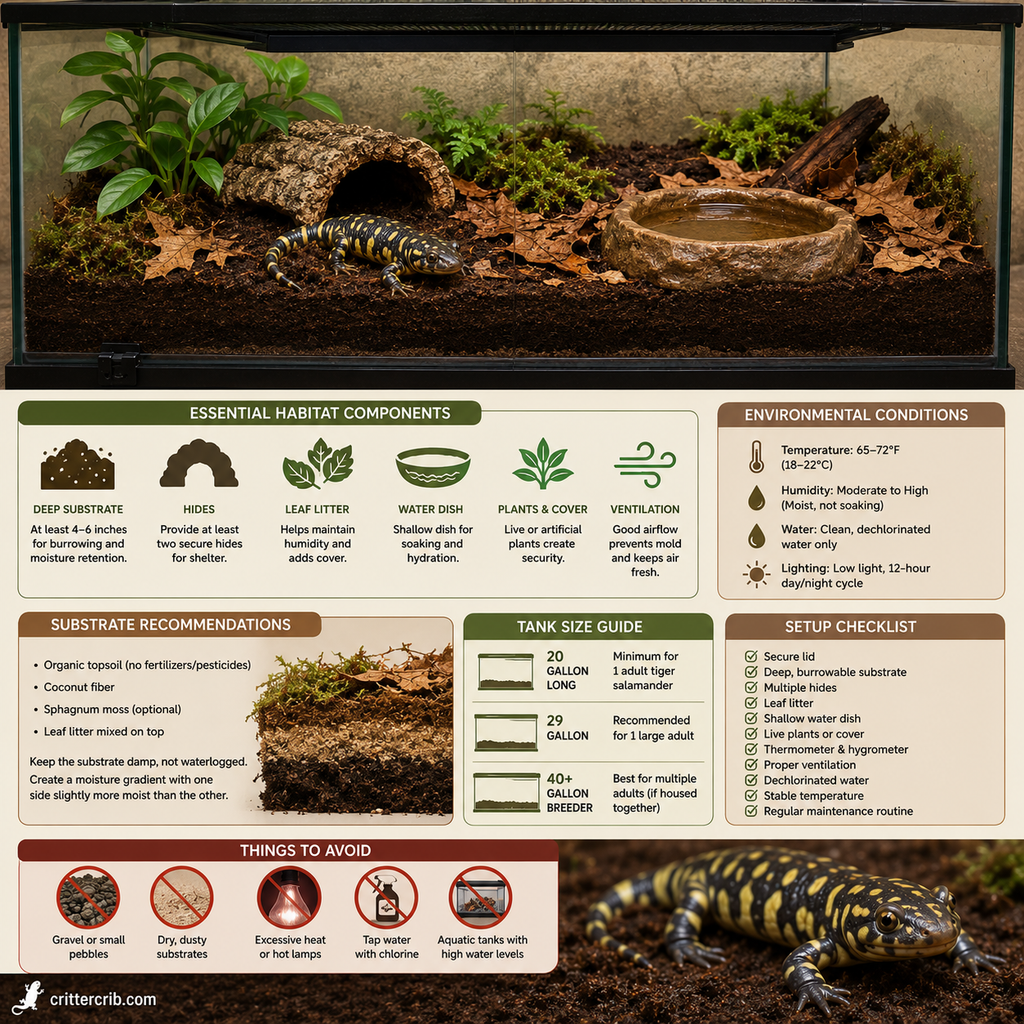
Once you have the supplies, assembling the habitat is straightforward.
Step 1: Clean the Empty Enclosure
Start with a clean enclosure.
Avoid leaving soap, disinfectant, or chemical residue behind.
If cleaning products are required for a used enclosure, make sure they’re appropriate for the situation and completely removed before the salamander is introduced.
Step 2: Add Deep Substrate
Add approximately 4–6 inches or more of appropriate burrowing substrate where practical.
Make it deep enough for the salamander to disappear beneath the surface.
Step 3: Establish Moisture
Moisten the substrate with amphibian-safe water.
Aim for damp soil rather than mud.
Create some variation between wetter and moderately moist areas.
Step 4: Add Hides
Provide at least two secure hiding locations.
Partially burying the edges can make them feel more natural.
Step 5: Add Leaf Litter and Cover
Spread leaf litter across portions of the surface.
Add plants, cork bark, or other safe ground-level cover.
Leave enough open space for feeding and observation.
Step 6: Add the Water Dish
Use a stable, shallow dish containing clean, treated water.
Make sure the salamander can easily enter and exit.
Step 7: Install Monitoring Equipment
Add a reliable thermometer.
If you’re monitoring humidity, position the sensor where it provides a representative reading rather than directly against wet substrate.
Step 8: Check the Temperature
Allow the habitat to sit long enough to see how temperature behaves throughout the day.
Check both daytime and nighttime conditions.
Step 9: Check Moisture and Ventilation
Make sure the substrate remains damp without becoming saturated.
Look for reasonable airflow.
Step 10: Add the Salamander
Once conditions are stable, introduce the salamander with as little handling as possible.
Then give it time to settle in.
Don’t immediately dig it up because it disappears.
Burrowing is exactly what you built the habitat for.
What a Good Tiger Salamander Setup Should Look Like
A functional enclosure doesn’t need to resemble a miniature rainforest.
You should see:
- Deep, loose substrate
- Leaf litter
- Multiple hides
- A shallow water dish
- Ground-level cover
- Plenty of usable floor space
- Appropriate ventilation
You may not see the salamander.
That’s okay.
If your habitat is working properly, the animal has enough substrate and cover to disappear when it wants.
Feeding Area Setup
Tiger salamanders are enthusiastic predators.
Feeding in a controlled area can make it easier to:
- Monitor food intake
- Remove uneaten prey
- Reduce accidental substrate ingestion
Some keepers offer food with blunt feeding tongs.
Appropriate foods may include:
- Earthworms
- Nightcrawlers
- Crickets
- Appropriate captive-raised roaches where legal
- Other suitable invertebrates
Earthworms can make an excellent staple for many tiger salamanders.
Avoid releasing large numbers of feeder insects into the enclosure and forgetting about them.
Uneaten insects may stress or potentially injure the salamander.
How Often Should You Clean the Habitat?
Routine cleaning should focus on removing waste rather than repeatedly replacing everything.
Regular maintenance may include:
- Removing feces
- Removing uneaten food
- Cleaning the water dish
- Replacing dirty water
- Removing moldy material
- Checking substrate moisture
Substrate can be partially or fully replaced when it becomes contaminated, breaks down excessively, develops persistent problems, or otherwise needs renewal.
You don’t need to completely sterilize a healthy enclosure every week.
Can You Make a Bioactive Tiger Salamander Habitat?
Yes.
A bioactive enclosure may include:
- Appropriate soil layers
- Leaf litter
- Live plants
- Springtails
- Suitable isopods
A cleanup crew can help process some organic waste.
However, bioactive doesn’t mean maintenance-free.
You still need to:
- Remove significant waste
- Maintain appropriate moisture
- Monitor the salamander
- Clean the water dish
- Remove uneaten food
- Maintain plants
- Watch for mold or pest problems
Build a bioactive setup because you understand how the system works, not because you want to avoid cleaning.
Should Tiger Salamanders Be Housed Together?
Individual housing is generally the simplest and safest choice.
Tiger salamanders don’t require another salamander for companionship.
Housing multiple animals together introduces concerns such as:
- Competition for food
- Biting
- Size differences
- Stress
- Disease transmission
- Difficulty monitoring individual appetite and waste
One properly sized habitat per salamander makes care easier to manage.
Don’t Mix Tiger Salamanders With Other Species
Avoid mixed-species enclosures.
Other amphibians, reptiles, fish, or invertebrates aren’t needed as companions.
Different species may have:
- Different environmental requirements
- Different pathogens
- Different defensive chemicals
- Predator-prey relationships
A tiger salamander habitat should be designed specifically for the tiger salamander.
Common Tiger Salamander Habitat Setup Mistakes
Using Too Little Substrate
A thin layer of soil prevents normal burrowing.
Give the salamander depth.
Keeping Everything Soaked
Moist doesn’t mean flooded.
Provide damp substrate without creating permanent mud.
Making the Tank Too Hot
Tiger salamanders generally prefer moderate to cool temperatures.
Don’t automatically add tropical heating equipment.
Choosing a Tall Tank Instead of Floor Space
These are terrestrial burrowers.
Prioritize footprint.
Providing No Hides
Even with deep substrate, surface hides give the salamander additional options.
Using Untreated Tap Water
Use amphibian-safe water for soaking and misting.
Adding Strong Lighting
Bright, hot lighting can make the habitat uncomfortable.
Provide shade and a normal day-night cycle.
Using Gravel
Gravel doesn’t support normal digging and may create unnecessary ingestion risks.
Handling the Salamander Frequently
The habitat should allow you to enjoy the animal without repeatedly touching it.
Amphibian skin is delicate and permeable.
Tiger Salamander Habitat Supply Checklist
Before bringing your salamander home, gather:
- Terrestrial enclosure
- Secure ventilated lid
- Amphibian-safe substrate
- Organic topsoil if used
- Coconut fiber if used
- Leaf litter
- At least two hides
- Shallow water dish
- Water conditioner
- Spray bottle or mister
- Digital thermometer
- Hygrometer if desired
- Cork bark
- Safe plants or artificial cover
- Feeding tongs
- Appropriate feeder animals
- Cleaning supplies reserved for the enclosure
Setting everything up before the salamander arrives is much easier than trying to adjust the habitat around an animal already living in it.
Frequently Asked Questions
What Size Tank Does a Tiger Salamander Need?
For one adult, an enclosure with roughly the footprint of a 20-gallon-long tank or larger provides a useful starting point.
Prioritize floor space rather than height.
How Deep Should Tiger Salamander Substrate Be?
Around 4–6 inches or more is useful for many adults when enclosure dimensions allow.
The salamander should be able to burrow deeply enough to conceal itself.
What Is the Best Substrate for Tiger Salamanders?
An amphibian-safe moisture-retaining soil mixture works well.
Organic topsoil without fertilizer or pesticides, coconut fiber, and leaf litter are commonly used components.
Do Tiger Salamanders Need Water?
Yes.
Provide a shallow dish of clean, amphibian-safe water for soaking.
Terrestrial adults generally don’t need a large permanent swimming area.
Do Tiger Salamanders Need a Heat Lamp?
Usually not if normal room temperatures already provide appropriate conditions.
Tiger salamanders generally prefer moderate to cool temperatures and can be sensitive to excessive heat.
Do Tiger Salamanders Need High Humidity?
They require adequate moisture, particularly in their substrate, but the habitat should also have good ventilation.
Avoid both excessively dry substrate and constantly saturated, stagnant conditions.
Do Tiger Salamanders Need UVB?
Intense UVB isn’t appropriate for an animal that naturally spends considerable time underground.
Some keepers use carefully selected low-level UVB, but the salamander should always have access to deep shade and hides.
Do Tiger Salamanders Need Plants?
No, but appropriate live or artificial plants can provide useful cover and improve the enclosure.
Why Is My Tiger Salamander Always Buried?
Because it’s a tiger salamander.
Burrowing is one of its most characteristic natural behaviors.
As long as the animal is otherwise healthy and the habitat conditions are appropriate, spending significant time underground isn’t necessarily concerning.
Can Two Tiger Salamanders Live Together?
Individual housing is generally safer and makes feeding, health monitoring, and habitat management easier.
Tiger salamanders don’t need companions.
Building a Habitat Around the Salamander
The best tiger salamander habitat isn’t necessarily the one that looks most impressive in photographs.
It’s the one that lets the salamander behave like a salamander.
Give it deep soil to dig into. Keep that substrate damp without turning it into a swamp. Provide secure hiding places, leaf litter, clean water, moderate temperatures, and plenty of usable ground space.
Then let the animal decide where it wants to be.
Some evenings you may see it sitting near the entrance of a burrow waiting for food. Other days you may barely see it at all.
That’s part of keeping a fossorial amphibian.
Once the habitat is established, your main job becomes maintaining stable conditions rather than constantly redesigning the enclosure.
A cool, moist, secure terrestrial habitat with deep substrate may not be the most complicated setup in the amphibian world.
But for a tiger salamander, it’s exactly the kind of home that allows its natural behavior to shine.