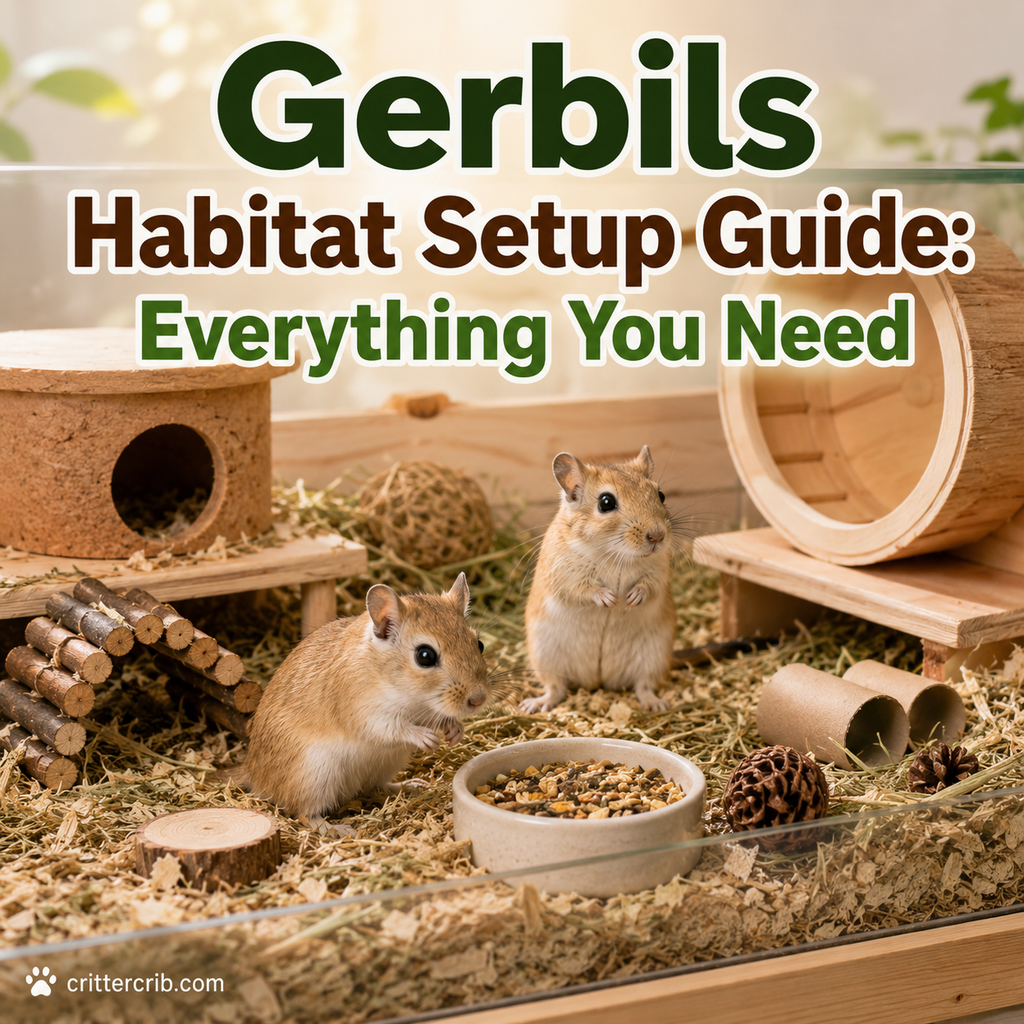
Bringing home gerbils is exciting, but it’s much easier when their habitat is completely set up before they arrive.
Gerbils may be tiny, yet they need more than a small cage, food bowl, and water bottle. They’re active animals with strong instincts to dig, tunnel, chew, forage, and build nests. A good setup needs to support all of those behaviors while giving them somewhere safe and comfortable to live.
The shopping list can seem surprisingly long at first. Fortunately, many gerbil supplies are simple, inexpensive, and don’t need constant replacement.
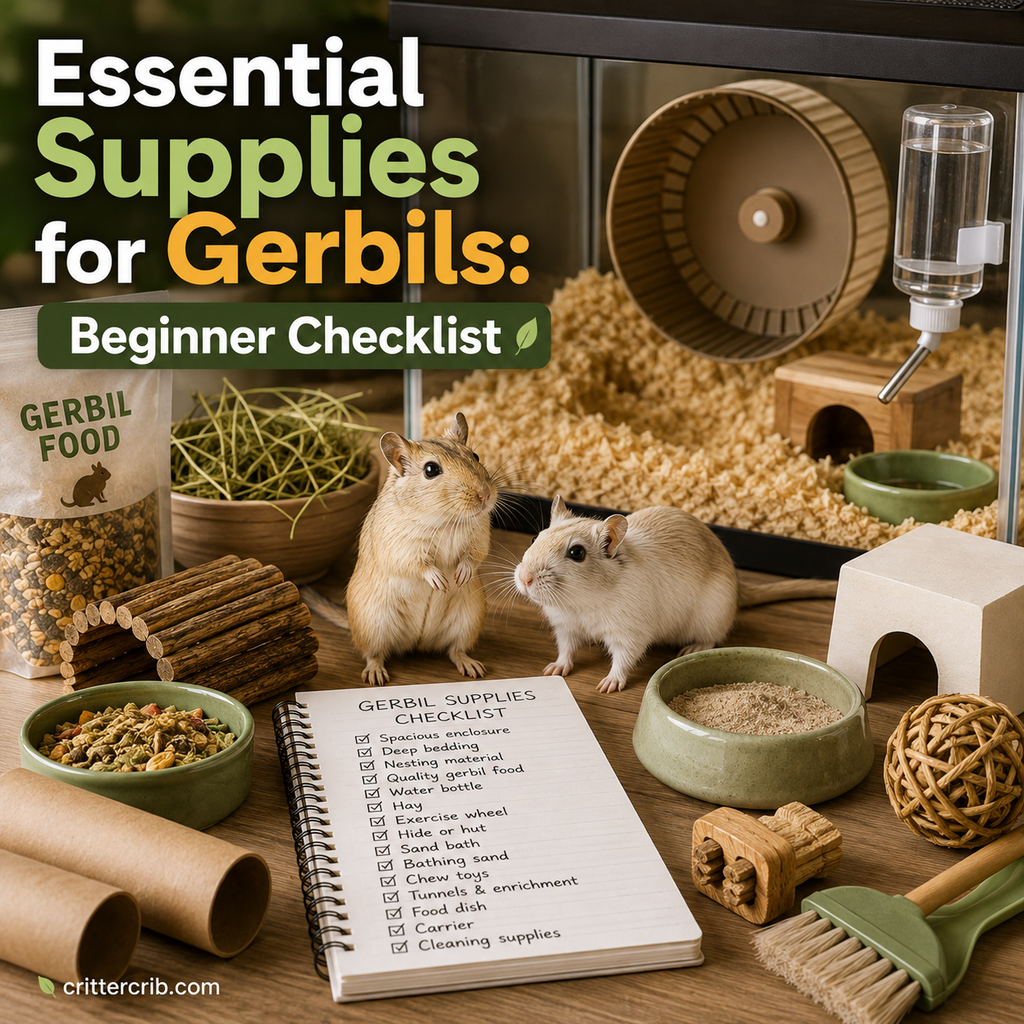
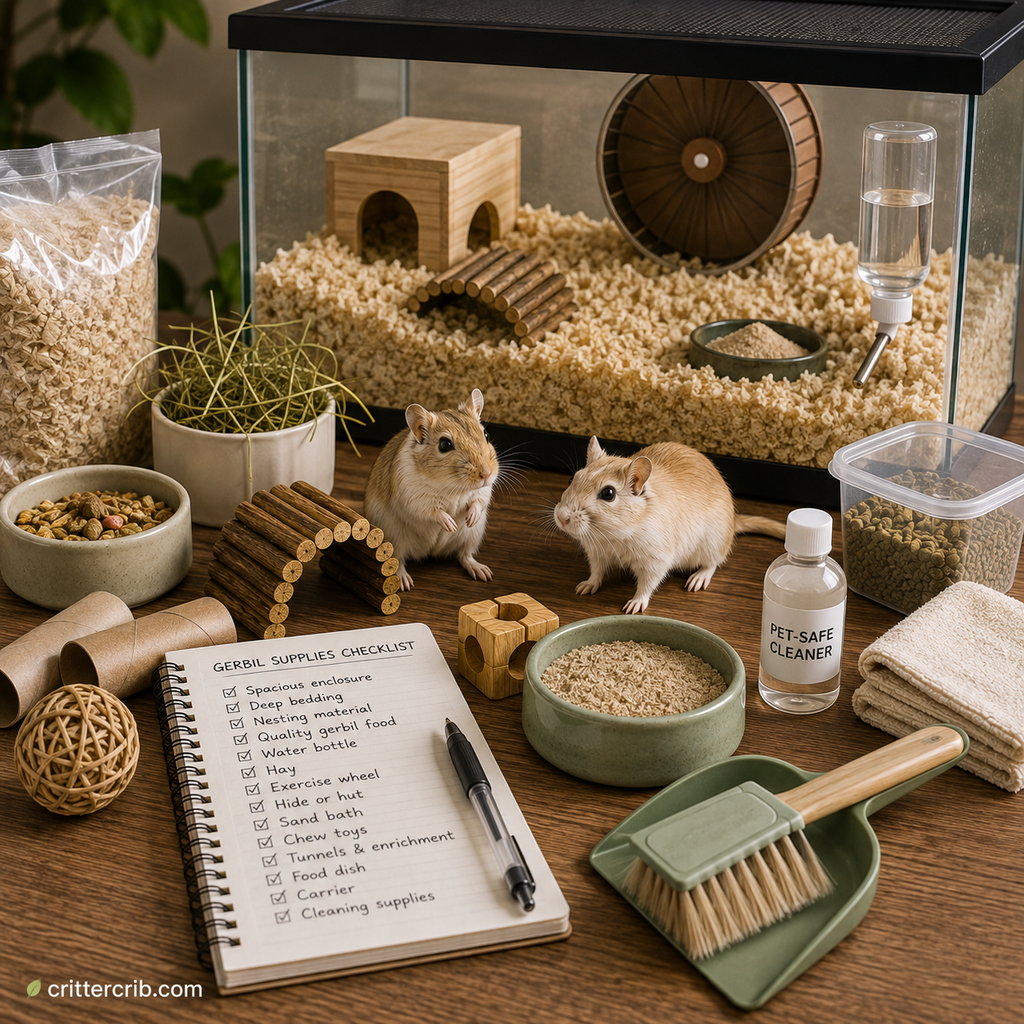
This beginner gerbil checklist covers the essentials you’ll need before bringing your pets home, including the enclosure, bedding, food, water, hides, exercise wheel, sand bath, chewable materials, enrichment, cleaning supplies, and a few optional extras worth considering.
Gerbil Supplies Checklist at a Glance
If you’re preparing for your first gerbils, start with these essentials:
- Spacious, secure enclosure
- Deep, safe bedding
- Nesting material
- Quality gerbil food
- Fresh water and water bottle
- Hay
- Appropriate exercise wheel
- Hide or nesting area
- Sand bath
- Gerbil-safe bathing sand
- Chewable materials
- Tunnels and enrichment
- Food dish, if using one
- Carrier
- Basic cleaning supplies
You don’t need to buy every colorful accessory marketed for gerbils.
Focus first on space, bedding, nutrition, exercise, chewing, and enrichment. You can always expand the habitat later once you learn what your gerbils actually enjoy.
1. A Spacious Gerbil Enclosure
The enclosure should be at the top of your shopping list.
Gerbils spend most of their lives inside their habitat, so choosing the right one matters considerably more than picking cute accessories.
Gerbils need room for:
- Deep bedding
- Burrowing
- Tunnels
- Nesting
- Food and water
- Exercise
- Chewing
- Foraging
- A sand bath
- Exploration
A tall wire cage with a thin layer of bedding isn’t particularly useful for an animal whose natural instinct is to dig.
Tank-Style Gerbil Habitats
Large glass tanks or similarly designed enclosures are popular choices because they can hold a substantial amount of bedding without sending it all over your floor.
A tank can also provide good visibility.
You’ll probably spend more time than expected watching your gerbils construct tunnels.
However, ventilation remains important. A secure, well-ventilated lid or topper can allow airflow while preventing escapes.
Make Sure the Enclosure Is Secure
Gerbils are small, curious, and persistent.
Check the habitat for:
- Gaps
- Loose lids
- Weak latches
- Escape routes
- Unsafe sharp edges
- Materials that can easily be chewed through
Don’t underestimate their ability to reach an opening.
A pile of bedding can quickly become a staircase.
2. Plenty of Deep Bedding
Bedding is one of the most important gerbil supplies you’ll buy.
Gerbils are enthusiastic burrowers. Given enough suitable substrate, they’ll create networks of tunnels, sleeping chambers, and storage areas.
A thin layer of bedding doesn’t provide much opportunity for this behavior.
Give them enough depth to actually dig.
Good Gerbil Bedding
Suitable options may include:
- Unscented paper-based bedding
- Aspen bedding
- Shredded plain paper
- Appropriate hay mixed into bedding
Combining different safe materials can help tunnels hold their shape.
Hay, for example, can add structure when mixed through paper bedding.
Bedding to Avoid
Avoid materials that are excessively dusty, strongly scented, or unsafe when chewed.
Fluffy cotton-like nesting material is also unnecessary. Stringy fibers can potentially become wrapped around small feet or limbs.
Simple, safe materials are usually better.
3. Safe Nesting Material
Gerbils will usually create their own sleeping area somewhere within their burrow system.
Give them material they can carry, shred, and arrange.
Simple options include:
- Unscented toilet tissue
- Plain paper
- Safe paper-based nesting material
You don’t need to construct the nest for them.
That’s their job.
Drop some suitable nesting material into the enclosure and let your gerbils decide where it belongs.
Don’t be surprised if your carefully chosen wooden house gets ignored in favor of a bedroom they’ve excavated underneath it.
4. Quality Gerbil Food
Choose a nutritionally balanced food formulated for gerbils.
Your gerbils’ staple diet should provide appropriate nutrition rather than relying heavily on treats or whichever seeds they happen to like most.
When shopping, look for food intended specifically for gerbils or appropriately formulated for their nutritional requirements.
Pellets and Food Mixes
Gerbil foods may come as:
- Pellets
- Blocks
- Seed and grain mixtures
- Formulas combining several ingredients
One potential issue with loose mixes is selective feeding.
A gerbil may enthusiastically pick out favorite ingredients while leaving the less exciting pieces behind.
Monitor what your gerbils actually eat rather than assuming an empty-looking bowl means they’ve consumed everything evenly.
Fresh Foods
Small portions of suitable fresh foods can sometimes provide variety, but they shouldn’t replace a balanced staple diet.
Introduce unfamiliar foods gradually.
Because gerbils originate from relatively dry environments, don’t overwhelm their diet with large portions of watery produce.
Remove uneaten fresh foods before they spoil inside a food cache.
5. A Water Bottle
Fresh drinking water should always be available.
A water bottle is often practical for gerbils because an open bowl can quickly become filled with bedding.
Choose a bottle that:
- Attaches securely
- Doesn’t leak excessively
- Is easy to clean
- Has an accessible drinking nozzle
- Holds enough water for your gerbils
Check it every day.
Test the Bottle, Don’t Just Look at It
A bottle can appear full while the nozzle is blocked.
Make a habit of checking that water actually flows.
Also watch for leaks.
A dripping bottle can create a damp patch inside an enclosure that should otherwise remain relatively dry.
6. A Food Bowl
A small food bowl can be useful, although it isn’t always necessary for every meal.
Choose something sturdy and difficult to tip.
A small ceramic dish is often more stable than lightweight plastic.
However, feeding everything from a bowl misses an opportunity for enrichment.
Try Scatter Feeding
You can distribute some of your gerbils’ regular dry food around clean areas of the habitat.
This encourages them to search for food rather than simply sitting beside a bowl.
Scatter feeding turns an everyday necessity into a simple foraging activity.
You can still use a bowl when it makes feeding easier.
The two methods don’t have to be mutually exclusive.
7. Hay
Hay can serve several purposes in a gerbil habitat.
Depending on the type and how it’s provided, gerbils may:
- Chew it
- Shred it
- Carry it
- Use it in nests
- Incorporate it into tunnels
Hay mixed with other bedding materials can also help give burrows more structure.
Make sure the hay is clean, dry, and free from mold.
Discard any hay that becomes wet or contaminated.
8. An Appropriately Sized Exercise Wheel
Gerbils are active animals, and a good exercise wheel provides another outlet for movement.
Choose a wheel large enough for your gerbil to run without its back being forced into an exaggerated curve.
The running surface should be solid.
Avoid wheels with widely spaced bars or mesh surfaces that could create problems for small feet.
Look for a Chew-Resistant Wheel
This is where gerbil ownership becomes interesting.
Gerbils chew.
A lot.
Lightweight plastic accessories can quickly become the target of enthusiastic dental remodeling.
When possible, choose durable, gerbil-appropriate materials and regularly inspect the wheel for damage.
The wheel should also remain stable during use.
9. A Hide or Nesting House
Even when gerbils create underground nests, providing a safe hide gives them another sheltered area to use.
Suitable hides may include:
- Wooden houses
- Cork tunnels
- Ceramic hides
- Cardboard boxes
- Other gerbil-safe shelters
Wood and cardboard have an additional benefit.
They’re chewable.
Just understand that a beautiful wooden house may eventually become a slightly smaller wooden house.
That’s normal.
10. A Sand Bath
Gerbils shouldn’t need routine water baths.
Instead, provide an appropriate sand bath that allows them to roll and groom their coats.
You’ll need:
- A sturdy bath container
- Suitable gerbil bathing sand
Choose a container that’s large enough for a gerbil to turn and roll comfortably.
It should also be stable enough that energetic digging doesn’t immediately flip it over.
Sand, Not Dust
Pay attention to what you’re buying.
Very fine, dusty bathing products can create unnecessary airborne particles.
Look for a suitable bathing sand recommended for gerbils rather than assuming every small-animal bath product is interchangeable.
Keeping the Sand Bath Clean
Gerbils may use their sand bath for more than bathing.
Some decide it’s also a convenient bathroom.
Scoop out droppings and debris regularly and replace the sand when it becomes dirty.
This can actually make spot cleaning easier if your gerbils consistently use the same area.
11. Plenty of Things to Chew
If you remember only one thing about gerbil enrichment, remember this:
Gerbils need things to destroy.
Chewing is normal and necessary behavior.
Their teeth continue growing, and gnawing on appropriate materials provides both physical activity and enrichment.
Provide safe chewable items regularly.
Simple Gerbil Chews
You don’t need to spend much money.
Gerbils often enjoy:
- Plain cardboard
- Toilet paper tubes
- Paper towel tubes
- Safe wooden chews
- Cardboard boxes
- Suitable untreated wood
- Hay
A toilet paper tube may last five minutes.
That’s fine.
The destruction is the activity.
Be Careful With Household Cardboard
Plain cardboard can make excellent enrichment, but inspect it first.
Avoid giving your gerbils cardboard contaminated with:
- Food residue
- Cleaning chemicals
- Grease
- Strong adhesives
- Plastic coatings
- Staples
- Tape
Remove labels, plastic windows, and other potentially unsafe components.
12. Tunnels and Burrowing Enrichment
Gerbils are natural tunnel builders, so you don’t necessarily need to create an elaborate artificial tunnel network.
Deep bedding does much of the work.
Still, tunnels can make excellent additions.
Consider:
- Cork tunnels
- Cardboard tubes
- Wooden tunnels
- Buried cardboard structures
Partially burying a tube can provide a starting point for a burrow.
Your gerbils will probably take over from there.
13. Foraging Toys and Enrichment
Enrichment doesn’t have to mean buying a different toy every week.
The goal is to encourage natural behavior.
Simple enrichment ideas include:
- Scatter feeding
- Food hidden inside cardboard
- Hay stuffed into tubes
- Cardboard boxes with entrances
- Buried treats
- Safe chewable branches
- New digging areas
Rotate some items occasionally while leaving enough familiar features that the habitat doesn’t constantly feel brand new.
14. A Secure Pet Carrier
A carrier is easy to forget until you suddenly need one.
Buy it before bringing your gerbils home.
You’ll need a secure carrier for:
- The trip home
- Veterinary appointments
- Emergencies
- Temporary relocation during cleaning
- Moving
Choose a carrier that’s secure, well ventilated, and appropriate for small rodents.
Check the door and ventilation openings carefully.
Gerbils can fit through surprisingly small spaces.
Add appropriate bedding and hiding material during transport.
15. Basic Cleaning Supplies
You don’t need a cabinet full of specialized products.
A simple cleaning kit is enough.
Useful supplies include:
- Small dustpan and brush
- Paper towels
- Clean reusable cloths
- Replacement bedding
- Pet-safe cleaning product
- Bottle brush
- Trash bags
Keep these supplies somewhere convenient.
Quick spot cleaning is much easier when you don’t have to search the house for everything first.
Avoid Strongly Scented Products
Gerbil habitats don’t need to smell like artificial flowers.
Avoid unnecessarily strong fragrances, aerosols, and harsh chemical residues.
Cleaning should remove dirt and contamination rather than cover odors with perfume.
Always allow cleaned items to dry properly before returning them to the enclosure.
16. A Small Scoop
This isn’t absolutely essential, but you’ll probably appreciate having one.
A scoop makes it easier to:
- Remove dirty sand
- Remove wet bedding
- Transfer clean bedding
- Spot-clean corners
- Remove contaminated food
Keep a scoop specifically for your gerbil habitat rather than borrowing one from the kitchen.
17. Spare Bedding and Food
Don’t wait until you’ve completely run out before buying more.
Keep enough bedding and staple food available to get through at least your next normal cleaning and feeding period.
Running out of bedding halfway through a deep clean is particularly inconvenient.
Check supplies periodically and restock before you’re down to the last handful.
18. A Safe Play Area
A separate playpen isn’t mandatory if the permanent enclosure provides plenty of space and enrichment, but supervised exploration can add variety.
If you create an outside play area, it needs to be completely gerbil-proof.
Remove access to:
- Electrical cords
- Small gaps
- Toxic plants
- Other pets
- Unsafe furniture
- Cleaning products
- Objects that could be swallowed
- Anything dangerous to chew
Gerbils move quickly.
Don’t assume you’ll be able to catch one easily if it discovers a gap behind a cabinet.
19. A Small-Animal First-Aid Kit
A basic pet-care kit can be useful, but it shouldn’t become a substitute for veterinary care.
Useful non-medication items might include:
- Small clean towels
- Gauze
- Carrier
- Veterinary contact information
- Emergency clinic information
Don’t stock medications with the intention of treating illnesses yourself unless specifically directed by a veterinarian.
Gerbils are tiny, which makes safe medication dosing particularly important.
20. A Digital Kitchen Scale
This is one of the most useful optional supplies for small-pet owners.
A digital scale capable of measuring in grams allows you to monitor your gerbils’ weight.
Weight changes aren’t always obvious by looking at such a small animal.
Recording weight periodically can help you notice a trend that might otherwise go undetected.
Use a secure container on the scale if your gerbil won’t sit still.
Never leave the gerbil unattended on an elevated surface.
What You Don’t Need for Gerbils
Pet stores contain plenty of products marketed toward small animals.
Not everything belongs in a gerbil habitat.
Think carefully before purchasing:
- Tiny starter cages
- Exercise balls
- Fluffy cotton nesting material
- Heavily scented bedding
- Fragile plastic accessories
- Wire or mesh exercise wheels
- Extremely dusty bathing products
- Unnecessary supplements
- Sugary treats
- Decorative items with no practical purpose
A simple, spacious environment designed around natural behavior is usually better than an enclosure packed with colorful accessories.
Do Gerbils Need Exercise Balls?
Exercise balls have traditionally been marketed for small pets, but they’re unnecessary for providing exercise.
A spacious enclosure with deep bedding, a suitable wheel, tunnels, foraging opportunities, and other enrichment gives your gerbils ways to exercise while remaining in control of their environment.
For supervised exploration outside the habitat, a secure gerbil-proofed play area is a better approach.
Do Gerbils Need Lots of Toys?
They need enrichment, but enrichment doesn’t have to come from expensive toys.
Gerbils are often perfectly happy shredding a cardboard tube that cost you nothing.
What matters is whether the environment allows them to:
- Dig
- Burrow
- Chew
- Run
- Forage
- Hide
- Explore
- Build nests
Think in terms of behaviors rather than products.
That mindset can save money while creating a better habitat.
Should You Get One Gerbil or Two?
Gerbils are social animals and are generally kept with compatible companions rather than alone.
A bonded same-sex pair is a common arrangement for pet owners.
This means your beginner shopping list should usually be planned around more than one gerbil.
The enclosure, food supply, water access, hides, and other resources need to accommodate both animals comfortably.
More Isn’t Always Better
If two gerbils are good, that doesn’t automatically mean four are better.
Larger groups can have more complicated social dynamics.
For beginners, an established compatible pair can be simpler to manage than trying to build a large group.
Buy Supplies Before Bringing Gerbils Home
Try to have the entire habitat ready before your gerbils arrive.
Don’t bring them home and then start figuring out where everything goes.
Set up:
- The enclosure.
- Deep bedding.
- Nesting material.
- Wheel.
- Sand bath.
- Hides.
- Food.
- Water.
- Chews.
- Enrichment.
Check that the water bottle works.
Make sure the lid is secure.
Look for potential escape routes.
Then step back and imagine you’re approximately four inches tall and determined to chew everything.
You’ll probably notice a few things worth changing.
How to Arrange a Gerbil Habitat
The setup doesn’t need to look perfectly organized.
In fact, your gerbils are likely to reorganize it anyway.
A practical arrangement might include a deep burrowing area along with a more stable section for the wheel, water, and sand bath.
Burrowing Zone
Make this the deepest portion.
Include:
- Plenty of bedding
- Hay
- Cardboard
- Tubes
- Nesting material
Let your gerbils construct the rest.
Exercise and Feeding Zone
Keep the wheel somewhere it can turn without becoming completely buried.
Position the water bottle so the nozzle remains accessible even after the gerbils rearrange their bedding.
Sand Bath Area
Place the sand bath somewhere stable and reasonably easy to remove for cleaning.
If it becomes buried every night, you may need to adjust its location.
Your First Week With Gerbils
Once your gerbils arrive, resist the urge to constantly handle them and rearrange their enclosure.
Give them time to settle.
During the first several days:
- Keep food available.
- Check water frequently.
- Watch for normal eating.
- Observe droppings.
- Allow burrowing.
- Keep noise reasonable.
- Avoid unnecessary disruption.
- Begin interacting gradually.
They may spend substantial time underground.
That’s okay.
A gerbil disappearing into a tunnel doesn’t mean you’ve created a boring habitat.
It often means the bedding is doing exactly what it’s supposed to do.
Signs Your Setup May Need Adjusting
No first setup is perfect.
Watch how your gerbils actually use it.
You may need to make changes if:
- The wheel is constantly buried.
- The water bottle becomes inaccessible.
- Bedding repeatedly falls into the sand bath.
- There isn’t enough room for deep burrows.
- The enclosure becomes damp.
- Accessories are heavily chewed.
- Gerbils appear unable to run comfortably.
- The lid isn’t secure.
- Food and water are difficult to access.
The best habitat often develops gradually as you learn your gerbils’ habits.
Gerbil Supply Checklist for New Owners
Before bringing your gerbils home, run through this final list.
Habitat Essentials
- Spacious enclosure
- Secure ventilated lid
- Deep bedding
- Nesting material
- Hide
- Stable exercise wheel
Food and Water
- Balanced gerbil food
- Water bottle
- Food dish, if desired
- Hay
Grooming
- Sand bath container
- Gerbil-appropriate bathing sand
Enrichment
- Cardboard tubes
- Safe wooden chews
- Tunnels
- Foraging materials
- Cardboard boxes
Maintenance
- Small broom
- Dustpan
- Cleaning cloths
- Pet-safe cleaner
- Bedding scoop
- Spare bedding
Travel and Health
- Secure carrier
- Digital scale
- Small clean towels
- Veterinarian contact information
- Emergency veterinary information
You don’t need to buy everything from the same store or on the same day.
Just make sure the essentials are ready before the gerbils arrive.
Frequently Asked Questions About Gerbil Supplies
What Do I Need Before Getting Gerbils?
At minimum, you’ll need a spacious secure habitat, deep bedding, nesting material, appropriate food, fresh water, an exercise wheel, hides, a sand bath, safe chewing materials, enrichment, and a carrier.
Set everything up before bringing the gerbils home.
What Type of Cage Is Best for Gerbils?
An enclosure capable of holding a deep layer of bedding is particularly useful because burrowing is such an important gerbil behavior.
Large tank-style habitats with secure ventilated tops are popular for this reason.
Whatever you choose should provide adequate space, ventilation, security, and substantial bedding depth.
How Much Bedding Do Gerbils Need?
Gerbils should have a genuinely deep area where they can construct tunnels rather than just a thin layer covering the floor.
Provide as much safe burrowing depth as your enclosure can reasonably accommodate while keeping food, water, and the wheel accessible.
Do Gerbils Need a Wheel?
A suitable wheel provides valuable exercise and is a worthwhile part of a well-designed habitat.
Choose a solid-surface wheel that’s large enough for your gerbil to run comfortably.
Do Gerbils Need a Sand Bath?
Yes, an appropriate sand bath gives gerbils a way to groom their coats naturally.
Use gerbil-safe bathing sand rather than extremely fine dust.
Can Gerbils Use Hamster Supplies?
Some products may be appropriate for both animals, but don’t assume everything labeled for hamsters is automatically suitable for gerbils.
Evaluate the item’s size, materials, safety, and purpose.
Gerbils are particularly enthusiastic chewers and need substantial burrowing opportunities.
Are Plastic Toys Safe for Gerbils?
Plastic is often a poor choice for items gerbils can easily chew.
Inspect any plastic in the habitat regularly and remove damaged items.
Wood, cardboard, ceramic, and other appropriate materials can often be better choices depending on the accessory.
How Expensive Is a Gerbil Setup?
The initial habitat is usually the largest expense.
After that, recurring costs typically include:
- Food
- Bedding
- Hay
- Bathing sand
- Replacement chews
- Veterinary care
You can reduce enrichment costs by using appropriate household cardboard and paper products rather than constantly purchasing new toys.
Don’t cut costs on enclosure space, nutrition, or veterinary care.
Start With the Essentials and Build From There
A good gerbil setup doesn’t need to look like a miniature amusement park.
It needs to let gerbils behave like gerbils.
Start with a spacious, secure enclosure and fill it with enough safe bedding for serious digging. Provide balanced food, fresh water, a suitable exercise wheel, a sand bath, nesting material, and plenty of things to chew.
Then add enrichment that encourages exploration and foraging.
Cardboard tubes, hay, boxes, and safe wooden items may not look particularly impressive to us, but your gerbils won’t care about the price tag. They’re much more interested in whether something can be tunneled through, climbed around, buried, or reduced to tiny pieces.
Once your gerbils move in, watch what they do.
They’ll show you which areas they prefer, where they build their nest, what they enjoy chewing, and how they use the space.
You can adjust the habitat from there.
Get the fundamentals right first, and you’ll have a setup that’s easier to maintain, more interesting to watch, and much better suited to the busy little animals living inside it.