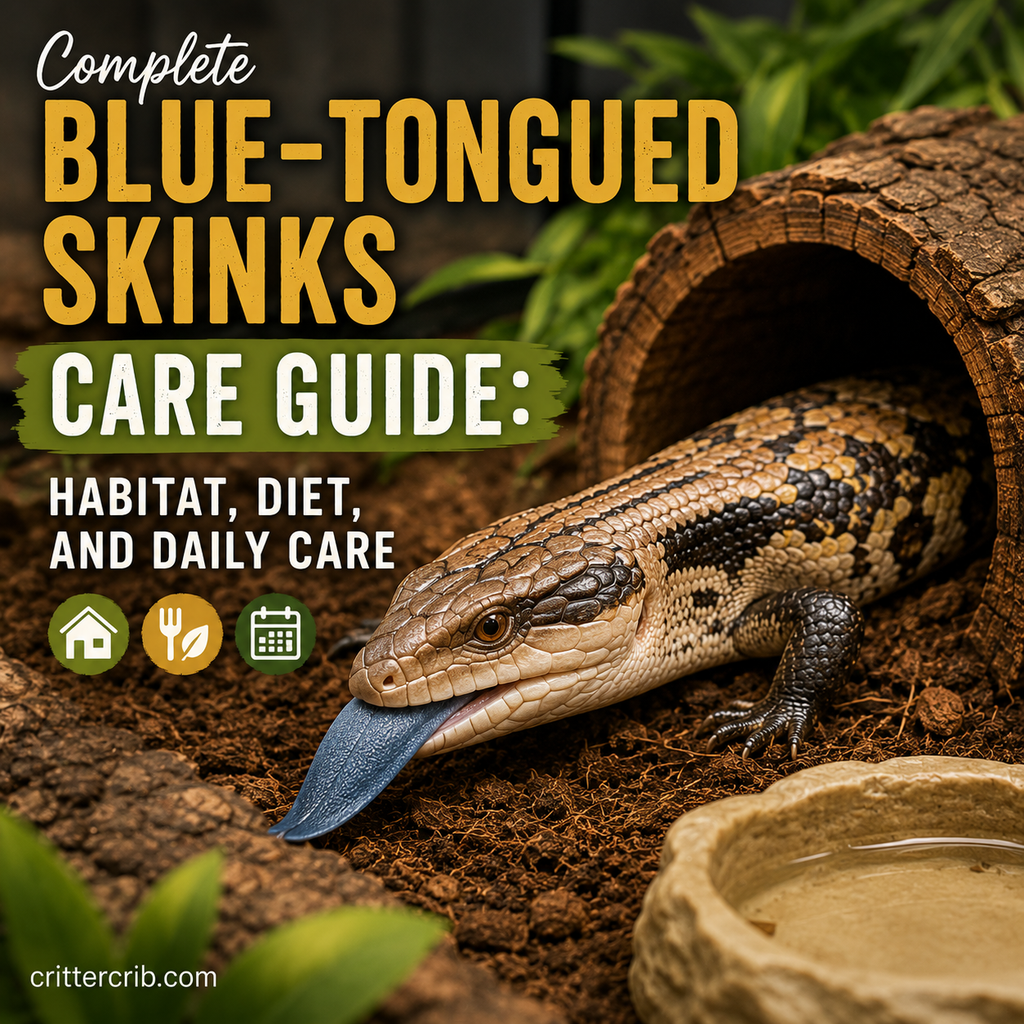
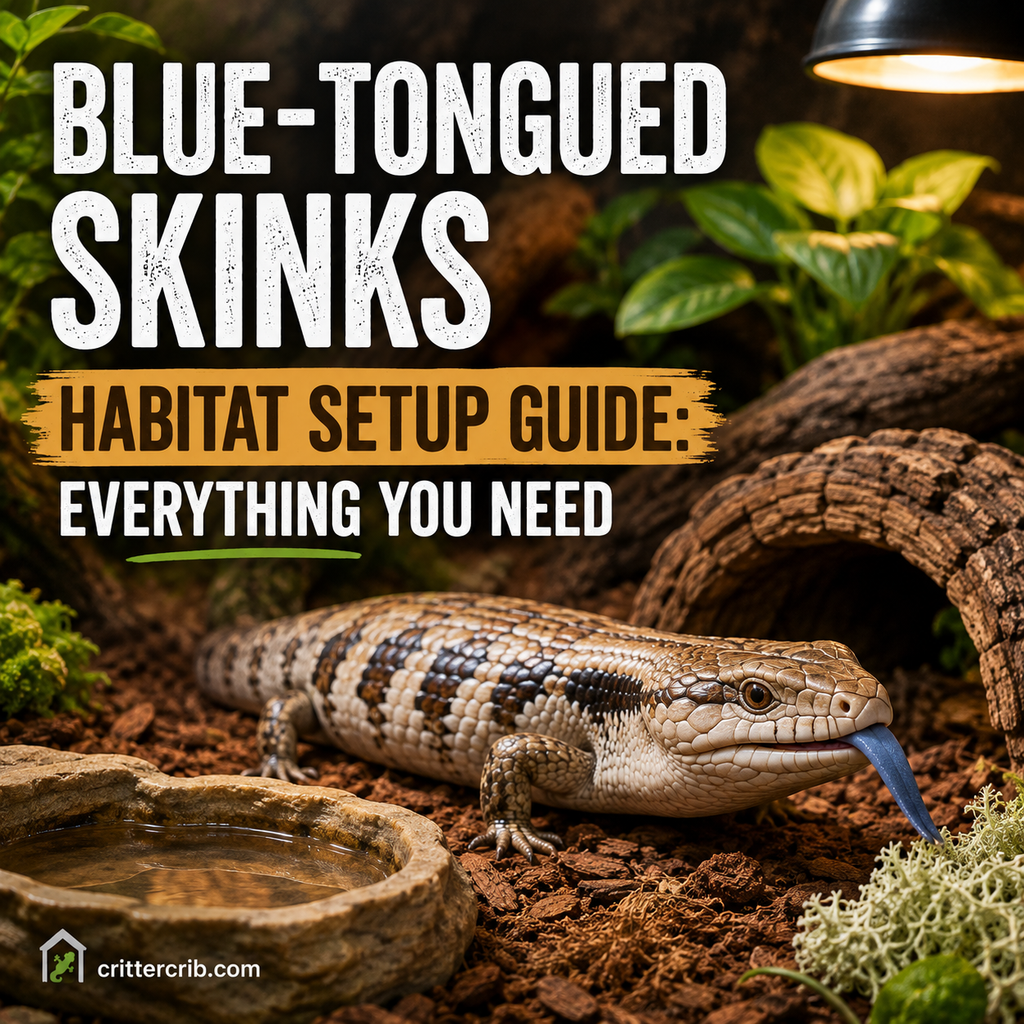
Blue-tongued skinks are sturdy, curious reptiles with one feature that’s impossible to miss: that brilliant blue tongue.
They’re also fairly large, ground-dwelling lizards. That means setting up a blue-tongued skink habitat requires more space and equipment than putting together a small gecko enclosure.
A good setup needs room to explore, a proper temperature gradient, UVB lighting, suitable humidity, deep substrate, secure hiding places, and plenty of enrichment.
There’s another important consideration, too. “Blue-tongued skink” describes several species and subspecies, and they don’t all have identical husbandry requirements. An Indonesian blue-tongued skink, for example, generally requires higher humidity than an Australian species.
So before buying equipment, find out exactly which type of blue-tongued skink you have.
Once you know that, you can build the habitat around its specific needs.
What Does a Blue-Tongued Skink Habitat Need?
A proper blue-tongued skink enclosure should provide several basic things:
- Plenty of floor space
- A warm basking area
- A cooler retreat
- Appropriate UVB lighting
- Suitable humidity
- Deep, diggable substrate
- At least two secure hides
- Fresh drinking water
- Enrichment and cover
- Safe climbing opportunities
- A regular day-night cycle
The goal isn’t to create a decorative glass box.
You’re creating an environment where your skink can choose between different temperatures, hide when it wants privacy, dig into substrate, explore, bask, and perform other natural behaviors.
Know Which Blue-Tongued Skink You Have
This should be one of your first steps.
Blue-tongued skinks belong primarily to the genus Tiliqua, and several species and subspecies are kept as pets.
Common examples include:
- Northern blue-tongued skinks
- Eastern blue-tongued skinks
- Indonesian blue-tongued skinks
- Merauke blue-tongued skinks
- Halmahera blue-tongued skinks
Their natural environments vary considerably.
Australian varieties generally experience conditions that differ from the humid environments associated with many Indonesian blue-tongued skinks.
This matters particularly when determining humidity and substrate.
Don’t assume that a care sheet labeled simply “blue tongue skink” is appropriate for every animal.
If you purchased your skink from a breeder, ask for the exact species or subspecies. If its origin isn’t clear, an experienced reptile veterinarian or knowledgeable keeper may be able to help with identification.
What Size Enclosure Does a Blue-Tongued Skink Need?
Adult blue-tongued skinks need substantial floor space.
For most adults, an enclosure around 4 feet long by 2 feet deep by 2 feet tall (48 x 24 x 24 inches) should be viewed as a practical starting point rather than an oversized luxury.
Larger is even better when you can provide it properly.
Floor space is especially important because blue-tongued skinks spend most of their time on or near the ground.
Unlike arboreal reptiles, they won’t benefit nearly as much from an enclosure that’s extremely tall but narrow.
Prioritize:
- Length
- Depth
- Usable floor space
- Enough height for lighting and enrichment
A spacious enclosure also makes creating a proper temperature gradient much easier.
Can a Baby Blue-Tongued Skink Live in a Large Enclosure?
Yes, provided the enclosure is set up appropriately.
A large enclosure doesn’t automatically stress a young skink.
An exposed enclosure does.
Give a juvenile plenty of:
- Hides
- Plants
- Cork
- Ground cover
- Deep substrate
- Visual barriers
The animal should be able to move around without feeling exposed from every direction.
Glass, PVC, or Wood Enclosure?
Several enclosure materials can work.
PVC Enclosures
PVC is popular because it’s lightweight, relatively easy to clean, and often retains heat and humidity better than a heavily ventilated glass enclosure.
It’s particularly useful when maintaining higher humidity.
Glass Terrariums
Large glass enclosures can work, but they’re often heavy and may lose heat more quickly.
Glass also creates considerable visual exposure.
Covering portions of the sides and back can help a nervous skink feel more secure.
Sealed Wood Enclosures
Properly constructed wooden vivariums can also work well.
Any wood exposed to moisture should be appropriately sealed with a reptile-safe finish.
Regardless of material, ventilation is important.
You want adequate airflow without making temperature and humidity impossible to maintain.
Blue-Tongued Skink Temperature Requirements
Blue-tongued skinks need a temperature gradient.
In simple terms, one side of the enclosure should be warmer while the opposite side remains cooler.
That allows your skink to thermoregulate by moving around the enclosure.
A useful general starting point is:
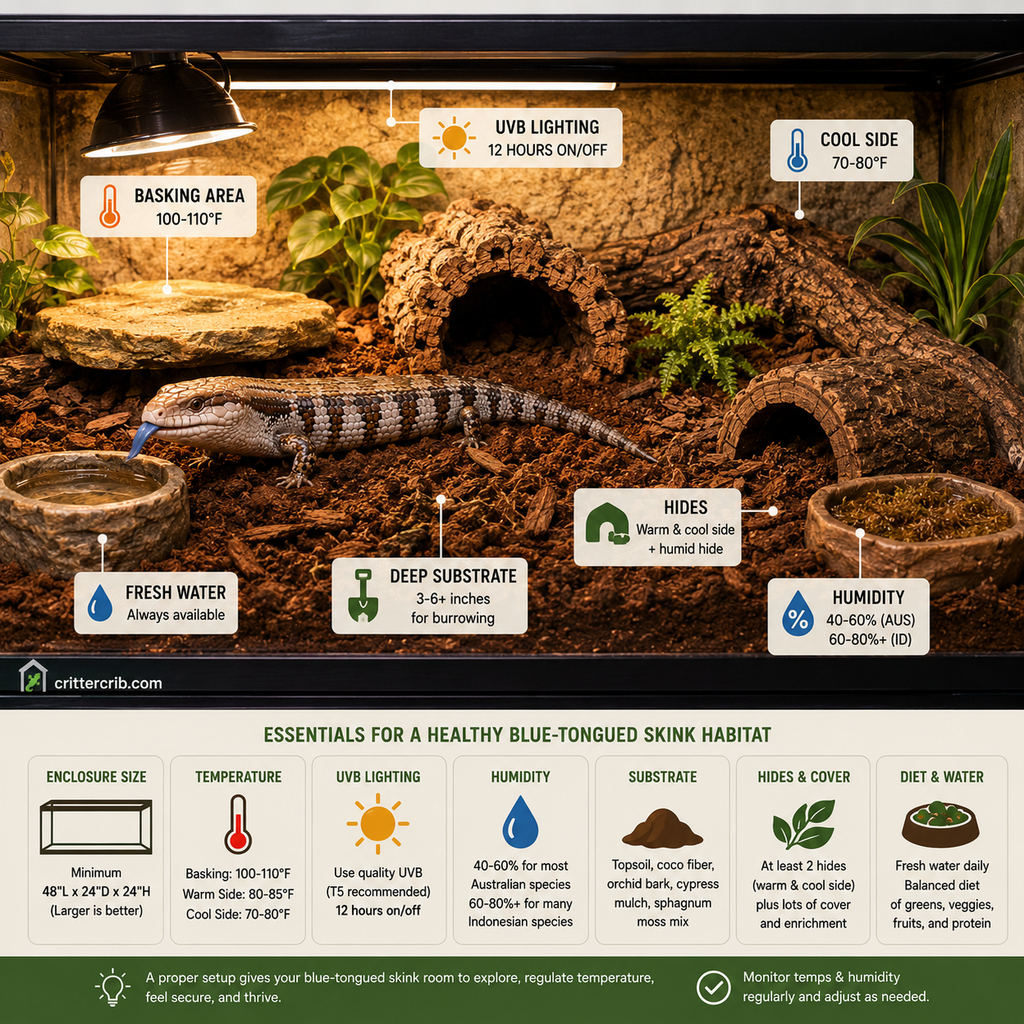
- Basking surface: approximately 100–110°F (38–43°C), depending on species
- Warm side ambient temperature: approximately 80–85°F (27–29°C)
- Cool side: approximately 70–80°F (21–27°C)
Species-specific recommendations vary, so confirm the appropriate basking temperature for your particular skink.
The entire enclosure should never be heated to basking temperature.
Your skink needs somewhere cooler to retreat.
How to Measure Basking Temperature
Measure the actual surface your skink sits on.
An infrared temperature gun is extremely useful for checking:
- Basking surfaces
- Substrate
- Hides
- Rocks
- Different enclosure zones
Use digital thermometers to monitor ambient air temperatures as well.
Don’t rely on analog stick-on gauges or how warm something feels to your hand.
What Should You Use for Heating?
Overhead heating is generally the most practical way to create a basking area for blue-tongued skinks.
Depending on the setup, appropriate options may include:
- Halogen flood lamps
- Reptile basking lamps
- Other suitable overhead heat sources
Position the heat source over one end of the enclosure.
This naturally creates a warmer side and a cooler side.
Avoid heating the enclosure evenly from end to end.
Use a Thermostat
Heating equipment should be appropriately controlled.
A compatible thermostat helps prevent dangerous temperature spikes and keeps heating more consistent.
It’s an important safety device, not simply an optional accessory.
You’ll still need thermometers and an infrared temperature gun to verify conditions independently.
Do Blue-Tongued Skinks Need UVB?
Providing appropriate UVB lighting is strongly recommended for blue-tongued skinks.
UVB supports vitamin D3 production, which plays an important role in calcium metabolism and skeletal health.
Use a quality reptile UVB fixture appropriate for the enclosure dimensions.
Linear fluorescent UVB systems are generally much better suited to providing useful coverage than tiny bulbs illuminating only one small point.
Place the UVB so it overlaps the basking area.
This creates a naturalistic “sunlight” zone where your skink receives heat, bright visible light, and UVB at the same time.
UVB Distance Matters
The correct distance between the lamp and your skink depends on:
- The specific UVB lamp
- Fixture and reflector
- Whether the lamp is above mesh
- Mesh density
- Manufacturer recommendations
- Desired UV exposure
Don’t guess.
Follow the manufacturer’s positioning guidance for your specific fixture and replace UVB lamps according to the manufacturer’s recommended schedule.
A bulb can continue producing visible light even after its useful UVB output has declined.
Blue-Tongued Skink Humidity Requirements
Humidity is where knowing your exact species becomes especially important.
Australian blue-tongued skinks generally require considerably drier conditions than many Indonesian varieties.
As a broad starting point:
- Northern/Australian types: often around 40–60% humidity
- Indonesian types: commonly require approximately 60–80% or higher depending on the particular locality
Some Indonesian varieties, especially Halmahera blue-tongued skinks, may thrive with consistently higher humidity than Australian animals.
Don’t choose a single humidity number for every blue tongue.
Research your exact skink.
Measure Humidity With a Digital Hygrometer
Use a digital hygrometer to monitor humidity.
Positioning multiple sensors can be useful in a large enclosure because humidity may differ between the warm and cool ends.
Also pay attention to microclimates.
A humid hide can provide access to higher moisture even when the overall enclosure is relatively dry.
Best Substrate for Blue-Tongued Skinks
Blue-tongued skinks like to burrow.
Give them enough substrate to do it.
A substrate depth of several inches provides much more behavioral opportunity than a thin layer covering the enclosure floor.
The best material depends partly on the humidity requirements of your species.
Possible substrate components include:
- Organic topsoil
- Coconut fiber or coconut husk
- Cypress mulch
- Orchid bark
- Sphagnum moss
- Reptile-safe soil mixtures
Higher-humidity species benefit from substrates that retain moisture without becoming waterlogged.
Drier species need a setup that doesn’t remain constantly wet.
Substrates to Avoid
Avoid materials that create unnecessary risks or don’t support natural behavior well.
Examples can include:
- Cedar
- Pine shavings containing aromatic oils
- Extremely dusty substrate
- Sharp materials
- Substrate treated with pesticides or fertilizers
- Materials that become moldy or waterlogged easily
Paper towels can be useful temporarily during quarantine or medical monitoring, but they don’t provide the digging opportunities of a well-designed permanent substrate.
Give Your Skink Plenty of Hiding Places
A blue-tongued skink shouldn’t have to choose between hiding and maintaining the right body temperature.
Provide at least:
- One hide on the warm side
- One hide on the cool side
Additional hiding opportunities are even better.
Hides should feel secure rather than enormous and exposed.
Good options include:
- Cork bark
- Reptile caves
- Half logs
- Artificial rock hides
- Buried cork structures
Make sure everything is stable.
Blue-tongued skinks are strong animals and can push decorations around surprisingly easily.
Add a Humid Hide
A humid hide gives your skink access to a moist microclimate without requiring you to make the entire enclosure equally humid.
This can be particularly useful during shedding.
You can create one using a secure hide containing slightly damp:
- Sphagnum moss
- Suitable soil
- Other moisture-retaining substrate
Keep it moist rather than soaked.
Check it regularly for mold and replace the material as necessary.
What Kind of Water Bowl Does a Blue-Tongued Skink Need?
Provide clean, fresh drinking water at all times.
The bowl should be:
- Heavy enough not to tip easily
- Easy to clean
- Large enough for convenient access
- Shallow enough to enter and exit safely
Some blue-tongued skinks may climb into their water bowls.
If yours does, expect the water to become dirty fairly quickly.
Replace contaminated water immediately rather than waiting for your normal cleaning schedule.
A large water bowl can also influence enclosure humidity, particularly when positioned toward the warmer side.
If you’re already struggling with excessive humidity, placement may need adjustment.
Furnishing a Blue-Tongued Skink Enclosure
Once the essentials are installed, think about enrichment.
A good enclosure gives the skink reasons to move around.
Consider adding:
- Cork bark
- Low branches
- Sturdy logs
- Rocks
- Plants
- Leaf litter
- Tunnels
- Multiple textures
- Partially buried hides
Blue-tongued skinks aren’t primarily arboreal, but they may climb low structures.
Keep climbing opportunities relatively close to the ground and stable enough to support a heavy-bodied lizard.
Avoid tall structures that could result in a dangerous fall.
Can You Use Live Plants?
Yes, but don’t expect every plant to survive.
Blue-tongued skinks are powerful diggers.
A beautifully planted enclosure may quickly become a landscaping project from your skink’s perspective.
If you want live plants, choose reptile-safe varieties and protect their roots when possible.
Artificial plants are another option for creating visual cover.
Make sure they’re durable and don’t have sharp wires or small pieces that can easily break off.
Where Should Everything Go?
Think of the enclosure as several connected zones.
Warm Side
Place the primary basking equipment at one end.
This area can include:
- Basking surface
- Warm hide
- UVB exposure
- Nearby cover
Middle
The center can function as an exploration zone.
Use:
- Cork
- Plants
- Logs
- Ground cover
- Additional hides
Cool Side
The opposite end should allow your skink to completely escape the heat.
Include:
- Cool hide
- Deep substrate
- Cover
- Water bowl, depending on humidity goals
Your skink should have meaningful choices throughout the enclosure.
Creating a Day-Night Cycle
Blue-tongued skinks need a consistent day-night rhythm.
Heating and lighting shouldn’t remain on 24 hours a day.
Using timers makes the schedule easy to maintain.
A roughly 12-hour light and 12-hour dark schedule is a practical starting point, with seasonal adjustments possible depending on husbandry goals and species.
At night, visible lights should be turned off.
Avoid red, blue, or other colored “night bulbs” simply so you can watch the animal.
Darkness is part of a normal nighttime environment.
If nighttime supplemental heating is genuinely necessary, use an appropriate heat source that doesn’t produce visible light.
Setting Up the Enclosure Before Bringing Your Skink Home
Don’t assemble the habitat on the same afternoon you bring home the animal.
Set it up in advance.
Then run everything for several days.
Check:
- Basking surface temperature
- Warm-side temperature
- Cool-side temperature
- Daytime humidity
- Nighttime humidity
- Thermostat operation
- UVB placement
- Stability of decorations
- Water bowl accessibility
- Hide placement
Make adjustments before your skink arrives.
This is much easier than repeatedly changing equipment while a new animal is trying to settle in.
A Simple Blue-Tongued Skink Setup Checklist
Before bringing your skink home, make sure you have:
- Appropriately sized enclosure
- Secure doors or locks
- Overhead basking heat
- Compatible thermostat
- Linear UVB fixture
- Digital thermometers
- Infrared temperature gun
- Digital hygrometer
- Deep substrate
- Warm hide
- Cool hide
- Humid hide if appropriate
- Water bowl
- Cork, logs, or other enrichment
- Reptile-safe cover or plants
- Lighting timers
- Cleaning supplies
Buying everything before the animal arrives helps prevent rushed decisions.
How Often Should You Clean a Blue-Tongued Skink Enclosure?
Spot-clean regularly.
Remove:
- Feces
- Urates
- Shed skin
- Spoiled food
- Contaminated substrate
Clean the water bowl frequently and provide fresh water.
How often you perform a deeper substrate change depends on the substrate, enclosure design, humidity, animal, and whether you’re maintaining a bioactive setup.
Don’t wait for the enclosure to smell bad before cleaning it.
At the same time, completely sterilizing and rebuilding the habitat unnecessarily often isn’t required.
Routine spot cleaning can prevent many problems.
Can Blue-Tongued Skinks Live in Bioactive Enclosures?
Yes, blue-tongued skinks can be kept in thoughtfully designed bioactive habitats.
However, creating one for such a large, strong reptile is more challenging than building a bioactive enclosure for a small gecko.
You’ll need:
- Deep substrate
- Appropriate drainage if required
- Suitable cleanup crew organisms
- Plants capable of surviving the skink
- Correct moisture levels
- Enough space for a functioning substrate ecosystem
A bioactive setup also isn’t maintenance-free.
You’ll still need to monitor the animal, clean water and food dishes, remove waste when appropriate, care for plants, and maintain environmental conditions.
For a first-time blue-tongued skink owner, a conventional naturalistic setup may be easier to learn and troubleshoot.
Common Blue-Tongued Skink Habitat Mistakes
Even an expensive enclosure can have husbandry problems.
Using Too Small an Enclosure
Blue-tongued skinks need room to move.
A cramped enclosure makes it harder to provide exercise, enrichment, and an effective temperature gradient.
Using the Same Humidity for Every Species
This is one of the biggest mistakes in generic blue-tongued skink care.
Identify your skink first.
Then establish the humidity range.
Providing Too Little Substrate
A thin layer may be easy to clean, but it removes one of the skink’s natural behavioral opportunities.
Give it enough depth to dig and partially bury itself.
Heating the Entire Enclosure
Your skink needs to choose between warm and cool conditions.
Always maintain a gradient.
Using Heat Without a Thermostat
Unregulated heating equipment can overheat an enclosure.
Use proper temperature control and verify it independently.
Providing Nowhere to Hide
Large reptiles still need security.
An enclosure with plenty of floor space but no cover can feel extremely exposed.
Forgetting UVB Placement
Simply owning a UVB lamp isn’t enough.
Correct fixture type, placement, distance, and replacement schedule all matter.
Making the Enclosure Too Bare
Your skink should have opportunities to dig, investigate, hide, climb over low objects, and move between different microhabitats.
A water bowl and two plastic caves in an otherwise empty enclosure meet only the most basic requirements.
Frequently Asked Questions
What Size Tank Does a Blue-Tongued Skink Need?
For most adult blue-tongued skinks, approximately 48 x 24 x 24 inches should be considered a practical starting point.
More floor space is beneficial when you can provide it.
Do Blue-Tongued Skinks Need UVB?
Providing appropriate UVB lighting is strongly recommended.
Combine UVB with a suitable basking area to create a well-lit zone where your skink can bask and receive UV exposure.
Do Blue-Tongued Skinks Need a Heat Lamp?
They require an appropriate heat source to create a basking area and temperature gradient.
Overhead heating is generally well suited to this purpose.
Always monitor temperatures and control heating equipment appropriately.
How Deep Should Blue-Tongued Skink Substrate Be?
Provide several inches when possible.
Blue-tongued skinks naturally dig and burrow, so deeper substrate gives them an important form of enrichment.
Larger enclosures may allow considerably deeper substrate in selected areas.
Do Blue-Tongued Skinks Like to Climb?
They’re primarily terrestrial, but many will climb over low logs, cork, rocks, and other sturdy structures.
Keep climbing features stable and relatively low to reduce the risk of falls.
Do Blue-Tongued Skinks Need a Humid Hide?
A humid hide can be beneficial, particularly during shedding and for species requiring access to higher humidity.
The exact setup should reflect the humidity requirements of your particular skink.
Can I Keep Two Blue-Tongued Skinks Together?
Blue-tongued skinks are generally best housed individually.
Keeping multiple skinks together can result in competition, stress, injury, and other problems.
Separate enclosures allow you to control each animal’s environment and monitor feeding and health individually.
Where Should I Put My Blue-Tongued Skink Enclosure?
Choose a stable location away from:
- Direct sunlight
- Heating vents
- Air-conditioning vents
- Strong drafts
- Constant vibration
- Extremely busy household areas
Direct sunlight through enclosure glass can cause temperatures to rise dangerously fast.
Final Thoughts
Building a good blue-tongued skink habitat isn’t about filling an enclosure with as much reptile equipment as possible.
It’s about giving the animal choices.
Your skink should be able to bask when it wants warmth, retreat when it needs to cool down, hide when it wants security, dig into deep substrate, explore different textures, drink fresh water, and move through an environment that encourages natural behavior.
Start with adequate floor space, reliable heating, appropriate UVB, digital monitoring equipment, deep substrate, multiple hides, and enrichment.
Then tailor the habitat to the most important variable of all: the particular blue-tongued skink you’re keeping.
Australian and Indonesian blue tongues don’t necessarily require the same humidity or substrate conditions. Identifying your species or subspecies before finalizing the enclosure can prevent many husbandry problems.
Set everything up before your skink comes home, test the temperatures and humidity for several days, and make adjustments as necessary.
A thoughtfully designed enclosure makes everyday care easier for you—and gives your blue-tongued skink a much better environment in which to explore, bask, burrow, and thrive.