Goldfish have a reputation for being simple pets that spend their days swimming around a bowl waiting for food. Anyone who has kept them in a well-designed aquarium, though, knows there’s a lot more going on.
Goldfish explore. They investigate new objects. They search through substrate for food, interact with their surroundings, and quickly learn routines. Some even seem to recognize the person who feeds them.
Providing enrichment gives your goldfish opportunities to express these natural behaviors instead of swimming through the same empty environment every day.
The good news is that goldfish enrichment doesn’t need to be complicated or expensive. A spacious aquarium, interesting places to explore, safe plants, varied foods, and occasional changes to their environment can make their daily lives much more engaging.
Here are some of the best enrichment ideas for keeping goldfish active and giving them plenty to do.
What Is Goldfish Enrichment?
Enrichment means creating opportunities for an animal to interact with its environment in ways that encourage natural behavior.
For goldfish, that can include activities such as:
- Exploring
- Foraging for food
- Investigating new objects
- Swimming through different areas
- Interacting with other compatible goldfish
- Searching through substrate
- Learning simple feeding routines
Enrichment isn’t about constantly entertaining your fish.
Instead, you’re creating an aquarium where interesting things happen naturally throughout the day.
A thoughtfully designed tank can provide much of this enrichment without requiring additional work every day.
Why Do Goldfish Need Enrichment?
Goldfish are active fish.
In an empty aquarium, there’s relatively little for them to investigate. They may still swim normally, but adding appropriate environmental variety gives them more opportunities to behave naturally.
Enrichment can encourage physical activity and exploration while making the aquarium itself more interesting.
It can also give you a better opportunity to observe your fish’s individual personality.
One goldfish might immediately investigate a new plant. Another may spend most of its time digging through the substrate. Some become enthusiastic food hunters.
The goal is to provide choices.
Your fish can decide whether to explore, forage, swim in open water, rest, or interact with different areas of the aquarium.
1. Create an Interesting Aquarium Layout
One of the easiest ways to enrich a goldfish’s life is simply to design a more interesting tank.
Instead of leaving the aquarium completely empty, create different areas for swimming and exploration.
You might include:
- Open swimming space
- Smooth rocks
- Aquarium-safe wood
- Hardy plants
- Different substrate areas
- Gentle changes in elevation
- Open areas for foraging
Don’t fill every inch of the aquarium with decorations.
Goldfish need plenty of swimming room, and elaborate aquascaping can actually become an obstacle—especially for larger fish.
Think of the tank as a combination of open space and interesting features rather than a densely decorated display.
2. Give Your Goldfish Plenty of Swimming Space
Before adding toys or complicated enrichment activities, make sure your fish has enough room to move comfortably.
Swimming itself is enrichment.
Goldfish can become surprisingly large, and the tiny bowls traditionally associated with them don’t provide much room for natural movement.
Tank requirements vary depending on whether you’re keeping fancy or single-tailed goldfish, as well as the number and eventual adult size of the fish.
Single-tailed varieties such as common and comet goldfish can grow particularly large and often require very large aquariums or appropriately maintained ponds.
Whatever setup you choose, prioritize:
- Horizontal swimming space
- Good filtration
- Adequate water volume
- Reliable oxygenation
- Room for the fish to turn comfortably
- Space that accommodates adult size
A spacious, well-maintained environment provides far more enrichment than filling a cramped aquarium with toys.
3. Add Live Plants
Live plants can turn an ordinary aquarium into an environment worth investigating.
Goldfish may swim between leaves, search around plant bases, or occasionally nibble on vegetation.
There’s just one challenge.
Goldfish aren’t exactly famous for respecting carefully planted aquascapes.
They may uproot plants, chew leaves, or rearrange things while searching for food.
Hardier options often work best. Depending on your aquarium setup, you might experiment with plants such as:
- Anubias
- Java fern
- Hornwort
- Vallisneria
- Elodea or anacharis
Plants attached to rocks or aquarium-safe wood can sometimes withstand goldfish activity better than delicate plants rooted directly in the substrate.
Expect a little gardening chaos.
That’s part of the enrichment.
4. Encourage Natural Foraging
Food doesn’t always have to arrive in exactly the same place at exactly the same time.
Goldfish naturally spend a considerable amount of time investigating their surroundings for something edible.
You can encourage this behavior by occasionally changing how appropriate foods are offered.
For example:
- Scatter sinking food across a safe area of the aquarium.
- Place small portions in different locations.
- Offer appropriate vegetables in a feeding clip.
- Allow your fish to search for food among safe aquarium features.
- Alternate between floating and sinking foods when suitable for your fish.
This turns feeding into an activity rather than simply dropping everything into one corner.
Just keep track of how much food you’re offering.
Enrichment shouldn’t result in overfeeding or large amounts of uneaten food decomposing in the tank.
5. Offer a Varied Diet
Variety can make feeding more interesting while also helping you provide balanced nutrition.
A goldfish’s primary diet should be nutritionally appropriate for the species, but suitable foods can occasionally add variety.
Depending on your fish and feeding plan, options may include:
- Quality goldfish pellets
- Gel foods
- Appropriate vegetables
- Shelled peas as an occasional food
- Daphnia
- Brine shrimp
- Bloodworms as an occasional treat
Different textures, shapes, and feeding methods encourage different behaviors.
Make dietary changes gradually, and avoid assuming that every human food is safe for fish.
Variety is useful, but balanced nutrition should remain the priority.
6. Use Vegetable Feeding Clips
A simple aquarium feeding clip can provide surprisingly effective enrichment.
Attach an appropriate piece of vegetable and allow the fish to investigate and nibble at it over time.
Depending on your feeding routine, suitable choices might include small portions of:
- Blanched zucchini
- Spinach
- Romaine lettuce
- Cucumber
- Broccoli
Remove uneaten vegetables before they begin breaking down and affecting water quality.
Watching goldfish figure out how to pull food from a clip can be entertaining for you, too.
7. Rearrange the Aquarium Occasionally
Goldfish can become familiar with their surroundings.
Changing part of the aquarium layout occasionally creates something new to investigate.
You don’t need to completely rebuild the tank.
Try moving:
- A smooth rock
- A plant
- A piece of aquarium-safe wood
- A familiar decoration
Even a modest change can encourage exploration.
Don’t rearrange everything constantly, however. Fish also benefit from having a stable environment.
Occasional changes are enough.
8. Create Different Areas to Explore
A good goldfish aquarium doesn’t need to look the same from one end to the other.
You can create small environmental zones.
For example, one side might contain plants and smooth rocks while another remains relatively open for swimming.
You could create:
- A planted area
- Open swimming space
- A foraging area
- A shaded resting area
- A gentle bubble zone
This gives the fish options instead of forcing them to use one type of environment.
Just make sure water can circulate properly throughout the aquarium.
9. Provide Safe Substrate for Foraging
Goldfish frequently investigate the bottom of their environment.
They may sift through substrate while searching for tiny pieces of food.
If you use substrate, choose it carefully.
Fine sand can allow natural sifting behavior. If gravel is used, it should be appropriately sized and selected with goldfish safety in mind, since pieces that can fit into a goldfish’s mouth may potentially become lodged.
Whatever substrate you choose should also be manageable to clean.
Goldfish produce plenty of waste, and leftover food can accumulate between substrate particles.
A safe, clean bottom area provides an excellent place for natural exploration.
10. Add Gentle Water Movement
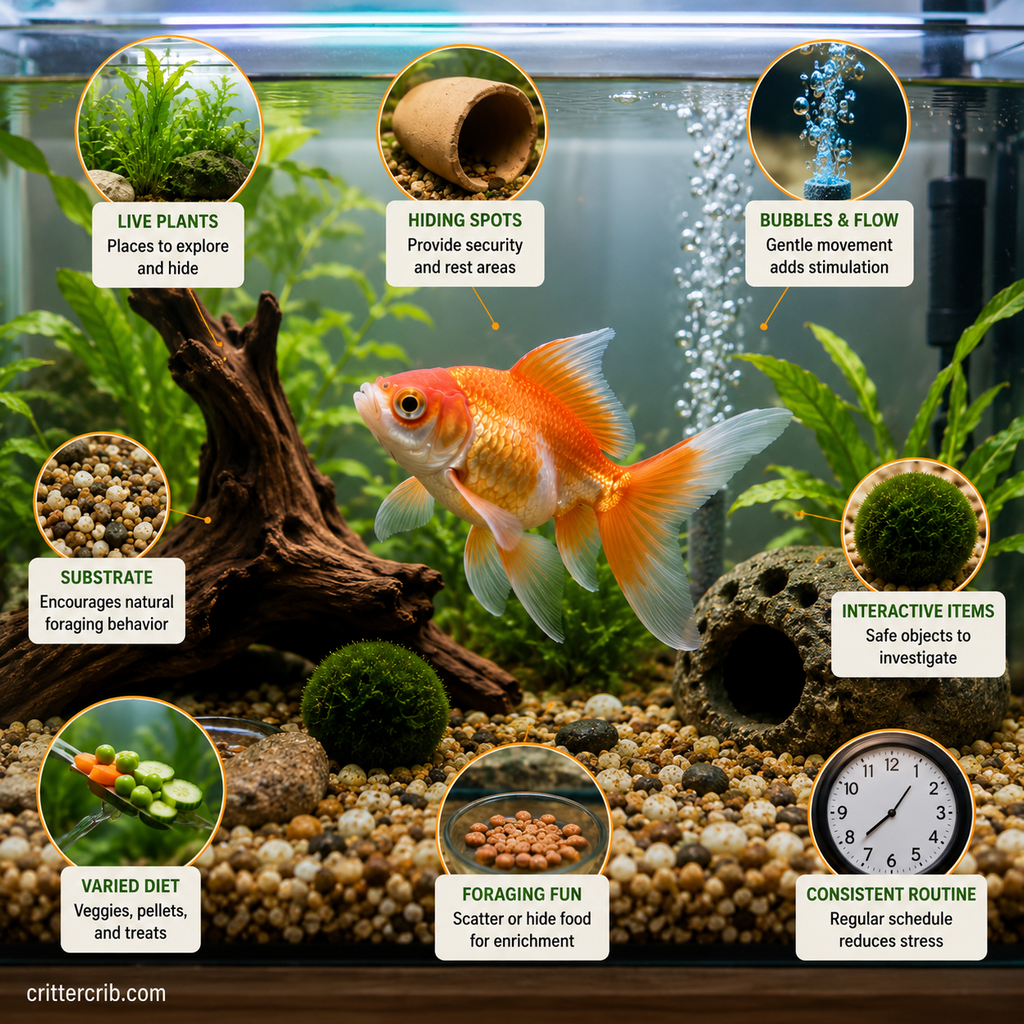
Water movement can create another environmental feature for your goldfish to explore.
Filters, air stones, and sponge filters can produce areas of gentle current and bubbles.
Some goldfish appear interested in swimming around these areas.
However, stronger isn’t automatically better.
Fancy goldfish in particular may have body shapes and fins that make swimming in powerful currents difficult.
Your filtration system should provide adequate circulation and oxygenation without forcing the fish to struggle continuously against the flow.
11. Try Simple Target Training
Goldfish can learn basic associations, especially when food is involved.
Target training is one way to provide mental stimulation.
You can use a clearly visible, aquarium-safe target and reward the fish for approaching it.
A basic training session might look like this:
- Present the target where the fish can see it.
- Wait for the fish to approach.
- Immediately provide a small food reward.
- Repeat a few times.
- End the session before the fish loses interest.
Over time, the fish may learn to follow the target.
Keep sessions short and account for training rewards as part of the fish’s normal daily food allowance.
12. Teach Your Goldfish to Follow Your Finger
Here’s an enrichment activity that doesn’t require special equipment.
Some goldfish learn to follow a person’s finger along the outside of the aquarium because they associate movement near the tank with feeding.
Slowly move your finger along the glass and see whether your fish follows.
If you’re using food as a reward, provide only a small amount.
Never tap repeatedly on the aquarium glass. Vibrations can disturb fish and aren’t necessary for getting their attention.
13. Use Floating Enrichment Carefully
Floating aquarium-safe objects can sometimes encourage investigation.
The key words are aquarium safe.
Avoid simply dropping household objects into the aquarium. Materials that appear harmless may contain paints, adhesives, coatings, metals, or chemicals that aren’t appropriate for prolonged contact with aquarium water.
Any object placed inside the tank should be:
- Non-toxic
- Smooth
- Large enough not to be swallowed
- Free of sharp edges
- Easy to remove and clean
- Designed or verified as safe for aquarium use
Observe your fish whenever you introduce something unfamiliar.
If an object appears to cause stress or creates an entrapment hazard, remove it.
14. Give Goldfish Appropriate Companionship
Goldfish are social fish and can benefit from interaction with other compatible goldfish when adequate space is available.
However, adding another fish isn’t something to do purely for entertainment.
Every additional goldfish increases:
- Waste production
- Space requirements
- Filtration demands
- Oxygen requirements
- Maintenance needs
Compatibility matters too.
Very fast single-tailed goldfish may outcompete slower fancy varieties for food. Some fancy goldfish may also have difficulty competing with more agile tank mates.
If you keep multiple goldfish, make sure the aquarium can comfortably support all of them at their adult size.
15. Provide Places to Rest
Enrichment doesn’t mean your goldfish needs to be active every second of the day.
Rest is normal.
Plants and carefully positioned decorations can create calmer areas where fish can slow down.
Make sure resting areas don’t become cramped hiding places where a goldfish could become trapped.
Goldfish generally need accessible, open environments rather than tiny caves designed for much smaller species.
16. Maintain a Natural Day-and-Night Cycle
Lighting is another part of a fish’s environment.
Goldfish don’t need aquarium lights running around the clock.
Provide a predictable period of light during the day followed by darkness at night.
An aquarium light timer can make this easy.
Consistency creates a more natural daily rhythm while preventing the aquarium from being brightly illuminated when the fish should be resting.
It can also help control excessive light exposure that may encourage algae growth.
17. Observe What Your Goldfish Actually Enjoys
Not every enrichment idea will interest every fish.
Pay attention to what happens after you introduce something new.
Does your goldfish immediately investigate it?
Does it return repeatedly?
Does it completely ignore it?
Does it appear uncomfortable or stressed?
Observation helps you learn which activities are genuinely useful for your particular fish.
It also gives you a chance to spot health problems.
A goldfish that normally rushes over to investigate food but suddenly stays motionless deserves closer attention.
Goldfish Enrichment Ideas to Avoid
Creativity is useful, but safety matters more.
Some activities can introduce unnecessary risks.
Avoid:
- Small objects that could be swallowed
- Decorations with sharp or rough edges
- Tiny openings where fish could become trapped
- Painted household objects not intended for aquariums
- Metal objects that may corrode
- Mirrors used for prolonged periods
- Constantly tapping on the aquarium
- Powerful currents that make swimming difficult
- Excessive feeding disguised as enrichment
- Frequent major changes to the aquarium environment
Be especially careful with novelty aquarium toys promoted online.
Something being entertaining to watch doesn’t necessarily mean it’s beneficial to the fish.
When you’re unsure whether an object is aquarium safe, leave it out.
Water Quality Comes Before Enrichment
An elaborate aquarium doesn’t benefit a goldfish if the water quality is poor.
Goldfish produce a substantial amount of waste, making adequate filtration and routine aquarium maintenance especially important.
Before worrying about toys or training, concentrate on:
- Proper aquarium size
- Effective biological filtration
- Regular water testing
- Appropriate partial water changes
- Stable water parameters
- Adequate oxygenation
- Proper nutrition
Ammonia and nitrite should remain at 0 ppm in an established aquarium.
Think of good husbandry as the foundation. Enrichment builds on top of it.
Signs Your Goldfish May Be Enjoying Its Environment
It’s impossible to ask a goldfish whether it’s having fun, so avoid interpreting every behavior in human terms.
Instead, look for healthy, normal activity.
A well-adjusted goldfish may:
- Explore different areas of the aquarium
- Forage through appropriate substrate
- Show interest during feeding
- Investigate new aquarium features
- Swim normally throughout the tank
- Interact with other compatible goldfish
- Alternate between active periods and rest
Learning your fish’s normal routine makes unusual behavior much easier to recognize.
When Reduced Activity Might Be a Problem
A goldfish resting occasionally isn’t necessarily bored or sick.
Sudden behavioral changes, however, deserve attention.
Watch for:
- Unusual lethargy
- Loss of appetite
- Gasping at the surface
- Clamped fins
- Difficulty maintaining balance
- Remaining at the bottom for extended periods
- Rapid breathing
- Unusual spots, sores, or swelling
If your normally active goldfish suddenly stops exploring, don’t immediately assume it needs more enrichment.
Check the basics first.
Test the water, confirm the temperature, examine the fish carefully, and make sure the aquarium equipment is functioning correctly.
Environmental or health problems should be addressed before adding new activities.
How Often Should You Change Goldfish Enrichment?
You don’t need to introduce something new every day.
In fact, constantly changing the aquarium could create unnecessary disruption.
A better approach is to maintain a stable, interesting environment while occasionally introducing small changes.
You might:
- Offer a different appropriate food occasionally
- Move one aquarium feature every few weeks
- Change where sinking food is offered
- Rotate safe enrichment objects
- Practice brief target-training sessions
- Introduce seasonal plant growth or new aquarium-safe plants
Some of the best enrichment comes from everyday activities such as swimming, foraging, interacting with other goldfish, and exploring plants.
Enrichment should complement the aquarium rather than turn it into a constantly changing obstacle course.
Frequently Asked Questions About Goldfish Enrichment
Do goldfish get bored?
We can’t know whether goldfish experience boredom exactly as humans do, but they are capable of learning, exploring, and responding to changes in their environment. Providing opportunities for natural behaviors such as swimming and foraging can create a more stimulating environment.
Do goldfish need toys?
Goldfish don’t need conventional toys in the way a dog or cat might. A spacious, well-designed aquarium with plants, safe substrate, varied feeding opportunities, and areas to explore can provide plenty of enrichment.
Can you play with a goldfish?
You can interact with a goldfish through activities such as target training or teaching it to follow your finger outside the aquarium. Avoid tapping the glass or physically handling the fish unnecessarily.
Can goldfish recognize their owners?
Goldfish can learn associations involving people, visual cues, and feeding routines. A goldfish that swims toward you when you approach the aquarium may have learned that your appearance predicts food or another familiar interaction.
What is the easiest enrichment for goldfish?
Foraging is one of the simplest options. Occasionally scatter an appropriate portion of sinking food across a safe area instead of placing all the food in exactly the same location.
Are live plants good enrichment for goldfish?
Yes. Live plants can provide areas to explore and forage around, and some goldfish may nibble them. Choose hardy, aquarium-safe plants because goldfish are known for uprooting and eating vegetation.
Final Thoughts
The best goldfish enrichment isn’t necessarily a collection of elaborate toys.
Start with the environment.
Give your goldfish plenty of swimming space, clean water, appropriate filtration, plants or other safe features to investigate, and opportunities to forage. Add dietary variety and occasional environmental changes, and you already have a surprisingly enriching aquarium.
You can take things further with feeding activities or simple target training, but don’t feel like your fish needs constant entertainment.
Sometimes the simplest enrichment is also the most natural: plenty of room to swim, something interesting to investigate, and the opportunity to spend the afternoon searching around the aquarium for the last pellet everyone else somehow missed.