
Aquatic snails can be surprisingly entertaining once you start paying attention to what they’re doing.
One minute your snail is slowly cruising across the aquarium glass. A few hours later, it’s floating at the surface, buried beneath the substrate, hanging upside down from a plant, or sitting completely still in its shell.
Some of these behaviors can look alarming if you’re new to keeping aquarium snails.
Fortunately, many strange-looking snail behaviors are completely normal.
Aquatic snails explore, eat, rest, reproduce, and respond to their environment in ways that are very different from fish. Learning what’s normal for your particular snail makes it much easier to recognize when something may actually be wrong.
This guide explains common aquatic snail behaviors, what they usually mean, and which changes deserve a closer look.
Understanding Normal Aquatic Snail Behavior
There isn’t one set of behaviors shared equally by every freshwater aquarium snail.
Different species have different habits.
Common aquarium snails include:
- Mystery snails
- Nerite snails
- Ramshorn snails
- Malaysian trumpet snails
- Bladder snails
- Pond snails
- Rabbit snails
- Assassin snails
Some spend most of their time above the substrate. Others regularly burrow.
Some reproduce rapidly in freshwater, while others won’t.
That’s why identifying your snail species is important before deciding whether a particular behavior is unusual.
In general, healthy aquatic snails spend their time moving between food sources, resting, exploring surfaces, and responding to changes in their environment.
Why Is My Aquatic Snail Climbing the Glass?
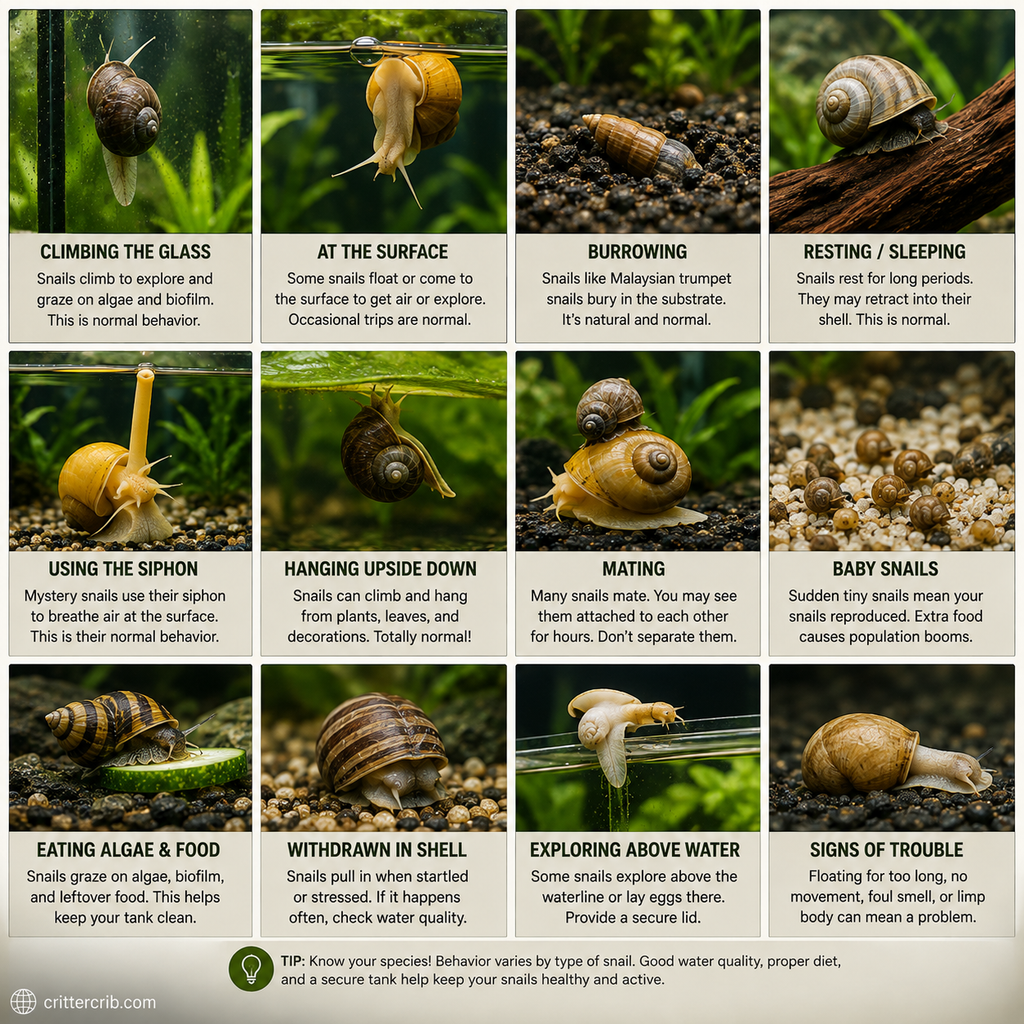
Climbing aquarium glass is one of the most normal things a snail can do.
The glass provides a large surface where snails can graze on:
- Algae
- Biofilm
- Microorganisms
- Tiny food particles
- Organic material
A snail may spend hours slowly traveling from one end of the aquarium to another.
You might even notice winding trails through algae where the snail has been feeding.
Glass climbing by itself isn’t a reason for concern.
However, there’s a difference between exploring the glass and repeatedly trying to leave the aquarium. If your snail spends unusual amounts of time above the waterline or attempting to escape, it’s worth checking the tank conditions.
Why Does My Snail Climb Above the Water?
This depends heavily on the species.
Mystery snails, for example, naturally venture above the waterline. Females also lay their egg clutches above the water.
Other snails may briefly explore the area near the surface.
Occasional above-water activity can therefore be perfectly normal.
Repeated escape attempts are different.
If several snails suddenly begin trying to leave the water, check:
- Ammonia
- Nitrite
- Nitrate
- Temperature
- pH
- Recent chemical additions
- Oxygenation
- Recent water changes
Aquatic animals sometimes respond to deteriorating environmental conditions before the problem is obvious to you.
Why Is My Aquarium Snail Floating?
Seeing a snail floating at the surface can be startling.
You may immediately assume something is wrong.
Not necessarily.
Some aquatic snails can trap air inside their shell or body cavity, allowing them to float. Mystery snails are particularly well known for doing this.
Floating may help a snail move around the aquarium or reach another location.
A healthy snail may eventually release the trapped air and sink again.
When Is Floating a Concern?
Pay more attention if floating occurs alongside other unusual signs, such as:
- No response when touched gently
- Strong unpleasant odor
- Body hanging limply from the shell
- Long periods of complete inactivity
- Other snails or fish behaving abnormally
- Recent water-quality problems
Floating alone doesn’t tell you whether a snail is healthy.
Look at the whole situation.
Why Did My Snail Suddenly Drop From the Glass?
Aquarium snails sometimes let go and fall.
This can look surprisingly dramatic.
A snail may release its grip and drop from the glass, plants, driftwood, or decorations rather than slowly crawling all the way down.
Some mystery snails seem particularly enthusiastic about this shortcut.
An occasional controlled-looking drop generally isn’t concerning.
However, make sure the aquarium doesn’t contain sharp rocks or decorations that could damage the snail’s shell during a fall.
Why Is My Snail Not Moving?
Snails don’t move continuously.
They need periods of rest, and some can remain still long enough to make you wonder whether they’re alive.
A resting snail may:
- Sit partially inside its shell
- Attach itself to the glass
- Remain on the substrate
- Rest beneath plants
- Stay still for several hours
Some species are also more active at particular times of day.
If the snail begins moving again later and otherwise appears normal, it was probably resting.
Persistent inactivity deserves more attention, especially when it’s a sudden change from the snail’s usual routine.
Do Aquatic Snails Sleep?
Aquatic snails have periods of rest and inactivity, although their sleep patterns don’t necessarily match the human day-and-night schedule.
You may find a snail resting:
- On aquarium glass
- On driftwood
- Under leaves
- On the substrate
- Inside a hiding place
- Partially withdrawn into its shell
Individual snails can develop routines.
Once you’ve kept the same snail for a while, you’ll probably begin recognizing where it likes to rest and when it’s usually active.
Why Is My Snail Hiding in Its Shell?
Retracting into the shell is an important protective behavior.
Your snail may withdraw when:
- Resting
- Startled
- Touched
- A fish approaches
- The aquarium is disturbed
- Conditions become uncomfortable
Briefly retreating into the shell is normal.
A snail that remains tightly closed for an unusually long period may simply be resting, but persistent inactivity can also indicate stress or a health problem.
Check water conditions if the behavior is unusual for your snail.
Why Is My Snail Buried in the Substrate?
For some species, burrowing is completely normal.
Malaysian trumpet snails spend much of their time within the substrate and may become more visible after the aquarium lights go out.
Assassin snails also commonly bury themselves while waiting for prey.
Other snails may dig partially into the substrate while searching for food.
Before worrying about a buried snail, consider its species.
Burrowing behavior that would be completely normal for a Malaysian trumpet snail might be less typical for another type.
Why Do My Snails Come Out at Night?
Many aquatic snails become more noticeable after the aquarium lights turn off.
During the day, they may rest beneath plants, inside decorations, or within the substrate.
At night, they emerge to forage.
This is particularly noticeable with Malaysian trumpet snails.
You might look at the aquarium during the day and see only a few, then switch on a room light late at night and suddenly discover dozens.
They didn’t appear from nowhere.
They were hiding.
Why Is My Snail Eating Algae?
Algae grazing is normal behavior for many aquarium snails.
Nerite snails are particularly popular because of their ability to graze on algae growing across hard surfaces.
Snails may feed on algae growing on:
- Aquarium glass
- Rocks
- Driftwood
- Decorations
- Plant leaves
However, don’t assume every snail can survive entirely on whatever algae happens to grow in the aquarium.
Different snail species have different diets.
Some require supplemental food, especially in very clean aquariums where natural food is limited.
Why Is My Snail Eating a Dead Fish?
Aquatic snails are opportunistic feeders and scavengers.
If a fish dies, snails may begin feeding on the body.
This sometimes leads owners to assume the snail killed the fish.
In many cases, the fish died first and the snail simply discovered an available food source.
The same applies to dead shrimp and other aquarium animals.
If you discover snails feeding on a dead tank inhabitant, remove the remains and investigate why the animal died.
Check water quality and observe the remaining livestock.
Why Is My Snail Eating My Plants?
This depends on the snail and the condition of the plant.
Many common aquarium snails prefer:
- Algae
- Biofilm
- Soft decaying plant tissue
- Leftover food
- Organic debris
Sometimes it looks like a snail is destroying a plant when it’s actually eating tissue that was already dying.
However, some snails may eat healthy plant material under certain conditions.
Species identification matters.
If you’re seeing significant plant damage, don’t assume all aquarium snails behave the same way.
Why Is My Snail Hanging Upside Down?
Snails can travel across surfaces that seem impossible from our perspective.
You may find one:
- Underneath a broad leaf
- Hanging from driftwood
- Attached upside down to aquarium equipment
- Moving along the underside of a decoration
If the snail is firmly attached and moving normally, this is usually just exploration or feeding.
Biofilm and algae grow on surfaces facing every direction.
To a snail, the underside of a leaf can be just another dining table.
Why Is My Snail Stretching Out of Its Shell?
Some snails can extend their bodies surprisingly far while moving or reaching for another surface.
Mystery snails are particularly noticeable because of their relatively large bodies.
They may stretch toward:
- Food
- Plants
- Glass
- Decorations
- The water surface
Normal stretching shouldn’t be confused with a snail hanging limp and unresponsive from its shell.
An active snail that stretches, attaches to another surface, and continues moving is generally behaving normally.
Why Does My Mystery Snail Have a Long Tube?
If you keep mystery snails, you may notice what looks like a strange tube extending from the side of the snail.
This is its siphon.
Mystery snails can use the siphon to draw atmospheric air while remaining underwater or near the surface.
You may see the snail position itself close to the waterline and extend the siphon upward.
This is normal anatomy and behavior.
Once you know what you’re looking at, it becomes one of the more interesting behaviors to watch.
Why Is My Snail Moving So Fast?
“Fast” is relative when we’re talking about snails.
Still, aquarium snails can move surprisingly quickly when motivated.
Food is a common reason.
Drop a favorite food into the aquarium and a snail that seemed asleep five minutes earlier may begin heading toward it.
Changes in activity can also occur because of:
- Time of day
- Feeding
- Mating behavior
- Water changes
- Exploration
- Environmental changes
A temporary increase in activity isn’t usually concerning.
If every snail suddenly becomes frantic or begins climbing out of the water, test the aquarium conditions.
Why Are Two Snails Stuck Together?
They may be mating.
Snail reproduction varies significantly by species.
Some aquarium snails have separate males and females, while others are hermaphroditic.
Two snails remaining attached for an extended period may therefore be displaying reproductive behavior.
Don’t pull them apart.
If you’re concerned about reproduction, identify the species and learn how it produces offspring.
Why Are There Suddenly Baby Snails Everywhere?
This is one of the most common surprises in freshwater aquariums.
Small snails such as bladder and ramshorn snails can reproduce readily when conditions allow.
They may enter an aquarium accidentally on:
- Live plants
- Decorations
- Substrate
- Equipment transferred from another tank
You may not notice the original snails or their eggs.
Then suddenly there seem to be dozens.
Why Do Snail Populations Explode?
Food availability plays a major role.
A rapidly growing population can indicate abundant resources, including:
- Uneaten fish food
- Excessive feeding
- Dead plant material
- Algae
- Organic waste
Reducing excess food and improving aquarium maintenance can help limit population growth.
Don’t simply add a snail-eating animal unless that species is genuinely appropriate for your aquarium.
Why Is My Mystery Snail Laying Eggs Above the Water?
Mystery snails lay their eggs above the waterline.
A female may climb out of the water and deposit a cluster of eggs on the aquarium glass or another surface above the water.
The clutch often looks like a dense cluster of small round eggs.
This behavior is normal.
A secure lid is especially important because a mystery snail searching for an egg-laying location may crawl farther than expected.
If you don’t want baby snails, research appropriate and humane ways to manage unwanted egg clutches for the species you’re keeping.
Why Are There White Dots All Over My Aquarium?
If you keep nerite snails, those tiny hard white dots may be eggs.
Nerites commonly deposit individual eggs on:
- Glass
- Rocks
- Driftwood
- Decorations
- Equipment
The eggs can be difficult to remove.
In typical freshwater aquariums, most commonly kept nerite snails won’t produce a growing population from these eggs because successful development generally requires different conditions.
The eggs themselves, however, can remain visible for quite a while.
Why Is My Snail Always Near the Waterline?
There are several possible explanations.
Your snail may simply be:
- Grazing
- Exploring
- Resting
- Breathing atmospheric air
- Preparing to lay eggs
Species matters here.
A mystery snail spending time near the surface isn’t unusual.
However, if multiple aquatic animals suddenly gather near the surface or snails begin repeatedly leaving the water, check water quality and oxygenation.
Changes affecting several animals at once are particularly important.
Why Does My Snail Keep Trying to Escape?
Occasional exploration above the waterline can be normal for certain snails.
Persistent escape behavior deserves investigation.
First, check:
- Water quality
- Temperature
- pH
- Oxygenation
- Chemical exposure
- Tank crowding
Then consider whether the behavior is normal for that species.
Mystery snails, for example, need access above the waterline for egg laying.
A secure aquarium lid helps prevent an adventurous snail from ending up on the floor.
Cover filter openings and other escape routes where practical.
Can Aquatic Snails Recognize Feeding Time?
Snails don’t need to understand a feeding schedule in the way a person does to respond to food.
They can detect chemical cues in the water.
When food enters the aquarium, you may notice nearby snails change direction and begin moving toward it.
In a tank with several snails, feeding time can turn into an unexpectedly competitive slow-motion race.
Why Is My Snail Riding Another Snail?
Sometimes one snail simply crawls over another while exploring.
In other situations, the behavior may be related to mating.
If they’re otherwise healthy, there’s usually no reason to intervene.
Snails aren’t particularly respectful of personal space.
Plants, rocks, aquarium glass, filter equipment, other snails—it’s all just another surface to crawl across.
How Can You Tell If an Aquatic Snail Is Stressed?
Snail behavior varies too much to diagnose stress from one action alone.
Look for changes from the snail’s normal pattern.
Potential warning signs include:
- Persistent inactivity
- Repeated attempts to leave the aquarium
- Remaining deeply withdrawn for unusually long periods
- Loss of normal attachment
- Unusual body appearance
- Multiple snails behaving abnormally at once
If you’re concerned, test the aquarium water before adding medications or chemicals.
Environmental problems can affect every animal in the tank.
How Can You Tell If an Aquarium Snail Is Dead?
This can be surprisingly difficult.
A deeply resting snail may look dead.
Don’t immediately discard a snail simply because it hasn’t moved for several hours.
Signs that deserve closer investigation include:
- No reaction when gently disturbed
- Body hanging loosely from the shell
- Inability to remain attached
- Obvious decomposition
- A strong foul odor
The odor from a dead aquatic snail is usually quite distinctive.
If you’re uncertain, carefully remove the snail into a container of aquarium water and observe it rather than leaving a potentially dead animal in the tank indefinitely.
A decomposing snail can negatively affect water quality, particularly in a small aquarium.
What Does Healthy Aquatic Snail Behavior Look Like?
Healthy behavior depends on the species, but you should generally see a mixture of movement and rest.
A healthy snail may:
- Crawl across the aquarium glass
- Graze on algae and biofilm
- Explore plants and decorations
- Rest for extended periods
- Respond to food
- Retract when disturbed
- Burrow if appropriate for the species
- Explore the waterline
- Display normal reproductive behavior
The important thing is learning what’s normal for your individual snail.
A mystery snail that regularly explores the entire aquarium may naturally be more visible than a Malaysian trumpet snail that spends daylight hours hidden beneath the substrate.
How to Encourage Natural Snail Behavior
A well-designed aquarium allows snails to behave naturally.
Provide Grazing Surfaces
Plants, driftwood, rocks, and other aquarium-safe surfaces provide places for algae and biofilm to develop.
Avoid trying to make every surface perfectly sterile.
Feed an Appropriate Diet
Don’t assume algae will provide everything your snail needs.
Research the diet of your particular species.
Depending on the snail, appropriate foods may include:
- Algae wafers
- Sinking foods
- Vegetables
- Calcium-rich foods
- Natural biofilm
- Other species-appropriate foods
Remove significant uneaten food before it decomposes.
Maintain Appropriate Minerals
Snail shells depend on suitable water chemistry and access to appropriate minerals.
Very soft or acidic water can create challenges for some snail species.
Research the GH, KH, and pH requirements of the snail you’re keeping rather than adding calcium products automatically.
Provide a Secure Lid
Some snails are excellent explorers.
A lid helps prevent escapes while still allowing appropriate air space for species that need access to atmospheric air or lay eggs above the water.
Maintain Stable Water Quality
Regularly monitor:
- Ammonia
- Nitrite
- Nitrate
- pH
- Temperature
Additional parameters such as GH and KH can be important for shell health.
Perform appropriate partial water changes and avoid sudden environmental changes.
Common Aquatic Snail Behavior: Normal or Concerning?
Many behaviors that look strange are normal.
Usually normal behaviors include:
- Climbing glass
- Floating occasionally
- Resting for hours
- Burrowing in species that naturally dig
- Dropping from aquarium surfaces
- Hanging upside down
- Stretching from the shell
- Eating algae
- Grazing on dead plant material
- Mating
- Mystery snails laying eggs above water
- Mystery snails using their siphon
Behaviors worth investigating include:
- Persistent attempts to escape
- Several snails suddenly leaving the water
- Long-term unexplained inactivity
- Loss of attachment
- Severe shell deterioration
- Limp, unresponsive body tissue
- Multiple unexplained snail deaths
Context matters.
One snail resting isn’t necessarily a problem. Every snail suddenly trying to climb out of the aquarium is much more significant.
Frequently Asked Questions About Aquatic Snail Behavior
Why Is My Snail Sitting in One Spot All Day?
It may simply be resting.
Snails can remain inactive for surprisingly long periods.
If inactivity continues and is unusual for that snail, check water conditions and look for other signs of trouble.
Why Does My Snail Keep Falling Over?
An occasional fall can happen.
A healthy snail can often right itself, although ability varies by species and the surface beneath it.
Repeatedly finding a snail unable to move normally may indicate weakness or another problem worth investigating.
Do Aquarium Snails Feel Their Shell?
A snail’s shell is a living part of its body rather than a removable house.
The animal remains physically connected to it throughout its life.
Shell condition can therefore provide useful information about nutrition, water chemistry, and long-term care.
Why Is My Snail’s Shell Turning White?
Shell whitening, pitting, or erosion can be associated with water chemistry and mineral availability.
Acidic conditions can contribute to shell deterioration.
Test pH, GH, and KH and research the preferred parameters of your particular snail species.
Can Snails Hear You?
Aquatic snails don’t hear sound the way humans do, but they can respond to vibrations and changes in their environment.
Tapping on aquarium glass isn’t necessary and can disturb tank inhabitants.
Do Aquarium Snails Need Darkness?
Snails benefit from a normal day-and-night cycle along with the other animals in the aquarium.
Some species become considerably more active after the lights turn off.
Don’t leave aquarium lighting on continuously.
Final Thoughts
Aquatic snails do plenty of things that can look bizarre until you understand what you’re seeing.
Floating, falling from the glass, disappearing into the substrate, stretching far outside the shell, resting for hours, hanging upside down, and racing toward food at snail speed can all be perfectly normal.
The key is knowing what species you have and learning its usual routine.
Pay particular attention to sudden changes that affect several animals at once. If multiple snails begin trying to escape, become unusually inactive, or behave differently after a water change or new chemical treatment, check the aquarium conditions.
Most of the time, though, that snail doing something strange isn’t having an emergency.
It’s just being a snail.
And once you start recognizing these behaviors, aquarium snails become much more interesting than the simple “cleanup crew” they’re often assumed to be.