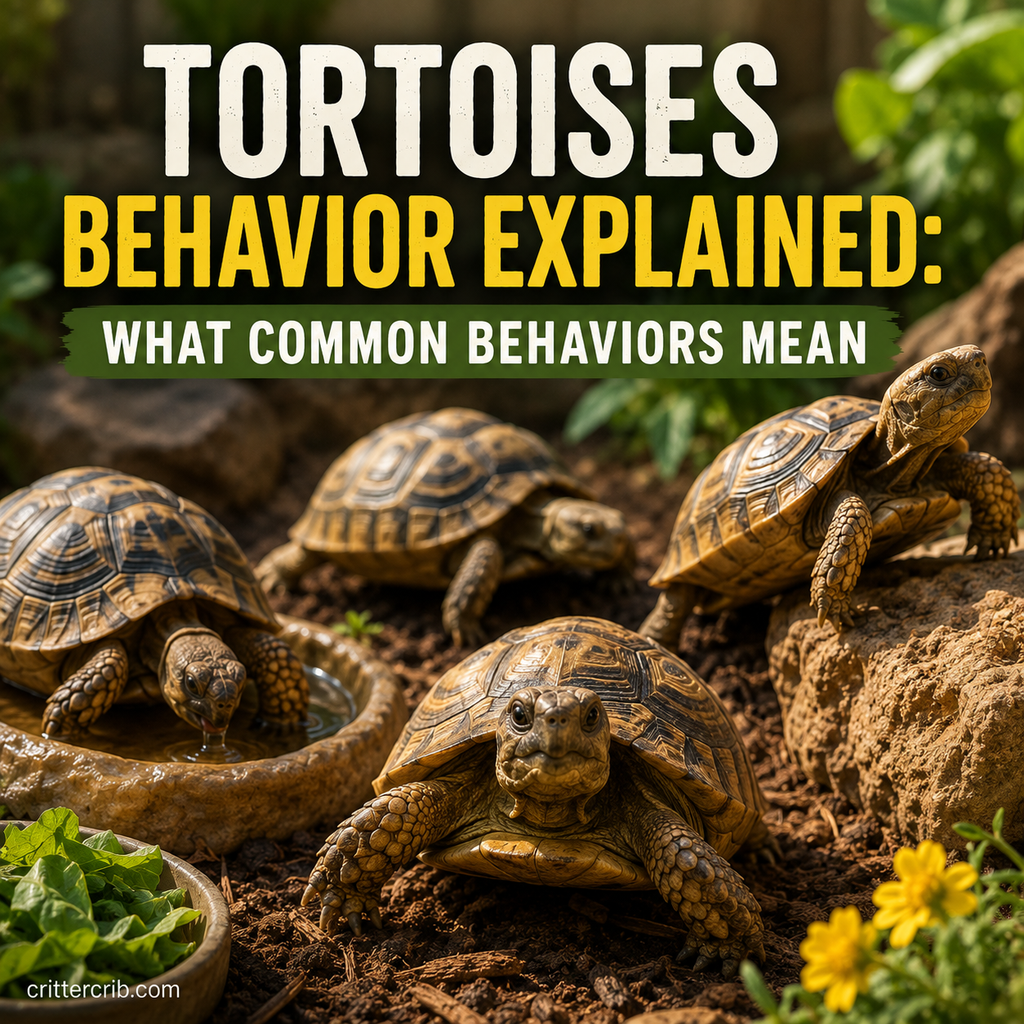
Tortoises may have a reputation for being slow and quiet, but spend enough time around one and you’ll notice there’s quite a lot going on.
They dig. They climb things they have no business climbing. They pace along boundaries, bulldoze decorations, stretch their necks toward you, and sometimes seem determined to rearrange an enclosure you spent hours setting up.
Some behaviors are simply part of being a tortoise. Others can tell you something about temperature, lighting, diet, stress, seasonal changes, or health.
The challenge is knowing the difference.
There are many tortoise species kept as pets, and they don’t all behave exactly the same way. A Russian tortoise, sulcata, Hermann’s tortoise, and red-footed tortoise come from different environments and have different husbandry needs.
Still, many common behaviors appear across species.
Here’s what some of the things your tortoise does may actually mean.
Understanding Normal Tortoise Behavior
The first rule of interpreting tortoise behavior is simple: know what’s normal for your individual animal.
Some tortoises are surprisingly active and curious. Others spend more time resting or hiding.
Behavior can be influenced by:
- Species
- Age
- Sex
- Temperature
- Season
- Lighting
- Enclosure size
- Diet
- Reproductive activity
- Health
- Individual personality
That means one behavior rarely tells the whole story.
A tortoise hiding for part of the day may be perfectly comfortable. A tortoise that suddenly hides all day after previously being highly active deserves a closer look.
Changes from an established routine are often more useful than comparing your tortoise with someone else’s pet.
Why Does My Tortoise Pace Back and Forth?
Repeated pacing along the edge of an enclosure is one of the most common behaviors tortoise owners notice.
Sometimes it’s simply exploration.
Tortoises are naturally active animals that may travel considerable distances while looking for food, shelter, mates, or suitable temperatures.
Persistent pacing, however, can also suggest that the animal is trying to get somewhere else.
Possible reasons include:
- An enclosure that’s too small
- Transparent walls
- Seeing something outside the enclosure
- Incorrect temperatures
- Lack of enrichment
- Reproductive behavior
- Seasonal activity
- A desire to explore
Why Glass Walls Can Cause Problems
Tortoises don’t necessarily understand transparent barriers.
If your tortoise can see through glass, it may repeatedly attempt to walk through it.
Covering the lower portion of transparent enclosure walls with an opaque visual barrier can sometimes reduce this behavior.
More importantly, make sure the enclosure provides enough usable space.
Tortoises may be slow, but many need considerably more room than new owners expect.
Why Does My Tortoise Try to Climb the Walls?
A tortoise repeatedly trying to climb its enclosure walls can be both impressive and alarming.
Despite their body shape, tortoises can be persistent climbers.
Wall climbing may occur because the tortoise:
- Wants to explore
- Can see beyond the enclosure
- Is searching for a mate
- Needs more space
- Is responding to seasonal activity
- Is investigating a corner
- Has discovered a route that almost works
Check the enclosure carefully.
A tortoise can sometimes use hides, rocks, or decorations as steps and climb higher than you’d expect.
This creates a risk of escape or flipping over.
Keep climbable objects far enough from enclosure walls that they don’t become unintended ladders.
Why Does My Tortoise Dig?
Digging is normal behavior for many tortoise species.
Depending on the species and circumstances, a tortoise may dig to:
- Create a sleeping area
- Escape excessive heat
- Find a more humid microclimate
- Prepare for seasonal dormancy
- Lay eggs
- Feel more secure
- Regulate body temperature
Some species are especially enthusiastic burrowers.
Is Constant Digging Normal?
Frequent digging isn’t automatically a problem.
Look at where and when it happens.
A tortoise repeatedly digging into one particular corner may simply have decided that’s the best place to sleep.
Frantic digging along every wall while constantly attempting to escape may indicate something different.
Review the habitat, particularly enclosure size, temperature, substrate depth, hiding opportunities, and visual barriers.
Why Does My Tortoise Bury Itself?
Finding an apparently empty enclosure can be unsettling the first time your tortoise completely disappears beneath the substrate.
Burrowing can be perfectly normal.
A tortoise may bury itself to:
- Sleep
- Feel secure
- Cool down
- Retain moisture
- Respond to seasonal changes
- Escape bright conditions
Appropriate substrate depth gives species that naturally dig the opportunity to do so.
However, sudden prolonged inactivity should still be monitored.
If your normally active tortoise stays buried for an unusual length of time, check temperatures and consider whether seasonal changes or illness could be involved.
Why Does My Tortoise Follow Me?
Some tortoises appear to follow their owners.
You walk across the yard, and your tortoise starts heading in the same direction.
Does that mean it loves you?
It’s better not to interpret reptile behavior entirely through human emotions.
Your tortoise may associate you with:
- Food
- Access to another area
- Routine
- Activity
- Interesting movement
Tortoises can learn patterns.
If you regularly appear immediately before feeding, your presence may become a reliable signal that something good is about to happen.
That learned association can look a lot like following.
Does My Tortoise Recognize Me?
Tortoises can become familiar with repeated sights, sounds, routines, and interactions.
An animal that initially retreats into its shell when you approach may eventually remain relaxed, walk toward you, or become active when you arrive with food.
That doesn’t necessarily mean it understands “ownership” the way a person does.
But it does mean tortoises aren’t simply unresponsive objects wandering around an enclosure.
They can learn from repeated experiences.
Why Does My Tortoise Stretch Its Neck Out?
A tortoise extending its neck can mean several things depending on the situation.
It may be:
- Looking around
- Smelling or investigating something
- Reaching for food
- Basking
- Becoming comfortable around you
- Trying to reach a particular surface
A relaxed tortoise may sit with its head and limbs extended while warming itself.
That’s very different from a tortoise stretching its neck while struggling to breathe.
Always look at the rest of the animal.
Normal alert posture is one thing. Open-mouth breathing, wheezing, nasal discharge, or obvious respiratory effort requires attention.
Why Does My Tortoise Bob Its Head?
Head bobbing can be associated with social and reproductive behavior.
It’s often seen more frequently in males, particularly when another tortoise is nearby.
Depending on species and context, head movements may occur during:
- Courtship
- Territorial encounters
- Aggressive interactions
- Investigation
If multiple tortoises are housed together, don’t assume head bobbing is harmless simply because there hasn’t been a visible fight.
Watch for chasing, ramming, biting, blocking access to food, and other signs of conflict.
Why Does My Tortoise Ram Things?
Some tortoises, particularly males, may ram objects, other tortoises, shoes, or occasionally people.
This behavior can be related to:
- Territoriality
- Dominance
- Courtship
- Reproductive hormones
A tortoise repeatedly ramming another tortoise can cause stress or injury.
Cohabitation should be monitored carefully, and separation may be necessary.
Don’t assume two tortoises need to live together for companionship.
Depending on the species and individuals involved, solitary housing may be safer.
Why Does My Tortoise Bite?
Tortoises can bite.
A bite may happen because of:
- Food confusion
- Territorial behavior
- Courtship
- Aggression
- Stress
- Curiosity
Fingers can look surprisingly food-like when they’re near a meal.
Wash your hands after handling food, and avoid placing fingers directly in front of a tortoise that is actively eating.
Larger species can deliver powerful bites, so respect the animal’s space and body language.
Why Does My Tortoise Push and Bulldoze Everything?
You carefully arrange a hide, plant, and decorative piece.
Your tortoise takes one look at your work and begins demolition.
This is extremely common.
Tortoises often push through their environment rather than delicately walking around obstacles.
They may move:
- Plants
- Lightweight hides
- Food dishes
- Small rocks
- Decorations
It’s usually normal exploratory behavior.
Design the enclosure with this in mind.
Heavy objects should be secure enough that the tortoise can’t tip them onto itself, while lightweight decorations shouldn’t create hazards when they’re inevitably moved.
Why Does My Tortoise Hide?
Hiding is normal.
Tortoises need somewhere they can retreat from:
- Heat
- Bright light
- Activity
- Other animals
- Unwanted interaction
A good habitat should provide secure hiding areas.
Depending on the species, this might include a hide box, dense vegetation, a burrow, or another sheltered location.
When Hiding Becomes Unusual
Pay closer attention when hiding represents a significant change from your tortoise’s normal routine.
Possible reasons include:
- Temperatures that are too low or too high
- Stress
- Seasonal changes
- Recent relocation
- Illness
- Inadequate lighting
- Another animal causing stress
Don’t drag a tortoise out of its hide repeatedly just because you want to see it.
Instead, make sure the environmental conditions are appropriate and observe its overall routine.
Why Does My Tortoise Sleep So Much?
Tortoises spend a significant amount of time resting.
How much is normal varies with species, age, temperature, season, and individual habits.
A tortoise may rest after:
- Eating
- Basking
- Exploring
- Digging
- Periods of high activity
Young animals may also have different activity patterns from adults.
What matters is whether the sleep is consistent with the animal’s usual routine.
A sudden shift toward extreme lethargy, particularly when accompanied by reduced appetite, weight loss, abnormal breathing, or other symptoms, deserves closer attention.
Why Does My Tortoise Bask?
Basking is an important part of thermoregulation.
A tortoise may move beneath its heat source and remain there while raising its body temperature.
Once warm, it may become more active and begin:
- Eating
- Exploring
- Digging
- Moving to another temperature zone
Regular basking is generally expected for species that use basking heat.
If your tortoise never approaches the basking area, check the temperature.
It may be too hot, too cold, poorly positioned, or otherwise uncomfortable.
Why Does My Tortoise Sit Under the Heat Lamp All Day?
Spending excessive amounts of time beneath the heat source can suggest that the rest of the habitat is too cool.
Check temperatures with reliable digital equipment.
Don’t judge by how the enclosure feels to your hand.
Also consider:
- Room temperature
- Heat source strength
- Enclosure size
- Basking surface temperature
- Seasonal conditions
A tortoise should have access to a useful thermal gradient rather than being forced to stay in one spot to remain warm.
Why Does My Tortoise Stop Eating?
A change in appetite can have many explanations.
Possible reasons include:
- Incorrect temperatures
- Seasonal changes
- Stress
- Recent relocation
- Reproductive behavior
- Diet changes
- Illness
Tortoises need appropriate temperatures to function normally.
A tortoise that’s too cold may become less active and lose interest in food.
Before assuming your pet has simply become picky, check its environment.
Track Body Weight
A digital scale is extremely useful.
Periodic weighing allows you to distinguish between a tortoise that skipped a meal and one that’s experiencing ongoing weight loss.
Record the measurements.
Gradual changes can be difficult to notice visually.
Why Does My Tortoise Scratch at Corners?
Repeated corner scratching is often closely related to pacing and wall climbing.
Your tortoise may be attempting to continue moving beyond the enclosure.
Consider:
- Whether it can see through the barrier
- Whether the habitat is large enough
- Temperature
- Seasonal activity
- Enrichment
- Reproductive behavior
If one particular corner is always the target, look at what’s outside that part of the enclosure.
There may be something visually attracting the tortoise.
Why Does My Tortoise Flip Over?
Tortoises can accidentally flip onto their backs while:
- Climbing
- Ramming
- Moving over uneven objects
- Interacting with another tortoise
- Attempting to escape
Some can right themselves, but others may struggle.
A tortoise left upside down can become overheated, stressed, or otherwise endangered.
Reduce the risk by keeping unstable climbing hazards away from walls and monitoring interactions between animals.
If you find your tortoise upside down, safely return it to its normal position and investigate what caused the fall.
Why Does My Tortoise Soak in Its Water?
Some tortoises voluntarily enter shallow water.
Depending on the species and environment, soaking may be associated with:
- Drinking
- Hydration
- Cooling
- Defecation
It’s common for tortoises to defecate while soaking.
That’s one reason water dishes need regular cleaning.
The dish should be shallow and easy for the tortoise to enter and exit safely.
A steep-sided container can create an unnecessary hazard.
Why Does My Tortoise Poop in Its Water?
If your tortoise regularly turns its clean water dish into a toilet, you’re not alone.
Warm water and soaking can stimulate bowel movements.
This isn’t usually a behavioral problem.
Simply clean the dish thoroughly and replace the water.
Don’t leave fecally contaminated water sitting in the enclosure.
Why Does My Tortoise Eat Dirt or Substrate?
An occasional accidental mouthful while feeding can happen.
Persistent substrate eating is different.
Possible contributing factors may include:
- Investigating the environment
- Food particles on the substrate
- Dietary imbalance
- Inappropriate substrate
- Other husbandry issues
Feeding directly on heavily contaminated or easily swallowed loose substrate can increase accidental ingestion.
If your tortoise repeatedly and deliberately consumes substrate, review its diet and husbandry and discuss the behavior with a reptile veterinarian.
Why Does My Tortoise Eat Its Own Poop?
Coprophagy — eating feces — can occur in tortoises.
Occasional investigation or consumption doesn’t necessarily indicate a serious problem, but waste should still be removed promptly for hygiene.
Persistent behavior is worth discussing with a reptile veterinarian, particularly if accompanied by weight loss, abnormal stool, poor appetite, or other changes.
Regular fecal testing may be recommended depending on your tortoise’s history and health.
Why Is My Tortoise Suddenly Aggressive?
A tortoise that suddenly begins ramming, chasing, or biting may be responding to:
- Reproductive hormones
- Territorial behavior
- Another tortoise
- Environmental changes
- Stress
- Pain or illness
Male tortoises can become particularly persistent during breeding periods.
If aggression is directed toward another animal, separate them when necessary.
Don’t allow repeated harassment simply because no serious injury has occurred yet.
Chronic stress matters too.
Mating and Courtship Behavior
Tortoise courtship can look surprisingly aggressive.
Depending on the species, males may:
- Follow females
- Circle them
- Ram
- Bite at legs
- Head bob
- Mount
- Vocalize
This doesn’t mean all aggressive-looking behavior is courtship.
Species, sex, and context matter.
Females also need appropriate nesting opportunities when producing eggs.
Importantly, some female tortoises can produce infertile eggs without mating.
Persistent digging in a mature female should therefore be interpreted with reproductive behavior in mind.
Why Is My Tortoise Making Sounds?
Tortoises aren’t completely silent.
You may occasionally hear sounds associated with:
- Mating
- Exertion
- Withdrawal into the shell
- Movement
- Breathing
A brief hiss when a tortoise suddenly pulls into its shell can simply be air being expelled.
Persistent wheezing, clicking, bubbling, or noisy breathing is different.
If respiratory sounds are accompanied by nasal discharge, open-mouth breathing, lethargy, or reduced appetite, contact a reptile veterinarian.
What Does It Mean When a Tortoise Pulls Into Its Shell?
Retreating into the shell is a basic defensive response.
Your tortoise may withdraw when:
- Startled
- Picked up
- Approached suddenly
- Exposed to an unfamiliar animal
- Feeling threatened
A new tortoise may retreat frequently when you approach.
As it becomes accustomed to predictable, gentle interactions, it may remain extended more often.
Never try to forcibly pull a tortoise’s legs or head from its shell.
How Can You Tell If a Tortoise Is Comfortable?
There isn’t one universal “happy tortoise” behavior.
Look for a combination of normal activities.
A comfortable tortoise may:
- Bask regularly
- Explore its habitat
- Eat consistently
- Dig or burrow
- Rest in secure locations
- Move between warm and cool areas
- Investigate food and surroundings
- Maintain a stable, healthy body condition
- Respond normally when approached
The key is having choices.
Your tortoise should be able to warm up, cool down, hide, explore, eat, and rest without being forced into one small area.
Signs a Tortoise May Be Stressed
Possible signs of stress can include:
- Constant pacing
- Frantic wall climbing
- Repeated escape attempts
- Persistent hiding that is unusual for the individual
- Reduced appetite
- Increased defensive behavior
- Frequent conflict with another tortoise
Stress doesn’t have one specific appearance.
Before deciding your tortoise is stressed, review the entire situation.
Ask what’s changed.
A new enclosure, different lighting, another pet nearby, incorrect temperatures, or a recent move can all influence behavior.
Seasonal Behavior and Brumation
Some tortoise species naturally experience a period of winter dormancy commonly called brumation or hibernation in captive-care discussions.
Not every tortoise species should be brumated.
Tropical species have very different seasonal biology from tortoises adapted to colder winters.
For species that do naturally brumate, preparation needs to be taken seriously.
A tortoise that is sick, underweight, or carrying certain health problems shouldn’t simply be allowed to become dormant without proper evaluation.
If you’re considering brumating your tortoise, work with an experienced reptile veterinarian and follow species-specific guidance.
Never assume unexplained lethargy is “just brumation.”
When Tortoise Behavior Could Signal Illness
Behavioral changes can sometimes provide the first clue that something isn’t right.
Seek veterinary advice when unusual behavior occurs alongside signs such as:
- Significant weight loss
- Persistent refusal to eat
- Severe lethargy
- Swollen or closed eyes
- Nasal discharge
- Open-mouth breathing
- Persistent wheezing
- Difficulty walking
- Weakness
- Shell injuries
- Unusual swelling
- Persistent diarrhea
- Straining without producing waste or eggs
One symptom doesn’t tell you exactly what’s wrong.
It tells you that the animal needs closer evaluation.
Find a veterinarian experienced with reptiles rather than waiting until a minor concern becomes an emergency.
Keep Track of Your Tortoise’s Normal Behavior
One of the most useful things you can do is establish a baseline.
Pay attention to:
- Morning activity
- Basking routine
- Appetite
- Favorite hiding areas
- Digging habits
- Body weight
- Bowel movements
- Seasonal changes
- Reactions to handling
- Normal sleep schedule
You don’t need to document every step your tortoise takes.
A weight record and occasional notes are enough to make gradual changes much easier to notice.
Common Tortoise Behaviors at a Glance
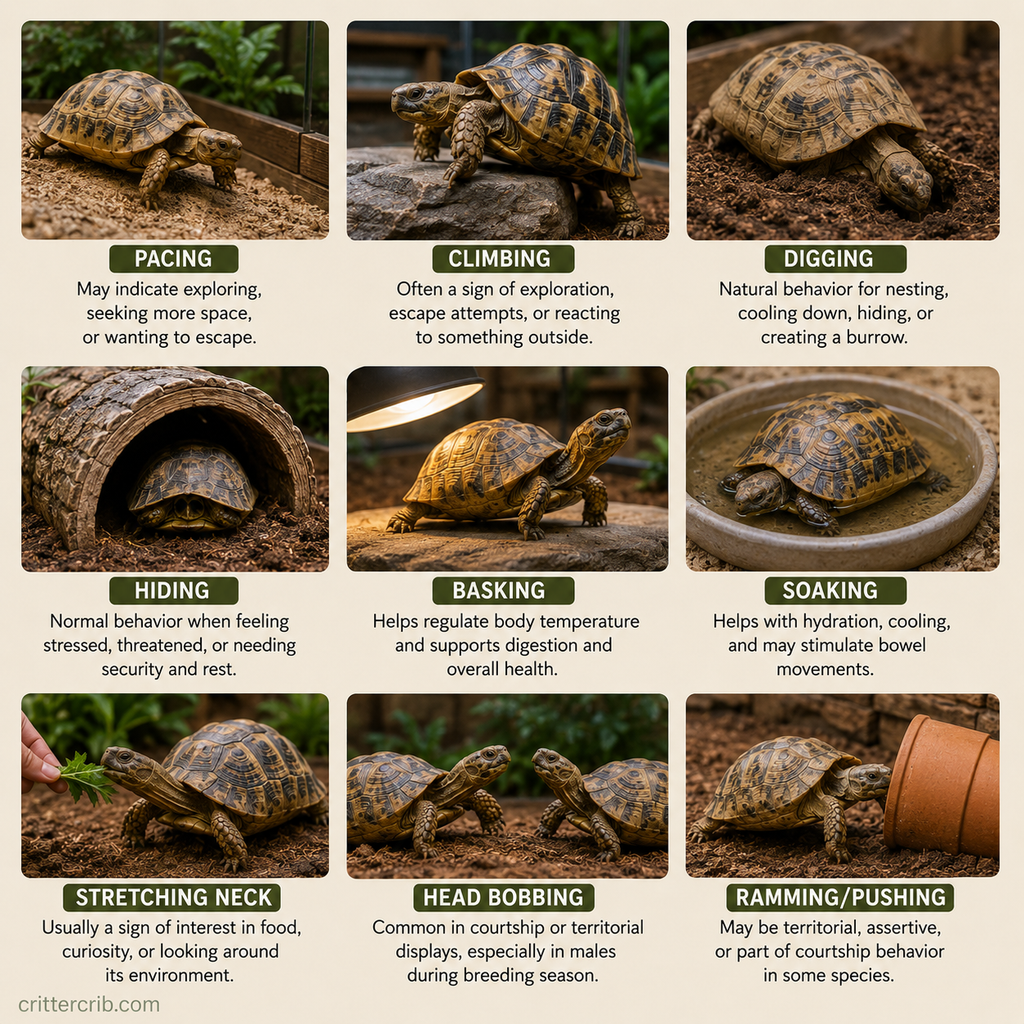
Here’s a quick reference:
- Digging: Usually normal
- Burrowing: Often normal and species-dependent
- Basking: Normal thermoregulation
- Following you: Often associated with food, routine, or curiosity
- Neck stretching: Usually normal exploration or basking
- Pacing: Can be normal exploration, but persistent pacing deserves investigation
- Wall climbing: May indicate exploration, escape attempts, or enclosure issues
- Bulldozing decorations: Very normal
- Head bobbing: Often social, territorial, or reproductive
- Ramming: Frequently territorial or reproductive
- Hiding: Normal, unless there’s a significant change
- Soaking: Can be normal
- Defecating in water: Common
- Pulling into shell: Defensive response
- Flipping over: Not a behavior to ignore; identify the cause
- Persistent wheezing or open-mouth breathing: Not normal
- Sudden prolonged lethargy: Worth investigating
Always interpret behavior in context.
Final Thoughts on Tortoise Behavior
Understanding tortoise behavior gets easier once you stop expecting your tortoise to behave like a furry pet.
A tortoise may not wag its tail when you walk through the door, but it can learn routines, recognize familiar patterns, explore its environment, respond to food, and develop predictable habits.
Digging, basking, hiding, bulldozing decorations, and even occasional attempts to climb are often perfectly normal.
The most useful thing you can learn is what’s normal for your individual tortoise.
When you know when it usually wakes up, where it likes to bask, how eagerly it eats, and how active it normally is, unusual behavior becomes much easier to recognize.
Watch the whole animal rather than focusing on one isolated action. Consider the species, environment, season, temperature, diet, and recent changes.
Your tortoise may move slowly, but its behavior can tell you quite a lot if you know what to look for.