
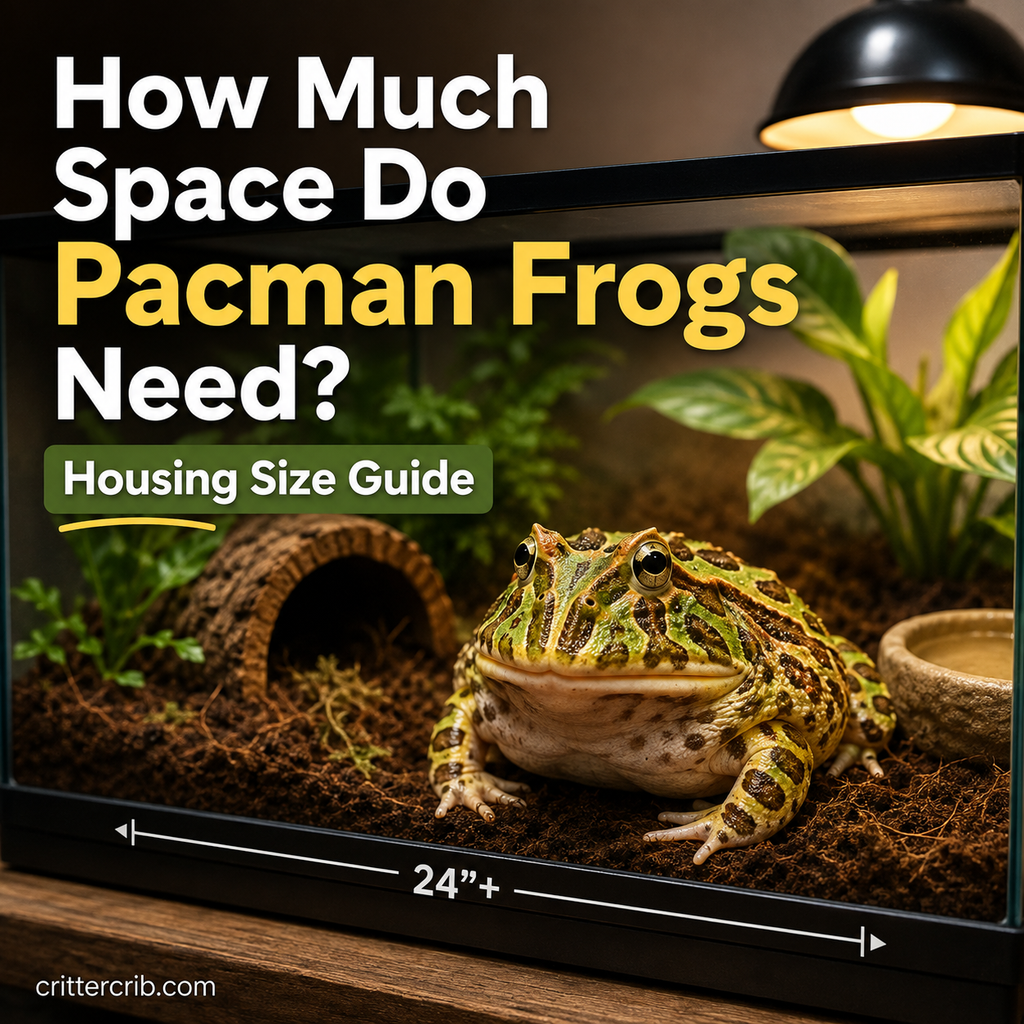
Pacman frogs aren’t exactly known for roaming around their enclosure all day. In fact, a healthy Pacman frog may spend so much time sitting in the same spot that you start wondering whether it has moved at all.
That doesn’t mean enclosure size isn’t important.
A Pacman frog still needs enough room to burrow, reposition itself, thermoregulate, and move between slightly different areas of its habitat. At the same time, putting one in an enormous enclosure isn’t automatically better. A well-designed habitat with appropriate temperature, humidity, substrate, and hiding opportunities matters more than simply buying the biggest tank you can find.
So, how much space does a Pacman frog actually need?
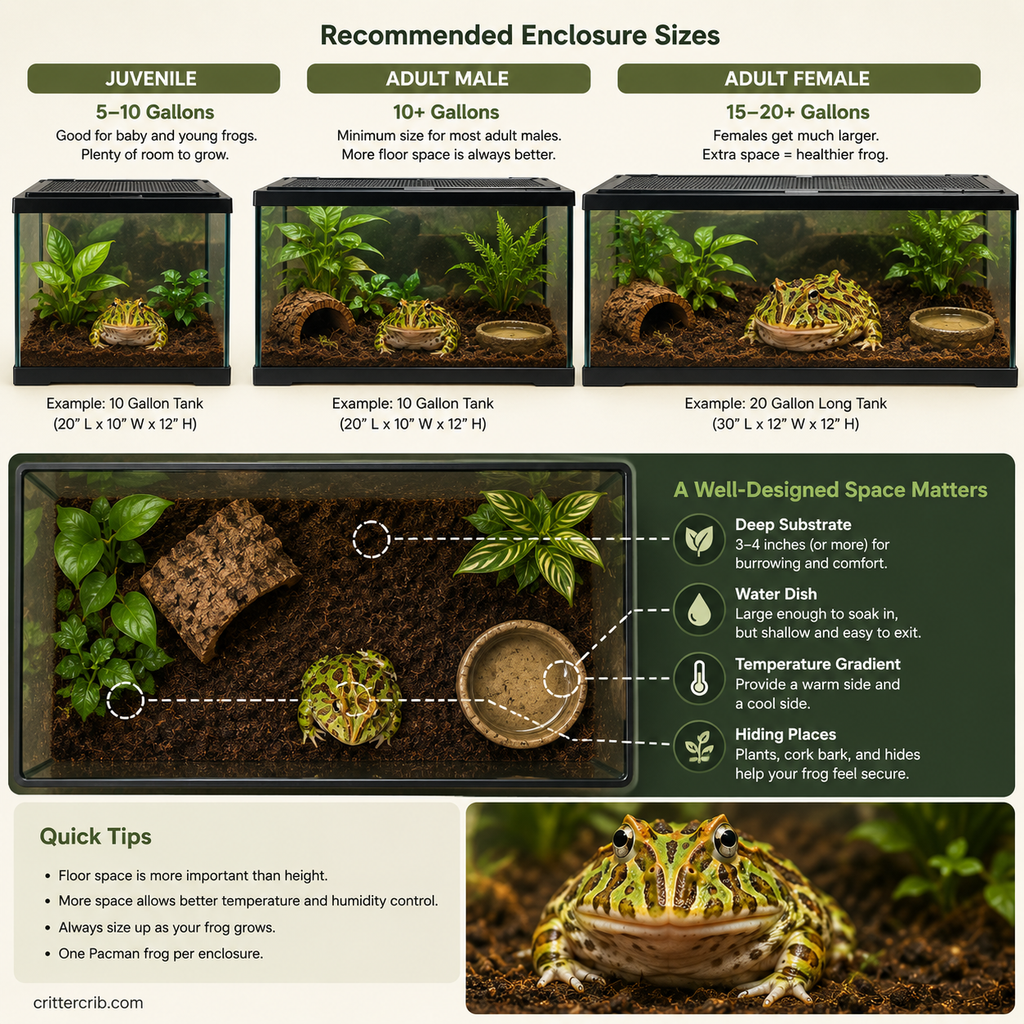
For most adult Pacman frogs, an enclosure with roughly 10 gallons of usable space is commonly considered a practical starting point, although larger frogs—especially females—can benefit from additional floor space. Juveniles can live in smaller setups temporarily, but their enclosure should be upgraded as they grow.
Here’s how to choose the right Pacman frog enclosure size and, just as importantly, make good use of the space you provide.
How Big of a Tank Does a Pacman Frog Need?
Pacman frogs are terrestrial amphibians, which means floor space is more important than height.
Unlike tree frogs, they aren’t going to spend their nights climbing branches or exploring the upper half of a tall terrarium. Pacman frogs typically stay at ground level and spend much of their time partially buried in substrate.
As a general guideline:
- Small juveniles can temporarily live in compact enclosures.
- Growing juveniles should receive more space as their body size increases.
- Most adults should have around 10 gallons or more of usable enclosure space.
- Large adult females may benefit from a 15- to 20-gallon enclosure or a similarly sized terrarium with generous floor space.
These aren’t magic numbers. The actual dimensions and layout matter.
A long, low enclosure is usually more useful to a Pacman frog than a tall enclosure with the same gallon capacity.
Pacman Frog Tank Size by Age
Pacman frogs grow considerably from the tiny frogs commonly sold in pet stores.
Buying an enclosure based only on your frog’s current size can mean replacing it sooner than expected.
Baby and Juvenile Pacman Frogs
A young Pacman frog doesn’t require a huge habitat immediately.
Smaller enclosures can actually make it easier to:
- Monitor feeding
- Locate waste
- Maintain the habitat
- Keep track of the frog’s condition
- Ensure prey is easily accessible
However, the enclosure still needs enough room for proper substrate depth, a water dish, and a temperature gradient.
As the frog grows, increase the available space.
You don’t necessarily need to purchase several tanks along the way. Many owners simply start with an enclosure large enough for the frog’s eventual adult size and arrange it appropriately for a juvenile.
Adult Male Pacman Frogs
Male Pacman frogs generally remain smaller than females.
An enclosure around 10 gallons can provide sufficient space for many adult males when properly arranged.
Floor dimensions are more important than the gallon number printed on the packaging. The frog should have enough room to turn comfortably, burrow in different locations, and move between warmer and cooler portions of the habitat.
Adult Female Pacman Frogs
Females can become substantially larger and heavier than males.
For a large female, moving beyond a basic 10-gallon setup can provide noticeably more usable floor area.
A 15- or 20-gallon enclosure—or a terrarium with comparable floor dimensions—can make it easier to create distinct temperature zones while leaving plenty of room for substrate and a water dish.
If your frog looks oversized relative to its habitat, upgrading is a reasonable choice even if the current enclosure technically meets a minimum recommendation.
Floor Space Matters More Than Height
When comparing Pacman frog enclosures, don’t focus entirely on gallons.
Two tanks can hold approximately the same amount of water while having very different dimensions.
For a Pacman frog, a wider enclosure generally provides more useful space than a narrow, tall one.
Why?
Because Pacman frogs spend almost all their time on or beneath the substrate.
Useful enclosure space allows the frog to:
- Burrow
- Turn around easily
- Choose different resting locations
- Move toward or away from a heat source
- Access its water dish
- Hunt or accept food comfortably
Vertical space can still be useful for accommodating substrate depth, plants, lighting, and equipment, but excessive height doesn’t give a Pacman frog much additional living area.
When choosing between two similarly sized enclosures, prioritize the one with the larger footprint.
Do Pacman Frogs Need a Lot of Room?
Compared with many reptiles and amphibians, Pacman frogs have relatively modest space requirements.
They are ambush predators.
Rather than actively pursuing prey over long distances, a Pacman frog typically settles into a position, partially buries itself, and waits for food to come within striking distance.
That sedentary lifestyle is one reason they can thrive in relatively compact habitats.
However, “sedentary” shouldn’t be interpreted as “doesn’t need space.”
Even a frog that spends several days in one burrow needs an environment large enough to support proper husbandry.
The enclosure has to accommodate much more than the frog itself.
You need room for:
- Deep substrate
- A shallow water dish
- A temperature gradient
- Appropriate humidity
- Hiding or sheltered areas
- Feeding access
- Maintenance and cleaning
A cramped container may physically fit the frog while failing to provide a suitable habitat.
Can a Pacman Frog Tank Be Too Big?
This question comes up frequently with young Pacman frogs.
A larger enclosure isn’t inherently dangerous simply because it has extra space. Problems usually come from how that space is managed.
For example, a very large enclosure may make it harder for a keeper to monitor a tiny juvenile or ensure that food is easily accessible.
Large habitats can also be more complicated to manage if you’re struggling to maintain appropriate temperature and humidity.
On the other hand, a properly designed larger enclosure can work well.
If you’re placing a juvenile in an adult-sized habitat:
- Provide plenty of substrate.
- Keep feeding controlled and easy to monitor.
- Make sure the frog can easily reach its water dish.
- Monitor temperature across the enclosure.
- Provide sheltered areas rather than leaving the entire enclosure exposed.
You don’t have to keep upgrading through several different tank sizes if you can create an appropriate adult-sized setup from the beginning.
How Deep Should Pacman Frog Substrate Be?
Enclosure size and substrate depth go hand in hand.
Pacman frogs naturally burrow, sometimes leaving little more than their eyes and the top of their head visible.
The substrate therefore isn’t just decoration. It’s part of the frog’s usable habitat.
Provide enough substrate for the frog to bury itself comfortably.
For many adult setups, several inches of substrate are appropriate, with additional depth potentially useful for larger frogs.
The exact amount depends partly on the frog’s size. A large adult obviously needs more depth to burrow completely than a small juvenile.
Suitable substrate also needs to hold moisture without becoming permanently waterlogged.
Commonly used options include appropriate moisture-retaining substrates intended for amphibian habitats. Whatever you use, make sure it is suitable for a burrowing frog and doesn’t introduce dangerous particles or chemicals.
How Much Space Should the Water Dish Take Up?
Pacman frogs need access to clean, dechlorinated water, but they’re not aquatic frogs.
You don’t need to turn half of the enclosure into a swimming pool.
A shallow water dish should be:
- Large enough for the frog to sit in
- Easy to enter and exit
- Stable enough that it won’t tip
- Shallow enough to reduce drowning risk
- Easy to remove and clean
Large Pacman frogs can displace a surprising amount of water when they climb into a dish, so choose one with their adult body size in mind.
The dish should provide useful soaking space without consuming most of the enclosure’s floor area.
This is another reason a slightly larger enclosure can be convenient for an adult female. You can accommodate a suitably sized water dish without sacrificing most of the usable substrate.
Pacman Frogs Need Room for a Temperature Gradient
One of the biggest problems with extremely small enclosures is temperature management.
Your frog shouldn’t be forced to sit directly beneath a heat source simply because there’s nowhere else to go.
A properly sized enclosure makes it easier to establish a warmer area and a cooler area.
The frog can then choose where it wants to sit.
This ability to move between microclimates is an important part of reptile and amphibian husbandry.
When setting up the enclosure, measure temperatures rather than guessing based on how the room feels.
A digital thermometer or temperature-monitoring setup can help you understand what’s actually happening inside the habitat.
Remember that heat can also affect humidity. Creating the right environment requires balancing both rather than treating them as unrelated factors.
Humidity Matters as Much as Enclosure Size
A perfectly sized Pacman frog enclosure can still be unsuitable if it’s too dry or constantly saturated.
Pacman frogs need a humid environment and moist substrate, but the enclosure shouldn’t become a stagnant swamp.
This balance depends on several factors:
- Ventilation
- Substrate
- Room humidity
- Temperature
- Enclosure design
- Misting or other moisture management
A larger enclosure may behave differently from a smaller one.
For example, switching from a compact plastic habitat to a larger screen-topped glass terrarium may increase moisture loss. You’ll need to monitor conditions and adjust your setup rather than assuming the same routine will work.
Use a hygrometer as a reference and pay attention to the condition of the substrate.
Do Pacman Frogs Need Hides?
A Pacman frog’s favorite hiding place is often the substrate itself.
Once buried, the frog may remain in the same location for surprisingly long periods.
That said, creating a sheltered environment can still help the frog feel secure.
You can use:
- Cork bark
- Frog-safe artificial plants
- Live plants suitable for the enclosure
- Leaf litter
- Appropriately sized hides
Make sure decorations cannot collapse onto the frog or trap it underneath.
Also remember that Pacman frogs are enthusiastic burrowers. They may completely rearrange whatever beautiful enclosure design you created.
The frog doesn’t care about your landscaping plans.
Should Pacman Frogs Be Housed Together?
No matter how large the enclosure is, Pacman frogs are generally best housed individually.
They’re solitary predators with enormous mouths and strong feeding responses.
Another frog moving nearby can potentially be mistaken for food, and size differences between animals can make the situation even more dangerous.
Cannibalism is a genuine concern with Pacman frogs.
Providing a 20-gallon tank instead of a 10-gallon tank doesn’t suddenly make cohabitation safe.
The simplest rule is:
One Pacman frog per enclosure.
If you want multiple Pacman frogs, plan on maintaining separate habitats.
Glass Tank or Front-Opening Terrarium?
Both can work.
The best enclosure is one that provides sufficient floor space while allowing you to maintain appropriate environmental conditions.
Glass Aquariums
Traditional glass aquariums are widely available and relatively inexpensive.
They can work well for Pacman frogs when equipped with a secure lid and an appropriate setup.
Their simple rectangular footprint also provides plenty of substrate area.
Front-Opening Terrariums
Front-opening terrariums can make feeding and maintenance more convenient.
Instead of reaching down from directly above the frog, you can access the enclosure from the front.
Just make sure the front doors leave enough room below them for the deep substrate Pacman frogs need.
Some terrarium designs provide more substrate depth than others.
Plastic Enclosures
Certain plastic tubs or purpose-built habitats can also work when properly ventilated and securely closed.
They may retain humidity effectively, although they aren’t always as visually appealing as glass terrariums.
Regardless of enclosure material, environmental stability matters more than appearance.
How to Set Up the Space Inside a Pacman Frog Enclosure
Buying the right tank is only step one.
A simple layout often works best.
1. Add Deep, Moist Substrate
Create enough depth for your frog to burrow comfortably.
Avoid packing the substrate so tightly that digging becomes difficult.
2. Create a Temperature Gradient
Position heating equipment appropriately so the entire enclosure doesn’t become equally warm.
Always control and monitor heating equipment rather than allowing temperatures to rise unchecked.
3. Add a Shallow Water Dish
Place the water dish somewhere the frog can access easily.
Keep it clean and replace the water regularly.
4. Provide Cover
Add plants, cork bark, leaf litter, or another safe form of shelter.
Don’t overcrowd the enclosure.
5. Leave Open Ground
Your Pacman frog still needs accessible substrate for burrowing and repositioning.
Decorating every square inch may look attractive to you but can actually reduce the amount of useful space available to the frog.
Signs Your Pacman Frog May Need a Larger Enclosure
Pacman frogs aren’t going to pace around their enclosure like an active lizard, so recognizing inadequate space isn’t always obvious.
Instead, evaluate the habitat itself.
Consider upgrading if:
- Your adult frog occupies a large percentage of the enclosure.
- The water dish takes up most of the remaining floor space.
- You cannot create meaningful warmer and cooler areas.
- There isn’t enough substrate area for comfortable burrowing.
- Decorations leave almost no open space.
- Your frog has substantially outgrown its juvenile setup.
- Maintaining stable conditions has become difficult because everything is crowded together.
An enclosure should function as a complete habitat, not simply a container large enough to hold the frog.
How Often Will a Pacman Frog Use Its Entire Enclosure?
Possibly not very often.
You might spend time creating an attractive habitat only to discover your frog has selected one corner and apparently intends to remain there forever.
That’s normal Pacman frog behavior.
Some frogs change burrows periodically, while others repeatedly return to the same general area.
The fact that your frog doesn’t constantly explore every inch doesn’t mean the unused space is pointless.
Extra floor area allows you to create different environmental zones and gives the frog the option to relocate when it chooses.
Choice is part of what makes the enclosure functional.
Is a 5-Gallon Tank Big Enough for a Pacman Frog?
A 5-gallon enclosure may be usable temporarily for a small juvenile, depending on its dimensions and setup.
It isn’t a great long-term target for most adult Pacman frogs.
Once you account for substrate, a water dish, shelter, and environmental gradients, a very small enclosure becomes restrictive quickly.
If you’re purchasing equipment for a frog you intend to keep long term, planning around its adult size is usually more practical.
Is a 10-Gallon Tank Big Enough for a Pacman Frog?
A 10-gallon enclosure is commonly used as a practical minimum-size setup for an adult Pacman frog, particularly a smaller male.
However, don’t evaluate an enclosure by gallon capacity alone.
Look at the dimensions.
A 10-gallon enclosure with useful horizontal floor space can be more suitable than a taller enclosure that technically holds more volume but offers little additional ground area.
Large females may benefit from moving up to a roomier enclosure.
Is a 20-Gallon Tank Too Big for a Pacman Frog?
A 20-gallon enclosure isn’t automatically too large for an adult Pacman frog.
It can actually provide useful extra room for a large female and make it easier to establish different environmental zones.
The key is setting it up properly.
A large, mostly empty enclosure isn’t necessarily better than a smaller, thoughtfully arranged habitat.
Provide appropriate substrate, shelter, humidity, temperatures, and accessible feeding opportunities.
What Size Enclosure Is Best for a Pacman Frog?
For many keepers, an enclosure providing approximately 10 to 20 gallons of space works well for an adult, with the exact choice depending on the frog’s size and the enclosure’s dimensions.
A smaller adult male may be perfectly comfortable in a properly arranged 10-gallon habitat.
A large female may be better suited to something closer to 15 or 20 gallons.
Rather than obsessing over one exact number, ask whether the enclosure provides enough usable floor space to meet all of the frog’s needs.
Your Pacman frog should be able to:
- Burrow completely
- Turn and reposition comfortably
- Reach its water dish easily
- Move between warmer and cooler areas
- Find shelter
- Feed without excessive difficulty
If the habitat accomplishes those things while maintaining appropriate environmental conditions, you’re on the right track.
Frequently Asked Questions About Pacman Frog Enclosure Size
What is the minimum tank size for a Pacman frog?
Around 10 gallons of usable enclosure space is commonly used as a starting point for adult Pacman frogs. Larger adults, particularly females, may benefit from 15 to 20 gallons or comparable floor space.
Do Pacman frogs need more floor space or height?
Floor space is more important. Pacman frogs are terrestrial and spend most of their time sitting on or burrowing into the substrate rather than climbing.
Can a baby Pacman frog live in a 10-gallon tank?
A juvenile can live in a larger enclosure as long as the habitat is properly arranged and the keeper can reliably monitor feeding and environmental conditions. You don’t necessarily have to start with a tiny enclosure.
Can an adult Pacman frog live in a 5-gallon tank?
A 5-gallon enclosure can become restrictive for an adult once you account for the water dish, substrate, shelter, and temperature gradient. A larger enclosure is generally a better long-term choice.
Is a 20-gallon enclosure good for a Pacman frog?
Yes, a properly designed 20-gallon enclosure can work well, particularly for a large adult. Prioritize horizontal floor area over unnecessary height.
How deep should a Pacman frog enclosure be?
The enclosure should be tall enough to accommodate several inches of substrate while leaving safe space for the frog, decorations, and any heating or lighting equipment. Substrate depth should allow the frog to burrow comfortably.
Do Pacman frogs need separate tanks?
Yes. Pacman frogs are generally best kept individually because of their solitary nature and strong feeding response. Housing two together can result in injury or cannibalism.
Do Pacman frogs need a large enclosure if they barely move?
They don’t require enormous habitats, but they still need enough space for burrowing, a water dish, shelter, and a temperature gradient. A frog remaining in one favorite spot doesn’t mean those other areas aren’t important.
Give Your Pacman Frog Usable Space, Not Just a Bigger Tank
Pacman frogs are relatively easy to accommodate compared with highly active amphibians, but enclosure size still deserves careful thought.
For most adults, think in the neighborhood of 10 gallons as a practical starting point, with 15 to 20 gallons providing additional room for larger frogs. More importantly, pay attention to the enclosure’s footprint.
Your frog lives at ground level.
A habitat with deep substrate, a safe water dish, appropriate temperatures, proper humidity, and enough open floor area to burrow and reposition is far more valuable than a tall tank filled with unused vertical space.
And don’t worry if you provide all that room only for your Pacman frog to spend three days sitting in exactly the same hole.
That’s about as Pacman frog as it gets.