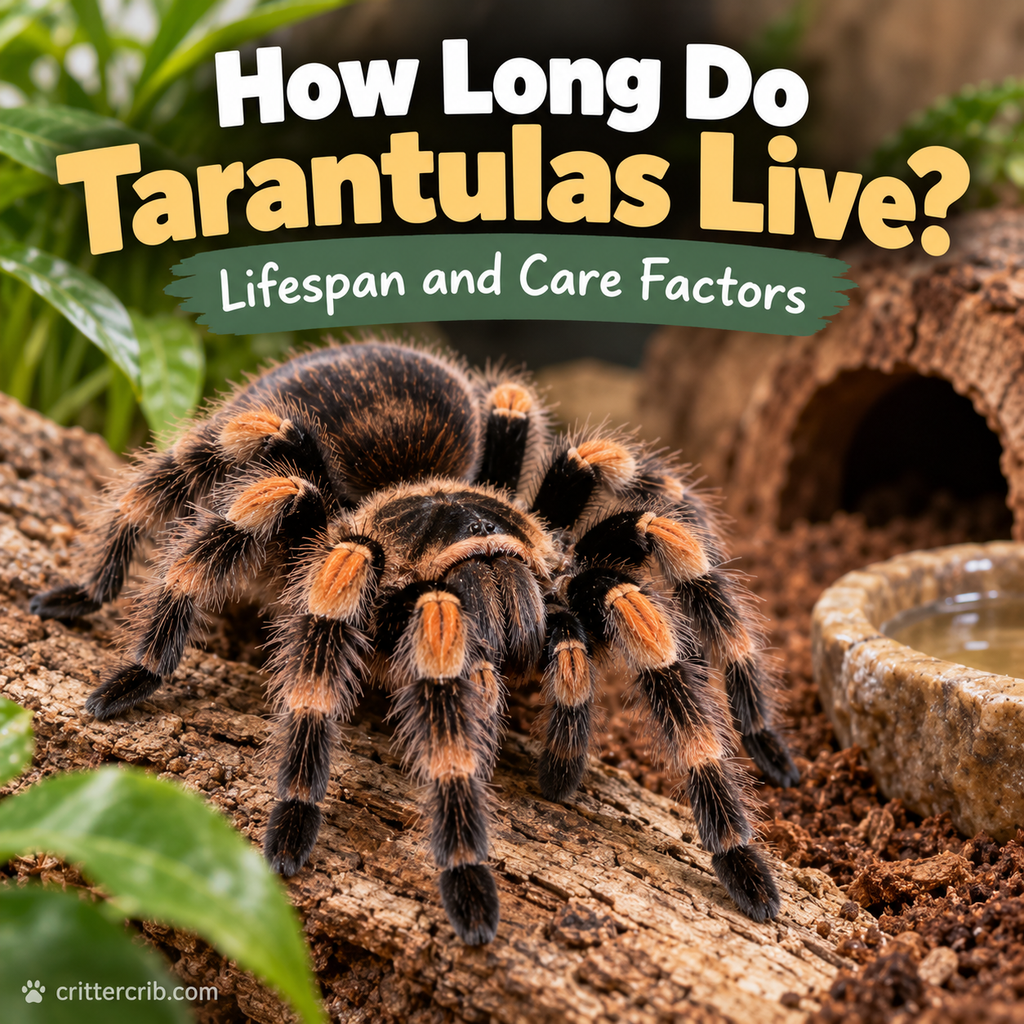
Tarantulas aren’t usually the first animals that come to mind when you think of long-lived pets. They’re small, don’t require daily walks, and spend a surprising amount of time doing very little. Yet some tarantulas can live for decades.
The catch is that lifespan varies dramatically between males and females.
Female tarantulas generally live much longer than males, with females of some species potentially surviving 20 years or more under good conditions. Males often live only several years because their lifespan is closely tied to reaching sexual maturity.
Species, sex, temperature, diet, hydration, enclosure conditions, and general husbandry can all influence how long a pet tarantula lives.
If you’re considering keeping one—or already have one sitting quietly in an enclosure—here’s what to expect.
How Long Do Tarantulas Live?
A tarantula’s lifespan can range from only a few years to several decades.
As a broad guideline:
- Female tarantulas may live around 10–25+ years, depending heavily on species.
- Male tarantulas commonly live around 3–10 years in total.
- Mature males usually have a much shorter remaining lifespan than mature females.
- Slow-growing species often live longer than fast-growing species.
These are general ranges rather than guarantees.
There are more than 1,000 described tarantula species, and they don’t all grow, mature, or age at the same rate. Even two individuals of the same species can have different lifespans.
One factor, however, stands out more than almost anything else: whether your tarantula is male or female.
Why Do Female Tarantulas Live Longer Than Males?
The lifespan difference between male and female tarantulas can be enormous.
Females continue living and molting after reaching sexual maturity. With suitable conditions, an adult female may remain alive for many years and continue producing new exoskeletons through periodic molts.
Males follow a different path.
Once a male reaches maturity, his biology becomes focused heavily on reproduction. Mature males often become more active and spend considerable time wandering in search of females.
Unlike females, mature males generally don’t continue through a normal lifelong cycle of molts.
This means buying a young tarantula without knowing its sex can make it difficult to predict how long you’ll have it.
A female may become a pet you’ll care for for decades. A male of the same species may have a much shorter lifespan.
Tarantula Lifespan by Species
Species makes a major difference in longevity.
Tarantulas come from a wide range of habitats, including tropical forests, dry scrublands, deserts, and grasslands. Different species have different growth rates, metabolisms, and reproductive timelines.
Some commonly kept terrestrial species are known for relatively slow growth and long female lifespans, while others develop more quickly.
Mexican Red Knee Tarantula Lifespan
The Mexican red knee tarantula (Brachypelma hamorii) is one of the most recognizable species in the hobby.
Females are known for their longevity and may live for 20 years or longer under favorable conditions. Males have considerably shorter lives and typically survive only a fraction of that time.
Their relatively slow growth contributes to their reputation as a long-term pet.
Anyone purchasing a young female Mexican red knee should be prepared for a commitment that could potentially span decades.
Chilean Rose Tarantula Lifespan
The Chilean rose tarantula (Grammostola rosea) is another species associated with impressive female longevity.
Females can potentially live well beyond a decade, with some captive individuals reported to survive 20 years or more.
Males again have much shorter lifespans.
This species is also known for a relatively slow metabolism and can sometimes go surprisingly long periods without eating, particularly when preparing to molt.
Curly Hair Tarantula Lifespan
The curly hair tarantula (Tliltocatl albopilosus) is popular because of its distinctive fuzzy appearance and generally manageable care requirements.
Females may live roughly 15–20 years or potentially longer with appropriate husbandry.
Males generally live significantly shorter lives.
As with other tarantulas, individual longevity isn’t guaranteed simply because the species is capable of reaching a certain age.
Pink Toe Tarantula Lifespan
Pink toe tarantulas, including Avicularia species commonly kept as pets, are arboreal tarantulas.
Females may live roughly 8–12 years or longer, depending on the species and conditions. Males tend to have shorter lifespans.
Because these tarantulas live above ground and rely heavily on climbing structures, their enclosure requirements differ from terrestrial species.
Good ventilation is especially important when keeping many arboreal tarantulas.
Greenbottle Blue Tarantula Lifespan
The greenbottle blue (Chromatopelma cyaneopubescens) is known for its striking coloration and extensive webbing.
Females may live around 10–15 years or longer, while males generally have considerably shorter lifespans.
They’re relatively fast growers compared with some of the slow-growing Brachypelma and Grammostola species.
How Long Do Male Tarantulas Live After Maturity?
Once a male tarantula reaches sexual maturity, the clock begins ticking much faster.
A mature male may live for months or potentially a few years after his final maturation molt, depending on species and individual conditions.
You may notice behavioral changes after maturity.
A mature male might:
- Wander around the enclosure frequently
- Spend more time near the walls
- Show less interest in food
- Produce sperm webs
- Appear more focused on escaping or exploring
- Become noticeably thinner over time
These behaviors aren’t necessarily signs that something is wrong with the enclosure.
They’re often related to the male’s natural drive to locate a mate.
If you purchased your tarantula as an unsexed juvenile, discovering that it is male can therefore significantly change your expected timeline.
How Can You Tell if a Tarantula Is Male or Female?
Determining a tarantula’s sex isn’t always easy, particularly when it’s young.
One of the more reliable methods involves examining a shed exoskeleton, or molt.
Sexing a Tarantula From a Molt
Experienced keepers can examine the inside of the abdominal portion of a sufficiently intact molt for reproductive structures associated with females.
This can sometimes allow a tarantula to be sexed before it reaches full maturity.
The smaller the spider, however, the more difficult this becomes.
Signs of a Mature Male
Once males mature, identification becomes easier in many species.
Mature males may develop:
- Bulb-shaped ends on the pedipalps
- Tibial hooks on the front legs in species that possess them
- Longer, leggier body proportions
- Increased wandering behavior
Not every species develops tibial hooks, so their absence doesn’t automatically mean a tarantula is female.
If knowing the sex is important to you, purchasing a confirmed female from a reputable breeder or seller is generally more reliable than guessing based on appearance.
What Factors Affect a Tarantula’s Lifespan?
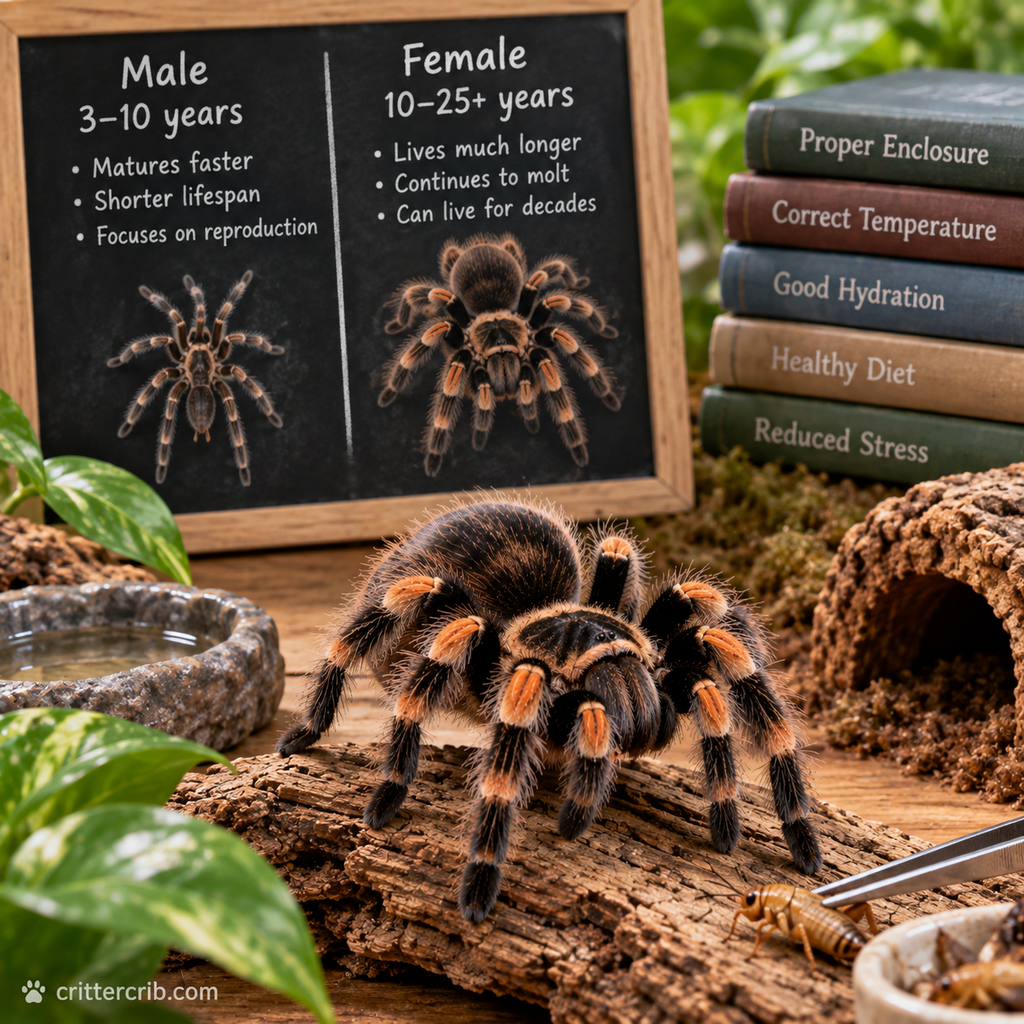
Genetics, sex, and species establish much of a tarantula’s potential lifespan, but husbandry still matters.
A tarantula kept in unsuitable conditions may experience stress, dehydration, injury, or molting problems.
Several care factors deserve particular attention.
Proper Hydration
Tarantulas need reliable access to water.
A shallow water dish should generally be available, even for species originating from relatively dry environments.
One common misconception is that desert or scrubland tarantulas don’t need water because their natural habitat is dry. They still need hydration.
Rather than relying solely on misting, provide an appropriately sized water dish and refill it when necessary.
For very small slings, hydration methods may differ because their tiny size requires extra care.
Temperature and Tarantula Lifespan
Most commonly kept tarantulas don’t require extreme heat.
In many cases, comfortable household temperatures within the appropriate range for the particular species are sufficient.
Excessive heat can be dangerous.
Warmer conditions can also influence metabolism and growth. A tarantula kept consistently warmer and fed heavily may grow more quickly than one developing under more moderate conditions.
That doesn’t mean deliberately keeping a tarantula cold to make it live longer.
Instead, research the species you’re keeping and maintain appropriate, stable conditions.
Avoid placing an enclosure:
- In direct sunlight
- Directly beside a heater
- Against a heating vent
- In areas with major temperature fluctuations
Direct sunlight can heat a small enclosure surprisingly quickly.
Feeding and Nutrition
Tarantulas are predators.
In captivity, they are commonly fed appropriately sized live prey such as:
- Crickets
- Dubia roaches
- Mealworms
- Superworms
- Other suitable feeder insects
The prey should be appropriate for the size of the spider.
Adult tarantulas generally don’t need to eat every day. Feeding frequency varies with age, species, body condition, temperature, and whether the spider is approaching a molt.
Spiderlings usually eat more frequently because they’re growing quickly.
Overfeeding doesn’t automatically create a healthier tarantula. A very large abdomen can make terrestrial tarantulas more vulnerable to serious injury if they fall.
Enclosure Size
Bigger isn’t always better when it comes to tarantula enclosures.
A tarantula needs enough room to move and behave normally, but enormous enclosures can make prey difficult to locate and may introduce unnecessary fall hazards.
The correct setup depends strongly on whether the species is:
- Terrestrial
- Fossorial
- Arboreal
Terrestrial tarantulas generally benefit from more horizontal space and sufficient substrate.
Fossorial species need deeper substrate that allows extensive burrowing.
Arboreal species need vertical space and suitable structures for climbing and webbing.
Design the enclosure around the spider’s natural lifestyle rather than simply choosing the largest container available.
Preventing Falls and Injuries
Falls are a particularly important concern for heavy-bodied terrestrial tarantulas.
A relatively short fall onto a hard object can rupture the abdomen, potentially causing a fatal injury.
To reduce the risk:
- Don’t provide excessive vertical space for terrestrial species.
- Use adequate substrate depth.
- Avoid sharp decorations.
- Secure rocks and heavy objects.
- Keep climbing heights appropriate for the species.
- Make sure enclosure lids are secure.
Arboreal tarantulas are built for climbing, so their enclosure layout is different.
Understanding whether your tarantula is terrestrial or arboreal is essential before setting up its home.
Humidity and Ventilation
There’s no universal “perfect humidity” for every tarantula.
Some species come from relatively dry environments, while others experience much more moisture.
Trying to keep every tarantula enclosure constantly wet can create problems.
Stagnant, overly damp conditions may encourage mold and other unwanted organisms. Good ventilation helps prevent the enclosure from becoming stuffy.
Instead of chasing a single humidity percentage for all tarantulas, research the natural conditions and husbandry recommendations for your particular species.
Molting and Tarantula Lifespan
Molting is one of the most vulnerable periods in a tarantula’s life.
Because tarantulas have an exoskeleton, they must shed it to grow.
Before a molt, a tarantula may:
- Stop eating
- Become less active
- Spend more time hiding
- Develop a darker abdomen
- Create a webbed molting area
Eventually, the spider may flip onto its back.
For a new keeper, this can look alarming.
A tarantula lying on its back is often molting—not dying.
Never Disturb a Molting Tarantula
Molting requires enormous effort, and the new exoskeleton remains soft for a period afterward.
Do not attempt to flip the spider over or handle it.
Remove uneaten live prey from the enclosure when you suspect a molt is approaching. Crickets and other feeder insects can potentially injure a vulnerable tarantula.
After the molt, wait until the fangs have hardened before offering food again. The amount of time required depends partly on the spider’s size.
Small tarantulas harden faster than large adults.
Fresh water should remain available throughout the process.
Does Handling Affect a Tarantula’s Lifespan?
Tarantulas generally don’t benefit from handling in the way many mammals do.
Handling introduces unnecessary risks.
The biggest concern isn’t necessarily that the spider will attack you. It’s that you might drop the spider.
A startled tarantula can suddenly bolt or move unexpectedly. A fall that seems insignificant to a person can seriously injure a terrestrial tarantula.
Handling can also expose people to defensive behaviors such as bites or, with many New World species, irritating urticating hairs.
For these reasons, tarantulas are usually best treated as observation pets.
You can still enjoy watching them hunt, web, burrow, molt, and explore without routinely picking them up.
Do Tarantulas Live Longer in Captivity?
A well-kept captive tarantula can potentially live a very long time.
Captivity removes several threats wild spiders face, including:
- Predators
- Extreme weather
- Food shortages
- Habitat destruction
- Some parasites
- Competition
- Difficulty finding water
However, captivity introduces its own risks.
Poor enclosure design, dehydration, excessive moisture, incorrect temperatures, falls, unsafe handling, and mistakes during molting can all cause problems.
Captivity itself doesn’t guarantee a longer life. Appropriate husbandry is what gives the animal the opportunity to reach its natural longevity.
How Can You Help a Tarantula Live Longer?
You can’t change your tarantula’s genetics or biological sex, but you can provide conditions that reduce avoidable risks.
Focus on the basics:
- Identify the species you’re keeping.
- Learn whether it’s terrestrial, fossorial, or arboreal.
- Provide an appropriately designed enclosure.
- Keep clean water available.
- Feed suitable prey in sensible amounts.
- Maintain species-appropriate temperature and moisture.
- Provide adequate ventilation.
- Minimize unnecessary handling.
- Remove uneaten prey before and during molts.
- Avoid unnecessary disturbance while the spider is molting.
Tarantula care doesn’t need to be complicated.
In fact, constantly interfering with the enclosure can sometimes cause more problems than maintaining a stable, appropriate setup and allowing the spider to behave naturally.
Are Tarantulas Good Long-Term Pets?
They certainly can be.
A confirmed female of a long-lived species may remain with you for 15, 20, or potentially even more years.
That’s worth considering before buying one.
Tarantulas require relatively little day-to-day attention compared with many traditional pets, but they’re still a long-term responsibility.
They need:
- Appropriate housing
- Fresh water
- Suitable feeder insects
- Periodic enclosure maintenance
- Safe conditions during molts
- Someone knowledgeable to care for them when you’re away
Their quiet lifestyle makes them appealing to people who enjoy observing animal behavior without needing constant interaction.
Frequently Asked Questions About Tarantula Lifespan
How long do pet tarantulas live?
Depending on sex and species, pet tarantulas may live anywhere from several years to more than 20 years. Females generally live substantially longer than males.
How long do female tarantulas live?
Female lifespan varies considerably by species. Some females may live around 10–15 years, while long-lived species can potentially survive 20 years or longer under good conditions.
How long do male tarantulas live?
Male tarantulas commonly have total lifespans of several years, although this varies by species. Once sexually mature, males generally have much less time remaining than females.
Can a tarantula live for 20 years?
Yes. Females of certain long-lived tarantula species can potentially live for 20 years or more.
Can tarantulas live for 30 years?
Exceptionally long lifespans are reported for females of some slow-growing species, but 30 years shouldn’t be treated as the expected lifespan for every tarantula. Species, individual biology, and care conditions all matter.
Why do male tarantulas die sooner?
Male tarantulas have a different reproductive life cycle. After reaching sexual maturity, males focus heavily on finding a mate and generally have a limited remaining lifespan compared with females, which continue molting and may survive for many more years.
How can I tell how old my tarantula is?
Determining an exact age can be difficult unless you know when the spider hatched. Size alone isn’t a reliable indicator because growth rates vary between species and individuals and are influenced by feeding and environmental conditions.
Do tarantulas stop eating before molting?
Yes. Refusing food is common before a molt and isn’t necessarily a reason for concern. Some tarantulas may fast for surprisingly long periods.
Do tarantulas need heat lamps?
Usually, a dedicated heat lamp isn’t necessary for commonly kept species when the room remains within an appropriate temperature range. Heat lamps can also create dangerously hot or dry areas in small enclosures. Always research the requirements of your particular species.
Final Thoughts
So, how long do tarantulas live?
The answer depends heavily on the tarantula sitting in front of you.
A male may live only several years, while a female from a long-lived species could potentially remain in your care for two decades or more. Species, growth rate, genetics, and sex establish much of that lifespan, while good husbandry helps give the spider the opportunity to reach it.
Fortunately, supporting a tarantula’s long-term health doesn’t require an elaborate routine.
Provide the right enclosure for the species, clean water, appropriate prey, sensible environmental conditions, and plenty of peace and quiet—especially during molts.
And if you’re shopping for your first tarantula, don’t overlook the importance of sex. Choosing a confirmed female could turn what seems like a small exotic pet into a companion you’ll be observing for a surprisingly large portion of your life.