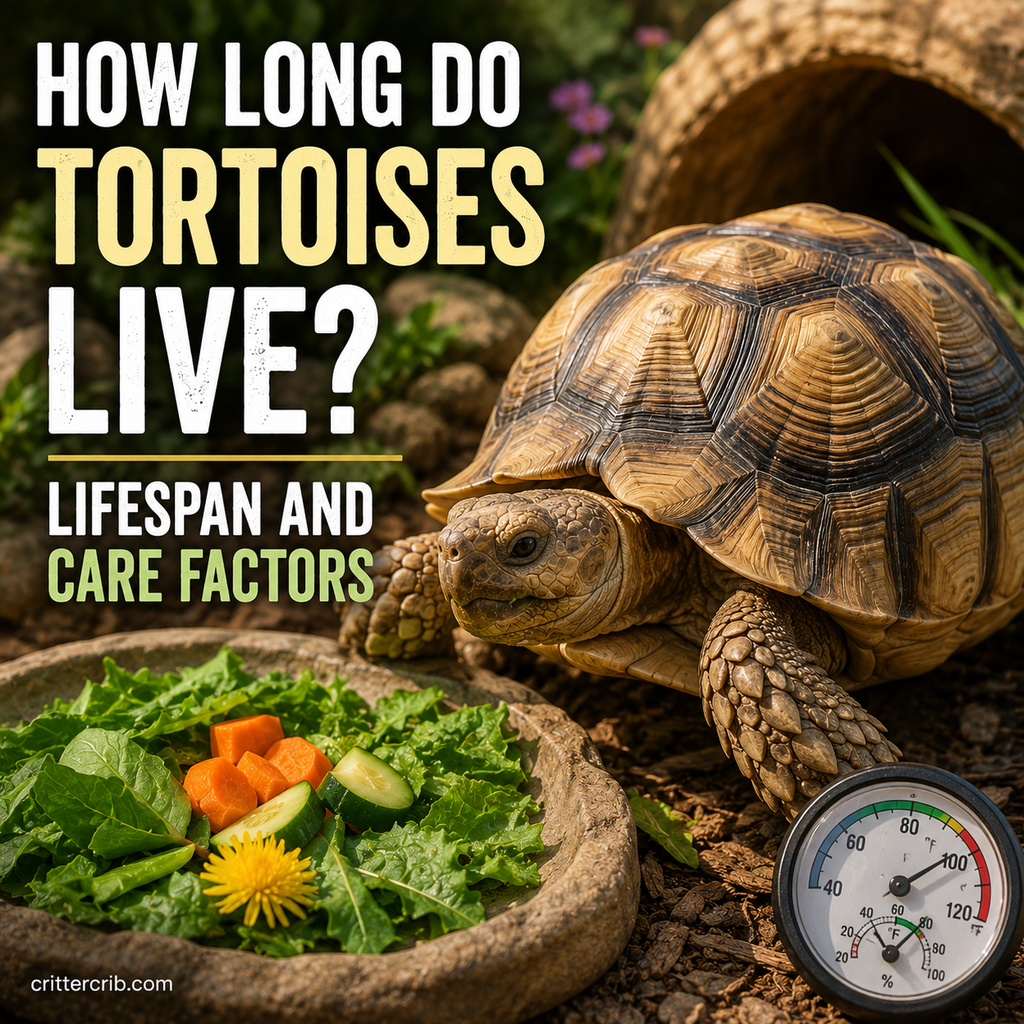
Bringing home a tortoise is very different from adopting most other pets. With proper care, some tortoises can live for many decades—and certain species may even outlive their owners.
So, how long do tortoises live?
Many commonly kept pet tortoises can live for 50 years or longer, while some species have the potential to reach 80, 100, or even more years under favorable conditions. Exactly how long an individual tortoise lives depends on its species, genetics, environment, nutrition, veterinary care, and overall husbandry.
That extraordinary lifespan is one of the things that makes tortoises fascinating. It’s also why getting one shouldn’t be an impulsive decision.
Here’s what prospective and current owners should know about tortoise lifespan and the care factors that can influence how long these reptiles live.
What Is the Average Lifespan of a Tortoise?
There isn’t one average lifespan that applies to every tortoise.
Tortoises are a diverse group of reptiles, ranging from relatively small Mediterranean species to enormous giant tortoises.
As a general rule, many pet tortoise species have the potential to live somewhere in the range of 50 to 100 years, although actual lifespans vary considerably.
Some individuals may live for less time because of disease, poor husbandry, injury, or other factors. Others can exceed typical expectations.
This means adopting a young tortoise can potentially be a commitment lasting for much of your own life.
Tortoise Lifespan by Species
Species is one of the biggest factors affecting how long a tortoise may live.
The numbers below should be viewed as general estimates rather than guarantees. Captive lifespan depends heavily on the individual animal and the quality of its care.
Russian Tortoise Lifespan
Russian tortoises are popular pets because of their manageable size and active personalities.
With appropriate care, a Russian tortoise can potentially live for 40 to 50 years or longer.
Some individuals may live considerably longer.
Their relatively small size sometimes leads people to assume they’re a short-term or easy pet, but adopting a young Russian tortoise can still represent a commitment spanning several decades.
Hermann’s Tortoise Lifespan
Hermann’s tortoises are another popular choice among reptile keepers.
They commonly have the potential to live for 50 years or more, and well-cared-for individuals may reach considerably greater ages.
Their long lifespan makes proper diet, UVB exposure, heating, and enclosure design especially important.
Small husbandry problems repeated over many years can have significant consequences.
Greek Tortoise Lifespan
Greek tortoises are also remarkably long-lived.
Depending on the individual and its care, a Greek tortoise may live for 50 years or longer, with some reaching much greater ages.
Because different populations and subspecies may have somewhat different environmental needs, owners should research the specific type they’re keeping rather than relying on generic tortoise care instructions.
Sulcata Tortoise Lifespan
Sulcata tortoises, also known as African spurred tortoises, present an especially significant long-term commitment.
They can potentially live for 70 years or longer, with some estimates extending well beyond that.
Their lifespan isn’t the only consideration.
Sulcatas grow extremely large compared with many commonly kept tortoises. An adorable hatchling can eventually become a powerful animal weighing dozens of pounds.
Anyone considering one should plan for the adult tortoise—not simply the small animal being purchased today.
Leopard Tortoise Lifespan
Leopard tortoises are another large and long-lived species.
They may live for 50 to 100 years under favorable conditions.
Like sulcatas, they require substantially more room as adults than many new owners initially expect.
Their long lifespan and eventual size mean housing plans need to account for decades of care.
Red-Footed Tortoise Lifespan
Red-footed tortoises are native to parts of South America and have somewhat different dietary and environmental requirements from arid or Mediterranean species.
They can potentially live for 50 years or more with appropriate care.
Maintaining suitable warmth, humidity, nutrition, and access to proper lighting can all contribute to long-term health.
Giant Tortoise Lifespan
Giant tortoises are famous for their longevity.
Some individuals have lived well beyond 100 years, making them among the longest-lived land animals.
Giant tortoises aren’t typical household pets, but they demonstrate just how remarkable tortoise longevity can be.
Why Do Tortoises Live So Long?
Scientists continue to study the biological mechanisms behind tortoise longevity.
Their long lives likely result from a combination of factors rather than one simple explanation.
Tortoises generally have slow metabolisms, slow growth rates, and life histories built around long-term survival.
Some research into long-lived tortoise species has also explored their cellular responses to aging, DNA damage, and disease.
In other words, tortoises aren’t simply ordinary reptiles that happen to survive for a long time. Their biology appears particularly well suited to longevity.
How Long Do Tortoises Live in Captivity?
Captivity can provide some major advantages.
A well-cared-for pet tortoise doesn’t need to contend with predators, severe food shortages, or many of the hazards a wild animal might encounter.
Owners can provide:
- Consistent access to appropriate food
- Fresh water
- Safe shelter
- Controlled temperatures
- UVB exposure
- Protection from predators
- Veterinary care
However, captivity doesn’t automatically guarantee a long life.
Poor husbandry can introduce entirely different risks, including nutritional deficiencies, obesity, metabolic bone disease, dehydration, respiratory problems, injuries, and inappropriate environmental conditions.
A tortoise’s lifespan in captivity therefore depends heavily on whether its biological needs are actually being met.
What Factors Affect a Tortoise’s Lifespan?
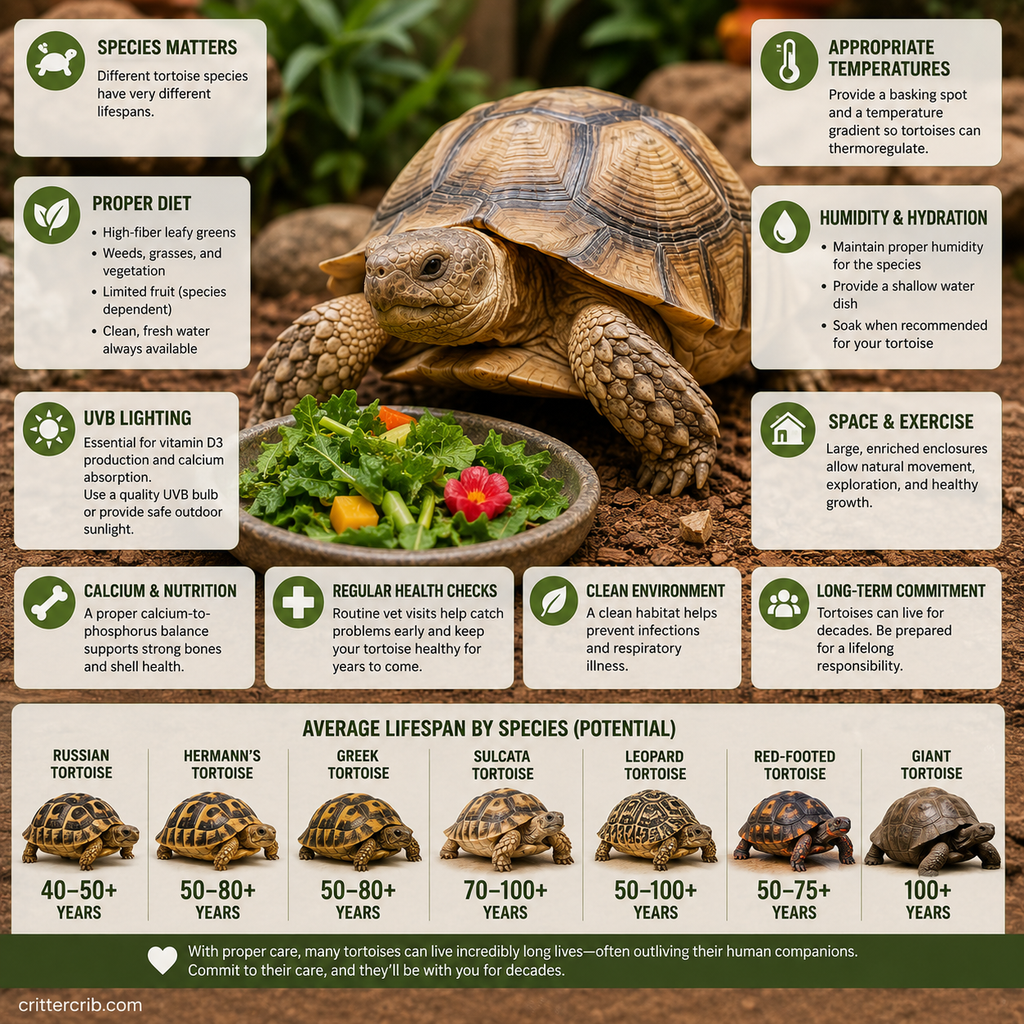
Genetics and species set part of the foundation, but day-to-day care can have a major influence on long-term health.
Several factors are especially important.
1. A Species-Appropriate Diet
One of the biggest mistakes in tortoise care is assuming every species should eat the same foods.
They shouldn’t.
Many commonly kept tortoises are primarily herbivorous, but their ideal diets can differ considerably.
Mediterranean and grazing species often thrive on diets built around appropriate leafy greens, weeds, grasses, and other high-fiber plant material.
Other species, such as red-footed tortoises, naturally consume a somewhat different variety of foods.
Before deciding what belongs in the food bowl, identify exactly which species you own.
Avoid Making Fruit a Staple for Species That Don’t Need It
Fruit can be particularly tempting because many tortoises readily eat it.
But a food being eagerly accepted doesn’t necessarily mean it should be offered regularly.
For species adapted to diets dominated by grasses, weeds, and fibrous vegetation, large amounts of sugary fruit aren’t appropriate.
Base the diet on the nutritional needs of the species rather than the foods it appears to enjoy most.
2. Proper UVB Lighting
UVB exposure plays an important role in reptile health.
Tortoises use UVB radiation to help produce vitamin D3, which is involved in calcium metabolism.
Without appropriate UVB exposure, a tortoise can develop serious health problems even if other parts of its care seem adequate.
Outdoor access to natural sunlight can be beneficial when conditions are appropriate and the enclosure is safe.
Indoor tortoises generally require a suitable reptile UVB lighting system.
UVB bulbs don’t remain effective indefinitely. Follow manufacturer recommendations and monitor the setup rather than assuming a bulb is still providing adequate UVB simply because it continues producing visible light.
3. Correct Temperatures
Tortoises are ectothermic.
They rely on environmental heat to regulate their body temperature, digestion, activity, and other physiological processes.
An enclosure should provide a temperature gradient rather than being uniformly hot or cold.
This generally includes:
- An appropriate basking area
- Cooler areas for retreat
- Suitable daytime temperatures
- Safe nighttime temperatures
Exact requirements vary by species.
Use reliable digital thermometers and, where useful, an infrared temperature gun to monitor conditions.
Guessing based on how the enclosure feels isn’t accurate enough.
4. Appropriate Humidity
Humidity requirements vary substantially among tortoise species and life stages.
Keeping an animal that’s adapted to one type of environment under completely different conditions can contribute to health problems.
Young tortoises may also have different hydration and humidity requirements than many outdated care guides suggest.
Research the needs of your particular species and provide suitable microclimates within the enclosure.
This can include appropriately humid hiding areas when necessary.
5. Hydration
Tortoises can become dehydrated even when a water bowl is present.
Provide clean drinking water in a shallow, easily accessible container.
The bowl should be stable enough that the tortoise can’t constantly overturn it.
Depending on the species, age, environment, and veterinary recommendations, periodic soaking may also form part of a hydration routine.
Water availability, humidity, diet, and temperature all work together, so hydration shouldn’t be treated as an isolated part of husbandry.
6. Enough Space and Exercise
Tortoises need more than a small glass tank.
Even smaller species can be surprisingly active when given enough room.
A suitable habitat should allow a tortoise to:
- Walk and explore
- Bask
- Find shade
- Hide
- Forage
- Move between warmer and cooler areas
- Display natural behaviors
Larger species require dramatically more space.
Sulcatas in particular can become powerful animals capable of digging, pushing objects, and testing enclosure boundaries.
Planning for adult size is essential.
7. Maintaining a Healthy Weight
Overfeeding doesn’t equal better care.
Captive tortoises may have easy access to calorie-dense foods while getting less exercise than their wild counterparts.
Regularly monitor your tortoise’s growth and body condition.
Rapid growth isn’t necessarily desirable.
A balanced species-appropriate diet, adequate space, and opportunities for natural movement are much more important than trying to make a tortoise grow as quickly as possible.
8. Calcium and Mineral Balance
Calcium is essential for healthy bones and shell development.
A proper diet should provide a favorable nutritional balance, and some tortoises may require appropriate calcium supplementation depending on their diet and husbandry.
However, supplementation should complement—not compensate for—a poor diet or inadequate UVB exposure.
Nutrition, calcium, vitamin D3, and UVB all interact.
If you’re uncertain about supplementation, consult a veterinarian experienced with reptiles.
9. Veterinary Care
Tortoises can hide signs of illness surprisingly well.
By the time symptoms become obvious, a health problem may already be advanced.
Watch for changes such as:
- Loss of appetite
- Unexplained weight loss
- Swollen or closed eyes
- Nasal discharge
- Noisy or labored breathing
- Unusual lethargy
- Shell abnormalities
- Changes in stool
- Difficulty walking
- Injuries
- Sudden behavioral changes
Establishing a relationship with a reptile-experienced veterinarian before an emergency occurs can make getting appropriate treatment much easier.
10. Safe Outdoor Housing
For species and climates where outdoor housing is appropriate, access to natural sunlight and additional space can be extremely beneficial.
But an outdoor enclosure must be secure.
Potential hazards include:
- Dogs
- Raccoons and other wildlife
- Birds of prey
- Toxic plants
- Pesticides
- Escape routes
- Extreme heat
- Cold temperatures
- Flooding
- Falling objects
Never assume a tortoise is protected simply because it has a shell.
Dogs in particular can seriously injure tortoises.
Common Care Mistakes That May Shorten a Tortoise’s Life
Many long-term health problems develop gradually.
Common husbandry mistakes include:
- Feeding an inappropriate diet
- Offering excessive fruit
- Inadequate UVB exposure
- Incorrect temperatures
- Chronic dehydration
- Improper humidity
- Insufficient space
- Overfeeding
- Poor calcium balance
- Unsafe outdoor housing
- Ignoring early symptoms of illness
- Keeping different species under identical conditions
A tortoise may survive inappropriate care for some time, which can make it seem as though the setup is working.
Survival isn’t the same thing as thriving.
Good husbandry is about supporting the animal’s health over decades.
How Can You Help a Tortoise Live a Long Life?
There isn’t a trick that guarantees your tortoise will reach a particular age.
Instead, focus on consistently getting the fundamentals right.
A good long-term care routine includes:
- Identify the exact species you own.
- Research its natural habitat and dietary needs.
- Provide sufficient space for the adult animal.
- Maintain appropriate temperatures and humidity.
- Provide proper UVB exposure.
- Feed a varied, species-appropriate diet.
- Keep clean water available.
- Monitor weight and shell development.
- Maintain a clean, safe habitat.
- Arrange veterinary care when health concerns appear.
Consistency matters enormously when caring for an animal that may live for half a century or more.
Think About Who Will Care for Your Tortoise in the Future
This isn’t something most people need to consider when buying a hamster or adopting an older dog.
With a tortoise, it’s worth thinking about.
A healthy tortoise acquired when you’re young could still be alive many decades later.
Owners should consider what would happen if they eventually became unable to provide care.
That might mean discussing the tortoise with family members, keeping detailed husbandry records, or including the animal in long-term planning.
For particularly long-lived species, future care isn’t a pessimistic subject. It’s responsible ownership.
Frequently Asked Questions About Tortoise Lifespan
Can tortoises live for 100 years?
Yes, some tortoises can live for 100 years or longer.
This is particularly well documented among giant tortoises, although some other tortoise species are also exceptionally long-lived.
Not every pet tortoise will reach 100. Species, genetics, environment, nutrition, disease, injuries, and quality of care all influence lifespan.
How long do small pet tortoises live?
Small size doesn’t necessarily mean a short lifespan.
Species such as Russian and Hermann’s tortoises can potentially live for several decades, with some individuals reaching 50 years or considerably longer.
Don’t choose a smaller tortoise under the assumption that it represents a short-term commitment.
Do tortoises live longer than turtles?
It’s difficult to make a blanket comparison because both groups contain many different species.
Some tortoises are extraordinarily long-lived, particularly giant species, but certain aquatic and semi-aquatic turtles can also live for many decades.
Species is much more useful than the general label “turtle” or “tortoise” when estimating lifespan.
What is the oldest tortoise?
One of the most famous examples is Jonathan, a Seychelles giant tortoise living on the island of St. Helena.
Jonathan hatched in the early 1830s, based on historical estimates, making him more than 190 years old.
His remarkable age illustrates the extraordinary longevity some tortoise species are capable of achieving.
How can you tell how old a tortoise is?
Determining the exact age of an adult tortoise is difficult unless its hatch date or early history is known.
Counting growth rings on the shell isn’t a reliable way to determine exact age. Growth patterns are influenced by nutrition, climate, seasonal conditions, and other factors.
A veterinarian or experienced specialist may be able to estimate an age range based on size, shell condition, and development, but this usually won’t provide an exact birth year.
Is a tortoise a lifetime commitment?
Potentially, yes.
Many popular pet tortoises can live for 50 years or longer, so purchasing a young animal should be treated as a very long-term responsibility.
Depending on your age and the tortoise species, you may even need a plan for someone else to care for the animal in the future.
Final Thoughts
Tortoises aren’t simply long-lived compared with other reptiles. Some are among the longest-lived land animals on Earth.
Many popular pet species can potentially live for 50 years or more, while particularly long-lived tortoises may reach or exceed a century.
But longevity isn’t automatic.
Diet, UVB exposure, temperature, hydration, humidity, space, exercise, veterinary care, and protection from injury all contribute to long-term health.
The most important first step is understanding the specific tortoise you have. Care requirements that work well for one species may be inappropriate for another.
If you’re considering getting a tortoise, think beyond the hatchling or juvenile in front of you. Consider its adult size, housing requirements, ongoing expenses, and potentially extraordinary lifespan.
You aren’t just choosing a pet for the next few years. You may be choosing an animal that will be part of your life for decades.