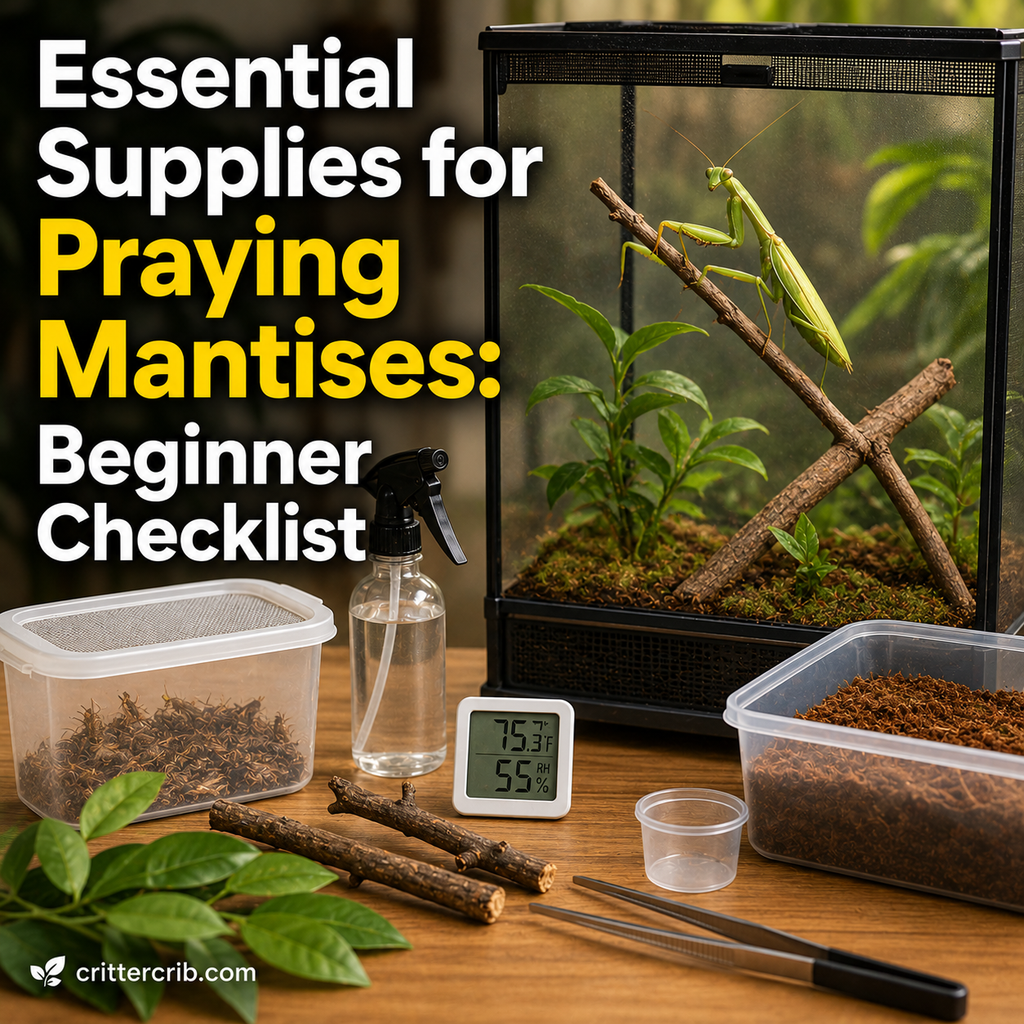
Bringing home a praying mantis doesn’t require a shopping cart full of expensive equipment. Compared with many exotic pets, mantises have fairly simple setups.
Simple doesn’t mean you can put one in a jar and call it a day, though.
The right enclosure, ventilation, climbing surfaces, appropriate humidity, and correctly sized live prey all matter. Molting makes enclosure setup especially important because a mantis needs enough vertical space to hang upside down and shed its old exoskeleton safely.
If you’re getting your first mantis, this checklist covers the essential praying mantis supplies you’ll want before your new pet arrives, along with a few optional items that can make care easier.
Praying Mantis Supplies at a Glance
For most pet mantises, your basic setup will include:
- Appropriately sized enclosure
- Secure, well-ventilated lid
- Safe substrate
- Climbing branches or twigs
- Suitable surfaces for hanging
- Live feeder insects
- Feeder insect container
- Fine misting bottle
- Thermometer
- Hygrometer when humidity monitoring is useful
- Feeding tongs
- Basic cleaning supplies
Depending on the species and temperature of your home, you may also need controlled supplemental heating.
Before buying equipment, identify the species you’re planning to keep. A ghost mantis, orchid mantis, giant Asian mantis, and other commonly kept species don’t necessarily have identical environmental requirements.
1. A Proper Praying Mantis Enclosure
The enclosure is the most important item on your shopping list.
Mantises need a secure habitat with enough room to move, climb, hunt, and molt.
Popular options include:
- Acrylic enclosures
- Glass terrariums
- Mesh enclosures
- Modified plastic containers
- Purpose-built invertebrate enclosures
The exact style matters less than whether it provides appropriate space and ventilation.
How Big Should a Praying Mantis Enclosure Be?
A useful general guideline is to provide an enclosure approximately:
- Three times the mantis’s body length in height
- Two times its body length in width
More room is fine as long as the mantis can still locate prey easily.
Height is especially important.
During a molt, a mantis hangs upside down and gradually pulls itself free from its old exoskeleton. If the enclosure is too short or decorations block the space underneath, the mantis may not have enough room to molt properly.
Don’t Start Too Large With Tiny Nymphs
A huge enclosure isn’t always better for a baby mantis.
Very small nymphs can have difficulty finding tiny feeder insects in an oversized habitat.
Starting with a smaller enclosure and upgrading as the mantis grows often makes feeding and monitoring easier.
2. A Secure, Ventilated Lid
Mantises can climb extremely well.
An unsecured lid can quickly turn into an escaped-mantis search.
The enclosure should close securely while still allowing adequate airflow.
Ventilation helps:
- Reduce stagnant air
- Control excessive condensation
- Lower the risk of mold
- Allow the enclosure to dry between mistings
- Maintain healthier overall conditions
Many setups use ventilation on more than one side to encourage airflow.
The exact amount needed depends on species and humidity requirements.
Make Sure the Mantis Can Hang From the Top
The underside of the lid is important.
Mantises frequently hang upside down when resting and molting. A smooth surface that offers no grip isn’t ideal.
Fine mesh or another safe textured surface can provide secure footing.
Avoid sharp wire or materials that could damage the mantis’s feet.
3. Safe Substrate
The bottom of a mantis enclosure doesn’t need to be complicated.
Substrate mainly helps absorb moisture, maintain humidity, and make routine cleaning easier.
Options may include:
- Coconut fiber
- Organic soil without fertilizers or pesticides
- Sphagnum moss
- Paper towel for simple temporary setups
- Species-appropriate naturalistic substrate mixtures
For a basic beginner enclosure, a thin layer is usually sufficient.
Mantises don’t generally require deep burrowing substrate like many terrestrial tarantulas or millipedes.
Paper Towel vs. Natural Substrate
Paper towel is inexpensive and easy to replace, making it useful for temporary enclosures or young mantises.
Natural substrate creates a more attractive environment and can help maintain humidity.
Neither approach is automatically better.
Choose based on the species, enclosure design, and how naturalistic you want the setup to be.
4. Climbing Branches and Twigs
A nearly empty enclosure isn’t suitable for a mantis.
These insects spend much of their time perched above the ground.
Provide branches or twigs that allow your mantis to:
- Climb
- Rest
- Hunt
- Reach the enclosure ceiling
- Choose different positions
Arrange them securely so they don’t fall when the mantis climbs across them.
Branches shouldn’t crowd every inch of the habitat. Your mantis still needs clear open areas beneath its preferred hanging spots for molting.
5. Safe Molting Surfaces
Molting deserves special attention because it’s one of the most vulnerable periods in a mantis’s life.
Your mantis needs surfaces it can grip securely while hanging upside down.
Suitable surfaces can include:
- Fine mesh
- Textured enclosure ceilings
- Secure twigs
- Artificial plant stems
- Other species-safe climbing materials
Before introducing the mantis, look at the enclosure from its perspective.
Can it easily reach the top?
Can it grip the ceiling?
Is there open space underneath?
If the answer to any of those questions is no, adjust the setup.
6. Artificial or Live Plants
Plants aren’t strictly required, but they can improve the enclosure considerably.
They provide:
- Climbing surfaces
- Visual cover
- Perching areas
- A more natural appearance
Artificial plants are easy to clean and don’t require lighting or watering.
Live plants can create a beautiful display enclosure but add another layer of maintenance.
If you use live plants, make sure they haven’t been treated with pesticides or other chemicals that could harm your mantis.
Avoid plants with sharp spines, sticky sap, or other potentially hazardous features.
7. A Fine Misting Bottle
A small misting bottle is one of the most useful mantis care supplies.
Many mantises obtain water by drinking droplets from enclosure surfaces after misting.
A fine spray works better than blasting the enclosure with large amounts of water.
Misting can also help maintain humidity.
How often you need to mist depends on:
- Species
- Ventilation
- Room humidity
- Temperature
- Substrate
- Enclosure size
The goal isn’t to keep the habitat constantly soaked.
Allowing some drying between mistings can help prevent stagnant, moldy conditions.
8. Thermometer
A small digital thermometer makes it much easier to know what’s happening inside the enclosure.
Don’t rely entirely on how warm the room feels.
Different mantis species have different preferred temperature ranges, and conditions inside an enclosure may differ from the surrounding room.
Place the thermometer where it provides a useful representation of the habitat rather than directly against a heating source.
9. Hygrometer
A hygrometer measures relative humidity.
Whether you absolutely need one depends on the species and your experience level, but it’s useful for beginners—particularly with mantises that have more specific humidity requirements.
Digital thermometer/hygrometer combinations are convenient because they monitor both conditions at once.
Remember that a humidity percentage doesn’t tell the whole story.
Ventilation is equally important.
A humid enclosure with stagnant air isn’t necessarily healthier than one with slightly lower humidity and good airflow.
10. Heating Equipment, If Necessary
Not every mantis enclosure requires supplemental heat.
If your room naturally stays within an appropriate temperature range for the species, additional heating may be unnecessary.
For species requiring warmer conditions, you may need a controlled heat source.
Any supplemental heating should be:
- Appropriate for the enclosure
- Positioned safely
- Monitored with a thermometer
- Controlled to prevent overheating
Avoid placing a mantis where direct sunlight can heat the enclosure.
A small glass or plastic habitat can become dangerously hot much faster than you might expect.
Research the temperature requirements of your particular species before purchasing heating equipment.
11. Live Feeder Insects
Mantises are predators.
That means live prey is one of the most important ongoing supplies you’ll need.
Depending on the size and species of your mantis, suitable feeders may include:
- Fruit flies
- Houseflies
- Blue bottle flies
- Small roaches
- Crickets
- Locusts where available and appropriate
- Other captive-raised feeder insects
Prey should be appropriately sized for the mantis.
Tiny nymphs may begin with fruit flies, while larger mantises can handle larger prey.
Buy Feeders From Reliable Sources
Avoid routinely collecting insects outdoors.
Wild insects may have been exposed to:
- Pesticides
- Parasites
- Environmental contaminants
Captive-raised feeders from reputable sources are generally easier to manage and provide more predictable feeding.
12. A Feeder Insect Container
Don’t forget that your mantis’s food needs somewhere to live too.
If you’re keeping flies, roaches, or other feeders, you’ll need suitable containers for maintaining them between feedings.
What you need depends on the feeder.
Fruit fly cultures, for example, are often maintained in ventilated culture cups.
Larger feeders may require separate ventilated containers, food, and hydration.
Before buying a mantis, think about whether you’re comfortable storing live insects in your home.
For many new keepers, managing the feeders is actually more work than maintaining the mantis.
13. Feeding Tongs
Long feeding tongs can be useful for offering or removing prey without putting your fingers directly next to the mantis.
They’re particularly handy for:
- Moving feeder insects
- Removing uneaten prey
- Adjusting small decorations
- Routine enclosure maintenance
Use them carefully.
Don’t poke the mantis or try to force food into its mouth.
Many mantises are perfectly capable of hunting loose prey without assistance.
14. A Small Catch Cup
A clear plastic cup is an inexpensive but surprisingly useful piece of equipment.
Keep one nearby for:
- Temporarily containing the mantis
- Catching an escapee
- Moving the mantis during enclosure changes
- Transferring feeder insects
Trying to grab a fast-moving mantis with your hands can result in injury to the animal.
A cup-and-card method is often much safer.
15. Basic Cleaning Supplies
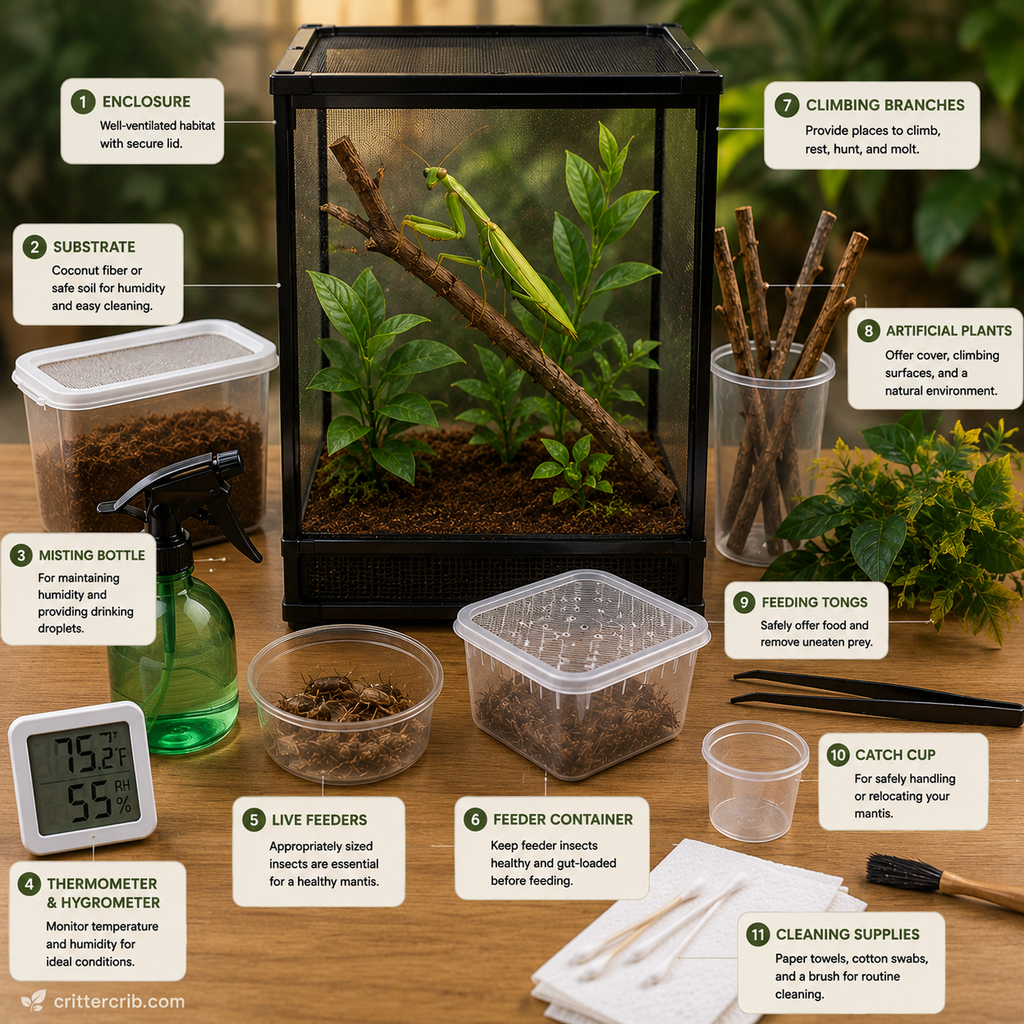
Mantis enclosures are fairly easy to maintain.
Keep a few dedicated supplies nearby:
- Paper towels
- Cotton swabs
- Small soft brush
- Feeding tongs
- Clean cloth
- Spare substrate
Remove uneaten prey and insect remains before they accumulate.
Wipe dirty enclosure surfaces as necessary.
Avoid spraying household cleaners, pesticides, fragrances, or disinfectants around an occupied mantis enclosure.
What You Probably Don’t Need
Pet stores and online marketplaces offer plenty of accessories, but mantises don’t require much equipment.
For most setups, you can skip:
- Large water bowls
- Decorative heat rocks
- Bright nighttime lights
- Deep substrate
- Expensive electronic equipment
- Elaborate feeding dishes
- Huge enclosures for tiny nymphs
- Excessive decorations
A simple enclosure designed around the mantis’s actual biology is better than an expensive setup filled with unnecessary accessories.
Do Praying Mantises Need a Water Bowl?
Generally, mantises don’t require a traditional water bowl.
Many drink droplets from leaves, enclosure walls, and other surfaces after misting.
Deep standing water can also create an unnecessary hazard for small mantises.
A fine misting routine appropriate for the species is usually more useful than adding a large dish.
Do Praying Mantises Need a Heat Lamp?
Not automatically.
Some species do well at typical warm indoor temperatures, while others require additional heat.
A heat lamp can also dry or overheat a small enclosure quickly.
Start by researching the species’ temperature requirements and measuring the actual enclosure temperature.
Only add heating if it’s needed.
Do Praying Mantises Need UVB Lighting?
Mantises generally aren’t kept with UVB lighting as an essential husbandry requirement in the way certain reptiles are.
A normal day-night cycle is still useful.
Ambient room lighting or appropriate enclosure lighting can provide that cycle, particularly for display setups containing live plants.
Avoid leaving bright lights on continuously.
Setting Up Your Praying Mantis Enclosure
Once you have your supplies, assemble everything before bringing the mantis home.
A basic setup can be completed in a few steps:
- Choose an appropriately sized enclosure.
- Add ventilation if necessary.
- Install a secure, grippable lid or ceiling.
- Add a thin layer of suitable substrate.
- Position climbing branches.
- Add artificial or live plants if desired.
- Leave clear vertical space for molting.
- Install your thermometer and hygrometer.
- Check temperature and humidity.
- Make sure the enclosure closes securely.
Run the setup before adding the mantis if heating or humidity management requires adjustment.
It’s much easier to make changes without an animal already inside.
Beginner Praying Mantis Shopping Checklist
Before bringing your mantis home, check off the essentials.
Essential Supplies
- Appropriately sized enclosure
- Secure lid
- Good ventilation
- Grippable ceiling
- Safe substrate
- Climbing branches
- Molting space
- Fine misting bottle
- Thermometer
- Appropriate live feeder insects
- Feeder insect container
- Feeding tongs
- Small catch cup
Useful Optional Supplies
- Hygrometer
- Artificial plants
- Live plants
- Supplemental heating
- Thermostat or temperature controller
- Spare enclosure for future upgrades
- Extra feeder cultures
You don’t have to buy everything at once.
Prioritize the enclosure, molting space, environmental conditions, and reliable access to live food.
Common Beginner Supply Mistakes
Buying the wrong equipment can make mantis care harder than it needs to be.
Buying an Enclosure That’s Too Short
Vertical space is critical for molting.
Always consider the mantis’s adult size when planning future enclosure upgrades.
Using an Oversized Enclosure for a Tiny Nymph
More space isn’t automatically better.
Very small mantises can struggle to locate prey in huge enclosures.
Forgetting About Ventilation
Humidity matters, but so does airflow.
Don’t create a sealed, constantly wet environment.
Adding Too Many Decorations
A beautiful enclosure packed with branches can actually interfere with molting.
Keep open vertical areas available.
Buying the Mantis Before the Feeders
Make sure you can reliably obtain appropriately sized live prey before your mantis arrives.
Assuming Every Species Needs the Same Setup
“Mantis care” isn’t one universal formula.
Temperature, humidity, enclosure size, and feeding can vary by species.
How Much Does a Basic Praying Mantis Setup Cost?
A basic setup can be relatively inexpensive.
Your largest initial expenses are usually the enclosure and any environmental equipment you need.
Simple setups using modified plastic or acrylic containers can cost considerably less than decorative glass terrariums.
Ongoing expenses are generally modest but include:
- Feeder insects
- Replacement substrate
- Feeder cultures
- Occasional enclosure upgrades
- Heating electricity, if used
Don’t choose supplies solely based on price.
A secure enclosure with proper dimensions and ventilation is more valuable than decorative accessories.
Supplies Change as Your Mantis Grows
A baby mantis and an adult mantis don’t necessarily belong in the same enclosure.
As your mantis molts and grows, you’ll likely need to upgrade:
- Enclosure size
- Feeder size
- Branch placement
- Molting clearance
Inspect the setup after each molt.
Make sure your mantis still has enough vertical space for the next one.
Planning ahead prevents the animal from suddenly outgrowing its habitat.
Frequently Asked Questions About Praying Mantis Supplies
What Do I Need Before Buying a Praying Mantis?
At minimum, have an appropriately sized ventilated enclosure, secure climbing and molting surfaces, substrate, a misting bottle, a thermometer, and a reliable source of correctly sized live feeder insects.
What Size Enclosure Does a Praying Mantis Need?
A commonly used guideline is approximately three times the mantis’s body length in height and twice its body length in width.
The enclosure must provide sufficient open space underneath the mantis for safe molting.
What Substrate Is Best for a Praying Mantis?
Coconut fiber, safe organic soil, sphagnum moss, and simple paper towel setups can all work depending on species and enclosure style.
Substrate doesn’t need to be extremely deep.
Do Praying Mantises Need Live Food?
Yes. Mantises are predators and generally require live prey.
The type and size of feeder should match the size of the mantis.
Do Mantises Need a Hygrometer?
Not every setup absolutely requires one, but a hygrometer can be helpful for monitoring species with particular humidity needs.
Don’t ignore ventilation while trying to achieve a specific humidity number.
Do Mantises Need Plants?
Plants aren’t essential, but they provide useful climbing surfaces and cover.
Both artificial and safe live plants can work.
Do I Need a Separate Feeder Insect Setup?
Usually, yes.
If you’re keeping live prey between feedings, you’ll need appropriate containers and care supplies for those insects too.
Final Thoughts on Praying Mantis Supplies
A good praying mantis setup doesn’t need to be expensive or complicated.
Focus your budget on the things that actually affect the animal: a secure enclosure, proper ventilation, plenty of vertical molting space, safe climbing surfaces, suitable environmental conditions, and reliable live food.
Everything else is secondary.
One of the easiest beginner mistakes is designing an enclosure around how it looks rather than how a mantis behaves. Remember that your mantis needs to climb, hang upside down, hunt, and molt safely.
Start with the species you’re keeping, build the habitat around its adult size and environmental needs, and upgrade the enclosure as it grows.
Once those basics are covered, you’re ready for one of the most interesting parts of keeping a mantis: watching this tiny ambush predator hunt, molt, grow, and explore its carefully prepared habitat.