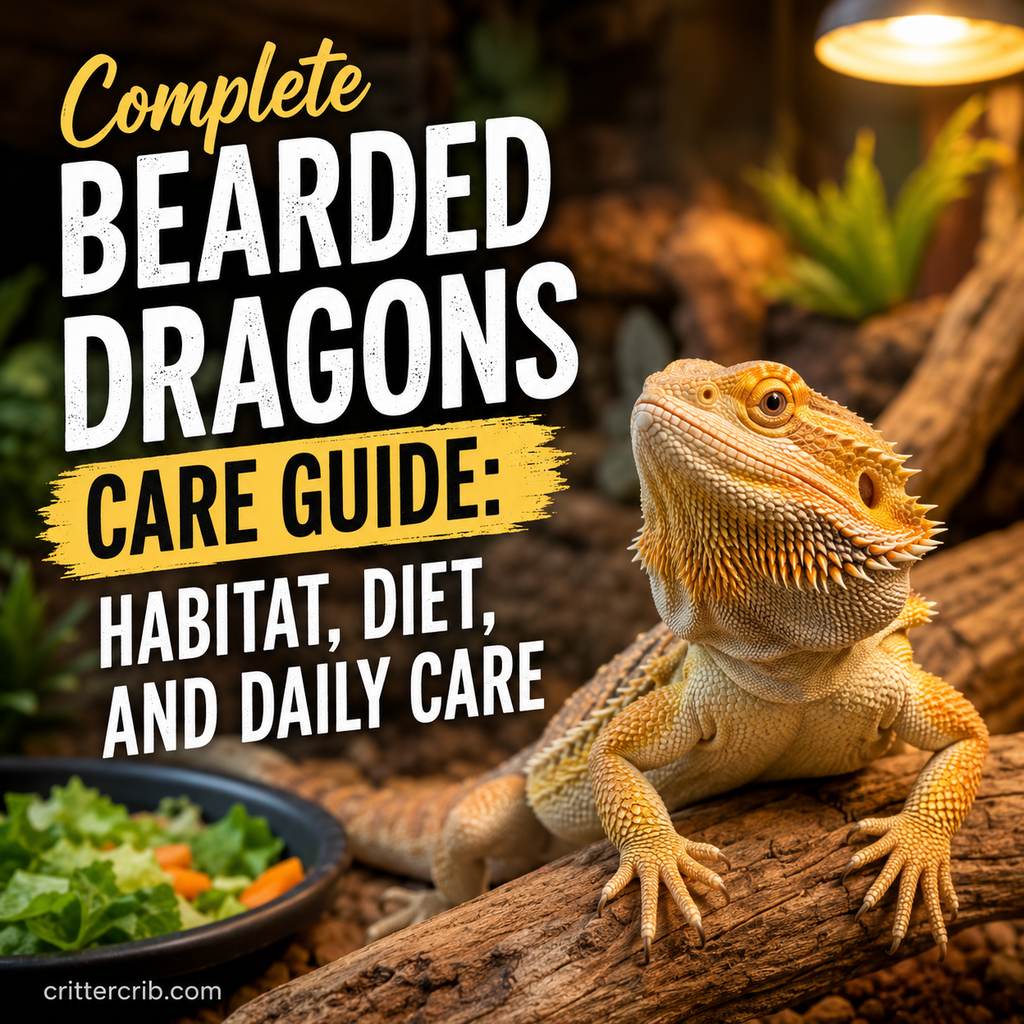
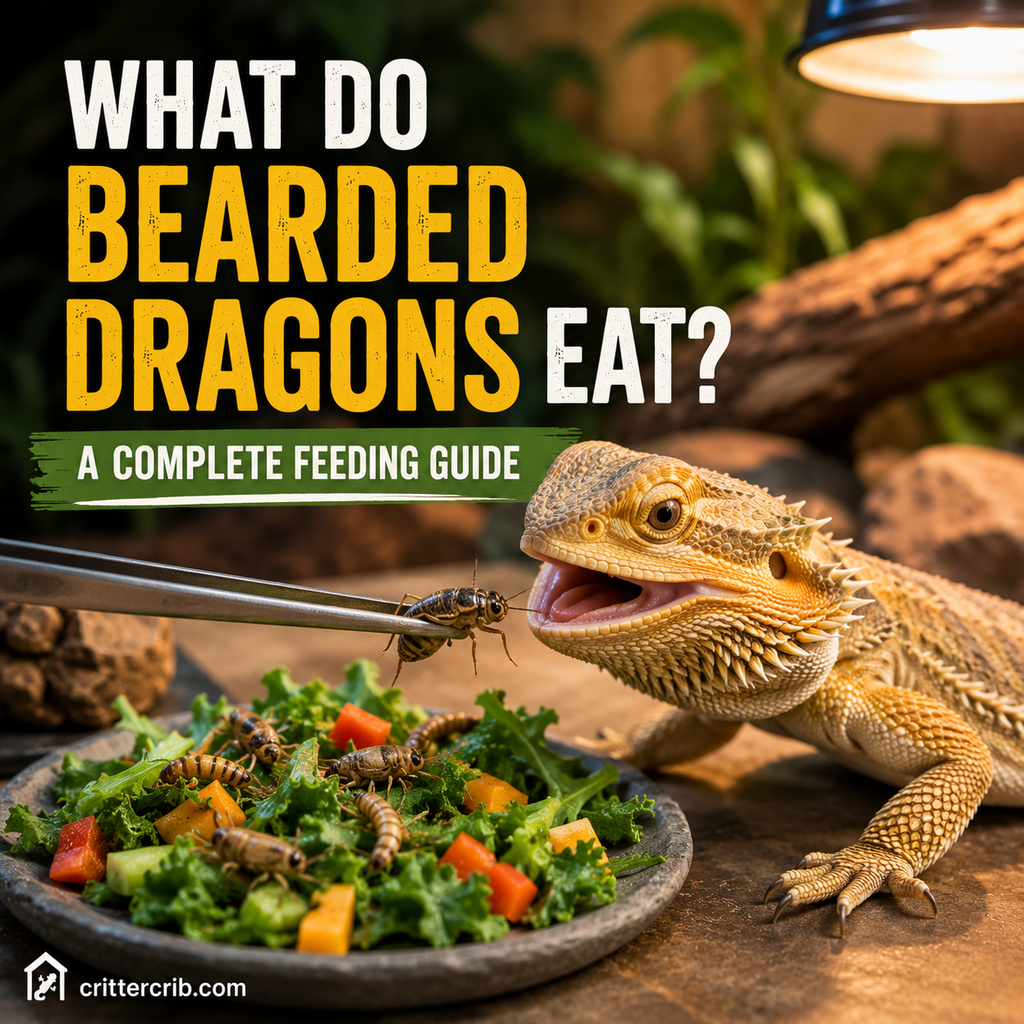
Bearded dragons aren’t picky-looking animals. Put something interesting in front of them and there’s a good chance they’ll investigate it, lick it, or try to eat it.
That doesn’t mean everything they’ll eat is good for them.
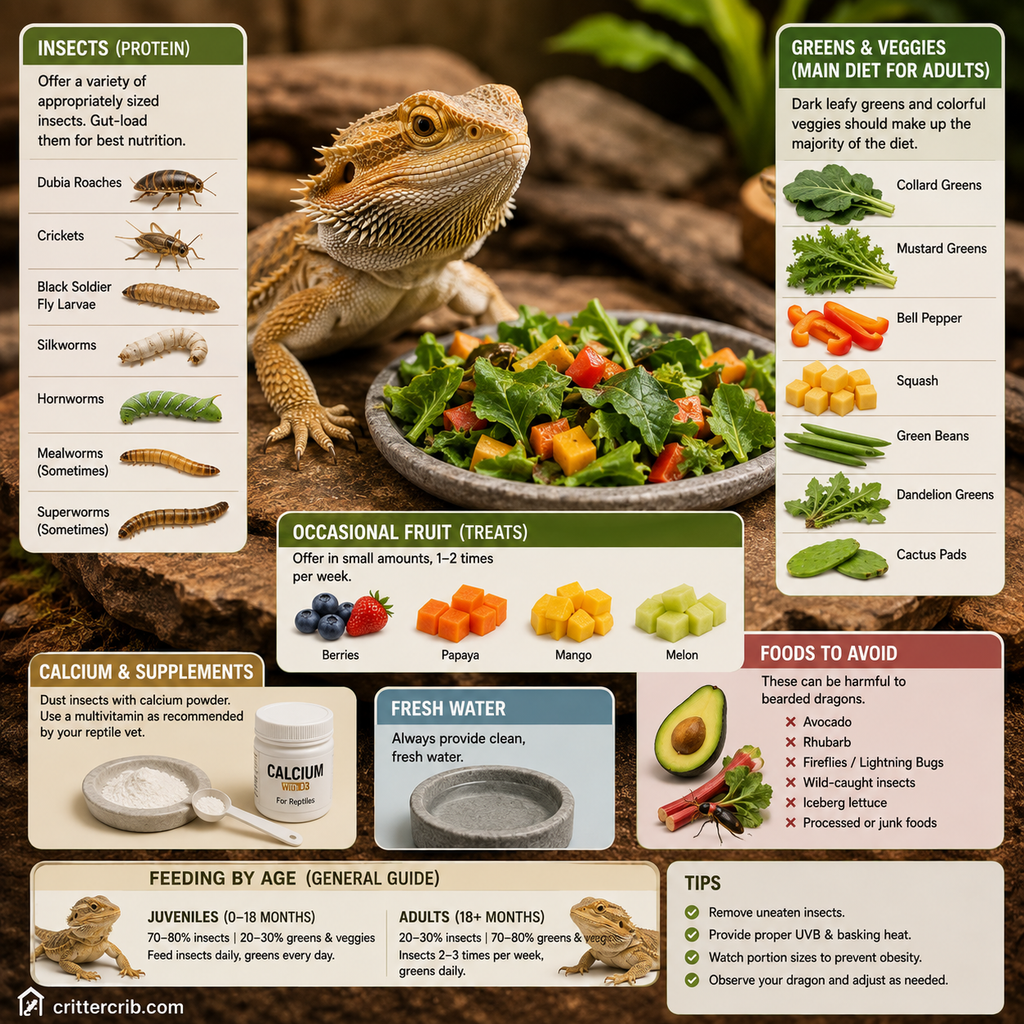
A healthy bearded dragon diet includes both animal and plant foods, but the balance changes significantly as the dragon grows. Young bearded dragons need more protein to support rapid growth, while adults should get a much larger portion of their diet from leafy greens and vegetables.
Variety matters too. Feeding the same insect or vegetable every day isn’t the best way to provide balanced nutrition.
So, what should your bearded dragon actually eat?
Here’s how to build a practical feeding routine from the juvenile stage through adulthood.
What Do Bearded Dragons Eat?
Bearded dragons are omnivores.
In captivity, their diet generally includes a combination of:
- Live insects
- Leafy greens
- Vegetables
- Occasional fruit
- Calcium supplementation
- Vitamin supplementation when appropriate
- Fresh water
The proportions depend heavily on age.
A rapidly growing juvenile has very different nutritional needs from a fully grown adult.
That’s why feeding advice should always consider the dragon’s age rather than recommending one diet for every bearded dragon.
Baby and Juvenile Bearded Dragon Diet
Young bearded dragons grow quickly.
During this stage, insects make up a larger portion of the diet because they provide protein and other nutrients needed for development.
However, vegetables and greens should still be introduced early.
Don’t wait until your dragon is an adult to offer plant foods.
Giving young dragons regular access to appropriate greens helps establish them as a normal part of the diet.
What Can Juvenile Bearded Dragons Eat?
Appropriate foods can include:
- Dubia roaches
- Crickets
- Black soldier fly larvae
- Silkworms
- Appropriate leafy greens
- Suitable vegetables
Exact feeding frequency depends on the dragon’s age, size, growth, body condition, and the nutritional value of the foods being offered.
Very young dragons may eat more frequently than older juveniles.
Rather than trying to maximize growth by feeding as much as possible, aim for steady, healthy development.
What Should Adult Bearded Dragons Eat?
As bearded dragons mature, their diet should shift toward plant foods.
For many healthy adults, leafy greens and vegetables should make up the majority of what they eat, while insects are offered in smaller amounts than they were during juvenile growth.
A commonly used general guideline is approximately:
- 70–80% plant foods
- 20–30% insects
Don’t treat those percentages as a mathematical requirement for every meal.
Think of them as an overall dietary direction.
The important change is that an adult shouldn’t continue eating like a rapidly growing baby.
Too many calorie-dense insects can contribute to excess weight in adult dragons.
Best Insects for Bearded Dragons
Live insects provide protein and encourage natural hunting behavior.
Variety is better than relying on a single feeder.
Good options can include:
- Dubia roaches
- Crickets
- Black soldier fly larvae
- Silkworms
- Hornworms
- Mealworms
- Superworms
Not all of these should be used in exactly the same way.
Some make better staples, while others are more appropriate as part of a varied rotation.
Dubia Roaches
Dubia roaches are popular feeder insects because they’re nutritious, easy for many dragons to catch, and don’t jump around the enclosure like crickets.
They can work well as part of a regular feeder rotation.
Crickets
Crickets are widely available and encourage active hunting.
They should be appropriately sized and gut-loaded before feeding.
Don’t leave uneaten crickets roaming around the enclosure for long periods. They can bother or potentially bite a resting reptile.
Black Soldier Fly Larvae
Black soldier fly larvae are useful because of their naturally favorable calcium content.
They’re small, soft-bodied, and can be especially convenient for younger dragons when appropriately sized.
Silkworms
Silkworms are soft-bodied feeders that can add variety to the diet.
They’re generally less fatty than some common treat insects.
Hornworms
Hornworms have a high moisture content and can be useful for dietary variety and hydration.
They’re not ideal as the only feeder insect.
They also grow extremely quickly, so make sure the worm isn’t too large for your dragon.
Mealworms and Superworms
Mealworms and superworms can be included in a varied diet, particularly for appropriately sized older dragons.
They’re relatively high in fat compared with some staple feeders and have a tougher exoskeleton.
Use them as part of a broader rotation rather than automatically making them the only insect offered.
How Big Should Feeder Insects Be?
Appropriate feeder size is particularly important for young dragons.
Avoid insects that are excessively large for the animal eating them.
A commonly used guideline is to choose prey no wider than the space between the bearded dragon’s eyes.
This isn’t a perfect scientific measurement for every feeder, but it provides beginners with a useful visual reference.
When in doubt, choose the smaller prey item.
Gut-Load Feeder Insects
Your bearded dragon eats what the insect has eaten.
That’s why gut-loading matters.
Gut-loading means feeding insects a nutritious diet before they’re offered to your reptile.
Depending on the feeder, appropriate gut-loading foods may include:
- Leafy greens
- Vegetables
- Commercial gut-loading diets
Poorly nourished feeder insects aren’t as useful nutritionally as properly maintained ones.
Think of feeder care as part of your bearded dragon’s diet.
Best Greens for Bearded Dragons
Leafy greens should become a major part of an adult bearded dragon’s diet.
Good options include:
- Collard greens
- Mustard greens
- Turnip greens
- Dandelion greens
- Endive
- Escarole
Rotate greens rather than serving the exact same combination indefinitely.
Different plants provide different nutrient profiles, textures, and flavors.
Collard Greens
Collard greens are widely used as a staple option.
They’re readily available in many grocery stores and can form part of a varied salad.
Mustard and Turnip Greens
Mustard and turnip greens are other useful choices.
Their stronger flavors may be more appealing to some dragons than others.
Dandelion Greens
Dandelion greens can be another excellent addition.
If collecting plants outdoors, never use weeds from areas that may have been treated with pesticides, herbicides, fertilizers, or other chemicals.
When you’re unsure, buy food intended for human consumption instead.
Vegetables Bearded Dragons Can Eat
Vegetables can add variety, color, moisture, and nutrients to your dragon’s salad.
Options may include:
- Squash
- Bell pepper
- Green beans
- Okra
- Cactus pads
- Carrots in moderation
Cut or grate harder vegetables into manageable pieces.
For many dragons, finely chopping different vegetables and mixing them with leafy greens makes the salad more appealing.
Squash
Several types of squash can be incorporated into a varied diet.
Hard squash may be grated or finely chopped to make it easier to eat.
Bell Peppers
Bell peppers can add color and variety.
Use them as part of a mixed salad rather than the entire plant portion of the diet.
Cactus Pads
Prickly pear cactus pads, often sold as nopales, can be a useful addition when properly prepared.
Make sure all spines are completely removed.
Can Bearded Dragons Eat Fruit?
Yes, but fruit should generally be an occasional food rather than a major part of the diet.
Fruit tends to contain more sugar than leafy greens and many vegetables.
Small amounts of appropriate fruit may include:
- Berries
- Papaya
- Mango
- Melon
Think of fruit as variety or an occasional treat.
Your dragon doesn’t need a fruit-heavy salad every day.
Foods Bearded Dragons Should Avoid
Just because something is edible to humans doesn’t mean it belongs in a bearded dragon’s diet.
Some foods should be avoided entirely, while others simply shouldn’t be relied upon as staples.
Avocado
Don’t feed avocado to bearded dragons.
It’s not considered an appropriate reptile food and may pose toxicity concerns.
Rhubarb
Rhubarb should not be fed.
It contains high levels of oxalates and isn’t appropriate for bearded dragons.
Fireflies
Never feed fireflies or lightning bugs to a bearded dragon.
They can be highly toxic to reptiles and potentially fatal.
This is one reason you shouldn’t simply catch random insects outdoors and offer them to your pet.
Wild Insects
Avoid feeding insects collected outdoors unless you can be absolutely certain they’re a safe species and haven’t encountered pesticides, herbicides, parasites, or other contaminants.
Using established feeder insects from reputable sources is much safer.
Processed Human Food
Bearded dragons don’t need:
- Bread
- Chips
- Crackers
- Cheese
- Deli meat
- Sweets
- Seasoned foods
- Fried foods
Their diet should be built around appropriate whole plant foods and feeder insects.
Iceberg Lettuce
Iceberg lettuce isn’t generally toxic, but it’s nutritionally poor compared with better leafy greens.
There are far more useful choices for a regular salad.
Spinach
Spinach contains oxalates that can bind calcium.
Small occasional amounts aren’t necessarily the same as feeding a toxic food, but spinach shouldn’t dominate your dragon’s greens.
With so many better staple options available, there’s little reason to rely heavily on it.
Why Calcium Is So Important
Calcium is one of the most important nutritional considerations in bearded dragon care.
Inadequate calcium, inappropriate supplementation, poor UVB exposure, and other husbandry problems can contribute to metabolic bone disease.
This serious condition can affect:
- Bones
- Jaw
- Spine
- Limbs
- Mobility
- Overall health
Diet and lighting work together.
Simply dusting insects with calcium won’t compensate for an inadequate UVB setup.
Likewise, excellent UVB doesn’t make an unbalanced diet acceptable.
How to Use Calcium Powder
Feeder insects are commonly dusted with reptile calcium powder before feeding.
Place the insects in a container or bag with a small amount of supplement and gently shake until they’re lightly coated.
They don’t need to look like powdered doughnuts.
A light coating is enough.
How often you supplement depends on factors such as:
- Dragon’s age
- Diet
- Feeder insects
- UVB setup
- Calcium product
- Whether the supplement contains vitamin D3
- Veterinary recommendations
Follow the instructions for your specific supplement and discuss your routine with a reptile veterinarian if you’re unsure.
Do Bearded Dragons Need Multivitamins?
A reptile multivitamin may be used as part of an appropriate feeding plan.
More isn’t necessarily better.
Fat-soluble vitamins can accumulate in the body, so supplements shouldn’t be added randomly or excessively.
Choose products formulated for reptiles and follow appropriate dosing guidance.
A varied diet remains important even when supplements are used.
UVB and Diet Go Together
You can’t talk about bearded dragon nutrition without mentioning UVB.
Bearded dragons require appropriate UVB exposure to synthesize vitamin D3 and use calcium properly.
A good indoor setup typically includes a suitable linear UVB fixture positioned to overlap the basking area.
The correct distance depends on:
- UVB lamp
- Fixture
- Reflector
- Mesh
- Manufacturer specifications
Replace the lamp according to the manufacturer’s schedule.
A UVB bulb may still produce visible light after its useful UVB output has declined.
How Often Should You Feed a Bearded Dragon?
Feeding frequency changes with age.
Baby Bearded Dragons
Babies require frequent access to appropriately sized food because they’re growing rapidly.
They typically eat insects more frequently than adults while still receiving fresh greens regularly.
Juveniles
As growth begins to slow, feeding frequency and insect intake can gradually decrease.
Plant foods should become increasingly important.
Adults
Healthy adults generally don’t need large quantities of insects every day.
Their routine should emphasize greens and vegetables, with appropriately portioned insects offered less frequently.
The exact schedule should reflect:
- Age
- Body condition
- Weight
- Activity
- Health
- Reproductive status
- Veterinary advice
Watch the animal, not just the calendar.
How Much Should You Feed?
This is where many owners accidentally overfeed.
Bearded dragons are often enthusiastic eaters.
Enthusiasm doesn’t mean they need unlimited food.
For adults especially, regularly feeding large quantities of fatty insects can contribute to obesity.
Look at:
- Body condition
- Weight trends
- Activity level
- Age
- Overall diet
Weighing your dragon periodically with a digital kitchen scale can help you identify gradual changes that are difficult to notice by sight alone.
What Time of Day Should You Feed?
Feed when your bearded dragon has had time to warm up.
Reptiles rely on environmental heat for digestion, so offering a large meal immediately after the lights turn on isn’t ideal.
Allow your dragon to bask and become active first.
Similarly, avoid feeding a large meal immediately before the lights turn off.
Give the dragon enough basking time afterward to begin digestion.
A consistent daily lighting schedule makes feeding routines much easier.
Do Bearded Dragons Need Water?
Yes.
Provide clean, fresh water even if your dragon doesn’t seem to drink from the bowl frequently.
Bearded dragons can also obtain moisture from:
- Fresh greens
- Vegetables
- Certain feeder insects
- Occasional high-moisture foods
Some individuals readily drink from bowls, while others don’t appear to use them often.
Keep the water clean regardless.
Can You Mist Bearded Dragons for Hydration?
Misting isn’t a substitute for proper drinking water and a balanced diet.
Some dragons may lick droplets from surfaces, but repeatedly soaking the enclosure in an attempt to hydrate the animal can create unnecessarily damp conditions.
If you’re concerned that your bearded dragon is dehydrated, investigate the underlying cause rather than simply spraying more water.
Persistent dehydration deserves veterinary attention.
Should Bearded Dragons Eat From a Bowl?
Greens and vegetables can be offered in a shallow food dish.
Choose one that’s:
- Easy to clean
- Stable
- Shallow enough to access
- Large enough for the salad
Insects may be offered in an escape-resistant feeding dish when appropriate or fed individually with feeding tongs.
Don’t leave large numbers of loose insects roaming around the enclosure.
How to Get a Bearded Dragon to Eat Greens
Some bearded dragons would happily choose insects over salad every time.
This can become especially noticeable when transitioning an older juvenile toward an adult diet.
Try:
- Offering fresh greens early in the day
- Chopping vegetables into manageable pieces
- Rotating different greens
- Mixing colors and textures
- Adding a small amount of a favorite vegetable
- Reducing excessive insect feeding when appropriate
- Making sure temperatures and UVB are correct
Don’t immediately cover every salad with fruit just to convince the dragon to eat it.
That can teach the animal to wait for sweeter foods.
Patience and consistency usually work better.
Why Isn’t My Bearded Dragon Eating?
A temporary reduction in appetite can happen for several reasons.
Possible causes include:
- Shedding
- Stress
- Incorrect temperatures
- Inadequate UVB
- Seasonal changes
- Recent relocation
- Brumation-related behavior
- Illness
- Parasites
- Impaction or digestive problems
- Reproductive activity
Don’t automatically assume your dragon is simply being picky.
Check the enclosure conditions first.
If appetite loss continues, especially alongside weight loss, lethargy, abnormal stools, swelling, weakness, or other symptoms, contact a reptile veterinarian.
Feeding During Shedding
Some bearded dragons eat less while shedding.
Others continue eating normally.
Both can happen.
Continue offering an appropriate diet and fresh water.
Avoid peeling off shedding skin.
The dragon should remove it naturally as long as husbandry conditions are appropriate.
Feeding During Brumation
Adult bearded dragons may reduce activity and food intake during brumation or brumation-like seasonal behavior.
However, you shouldn’t automatically assume that a lethargic dragon refusing food is brumating.
Illness can look similar.
A reptile veterinarian can help rule out health problems, particularly if the behavior is new or the dragon hasn’t been evaluated recently.
Never allow an unhealthy or significantly underweight dragon to enter an unmanaged period of prolonged inactivity.
A Simple Adult Bearded Dragon Salad
A practical salad might combine several ingredients rather than relying on one food.
For example:
- Collard greens
- Dandelion greens
- A little grated squash
- Small pieces of bell pepper
Rotate ingredients throughout the week.
Another day might use mustard greens, turnip greens, and a different vegetable.
Variety over time matters more than creating a complicated salad every morning.
Sample Bearded Dragon Feeding Routine
Every animal is different, but a simple adult routine could look something like this:
- Turn on heat and UVB lighting.
- Allow the dragon time to warm up.
- Offer fresh greens and vegetables.
- Remove old or wilted food later in the day.
- Offer appropriately portioned live insects on scheduled insect-feeding days.
- Use calcium or vitamin supplements according to your established schedule.
- Keep fresh water available.
- Allow adequate basking time before lights go out.
Young dragons require a different routine with more frequent insect feeding.
Common Bearded Dragon Feeding Mistakes
Feeding Adults Like Babies
Juveniles need more animal protein.
Adults generally need much more plant matter.
Failing to make that transition can lead to excessive calorie intake.
Feeding Only One Insect
Variety provides a broader nutritional profile and more enrichment.
Rotate appropriate feeders when possible.
Using Too Many Treat Insects
Some worms are particularly calorie-dense.
They shouldn’t automatically become the primary feeder simply because your dragon loves them.
Feeding Too Much Fruit
Fruit is best treated as an occasional addition rather than a major salad ingredient.
Ignoring Calcium
Appropriate calcium supplementation is an important part of bearded dragon husbandry.
Ignoring UVB
Nutrition and UVB are closely connected.
You need both.
Feeding Wild-Caught Bugs
You may not know whether they contain toxins, parasites, or pesticide residues.
Use appropriately raised feeder insects.
Overfeeding
A fat bearded dragon isn’t necessarily a healthy bearded dragon.
Monitor body condition and weight over time.
Frequently Asked Questions
Can Bearded Dragons Eat Bananas?
Small amounts can be offered occasionally, but bananas shouldn’t be a regular staple.
They’re relatively high in sugar and have an unfavorable calcium-to-phosphorus balance compared with better everyday foods.
Can Bearded Dragons Eat Strawberries?
Yes, small pieces of strawberry can be offered occasionally.
Treat strawberries as fruit rather than a daily staple.
Can Bearded Dragons Eat Blueberries?
Blueberries can be offered occasionally in small amounts.
Again, fruit should make up only a minor portion of the overall diet.
Can Bearded Dragons Eat Carrots?
Yes, carrots can be incorporated in moderation.
Grating or finely chopping them makes them easier to mix into salads.
They shouldn’t replace leafy greens.
Can Bearded Dragons Eat Lettuce?
Some types are more useful than others.
Iceberg lettuce has relatively little nutritional value and shouldn’t be relied upon as a staple.
More nutritious leafy greens such as collard, mustard, turnip, dandelion, endive, and escarole are better choices.
Can Bearded Dragons Eat Mealworms?
Appropriately sized bearded dragons can eat mealworms as part of a varied diet.
They’re better used in rotation rather than as the only feeder insect.
Can Bearded Dragons Eat Superworms?
Adult and appropriately sized juvenile bearded dragons can eat superworms in moderation.
Because they’re relatively calorie-dense, they shouldn’t automatically become the primary feeder.
Can Bearded Dragons Eat Crickets?
Yes.
Crickets are a common feeder insect and can form part of a varied feeding plan.
Gut-load them before feeding and remove uneaten crickets from the enclosure.
Can Bearded Dragons Eat Dubia Roaches?
Yes.
Dubia roaches are commonly used as a nutritious feeder insect for bearded dragons.
Choose appropriately sized roaches and maintain them on a good diet before feeding.
Can Bearded Dragons Eat Spinach?
Small occasional amounts aren’t generally treated the same as a toxic food, but spinach is high in oxalates and shouldn’t be a primary green.
There are better options for regular feeding.
Can Bearded Dragons Eat Avocado?
No.
Avocado isn’t an appropriate food for bearded dragons and should be avoided.
How Long Can a Bearded Dragon Go Without Eating?
That depends on age, health, body condition, season, and the reason for not eating.
A healthy adult may tolerate periods without food very differently from a rapidly growing juvenile.
Rather than focusing on how long a dragon can survive without eating, determine why it stopped eating.
Persistent appetite loss should be discussed with a reptile veterinarian.
Final Thoughts
A healthy bearded dragon diet is about balance, variety, and changing the menu as your dragon grows.
Young dragons need more insects to support development. As they mature, leafy greens and vegetables should become the foundation of the diet, with insects offered in more controlled amounts.
Rotate nutritious feeder insects such as Dubia roaches, crickets, black soldier fly larvae, and silkworms. Offer a variety of greens such as collard, mustard, turnip, and dandelion greens, along with suitable vegetables.
Keep fruit occasional.
And remember that food is only one part of nutrition.
Calcium supplementation, proper UVB exposure, appropriate basking temperatures, hydration, and healthy feeder insects all affect how well your dragon can use the nutrients it eats.
You don’t need to create a perfect menu at every single meal.
Aim for a varied, species-appropriate diet over time, watch your dragon’s body condition, and adjust its feeding routine as it grows.
That’s a much better strategy than simply feeding whatever your bearded dragon happens to like most.