

Aquatic snails are easy to overlook when you’re planning a freshwater aquarium. They’re small, quiet, and often sold as cleanup animals rather than pets in their own right.
Spend some time watching them, though, and you’ll quickly see there’s more going on.
Aquatic snails climb the glass, graze across plants and decorations, search the substrate for food, and explore nearly every accessible part of an aquarium. Some species have striking shells and colors, while others are valued for their ability to consume algae and leftover food.
They’re also relatively straightforward to care for once you understand what they actually need.
The biggest misconception is that snails can simply be dropped into any aquarium and survive on whatever waste they find. Like fish and shrimp, aquatic snails need appropriate water conditions, enough food, suitable minerals for shell development, and regular aquarium maintenance.
This complete aquatic snails care guide covers the essentials, from choosing a species and setting up the habitat to feeding, water quality, shell care, tank mates, breeding, and daily maintenance.
Aquatic Snail Care at a Glance
Requirements vary between species, but a typical freshwater snail setup includes:
- A properly cycled freshwater aquarium
- Gentle to moderate filtration
- Stable water parameters
- Adequate calcium and minerals
- Aquarium-safe substrate
- Plants, rocks, or driftwood for grazing
- A secure lid for species prone to exploring
- A varied, appropriate diet
- Regular partial water changes
- Compatible tank mates
Some snails reproduce readily in freshwater, while others don’t.
That’s an important distinction when choosing your first species.
Popular Types of Freshwater Aquarium Snails
“Aquatic snail” describes a large number of animals rather than one specific pet.
Different species vary in size, appearance, diet, behavior, and reproduction.
Here are several commonly kept freshwater aquarium snails.
Nerite Snails
Nerite snails are popular because they’re excellent grazers and come in several attractive shell patterns.
Depending on the variety, you may see names such as:
- Zebra nerite
- Tiger nerite
- Olive nerite
- Horned nerite
One of their biggest advantages is population control.
Nerites may lay eggs in freshwater, but their larvae generally require brackish or marine conditions to develop successfully. That means they don’t normally create an exploding freshwater population.
They can, however, leave small white eggs on hard surfaces around the aquarium.
Mystery Snails
Mystery snails are larger and considerably more noticeable.
They’re available in several shell and body colors and can be surprisingly active.
Mystery snails may climb the glass, extend long tentacles, travel across the substrate, and occasionally float or descend quickly through the water.
Unlike nerites, mystery snails can reproduce successfully in freshwater.
They lay clusters of eggs above the waterline, which makes reproduction easier to manage if you notice and remove unwanted clutches before they hatch.
Ramshorn Snails
Ramshorn snails have distinctive coiled shells that resemble a ram’s horn.
They’re effective scavengers and can be useful aquarium inhabitants.
They also reproduce readily.
A small number can become a large population when plenty of food is available.
This isn’t necessarily because the snails are “taking over” for no reason. A population boom often indicates that the aquarium contains an abundant food supply.
Malaysian Trumpet Snails
Malaysian trumpet snails have elongated, cone-shaped shells and frequently burrow into the substrate.
They can help stir portions of the substrate while searching for food.
They’re also prolific breeders.
Like ramshorn snails, their population can increase dramatically when excessive food is available.
Bladder Snails
Bladder snails often arrive in aquariums unintentionally on live plants.
Some aquarists consider them pests. Others happily keep them as part of the aquarium ecosystem.
They’re small, active scavengers and reproduce easily when conditions allow.
Choosing the Right Aquatic Snail
Before buying a snail, think about what you want from the aquarium.
Ask yourself:
- Do I want one or two visible pet snails?
- Do I want help grazing on algae?
- Am I comfortable with reproduction?
- Do I want snails that burrow?
- What fish or shrimp already live in the aquarium?
- Are my water parameters suitable for the species?
- Is the aquarium large enough?
If uncontrolled reproduction concerns you, nerite snails are often attractive because they don’t normally reproduce successfully in freshwater.
If you want a large, highly visible snail, mystery snails may be more appealing.
Research the exact species before bringing it home.
What Size Tank Do Aquatic Snails Need?
Aquatic snails don’t require enormous aquariums, but tank size still matters.
A larger water volume provides more stable conditions and more grazing surfaces.
For one or a few small snails, a 5-gallon aquarium may work depending on the species and other inhabitants.
A 10-gallon aquarium provides more flexibility and is often easier for beginners to maintain.
Larger species such as mystery snails produce more waste than their slow-moving appearance might suggest.
If you’re adding snails to an existing community aquarium, include them when considering the tank’s total biological load.
They’re not waste-free cleanup tools.
They eat, breathe, and produce waste like other animals.
Does an Aquatic Snail Tank Need a Lid?
For some species, a secure lid is highly recommended.
Aquatic snails can climb.
Mystery snails naturally travel above the waterline to lay eggs, and nerites can also explore surprisingly high on aquarium surfaces.
An uncovered aquarium creates the possibility of a snail leaving the tank.
Check around filter openings, cables, and other gaps.
A lid doesn’t need to create an airtight aquarium. Normal gas exchange still needs to occur.
The goal is simply to reduce escape opportunities.
Setting Up an Aquatic Snail Habitat
A snail aquarium doesn’t need elaborate decorations.
If you’re starting a new aquarium, our aquatic snails habitat setup guide goes deeper into tank size, filtration, cycling, water parameters, substrate, plants, grazing surfaces, minerals, and other setup essentials.
A good basic setup can include:
- Aquarium
- Filter
- Heater when required
- Thermometer
- Aquarium light
- Substrate
- Live plants
- Rocks
- Driftwood
- Water conditioner
- Water-testing supplies
- Secure lid when appropriate
Snails benefit from having plenty of surfaces to explore.
Rocks, wood, plants, and aquarium glass all provide potential grazing areas where algae and biofilm can develop.
Do Aquatic Snails Need a Filter?
Yes, filtration is strongly recommended.
Snails may have a reputation for cleaning aquariums, but they also create waste.
A filter helps:
- Provide biological filtration
- Capture suspended debris
- Move water
- Support gas exchange
- Maintain overall water quality
Make sure filter intakes are appropriate for the animals in the aquarium.
If you’re keeping tiny snails, shrimp, or fish fry, an intake sponge can help prevent small animals from being pulled into the filter.
The Nitrogen Cycle Still Matters
Aquatic snails need a cycled aquarium just like fish and shrimp.
Waste and decomposing organic material produce ammonia.
Beneficial bacteria then convert:
- Ammonia into nitrite
- Nitrite into nitrate
Ammonia and nitrite are toxic and should generally remain at 0 ppm in an established aquarium.
Nitrate is less immediately toxic but still needs to be controlled through regular maintenance, water changes, plants, and responsible stocking.
Don’t assume a snail is tough enough to ignore cycling.
A healthy shell doesn’t protect the animal from poor water quality.
Do Aquatic Snails Need a Heater?
It depends on the species and your home’s temperature.
Many commonly kept freshwater snails do well at temperatures typical of tropical community aquariums, but individual requirements vary.
If the aquarium remains within an appropriate stable range without a heater, additional heating may not be necessary.
If temperatures drop too low or fluctuate significantly, a heater can provide stability.
Always research the particular snail species you’re keeping rather than choosing one universal temperature for every aquatic snail.
Use a thermometer even if the aquarium isn’t heated.
Water Parameters for Aquatic Snails
Water chemistry is especially important for snails because their shells are made largely from calcium carbonate.
Extremely soft or acidic water can contribute to shell erosion and poor shell condition.
Important parameters include:
- Ammonia
- Nitrite
- Nitrate
- pH
- GH
- KH
- Temperature
Many freshwater snails do well in neutral to moderately alkaline water containing enough dissolved minerals to support healthy shells.
However, exact requirements vary by species.
Why GH Matters
GH, or general hardness, reflects dissolved minerals such as calcium and magnesium.
These minerals are important for shell development.
Very soft water may not provide enough mineral content for healthy long-term shell growth.
Why KH Matters
KH, or carbonate hardness, helps buffer pH.
Adequate buffering can reduce sudden pH swings.
Because carbonate is also associated with shell formation, understanding KH can be useful when keeping snails.
Don’t add mineral products blindly.
Test your water first.
Calcium and Healthy Snail Shells
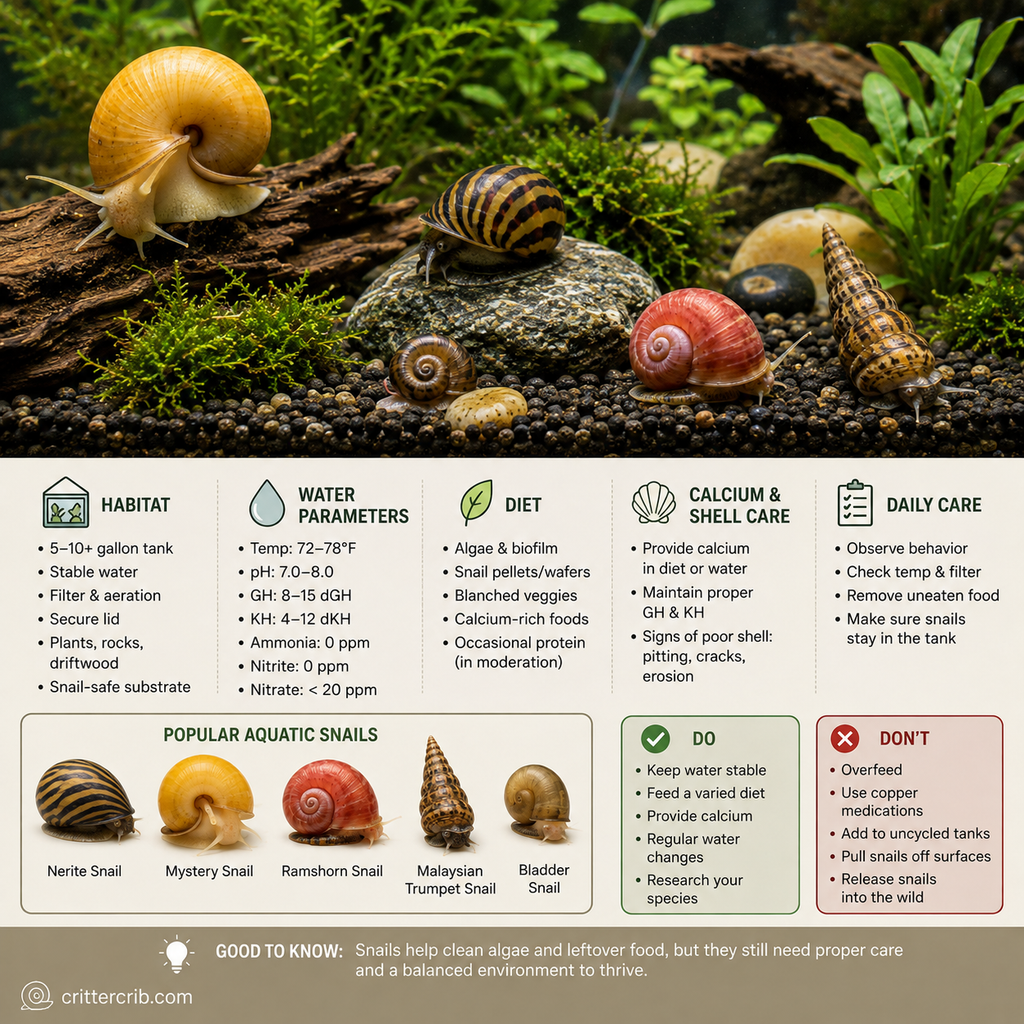
Shell condition is one of the most visible indicators of aquatic snail health.
Snails require calcium and other minerals to build and maintain their shells.
Depending on your water and diet, calcium can come from several sources.
Potential dietary sources include:
- Calcium-rich snail foods
- Appropriate vegetables
- Mineral-rich prepared foods
- Commercial calcium supplements when needed
Some aquarists use cuttlebone or other aquarium-safe calcium sources.
However, adding calcium products isn’t automatically necessary if your water already contains adequate minerals.
Test first and adjust only when there’s a reason.
Signs of Possible Shell Problems
Watch for:
- Pitting
- Cracks
- Thin new shell growth
- Eroded areas
- Whitening or deterioration
- Unusual holes
Some shell damage is permanent.
A snail can often improve the quality of new shell growth when conditions are corrected, but old damaged shell doesn’t simply regenerate to its original appearance.
Prevention is much easier than repair.
What Substrate Is Best for Aquatic Snails?
Most common aquarium snails aren’t particularly demanding about substrate.
Options include:
- Aquarium sand
- Fine gravel
- Smooth gravel
- Planted aquarium substrate
Avoid sharp materials that could potentially cause injury.
Substrate choice may depend more on the other aquarium inhabitants and plants than on the snails themselves.
Malaysian trumpet snails are an exception worth considering because they naturally spend significant time burrowing.
A substrate they can move through easily allows them to display that behavior.
Live Plants in a Snail Aquarium
Live plants are excellent additions to aquatic snail habitats.
They provide:
- Grazing surfaces
- Biofilm
- Cover
- Natural structure
- Nutrient uptake
- A more interesting environment
Healthy snails generally spend plenty of time exploring plant leaves.
Will Aquatic Snails Eat Live Plants?
It depends on the snail and the condition of the plant.
Many popular aquarium snails primarily graze algae, biofilm, decaying vegetation, and leftover food rather than aggressively consuming healthy plants.
However, feeding behavior varies by species and food availability.
You may see snails eating damaged or dying leaves.
That doesn’t necessarily mean they caused the original damage.
If plants are disappearing rapidly, investigate both the snail species and whether the animals are receiving enough appropriate food.
What Do Aquatic Snails Eat?
Aquatic snails are often described as cleanup animals because many species consume algae, biofilm, leftover food, and decaying organic matter.
That’s useful, but it doesn’t mean you should expect them to live entirely on whatever happens to be available.
For a deeper look at algae, biofilm, prepared foods, vegetables, calcium sources, feeding frequency, and avoiding overfeeding, see our complete aquatic snail feeding guide.
A varied snail diet may include:
- Algae
- Biofilm
- Sinking algae wafers
- Snail-specific foods
- Appropriate sinking fish foods
- Blanched vegetables
- Decaying plant material
- Calcium-rich foods
The appropriate diet depends on the species.
Vegetables for Aquatic Snails
Depending on the species, snails may accept vegetables such as:
- Zucchini
- Green beans
- Spinach
- Kale
- Cucumber
Blanching firmer vegetables can soften them and make them easier to eat.
Remove uneaten portions before they begin decomposing heavily and affecting water quality.
Do Snails Need Algae Wafers?
Not necessarily, but algae wafers can be a useful supplemental food.
Choose a quality product and feed according to the number and size of animals in the aquarium.
Don’t drop large amounts of food into the tank simply because snails eat slowly.
How Often Should You Feed Aquatic Snails?
Feeding frequency depends heavily on how much natural food is already available.
A mature aquarium containing algae and biofilm may provide considerable grazing.
A very clean or newly established aquarium may provide much less.
Watch the snails and the food.
If supplemental food disappears reasonably quickly, your feeding amount may be appropriate.
If large amounts remain for long periods and begin breaking down, reduce the portion.
You don’t need to keep food sitting in the aquarium around the clock.
Don’t Rely on Snails to Eat Fish Waste
This is an important misconception.
Snails aren’t a solution for fish poop.
They may consume uneaten food and other organic material, but adding snails doesn’t remove waste from the aquarium ecosystem.
Snails produce waste themselves.
You still need:
- Filtration
- Partial water changes
- Substrate maintenance
- Appropriate stocking
- Responsible feeding
Think of snails as aquarium inhabitants that happen to graze—not maintenance equipment.
Daily Aquatic Snail Care
Daily care is usually simple.
Spend a few minutes observing the aquarium.
Check:
- Are the snails moving normally?
- Are they attached securely to surfaces?
- Are they feeding?
- Is the shell condition changing?
- Is the temperature normal?
- Is the filter operating?
- Have any snails escaped?
- Is there excessive uneaten food?
You don’t need to handle or move your snails every day.
Observation is often enough.
Weekly Aquatic Snail Care
A typical weekly routine may include:
- Testing water parameters as necessary
- Performing a partial water change
- Removing excess debris
- Cleaning the glass when needed
- Removing uneaten food
- Trimming dead plant material
- Checking filter operation
- Inspecting snail shells
For many established aquariums, changing roughly 20–30% of the water weekly is a reasonable starting point.
Actual maintenance requirements depend on stocking, feeding, filtration, plants, and water-test results.
How to Perform a Safe Water Change
Snails can usually remain inside the aquarium during routine maintenance.
A basic water change looks like this:
- Test the water if needed.
- Turn off equipment that can’t safely operate at a lower water level.
- Siphon out a portion of the aquarium water.
- Remove excessive substrate debris.
- Prepare replacement water.
- Treat tap water with an appropriate conditioner.
- Match the new water reasonably closely to the aquarium temperature.
- Add the replacement water slowly.
- Restart the filter and heater.
- Check the aquarium for normal operation.
Watch where the snails are before moving equipment.
They’re not always easy to see when attached to decorations or hiding near the substrate.
Never Pull a Snail Off the Glass
If you need to move an aquatic snail, don’t simply grab the shell and yank.
The snail’s muscular foot may be firmly attached to the glass or another surface.
Forcefully pulling it can injure the animal.
Instead, gently encourage the snail to release its grip or wait until it begins moving.
Handle only when necessary.
Why Is My Aquatic Snail Not Moving?
A snail remaining still isn’t automatically dead.
Aquatic snails have periods of inactivity and may remain in one location for quite a while.
They may also rest after eating.
If you’re concerned, observe it over time.
Signs That Deserve Attention
Investigate further if the snail:
- Remains completely inactive for an unusually long period
- Hangs loosely from its shell
- Has an unpleasant smell after removal
- Doesn’t respond at all when gently examined
- Shows severe tissue deterioration
A dead snail should be removed promptly because decomposition can affect water quality.
If you’re uncertain whether a snail is alive, don’t dispose of it simply because it hasn’t moved for several hours.
Why Is My Snail Floating?
Floating can look alarming, but it isn’t always a sign of illness.
Some aquatic snails can trap air inside their shells and float.
They may use this behavior to move around the aquarium.
A floating snail that later attaches to a surface and behaves normally may be fine.
Persistent inability to submerge combined with other abnormal signs deserves closer observation.
Why Is My Snail Climbing Out of the Water?
Some species naturally explore above the waterline.
Mystery snails, for example, leave the water to lay eggs.
However, repeated escape attempts can also be a reason to check aquarium conditions.
Test:
- Ammonia
- Nitrite
- Nitrate
- pH
- Temperature
Also check whether there is enough oxygenation and whether anything has recently changed.
Keep the aquarium securely covered.
Why Does My Snail Keep Falling Over?
Aquatic snails occasionally lose their grip and fall.
Some can right themselves relatively easily.
Others may struggle, especially on smooth or awkward surfaces.
If you see a snail lying upside down and repeatedly failing to turn over, gently assist it by placing it upright against a surface where it can grip.
Repeated falling may indicate weakness or another problem and deserves closer observation.
Understanding Snail Reproduction
Reproduction varies dramatically between species.
This is something you should research before introducing snails.
Mystery Snail Eggs
Mystery snails lay distinctive egg clutches above the waterline.
If you don’t want more snails, unwanted clutches can be removed and disposed of responsibly before they hatch.
Never release aquarium snails or eggs into natural waterways.
Nerite Snail Eggs
Nerites may leave small white eggs attached to hard surfaces.
These eggs generally don’t develop successfully in ordinary freshwater conditions.
They can be difficult to remove from decorations.
Ramshorn and Bladder Snail Reproduction
Ramshorn and bladder snails can reproduce quickly.
You’ll often notice small gelatinous egg clusters attached to glass, plants, or decorations.
If food is abundant, the population may grow rapidly.
Malaysian Trumpet Snail Reproduction
Malaysian trumpet snails can also multiply quickly.
Because many hide in the substrate during the day, you may not realize how large the population has become until you see them emerge in greater numbers.
Why Is My Snail Population Exploding?
A rapidly increasing snail population often means there’s plenty of food available.
Potential food sources include:
- Overfeeding fish
- Excess algae
- Decaying plants
- Large amounts of organic debris
- Leftover food in the substrate
If you have hundreds of pest snails, simply removing snails without addressing the food supply may provide only temporary relief.
Reduce excessive feeding and improve aquarium maintenance.
The population often becomes easier to manage when fewer resources are available.
Can Aquatic Snails Live With Fish?
Yes, many aquatic snails can live successfully in community aquariums.
The important word is compatible.
Some fish ignore snails.
Others may:
- Nip antennae
- Harass them
- Flip them over
- Eat small snails
- Crush shells
Research every fish species before combining it with snails.
Fish known for eating mollusks aren’t appropriate companions if your goal is to keep pet snails.
Can Aquatic Snails Live With Shrimp?
Yes.
Freshwater shrimp and peaceful aquatic snails are commonly kept together.
They often share similar interests in biofilm, algae, and other grazing surfaces.
However, remember that both contribute to the aquarium’s biological load.
Make sure the tank is large enough and properly filtered for the total population.
Can Different Snail Species Live Together?
Often, yes.
Compatible freshwater snail species can sometimes share an aquarium when their environmental requirements overlap.
Before combining species, compare:
- Temperature requirements
- Water hardness
- pH
- Adult size
- Feeding needs
- Reproductive behavior
- Total biological load
Don’t add multiple snail species simply because they’re all marketed as “cleanup crew.”
Each animal still needs appropriate care.
Copper and Aquatic Snails
Snails and other invertebrates can be sensitive to copper.
Some fish medications contain copper at concentrations intended to treat disease.
Before adding any medication to an aquarium containing snails, read the label carefully and verify whether it’s safe for invertebrates.
Never assume a medication that’s safe for fish is automatically safe for snails.
If treatment is necessary, follow professional veterinary guidance and the medication manufacturer’s instructions.
Common Aquatic Snail Care Mistakes
Most snail-care problems come from a few common misunderstandings.
Treating Snails Like Disposable Cleaners
Snails are animals with specific care requirements.
Don’t add them simply to solve an algae problem without considering their long-term needs.
Not Providing Enough Food
An aquarium that looks algae-covered may provide plenty of grazing.
A spotless aquarium may not.
Supplement the diet when necessary.
Overfeeding
The opposite problem is equally common.
Excess food can degrade water quality and encourage uncontrolled reproduction in prolific species.
Ignoring Water Hardness
Shell-building requires appropriate minerals.
Very soft or acidic water can contribute to shell deterioration.
Adding Calcium Without Testing
More calcium isn’t automatically better.
Understand your existing water chemistry first.
Using Copper-Based Medication Carelessly
Check every medication before using it in an aquarium containing invertebrates.
Keeping Escape-Prone Snails Without a Lid
Some snails are surprisingly adventurous.
Secure openings around the aquarium.
Pulling Snails From Surfaces
Never forcefully yank an attached snail from the glass.
Assuming Snails Replace Aquarium Maintenance
They don’t.
You still need regular water changes, filtration, and appropriate cleaning.
Aquatic Snail Care FAQ
Are Aquatic Snails Easy to Care For?
Many common freshwater snails are relatively easy to care for when provided with stable water conditions, enough food, appropriate minerals, and compatible tank mates.
They’re beginner-friendly, but not maintenance-free.
If you’re still deciding whether they’re right for your aquarium, our guide to aquatic snails as pets for beginners covers what ownership is actually like and what you should know before bringing one home.
Do Aquatic Snails Need a Filter?
Yes, filtration is strongly recommended.
Snails produce waste, and biological filtration helps maintain healthy water conditions.
Do Aquatic Snails Need a Heater?
Not always.
The need for a heater depends on the species and the temperature of your home.
Research your snail’s preferred range and aim for stable conditions.
What Do Aquatic Snails Eat?
Depending on the species, aquatic snails may eat algae, biofilm, leftover food, decaying plant material, prepared snail foods, algae wafers, and appropriate vegetables.
How Often Should I Feed My Snails?
Feed according to the amount of natural food available and the number and size of your snails.
Avoid leaving excessive uneaten food in the aquarium.
Do Aquatic Snails Need Calcium?
Snails need adequate calcium and minerals for shell development.
Whether you need to supplement depends on your water chemistry and diet.
Can Aquatic Snails Live Alone?
Many aquatic snails can live without other snails.
They don’t need a companion simply to prevent loneliness.
Do Aquatic Snails Eat Fish Poop?
Snails aren’t an effective solution for fish waste.
They may consume various organic materials, but they also produce waste themselves. Regular aquarium maintenance is still necessary.
Why Is My Snail’s Shell Turning White?
Shell whitening or erosion can be associated with inappropriate water chemistry, insufficient minerals, age, or previous shell damage.
Test pH, GH, and KH and evaluate the snail’s diet and overall environment.
How Long Do Aquatic Snails Live?
Lifespan varies considerably by species and conditions.
Some common aquarium snails may live around one to several years with appropriate care.
Our guide to aquatic snail lifespan and care factors breaks this down further by species and explains how water quality, temperature, diet, minerals, shell health, and tank mates can affect longevity.
Why Has My Snail Disappeared?
Check:
- Behind decorations
- Under plants
- Inside caves
- Around the filter
- Under the aquarium lid
- Outside the tank
Some species hide surprisingly well, while others may climb out through openings.
Can I Release Extra Aquarium Snails Outside?
No.
Never release aquarium snails, eggs, plants, or aquarium water containing organisms into natural waterways.
Non-native species can harm local ecosystems and may be illegal to release.
Rehome unwanted snails responsibly or use an appropriate humane management method.
A Simple Aquatic Snail Care Routine
Once your aquarium is established, snail care becomes fairly straightforward.
Every Day
- Observe snail activity
- Check the temperature
- Make sure the filter is working
- Look for escaped snails
- Feed when appropriate
- Remove excessive leftover food
Every Week
- Test water as needed
- Perform an appropriate partial water change
- Remove excessive debris
- Trim dead plant material
- Inspect shells
- Check aquarium equipment
Periodically
- Service filter media when necessary
- Check GH and KH
- Inspect the aquarium lid
- Manage egg clutches if needed
- Evaluate population size
- Adjust feeding based on algae and biofilm availability
Consistency is more important than aggressively cleaning the aquarium.
Final Thoughts on Aquatic Snail Care
Aquatic snails can be some of the most interesting animals in a freshwater aquarium.
They spend their days grazing across plants, glass, wood, and rocks, quietly exploring areas that fish often ignore. Larger species such as mystery snails can become surprisingly noticeable pets, while smaller snails contribute to the activity of the aquarium ecosystem.
Their care isn’t complicated, but it shouldn’t be ignored.
Provide stable, clean water. Make sure the aquarium contains enough minerals to support healthy shell growth. Offer supplemental food when natural grazing isn’t enough, and don’t expect algae alone to provide a complete diet indefinitely.
Most importantly, choose the species carefully.
A nerite snail, mystery snail, ramshorn snail, and Malaysian trumpet snail may all be sold in the same aquarium department, but their reproduction and behavior can be very different.
Understanding those differences before bringing snails home can prevent a lot of surprises later.
With an established aquarium, appropriate food, good water quality, and a little attention to shell health, aquatic snails can be hardy, fascinating additions to a freshwater setup—and much more than simply a cleanup crew.