Leopard geckos may be small, but bringing one home can be a surprisingly long commitment.
With proper care, a leopard gecko can live for many years—often considerably longer than new reptile owners expect.
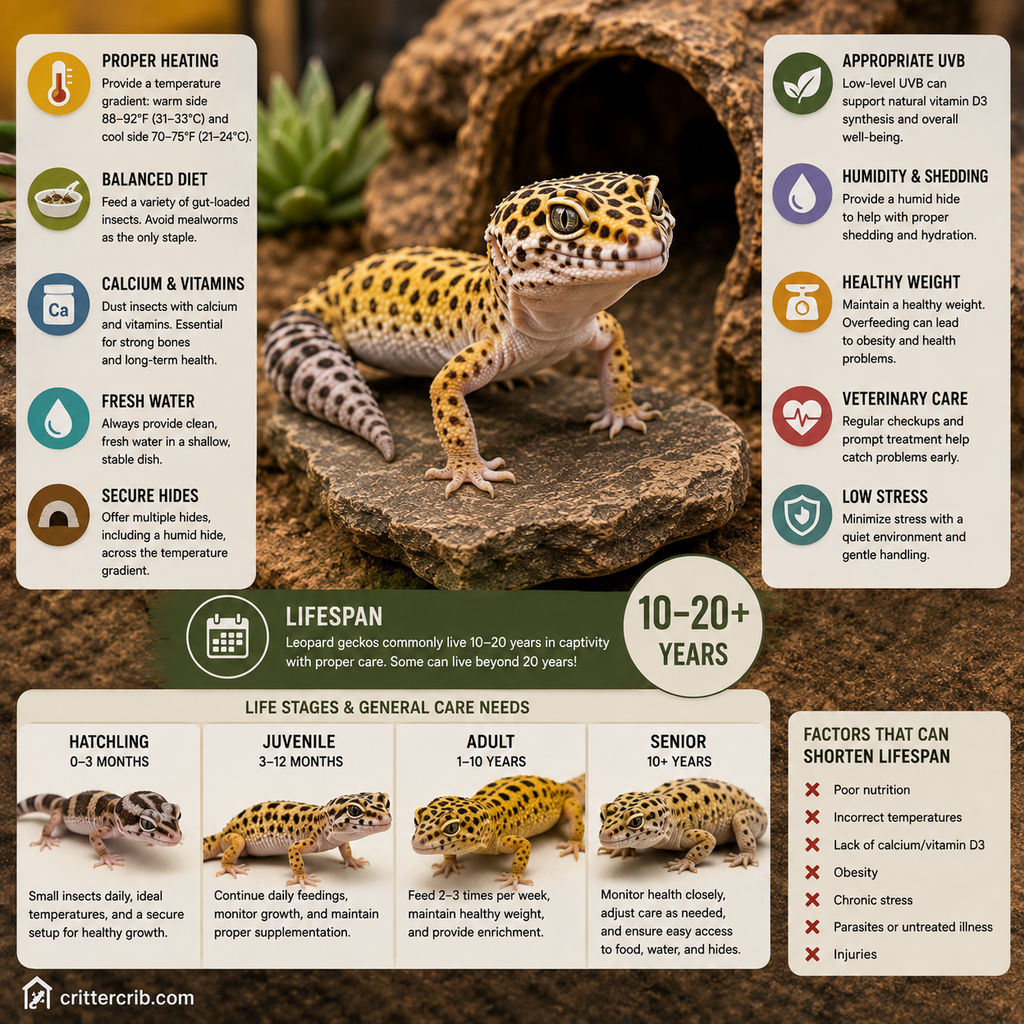
In captivity, leopard geckos commonly live around 10–20 years, although lifespan varies from one animal to another. Some well-cared-for individuals can reach or exceed 20 years.
That’s a big difference from treating a leopard gecko as a short-term starter pet.
Genetics play a role in longevity, but everyday care matters too. Diet, heating, supplementation, enclosure conditions, body weight, stress, and access to veterinary care can all influence how well a gecko ages.
Here’s what to expect from a leopard gecko’s lifespan and what you can do to give yours the best chance at a long, healthy life.
What Is the Average Lifespan of a Leopard Gecko?
A captive leopard gecko can commonly live for approximately 10–20 years with appropriate husbandry.
Some live shorter lives, while exceptional individuals may live beyond 20 years.
There’s no guaranteed age.
A gecko’s lifespan can be influenced by:
- Genetics
- Early development
- Diet
- Calcium intake
- Vitamin supplementation
- Heating
- Enclosure conditions
- Hydration
- Body condition
- Stress
- Disease
- Parasites
- Injuries
- Veterinary care
This is why two leopard geckos of the same age can have very different health outcomes.
How Long Do Leopard Geckos Live in the Wild?
Wild leopard geckos generally face more environmental pressures than animals kept in well-managed captivity.
Wild reptiles must deal with:
- Predators
- Food shortages
- Drought
- Temperature extremes
- Parasites
- Injuries
- Competition
- Disease
Because of those challenges, wild leopard geckos may have shorter average lifespans than captive animals receiving consistent food, shelter, and veterinary attention.
However, reliable lifespan data for wild individuals are much harder to establish than captive records.
Rather than focusing on one exact wild lifespan number, the useful takeaway is that captivity removes many natural risks—but only when the captive environment is appropriate.
Can Leopard Geckos Live for 20 Years?
Yes.
A leopard gecko reaching 20 years old is entirely possible.
That doesn’t mean every leopard gecko will.
Think of 20 years as a realistic possibility rather than a guarantee.
If you’re considering getting a leopard gecko, plan as though you’ll be caring for the animal for 15–20 years.
That’s particularly important for parents buying one for a child.
A leopard gecko purchased for a 10-year-old could potentially still be alive when that child is well into adulthood.
Do Male and Female Leopard Geckos Have Different Lifespans?
You may encounter claims that male leopard geckos consistently live longer than females.
There’s some logic behind the idea because reproductive activity can place additional physical demands on females, particularly those producing eggs.
However, sex alone doesn’t determine lifespan.
A healthy female receiving excellent nutrition and husbandry may outlive a poorly cared-for male.
For females, particular attention should be paid to:
- Calcium intake
- Body condition
- Egg production
- Appetite changes
- Signs of egg retention
- Veterinary care when reproductive problems are suspected
Even females that haven’t been housed with a male may produce infertile eggs.
What Factors Affect a Leopard Gecko’s Lifespan?
You can’t control everything about your gecko’s longevity.
Genetics and early-life development are largely outside your control once the animal comes home.
Husbandry is different.
The environment you provide every day can have a major effect on long-term health.
1. Genetics and Breeding
Healthy animals tend to start with an advantage.
Responsible breeding involves more than producing visually interesting colors and patterns.
Breeders should consider:
- Genetic health
- Parent health
- Known hereditary problems
- Appropriate pairings
- Hatchling development
- Nutrition
- Overall body condition
Some leopard gecko morphs are associated with specific genetic health concerns.
Before choosing a gecko based solely on appearance, research the morph and breeder.
A reputable breeder should be willing to answer questions about the animal’s genetics, feeding history, age, and health.
2. Proper Heating
Leopard geckos are ectothermic, which means their body temperature depends heavily on environmental conditions.
They need access to warmer and cooler areas.
A proper temperature gradient allows your gecko to move between different zones depending on what it needs.
Without appropriate heat, digestion, activity, appetite, and other biological processes can be affected.
Don’t Heat the Entire Enclosure Equally
The habitat shouldn’t be one uniform temperature.
Provide:
- A warm area
- A cooler area
- Secure hides across the temperature gradient
Your gecko should always be able to move away from the heat.
Measure Temperatures
Don’t judge enclosure temperature with your hand.
Use reliable digital thermometers and an infrared temperature gun to check surfaces.
Heating equipment should also be appropriately controlled with a compatible thermostat.
Consistently overheating a reptile enclosure can be dangerous.
3. A Balanced Diet
Leopard geckos are insectivores.
Their diet should consist of appropriately sized feeder insects rather than fruit, vegetables, or commercial foods intended for omnivorous reptiles.
Suitable feeders can include:
- Dubia roaches
- Crickets
- Black soldier fly larvae
- Silkworms
- Mealworms
- Other appropriate captive-raised feeder insects
Variety is useful.
Different insects have different nutritional profiles, so relying exclusively on one feeder for years isn’t ideal.
Gut-Load Your Insects
Feeder insects should be well nourished before your gecko eats them.
This is called gut-loading.
Depending on the feeder species, provide appropriate nutritious foods before feeding them to your gecko.
Remember: feeder insect care is part of leopard gecko nutrition.
4. Calcium and Vitamin Supplementation
Calcium is particularly important for leopard geckos.
Inadequate calcium and vitamin D3 can contribute to metabolic bone disease, a serious condition that can affect the skeleton, jaw, spine, and mobility.
Feeder insects are commonly dusted with reptile calcium and vitamin supplements according to an appropriate schedule.
The exact routine depends on:
- Gecko’s age
- Diet
- Feeder insects
- Supplement product
- UVB exposure
- Health
- Reproductive status
Follow the instructions for the products you’re using and consult a reptile veterinarian if you’re unsure.
More supplement isn’t automatically better.
Over-supplementation can cause problems too.
5. Appropriate UVB Exposure
Leopard geckos have historically been kept without UVB, with vitamin D3 provided through supplementation.
However, appropriately provided low-level UVB can be beneficial and allows leopard geckos opportunities for natural vitamin D3 synthesis.
If you provide UVB, use equipment appropriate for a leopard gecko rather than installing a powerful lamp designed for high-UV basking reptiles.
UVB intensity depends on:
- Lamp type
- Distance
- Reflector
- Mesh
- Enclosure height
- Available shade
Always give your gecko shaded areas where it can completely escape the light.
Follow manufacturer recommendations for positioning and replacement.
6. Maintaining a Healthy Weight
A chunky leopard gecko isn’t necessarily a healthy leopard gecko.
These animals store fat in their tails, which can make body condition relatively easy to notice—but also easy to misunderstand.
Overfeeding high-fat insects can contribute to obesity.
Long-term excessive weight can place unnecessary strain on the body and may contribute to health problems.
On the other hand, a rapidly thinning tail or unexplained weight loss can indicate illness, parasites, inadequate feeding, or other problems.
Weigh your gecko periodically with a small digital scale.
Recording the weight makes gradual changes easier to identify.
7. Proper Humidity and Shedding
Leopard geckos don’t require a uniformly tropical enclosure.
However, they still need access to appropriate moisture, particularly when shedding.
A humid hide is an important part of the habitat.
It can contain slightly damp:
- Sphagnum moss
- Paper towel
- Other suitable moisture-retaining material
Keep it moist rather than soaking wet.
Check Toes After a Shed
Retained shed commonly becomes trapped around:
- Toes
- Tail tip
- Eyes
Repeated layers around the toes can restrict circulation and potentially result in tissue damage.
After your gecko sheds, visually check the feet.
Don’t pull stubborn shed from the animal.
If retained skin doesn’t resolve with appropriate husbandry or safe assistance, consult a reptile veterinarian.
8. Clean Water and Hydration
Provide fresh drinking water at all times.
Use a shallow, stable dish that’s easy for the gecko to access.
Replace the water regularly and clean the bowl whenever it becomes contaminated.
Even reptiles adapted to relatively dry environments need access to water.
Hydration also relates to:
- Humidity
- Shedding
- Diet
- Overall health
9. A Secure, Enriching Enclosure
A leopard gecko habitat shouldn’t be an empty box containing only a water bowl and one hide.
Your gecko needs choices.
Provide multiple secure hides, including:
- Warm hide
- Cool hide
- Humid hide
You can also add:
- Cork bark
- Rocks
- Low climbing structures
- Artificial or reptile-safe plants
- Tunnels
- Textured surfaces
- Additional cover
Everything should be stable enough that it can’t collapse onto the animal.
A well-designed enclosure allows your gecko to explore while still feeling secure.
10. Reducing Chronic Stress
Short periods of stress are unavoidable.
Moving to a new home, enclosure cleaning, veterinary visits, and handling can all temporarily disrupt a gecko’s routine.
Chronic stress is different.
Potential stressors can include:
- Excessive handling
- Lack of hiding places
- Incorrect temperatures
- Constant disturbance
- Bright environments with nowhere to retreat
- Inappropriate cohabitation
- Other pets staring into or accessing the enclosure
Give your leopard gecko control over when it wants to be visible.
A reptile that spends time hiding isn’t necessarily unhappy.
Hiding is normal behavior.
Should Leopard Geckos Live Together?
Generally, individual housing is the safest and simplest approach.
Leopard geckos don’t need roommates to prevent loneliness.
Cohabitation can create:
- Competition for food
- Competition for hides
- Competition for heat
- Stress
- Bites
- Injuries
- Unwanted breeding
Even animals that appear to tolerate each other may compete in subtle ways.
Keeping geckos separately also makes it much easier to monitor exactly how much each animal eats, defecates, and weighs.
How Often Should a Leopard Gecko See a Veterinarian?
It’s a good idea to locate a reptile veterinarian before you actually need one.
Not every veterinarian treats reptiles.
A reptile-experienced veterinarian can help with preventative care and problems involving:
- Parasites
- Weight loss
- Appetite changes
- Abnormal stools
- Respiratory symptoms
- Eye problems
- Injuries
- Retained shed
- Metabolic bone disease
- Reproductive issues
New reptiles may also benefit from an initial health evaluation and parasite screening based on veterinary recommendations.
Signs a Leopard Gecko May Be Sick
Reptiles often hide signs of illness.
Pay attention to changes in your gecko’s normal behavior and appearance.
Potential warning signs include:
- Unexplained weight loss
- Rapidly thinning tail
- Persistent refusal to eat
- Extreme lethargy
- Weakness
- Swollen joints
- Soft or abnormal jaw
- Difficulty walking
- Eye discharge
- Swelling
- Abnormal stools
- Persistent diarrhea
- Regurgitation
- Labored breathing
- Wounds
One unusual day doesn’t necessarily indicate a serious illness.
Persistent or worsening changes deserve attention.
When in doubt, contact a reptile veterinarian rather than trying to diagnose the animal from symptoms alone.
Leopard Gecko Life Stages
A leopard gecko’s needs change throughout its life.
Hatchling and Juvenile Stage
Young leopard geckos are actively growing.
They generally need:
- More frequent feeding
- Appropriately sized insects
- Careful supplementation
- Stable temperatures
- Regular weight monitoring
Healthy development during this stage can influence the animal for years.
Adult Stage
Once growth slows, feeding frequency generally decreases.
Adults should maintain a stable, healthy body condition rather than continuing to gain weight rapidly.
This is when overfeeding can become a common problem.
Senior Leopard Geckos
There’s no exact birthday when every leopard gecko becomes “senior.”
As your gecko ages, you may notice gradual changes in:
- Activity
- Appetite
- Body condition
- Mobility
- Feeding response
Older geckos may benefit from closer weight monitoring and adjustments to enclosure accessibility.
For example, an aging gecko with reduced mobility shouldn’t have to navigate difficult obstacles just to reach its warm hide or water.
How Can You Help a Leopard Gecko Live Longer?
There’s no secret supplement that guarantees a 20-year lifespan.
Focus on consistent husbandry.
A practical longevity checklist includes:
- Feed a varied insect diet.
- Gut-load feeder insects.
- Use calcium and vitamins appropriately.
- Maintain a proper temperature gradient.
- Control heating equipment safely.
- Provide suitable UVB if included in your husbandry plan.
- Maintain a humid hide.
- Keep fresh water available.
- Provide multiple secure hides.
- Maintain a healthy body weight.
- Keep the enclosure clean.
- House leopard geckos individually.
- Monitor weight and behavior.
- Find a reptile veterinarian before an emergency happens.
None of these steps is particularly dramatic.
That’s the point.
Long-term reptile health usually comes from getting the basics right consistently.
Common Mistakes That May Affect Leopard Gecko Health
Overfeeding
An overweight gecko isn’t automatically thriving.
Control portions and monitor body condition.
Feeding Only Mealworms
Mealworms can be part of the diet, but relying on a single feeder limits variety.
Rotate appropriate insects.
Incorrect Heating
Temperatures that are consistently too hot or too cold can affect health.
Measure rather than guess.
No Humid Hide
Even though leopard geckos aren’t tropical reptiles, they need access to moisture for healthy shedding.
Ignoring Retained Shed
Pay particular attention to the toes after shedding.
Excessive Supplementation
Calcium and vitamins are important, but more isn’t always better.
Use an appropriate schedule.
Keeping Multiple Geckos Together
Cohabitation can create stress, competition, and injury even when obvious fighting isn’t occurring.
Waiting Too Long to Seek Veterinary Care
Reptiles can hide illness.
If something seems persistently wrong, don’t wait until the gecko is severely debilitated before seeking help.
Frequently Asked Questions
How Long Do Leopard Geckos Live as Pets?
Leopard geckos commonly live around 10–20 years in captivity with appropriate care.
Some individuals can live beyond 20 years.
Can a Leopard Gecko Live 20 Years?
Yes.
Twenty years is possible for a well-cared-for leopard gecko, although no individual lifespan can be guaranteed.
What Is the Oldest a Leopard Gecko Can Live?
Reports exist of leopard geckos living beyond 20 years, and exceptional individuals may live considerably longer.
Rather than aiming for a record, focus on providing excellent long-term husbandry.
Do Leopard Geckos Live Longer Than Bearded Dragons?
Their lifespans can overlap, but leopard geckos are often capable of living into their late teens or beyond.
Individual lifespan depends on genetics, health, and care.
How Can You Tell How Old a Leopard Gecko Is?
Once a leopard gecko reaches adulthood, determining its exact age from appearance alone is difficult.
Size isn’t a reliable age indicator because genetics, sex, nutrition, and development all affect growth.
If you want to know the exact age, obtain the hatch date from the breeder or previous owner whenever possible.
Is a 10-Year-Old Leopard Gecko Old?
A 10-year-old leopard gecko is mature, but it isn’t necessarily extremely old.
With good care, many leopard geckos can potentially live for years beyond that point.
Do Leopard Geckos Slow Down With Age?
Some older leopard geckos may become less active or experience changes in appetite and mobility.
However, sudden lethargy shouldn’t automatically be dismissed as normal aging.
Unexpected behavioral changes can indicate a husbandry or health problem.
Can Leopard Geckos Die From Stress?
Severe or chronic stress can negatively affect an animal’s health, but stress is usually one factor among several rather than a simple direct cause.
Focus on providing secure hides, proper environmental conditions, appropriate handling, and individual housing.
Final Thoughts
Leopard geckos can live surprisingly long lives.
A lifespan of around 10–20 years is realistic for many captive leopard geckos, and some individuals can live beyond 20 years.
That means getting one shouldn’t be viewed as a short-term experiment with reptile ownership.
You’re potentially choosing a companion you’ll care for for a significant part of your life.
You can’t control your gecko’s genetics or guarantee exactly how long it will live.
What you can control is the quality of its everyday care.
Provide appropriate heating, a varied insect diet, calcium and vitamin supplementation, clean water, a humid hide, secure shelter, environmental enrichment, and veterinary care when needed.
Monitor weight. Pay attention to changes. Don’t assume obesity means good health, and don’t wait too long when something seems wrong.
Most importantly, stay consistent.
A leopard gecko doesn’t need complicated care to have a good life, but it does need the right care year after year.
And when those basics are done well, you may have that little spotted gecko around for much longer than you originally expected.