Isopods may be tiny, but getting their environment right makes a big difference in how well a colony does. Temperature and humidity affect everything from activity and feeding to reproduction and molting.
The tricky part is that there isn’t one perfect temperature or humidity level for every isopod species.
Some species tolerate relatively dry conditions, while others need consistently moist areas. And when people talk about “humidity,” they’re sometimes focusing on the wrong thing. For most isopod setups, maintaining appropriate moisture in the substrate and providing a moisture gradient are just as important as the humidity percentage shown on a gauge.
Whether you’re keeping isopods as pets, raising a cleanup crew for a bioactive enclosure, or starting your first colony, here’s how to create conditions that keep them comfortable and thriving.
What Temperature Is Best for Isopods?
Many commonly kept isopods do well at typical indoor temperatures.
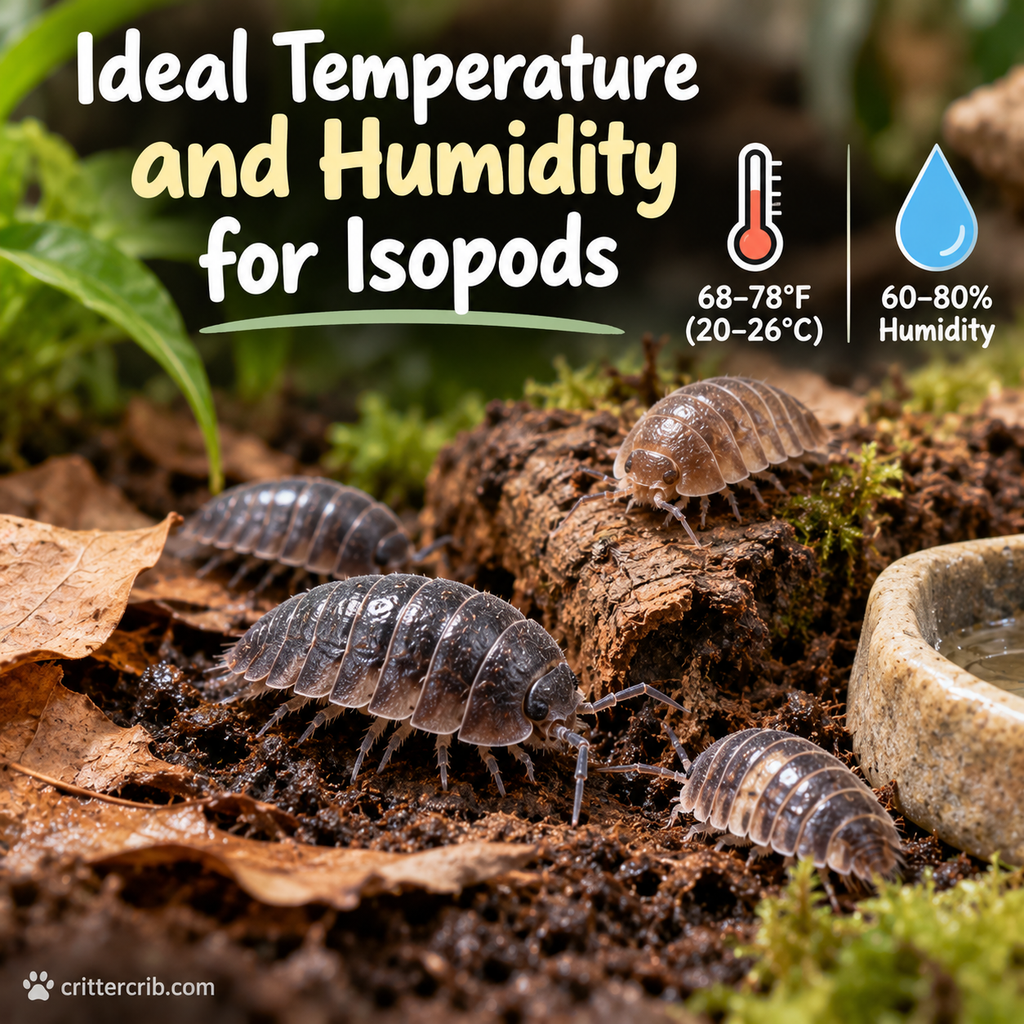
A general starting range for many species is around 68–78°F (20–26°C). Within that range, most popular species can remain active without requiring specialized heating.
That doesn’t mean every species has identical preferences.
Some tolerate cooler temperatures well, while others originating from warmer environments may be more active and reproduce more readily toward the warmer end of their acceptable range.
Before establishing a colony, research the particular species you’re keeping rather than assuming one temperature works for all isopods.
Do Isopods Need a Heat Source?
In a climate-controlled home, many isopod colonies don’t require supplemental heat.
If the room remains within an appropriate range for your species, additional heating may create more problems than it solves.
Small plastic tubs and terrariums can heat up surprisingly quickly. Excessive heat can dry the substrate and reduce humidity, potentially creating dangerous conditions for the colony.
If supplemental warmth is necessary because the room gets cold, it should be introduced carefully and monitored with a reliable thermometer.
Avoid placing an isopod enclosure:
- Directly in sunlight
- Against a radiator
- Next to a heating vent
- On an uncontrolled heat source
- Near areas with major temperature swings
Stable temperatures are generally better than repeatedly moving between hot and cold conditions.
How Cold Is Too Cold for Isopods?
Cold tolerance depends heavily on the species.
Many commonly kept isopods can tolerate temporary drops below their preferred range, although they may become less active. Feeding and reproduction can also slow as temperatures decrease.
Prolonged exposure to temperatures outside the species’ appropriate range can become a problem.
This is particularly important if you keep colonies in a garage, basement, shed, or other area that isn’t climate controlled.
Don’t assume that because wild isopods survive winter outdoors, a captive tropical or selectively bred species will handle the same conditions.
Wild populations may survive by moving deep beneath leaf litter, soil, logs, or other insulated areas—options that aren’t available inside a small enclosure.
How Hot Is Too Hot for Isopods?
Excessive heat can be especially dangerous because it often creates two problems at once.
The enclosure gets hotter while also drying out faster.
Once temperatures begin climbing much beyond the normal range for your species, conditions can deteriorate quickly inside a small container.
Warning signs may include:
- Isopods gathering in the wettest part of the enclosure
- Unusual inactivity
- Isopods attempting to climb the enclosure walls
- Substrate drying much faster than normal
- Increasing colony losses
If an enclosure becomes too warm, move it to a cooler location rather than making sudden, extreme changes.
What Is the Ideal Humidity for Isopods?
There isn’t a universal ideal humidity percentage for all isopods.
You’ll sometimes see specific numbers recommended, such as 70% or 80% relative humidity. Those numbers can be useful as a reference, but they shouldn’t become the sole measure of whether an enclosure is properly hydrated.
For many species, what matters more is having access to consistently moist substrate while still providing areas that are less wet.
This creates a moisture gradient.
The isopods can then move around the enclosure and choose the microclimate they need at any given time.
Why Is Moisture So Important for Isopods?
Isopods are crustaceans, not insects.
Although terrestrial isopods have adapted to living on land, they still depend heavily on moisture for respiration.
Their specialized respiratory structures need appropriate moisture to function effectively.
This helps explain a behavior you’ll frequently see in a healthy enclosure: isopods moving between wetter and drier areas.
Instead of forcing the entire enclosure to maintain exactly the same humidity, you can provide different microclimates and allow the animals to regulate themselves.
The Moisture Gradient: One of the Most Important Parts of Isopod Care
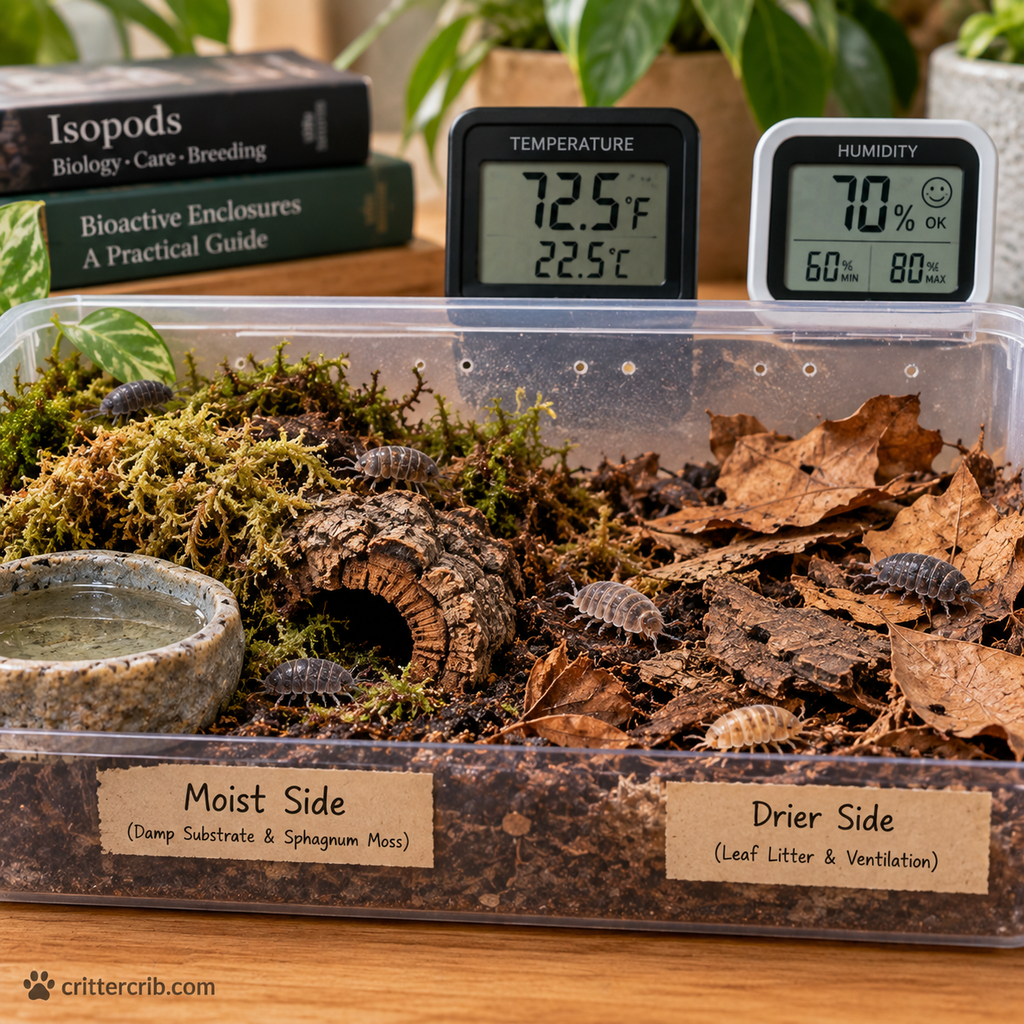
A moisture gradient means one portion of the enclosure stays noticeably more humid and moist than another.
A simple setup might have:
- A moist side with damp sphagnum moss
- Moderately moist substrate through the center
- A comparatively dry side
The dry side shouldn’t necessarily be bone-dry. Likewise, the wet side shouldn’t resemble a swamp.
You’re creating choices rather than extremes.
This approach is useful because individual isopods may seek different moisture levels depending on what they’re doing.
How to Create a Moisture Gradient
You don’t need complicated equipment.
One of the easiest methods is to dedicate roughly one-quarter to one-third of the enclosure to a moist area.
Sphagnum moss is commonly used because it holds water well and makes it easy to see where the moisture zone is located.
To establish the gradient:
- Add an appropriate substrate throughout the enclosure.
- Place sphagnum moss along one end.
- Moisten the moss and substrate beneath it.
- Leave the opposite end comparatively dry.
- Add leaf litter and hides across the enclosure.
- Monitor how quickly each area dries.
- Rehydrate the moist side as needed.
Pouring or adding water directly to the moisture zone can sometimes maintain deeper substrate moisture better than lightly misting the surface alone.
The goal is moist, not flooded.
Should You Mist an Isopod Enclosure?
You can mist an isopod enclosure, but misting shouldn’t automatically be the only way you provide moisture.
A fine spray can temporarily increase surface humidity while leaving deeper substrate relatively dry.
That’s why many keepers focus on actually hydrating part of the substrate.
When adding water, pay attention to how quickly it is absorbed and how long the moisture lasts.
If the substrate is drying within hours, you may have too much ventilation, insufficient substrate depth, excessive heat, or a substrate that doesn’t retain water well.
How Wet Should Isopod Substrate Be?
The moist portion should feel damp but shouldn’t be waterlogged.
If you squeeze a handful of substrate and water pours out, it’s probably too wet.
Standing water at the bottom of the enclosure is another warning sign.
Overly saturated substrate can reduce airflow through the soil and encourage undesirable microbial growth.
A good substrate should retain moisture while still maintaining structure and airflow.
Common substrate ingredients can include:
- Organic topsoil
- Decayed hardwood
- Leaf compost
- Sphagnum moss
- Other species-appropriate organic materials
Avoid substrates containing pesticides, synthetic fertilizers, or other chemicals that may harm your colony.
Is High Humidity Bad for Isopods?
High humidity itself isn’t automatically bad.
The bigger issue is often high humidity combined with stagnant air and constantly saturated substrate.
An enclosure that stays extremely wet everywhere can encourage:
- Mold growth
- Poor air exchange
- Anaerobic areas in the substrate
- Unwanted pests
- Colony stress
Some species tolerate very moist environments better than others, but even moisture-loving isopods benefit from appropriate ventilation.
Humidity and ventilation need to work together.
How Much Ventilation Do Isopods Need?
Good ventilation helps prevent the enclosure from becoming stagnant while still allowing the moisture zone to remain hydrated.
Many isopod containers use ventilation holes along the sides or lid.
Cross ventilation—air openings positioned so air can move through the enclosure—is often particularly effective.
However, more ventilation isn’t always better.
Too much airflow can cause the enclosure to dry excessively fast.
The right balance depends on:
- Species
- Enclosure size
- Room humidity
- Substrate depth
- Temperature
- Amount of moss
- Number and size of ventilation holes
Your enclosure may need adjustment based on the conditions inside your home.
Do You Need a Hygrometer for Isopods?
A hygrometer can be useful, but it isn’t essential for every colony.
The biggest limitation is that a single humidity reading only tells you the relative humidity near the sensor.
It doesn’t necessarily tell you whether the substrate beneath a piece of cork bark is appropriately moist or whether your sphagnum moss has dried out.
If you use a hygrometer, treat it as one piece of information rather than your only measurement.
Also pay attention to:
- Substrate moisture
- Moss moisture
- Condensation
- Colony behavior
- Drying rate
- Mold growth
- Ventilation
With experience, you’ll become better at recognizing what a properly hydrated enclosure looks and feels like.
Should an Isopod Enclosure Have Condensation?
A small amount of occasional condensation isn’t necessarily a problem, especially near the moisture zone.
Heavy condensation covering the entire enclosure all the time can suggest that conditions are excessively wet or poorly ventilated.
On the other hand, completely dry enclosure walls don’t necessarily mean humidity is too low.
Condensation is affected by temperature differences as well as moisture, so it shouldn’t be used as your only indicator.
Check the substrate itself.
Temperature and Humidity for Common Pet Isopods
Different types of isopods can have noticeably different environmental preferences.
Armadillidium Species
Many Armadillidium species appreciate a distinct moisture gradient with good ventilation.
They often spend considerable time in the drier portion of the enclosure but still need reliable access to a humid retreat.
Keeping the entire enclosure constantly saturated is usually unnecessary.
Porcellio Species
Many Porcellio species also benefit from strong ventilation and a defined moisture gradient.
Depending on the particular species, some may prefer conditions that are somewhat drier than those used for more moisture-dependent isopods.
The exact requirements should always be checked at the species level.
Porcellionides pruinosus
Often sold in varieties such as Powder Blue and Powder Orange, Porcellionides pruinosus is popular in bioactive setups because it is active, adaptable, and can reproduce quickly under favorable conditions.
A moisture gradient with adequate ventilation works well, allowing the colony to move between humid and comparatively dry areas.
Cubaris Species
Cubaris is a broad genus that includes many popular and sometimes expensive hobby species.
Their environmental requirements shouldn’t be generalized too aggressively.
Some commonly kept Cubaris prefer warm, humid conditions, but the appropriate moisture, temperature, ventilation, and substrate can differ between species.
If you’re keeping a specific Cubaris, especially a less common variety, research that species individually.
How Temperature Affects Isopod Reproduction
Temperature can influence colony activity and reproduction.
Within an appropriate range, warmer conditions may increase metabolism, feeding, growth, and reproductive activity for some species.
That doesn’t mean making the enclosure as warm as possible will produce more babies.
Once temperatures move beyond a species’ comfortable range, heat becomes stress rather than a benefit.
A stable, appropriate environment is much safer than trying to maximize reproduction through excessive warmth.
If your colony isn’t reproducing, temperature is only one possible factor.
Also consider:
- Colony maturity
- Number of individuals
- Sex ratio
- Nutrition
- Calcium availability
- Moisture
- Hides
- Substrate quality
- Overall stability
Sometimes a new colony simply needs time to establish itself.
Temperature and Humidity During Molting
Like other crustaceans, isopods grow by molting their exoskeleton.
Interestingly, an isopod doesn’t shed its entire exoskeleton at once. It generally molts in two stages, shedding one half of the body and then the other.
Appropriate moisture is especially important during this vulnerable period.
This is another reason a reliable moisture zone is so valuable. An isopod can move toward the microclimate it needs rather than being stuck in uniformly dry conditions.
Avoid allowing an enclosure to completely dry out between waterings.
Signs an Isopod Enclosure Is Too Dry
A dry enclosure can quickly become dangerous, particularly for species requiring higher moisture.
Possible signs include:
- Sphagnum moss becoming completely crisp
- Substrate pulling away from enclosure walls
- Isopods clustering almost exclusively in the wettest area
- Reduced activity
- Difficulty maintaining a colony
- Unexplained deaths
If your enclosure dries rapidly, don’t simply flood it with water.
Instead, gradually restore the moisture zone and determine why it dried so quickly.
You may need to reduce ventilation slightly, increase substrate depth, add more moisture-retaining material, or move the enclosure away from a heat source.
Signs an Isopod Enclosure Is Too Wet
Too much water creates a different set of problems.
Watch for:
- Standing water
- Permanently saturated substrate
- Strong or unpleasant odors
- Excessive mold
- Isopods constantly moving toward the driest area
- Heavy condensation throughout the enclosure
- Substrate becoming compacted and muddy
If everything is soaked, allow some moisture to evaporate and improve ventilation if necessary.
Don’t remove every source of moisture. Preserve a humid refuge while restoring a healthier gradient.
How Often Should You Add Water?
There isn’t a universal schedule such as “mist every three days.”
How often an enclosure needs water depends on your particular setup.
A small enclosure in a warm, dry room may lose moisture much faster than a large enclosure in a humid environment.
Instead of watering according to the calendar, check the moisture zone regularly.
If the moss is beginning to dry and the substrate underneath is losing moisture, add water.
Over time, you’ll learn your enclosure’s rhythm. You might discover that it needs attention every few days, once a week, or at another interval depending on conditions.
Seasonal Changes Matter
An enclosure that works perfectly in summer may behave differently during winter.
Air conditioning can dry indoor air. So can winter heating.
Changes in room temperature can also alter how quickly water evaporates from the substrate.
Check your colonies more frequently when the seasons change.
You may need to adjust:
- Watering frequency
- Ventilation
- Enclosure location
- Substrate moisture
- Supplemental heating, if genuinely necessary
Small adjustments are usually better than dramatic changes.
Temperature and Humidity in Bioactive Terrariums
Isopods kept as a cleanup crew have less controlled conditions than colonies living in dedicated isopod bins.
The needs of the primary animal come first.
If you’re adding isopods to a reptile, amphibian, or invertebrate enclosure, choose a species compatible with the environmental conditions already required by that animal.
A tropical bioactive terrarium may favor moisture-loving isopods, while a comparatively dry setup requires species that tolerate those conditions.
Even in a drier bioactive enclosure, creating humid refuges under cork bark, leaf litter, moss, or other protected areas can help isopods maintain the moisture they need.
How to Maintain Stable Isopod Conditions
Consistency becomes much easier once you understand how your enclosure behaves.
A simple routine works well:
- Check the moisture zone regularly.
- Make sure fresh water hasn’t completely disappeared from the substrate.
- Observe where the isopods are gathering.
- Check for standing water or excessive condensation.
- Monitor the enclosure temperature during hot and cold weather.
- Adjust moisture or ventilation gradually.
- Watch how the colony responds.
You don’t need to constantly change things.
In fact, repeatedly altering the enclosure can make it harder to understand what is actually working.
Common Temperature and Humidity Mistakes
Many beginner problems come from trying to control the enclosure too aggressively.
Common mistakes include:
- Keeping every inch of substrate equally wet
- Allowing the entire enclosure to dry out
- Relying entirely on a hygrometer
- Misting the surface without hydrating deeper substrate
- Providing insufficient ventilation
- Adding excessive ventilation and drying the enclosure
- Using uncontrolled heating equipment
- Placing the enclosure in direct sunlight
- Assuming all isopod species have identical requirements
- Making sudden environmental changes
Aim for stability and variety within the enclosure rather than chasing one exact humidity number.
What Is the Best Temperature and Humidity for Isopods?
For many popular pet isopods, normal indoor temperatures around 68–78°F (20–26°C) provide a reasonable general starting point.
Humidity is more complicated.
Instead of trying to maintain one exact relative humidity percentage throughout the enclosure, focus on creating a reliable moisture gradient. Give the colony access to a consistently moist retreat while keeping another part of the enclosure comparatively dry.
Then watch your isopods.
If they’re using different parts of the habitat, eating normally, molting successfully, and reproducing, that’s a much better indication of suitable conditions than obsessing over a single number on a humidity gauge.
Research your particular species, maintain good ventilation, keep the moisture zone from completely drying out, and make environmental adjustments gradually.
Get those basics right, and you’ll have a much easier time maintaining a healthy isopod colony.