

Rabbits can be affectionate, curious pets, but they don’t always enjoy being handled the way a dog or cat might. Many rabbits prefer sitting beside their people, accepting gentle pets, or climbing onto a lap rather than being picked up and carried around.
That makes sense when you consider how rabbits experience the world. As prey animals, they’re naturally cautious about being restrained or lifted off the ground. A hand suddenly reaching down from above can be frightening, even when the person attached to that hand has the best intentions.
Safe rabbit handling is therefore about more than learning how to pick up a rabbit correctly. It’s also about knowing when not to pick one up, recognizing signs of stress, and gradually showing your rabbit that you’re someone they can trust.
Whether you’ve just brought home your first rabbit or you’re trying to bond with a shy one, patience makes a huge difference.
Why Rabbits Often Don’t Like Being Picked Up
Some new rabbit owners are surprised when their pet runs away as soon as they try to pick it up.
This isn’t necessarily a sign that your rabbit dislikes you.
Rabbits are prey animals. In nature, being grabbed and lifted from the ground would usually mean something dangerous had caught them.
That instinct doesn’t disappear simply because a rabbit lives indoors.
A frightened rabbit may:
- Run away
- Hide
- Flatten its body
- Kick
- Scratch
- Struggle
- Freeze
- Thump its hind feet
- Try to jump from your arms
Some rabbits eventually become more comfortable with necessary handling. Others may never enjoy being carried.
Building trust means respecting those differences rather than forcing physical contact.
How to Build Trust With a Rabbit
If you’re bringing home a new rabbit, your first goal shouldn’t be getting it into your arms.
Start by making your presence feel safe.
Sit quietly on the floor near your rabbit and allow it to investigate you. Rabbits are naturally curious, and many will eventually approach when they realize they’re not being chased or grabbed.
You can read, work on your laptop, or simply sit nearby.
Let your rabbit make the first move.
It might sniff your clothing, nudge your leg, or eventually climb onto you. Resist the urge to immediately scoop it up.
Those voluntary interactions are an important part of building trust.
Use Food to Create Positive Associations
Small treats can help a cautious rabbit associate your presence with something enjoyable.
You can offer a rabbit-safe treat or a small portion of its regular food from your hand.
Over time, your rabbit may become comfortable approaching whenever you sit nearby.
Treats shouldn’t replace a balanced rabbit diet, and sugary foods should be limited. The goal isn’t to constantly feed your rabbit. You’re simply using occasional food rewards to reinforce calm interactions.
Get Down to Your Rabbit’s Level
Imagine being approached by something several times your height.
That’s essentially what happens when you stand over a rabbit.
Sitting or lying on the floor makes you considerably less intimidating.
It also gives your rabbit the option to approach and leave freely, which can make interactions feel much safer.
This simple habit is one of the easiest ways to strengthen your relationship.
How Should You Pet a Rabbit?
Once your rabbit is comfortable approaching you, gentle petting can become part of your routine.
Many rabbits enjoy being stroked around the:
- Forehead
- Cheeks
- Behind the ears
- Top of the head
- Upper back
Start slowly.
Offer your hand where your rabbit can see and smell it rather than immediately reaching over its head.
If your rabbit lowers its head toward the floor, it may be asking to be groomed or petted.
Areas to Approach Carefully
Individual preferences vary, but many rabbits are less comfortable having certain areas touched.
These can include:
- Feet
- Tail
- Belly
- Rear end
- Chin
- Legs
Pay attention to your rabbit’s reaction.
If it repeatedly moves away when you touch a particular area, respect that boundary unless handling is necessary for grooming or medical care.
Rabbit Body Language and Trust
Learning rabbit body language makes safe handling much easier.
A relaxed rabbit might:
- Stretch out on the floor
- Lie with its feet extended behind it
- Rest comfortably beside you
- Gently grind its teeth while being petted
- Groom itself in your presence
- Approach you voluntarily
- Nudge you for attention
A nervous or uncomfortable rabbit may:
- Crouch tightly
- Flatten its ears
- Widen its eyes
- Run away
- Hide
- Thump
- Become unusually still
- Kick or struggle when touched
Context matters because one behavior can sometimes have multiple meanings.
The more time you spend quietly observing your rabbit, the easier it becomes to recognize its normal behavior.
How to Pick Up a Rabbit Safely
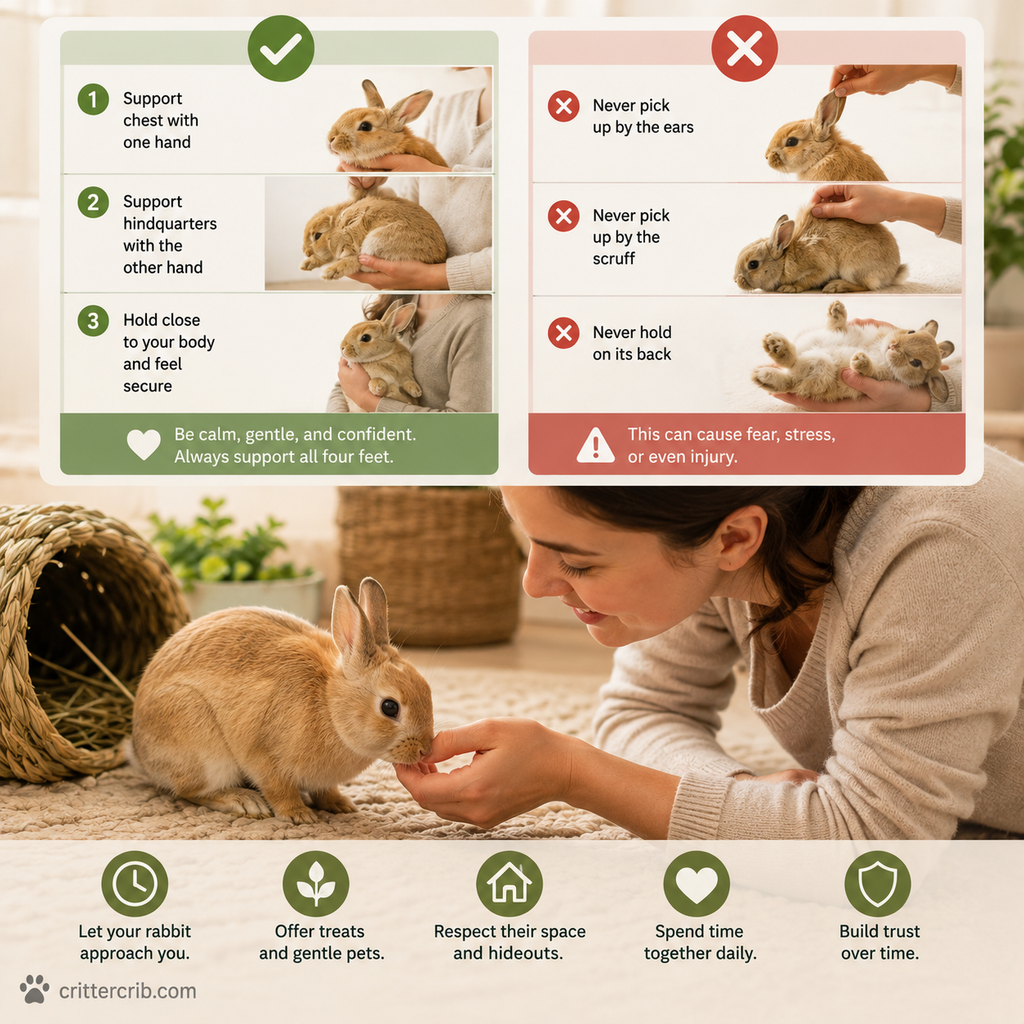
Sometimes picking up a rabbit is necessary.
You may need to move your rabbit into a carrier, perform a health check, trim nails, or remove it from an unsafe situation.
When lifting is necessary, supporting the rabbit’s body properly is extremely important.
Rabbits have powerful hind legs and relatively delicate skeletal structures. A panicked rabbit that kicks forcefully while unsupported can seriously injure itself.
Step 1: Approach Calmly
Don’t chase your rabbit around the room before attempting to pick it up.
Move slowly and speak softly.
Whenever possible, position yourself close to the floor.
A calm beginning makes the entire process easier.
Step 2: Secure the Front of the Body
Place one hand securely around or beneath the rabbit’s chest area behind the front legs.
The goal is to support the front portion of the body without squeezing.
Step 3: Support the Hindquarters
Your other hand should support the rabbit’s hindquarters and back legs.
This step is essential.
Never allow the rabbit’s back legs to hang unsupported.
Step 4: Bring the Rabbit Against Your Body
Once the rabbit is lifted, gently hold it against your body.
Keeping the rabbit securely supported can reduce the feeling that it’s suspended in open space.
Maintain support beneath the hindquarters throughout the entire lift.
Step 5: Keep the Lift Short
Unless there’s a specific reason to carry your rabbit farther, keep handling sessions brief.
If your rabbit is clearly uncomfortable, calmly return it to a safe surface rather than continuing unnecessarily.
How to Put a Rabbit Down Safely
Putting a rabbit down deserves just as much attention as picking one up.
A rabbit that realizes it’s approaching the floor may suddenly kick or launch itself from your arms.
Lower yourself toward the ground while continuing to support both the front and back of the rabbit.
Keep the rabbit secure until all four feet are very close to or touching the surface.
Then release gently.
Don’t let your rabbit jump from your arms from several feet above the floor.
Even if the rabbit appears eager to get down, a poorly controlled landing can result in injury.
Never Pick Up a Rabbit by the Ears
A rabbit should never be lifted by its ears.
Rabbit ears are delicate and aren’t designed to support the animal’s body weight. Doing so is painful and can cause serious injury.
You should also never lift a rabbit by:
- The legs
- The tail
- The scruff alone
Always support the rabbit’s body and hindquarters.
If you’re unsure how to safely hold your rabbit, ask a rabbit-experienced veterinarian to demonstrate the proper technique.
Should You Hold a Rabbit on Its Back?
You may have seen rabbits placed on their backs where they appear to become extremely still.
This is sometimes mistaken for relaxation.
In reality, this position can trigger a fear-related immobility response known as tonic immobility.
Because of the stress involved, routinely placing a rabbit on its back simply to make handling easier isn’t recommended.
There may be situations where a veterinarian uses specific restraint techniques during an examination or procedure, but that’s different from routinely doing it at home.
For normal interaction, allow your rabbit to remain in a natural, supported position.
What If Your Rabbit Struggles When Held?
If your rabbit starts struggling, your instinct may be to loosen your grip immediately.
Be careful.
A rabbit that suddenly launches from your arms can fall and injure itself.
Instead, maintain secure support without squeezing and lower yourself toward the floor as quickly and calmly as possible.
Once you’re close to a safe surface, gently let the rabbit go.
If struggling happens every time you pick up your rabbit, don’t repeatedly force handling in an attempt to make it “get used to it.”
Return to trust-building activities at floor level.
You can gradually work on necessary handling later.
How to Handle a Shy or Scared Rabbit
A frightened rabbit needs time.
Forcing interaction usually works against you.
Instead, create predictable routines.
Feed your rabbit at similar times each day. Sit quietly nearby. Offer treats occasionally. Move slowly around its space.
Allow the rabbit to learn that your presence doesn’t automatically mean being picked up.
You can follow a gradual process:
- Sit near the rabbit without touching it.
- Allow the rabbit to approach voluntarily.
- Offer food from your hand.
- Introduce gentle forehead petting.
- Gradually increase the length of calm interactions.
- Introduce necessary handling only when the rabbit is comfortable with your presence.
This process might take days for one rabbit and weeks or longer for another.
That’s normal.
Trust doesn’t follow a schedule.
How Long Does It Take for a Rabbit to Trust You?
There’s no universal timeline.
A confident, well-socialized rabbit might begin approaching you almost immediately.
A rabbit that has experienced rough handling, neglect, frequent environmental changes, or very little human interaction may need considerably longer.
Age and personality matter too.
Look for small improvements rather than expecting a dramatic change overnight.
Your rabbit choosing to sit slightly closer to you than yesterday can be progress.
So can taking a treat from your hand for the first time.
Eventually, those small interactions can develop into a strong bond.
Can You Train a Rabbit to Tolerate Being Picked Up?
Many rabbits can become more comfortable with handling through gradual, positive experiences.
Start with very small steps.
For example, while your rabbit is calmly sitting on the floor, gently place your hands in the positions you’d use for lifting without actually picking it up.
Reward calm behavior.
Later, you might lift the rabbit only slightly above the floor before immediately setting it down.
Gradually increase the duration only when the rabbit remains comfortable.
Keep sessions short and positive.
If your rabbit becomes frightened, return to an easier step rather than pushing forward.
The goal isn’t necessarily to make your rabbit love being carried.
It’s to make necessary handling less stressful.
Should Children Pick Up Rabbits?
Children and rabbits can form wonderful relationships, but picking up a rabbit requires careful supervision.
Rabbits can be heavier and stronger than they look.
A frightened rabbit may suddenly kick or twist, causing a child to lose their grip. The child may be scratched, and the rabbit may fall.
For younger children, floor-level interaction is usually safer.
Encourage children to sit quietly and allow the rabbit to approach them.
They can offer appropriate food, gently pet the rabbit, and participate in supervised care without carrying it around.
If an older child is learning to pick up a rabbit, an adult should demonstrate proper technique and supervise closely.
How to Move a Rabbit That Hates Being Picked Up
Sometimes you need to move your rabbit even if it strongly dislikes being held.
A carrier can make this easier.
Instead of picking up your rabbit and carrying it across the house, teach it to enter a carrier voluntarily.
Leave the carrier accessible during normal activities so it doesn’t appear only before stressful events such as veterinary appointments.
Place hay or a small treat inside.
Over time, your rabbit may begin entering the carrier without hesitation.
This can make transportation much less stressful for everyone.
How to Build a Stronger Bond With Your Rabbit
Handling is only one small part of your relationship.
In fact, some of the best bonding happens without picking the rabbit up at all.
Spend time together at floor level.
Provide toys and enrichment. Offer occasional treats by hand. Learn what kinds of petting your rabbit enjoys.
You can also teach simple behaviors using positive reinforcement.
The strongest relationships are built through consistency.
Your rabbit learns:
- You provide food and fresh water.
- You don’t chase it.
- You respect its hiding places.
- Your hands are gentle.
- You provide interesting activities.
- You respond when it’s uncomfortable.
- You allow it to make choices.
That sense of predictability helps your rabbit feel secure.
Common Rabbit Handling Mistakes
Even well-meaning owners can accidentally make rabbits nervous around them.
Common mistakes include:
- Chasing a rabbit before picking it up
- Grabbing it suddenly from above
- Lifting without supporting the hindquarters
- Carrying it unnecessarily
- Allowing it to jump from your arms
- Holding too tightly
- Picking it up by the ears, legs, or scruff
- Putting it on its back unnecessarily
- Ignoring signs of fear
- Waking or disturbing it simply for interaction
- Forcing a rabbit to cuddle
- Allowing young children to carry it unsupervised
If you’ve made one of these mistakes, don’t assume you’ve permanently damaged your relationship.
Adjust your approach and give your rabbit time to become comfortable again.
How Do You Know When a Rabbit Trusts You?
Rabbit affection can be subtle.
Unlike a dog that might race toward you when you enter the room, a rabbit may show trust simply by relaxing nearby.
Signs that your rabbit is becoming comfortable with you may include:
- Approaching you without hesitation
- Taking food gently from your hand
- Lying down beside you
- Grooming itself near you
- Nudging your hand
- Asking for head rubs
- Climbing onto your lap voluntarily
- Exploring while you’re nearby instead of hiding
- Resting in a relaxed position around you
Some rabbits may even lick their owners as a form of social grooming.
Remember that every rabbit has a different personality.
A rabbit doesn’t need to become extremely cuddly to have a strong bond with you.
When Handling Is Necessary for Health Care
Even rabbits that dislike being picked up need regular health checks.
You may occasionally need to examine:
- Nails
- Feet
- Teeth and mouth area
- Eyes
- Ears
- Coat and skin
- Rear end
- Body condition
Regular observation can help you notice changes early.
You should also pay attention to appetite, drinking, droppings, movement, and normal behavior.
Rabbits can sometimes hide signs of illness, so significant changes shouldn’t be ignored.
If your rabbit suddenly stops eating, produces fewer or no droppings, has difficulty breathing, becomes unusually lethargic, or shows signs of pain, contact a veterinarian promptly.
Let Your Rabbit Have a Choice
One of the most effective ways to build trust with a rabbit is surprisingly simple: give it some control over interactions.
Instead of always reaching for your rabbit, occasionally sit nearby and wait.
If it approaches, offer your hand.
If it wants attention, pet it.
If it walks away, let it go.
When rabbits learn that approaching you doesn’t automatically result in being grabbed or restrained, they often become more willing to interact.
This turns bonding into something your rabbit participates in rather than something that happens to it.
Safe Handling Builds Long-Term Trust
Learning how to handle a rabbit safely isn’t about becoming an expert at carrying your pet around.
Quite the opposite.
Good rabbit handling means recognizing that many rabbits feel safest with their feet on the ground.
When lifting is necessary, always support the front of the body and the powerful hindquarters, hold the rabbit securely against your body, and return it gently to a safe surface.
For everyday bonding, focus on quieter interactions.
Sit on the floor. Offer gentle head rubs. Provide enrichment. Let your rabbit investigate you. Pay attention to its body language and respect when it wants space.
It may take some patience, especially with a shy rabbit, but that’s part of the process.
Once your rabbit realizes that you’re predictable, gentle, and willing to respect its boundaries, trust can grow naturally—and that trust is far more valuable than simply being able to pick your rabbit up.