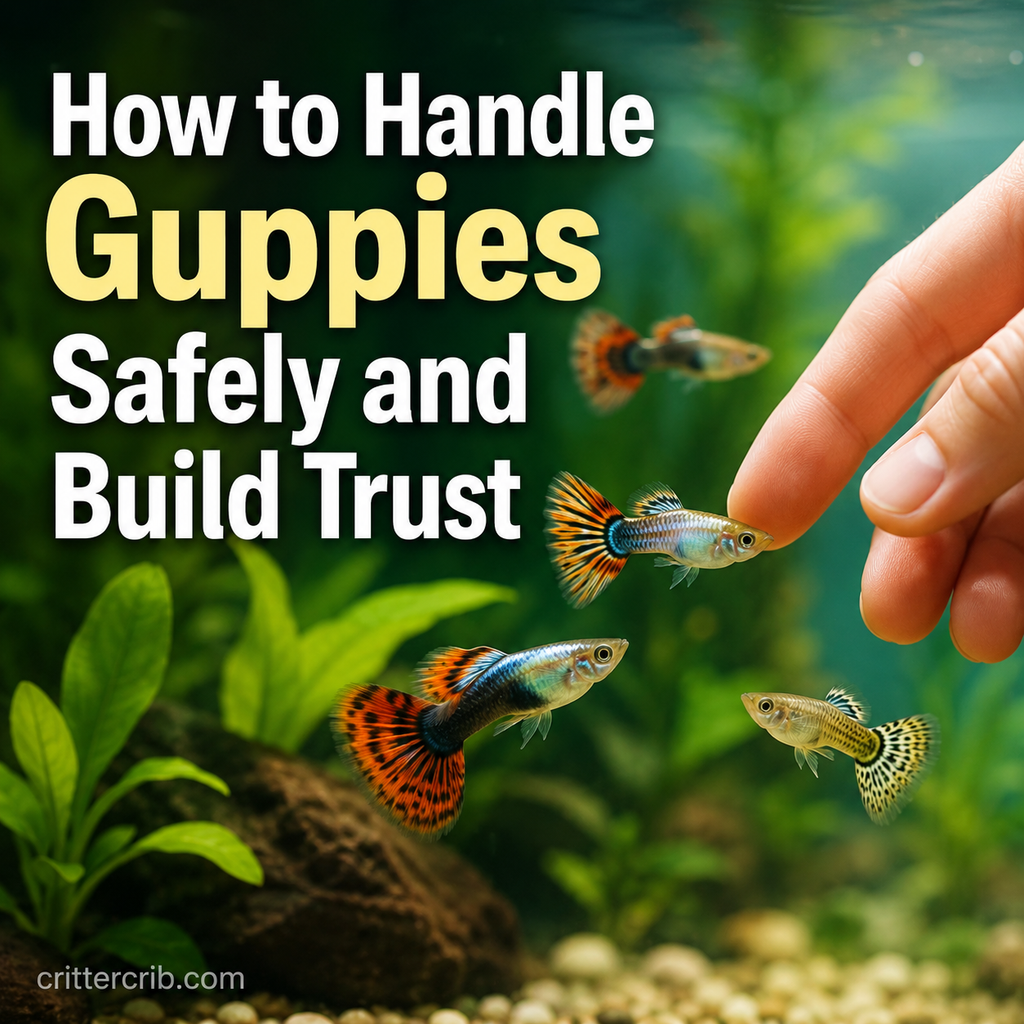
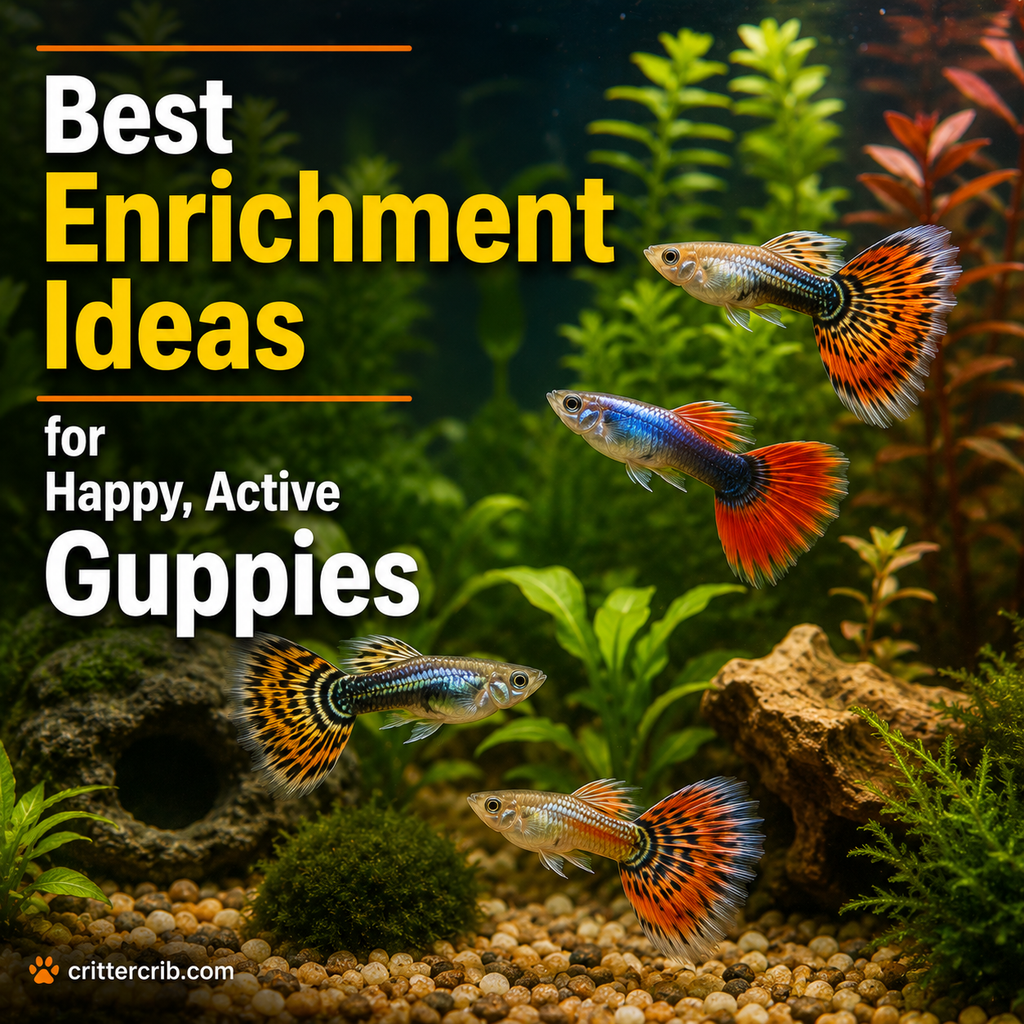
Guppies are small fish with big personalities. Spend a little time watching a healthy group and you’ll see them exploring plants, investigating objects, interacting with other guppies, and eagerly checking out anything new in their environment.
That natural curiosity makes guppies great candidates for enrichment.
Fish enrichment doesn’t mean buying complicated toys or constantly rearranging the aquarium. In fact, some of the best enrichment comes from creating a varied, comfortable habitat that gives guppies opportunities to explore, forage, swim, hide, and interact naturally.
The key is finding the right balance. A completely bare aquarium can offer very little stimulation, but an overcrowded tank filled with decorations isn’t ideal either.
Here are some of the best enrichment ideas for guppies, along with tips for introducing them without compromising water quality or safety.
Do Guppies Need Enrichment?
Guppies don’t need entertainment in exactly the same way a dog needs a game of fetch, but they do benefit from an environment that allows them to express natural behaviors.
In the wild, fish don’t spend their entire lives swimming back and forth through an empty glass box. Their surroundings include vegetation, changing light, food sources, other animals, currents, shelter, and different areas to investigate.
A thoughtfully designed aquarium can provide some of that environmental variety.
Good enrichment may encourage behaviors such as:
- Exploring
- Foraging
- Swimming at different levels
- Moving through plants
- Interacting socially
- Seeking shelter
- Investigating changes in the environment
Enrichment should complement proper aquarium care rather than compensate for poor conditions. Clean water, enough swimming space, appropriate temperatures, and good nutrition always come first.
1. Add Live Aquarium Plants
Live plants are one of the easiest ways to make a guppy aquarium more interesting.
Plants create different swimming paths and provide places for fish to investigate, rest near, or retreat into when they want some cover.
They can be particularly useful in a guppy tank because guppies frequently reproduce. Dense vegetation gives newborn fry places to hide from larger fish.
Beginner-friendly aquarium plants may include:
- Java fern
- Anubias
- Java moss
- Water sprite
- Hornwort
- Amazon sword
- Guppy grass
The best choice depends on your lighting, substrate, aquarium size, and water conditions.
Try Floating Plants
Floating plants add another dimension to the aquarium.
Their roots can hang down into the water, creating interesting areas for guppies to explore. They may also provide shade and cover near the surface.
Just don’t allow floating plants to completely cover the aquarium.
Guppies still need access to the surface, and excessive plant coverage can reduce light below and interfere with gas exchange if growth becomes extreme.
Regular trimming keeps floating plants under control.
2. Create Areas of Dense and Open Space
More decoration isn’t automatically better enrichment.
Guppies are active swimmers, so they need open water too.
A good aquarium layout might have a heavily planted area along the back and sides while leaving the center or front relatively open for swimming.
This creates distinct zones:
- Open swimming areas
- Planted exploration areas
- Sheltered resting areas
- Surface areas
- Lower areas around rocks or wood
The fish can then choose where they want to spend their time instead of being forced into one type of environment.
This kind of variety is more useful than filling every available inch with decorations.
3. Use Driftwood and Natural-Looking Structures
Aquarium-safe driftwood can make a tank much more interesting.
Its branches, curves, and openings create natural swimming routes while adding visual structure to the aquarium.
Guppies may investigate spaces around the wood, swim underneath branches, or use nearby plants for cover.
Choose wood specifically intended for aquarium use.
Random pieces of wood collected outdoors may contain contaminants, pesticides, sap, or organisms you don’t want in your aquarium.
Depending on the type, aquarium driftwood may also release tannins that give the water a yellow or brown tint. This isn’t necessarily harmful, although it may not fit the appearance you want.
4. Add Smooth Rocks and Caves
Rocks can create visual barriers and interesting areas for guppies to explore.
You can use appropriately sized aquarium-safe rocks to create:
- Small caves
- Overhangs
- Passages
- Sheltered corners
- Different swimming routes
Make sure any structure is stable.
A pile of loose rocks that can shift or collapse is more dangerous than enriching.
Also check decorations for sharp edges. Guppies have delicate fins that can potentially be damaged by rough surfaces.
Caves don’t need to be elaborate. Even a simple structure that breaks up the aquarium’s open space can make the environment more varied.
5. Give Guppies Places to Hide
Hiding places aren’t only useful for frightened fish.
Having the option to retreat can make an aquarium more comfortable, particularly when several fish share the same space.
Cover can be created using:
- Live plants
- Artificial plants
- Driftwood
- Rock formations
- Aquarium caves
- Floating plant roots
The important word is “option.”
A healthy guppy shouldn’t spend all day hiding. Persistent hiding can indicate stress, poor water conditions, illness, bullying, or another problem.
Providing shelter is good enrichment. A fish suddenly using that shelter constantly is something worth investigating.
6. Introduce Food-Based Enrichment
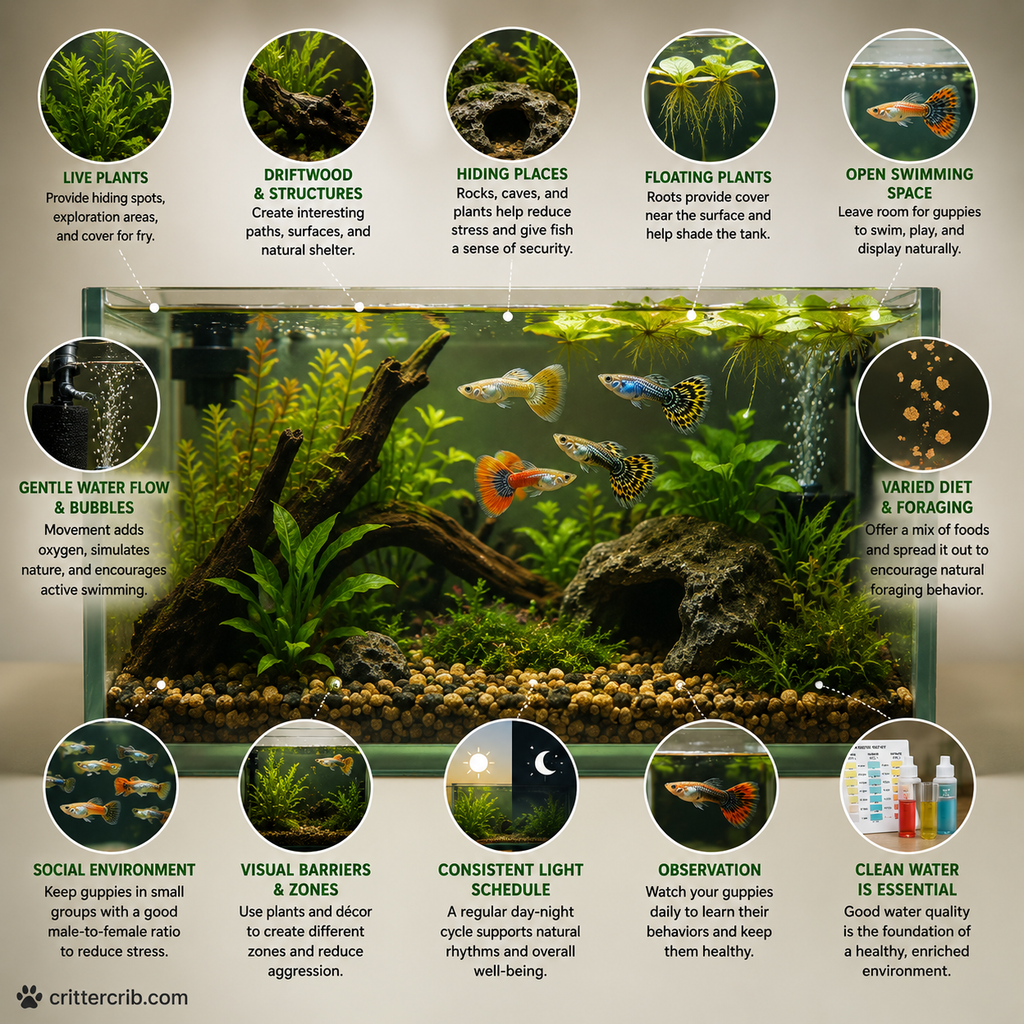
Feeding time is one of the easiest opportunities for enrichment.
Instead of having every meal arrive in exactly the same spot in exactly the same form, occasionally vary how appropriate foods are offered.
For example, you can distribute a small amount of food across a wider portion of the water surface rather than dropping everything into one location.
That encourages fish to move around and search.
Offer a Varied Diet
Depending on the diet you’re already providing, appropriate supplemental foods may include:
- Brine shrimp
- Daphnia
- Appropriate frozen foods
- Suitable live foods
- Quality guppy or tropical fish foods
Variety shouldn’t mean overfeeding.
Treat supplemental foods as part of the day’s food allowance rather than automatically adding them on top of the normal diet.
Consider Live Foods Occasionally
Appropriately sourced live foods can encourage natural hunting and foraging behaviors.
Watching guppies pursue tiny moving prey is very different from watching them wait beneath a pinch of flakes.
The source matters, though.
Don’t collect random larvae or small organisms from outdoor puddles, ponds, or waterways. They may introduce parasites, pathogens, pollutants, or unwanted animals into the aquarium.
Use foods from reliable aquarium sources or properly maintained cultures.
7. Create Gentle Water Movement
Water movement can add variety to the aquarium environment.
Guppies are active swimmers, and areas of gentle current can encourage them to move through different parts of the tank.
However, stronger isn’t better.
An excessively powerful current can make fish work constantly just to maintain their position. Long-finned guppies may be especially affected.
Ideally, the aquarium should provide some variation, with areas of gentle movement and calmer places where fish can rest.
If your guppies are constantly being pushed around the tank or avoiding one side because of the filter output, the flow may be too strong.
8. Use Bubbles for Environmental Variety
An air stone or sponge filter can create bubbles and water movement that some guppies may investigate.
Bubbles also increase surface agitation, which can help promote gas exchange.
Not every aquarium requires an additional air stone, particularly when the existing filter already creates sufficient surface movement.
Think of bubbles as part of the environment rather than a toy that every guppy must have.
If the bubbles create excessive turbulence, reduce the airflow or reposition the equipment.
9. Change the Environment Occasionally
A small change can give guppies something new to investigate.
You might occasionally:
- Reposition a piece of driftwood
- Move a rock
- Trim plants into a different shape
- Add a new aquarium-safe plant
- Change the location of a cave
The emphasis should be on occasionally.
Constantly tearing apart and rebuilding the aquarium can be stressful rather than enriching. Major changes can also disturb plants, substrate, beneficial bacteria, and established territories.
Small, gradual changes are usually the better approach.
10. Give Them Enough Swimming Space
Swimming space might not sound like enrichment, but it’s one of the most important parts of an engaging guppy environment.
Guppies are active fish.
They need room to:
- Swim normally
- Explore
- Move away from other fish
- Search for food
- Interact socially
- Choose different areas of the aquarium
An overcrowded aquarium limits those choices.
It also creates practical problems by increasing waste production and placing greater demands on filtration.
When planning a guppy tank, don’t calculate space based only on the size of the fish you have today. Guppies reproduce readily, so population growth can become a serious consideration.
11. Keep Guppies in an Appropriate Social Environment
Guppies are social fish and often interact with one another throughout the day.
Watching a group can reveal courtship, following, displaying, exploring, and other social behaviors.
However, social enrichment only works when the group itself is appropriate.
Pay Attention to Male-to-Female Ratios
Male guppies can persistently pursue females.
When too few females are kept with multiple males, individual females may receive excessive attention and become stressed.
If you’re keeping males and females together, research an appropriate sex ratio and be prepared for reproduction.
Guppies are livebearers and can produce fry frequently.
Consider an All-Male Tank
An all-male guppy aquarium can be an option if you want colorful fish without producing large numbers of fry.
You’ll still need to watch the group’s behavior because individual personalities vary and chasing can occur.
Provide enough space and visual barriers so fish can move away from one another when needed.
12. Use a Background on the Aquarium
A simple aquarium background can make a tank feel less exposed.
Backgrounds also reduce visual distractions from behind the aquarium, such as people walking past, cords, furniture, and moving shadows.
You don’t need anything elaborate.
A plain dark background or natural aquarium scene can work well.
Covering the back of the aquarium while leaving the front and sides open for viewing can provide a good balance between visibility and a sense of security.
13. Provide a Natural Day-and-Night Cycle
Lighting plays an important role in the aquarium environment.
Guppies shouldn’t live under bright aquarium lights 24 hours a day.
A predictable period of light followed by darkness creates a more natural daily rhythm.
An aquarium light timer makes this easy because the lights switch on and off consistently without you having to remember.
If your aquarium contains live plants, their lighting requirements also need to be considered.
Avoid placing the tank where intense direct sunlight causes overheating or excessive algae growth.
At night, give your fish a proper period of darkness rather than leaving the aquarium light running.
14. Let Plants Grow Into Different Levels
One of the advantages of live plants is that they can create enrichment throughout the water column.
Instead of keeping every plant at roughly the same height, consider using a combination of:
- Low-growing plants
- Mid-height plants
- Tall background plants
- Mosses
- Floating plants
This gives guppies different areas to investigate from the bottom of the aquarium to the surface.
It also creates a more visually interesting tank without sacrificing open swimming areas.
15. Encourage Safe Foraging
Guppies naturally spend time investigating their surroundings for potential food.
You can encourage this behavior without dumping extra food into the aquarium.
Occasionally spread a properly portioned meal across different areas so the fish have to move around to find it.
For live or frozen foods, you can vary the feeding location instead of always delivering food to exactly the same corner.
The important rule is that enrichment shouldn’t increase the total amount of food unnecessarily.
Food left sitting in the aquarium eventually becomes waste.
16. Observe Your Guppies
One of the best enrichment tools doesn’t go inside the aquarium at all.
It’s observation.
Spend a few minutes watching how your guppies use the tank.
Do they:
- Explore the plants?
- Prefer a particular swimming area?
- Avoid the filter current?
- Chase each other excessively?
- Spend time near the surface?
- Use hiding places?
- Search around plants for food?
- Remain active throughout the tank?
Those behaviors can tell you whether your setup is actually working.
An enrichment idea that sounds great in theory isn’t useful if your fish consistently avoids it.
Enrichment Ideas to Avoid
Not everything sold or promoted as a fish accessory is necessarily beneficial.
Be cautious with anything that could trap, injure, frighten, or contaminate your fish.
Mirrors
Mirrors are sometimes suggested as enrichment because fish may respond to their reflection.
Guppies don’t need mirrors for stimulation.
If a fish repeatedly interprets its reflection as another fish or rival, prolonged exposure could become stressful rather than beneficial.
A planted, varied aquarium offers plenty of safer opportunities for exploration.
Laser Pointers
Avoid using laser pointers to make fish chase a light.
They’re unnecessary, and shining a laser around an aquarium introduces avoidable risk to the fish’s eyes.
Food-based foraging and environmental enrichment are better options.
Sharp Decorations
Run your fingers carefully over artificial decorations before placing them in the aquarium.
Avoid items with:
- Sharp edges
- Rough openings
- Narrow holes that could trap fish
- Exposed metal
- Flaking paint
- Unknown coatings
Long-finned guppies can be particularly vulnerable to rough surfaces.
Random Household Objects
Don’t assume something is aquarium-safe because it’s waterproof.
Painted ornaments, metals, plastics, ceramics, adhesives, and other materials may release unwanted substances into the water.
Use products specifically designed for aquariums or materials known to be aquarium-safe.
Don’t Sacrifice Water Quality for Enrichment
This is the most important rule.
A beautifully decorated aquarium isn’t enriching if ammonia or nitrite is present, the tank is overcrowded, or waste is accumulating.
Every object added to an aquarium affects the environment in some way.
Dense decorations can trap debris. Extra food creates waste. Plants require maintenance. Driftwood may affect water appearance and chemistry. New items can potentially introduce contaminants.
Continue monitoring:
- Ammonia
- Nitrite
- Nitrate
- Temperature
- Overall water quality
In an established, properly cycled aquarium, ammonia and nitrite should remain at zero.
Enrichment should make a healthy aquarium more interesting—not make basic maintenance harder.
Signs Your Guppies Are Comfortable and Active
Individual behavior varies, but healthy guppies are generally alert and active.
Positive signs may include:
- Exploring different areas of the aquarium
- Swimming normally
- Showing interest at feeding time
- Interacting with other guppies
- Moving through plants and structures
- Maintaining normal coloration and body condition
Remember that activity alone doesn’t prove everything is perfect.
A fish frantically swimming against the glass, repeatedly gasping at the surface, or constantly fleeing another fish isn’t necessarily “active” in a positive sense.
Learn what normal behavior looks like for your particular group.
Signs Your Guppies May Be Stressed
Changes in behavior can indicate a problem with the environment.
Watch for:
- Constant hiding
- Loss of appetite
- Clamped fins
- Unusual lethargy
- Persistent surface gasping
- Frantic swimming
- Repeated bullying
- Fish isolating themselves
- Sudden changes in coloration
- Abnormal swimming
If you notice these signs, check water parameters before assuming your fish simply needs more enrichment.
Poor water quality can cause major behavioral changes.
A Simple Guppy Enrichment Setup
You don’t need to turn your aquarium into an underwater amusement park.
A simple enrichment-friendly setup could include:
Back and Sides
Use taller live plants to provide cover and create visual barriers.
Middle
Add a piece of aquarium-safe driftwood or a few smooth rocks surrounded by medium-height plants.
Front
Keep much of the area open so the guppies have plenty of swimming space and you can easily observe them.
Surface
Add a controlled amount of floating vegetation while keeping substantial open surface area.
Feeding
Provide a balanced staple diet and occasionally vary appropriate foods and feeding locations.
Lighting
Use a consistent day-and-night schedule, preferably controlled by a timer.
That combination creates variety without making the aquarium overly complicated.
Frequently Asked Questions About Guppy Enrichment
Do guppies get bored?
We can’t know whether guppies experience boredom exactly as humans do, but fish can respond to their surroundings and benefit from environments that allow natural behaviors such as exploring, foraging, swimming, and interacting socially.
Providing environmental complexity is a sensible part of good fish husbandry.
Do guppies like toys?
Guppies don’t need conventional pet toys. Plants, driftwood, rocks, caves, appropriate water movement, varied feeding, and social interaction provide more natural forms of stimulation.
Do guppies like heavily planted tanks?
Guppies often make good use of planted aquariums. Plants provide cover and areas to explore, while dense vegetation can help protect fry. Just maintain enough open water for swimming.
Do guppies like bubbles?
Some guppies may investigate bubbles and water movement. Air stones and sponge filters can also improve surface agitation and gas exchange. However, bubbles aren’t required purely for entertainment.
Should I rearrange my guppy tank?
Occasional small changes can create something new for your fish to investigate. Avoid frequently rebuilding the entire aquarium, as major environmental changes can cause unnecessary stress.
What plants are good for guppies?
Popular choices include Java fern, Java moss, Anubias, water sprite, hornwort, and guppy grass. Choose plants suited to your aquarium’s lighting, substrate, and water conditions.
Can food be used as enrichment for guppies?
Yes. You can occasionally vary suitable foods or distribute a properly sized meal across different areas to encourage searching and foraging. Avoid increasing the total amount of food simply for enrichment.
Is a bare tank bad for guppies?
Bare tanks can be useful temporarily for quarantine, treatment, or certain breeding situations because they’re easy to clean and monitor. For long-term display housing, however, providing safe plants, structures, and environmental variety gives guppies more opportunities to express natural behaviors.
Final Thoughts
The best enrichment for guppies isn’t necessarily a toy.
It’s a good environment.
Live plants, open swimming space, hiding places, gentle water movement, natural structures, appropriate social interaction, varied feeding, and a consistent light cycle can turn an ordinary aquarium into a much more engaging habitat.
You don’t need to introduce everything at once.
Start with the basics: clean water, enough space, proper filtration, a balanced diet, and an appropriate social group. From there, add plants and structures that create different areas for your guppies to explore.
Then watch them.
Your fish will often show you which parts of the aquarium they find most interesting. And that’s one of the best things about enrichment—you get a healthier, more engaging environment for your guppies and a much more interesting aquarium to enjoy yourself.