
Corydoras catfish have a reputation for being hardy, peaceful, beginner-friendly aquarium fish. That’s mostly deserved. Give them clean water, suitable tank mates, good food, and a comfortable environment, and these little bottom-dwellers can be wonderful additions to a community aquarium.
The problem is that their easygoing nature sometimes leads people to underestimate their needs.
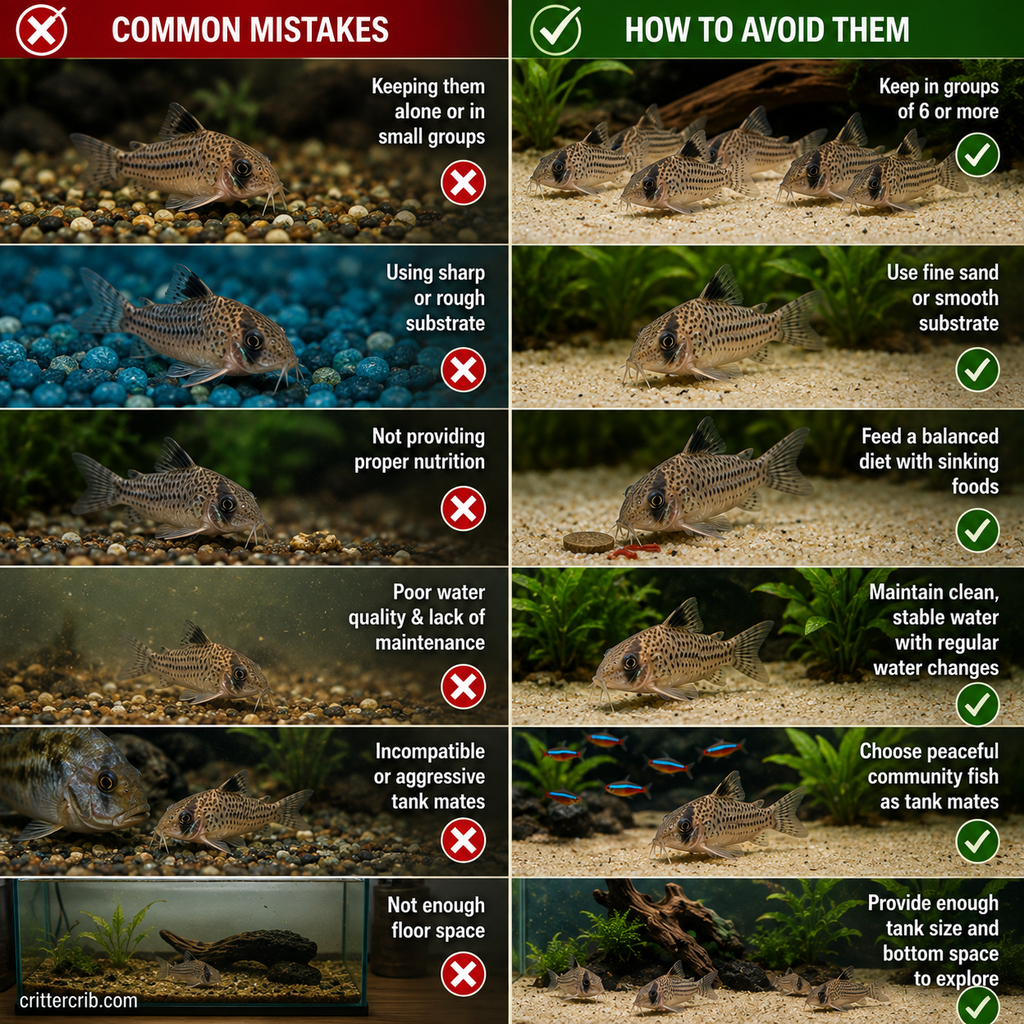
Corydoras aren’t simply aquarium cleanup crews. They need proper nutrition, companionship, suitable substrate, stable water conditions, and enough room to behave naturally.
Some common Corydoras care mistakes aren’t obvious either. A tank may look perfectly fine while the fish are dealing with rough substrate, poor water quality near the bottom, inadequate feeding, or the stress of being kept alone.
Here are the most common mistakes new Cory keepers make—and what to do instead.
1. Keeping a Corydoras Alone
One of the biggest Corydoras care mistakes is buying a single fish.
Corydoras are social fish. In nature, they can occur in groups, and that social behavior remains important in an aquarium.
A lone Cory may survive, but keeping several compatible Corydoras allows you to see much more of their natural behavior.
They may:
- Explore together
- Rest near one another
- Search for food as a group
- Follow each other around the aquarium
- Become more confident in open areas
For most commonly kept species, aim for a group of at least six when aquarium size allows.
Keep the Same Species When Possible
“Corydoras” refers to many different species.
Although different Cory species may sometimes associate with one another, keeping a proper group of the same species is generally preferable.
For example, six panda Corydoras will usually provide a more appropriate social group than buying one panda Cory, one bronze Cory, one peppered Cory, and several unrelated bottom-dwelling fish.
Research the particular species before purchasing because adult size and environmental preferences can vary.
2. Treating Corydoras as Cleanup Fish
Walk into an aquarium store and you may hear bottom-dwelling catfish described as part of a “cleanup crew.”
That’s misleading.
Corydoras do search the bottom for food, and they’ll happily find pieces other fish miss. But leftovers aren’t a complete diet.
They aren’t substitutes for aquarium maintenance either.
Corydoras don’t make fish waste disappear. They produce waste themselves, just like every other fish.
Your Corys need food specifically intended for them.
Good options can include:
- Quality sinking pellets
- Sinking wafers
- Frozen or live foods
- Daphnia
- Brine shrimp
- Bloodworms as an occasional food
- Other appropriately sized foods
Make sure enough food actually reaches the bottom.
If fast-swimming tank mates eat everything before your Corydoras get a chance, you’ll need to adjust your feeding routine.
3. Using Sharp or Rough Substrate
Corydoras spend a great deal of time interacting with the bottom of the aquarium.
Their sensitive barbels around the mouth help them search for food, and watching a group sift through the substrate is one of the most entertaining parts of keeping them.
The substrate therefore deserves careful consideration.
Fine aquarium sand is a popular choice because Corydoras can sift through it naturally.
If you prefer gravel, choose smooth material without sharp or abrasive edges.
Avoid substrates that could repeatedly scrape the fish’s underside or barbels.
Substrate Cleanliness Matters Too
Damaged barbels aren’t always caused by substrate texture alone.
Dirty conditions and poor water quality can contribute to problems as well.
Food and organic waste can collect along the aquarium bottom, exactly where Corydoras spend much of their time.
Regular maintenance matters even when you’re using perfectly smooth sand.
4. Assuming Corydoras Eat Algae
Corydoras are sometimes confused with algae-eating catfish.
They aren’t dedicated algae eaters.
You may occasionally see them investigating surfaces where algae are present, but they shouldn’t be purchased as an algae-control solution.
If your aquarium has an algae problem, look at factors such as:
- Lighting duration
- Nutrient levels
- Overfeeding
- Plant health
- Aquarium maintenance
Don’t expect your Corydoras to solve it.
More importantly, don’t assume visible algae means your Corys have enough to eat.
Feed them an appropriate diet regardless of how much algae is growing in the tank.
5. Overfeeding the Aquarium
Underfeeding Corydoras is a problem, but going too far in the other direction isn’t helpful either.
Because sinking food disappears behind plants and decorations, it’s easy to keep adding more because you’re unsure whether the fish found it.
That excess food eventually decomposes.
Overfeeding can contribute to:
- Poor water quality
- Elevated nitrate
- Ammonia problems in unstable tanks
- Excessive organic waste
- Unwanted pest populations
Watch your Corydoras during feeding.
Learn how quickly the group finds and consumes food, then adjust portions accordingly.
You want enough food for them to eat without leaving large amounts decomposing on the aquarium floor.
6. Keeping Corydoras in an Uncycled Tank
Corydoras shouldn’t be used to “cycle” a new aquarium.
During the nitrogen cycle, toxic ammonia and nitrite can accumulate before enough beneficial bacteria become established to process fish waste.
Exposing fish to these conditions can cause serious stress and injury.
Whenever possible, establish the aquarium’s biological cycle before introducing Corydoras.
In a properly cycled aquarium:
- Fish waste and other organic material produce ammonia.
- Beneficial bacteria convert ammonia into nitrite.
- Other bacteria convert nitrite into nitrate.
- Regular maintenance helps control nitrate and other accumulated waste.
For an established freshwater aquarium, ammonia and nitrite should generally remain at 0 ppm.
A water test kit makes it possible to see what’s happening rather than relying on appearance alone.
7. Ignoring Water Quality at the Bottom
The aquarium may look crystal clear while conditions aren’t ideal.
Corydoras spend much of their time near the substrate, where uneaten food, waste, and organic debris can accumulate.
Good filtration helps, but filtration doesn’t eliminate the need for maintenance.
Make routine care part of your schedule:
- Perform appropriate partial water changes
- Test water regularly
- Remove excess debris
- Maintain the filter correctly
- Vacuum or clean accessible substrate when necessary
- Avoid excessive feeding
Don’t aggressively sterilize the entire aquarium during every cleaning.
The goal is stable, healthy water—not a tank stripped of every microorganism.
8. Choosing the Wrong Temperature
Not every Corydoras species has exactly the same temperature preference.
This becomes especially important when you’re building a community aquarium.
Some commonly kept Cory species prefer somewhat cooler conditions than fish typically kept in very warm tropical tanks.
Before combining species, compare their preferred temperature ranges.
Don’t simply choose a middle temperature and assume everyone will tolerate it indefinitely.
A good community aquarium is built around overlapping long-term requirements.
9. Putting Corydoras With Incompatible Tank Mates
Corydoras are generally peaceful.
Their tank mates should be too.
Large predatory fish may view small Corys as prey, while aggressive or territorial species can prevent them from feeding comfortably.
Good tank mates depend on aquarium size and the Cory species involved, but peaceful community fish are usually the best direction.
Avoid combinations where Corydoras are:
- Constantly chased
- Prevented from reaching food
- Small enough to be swallowed
- Exposed to incompatible water conditions
- Competing with overly aggressive bottom-dwellers
Remember that “community fish” doesn’t automatically mean compatible.
Always compare adult size, temperament, temperature, and water requirements.
10. Choosing a Tank That’s Too Small
Many Corydoras are small fish, but that doesn’t mean they need only a tiny aquarium.
You’re ideally keeping them in a group, and groups need floor space.
For bottom-dwelling fish, the aquarium’s footprint is especially important.
A longer aquarium gives Corydoras more room to:
- Search for food
- Swim together
- Explore
- Rest without crowding
- Move away from other fish
Tank recommendations vary by species.
Small dwarf Corydoras have different space requirements from larger varieties, so research adult size before choosing the aquarium.
Don’t buy juvenile fish based solely on how small they look at the store.
11. Not Providing Enough Oxygen and Water Movement
Corydoras have an interesting behavior that sometimes surprises new owners: they may dart to the surface, take a gulp of air, and quickly return to the bottom.
Occasional surface trips can be normal.
Corydoras can use atmospheric oxygen through specialized intestinal respiration.
But there’s an important distinction between an occasional quick trip and the entire group repeatedly rushing to the surface.
Frequent surface breathing may indicate a problem such as low dissolved oxygen or poor water quality.
Make sure the aquarium has:
- Adequate filtration
- Good surface agitation
- Appropriate stocking levels
- Proper temperature
- Routine maintenance
If surface-dashing suddenly becomes much more frequent, test the water and investigate rather than assuming it’s normal Cory behavior.
12. Misinterpreting Normal Corydoras Behavior
Corys can be quirky.
One moment they’re sitting motionless on the substrate. The next, they’re racing around the aquarium.
New owners sometimes mistake normal behavior for illness.
Common behaviors can include:
- Resting on the bottom
- Group foraging
- Brief trips to the surface
- Sudden bursts of activity
- Sitting together
- Sifting through sand
Learning your particular fish’s routine makes unusual behavior easier to identify.
A sudden change matters more than whether a Cory occasionally sits still.
13. Ignoring Signs of Stress or Illness
Hardy doesn’t mean invulnerable.
Pay attention when a Corydoras suddenly stops behaving normally.
Possible warning signs include:
- Loss of appetite
- Unusual lethargy
- Rapid breathing
- Persistent surface breathing
- Clamped fins
- Red or irritated areas
- Damaged or shortened barbels
- White spots or unusual patches
- Swelling
- Difficulty swimming
Your first step should usually include checking the aquarium environment.
Test ammonia, nitrite, nitrate, temperature, and other relevant parameters.
A water-quality problem can affect multiple fish and may need immediate attention.
Persistent or serious symptoms may require help from a veterinarian experienced with aquatic animals.
14. Adding New Corydoras Without Quarantine
A new fish can look perfectly healthy at the store and still introduce disease or parasites into an established aquarium.
Quarantining new fish can reduce that risk.
A simple quarantine setup doesn’t need elaborate decorations.
It should provide:
- Appropriate water volume
- Established biological filtration
- Correct temperature
- Shelter
- Easy observation
Keep conditions suitable for the species while monitoring the new fish before introducing them to your main aquarium.
Quarantine requires extra planning, but it’s much easier than trying to manage an illness after it spreads throughout a large community tank.
15. Using Medications Without Research
Catfish can be sensitive to certain aquarium medications or inappropriate dosing.
Don’t assume a medication is safe simply because the package says it’s intended for freshwater fish.
Before treating:
- Identify the problem as accurately as possible.
- Check water quality.
- Research whether the medication is appropriate for Corydoras.
- Follow reliable dosing instructions.
- Avoid combining medications unless the combination is known to be safe.
Treating an unidentified problem with several medications at once can create additional stress without addressing the underlying cause.
When possible, consult an aquatic veterinarian for serious or persistent health problems.
16. Forgetting About Their Barbels
Those little whisker-like structures around a Corydoras’ mouth aren’t decorative.
They’re sensory barbels that help the fish locate food while exploring the bottom.
Healthy Corydoras should have intact barbels appropriate for their species.
If you notice them becoming unusually short, irritated, or damaged, investigate the environment.
Possible contributing factors can include:
- Poor water quality
- Excessive organic waste
- Rough substrate
- Infection following injury
Don’t automatically replace the substrate and assume the problem is solved.
Check the entire aquarium environment.
17. Buying Corydoras Without Checking the Species
Pet stores sometimes simply label fish “Cory catfish.”
That’s not enough information.
Different species can vary in:
- Adult size
- Temperature preference
- Appearance
- Activity level
- Availability
- Ideal tank size
There are also dwarf species that behave somewhat differently from larger Corydoras.
Before buying, find out exactly which species you’re getting.
That makes it much easier to build an appropriate group and choose compatible tank mates.
18. Adding Salt Without a Specific Reason
Aquarium salt is sometimes recommended as a general cure for almost every freshwater fish problem.
That doesn’t mean it belongs in every Corydoras tank.
Corydoras are freshwater fish, and routine salt use generally isn’t necessary for normal husbandry.
Rather than adding salt automatically, determine what problem you’re actually trying to solve.
For routine care, concentrate on:
- Clean water
- Stable parameters
- Appropriate temperature
- Good nutrition
- Low stress
- Proper stocking
If you’re considering salt as part of a specific treatment, research the species and treatment carefully first.
19. Moving or Handling Corydoras Carelessly
Corydoras have sharp fin spines that can become caught in nets.
This can make routine transfers trickier than they look.
Move them slowly and carefully.
When transferring Corydoras:
- Avoid chasing them excessively
- Use an appropriately sized container when practical
- Be careful with fine mesh nets
- Don’t grab the fish with your hands
- Give them time to settle after moving
Their spines can also injure a person, so unnecessary handling should be avoided.
20. Forgetting That Corydoras Need Rest
A healthy aquarium should have a normal day-and-night rhythm.
Corydoras don’t need bright aquarium lighting 24 hours a day.
Use a predictable lighting schedule and give the aquarium a period of darkness each night.
Plants, driftwood, and other appropriate aquarium features can also create sheltered areas where Corys feel comfortable resting.
You don’t need to fill the tank with tiny caves.
A combination of open substrate, plants, shaded areas, and swimming space usually creates a much more natural environment.
A Simple Corydoras Care Checklist
You don’t need to make Cory care complicated.
Focus on getting the fundamentals right:
- Keep Corydoras in an appropriate group, preferably of the same species
- Choose an aquarium with adequate floor space
- Use smooth substrate, with fine sand being a popular option
- Cycle the aquarium before adding fish
- Maintain ammonia and nitrite at 0 ppm
- Perform regular partial water changes
- Provide adequate filtration and oxygenation
- Feed a proper sinking diet
- Choose peaceful, compatible tank mates
- Match temperature to the particular Cory species
- Observe barbels, breathing, appetite, and activity
- Research medications before using them
- Consider quarantining new fish
- Provide a normal light-and-dark cycle
Get these basics right and you’ve avoided many of the most common Corydoras care mistakes already.
Frequently Asked Questions About Corydoras Care
How many Corydoras should be kept together?
Corydoras are social fish and generally do best in groups. For many commonly kept species, a group of at least six of the same species is a good target when aquarium size allows.
Can Corydoras live alone?
A Corydoras may survive alone, but solitary housing doesn’t allow it the same social opportunities as living with compatible members of its own species. Keeping an appropriate group is generally preferable.
Do Corydoras clean the bottom of the tank?
They search the substrate for food, but they aren’t aquarium cleaners. Corydoras still need their own balanced diet, and you’ll still need to perform normal aquarium maintenance.
Do Corydoras eat fish waste?
No. Corydoras shouldn’t be expected to eat or remove fish waste. Waste must be managed through filtration, biological cycling, appropriate stocking, and routine maintenance.
Do Corydoras eat algae?
Corydoras aren’t specialized algae eaters and shouldn’t be purchased for algae control. Feed them an appropriate sinking diet even if algae is present in the aquarium.
Is sand necessary for Corydoras?
Fine sand is popular because it allows Corydoras to sift naturally through the substrate. Smooth alternatives can also be suitable, but avoid sharp or abrasive materials that could injure fish.
Why does my Corydoras keep swimming to the surface?
Occasional quick trips to gulp air can be normal Corydoras behavior. Repeated or unusually frequent surface breathing, however, can indicate low oxygen, poor water quality, or another problem and should be investigated.
What is the biggest mistake with Corydoras?
Keeping a single Corydoras as a “cleanup fish” combines two common misconceptions. Corydoras are social animals that should generally be kept in appropriate groups, and they need their own food rather than surviving on leftovers.
Final Thoughts
Corydoras aren’t difficult fish to keep, but they’re often misunderstood.
The biggest improvement you can make is to stop thinking of them as little aquarium vacuum cleaners.
They’re active, social catfish with their own nutritional, environmental, and behavioral needs.
Give them a proper group, plenty of usable floor space, smooth substrate, clean and well-oxygenated water, suitable tank mates, and food that actually reaches them. Learn the requirements of the particular Cory species you’re keeping rather than treating every Corydoras as identical.
Once those fundamentals are in place, you’ll get to see what makes these fish so popular: groups of tiny catfish bustling around the aquarium floor, investigating everything in sight, and occasionally launching themselves toward the surface like they’ve suddenly remembered an appointment upstairs.