
Fire-bellied newts are striking little amphibians. Their dark backs may look fairly understated at first, but underneath you’ll find the bright orange or red belly markings that give them their name.
They’re also fascinating to watch in a well-designed aquarium.
Setting up that aquarium correctly takes some planning. Adult fire-bellied newts are largely aquatic, but they aren’t fish. They need clean, cool water, easy access to the surface, places to rest and hide, and opportunities to climb completely out of the water when they choose.
If you’re preparing for your first fire-bellied newt, it’s worth building the habitat before bringing the animal home. A properly established aquarium is much easier to manage than trying to correct water-quality and habitat problems after the newt has already moved in.
Here’s how to create a safe, practical fire-bellied newt habitat from the ground up.
Know Which Fire-Bellied Newt You Have
“Fire-bellied newt” is a common name that has been used for more than one species.
Historically, animals sold under this name have included Chinese fire-bellied newts and Japanese fire-bellied newts, among others.
Exact adult size, preferred conditions, behavior, and habitat requirements can vary between species.
Before designing your enclosure, identify the species you’re actually keeping whenever possible.
Don’t rely entirely on a pet-store label.
A reputable breeder or amphibian specialist should be able to tell you what species you’re purchasing and provide information about its origin and current care.
This guide focuses on the general habitat requirements of the primarily aquatic fire-bellied newts commonly kept as pets.
What Size Tank Does a Fire-Bellied Newt Need?
Fire-bellied newts are relatively small, but that doesn’t mean they should live in tiny containers.
For one or two small adult newts, an aquarium of around 10 gallons can serve as a practical minimum starting point, although a larger enclosure is usually easier to maintain.
A 20-gallon aquarium provides more room for swimming, plants, hides, and a proper land area while also giving you more water volume.
Larger water volumes tend to be more stable when it comes to:
- Temperature
- Waste concentration
- Water chemistry
- Ammonia spikes
- Overall water quality
If you’re keeping several newts, increase the enclosure size accordingly.
Floor space is particularly useful. A long aquarium generally offers more usable habitat than a very tall aquarium with the same volume.
Do Fire-Bellied Newts Need Water and Land?
Adult fire-bellied newts commonly spend much of their time in water, but they should still have access to an area where they can leave the water completely.
You don’t necessarily need to divide the aquarium into a dramatic 50/50 land-and-water paludarium.
A mostly aquatic setup with an accessible resting area often works well for aquatic adults.
Possible land or haul-out areas include:
- Floating cork bark
- Secure aquarium platforms
- Rocks extending above the waterline
- Sloped pieces of driftwood
- Planted elevated areas
- Commercial amphibian platforms
Whatever you use, make sure the newt can climb onto it easily.
A beautiful land section isn’t useful if the animal can’t actually reach it.
How Deep Should the Water Be?
There’s no single required depth for every fire-bellied newt enclosure.
Healthy aquatic adults are capable swimmers, but the aquarium should provide easy access to the surface.
A water depth of roughly 6–12 inches can work well in many setups, depending on the species, age, aquarium dimensions, and layout.
More important than hitting one exact number is providing:
- Easy routes to the surface
- Plants or structures at different heights
- Resting areas near the surface
- Gentle water movement
- No underwater traps
Watch your newts after introduction.
They should be able to move around comfortably and reach the surface without struggling.
Fire-Bellied Newts Prefer Cool Water
One of the biggest differences between fire-bellied newts and many tropical aquarium animals is temperature.
Fire-bellied newts generally prefer cool water, often around 60–70°F (16–21°C) for commonly kept species.
They usually don’t need a traditional tropical aquarium heater.
In fact, excessive heat is more likely to become a problem than cold temperatures in many homes.
Prolonged warm conditions can stress newts and may contribute to health problems.
Do Fire-Bellied Newts Need a Heater?
In many homes, no.
If your room naturally remains within an appropriate temperature range, adding a heater may be unnecessary or counterproductive.
Use an aquarium thermometer so you’re measuring the actual water temperature rather than guessing based on room temperature.
During summer, monitor the tank carefully.
A room that feels merely warm to you may be warmer than ideal for a cool-water amphibian.
How to Keep the Aquarium Cool
If your home gets hot during summer, plan for temperature control before the heat arrives.
Useful strategies can include:
- Keeping the aquarium away from direct sunlight
- Choosing a naturally cool room
- Using air conditioning
- Increasing safe ventilation around the aquarium
- Using an aquarium fan where appropriate
- Using a dedicated aquarium chiller when necessary
Don’t rely on repeatedly dropping ice cubes into the aquarium. That can create rapid temperature changes and introduce water that may not be appropriately treated.
Stable, controlled cooling is preferable.
Does a Fire-Bellied Newt Tank Need a Filter?
Filtration is highly beneficial in most fire-bellied newt aquariums.
Newts produce waste just like fish do, and leftover food also contributes to ammonia production.
The challenge is providing filtration without creating excessive current.
Fire-bellied newts generally prefer calm or gently moving water.
Good Filter Options
Depending on your setup, suitable options may include:
- Sponge filters
- Low-flow internal filters
- Adjustable aquarium filters
- Filters with baffled output
Sponge filters are popular because they provide biological filtration while producing relatively gentle water movement.
Whichever filter you choose, watch the newts.
If they’re constantly being pushed around or avoiding one side of the aquarium because of the current, the flow is probably too strong.
The Aquarium Must Be Cycled
This is one of the most important parts of setting up a fire-bellied newt habitat.
Don’t fill a brand-new aquarium with water and immediately add your newts.
The tank should first establish the beneficial bacteria responsible for the aquarium nitrogen cycle.
Waste produces ammonia.
Beneficial bacteria convert ammonia into nitrite and then convert nitrite into nitrate.
Both ammonia and nitrite are dangerous to aquatic animals.
In a properly cycled aquarium, you generally want:
- Ammonia: 0 ppm
- Nitrite: 0 ppm
- Nitrate: kept at an appropriate low level through maintenance and water changes
Use a reliable aquarium test kit to monitor the cycle.
Cycling can take time, so start preparing the aquarium well before you plan to purchase your newts.
Always Treat Tap Water
Municipal tap water commonly contains chlorine or chloramine to make it safe for human consumption.
Those chemicals can be harmful to amphibians.
Use an aquarium water conditioner that appropriately treats your local water before adding tap water to the aquarium.
Don’t assume that leaving water sitting overnight will solve the problem. Chloramine, in particular, doesn’t simply disappear the way chlorine may dissipate.
A suitable conditioner is the safer approach.
Choosing the Right Substrate
You have several options for the bottom of a fire-bellied newt aquarium.
Common choices include:
- Bare bottom
- Fine aquarium sand
- Large smooth stones
- Certain planted-aquarium substrates
Avoid loose gravel small enough for a newt to accidentally swallow while feeding.
Ingestion can potentially lead to digestive problems or impaction.
Bare-Bottom Tanks
Bare-bottom setups aren’t the most natural-looking, but they’re easy to clean.
Waste and leftover food are easy to spot and remove.
This can make them useful for quarantine or simple husbandry setups.
Fine Sand
Fine sand can create a more natural appearance.
Choose aquarium-safe sand and keep it clean.
Don’t create excessively deep, compacted areas where debris can accumulate unnoticed.
Large Stones
Smooth stones can also work if they’re much too large for the newt to swallow.
Make sure they’re stable.
A newt shouldn’t be able to burrow beneath a heavy rock and become trapped.
Add Plenty of Aquatic Plants
Plants are extremely useful in a fire-bellied newt habitat.
They make the aquarium look more natural, provide cover, and give the newts resting places at different depths.
Live plants can also contribute to the aquarium ecosystem by using nutrients from the water.
Possible aquarium plants include species that tolerate cooler water and the lighting conditions in your setup.
Floating plants can be particularly useful because newts may rest among vegetation near the surface.
Live or Artificial Plants?
Both can work.
Live plants provide the most natural environment, but they require suitable lighting and care.
Artificial plants are easier to maintain.
If you use artificial plants, choose soft aquarium-safe versions without sharp plastic edges that could scrape delicate amphibian skin.
Silk plants are often preferable to stiff plastic decorations.
Provide Hiding Places
Fire-bellied newts need places where they can retreat.
A completely open aquarium can leave them feeling exposed.
Good hiding options include:
- Aquatic plants
- Cork bark
- Smooth caves
- Driftwood
- Aquarium-safe ceramic hides
- Rock structures
- Leafy vegetation
Make sure every hide is safe.
Avoid tiny openings where a newt could enter but have difficulty turning around or escaping.
Be Careful With Rocks and Decorations
Newts can squeeze into surprisingly small spaces.
That makes unstable rock piles risky.
Any heavy decoration should be positioned securely so it can’t shift and trap an animal underneath.
Also check for:
- Sharp edges
- Rough surfaces
- Small holes
- Narrow gaps
- Flaking paint
- Exposed metal
- Decorations not designed for aquarium use
If you’re unsure whether an item is aquarium-safe, don’t put it in the tank.
Natural-looking doesn’t automatically mean safe.
Fire-Bellied Newts Are Escape Artists
A secure lid is essential.
Newts can climb better than many beginners expect. They may climb plants, filter tubing, aquarium corners, cables, or other equipment and reach surprisingly small gaps.
The lid should fit securely while still allowing appropriate ventilation.
Check carefully around:
- Filter cords
- Airline tubing
- Feeding openings
- Tank corners
- Cable cutouts
If the newt’s head can fit through a gap, treat it as a potential escape route.
An escaped amphibian can dehydrate quickly outside its aquarium.
What Lighting Do Fire-Bellied Newts Need?
Fire-bellied newts don’t need intense basking lights.
Standard aquarium lighting can provide a day-and-night cycle and support live plants.
A timer makes it easy to maintain a consistent schedule.
Avoid excessively bright lighting without shaded areas.
Plants, cork bark, and hides should provide darker places where the newts can retreat.
What About UVB?
UVB recommendations for amphibians continue to evolve, and requirements can vary by species and husbandry approach.
Some keepers provide low-level UVB as part of a carefully designed setup.
If you choose to use UVB, make sure the intensity, distance, and fixture are appropriate for the species and enclosure.
More UVB isn’t automatically better.
Newts should always have access to shaded areas.
Do Fire-Bellied Newts Need Humidity?
In a mostly aquatic adult setup, you usually won’t manage enclosure humidity the same way you would for a terrestrial frog or salamander.
The aquatic environment naturally provides high moisture.
The more important factors are:
- Clean water
- Correct temperature
- Access to land
- Safe ventilation
- Preventing the terrestrial area from becoming excessively dry
If your particular species or life stage spends significant time on land, terrestrial humidity becomes more important.
This is another reason species identification matters.
What Should the Land Area Be Like?
The terrestrial section should be easy to access and safe for delicate skin.
Depending on the design, you might use:
- Cork bark
- Damp moss used appropriately
- Planted substrate
- Smooth rocks
- Commercial amphibian platforms
Avoid creating a land section that stays swampy and foul.
Moist is fine. Stagnant and decaying isn’t.
Also make sure the land area doesn’t take up so much space that an aquatic adult loses most of its swimming room.
Can You Keep Fish With Fire-Bellied Newts?
A species-only setup is generally the simplest and safest option.
Fish can create several problems.
They may:
- Compete for food
- Stress the newts
- Nip at them
- Require warmer water
- Introduce pathogens
- Increase waste
- Become prey themselves
Newts also produce skin secretions that make casual mixed-species setups a poor idea.
Just because two animals can technically survive in the same temperature range doesn’t mean they should share an aquarium.
For beginners, keeping fire-bellied newts with their own species is usually the better choice.
Can Fire-Bellied Newts Live Together?
Compatible fire-bellied newts of the same species can often live together when given enough space, food, hides, and clean water.
Watch them during feeding.
Make sure every animal gets enough food and that one individual isn’t consistently dominating the best feeding areas.
Adding more newts also means adding more waste.
Increase aquarium size and filtration capacity accordingly.
What Does a Basic Fire-Bellied Newt Setup Need?
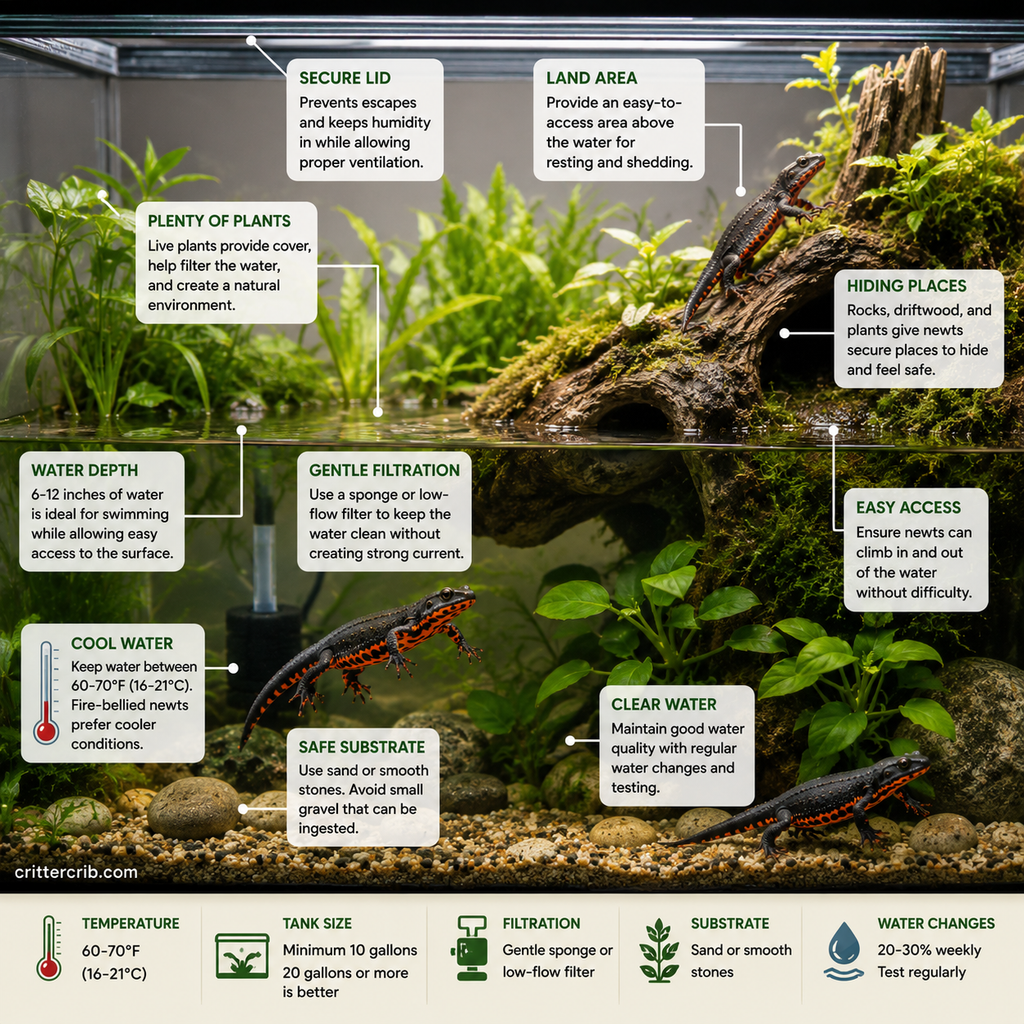
Before bringing your newt home, your equipment list may include:
- Appropriately sized aquarium
- Secure escape-proof lid
- Gentle aquarium filter
- Thermometer
- Water conditioner
- Aquarium water test kit
- Safe substrate
- Aquatic plants
- Hiding places
- Accessible land or haul-out area
- Aquarium-safe decorations
- Lighting on a timer if needed
- Gravel vacuum or siphon
- Dedicated aquarium maintenance bucket
Optional equipment may include cooling fans or an aquarium chiller if your home gets too warm.
How to Set Up a Fire-Bellied Newt Tank Step by Step
Planning the setup in the correct order can prevent a lot of frustration.
Step 1: Choose the Aquarium Location
Place the aquarium on a stable, level surface away from direct sunlight, heating vents, and areas with major temperature swings.
Remember that a filled aquarium is heavy.
Use furniture or a stand designed to support the weight.
Step 2: Add Your Substrate and Hardscape
Rinse aquarium-safe materials when appropriate.
Arrange rocks, driftwood, and hides securely.
Check for trapping hazards before adding water.
Step 3: Add Plants and the Land Area
Position plants throughout the aquarium and create an easy route onto the terrestrial resting area.
Make sure the newt can leave the water without having to climb a steep or slippery surface.
Step 4: Add Treated Water
Fill the aquarium with appropriately conditioned water.
Bring the water to a suitable temperature gradually.
Step 5: Install the Filter and Equipment
Set up your filter, thermometer, lighting, and any necessary cooling equipment.
Check that filter flow isn’t excessive.
Step 6: Cycle the Aquarium
Establish the nitrogen cycle before adding the newts.
Test ammonia, nitrite, and nitrate throughout the process.
Don’t rush this step.
Step 7: Check for Escape Routes
Inspect the lid after all cords, tubing, and equipment have been installed.
Equipment can create gaps that weren’t present when the aquarium was empty.
Step 8: Confirm Conditions Before Adding Newts
Before bringing your animals home, verify:
- Temperature is appropriate
- Ammonia is 0 ppm
- Nitrite is 0 ppm
- Nitrate is controlled
- Water is conditioned
- Filter flow is gentle
- Land is easily accessible
- Hides are secure
- Lid is escape-proof
Once those basics are stable, you’re in a much better position to introduce your newts.
How Often Should You Clean the Tank?
A properly cycled aquarium shouldn’t be completely stripped and sterilized every week.
Doing so can disrupt beneficial bacteria.
Instead, routine maintenance usually involves:
- Partial water changes
- Removing uneaten food
- Siphoning visible waste
- Cleaning dirty areas of substrate
- Trimming plants
- Checking the filter
- Testing water parameters
- Cleaning algae when necessary
The exact water-change schedule depends on aquarium size, number of animals, feeding, filtration, plants, and test results.
Let water quality guide your routine.
Don’t Replace All Filter Media at Once
Beneficial bacteria colonize filter media.
Throwing everything away and replacing it with brand-new media can remove a major portion of the aquarium’s biological filtration.
When filter media becomes dirty, it can often be gently rinsed in removed aquarium water rather than untreated tap water.
Replace media only when necessary and avoid changing all biological media simultaneously.
Common Fire-Bellied Newt Habitat Mistakes
Many beginner problems come from treating fire-bellied newts like tropical fish.
Avoid these common mistakes:
- Keeping the water too warm
- Adding newts before the aquarium is cycled
- Using untreated tap water
- Creating strong water currents
- Using swallowable gravel
- Providing no way to leave the water
- Using an insecure lid
- Keeping the aquarium in direct sunlight
- Building unstable rock structures
- Using sharp decorations
- Overcrowding the tank
- Mixing newts with unsuitable fish
- Completely replacing filter media during cleaning
- Assuming all “fire-bellied newts” have identical requirements
Most of these problems are much easier to prevent than fix.
A Simple Ideal Setup at a Glance
For a typical aquatic adult fire-bellied newt, a practical setup might include:
- Tank: 10 gallons as a starting minimum, with 20 gallons or larger preferable when practical
- Temperature: Roughly 60–70°F (16–21°C), depending on species
- Water depth: Often around 6–12 inches with easy surface access
- Filtration: Gentle, low-flow biological filtration
- Substrate: Bare bottom, fine sand, or appropriately sized smooth stones
- Plants: Plenty of aquatic vegetation and resting areas
- Land: Easily accessible area completely above water
- Lighting: Moderate aquarium lighting with shaded areas
- Water quality: 0 ppm ammonia and 0 ppm nitrite
- Lid: Secure and escape-proof
These are general guidelines rather than universal requirements for every species sold under the fire-bellied newt name.
Final Thoughts
A good fire-bellied newt habitat doesn’t need to be complicated.
It needs to be stable.
Focus first on clean, cool water, gentle filtration, a fully established nitrogen cycle, safe hiding places, aquatic plants, and an accessible area where the newt can leave the water.
Then pay attention to the details.
Make sure decorations can’t trap the newt. Keep the filter current gentle. Treat tap water properly. Monitor temperature during summer. And never underestimate how easily a determined newt can find a gap in an aquarium lid.
Most importantly, identify the species you’re keeping.
“Fire-bellied newt” covers animals with somewhat different requirements, and knowing exactly which newt you have will allow you to fine-tune the habitat rather than relying entirely on generalized advice.
Build and cycle the aquarium before bringing your newt home, and you’ll avoid many of the problems that make amphibian keeping unnecessarily difficult.
A cool, clean, planted aquarium with plenty of cover and easy access to both water and land gives a fire-bellied newt the foundation it needs to settle in and display its natural behavior.