

African dwarf frogs can be surprisingly entertaining little pets. One minute they’re quietly resting near the bottom of the aquarium, and the next they’re swimming toward the surface, floating with their limbs stretched out, or scrambling after a piece of food.
But how can you tell if your African dwarf frog is actually happy?
Frogs don’t show happiness the way dogs or cats do, so it’s better to think in terms of whether your frog appears comfortable, healthy, and free from obvious stress.
A comfortable African dwarf frog generally eats regularly, maintains a healthy body condition, explores its aquarium, surfaces normally for air, rests in relaxed positions, and shows behavior that’s consistent from day to day.
The key isn’t looking for one specific “happy frog” behavior. It’s learning what’s normal for your frog and noticing when that pattern changes.
What Does a Happy African Dwarf Frog Look Like?
There’s no single behavior that proves an African dwarf frog is happy.
Instead, look at the whole picture.
Signs that your frog is probably comfortable in its environment include:
- A consistent appetite
- Normal swimming and movement
- Regular trips to the surface for air
- Relaxed resting behavior
- Exploring different parts of the aquarium
- Maintaining a healthy body condition
- Normal interactions with other African dwarf frogs
- No obvious injuries, swelling, or skin abnormalities
- Consistent behavior without sudden unexplained changes
Some frogs are naturally more active than others.
One may eagerly investigate everything happening in the tank, while another spends more time tucked beneath plants or resting near a hide.
Both can be perfectly normal.
A Healthy Appetite Is a Good Sign
Eating normally is one of the easiest behaviors to monitor.
African dwarf frogs are aquatic carnivores and generally become interested when familiar foods are offered. Some may even learn to associate your presence near the aquarium with feeding time.
A frog that regularly finds and eats its food is usually showing several positive signs at once: it has enough energy to feed, recognizes food, and isn’t so stressed that it refuses meals.
Learn Your Frog’s Normal Feeding Behavior
African dwarf frogs aren’t always the most efficient hunters.
Their eyesight isn’t particularly strong, so they rely heavily on smell and movement to locate food.
You may see your frog:
- Searching along the bottom
- Lunging at food
- Missing its target and trying again
- Following the scent of food
- Becoming more active around feeding time
That’s part of their charm.
What matters is that your frog consistently gets enough to eat.
If it shares an aquarium with other animals, make sure faster tank mates aren’t consuming everything first.
Your Frog Should Maintain a Healthy Body Condition
Appetite isn’t the only thing to watch.
Look at the frog’s overall body condition over time.
A healthy African dwarf frog shouldn’t appear severely thin or dramatically bloated. Gradual unexplained weight loss can indicate that the frog isn’t getting enough food or may have an underlying health problem.
Because physical changes can happen slowly, it’s useful to observe your frog regularly rather than relying on memory from several months ago.
Taking occasional photographs from similar angles can help you notice gradual changes.
Normal Swimming Is Another Positive Sign
African dwarf frogs aren’t graceful swimmers all the time.
Sometimes they paddle gently through the aquarium. Other times they launch themselves toward the surface with surprising speed.
A comfortable frog should generally be capable of swimming normally and controlling its movements.
It may:
- Explore near the bottom
- Swim through plants
- Move between hiding places
- Dart to the surface
- Drift back toward the bottom
- Rest on decorations
You don’t need your frog to be constantly moving.
Periods of inactivity are normal.
The important thing is whether it can move normally when it chooses to.
Why African Dwarf Frogs Swim to the Surface
African dwarf frogs live underwater, but they have lungs and need to breathe atmospheric air.
That means regular trips to the surface are completely normal.
A frog may suddenly shoot upward, take a quick breath, and swim back down.
Don’t mistake this behavior for an attempt to escape the aquarium.
When Surface Behavior May Be Concerning
There’s a difference between normal breathing trips and a frog that seems unable to remain underwater or is constantly struggling at the surface.
Pay attention if your frog:
- Can’t swim downward
- Appears unusually buoyant
- Remains at the surface continuously
- Struggles to reach the surface
- Appears weak after surfacing
- Shows a major change in its usual breathing behavior
These signs don’t automatically identify a particular illness, but they deserve closer attention.
Check the aquarium conditions and consider contacting a veterinarian experienced with amphibians if abnormal behavior continues.
Relaxed Floating Can Be Normal
One behavior that sometimes alarms new owners is floating.
African dwarf frogs occasionally rest near the surface with their limbs spread out, appearing almost motionless.
Keepers sometimes call this relaxed floating position “burbling.”
It can look strange the first time you see it, but a frog that occasionally floats calmly and then resumes normal activity may simply be resting.
Context matters.
A relaxed frog that can easily dive and behaves normally afterward is very different from a frog that appears bloated, distressed, weak, or unable to submerge.
Hiding Doesn’t Necessarily Mean Your Frog Is Unhappy
African dwarf frogs appreciate places where they can retreat.
A frog spending time underneath plants, beside decorations, or inside an appropriate hide isn’t necessarily frightened.
Resting in sheltered areas can be perfectly normal.
Provide several safe options such as:
- Aquarium plants
- Smooth caves
- Driftwood arranged safely
- Broad leaves
- Other aquarium-safe hiding structures
Make sure any cave or decoration allows the frog to exit easily.
Because African dwarf frogs need access to the surface for air, avoid decorations where they could become trapped underwater.
Exploring the Aquarium Is a Positive Behavior
A comfortable African dwarf frog may spend time investigating its surroundings.
You might see it wandering along the substrate, climbing onto decorations, moving through plants, or checking familiar areas for food.
Exploration suggests the frog is interacting normally with its environment.
That doesn’t mean it needs to be active every time you look at the aquarium.
African dwarf frogs often alternate between periods of activity and rest.
African Dwarf Frogs Can Be More Active at Certain Times
Don’t judge your frog based only on what it does in the middle of the day.
African dwarf frogs may become more active later in the day or during lower-light periods.
If your frog seems quiet when the aquarium lights are bright but begins exploring later, that may simply be part of its normal routine.
Observe it at different times before deciding that it’s unusually inactive.
Do African Dwarf Frogs Like Living Together?
African dwarf frogs can generally be kept with others of their own species when the aquarium is appropriately sized and maintained.
Keeping more than one can allow you to observe interesting social behaviors.
They may rest near one another, gather around feeding areas, or move around the aquarium at the same time.
This doesn’t necessarily mean they’re forming friendships in the human sense, but compatible group housing can work well.
Make Sure Every Frog Gets Food
Group feeding creates one important responsibility.
You need to make sure each frog is actually eating.
A more assertive frog may reach food before a slower individual.
Watch feeding sessions closely enough to learn who is getting what.
Target feeding with appropriate aquarium feeding tools can help when necessary.
Singing Can Be Normal Behavior
Male African dwarf frogs can produce quiet buzzing or humming sounds, particularly when displaying reproductive behavior.
New owners sometimes hear an unfamiliar sound coming from the aquarium and wonder whether something is wrong with the filter.
It may actually be the frog.
Calling behavior is normal for males and isn’t generally a reason for concern on its own.
Healthy Frogs Usually Have Predictable Routines
One of the best indicators of comfort is consistency.
After you’ve owned your frog for a while, you’ll start recognizing its habits.
Maybe it rests underneath the same plant every afternoon.
Maybe it becomes active as soon as you approach with food.
Maybe it regularly floats near the surface at night.
Individual habits are useful because they create a baseline.
A sudden departure from that baseline can tell you more than comparing your frog to someone else’s frog online.
Signs Your African Dwarf Frog May Be Stressed
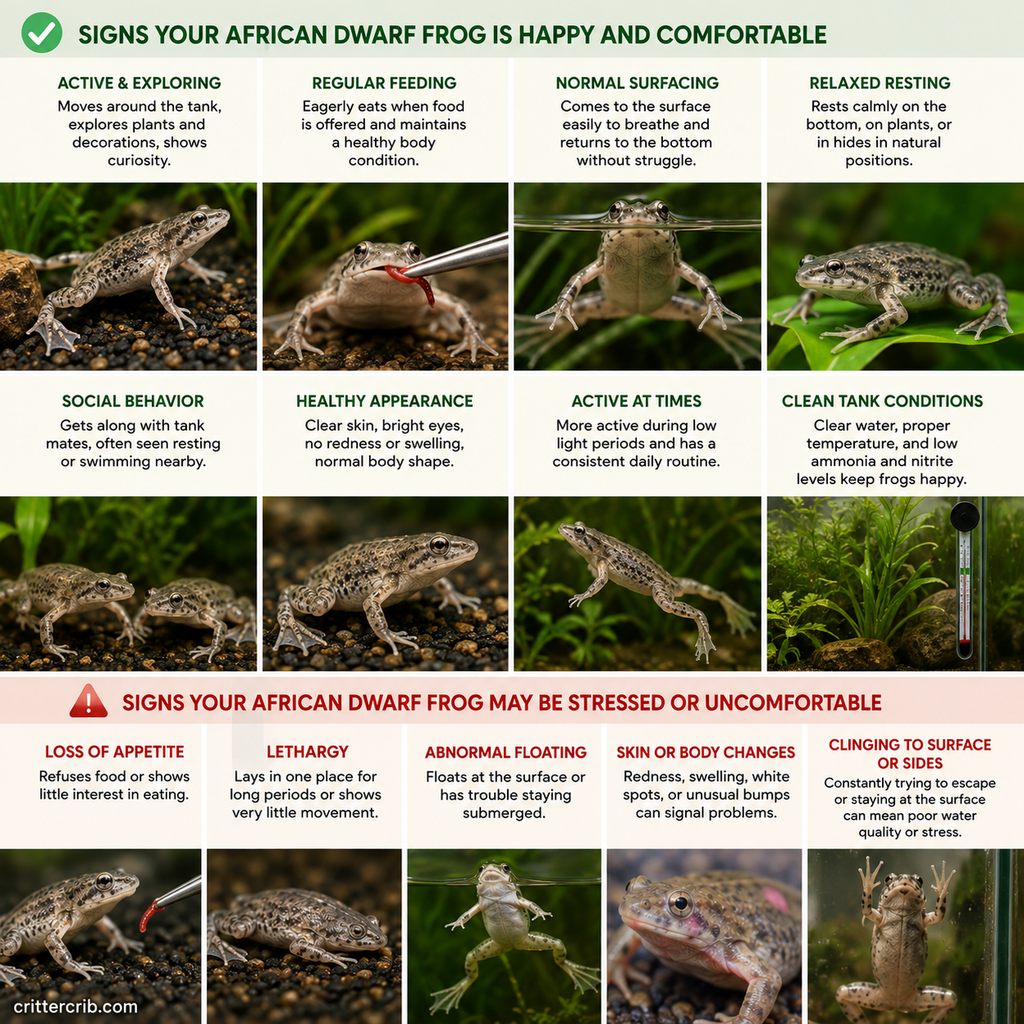
Not every unusual behavior means something is seriously wrong, but certain changes deserve investigation.
Possible signs of stress or poor conditions can include:
- Refusing food repeatedly
- Frantic or continuous swimming
- Repeated attempts to escape
- Extreme lethargy
- Difficulty reaching the surface
- Inability to remain submerged
- Unusual skin appearance
- Significant weight loss
- Persistent abnormal floating
- Staying in one unusual position for long periods
- Sudden changes in normal behavior
If you notice one of these signs, start by checking the environment.
For aquatic frogs, water quality is especially important.
Water Quality Has a Huge Effect on Comfort
An African dwarf frog spends essentially its entire life in aquarium water.
If that water isn’t healthy, neither is the frog.
A properly established aquarium needs a functioning biological cycle that processes waste.
Regularly monitor important water parameters, including:
- Ammonia
- Nitrite
- Nitrate
- pH
Ammonia and nitrite should generally remain at 0 ppm in an established aquarium.
Nitrate should be controlled through appropriate aquarium maintenance and partial water changes.
Don’t assume water is safe simply because it looks clear.
Invisible problems with water chemistry can cause significant stress.
Keep the Water at an Appropriate Temperature
African dwarf frogs are tropical animals.
A commonly recommended range is approximately 72–78°F (22–26°C), although husbandry recommendations can vary somewhat.
Consistency is important.
Avoid rapid temperature swings and make sure any aquarium heater is appropriately sized and regulated.
Use a reliable aquarium thermometer rather than relying solely on the heater’s settings.
Make It Easy to Reach the Surface
Because African dwarf frogs need to surface for air, aquarium depth matters.
They should be able to reach the surface comfortably without exhausting themselves.
This is especially important for:
- Young frogs
- Older frogs
- Weak or recovering frogs
- Frogs with mobility problems
Plants and decorations that provide resting spots at different heights can also be useful.
Avoid Excessively Strong Water Flow
African dwarf frogs don’t need to battle a powerful current all day.
Filtration is important for maintaining water quality, but excessive flow can make swimming and resting more difficult.
Watch your frog around the aquarium.
If it’s constantly being pushed around or avoids an entire section because of the filter output, consider reducing or redirecting the flow.
Gentle filtration is usually more appropriate.
Give Your Frog Places to Rest
A comfortable aquarium shouldn’t be completely empty.
African dwarf frogs benefit from an environment that provides both open swimming space and sheltered resting areas.
Useful additions include:
- Live or artificial aquarium-safe plants
- Smooth hides
- Broad leaves
- Safe driftwood
- Smooth decorations
Avoid sharp objects that could damage delicate skin.
Also inspect decorations for small openings where a frog could enter but struggle to escape.
Can African Dwarf Frogs Recognize Their Owners?
Your frog may eventually react when you approach the aquarium.
That doesn’t necessarily mean it recognizes you in the same way a dog recognizes its owner.
It’s more reasonable to assume that African dwarf frogs can become familiar with routines and learn that certain activity around the aquarium predicts food.
If your frog swims toward the front of the tank at feeding time, enjoy the interaction.
Just don’t interpret every food-related response as affection.
Should You Handle a Happy African Dwarf Frog?
No.
Even if your frog appears completely comfortable around you, African dwarf frogs should generally remain in the water.
They’re fully aquatic amphibians and aren’t suitable for routine handling.
Handling can stress the frog and potentially expose its delicate skin to oils, soaps, lotions, chemicals, or contaminants.
If you must move your frog for an emergency or veterinary reason, minimize direct handling and follow appropriate amphibian-safe practices.
The best place for a healthy African dwarf frog is inside its properly maintained aquarium.
Don’t Tap on the Glass to Get a Reaction
If your frog is hiding or resting, let it be.
Tapping the aquarium glass to make it move doesn’t tell you whether it’s healthy or happy.
It simply creates an unnecessary disturbance.
Instead, observe your frog during its normal active periods and feeding routine.
You’ll learn far more from natural behavior than from forcing a reaction.
How to Make Your African Dwarf Frog More Comfortable
If you want to improve your frog’s environment, focus on the basics rather than trying to entertain it through direct interaction.
A comfortable setup should provide:
- Clean, properly conditioned water.
- Stable tropical temperatures.
- A fully cycled aquarium.
- Gentle filtration.
- Easy access to the surface.
- Safe hiding and resting areas.
- Appropriate food.
- A predictable day-and-night cycle.
- Enough space to move normally.
- Regular maintenance without constant disturbance.
When those needs are met, your frog can spend its time behaving like a frog.
That’s exactly what you want.
When Should You Be Concerned About Behavior Changes?
A single unusual moment doesn’t always mean your frog is sick.
Maybe it skipped one meal.
Maybe it’s resting somewhere different.
Maybe it was unusually active one evening.
Look for patterns.
A persistent change is more concerning than an isolated event, especially if multiple symptoms appear together.
For example, a frog that stops eating, loses weight, and becomes unusually lethargic deserves more attention than one that simply ignores a meal.
Start by testing the water and checking temperature and equipment.
If environmental conditions are appropriate but your frog continues behaving abnormally, consult a veterinarian experienced with amphibians or exotic pets.
Signs of a Comfortable African Dwarf Frog at a Glance
A healthy, comfortable African dwarf frog will typically show a combination of positive behaviors rather than one definitive sign.
Look for:
- Regular feeding
- Healthy body condition
- Normal swimming
- Easy trips to the surface
- Periods of exploration
- Relaxed resting
- Normal hiding behavior
- Consistent daily routines
- Healthy-looking skin
- Normal interactions with tank mates
- No obvious signs of distress
Most importantly, learn what’s normal for your individual frog.
Final Thoughts
So, how can you tell if your African dwarf frog is happy?
You can’t measure frog happiness directly, but you can determine whether your pet appears healthy, comfortable, and free from obvious stress.
A frog that eats consistently, maintains a healthy body condition, explores its aquarium, swims normally, surfaces easily for air, and rests comfortably is giving you plenty of positive signs.
Don’t worry if your frog sometimes hides, floats quietly, or spends long periods doing very little. Those behaviors can all be normal depending on the circumstances.
Instead of looking for one perfect sign of happiness, watch for consistency.
Learn your frog’s normal routine, maintain excellent water quality, provide suitable food and shelter, and pay attention when something changes.
For an African dwarf frog, a clean aquarium where it can eat, swim, breathe, hide, and rest without stress is about as comfortable a home as you can provide.