
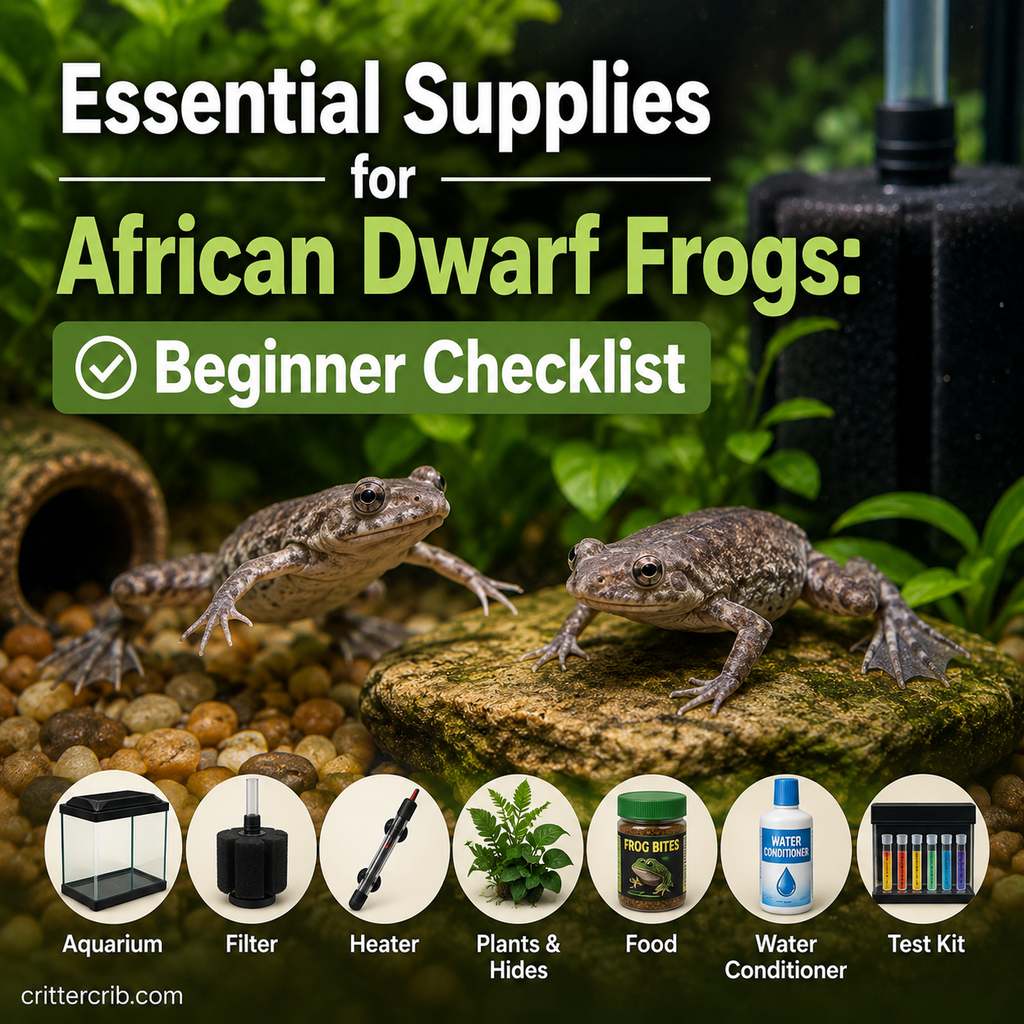
African dwarf frogs don’t require an enormous collection of specialized equipment, but getting the basics right before bringing them home makes a huge difference.
They’re fully aquatic frogs, which means their aquarium isn’t just somewhere they spend part of the day. It’s their entire environment. Water quality, temperature, filtration, access to the surface, and even the decorations you choose can affect how comfortably they live.
The good news is that setting up for African dwarf frogs is fairly straightforward once you know what you actually need.
If you’re preparing for your first frogs, this checklist covers the essential African dwarf frog supplies, which items are optional, and a few things that are better left on the pet store shelf.
African Dwarf Frog Supplies at a Glance
Before getting into the details, here’s the basic equipment you’ll need for a typical African dwarf frog aquarium:
- Appropriately sized aquarium
- Secure lid
- Aquarium filter with gentle flow
- Aquarium heater
- Thermometer
- Water conditioner
- Freshwater liquid test kit
- Suitable substrate
- Hides and other cover
- Aquarium plants
- Appropriate African dwarf frog food
- Feeding tools
- Aquarium maintenance equipment
- Dedicated bucket
- Siphon or gravel vacuum
You’ll also need to establish the aquarium’s biological cycle before adding your frogs.
That part isn’t something you can buy in a box and forget about. A properly cycled aquarium is one of the most important parts of preparing for any aquatic animal.
1. An Appropriately Sized Aquarium
The aquarium itself is obviously the first item on the list.
African dwarf frogs are small, but tiny bowls and novelty containers aren’t appropriate long-term homes.
A larger volume of water is generally easier to keep stable than a very small amount. More space also gives the frogs room to explore while allowing you to accommodate filtration, plants, hiding areas, and other equipment.
For a small group of African dwarf frogs, many keepers start with an aquarium around 10 gallons.
Larger setups can work well too, provided they’re designed around the frogs’ needs.
Don’t Forget About Water Depth
African dwarf frogs are fully aquatic, but they still breathe air at the surface.
They periodically swim upward, take a breath, and return to the bottom.
That means aquarium depth matters.
A very tall aquarium can make repeated trips to the surface more demanding, particularly for a weak, elderly, or unhealthy frog.
When choosing between aquariums, a setup that provides useful horizontal swimming space without excessive depth is often a practical choice.
2. A Secure Aquarium Lid
African dwarf frogs can reach the surface easily, and you don’t want that surface access turning into an escape route.
Use a secure lid that covers openings around:
- Filters
- Cables
- Airline tubing
- Heater cords
- Other equipment
Even a small gap can potentially become a problem.
The lid also helps reduce evaporation and keeps household pets or curious hands out of the aquarium.
Check it periodically, especially after rearranging equipment.
3. A Gentle Aquarium Filter
Filtration helps maintain water quality by circulating water and providing surfaces where beneficial bacteria can live.
However, African dwarf frogs aren’t powerful swimmers.
A filter that creates an aggressive current can make the aquarium unnecessarily difficult for them to navigate.
Look for filtration that provides effective biological and mechanical filtration without turning the tank into a river.
Depending on the setup, options may include:
- Sponge filters
- Adjustable internal filters
- Hang-on-back filters with controlled or diffused flow
Sponge filters are popular in smaller African dwarf frog setups because they can provide biological filtration with relatively gentle water movement.
Whatever filter you choose, make sure its intake and flow are safe for the frogs.
4. An Aquarium Heater
African dwarf frogs are tropical animals and generally require warm, stable water.
Unless the room maintains an appropriate aquarium temperature continuously throughout the year, you’ll likely need a heater.
Choose an aquarium heater appropriate for your tank’s water volume.
A heater that’s dramatically oversized can be harder to manage safely, while an undersized heater may struggle to maintain a stable temperature.
Adjustable heaters can offer more control than models with a fixed preset temperature.
Don’t rely on the heater’s dial alone.
That’s why the next item is important.
5. A Reliable Aquarium Thermometer
A thermometer is inexpensive and easy to overlook.
Use one anyway.
The temperature printed on a heater’s dial doesn’t necessarily tell you the exact temperature of the water.
A separate thermometer lets you verify what’s actually happening inside the aquarium.
Place it where you can check it easily.
Monitoring temperature regularly can help you notice:
- Heater failure
- Unexpected overheating
- Seasonal temperature changes
- Large day-to-night fluctuations
Consistency matters more than constantly chasing tiny temperature changes.
6. Water Conditioner
Tap water may contain chlorine or chloramine used to make municipal water safe for people.
That doesn’t mean untreated tap water should go directly into your frog aquarium.
A suitable aquarium water conditioner treats tap water so it can be used safely for aquatic animals.
You’ll use water conditioner when:
- Initially filling the aquarium
- Performing water changes
- Replacing evaporated or removed water when appropriate
Follow the product’s dosing directions rather than guessing.
It’s also worth keeping enough conditioner on hand for an unexpected large water change.
Running out exactly when you need it isn’t much fun.
7. A Freshwater Aquarium Test Kit
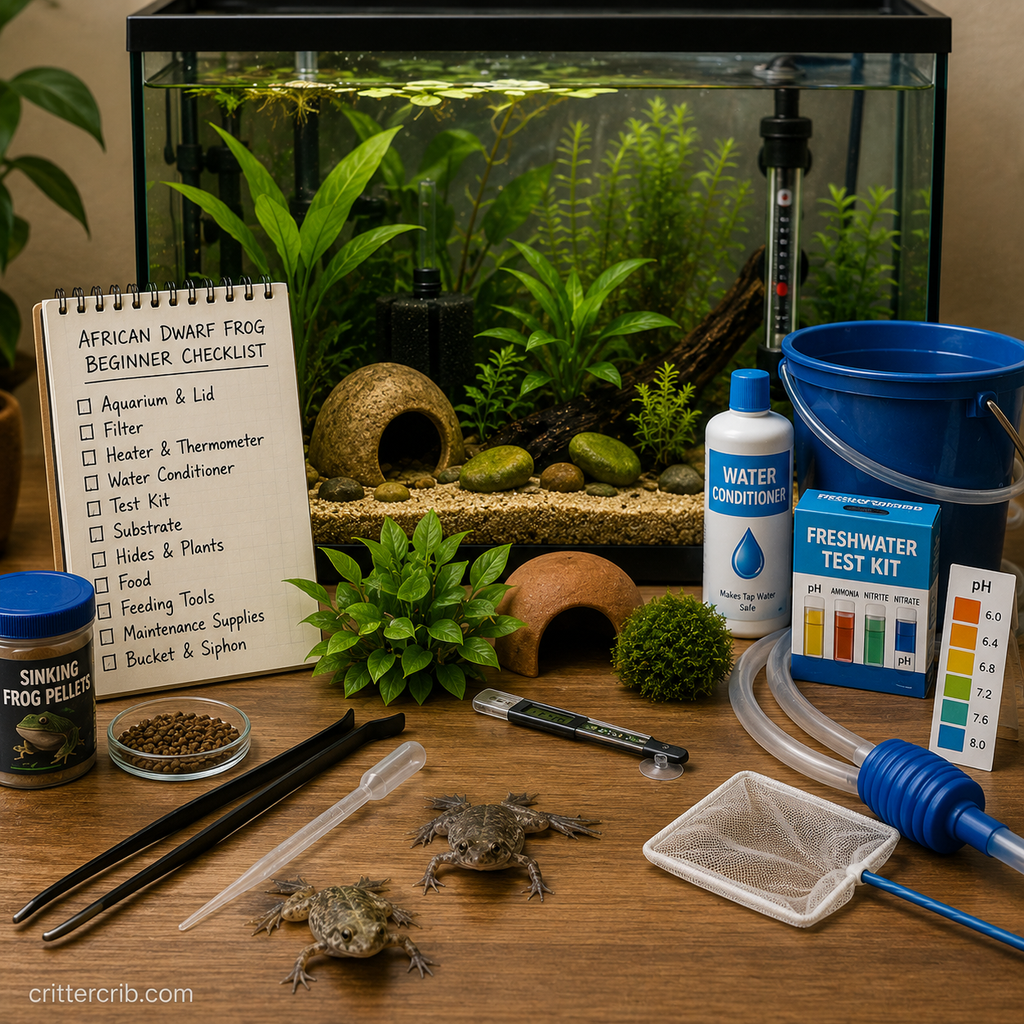
If there’s one item beginners are sometimes tempted to skip, it’s the water test kit.
Don’t.
Water can look crystal clear while still containing compounds that are harmful to aquatic animals.
At minimum, you should be able to monitor important water parameters such as:
- Ammonia
- Nitrite
- Nitrate
- pH
A liquid freshwater test kit is particularly useful for routine monitoring.
Test strips can be convenient for certain parameters, but make sure whatever testing method you choose actually measures the parameters you need.
Why Ammonia and Nitrite Matter
Waste from frogs and leftover food eventually produces ammonia.
In a properly cycled aquarium, beneficial bacteria help process ammonia into nitrite and then into nitrate.
Both ammonia and nitrite should remain at zero in an established aquarium.
Nitrate is managed partly through regular water changes and other aquarium maintenance.
Understanding this process is far more useful than simply memorizing a cleaning schedule.
8. A Cycled Aquarium
Technically, this isn’t a physical supply.
But it belongs near the top of the checklist.
Before adding African dwarf frogs, establish the aquarium’s nitrogen cycle.
A new aquarium doesn’t immediately contain enough beneficial bacteria to process animal waste safely.
Putting frogs into an uncycled tank can expose them to rising ammonia and nitrite.
Cycling an aquarium involves establishing bacterial colonies capable of converting waste products through the nitrogen cycle.
This process takes time.
Don’t assume that running the filter for a day or two means the aquarium is cycled.
Use your water test kit to monitor the process and confirm that the biological filtration is functioning before adding animals.
9. Safe Aquarium Substrate
African dwarf frogs spend a lot of time near the bottom of the aquarium, so substrate deserves some thought.
You’ll generally see several options.
Bare Bottom
A bare-bottom aquarium is simple to clean and makes waste easy to spot.
It isn’t the most natural-looking setup, but it can be practical.
Sand
Aquarium-safe sand can create a natural appearance and allows food to remain relatively visible on the surface.
Choose an appropriate aquarium substrate rather than using random outdoor sand.
Gravel
Gravel requires more caution.
African dwarf frogs feed by quickly grabbing or sucking food into their mouths. Small pieces of gravel may potentially be swallowed along with food.
If you use stones or gravel, choose material large enough that the frogs cannot easily ingest individual pieces.
Avoid sharp substrate that could cause injury.
10. Hiding Places
African dwarf frogs benefit from having places where they can retreat and feel secure.
Suitable hides can include:
- Aquarium caves
- Smooth ceramic shelters
- Driftwood arrangements
- Plant-covered areas
- Aquarium-safe decorations
Make sure any hide has openings large enough for the frog to enter and exit easily.
Avoid decorations with tiny holes where a frog could become trapped.
Remember that African dwarf frogs need to reach the surface to breathe. A hide should never create a situation where a frog can enter but struggles to find its way out.
Smooth surfaces are generally preferable to sharp or abrasive decorations.
11. Aquarium Plants
Plants provide cover and make an African dwarf frog aquarium feel much less exposed.
Both live and artificial plants can work.
Live Plants
Live plants can create a natural environment and may contribute to the overall aquarium ecosystem.
Depending on your lighting and experience level, beginner-friendly aquatic plants may be a good choice.
Plants with broad leaves can also provide resting spots closer to the surface.
Artificial Plants
Artificial plants require less maintenance.
If you use them, choose soft aquarium-safe plants without sharp plastic edges.
Silk-style plants are often preferable to stiff plastic decorations that could scrape delicate skin.
You don’t need to fill every inch of the aquarium with plants.
Leave open areas where your frogs can move around and reach food easily.
12. Appropriate African Dwarf Frog Food
African dwarf frogs need an animal-based diet.
They’re carnivorous and should receive foods appropriate for small aquatic frogs.
Depending on availability and your feeding routine, suitable foods may include:
- Quality sinking foods formulated for aquatic frogs or carnivorous aquatic animals
- Frozen foods appropriate for their size
- Certain small worms and aquatic invertebrates
- Other nutritionally appropriate meaty foods
Variety can help provide a more balanced diet than relying indefinitely on one treat food.
Be cautious with foods that are nutritionally incomplete or difficult for the frogs to eat.
Also remember that African dwarf frogs aren’t always great at competing with fast-moving fish for food.
Which brings us to one of the most useful inexpensive supplies you can buy.
13. Feeding Tongs or a Pipette
Target feeding can make life much easier.
African dwarf frogs rely heavily on scent and movement when locating food and aren’t always particularly efficient at finding every meal.
Long feeding tongs, aquarium tweezers, a pipette, or a similar feeding tool can help deliver food directly to the frog.
This has several benefits:
- Ensures each frog receives food
- Reduces competition
- Helps monitor appetite
- Prevents excess food from being lost in the substrate
- Reduces waste
You don’t necessarily need to place food directly into the frog’s mouth.
Simply positioning it nearby can make feeding much easier.
14. A Feeding Dish
A small feeding dish is optional, but it can be extremely useful.
Instead of allowing food to scatter throughout the substrate, you can teach the frogs to find food in a consistent location.
A shallow, smooth aquarium-safe dish can:
- Keep food contained
- Reduce substrate ingestion
- Make leftovers easier to remove
- Help you monitor how much the frogs eat
This is especially convenient when feeding sinking foods.
Remove uneaten food rather than allowing it to decay in the aquarium.
15. A Gravel Vacuum or Aquarium Siphon
Water changes are part of normal aquarium maintenance.
A siphon makes them much easier.
You can use an aquarium siphon to remove water while also collecting debris from the bottom.
If you’re using sand, adjust your technique so you remove waste without sucking large amounts of substrate out of the aquarium.
For tanks with larger gravel, a traditional gravel vacuum can help remove debris trapped between the stones.
Be careful around the frogs while siphoning.
African dwarf frogs are small enough that you should always know where they are before placing a siphon intake into the aquarium.
16. A Dedicated Aquarium Bucket
Buy a bucket and make it aquarium-only.
Seriously.
Don’t use the same bucket for washing the car, mopping the floor, mixing cleaners, and changing frog water.
Even small residues of soap or household chemicals can contaminate aquarium equipment.
A dedicated bucket is useful for:
- Removing old aquarium water
- Preparing replacement water
- Carrying equipment
- Cleaning aquarium decorations
Label it so nobody accidentally borrows it for household chores.
17. Aquarium Cleaning Tools
A few simple tools can make maintenance easier.
Useful items include:
- Algae scraper
- Dedicated sponge
- Small aquarium brush
- Turkey baster or similar debris-removal tool
- Long aquarium tweezers
- Paper towels for exterior surfaces
Keep these tools away from soaps and household cleaning chemicals.
Most routine aquarium cleaning relies more on physical removal of algae and debris than on chemical cleaners.
Never spray ordinary household glass cleaner into or around an open aquarium.
18. Aquarium Lighting
African dwarf frogs don’t require intense lighting for their own sake.
However, aquarium lighting can establish a normal day-night cycle and support live plants if you choose to grow them.
A basic aquarium LED is usually enough for a simple setup.
Use a timer if you want to keep the lighting schedule consistent.
Avoid leaving bright aquarium lights on continuously.
Your frogs need periods of darkness, and excessive lighting can also encourage unwanted algae growth.
19. A Timer
A basic electrical timer or smart plug can automate the aquarium light.
It’s inexpensive and removes one daily task from your routine.
Set the aquarium to have a consistent light and dark cycle rather than manually switching the light on whenever you remember.
If you’re growing live plants, adjust the lighting period based on their needs and algae growth.
20. A Safe Place for Aquarium Equipment
This isn’t something most shopping lists mention, but plan where all the equipment will go.
Aquariums involve electricity and water.
Create drip loops in electrical cords so water can’t travel directly down a cable into an outlet.
Keep power connections away from areas where they can become wet.
A ground-fault circuit interrupter (GFCI) outlet provides additional electrical protection around water.
Make sure the aquarium itself sits on a stable surface capable of supporting its full weight.
Water is heavy.
A 10-gallon aquarium isn’t just the weight of the empty glass tank. Once you add water, substrate, decorations, and equipment, the total becomes much heavier.
Supplies That Are Helpful but Not Always Essential
Once the basics are covered, a few optional items can make care easier.
Aquarium Background
A background can improve the aquarium’s appearance and may make the enclosure feel less exposed.
Live Plant Tools
If you’re keeping planted tanks, aquarium scissors and long tweezers can make maintenance easier.
Digital Thermometer
Simple thermometers work, but a digital model may be easier to read.
Backup Heater
A spare heater can be useful if your primary heater fails unexpectedly.
You don’t necessarily need one on day one, but having backup equipment becomes more valuable as you gain experience.
Battery-Powered Air Pump
If your filtration depends on an air pump, a battery-powered backup can be useful during power outages.
Supplies African Dwarf Frogs Usually Don’t Need
Pet stores sell plenty of aquarium products.
You don’t need all of them.
Powerful Water Pumps
African dwarf frogs don’t need strong currents.
More water movement isn’t automatically better.
Deep, Tall Aquariums
Extra water volume can be beneficial, but excessive height can make surface access less convenient.
Choose dimensions that make sense for the animal.
Sharp Decorations
Skip anything with rough edges, narrow holes, or areas where a frog could become trapped.
Tiny Gravel
Small gravel that can fit into a frog’s mouth isn’t worth the potential risk.
Bright Lights Running All Day and Night
African dwarf frogs don’t need 24-hour lighting.
Give them a normal day-night cycle.
Household Cleaning Chemicals
Your aquarium doesn’t need to smell like lemon disinfectant.
Keep soaps, sprays, detergents, and household cleaners away from aquarium water and equipment.
What Should You Buy Before Getting African Dwarf Frogs?
Ideally, almost everything.
Don’t bring home the frogs and then start figuring out how filtration works.
Set up the aquarium first.
A good order is:
- Buy the aquarium, lid, filter, heater, thermometer, substrate, and basic decorations.
- Set up the habitat.
- Add treated water.
- Start the filter.
- Establish the aquarium’s nitrogen cycle.
- Test the water throughout the process.
- Make sure temperature and equipment remain stable.
- Purchase food and feeding tools.
- Confirm that the aquarium is ready.
- Bring home the frogs.
This gives you time to solve equipment problems without live animals already depending on the setup.
If the heater doesn’t work or the filter creates far too much current, it’s much easier to correct the problem before your frogs arrive.
African Dwarf Frog Beginner Shopping Checklist
If you’re standing in the pet store wondering whether you’ve forgotten something, use this condensed list.
Essential Setup
- Aquarium
- Secure lid
- Gentle filter
- Appropriately sized heater
- Thermometer
- Water conditioner
- Freshwater test kit
- Safe substrate
- Hides
- Aquarium-safe plants
- Light if needed
Feeding Supplies
- Appropriate frog food
- Feeding tongs, pipette, or tweezers
- Optional feeding dish
Maintenance Supplies
- Aquarium siphon or gravel vacuum
- Dedicated bucket
- Algae scraper
- Dedicated cleaning brush or sponge
- Aquarium tweezers
- Water test supplies
Nice to Have
- Light timer
- Backup heater
- Battery air pump
- Aquascaping tools
- Aquarium background
You don’t have to buy the fanciest version of every item.
Reliable basic equipment is much more useful than expensive accessories your frogs don’t need.
Common Beginner Setup Mistakes
Having the right supplies is only half the job.
How you use them matters too.
Adding Frogs Before Cycling the Aquarium
This is one of the biggest mistakes to avoid.
A running filter doesn’t automatically mean the aquarium is biologically established.
Using a Filter That’s Too Powerful
Watch how water moves through the tank.
Your frogs shouldn’t constantly struggle against the current.
Choosing the Tank Based Only on Gallons
Consider depth and floor space as well as total water volume.
African dwarf frogs need regular access to the surface.
Forgetting a Lid
Don’t assume fully aquatic means incapable of escaping.
Secure openings around equipment.
Buying Small Gravel
If individual pieces can easily fit into a frog’s mouth, choose a safer substrate.
Assuming Frogs Will Find Every Piece of Food
African dwarf frogs can be surprisingly bad at locating food right in front of them.
Target feeding is useful, particularly when you’re monitoring a new frog.
Buying the Frogs First
An aquarium is an ecosystem, not a cage you can set up five minutes before the animal goes inside.
Prepare it in advance.
How Much Does an African Dwarf Frog Setup Cost?
The frogs themselves are often one of the least expensive parts of the setup.
The aquarium and equipment usually account for most of the initial cost.
Your total will depend on whether you:
- Buy a complete aquarium kit
- Purchase equipment individually
- Use live plants
- Choose premium decorations
- Already own aquarium supplies
- Buy equipment new or secondhand
Don’t sacrifice important equipment just to reduce the initial price.
A water test kit, appropriate filtration, heater, and water conditioner aren’t decorative upgrades. They’re fundamental parts of maintaining the aquatic environment.
At the same time, there’s no reason to spend heavily on elaborate decorations if a simpler setup meets the frogs’ needs.
Spend money on the things that affect water quality and animal care first.
Frequently Asked Questions About African Dwarf Frog Supplies
What do I need for an African dwarf frog tank?
At minimum, you’ll need an appropriately sized aquarium, secure lid, gentle filtration, heater, thermometer, water conditioner, water test kit, safe substrate or bare bottom, hiding areas, appropriate food, and basic maintenance equipment.
Do African dwarf frogs need a filter?
Yes, filtration is an important part of maintaining stable water quality. Choose a filter that provides adequate biological filtration without producing excessively strong currents.
Do African dwarf frogs need a heater?
African dwarf frogs require warm, stable water, so a heater is typically necessary unless the aquarium naturally remains within an appropriate temperature range throughout the year.
Do African dwarf frogs need a light?
They don’t require intense specialty lighting, but a regular day-night cycle is appropriate. Aquarium lighting may also be necessary if you’re growing live plants.
Do African dwarf frogs need an air pump?
Not necessarily. African dwarf frogs breathe atmospheric air at the surface rather than relying exclusively on dissolved oxygen through gills like fish. However, an air pump may be part of your filtration system if you’re using a sponge filter.
What substrate is best for African dwarf frogs?
Bare-bottom tanks and appropriate aquarium sand can both work. If using stones or gravel, avoid pieces small enough to be accidentally swallowed and avoid sharp materials.
Do African dwarf frogs need hiding places?
Yes. Hides, plants, and other forms of cover give frogs sheltered areas to retreat to. Make sure decorations don’t contain small openings that could trap them.
Can African dwarf frogs live in a bowl?
A small unfiltered bowl makes it difficult to provide stable temperature, filtration, water quality, and sufficient habitat space. A properly equipped aquarium is a much better long-term home.
Should I buy one or more African dwarf frogs?
African dwarf frogs can be kept with others of their species when the aquarium is appropriately sized and maintained. If keeping multiple frogs, make sure each animal is able to feed successfully and monitor them individually.
What should I buy first?
Start with the aquarium and life-support equipment rather than the frogs. Set up and cycle the aquarium, verify water conditions and temperature, and then add the animals once the habitat is ready.
Start With the Essentials, Not the Extras
Setting up for African dwarf frogs doesn’t have to be complicated.
Focus first on the equipment that creates a stable aquatic environment: an appropriately sized aquarium, gentle filtration, reliable heating, treated water, and a way to test water quality.
Then add the things that make the habitat functional for the frogs themselves—safe substrate, plants, hiding areas, suitable food, and feeding tools.
Finally, pick up the maintenance equipment you’ll need to keep everything working properly.
You can always add more plants or improve the aquascape later.
What matters on day one is that the aquarium is cycled, the water is safe, the temperature is stable, and your frogs can easily reach the surface, find food, and retreat into cover.
Get those fundamentals right and you’ve already purchased the most important thing an African dwarf frog needs:
A properly prepared home.