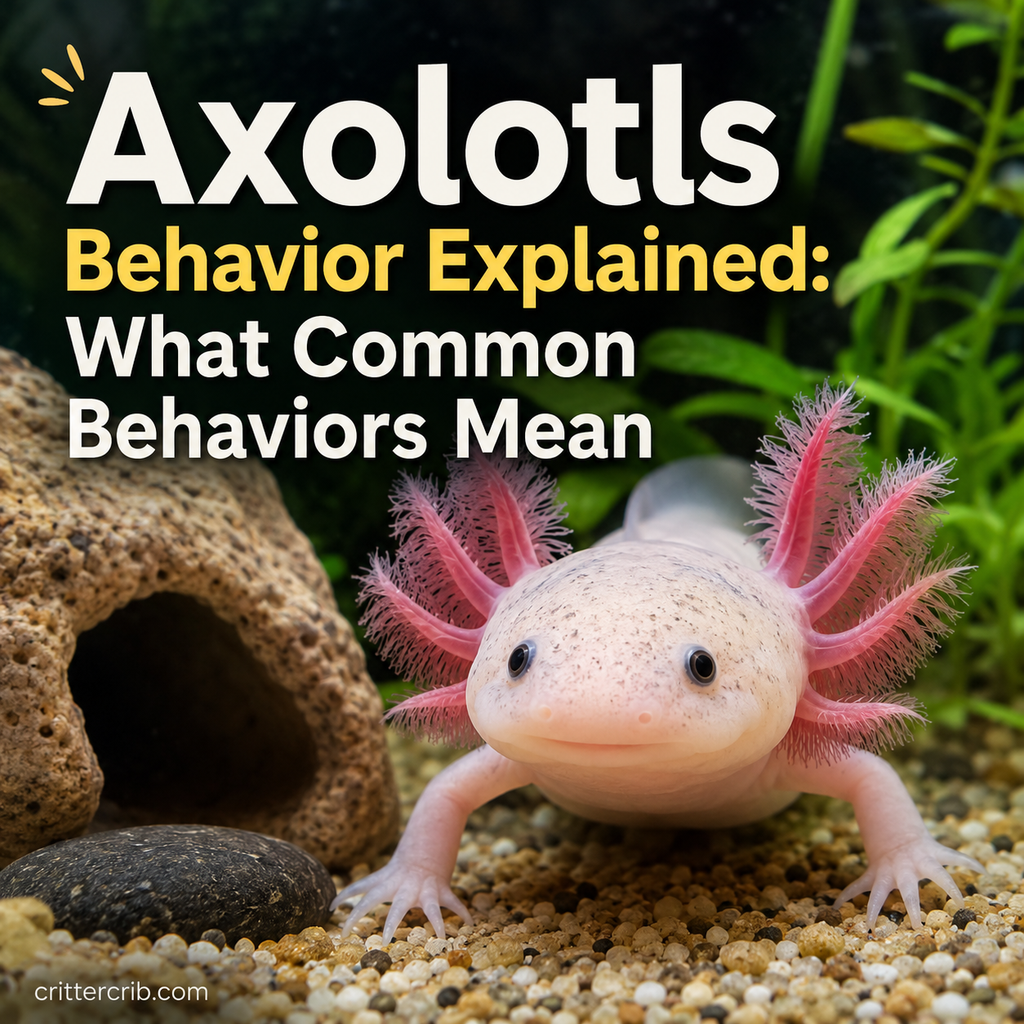
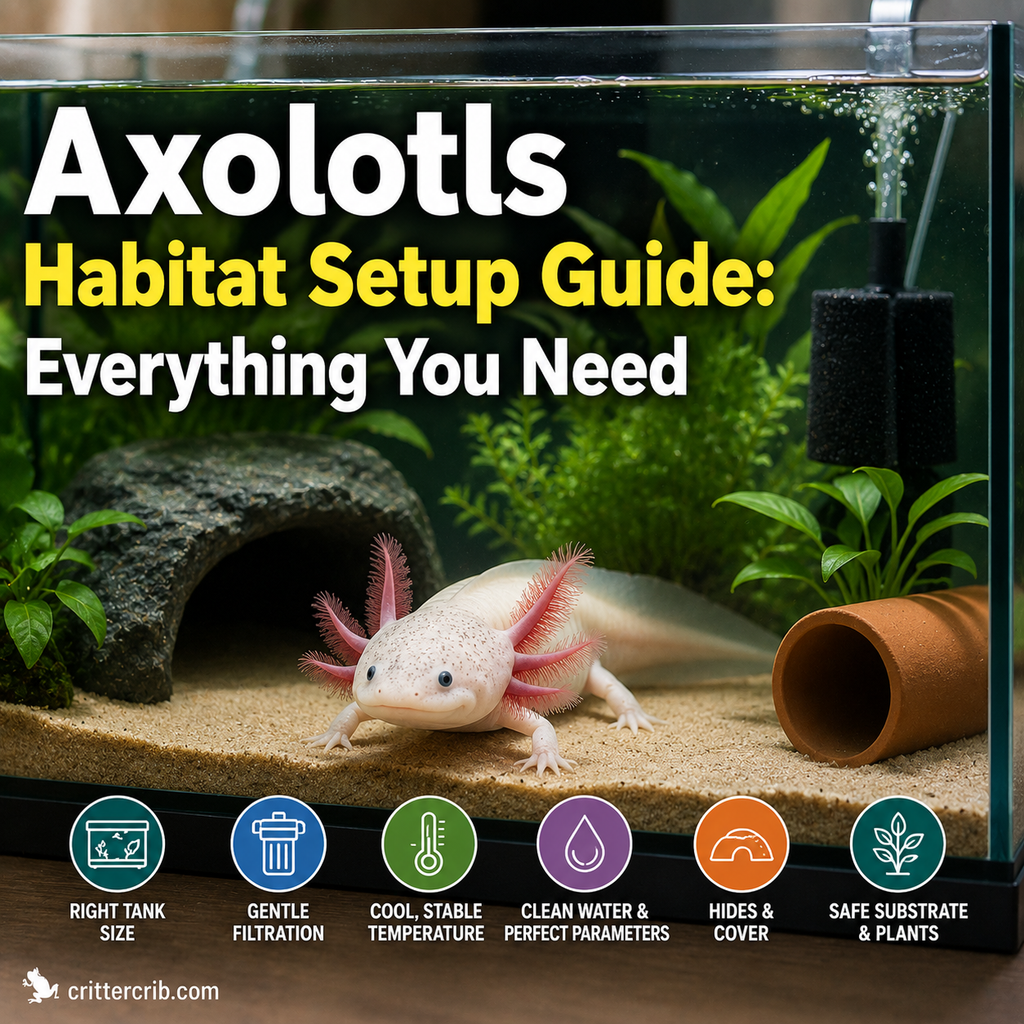
Setting up an axolotl habitat isn’t quite the same as setting up a typical tropical fish aquarium.
Axolotls need cool water, gentle flow, plenty of floor space, safe substrate, secure hiding areas, and—most importantly—a fully cycled aquarium. They’re also messy animals, so filtration and water quality need to be taken seriously from the beginning.
The biggest mistake is buying an axolotl and then trying to figure out the aquarium afterward.
A better approach is to build the habitat first, cycle it completely, confirm that the temperature and water parameters are stable, and only then bring the axolotl home.
This guide walks through the process from an empty aquarium to a finished axolotl habitat.
Axolotl Habitat Requirements at a Glance
A basic axolotl setup should include:
- Appropriately sized aquarium with plenty of floor space
- Fully established nitrogen cycle
- Gentle but effective filtration
- Cool, stable water temperature
- Water conditioner
- Liquid water test kit
- Bare bottom or appropriate fine sand for suitable animals
- Multiple hides
- Low or subdued lighting
- Aquarium thermometer
- Siphon or gravel vacuum
- Dedicated aquarium bucket
- Optional hardy live plants
For one adult axolotl, a tank around 29 gallons or larger is a practical starting point, with a 40-gallon breeder offering considerably more floor space and water volume.
Bigger tanks aren’t just about giving the axolotl more room. Additional water volume can also make water conditions more stable.
Choosing the Right Axolotl Tank
Start with the aquarium itself.
Axolotls spend essentially all of their time near the bottom, so horizontal floor space matters much more than height.
A tall, narrow aquarium may hold plenty of water while providing surprisingly little usable space.
Look for a tank that is:
- Long
- Wide
- Stable
- Easy to maintain
- Large enough for an adult
- Able to accommodate hides and filtration without becoming crowded
What Size Tank Does an Axolotl Need?
For one adult, approximately 29 gallons should be considered a practical minimum starting point rather than an ideal maximum.
A 40-gallon breeder is an excellent option when space and budget allow.
Its broad footprint provides room for:
- Walking along the bottom
- Multiple hides
- Feeding
- Plants
- Filter equipment
- A more varied habitat
Larger water volume also dilutes waste more effectively than a very small aquarium.
That doesn’t eliminate the need for water changes, but it can make conditions more stable.
Is a 20-Gallon Tank Big Enough?
Older axolotl care recommendations sometimes suggested 20-gallon aquariums.
For a full-grown axolotl, that’s quite restrictive.
Adult axolotls can grow to around 9–12 inches long, and they’re substantial waste producers.
Once you add hides, filtration, and other habitat features, a small tank becomes crowded quickly.
If you’re building a new habitat today, starting around 29 gallons or going directly to a 40-gallon breeder is a better long-term plan.
Do Axolotls Need a Tank Lid?
A lid isn’t always discussed as much as filtration or temperature, but it’s useful.
Axolotls aren’t climbing animals, but they can occasionally make sudden movements near the surface.
A lid also helps prevent:
- Accidental jumping
- Objects falling into the aquarium
- Other pets accessing the water
- Household contaminants entering the tank
If you use a lid, make sure it doesn’t trap excessive heat.
This is particularly important if maintaining cool water is already difficult in your home.
Cycle the Aquarium Before Getting an Axolotl
This is arguably the most important part of the entire setup.
An aquarium needs an established biological cycle before an axolotl is introduced.
Axolotls produce ammonia through waste and other biological processes. Ammonia is toxic.
Beneficial bacteria living primarily on filter media and other aquarium surfaces process that waste.
The basic nitrogen cycle works like this:
- Ammonia enters the aquarium.
- Beneficial bacteria convert ammonia into nitrite.
- Other bacteria convert nitrite into nitrate.
- Partial water changes help control nitrate.
Both ammonia and nitrite are dangerous.
In a properly cycled aquarium, they should remain at 0 ppm.
How Long Does Cycling an Axolotl Tank Take?
Cycling isn’t instantaneous.
A fishless cycle commonly takes several weeks, although the exact time varies.
That’s why the habitat should be prepared well before you plan to bring an axolotl home.
You’ll need:
- Aquarium
- Filter
- Dechlorinated water
- Liquid test kit
- Controlled ammonia source suitable for fishless cycling
Test regularly as the bacterial colonies develop.
Don’t assume the aquarium is cycled simply because the water has been running through a filter for a week.
Running water and cycling are not the same thing.
Water Parameters for an Axolotl Tank
Once the aquarium is cycled, water testing becomes part of regular maintenance.
Important parameters include:
Ammonia
Target: 0 ppm
Any detectable ammonia in an established aquarium deserves attention.
Nitrite
Target: 0 ppm
Like ammonia, nitrite is toxic and should not be present in a properly functioning cycled aquarium.
Nitrate
Nitrate is the final major product of the nitrogen cycle.
Unlike ammonia and nitrite, some nitrate will normally be present in an established aquarium.
Keep it controlled through regular partial water changes, appropriate stocking, filtration, and maintenance.
Many keepers aim to keep nitrate below approximately 20 ppm.
pH
Axolotls generally do well in neutral to moderately alkaline water.
Stability matters.
Avoid constantly adjusting pH with chemicals unless there’s a genuine reason to do so.
Sudden changes can create more problems than a stable value that isn’t theoretically perfect.
Use a Liquid Water Test Kit
Water can look crystal clear while containing dangerous levels of ammonia or nitrite.
You can’t reliably judge aquarium water by appearance.
A liquid aquarium test kit that measures ammonia, nitrite, nitrate, and pH is one of the most useful tools an axolotl keeper can own.
Test frequently while cycling.
Once the aquarium is established, continue testing regularly so you can identify changes before they become serious.
Axolotl Water Temperature
Axolotls are cold-water amphibians.
Temperature is one of the major differences between an axolotl habitat and a conventional tropical aquarium.
A useful target range is approximately 60–68°F (16–20°C).
Many keepers aim for the lower-to-middle portion of that range.
Prolonged temperatures above roughly 68°F can increase stress and may contribute to health problems.
Always Use a Thermometer
Don’t estimate water temperature based on how the room feels.
Use a reliable aquarium thermometer.
Water temperature can vary depending on:
- Season
- Room temperature
- Lighting
- Filter pumps
- Nearby electronics
- Sunlight
- Aquarium location
Monitoring becomes particularly important during summer.
Do Axolotls Need a Heater?
Usually, no.
In many homes, keeping the aquarium cool enough is a much greater challenge than keeping it warm.
A tropical aquarium heater generally isn’t appropriate unless your environment is unusually cold and the water consistently falls below the appropriate range.
Never add a heater simply because aquarium starter kits often include one.
Axolotls have very different temperature requirements from tropical fish.
How to Keep an Axolotl Tank Cool
If your aquarium becomes too warm, several strategies can help.
Keep the Tank Away From Sunlight
Direct sunlight can rapidly heat aquarium water.
It can also encourage excessive algae growth.
Choose a cool part of the room away from sunny windows.
Use an Aquarium Fan
Fans blowing across the water surface can lower temperature through evaporation.
The amount of cooling varies depending on room humidity and other conditions.
Evaporation will increase, so you’ll need to monitor the water level.
Keep the Room Cool
Air conditioning can be an effective solution when you’re already cooling the room.
Consider an Aquarium Chiller
In consistently hot climates or warm homes, an aquarium chiller may provide the most reliable temperature control.
Chillers are more expensive than fans, but they can maintain stable temperatures when passive methods aren’t sufficient.
Plan your cooling strategy before summer arrives.
Choosing an Axolotl Filter
Axolotls create a substantial amount of waste, so they need effective filtration.
At the same time, they don’t appreciate strong currents.
The goal is good filtration with gentle water movement.
Common options include:
- Sponge filters
- Canister filters
- Hang-on-back filters with modified flow
- Combinations of mechanical and biological filtration
Sponge Filters
Sponge filters are popular because they:
- Provide biological filtration
- Create relatively gentle flow
- Are inexpensive
- Are easy to maintain
Larger tanks may require more than one sponge filter or additional filtration depending on the setup.
Canister Filters
Canister filters can provide substantial filtration for larger aquariums.
However, the output may need to be diffused or adjusted to prevent excessive current.
A spray bar can help spread the flow across a larger area.
Hang-on-Back Filters
These can work, but waterfall-style output may create too much movement.
Baffles or other safe flow-reduction methods can help.
Whatever filter you choose, watch the axolotl rather than relying solely on the manufacturer’s flow rating.
Signs the Water Flow May Be Too Strong
Axolotls generally prefer calm water.
Possible signs of excessive current include:
- Constantly being pushed around
- Difficulty resting comfortably
- Repeatedly avoiding one part of the tank
- Persistent stress-related behavior
- Gills appearing strongly curved forward in combination with other signs of stress
Some gill positioning can vary normally, so don’t diagnose a problem based on one feature alone.
Look at the overall environment and behavior.
Best Substrate for an Axolotl Tank
Substrate deserves careful consideration because axolotls often inhale food from the bottom.
Loose material can be swallowed accidentally.
Bare Bottom
A bare-bottom aquarium is one of the safest and easiest options, especially for young axolotls.
Advantages include:
- Easy waste removal
- Easy feeding
- No loose substrate to swallow
- Simple cleaning
The downside is appearance, and some axolotls may have less traction on smooth glass.
Slate or other safe flat surfaces can sometimes provide additional grip.
Fine Sand
Appropriate fine sand is commonly used for sufficiently large adult axolotls.
It creates a natural-looking habitat and provides better traction than bare glass.
Choose very fine aquarium-safe sand.
Avoid coarse material.
Avoid Gravel and Small Stones
Do not use gravel or pebbles small enough to fit inside an axolotl’s mouth.
Axolotls feed by suction and can swallow substrate accidentally.
A swallowed stone can potentially cause intestinal blockage.
If you use decorative rocks, they should be far too large for the axolotl to ingest.
When you’re uncertain, go bigger.
Hides Are Essential
Axolotls don’t have eyelids and generally prefer subdued environments.
Provide several places where your axolotl can retreat from light and activity.
Good hides include:
- Aquarium caves
- PVC pipe
- Ceramic hides
- Large aquarium-safe decorations
- Smooth rock structures
- Driftwood arranged safely
Make sure openings are large enough for an adult axolotl.
They can be surprisingly good at squeezing themselves into awkward spaces.
Check Every Decoration for Sharp Edges
Axolotl skin is delicate.
Their external gills are even more vulnerable.
Before placing any decoration in the tank, run your fingers over it.
Avoid anything with:
- Sharp edges
- Rough plastic
- Narrow holes
- Jagged ceramic
- Exposed metal
- Small openings that could trap the animal
A decoration can look perfectly harmless on a store shelf and still have surprisingly sharp molding seams.
Smooth them safely or choose something else.
Lighting for an Axolotl Tank
Axolotls don’t need bright aquarium lighting.
They lack eyelids and often prefer relatively dim conditions.
If you use aquarium lights for viewing or plants, provide plenty of shaded areas.
A timer can maintain a predictable day-night schedule.
Avoid leaving bright lights on for excessive periods.
Live Plants for Axolotl Tanks
Live plants can work very well in an axolotl aquarium.
The challenge is finding plants that tolerate:
- Cool water
- Low lighting
- Occasional axolotl bulldozing
Good candidates often include hardy species such as:
- Anubias
- Java fern
- Java moss
- Hornwort
- Elodea or similar cool-water plants
- Floating plants where appropriate
Plants attached to rocks or driftwood can be easier to maintain than delicate rooted plants.
Benefits of Live Plants
Plants can provide:
- Shade
- Cover
- Resting areas
- A more natural appearance
- Some nutrient uptake
They’re helpful additions, but don’t rely on plants to replace filtration and water changes.
Artificial Plants
Artificial plants can also provide useful cover.
Choose soft silk or smooth aquarium-safe products.
Avoid stiff plastic plants with sharp points that could damage delicate skin or gills.
Run your hand over them before putting them in the aquarium.
If they feel scratchy to you, choose something softer.
Axolotl Water Conditioner
If your tap water contains chlorine or chloramine, treat it before adding it to the aquarium.
Use an aquarium water conditioner appropriate for the source water and follow the manufacturer’s instructions.
Never assume untreated tap water is safe.
Chlorine and chloramine can harm aquatic animals and may damage beneficial bacteria.
Should You Use Distilled Water?
Pure distilled water isn’t appropriate as the routine water source for an axolotl aquarium because it lacks the normal dissolved minerals found in suitable freshwater.
If your tap water has unusual chemistry, you may need a more specialized water-management strategy.
Test your source water before trying to modify it.
How Deep Should Axolotl Water Be?
Axolotls are fully aquatic and need enough water to move comfortably.
A properly sized aquarium will naturally provide adequate depth.
However, floor space remains more important than creating an unusually deep tank.
Make sure the axolotl can easily move along the bottom and reach the surface.
Don’t fill a small, tall aquarium simply to gain more gallons while sacrificing horizontal space.
Setting Up Hides and Open Space
Avoid filling every inch of the tank with decorations.
Your axolotl needs open floor space too.
A simple layout might include:
- Hide on the left
- Plants toward the back
- Another hide on the right
- Open feeding area toward the front
- Filter positioned to minimize direct current
- Thermometer where it’s easy to read
This creates both cover and usable movement space.
How to Set Up an Axolotl Tank Step by Step
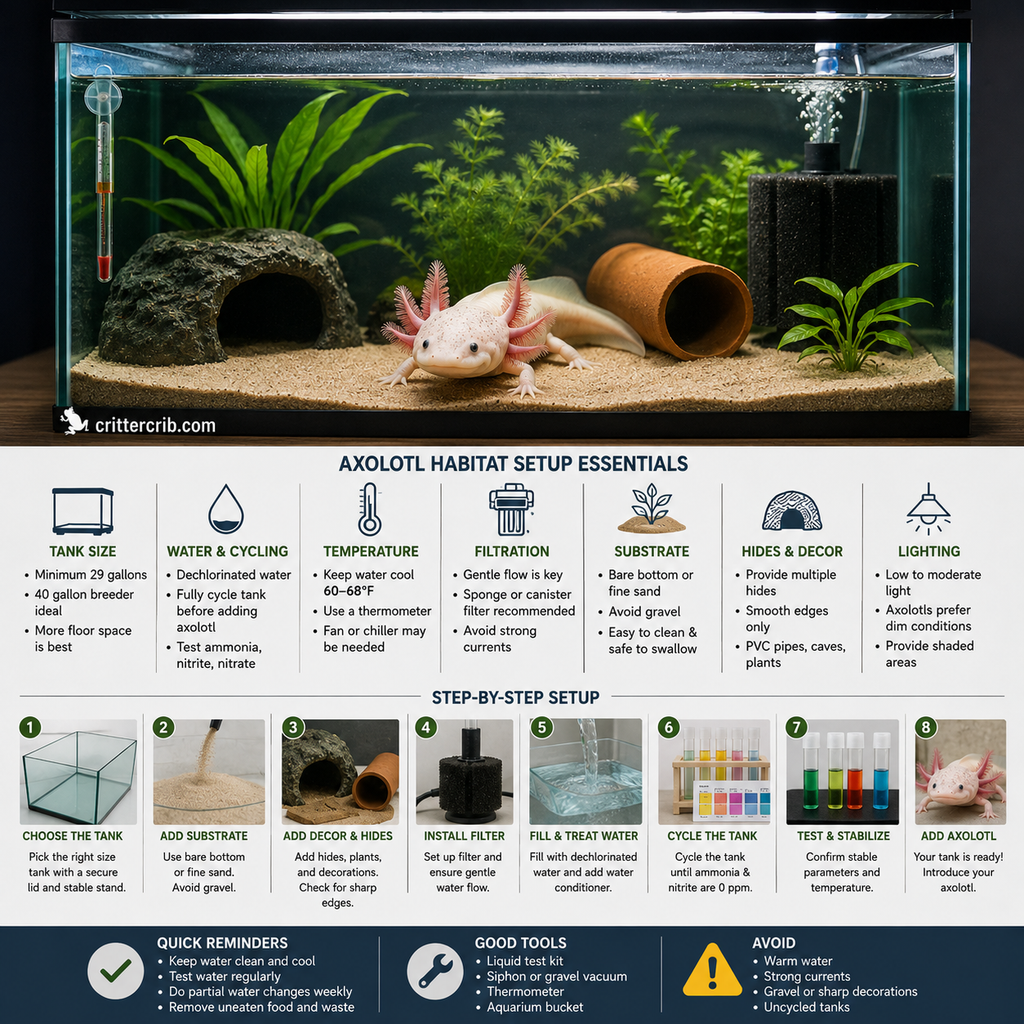
If you’re starting from scratch, use this order.
1. Choose the Aquarium
Select a tank with plenty of horizontal floor space.
For one adult, start around 29 gallons or preferably larger.
2. Choose a Safe Location
Place the aquarium:
- Away from direct sunlight
- Away from heating vents
- Away from high-traffic vibration
- On a stand designed for its weight
- Near convenient access to water and electricity
Remember that a filled aquarium is extremely heavy.
3. Add the Substrate
Choose bare bottom or appropriate fine sand depending on the axolotl’s size and your setup.
Avoid gravel.
4. Add Hides and Decorations
Provide at least a couple of secure hiding areas.
Inspect every object for sharp edges.
5. Install the Filter
Choose filtration capable of handling the tank while maintaining gentle flow.
6. Add Treated Water
Condition tap water appropriately.
7. Install the Thermometer
Place it where you can easily monitor temperature.
8. Add Plants
Arrange live or artificial plants while leaving plenty of open floor space.
9. Begin the Fishless Cycle
Establish beneficial bacteria before adding the axolotl.
Monitor ammonia, nitrite, and nitrate with a liquid test kit.
10. Confirm the Temperature
Make sure the aquarium remains within an appropriate cool range throughout the day.
11. Test the Finished Aquarium
Before adding the axolotl, confirm:
- Ammonia: 0 ppm
- Nitrite: 0 ppm
- Nitrate: controlled
- Temperature: stable and appropriate
- Filter flow: gentle
- Hides: secure
- Decorations: smooth
- Lid: secure if used
Only then is the habitat ready.
Axolotl Tank Maintenance
Setting up the aquarium correctly is only the beginning.
Once an axolotl lives there, routine maintenance keeps the environment stable.
Daily Tasks
Perform a quick check each day:
- Check temperature
- Remove visible waste
- Remove uneaten food
- Make sure the filter is operating
- Observe the axolotl
- Check the water level
Axolotl waste is often easy to spot and remove.
A turkey baster dedicated to aquarium use is useful for quick cleanup.
Weekly Tasks
Depending on water-test results, routine maintenance may include:
- Partial water change
- Water testing
- Substrate cleaning
- Glass cleaning
- Plant maintenance
- Equipment inspection
Use your actual water parameters to determine the water-change schedule rather than relying entirely on the calendar.
How to Clean the Filter Without Crashing the Cycle
Filter media contains beneficial bacteria.
Don’t routinely replace everything simply because it looks dirty.
When reusable media needs cleaning, gently rinse it in water removed from the aquarium during a water change.
Avoid aggressively sterilizing biological media.
If filter material eventually needs replacement, replacing portions gradually can help preserve the bacterial colony.
Common Axolotl Habitat Setup Mistakes
A few mistakes appear repeatedly in new setups.
Adding the Axolotl Before Cycling
An aquarium that’s been running for several days isn’t necessarily cycled.
Confirm the nitrogen cycle through water testing.
Using Gravel
Axolotls can swallow small stones while feeding.
Choose safer flooring.
Keeping the Water Too Warm
Temperature problems can become especially serious during summer.
Plan cooling before you need it.
Creating Too Much Current
Powerful filtration isn’t helpful if the axolotl is constantly fighting the water flow.
Diffuse the output.
Using Bright Lighting Without Hides
Axolotls need places to escape bright light.
Choosing a Tank That’s Too Small
Small aquariums provide less floor space and can experience faster changes in water quality.
Using Sharp Decorations
Inspect every object before it enters the aquarium.
Overdecorating the Tank
Hides and plants are useful, but leave open floor space for normal movement.
Axolotl Habitat Supplies Checklist
Before bringing your axolotl home, make sure you have:
Essential Equipment
- 29-gallon or larger aquarium for one adult
- Appropriate aquarium stand
- Gentle filter
- Aquarium thermometer
- Liquid water test kit
- Water conditioner
- Siphon
- Dedicated aquarium bucket
Habitat Supplies
- Safe substrate or bare bottom
- At least two hides
- Smooth aquarium decorations
- Live or soft artificial plants
- Secure lid if appropriate
Maintenance Supplies
- Turkey baster
- Algae scraper
- Aquarium-safe sponge
- Replacement filter media when eventually needed
- Towels
Temperature Control
Depending on your home:
- Aquarium fan
- Air conditioning
- Aquarium chiller
Don’t wait until a heat wave to discover your aquarium can’t stay cool enough.
Frequently Asked Questions About Axolotl Habitat Setup
What Size Tank Does One Axolotl Need?
For one adult axolotl, around 29 gallons is a practical minimum starting point.
A 40-gallon breeder provides more floor space and water volume and is an excellent long-term option.
Can an Axolotl Live in a 10-Gallon Tank?
A 10-gallon aquarium is far too small for a full-grown axolotl as a permanent habitat.
Adults need substantially more floor space and water volume.
Can an Axolotl Live in a 20-Gallon Tank?
A 20-gallon tank is smaller than recommended for a modern permanent adult setup.
Starting around 29 gallons or choosing a 40-gallon breeder provides more usable space and greater water volume.
Do Axolotls Need a Filter?
Yes, effective biological filtration is important.
Choose filtration that can handle their waste while producing gentle water movement.
Do Axolotls Need a Heater?
Usually not.
Axolotls require cool water, and many keepers are more concerned about cooling than heating.
Do Axolotls Need a Light?
They don’t require bright aquarium lighting.
If lighting is used for plants or viewing, provide shaded areas and hides.
Do Axolotls Need Sand?
No.
A bare-bottom aquarium can work well.
Appropriate fine sand may be used for suitably sized axolotls, while gravel and ingestible stones should be avoided.
How Many Hides Does an Axolotl Need?
Provide at least a couple of comfortable hiding options when space allows.
The axolotl should always have somewhere to retreat from light and activity.
Can I Put Plants in an Axolotl Tank?
Yes.
Choose hardy plants that tolerate cool water and relatively low lighting.
How Long Should an Axolotl Tank Cycle?
Fishless cycling commonly takes several weeks.
Don’t judge readiness by time alone. Use water testing to confirm that the biological filter can process ammonia and that ammonia and nitrite return to 0 ppm.
Final Thoughts on Setting Up an Axolotl Habitat
The best time to solve an axolotl habitat problem is before the axolotl moves in.
Start with a spacious aquarium that prioritizes floor area. Add gentle but effective filtration, safe flooring, smooth hides, subdued lighting, and a reliable thermometer.
Then cycle the aquarium completely.
That last step is worth emphasizing.
A tank can look beautiful and still be unsafe if the biological filtration isn’t established.
Once the cycle is working, confirm that ammonia and nitrite remain at zero, nitrate is controlled, and the water stays consistently cool.
After that, maintaining the habitat becomes much more straightforward.
Keep the water clean, remove waste regularly, monitor temperature and water chemistry, and resist the temptation to overcrowd the aquarium with decorations.
Axolotls don’t need an elaborate underwater landscape.
They need something much more important: a cool, clean, stable habitat with enough room to live comfortably.