Corydoras catfish are often recommended to beginner aquarium keepers, and for good reason. They’re peaceful, entertaining to watch, and generally get along well with other community fish.
But being beginner-friendly doesn’t mean Corydoras can simply be dropped into any aquarium.
These small bottom-dwelling catfish have a few important needs. They prefer living in groups, spend much of their time searching along the substrate, and need clean, well-oxygenated water. The right supplies make meeting those needs much easier.
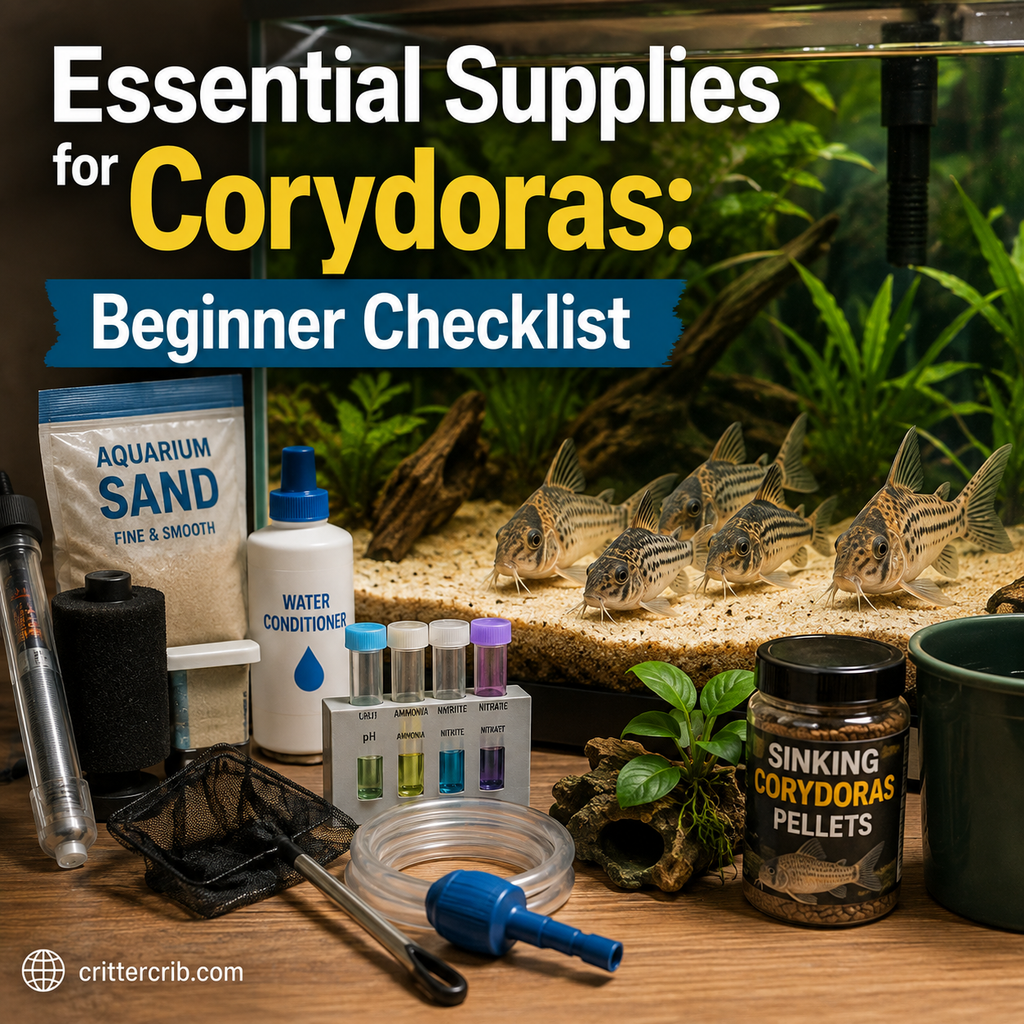
If you’re setting up a tank for Corydoras for the first time, you don’t need to buy every aquarium gadget on the shelf. You do need a properly sized aquarium, suitable substrate, filtration, water conditioner, testing supplies, appropriate food, and a few other basics.
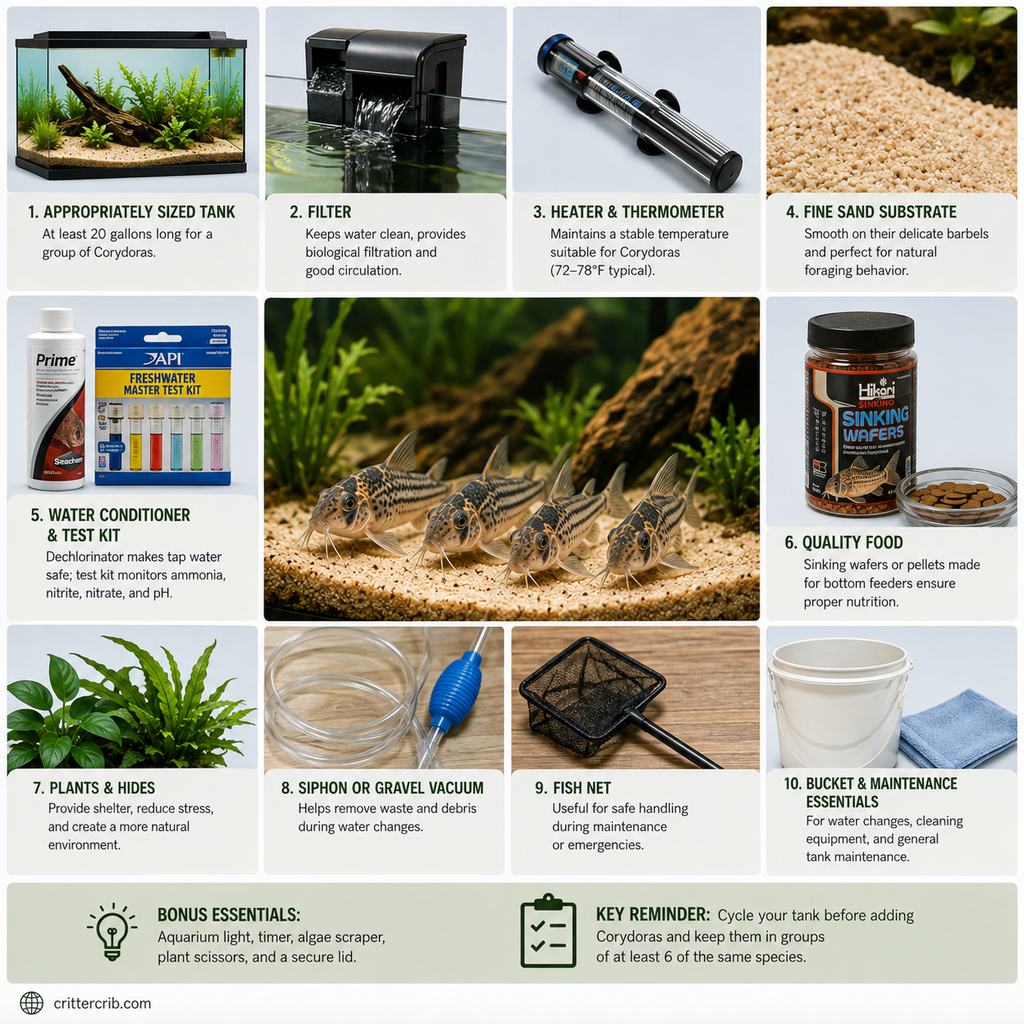
Here’s a practical beginner checklist of the essential supplies you’ll need for Corydoras and what each item actually does.
Corydoras Supplies Checklist
Before bringing your Corydoras home, try to have the aquarium fully set up and cycled.
Your basic shopping list should include:
- Appropriately sized aquarium
- Secure aquarium lid
- Aquarium filter
- Heater when appropriate
- Thermometer
- Fine sand or smooth substrate
- Water conditioner
- Freshwater test kit
- Siphon or gravel vacuum
- Aquarium-only bucket
- Suitable sinking foods
- Plants and hiding places
- Aquarium light
- Fish net
- Basic maintenance supplies
You may already own some of these items if you’re adding Corydoras to an established community aquarium.
If you’re starting from scratch, resist the temptation to buy the fish and equipment on the same day. A new aquarium needs time to establish the biological filtration that processes fish waste.
1. An Appropriately Sized Aquarium
The aquarium itself is naturally the first item on the list.
Corydoras are small fish, but they shouldn’t be kept individually. Because they do best in groups, you need to plan the tank around several fish rather than one tiny catfish.
For many commonly kept Corydoras species, a 20-gallon long aquarium or larger is a practical starting point for a group.
A longer aquarium is particularly useful because Corydoras spend much of their time near the bottom.
That means floor space matters.
A tall, narrow aquarium may contain the same number of gallons but provide less usable bottom area.
Tank Size Depends on the Species
“Corydoras” describes a large group of catfish rather than one single type.
Adult size varies.
Common aquarium species include:
- Bronze Corydoras
- Albino Corydoras
- Panda Corydoras
- Peppered Corydoras
- Sterbai Corydoras
- Pygmy Corydoras
Tiny species such as pygmy Corydoras have different space requirements from larger varieties.
Before buying your aquarium, identify the species you intend to keep and research its adult size and preferred conditions.
2. A Secure Aquarium Lid
Corydoras aren’t usually thought of as jumping fish, but an aquarium lid is still useful.
It helps:
- Reduce evaporation
- Prevent accidental escapes
- Keep household objects out of the aquarium
- Protect fish from curious pets
- Support a more stable aquarium environment
Corydoras also occasionally dart toward the surface to gulp air.
This is normal behavior.
They can absorb oxygen through their intestines, so don’t be surprised if one suddenly races upward and immediately returns to the bottom.
Leave appropriate access to the water’s surface rather than filling the tank completely to the lid.
3. A Reliable Aquarium Filter
Filtration is one of the most important parts of any Corydoras setup.
The filter helps remove suspended debris while providing a home for beneficial bacteria involved in the aquarium nitrogen cycle.
A suitable filter should provide:
- Mechanical filtration
- Biological filtration
- Water circulation
- Surface movement
Corydoras appreciate clean, oxygenated water, but you don’t need to turn the aquarium into a rushing river.
Choose filtration appropriate for the aquarium’s size and stocking level.
What Type of Filter Is Good for Corydoras?
Several types can work well.
Options include:
- Hang-on-back filters
- Sponge filters
- Internal filters
- Canister filters
Sponge filters are particularly useful in breeding tanks or aquariums containing very small fish because they provide gentle filtration without a powerful intake.
Hang-on-back and canister filters can also work well in community aquariums.
If your filter intake is strong, consider using a pre-filter sponge to prevent small fish or fry from being pulled toward it.
4. A Heater When Appropriate
Whether your Corydoras aquarium needs a heater depends on the species and your room temperature.
Many popular Corydoras are tropical or subtropical fish and benefit from stable water temperatures.
Different species don’t all prefer exactly the same temperature.
For example, a temperature that’s comfortable for one Corydoras species may be toward the warm end for another.
Choose the species first, then select a heater based on its temperature requirements.
A reliable adjustable aquarium heater generally gives you more control than relying on room temperature alone.
5. An Aquarium Thermometer
Even if your heater has a temperature setting, use a separate aquarium thermometer.
Heaters can malfunction, and their built-in settings aren’t always perfectly accurate.
A thermometer allows you to quickly verify the actual water temperature.
Simple options include:
- Digital aquarium thermometers
- Glass aquarium thermometers
- External temperature displays with aquarium probes
Place the thermometer somewhere you can check easily.
Temperature monitoring takes only a few seconds and can alert you to equipment problems before they become serious.
6. Fine Sand or Smooth Substrate
Substrate is particularly important for Corydoras.
These fish spend a large part of the day exploring the bottom of the aquarium with their sensitive barbels.
You’ll often see them digging their faces into the substrate while searching for tiny pieces of food.
Fine aquarium sand is a popular choice because it allows Corydoras to display this natural foraging behavior.
Can Corydoras Live on Gravel?
They can live on appropriately smooth substrate, but avoid sharp or rough gravel.
Jagged substrate can potentially injure fish as they forage along the bottom.
If you prefer gravel, choose small, rounded, smooth material.
Whatever substrate you use, keeping it reasonably clean is also important.
Waste and leftover food can collect along the aquarium floor, exactly where Corydoras spend most of their time.
7. Water Conditioner
If you use municipal tap water for water changes, you’ll generally need aquarium water conditioner.
Tap water is commonly treated with chlorine or chloramine to make it safe for human consumption.
Those disinfectants can be harmful to aquarium fish and the microorganisms supporting biological filtration.
Use a conditioner appropriate for your water supply and follow the manufacturer’s dosing directions.
Water conditioner is one supply you should always have available before performing a water change.
Running out halfway through aquarium maintenance isn’t a situation you want.
8. A Freshwater Aquarium Test Kit
Clear water isn’t necessarily safe water.
A freshwater aquarium test kit allows you to monitor what’s happening chemically inside the aquarium.
At minimum, you should be able to test:
- Ammonia
- Nitrite
- Nitrate
- pH
Depending on your water and the species you’re keeping, hardness tests for GH and KH can also be useful.
Why Water Testing Matters
Fish waste contributes to ammonia production.
In a properly cycled aquarium, beneficial bacteria convert ammonia into nitrite and then into nitrate.
Ammonia and nitrite should remain at safe, effectively zero levels in an established tank.
Nitrate accumulates more gradually and can be managed through appropriate stocking, plants, filtration, and regular partial water changes.
Testing is especially important when:
- Cycling a new aquarium
- Adding new fish
- Fish begin behaving strangely
- Changing your maintenance routine
- Increasing stocking
- Troubleshooting unexplained illness
Don’t wait until the water looks dirty.
9. A Gravel Vacuum or Aquarium Siphon
Corydoras may search the bottom for food, but they aren’t aquarium vacuum cleaners.
That’s an important distinction.
They don’t remove fish waste from the tank.
A gravel vacuum or siphon allows you to remove debris from the substrate while performing a partial water change.
Use it to clean:
- Uneaten food
- Fish waste
- Dead plant material
- Other accumulated debris
If you’re using fine sand, hover the siphon slightly above the surface or adjust your technique so you remove debris without sucking out large amounts of substrate.
Regular light cleaning is usually better than allowing waste to build up and then aggressively disturbing the entire aquarium.
10. An Aquarium-Only Bucket
A simple bucket is one of the most useful aquarium supplies you can own.
Use it for:
- Removing old aquarium water
- Preparing replacement water
- Cleaning reusable aquarium equipment
- Temporarily holding decorations during maintenance
The important part is keeping it dedicated to aquarium use.
Never use a bucket that has contained:
- Soap
- Household cleaners
- Paint
- Chemicals
- Automotive products
Labeling your aquarium bucket can prevent someone else in the household from accidentally using it for cleaning.
11. Appropriate Corydoras Food
One of the most common mistakes with Corydoras is assuming they’ll survive on whatever reaches the bottom after the other fish finish eating.
Corydoras need their own food.
They’re omnivorous bottom feeders and should receive a balanced diet appropriate for the species.
Useful foods may include:
- Quality sinking wafers
- Sinking pellets
- Bottom-feeder foods
- Frozen foods
- Appropriately sized live foods
- Occasional varied supplemental foods
Choose food small enough for your fish to eat comfortably.
Don’t Rely on Leftovers
Corydoras aren’t simply cleanup animals.
If faster fish eat most of the food before it reaches the bottom, your Corydoras may not receive enough nutrition.
Watch during feeding to make sure food reaches them.
In busy community tanks, feeding sinking food in more than one location can help reduce competition.
12. Plants and Hiding Places
Corydoras need open substrate for foraging, but they also appreciate areas where they can retreat.
A good aquarium layout combines both.
Consider adding:
- Live aquarium plants
- Driftwood
- Smooth rocks
- Aquarium-safe caves
- Shaded areas
- Open sand
Avoid filling the entire bottom with decorations.
Your Corydoras should still have plenty of unobstructed space to move around and search for food.
Are Live Plants Necessary?
No, but they’re an excellent addition.
Live plants can provide cover and make the aquarium feel more natural.
Beginner-friendly aquarium plants may include:
- Anubias
- Java fern
- Cryptocoryne
- Java moss
- Amazon sword
Plant requirements vary, so choose species compatible with your lighting and water conditions.
Artificial plants can also provide cover, but choose soft aquarium-safe designs without sharp edges.
13. Aquarium Lighting
Corydoras don’t require intense lighting simply for their own sake.
Your lighting needs will largely depend on whether you’re growing live plants.
A basic aquarium light on a timer provides a predictable day-and-night cycle.
Avoid leaving the lights on continuously.
Fish benefit from periods of darkness, and excessive lighting can encourage unwanted algae growth.
A timer is inexpensive and removes the need to remember to switch the aquarium lights on and off every day.
14. A Fish Net
A fish net is useful even if you rarely need to catch your Corydoras.
You may eventually need one for:
- Moving fish
- Aquarium emergencies
- Tank upgrades
- Quarantine
- Removing debris
- Managing new livestock
Choose a net appropriate for the fish’s size.
When handling Corydoras, be careful.
Their fin spines can become caught in netting, so avoid chasing or roughly scooping them around the aquarium.
Move slowly and handle them only when necessary.
15. Basic Aquarium Maintenance Supplies
A few inexpensive tools make routine aquarium care much easier.
Useful extras include:
- Algae scraper
- Aquarium-safe cleaning pad
- Plant scissors
- Long aquarium tweezers
- Clean towels
- Small aquarium brush
- Filter cleaning brush
- Water-change hose
You don’t need every tool immediately.
Start with the basics and add equipment as you discover what makes maintaining your particular aquarium easier.
How Many Corydoras Should You Keep?
Corydoras are social fish.
Rather than buying one or two, plan for a group.
A group of at least six of the same species is a commonly recommended starting point for many Corydoras.
Larger groups can display even more interesting social behavior when aquarium space and filtration allow.
You may see them:
- Foraging together
- Resting near one another
- Swimming as a loose group
- Exploring the aquarium together
- Darting toward the surface
Keeping several different Corydoras species doesn’t necessarily provide the same social experience as keeping a proper group of one species.
Plan your stocking before purchasing the fish so you know your aquarium can support the entire group.
Do Corydoras Need an Air Pump?
Not necessarily.
If your filter creates adequate surface movement and the aquarium has good oxygen exchange, a separate air pump may not be required.
However, an air pump can be useful.
Combined with an air stone or sponge filter, it can:
- Increase surface agitation
- Improve water movement
- Power sponge filtration
- Provide backup aeration in certain situations
Remember that Corydoras occasionally swimming to the surface for a gulp of air is normal.
Constantly rushing to the surface, rapid breathing, or other signs of distress deserve investigation.
Do Corydoras Need a Cave?
A cave isn’t strictly required, but sheltered areas are beneficial.
Corydoras often appreciate shaded areas beneath plants, driftwood, or aquarium decorations.
If you use caves, choose smooth designs without tiny openings where a fish could become trapped.
You don’t need one cave for every Corydoras.
The goal is to create a mixture of open foraging areas and protected resting spots.
Do Corydoras Need Live Plants?
Corydoras can be kept successfully without live plants, but plants provide several benefits.
They create:
- Shade
- Cover
- Natural-looking resting areas
- Additional surfaces for microorganisms
- A more complex environment
Plants can also contribute to nutrient uptake, although they don’t replace filtration or regular water changes.
If you’re new to planted tanks, start with a few hardy species rather than building a complicated high-tech planted aquarium.
Do Corydoras Need Special Food?
They need food that reliably reaches them.
A quality sinking diet designed for bottom-feeding omnivorous fish makes this much easier.
Variety is beneficial.
Rather than feeding exactly the same wafer every day, an appropriate diet can incorporate different sinking prepared foods along with suitable frozen or live foods.
Watch the fish while they eat.
If food disappears before the Corydoras reach it, adjust how and where you feed.
What You Don’t Need for a Corydoras Tank
Aquarium stores sell an enormous range of products, and beginners can easily feel like every bottle and gadget is essential.
Many aren’t.
You generally don’t need:
- Decorative “goldfish bowls”
- Sharp artificial decorations
- Constant chemical additives
- Disposable gadgets marketed as substitutes for water changes
- Automatic feeders for everyday use
- Expensive high-intensity lighting unless your plants require it
- Complicated CO2 equipment for a simple beginner setup
- A different medication for every possible disease “just in case”
A simple, stable aquarium with reliable equipment is usually easier to manage.
Spend your budget on the things that matter most: tank size, filtration, appropriate substrate, water testing, quality food, and regular maintenance.
Supplies to Have for Aquarium Emergencies
A few backup items can be useful even if you don’t use them every week.
Consider keeping:
- Extra water conditioner
- Battery-powered air pump
- Spare air stone
- Extra airline tubing
- Clean aquarium bucket
- Backup thermometer
- Spare sponge filter
- Towels
A battery-powered air pump can be particularly useful during power outages.
You don’t need to build an aquarium emergency warehouse, but a few basic supplies can make unexpected situations much easier to handle.
Before Bringing Corydoras Home
Buying the equipment is only the first step.
Don’t add Corydoras immediately to a brand-new aquarium simply because the filter has been running for a day or two.
The aquarium needs an established nitrogen cycle.
Before adding fish:
- Set up the aquarium and equipment.
- Add substrate, plants, and decorations.
- Fill the aquarium with appropriately conditioned water.
- Start the filter and heater if required.
- Establish the aquarium’s nitrogen cycle using an appropriate fishless cycling method.
- Test the water throughout the process.
- Confirm that the aquarium can process waste without measurable ammonia or nitrite accumulating.
- Make sure the temperature and other parameters are appropriate for your chosen Corydoras species.
- Purchase a suitable group rather than a single fish.
Cycling may be less exciting than choosing fish, but it’s one of the most important parts of setting up an aquarium.
Beginner Corydoras Setup Checklist
Before bringing your fish home, run through this final checklist.
Essential Equipment
- Appropriately sized aquarium
- Aquarium lid
- Filter
- Heater if required
- Thermometer
- Light
Inside the Aquarium
- Fine sand or smooth substrate
- Plants
- Hiding areas
- Open foraging space
- Smooth aquarium-safe decorations
Water Care
- Water conditioner
- Freshwater test kit
- Gravel vacuum or siphon
- Aquarium-only bucket
- Algae scraper
Feeding and Fish Care
- Quality sinking food
- Supplemental foods for variety
- Fish net
- Basic maintenance tools
Before Adding Fish
- Aquarium fully set up
- Nitrogen cycle established
- Ammonia and nitrite safely controlled
- Stable temperature
- Appropriate water parameters
- Enough room for a proper Corydoras group
Frequently Asked Questions About Corydoras Supplies
What Do I Need for Corydoras Catfish?
At minimum, Corydoras need an appropriately sized, cycled aquarium with filtration, suitable substrate, stable water conditions, appropriate temperature, sinking food, and enough room to live in a social group.
You’ll also need routine maintenance supplies such as water conditioner, a water test kit, and a siphon.
Is Sand Necessary for Corydoras?
Sand isn’t the only possible substrate, but fine aquarium sand is an excellent choice because it allows Corydoras to naturally sift and forage along the bottom.
Smooth, rounded substrate can also work.
Avoid sharp or jagged material.
Can I Keep One Corydoras?
Corydoras are social fish and are better kept in groups.
For many commonly kept species, planning for at least six of the same species is a sensible starting point.
Make sure the aquarium is large enough for the entire group.
Do Corydoras Clean the Tank?
No.
Corydoras may eat food that reaches the substrate, but they don’t remove fish waste or replace aquarium maintenance.
You still need to perform water changes, clean accumulated debris, and maintain the filter.
Think of Corydoras as pets, not cleaning equipment.
Do Corydoras Need a Filter?
Yes, an aquarium containing Corydoras should have appropriate filtration.
The filter provides mechanical filtration, water movement, and, most importantly, a place for beneficial bacteria involved in biological filtration.
Do Corydoras Need a Heater?
It depends on the species and ambient temperature.
Many popular Corydoras species benefit from heated aquariums, while others prefer somewhat cooler conditions.
Research the temperature range of the exact species you’re planning to keep.
What Is the Most Important Corydoras Supply?
It’s difficult to choose just one because the aquarium functions as a system.
However, an appropriately sized, fully cycled aquarium with reliable biological filtration is the foundation.
The best food, substrate, and decorations won’t compensate for unsafe water quality.
Final Thoughts
Setting up a Corydoras aquarium doesn’t require an enormous collection of expensive equipment.
Focus on the essentials.
Start with a properly sized aquarium that gives your fish plenty of bottom space. Add reliable filtration, suitable substrate, stable temperature control when needed, water testing supplies, and a good maintenance routine.
Then think about the fish themselves.
Corydoras are social catfish, so plan for a group rather than buying a single fish. Give them smooth substrate to explore, sheltered areas for resting, open space for foraging, and sinking foods that actually reach the bottom.
Most importantly, set up and cycle the aquarium before bringing your Corydoras home.
Getting the basics right from the beginning makes maintaining the tank easier and gives you much more time to enjoy what makes Corydoras so appealing: watching a little group of curious catfish explore the bottom of the aquarium together.