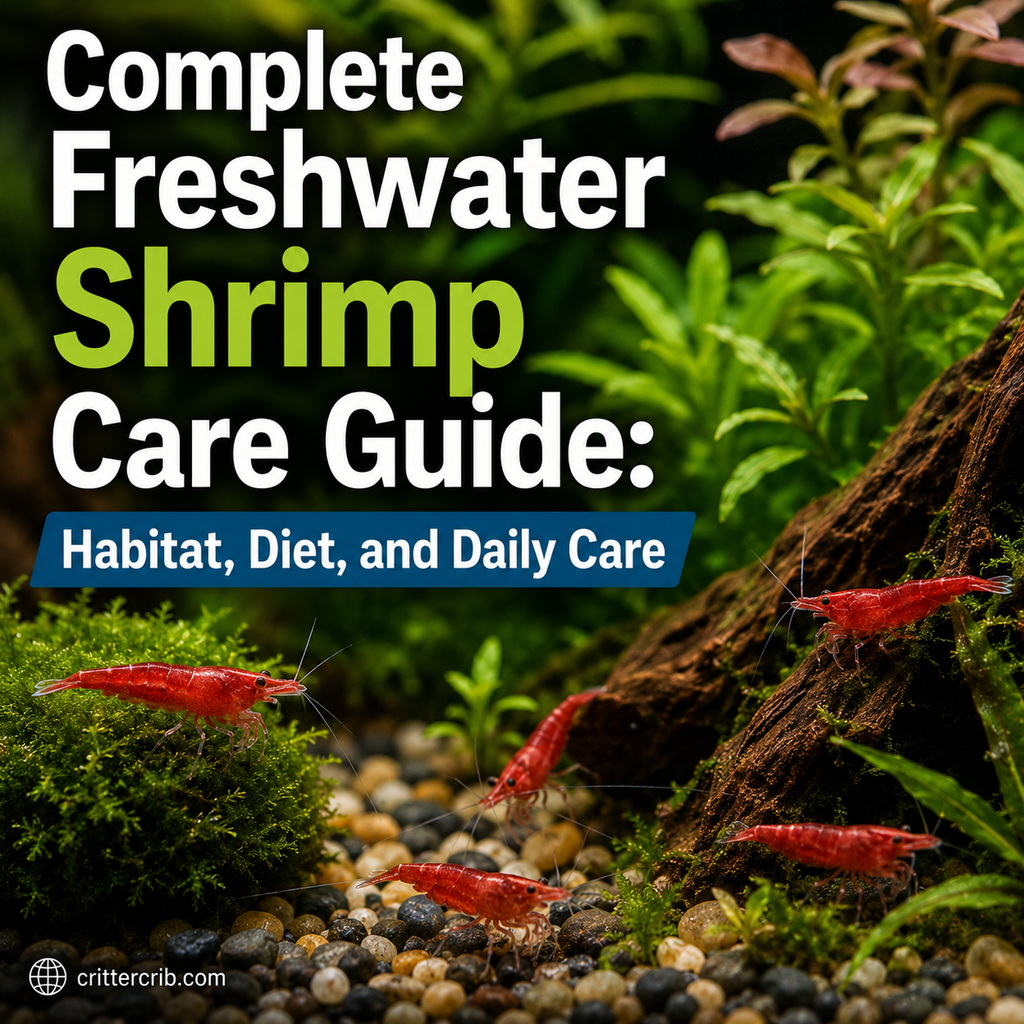
Freshwater shrimp are tiny animals with a surprising amount of personality. Put a group into a planted aquarium and you’ll soon see them picking through moss, climbing over driftwood, grazing on leaves, and somehow discovering microscopic bits of food you didn’t even know were there.
They’re also a little different from keeping fish.
Shrimp depend heavily on stable water conditions, and sudden changes that might not bother some aquarium fish can cause serious problems for them. They also molt as they grow, need access to appropriate minerals, and are particularly sensitive to certain contaminants.
The good news is that freshwater shrimp care doesn’t need to be complicated.
Once you understand their basic needs and establish a mature, stable aquarium, many popular freshwater shrimp can be fascinating and relatively low-maintenance pets.
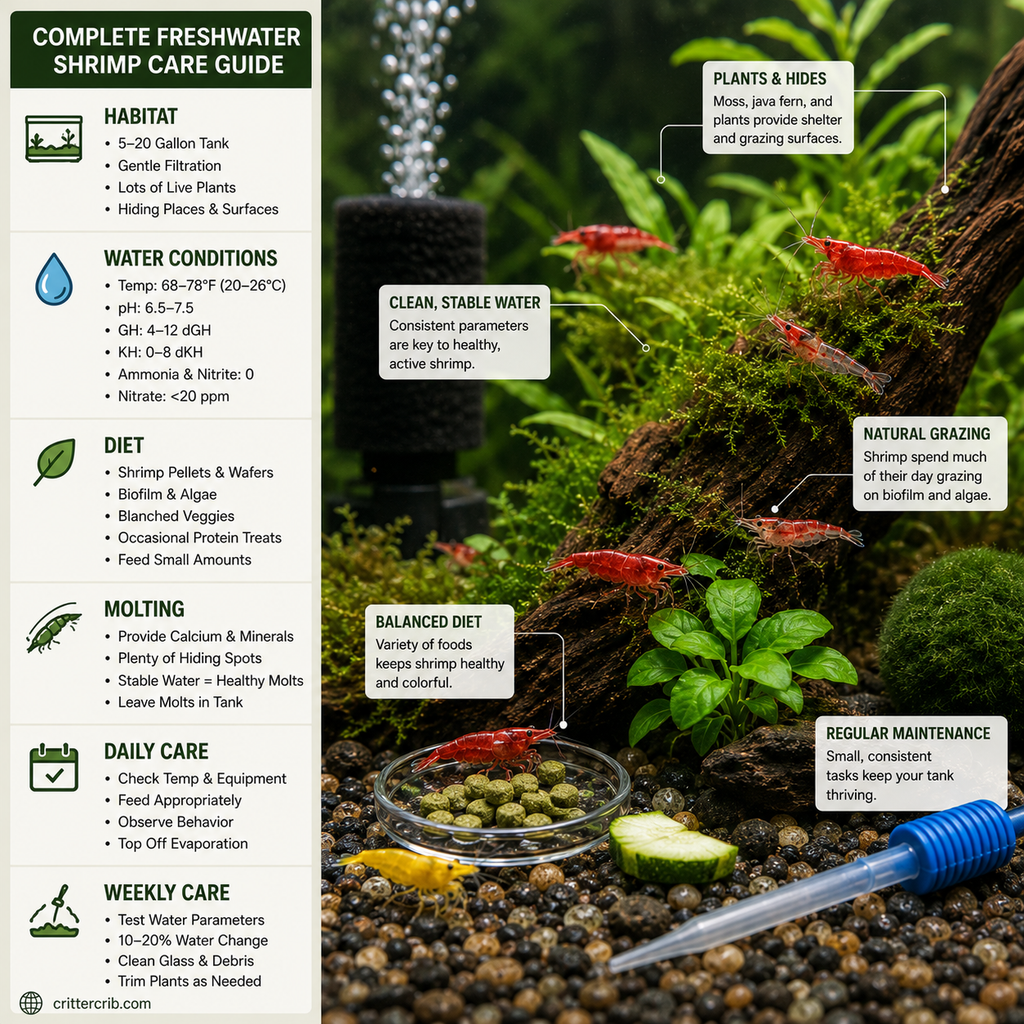
This complete freshwater shrimp care guide covers everything beginners need to know, from choosing a species and setting up the habitat to feeding, molting, breeding, tank maintenance, and daily care.
Are Freshwater Shrimp Good Pets for Beginners?
Some freshwater shrimp are excellent choices for beginners.
Neocaridina shrimp, particularly the popular cherry shrimp, are among the easiest places to start. They’re colorful, adaptable compared with more demanding shrimp species, and readily breed when conditions are suitable.
Other freshwater shrimp can require more specific water parameters.
Popular aquarium shrimp include:
- Cherry shrimp and other Neocaridina varieties
- Amano shrimp
- Ghost shrimp
- Crystal shrimp
- Bee shrimp
- Bamboo shrimp
- Vampire shrimp
These aren’t interchangeable.
Amano shrimp, for example, have different reproductive requirements from cherry shrimp, while many Caridina varieties can be much less forgiving about water chemistry.
If this is your first shrimp aquarium, research the exact species before purchasing it.
What Do Freshwater Shrimp Need?
At a basic level, freshwater aquarium shrimp need:
- A fully cycled aquarium
- Stable water parameters
- Appropriate temperature
- Suitable pH and hardness
- Gentle filtration
- Plenty of surfaces for grazing
- Plants and hiding places
- Appropriate food
- Minerals needed for healthy molts
- Compatible tank mates
- Regular but careful maintenance
Stability is one of the most important themes in shrimp keeping.
Shrimp often handle consistent conditions better than an aquarium that is constantly being adjusted in pursuit of supposedly perfect numbers.
If you’re building your first shrimp aquarium, our freshwater shrimp habitat setup guide walks through tank size, cycling, filtration, substrate, water parameters, plants, hardscape, and creating plenty of natural grazing surfaces.
Choosing the Right Freshwater Shrimp
Before setting up the aquarium, decide which shrimp you actually want to keep.
Different species have different requirements.
Neocaridina Shrimp
Neocaridina davidi includes many of the colorful dwarf shrimp commonly sold in aquarium stores.
Color varieties include:
- Red cherry
- Blue dream
- Yellow
- Orange
- Green
- Black
- Rili patterns
Despite their different colors, these are generally variations of the same species.
Neocaridina are popular with beginners because they’re relatively adaptable and reproduce readily in freshwater.
Amano Shrimp
Amano shrimp are larger than typical dwarf cherry shrimp and are well known for grazing on algae and biofilm.
They’re excellent aquarium inhabitants, but breeding them is much more complicated.
The larvae require brackish or marine conditions during part of their development, so you generally won’t end up with a rapidly expanding Amano shrimp colony in a normal freshwater aquarium.
Caridina Shrimp
Caridina shrimp include beautiful varieties such as crystal red and crystal black shrimp.
Many popular Caridina varieties require more carefully controlled water chemistry than Neocaridina.
Some keepers use:
- Remineralized reverse-osmosis water
- Active buffering substrate
- Careful GH and KH management
They’re rewarding animals, but beginners should understand their specific requirements before setting up the aquarium.
Ghost Shrimp
Ghost shrimp are inexpensive and widely available.
However, “ghost shrimp” is a common name used for more than one type of transparent shrimp in the aquarium trade.
Quality and identification can vary.
If you want to keep them as pets rather than use them as feeder animals, purchase from a source that can accurately identify what it’s selling.
How Big Should a Freshwater Shrimp Tank Be?
Dwarf shrimp don’t need enormous aquariums, but extremely small tanks can be harder to keep stable.
A 10-gallon aquarium is an excellent starting size for many beginner shrimp colonies.
It provides:
- Plenty of grazing area
- More stable water volume than a tiny container
- Room for plants and hardscape
- Space for a growing colony
- Easier equipment choices
Experienced aquarists successfully keep shrimp in nano aquariums smaller than 10 gallons, but smaller isn’t necessarily easier.
A small amount of evaporation or an accidental extra dose of something has a proportionally greater effect in a tiny aquarium.
For beginners, a little extra water volume can be very helpful.
Why Shrimp Tanks Need to Be Cycled
Never assume a new aquarium is ready for shrimp simply because the water looks clear.
Shrimp need an established nitrogen cycle.
Fish and other aquarium inhabitants produce waste that contributes to ammonia. Beneficial bacteria process ammonia into nitrite and eventually nitrate.
Ammonia and nitrite are toxic and should remain at safe, effectively zero levels in an established shrimp aquarium.
A properly cycled aquarium provides the biological filtration necessary to process this waste.
Mature Tanks Are Even Better
Cycling establishes biological filtration, but shrimp also benefit from an aquarium that has had time to develop natural grazing surfaces.
Over time, microorganisms and biofilm grow on:
- Plants
- Driftwood
- Rocks
- Substrate
- Filter surfaces
- Aquarium glass
Shrimp spend much of their day picking at these surfaces.
A spotless new aquarium may technically be cycled but still provide fewer natural grazing opportunities than a more mature setup.
Best Substrate for Freshwater Shrimp
The right substrate depends partly on the shrimp species.
Neocaridina Substrate
Neocaridina generally don’t require an active buffering substrate.
Common options include:
- Aquarium sand
- Fine gravel
- Inert planted-tank substrates
Dark substrate is popular because colorful shrimp often stand out against it.
Caridina Substrate
Some Caridina setups use active substrate designed to influence water chemistry and maintain a lower pH.
Don’t choose an active substrate simply because the package has shrimp on it.
Match the substrate to the water parameters required by your specific shrimp.
Best Filter for a Shrimp Tank
Shrimp need filtration, but the filter should be safe for tiny animals.
Baby shrimp are extremely small and can potentially be drawn into unprotected filter intakes.
Sponge Filters
Sponge filters are one of the most popular choices for shrimp aquariums.
They provide:
- Gentle filtration
- Biological filtration
- Surface agitation
- No dangerous open intake
- Additional grazing surface
Shrimp often spend time picking food and microorganisms from the sponge itself.
Hang-on-Back Filters
A hang-on-back filter can also work.
Cover the intake with a pre-filter sponge.
This helps prevent baby shrimp from being sucked into the filter while adding another useful surface for beneficial bacteria and grazing.
Canister Filters
Canister filters can be used on larger planted shrimp tanks, but the intake should also be protected.
Avoid excessive flow.
Shrimp can tolerate some water movement, but a small shrimp aquarium doesn’t need to feel like a fast-moving river.
Do Freshwater Shrimp Need a Heater?
It depends on the species and the temperature of the room.
Many popular dwarf shrimp can tolerate a range of temperatures, and some aquariums remain suitable without a heater in consistently climate-controlled homes.
A heater may still be useful when:
- Room temperatures fluctuate
- Winters are cold
- The shrimp species prefers warmer water
- Compatible tropical fish share the aquarium
The goal isn’t simply warm water.
It’s stable, species-appropriate temperature.
Always use a thermometer to monitor the actual aquarium temperature.
Freshwater Shrimp Water Parameters
Water chemistry is one of the most important parts of shrimp care.
The correct parameters depend on the species, so there isn’t one universal set of numbers for every freshwater shrimp.
Important parameters include:
- Temperature
- pH
- GH
- KH
- Ammonia
- Nitrite
- Nitrate
- Total dissolved solids when relevant
GH and Shrimp
GH, or general hardness, measures dissolved minerals in the water, particularly calcium and magnesium.
These minerals are important to shrimp because they’re involved in healthy exoskeleton development and molting.
KH and Shrimp
KH, or carbonate hardness, relates to the water’s buffering capacity.
It helps resist sudden changes in pH.
Different shrimp species have different preferences for KH, which is one reason you should research the species before trying to modify your water.
Don’t Chase Perfect Numbers
One of the easiest beginner mistakes is constantly adding products to raise or lower water parameters.
A stable aquarium that’s appropriately within a species’ acceptable range is often preferable to water chemistry that changes every few days because you’re trying to hit an exact target.
Test first.
Adjust only when there’s a clear reason.
Do Freshwater Shrimp Need Live Plants?
Live plants aren’t absolutely required, but they’re extremely beneficial in shrimp aquariums.
Plants provide:
- Cover
- Grazing surfaces
- Biofilm
- Hiding places during molts
- Nutrient uptake
- Shelter for baby shrimp
Mosses are especially useful.
Popular shrimp-tank plants include:
- Java moss
- Christmas moss
- Java fern
- Anubias
- Bucephalandra
- Cryptocoryne
- Floating plants
- Subwassertang
Dense moss gives baby shrimp an enormous network of surfaces to explore.
Driftwood, Rocks, and Hiding Places
A completely empty aquarium doesn’t provide much enrichment or protection.
Add aquarium-safe hardscape such as:
- Driftwood
- Smooth rocks
- Cholla wood
- Shrimp-safe caves
- Leaf litter when appropriate
Driftwood becomes particularly valuable as it matures because biofilm develops across its surface.
Don’t worry if every piece of wood isn’t perfectly clean.
To a shrimp, a slightly messy piece of established driftwood can be an all-you-can-eat buffet.
What Do Freshwater Shrimp Eat?
Freshwater shrimp are opportunistic omnivores and scavengers.
Much of their day is spent grazing on biofilm, algae, microorganisms, and tiny bits of organic material.
In an aquarium, they can eat a varied diet that may include:
- Shrimp pellets
- Shrimp wafers
- Algae-based foods
- Biofilm
- Some algae
- Blanched vegetables
- Protein-containing foods
- Decaying plant material
- Specialized powdered foods
They shouldn’t be expected to survive entirely on algae.
For a deeper look at biofilm, algae, prepared shrimp foods, vegetables, protein, feeding frequency, and avoiding overfeeding, see our complete freshwater shrimp feeding guide.
How Often Should You Feed Shrimp?
Feeding frequency depends on colony size, tank maturity, and how much natural food is available.
A mature planted aquarium with a small shrimp population may need surprisingly little supplemental food.
A large colony may require more.
Start conservatively.
If food sits untouched for hours, you’re probably offering too much.
Overfeeding can cause:
- Poor water quality
- Excessive waste
- Bacterial growth
- Pest snail population explosions
- Increased nitrate
Shrimp are tiny animals.
Their food portions should be tiny too.
Can Shrimp Eat Vegetables?
Many aquarium shrimp will graze on appropriately prepared vegetables.
Common options include small portions of:
- Zucchini
- Spinach
- Cucumber
- Green beans
Blanching harder vegetables can soften them.
Remove uneaten vegetables before they begin decomposing significantly.
Vegetables should supplement a balanced diet rather than become the only thing your shrimp eat.
Do Shrimp Need Calcium?
Shrimp need appropriate minerals, including calcium and magnesium, to support exoskeleton development and molting.
That doesn’t mean every shrimp tank needs random calcium supplements.
If your water already has appropriate GH for your shrimp species, additional supplementation may be unnecessary.
Adding mineral products without testing can push water parameters outside the desired range.
Test your water and understand what your shrimp require before adding mineral supplements.
Understanding Shrimp Molting
Shrimp have an exoskeleton.
As they grow, they periodically shed the old exoskeleton and form a new one.
This process is called molting.
You may suddenly discover what appears to be a perfectly hollow shrimp sitting on the substrate.
Don’t panic.
It’s probably an empty molt.
Should You Remove Shrimp Molts?
Usually, no.
Other shrimp often eat discarded exoskeletons and recover some of the minerals they contain.
Unless the molt is creating a specific problem, leaving it in the aquarium is generally fine.
Shrimp Hide After Molting
Freshly molted shrimp are vulnerable because their new exoskeleton hasn’t fully hardened.
They may hide among plants, moss, rocks, or driftwood.
This is one reason a shrimp aquarium should provide plenty of cover.
What Does a Healthy Shrimp Look Like?
Healthy shrimp are often busy.
You may see them:
- Grazing on surfaces
- Picking at plants
- Walking across substrate
- Swimming short distances
- Gathering around food
- Hiding occasionally
- Molting periodically
Individual behavior varies.
A shrimp sitting still for a while isn’t automatically sick.
Look for broader patterns and sudden changes in the colony.
Why Is My Shrimp Swimming Around the Tank?
Occasional swimming is normal.
Male dwarf shrimp may become particularly active when a female has recently molted and is ready to mate. You might suddenly see several males racing around the aquarium.
However, frantic activity throughout the entire colony can sometimes indicate a water-quality problem or sudden environmental change.
If many shrimp begin behaving strangely at once, test the water.
Freshwater Shrimp Tank Mates
Choosing tank mates requires some realism.
Shrimp are small.
Baby shrimp are even smaller.
Many fish will eat something that fits into their mouth.
Shrimp-Only Tanks
If your goal is to establish a large breeding colony, a shrimp-only aquarium is the safest option.
It allows baby shrimp to grow without constant predation.
Keeping Shrimp With Fish
Some small, peaceful fish can coexist with adult shrimp, but there is rarely a guarantee that baby shrimp won’t be eaten.
Possible community inhabitants depend on tank size and conditions, but the general principle is simple:
The larger and more predatory the fish, the greater the risk to shrimp.
Dense moss and plant cover can improve the chances of young shrimp surviving.
Can Bettas Live With Shrimp?
Sometimes.
Some bettas ignore shrimp. Others hunt them relentlessly.
Betta personality varies enough that you shouldn’t assume the combination will work simply because someone else’s did.
If you try it, provide heavy plant cover and be prepared to separate the animals if necessary.
Can Different Shrimp Live Together?
Sometimes, but consider both water requirements and genetics.
Different Neocaridina color varieties can interbreed.
Over multiple generations, offspring may lose the carefully selected colors of their parents and begin displaying more wild-type coloration.
If maintaining a specific color line matters to you, keep different Neocaridina varieties separate.
Different shrimp species may also require different water parameters, making them unsuitable tank mates even if they won’t directly harm one another.
Freshwater Shrimp Breeding
Neocaridina shrimp can reproduce readily in a stable aquarium.
You may first notice a female carrying eggs beneath her abdomen.
Aquarists often call this being “berried.”
The female fans the eggs with her swimmerets while they develop.
Eventually, tiny miniature shrimp emerge.
Unlike many fish, Neocaridina don’t have a free-swimming larval stage requiring specialized feeding.
The babies resemble extremely small versions of the adults.
Helping Baby Shrimp Survive
Baby shrimp benefit from:
- Mature biofilm
- Moss
- Dense plants
- Protected filter intakes
- Stable water conditions
- Tiny food particles
- Lack of predatory fish
Avoid aggressively cleaning every surface in a breeding shrimp tank.
Those seemingly dirty surfaces may contain exactly what baby shrimp are eating.
Daily Freshwater Shrimp Care
Shrimp don’t require hours of work every day.
A quick daily check is usually enough.
Every Day
Take a minute to:
- Observe shrimp behavior
- Check the temperature
- Make sure the filter is running
- Look for dead animals
- Feed when appropriate
- Check for equipment problems
You don’t necessarily need to feed every single day if the aquarium contains abundant natural grazing material and the colony is small.
Your feeding schedule should reflect the tank.
Weekly Shrimp Tank Maintenance
A weekly routine helps keep the aquarium stable.
Depending on water conditions, this may include:
- Testing important water parameters.
- Performing an appropriate partial water change.
- Removing excess debris.
- Cleaning the viewing glass if necessary.
- Trimming dead plant growth.
- Checking filter flow.
- Inspecting equipment.
- Observing the colony closely.
Avoid turning weekly maintenance into a complete aquarium teardown.
Shrimp tanks benefit from maturity.
How to Perform Water Changes in a Shrimp Tank
Shrimp can be sensitive to sudden changes, so water changes should be performed thoughtfully.
Use replacement water that is reasonably similar in:
- Temperature
- pH
- Hardness
- Mineral content
Always use an appropriate water conditioner when treating tap water containing chlorine or chloramine.
Add replacement water gradually rather than dumping it into the aquarium all at once.
How Much Water Should You Change?
There’s no universal percentage for every shrimp aquarium.
The appropriate amount depends on:
- Nitrate accumulation
- Stocking
- Feeding
- Tank size
- Plant growth
- Source water
- Shrimp species
Many established shrimp tanks do well with modest, regular partial water changes.
Testing your water is more useful than blindly following a percentage from the internet.
Cleaning a Shrimp Aquarium
A shrimp aquarium doesn’t need to look sterile.
In fact, aggressively cleaning every surface can remove valuable biofilm.
During routine maintenance:
- Siphon obvious waste
- Remove excessive debris
- Clean the front glass as needed
- Trim dead plants
- Maintain filter flow
- Leave healthy biofilm on appropriate surfaces
Be extremely careful when siphoning.
Baby shrimp can be almost invisible.
You can cover the siphon intake with fine mesh or use other shrimp-safe techniques when young shrimp are present.
How to Clean a Shrimp Tank Filter
Filter media supports beneficial bacteria.
Don’t sterilize it.
When a reusable sponge becomes clogged, gently rinse or squeeze it in water removed from the aquarium.
Avoid replacing all established biological media at once.
If you’re using a sponge filter, shrimp will probably spend plenty of time grazing on it. It doesn’t need to look perfectly clean to function properly.
Copper and Freshwater Shrimp
Shrimp are invertebrates and can be sensitive to copper and certain other substances.
This becomes particularly important when using:
- Fish medications
- Algae treatments
- Plant treatments
- Fertilizers
- Tap water from certain plumbing systems
Don’t add medications or chemical treatments to a shrimp aquarium without checking whether they’re safe for the shrimp species you’re keeping.
Some products containing copper may be dangerous to aquatic invertebrates at certain concentrations.
Read labels carefully and follow product instructions.
Acclimating New Freshwater Shrimp
Moving shrimp from one water source to another can expose them to differences in temperature, pH, hardness, and dissolved solids.
Gradual acclimation is commonly used to reduce the speed of that transition.
Drip acclimation is popular among shrimp keepers because it slowly introduces aquarium water into the shrimp’s transport water.
The exact method depends on the species and how different the two water sources are.
Regardless of method:
- Avoid sudden temperature changes.
- Don’t pour store water directly into your aquarium unnecessarily.
- Keep acclimation containers secure.
- Minimize handling.
- Transfer shrimp carefully.
After introduction, some hiding is normal.
Give them time to explore the new environment.
Common Freshwater Shrimp Care Mistakes
Shrimp keeping becomes much easier when you avoid a few common mistakes. Our guide to common freshwater shrimp care mistakes and how to avoid them goes deeper into problems involving uncycled tanks, unstable water parameters, minerals, overfeeding, acclimation, contaminants, and other issues that can cause trouble for new shrimp keepers.
Adding Shrimp to a Brand-New Tank
A newly filled aquarium isn’t established simply because the filter is running.
Cycle the tank before adding shrimp.
Overfeeding
Shrimp need much less food than many beginners expect.
Excess food creates waste and can destabilize water quality.
Constantly Adjusting Water Chemistry
Trying to achieve a perfect number can create unstable conditions.
Know the requirements of your species and prioritize consistency.
Keeping Shrimp With Predatory Fish
A fish doesn’t need to be aggressive to eat baby shrimp.
If it can fit a shrimp into its mouth, predation is possible.
Using an Unprotected Filter Intake
Baby shrimp can disappear into filter intakes.
Use a sponge pre-filter or shrimp-safe filtration.
Cleaning Too Aggressively
Biofilm is food.
A shrimp aquarium shouldn’t be treated like a kitchen counter that needs disinfecting.
Adding Supplements Without Testing
Mineral powders, calcium products, pH adjusters, and other additives can change water chemistry.
Don’t add them simply because another shrimp keeper uses them.
Their source water may be completely different from yours.
Ignoring Evaporation
When water evaporates, minerals remain behind.
Repeatedly allowing significant evaporation and topping off with mineral-rich water can gradually alter water chemistry.
Keep an eye on the water level and understand how your top-off water affects the tank.
Signs Something May Be Wrong
Pay attention when the entire colony changes behavior.
Potential warning signs include:
- Multiple unexplained deaths
- Repeated failed molts
- Shrimp becoming unusually inactive
- The entire colony swimming frantically
- Sudden loss of appetite
- Unexpected discoloration
- Shrimp repeatedly trying to leave the water
These symptoms don’t point to one specific diagnosis.
Start by checking:
- Ammonia and nitrite
- Nitrate
- Temperature
- pH
- GH and KH
- Recent water changes
- New medications or chemicals
- New plants or decorations
- Recent changes in source water
If several shrimp are affected simultaneously, consider what changed in the environment.
A Simple Freshwater Shrimp Setup for Beginners
If you’re feeling overwhelmed by all the options, keep your first setup simple.
A beginner-friendly Neocaridina aquarium might include:
- 10-gallon aquarium
- Lid
- Sponge filter
- Air pump
- Thermometer
- Heater if necessary
- Inert substrate
- Java moss
- Anubias or Java fern
- Driftwood
- Water conditioner
- Freshwater test kit
- GH/KH test kit
- Quality shrimp food
- Gravel siphon
- Aquarium-only bucket
- Small starter group of shrimp
Cycle the aquarium before adding the shrimp and give the tank time to develop some natural biofilm.
Simple setups can work extremely well.
Freshwater Shrimp Care Checklist
Before bringing shrimp home, make sure you can check off the basics.
Habitat
- Appropriately sized aquarium
- Fully established nitrogen cycle
- Shrimp-safe filter
- Suitable substrate
- Plants and hiding places
- Grazing surfaces
Water
- Species-appropriate temperature
- Suitable pH
- Appropriate GH and KH
- Zero or effectively zero ammonia and nitrite
- Controlled nitrate
- Stable water chemistry
Feeding
- Quality shrimp food
- Natural biofilm
- Appropriate supplemental foods
- Small portions
- Uneaten food removed when necessary
Maintenance
- Water conditioner
- Test kits
- Shrimp-safe siphon
- Aquarium bucket
- Regular partial water changes
- Careful filter maintenance
Safety
- Protected filter intake
- Compatible tank mates
- Shrimp-safe medications and treatments
- No sudden parameter changes
- Plenty of hiding places during molts
Frequently Asked Questions About Freshwater Shrimp Care
Are Freshwater Shrimp Easy to Keep?
Some species are relatively beginner-friendly, particularly Neocaridina.
The key is establishing a stable, cycled aquarium before adding them.
More specialized Caridina varieties can require much tighter control over water chemistry.
How Long Do Freshwater Shrimp Live?
Lifespan varies by species and environmental conditions.
Many commonly kept dwarf aquarium shrimp live roughly one to two years, while some larger species may live longer.
Good water quality, appropriate nutrition, and stable conditions all contribute to successful long-term care.
Do Freshwater Shrimp Need a Filter?
Yes, shrimp aquariums benefit from biological filtration and water circulation.
Sponge filters are particularly popular because they’re gentle and safe for baby shrimp.
Do Freshwater Shrimp Need an Air Pump?
Not always.
If another filter provides adequate water circulation and surface agitation, a separate air pump may not be necessary.
An air pump is required when using an air-powered sponge filter.
Can Shrimp Live Without Live Plants?
Yes, but live plants provide valuable cover and grazing surfaces.
A planted aquarium is particularly beneficial for baby shrimp.
How Many Shrimp Should I Start With?
For small dwarf shrimp such as Neocaridina, starting with a modest group gives you a better chance of having both males and females and establishing a colony.
The exact number depends on tank size, species, and your goals.
Why Did My Shrimp Disappear?
Shrimp are extremely good at hiding.
They can disappear into moss, behind filters, underneath driftwood, and inside tiny crevices.
Freshly molted shrimp may remain hidden until their new exoskeleton hardens.
If fish share the aquarium, predation is another possibility.
Check water conditions if multiple shrimp disappear unexpectedly.
Do Shrimp Really Clean the Aquarium?
Shrimp can consume some algae, biofilm, leftover food, and organic material.
They can help with aquarium housekeeping, but they don’t replace maintenance.
You still need to manage water quality, remove excessive waste, maintain filtration, and perform appropriate water changes.
Shrimp should be kept because you want shrimp, not because you want unpaid aquarium janitors.
Final Thoughts
Freshwater shrimp can turn even a small planted aquarium into a constantly changing little ecosystem.
They’re fascinating to watch, but successful shrimp care is less about buying complicated equipment and more about creating stability.
Start with a fully cycled aquarium. Choose a shrimp species suited to your water and experience level. Provide gentle filtration, plants, hiding places, appropriate food, and plenty of mature surfaces where biofilm can grow.
Then resist the urge to constantly interfere.
Feed lightly, test the water, perform sensible partial water changes, and make changes gradually.
Once a shrimp tank becomes established, daily care can be surprisingly simple. Most days, you’ll spend more time watching your shrimp climb through moss and inspect every inch of driftwood than actually maintaining the aquarium.
And that’s exactly how a good shrimp tank should feel.