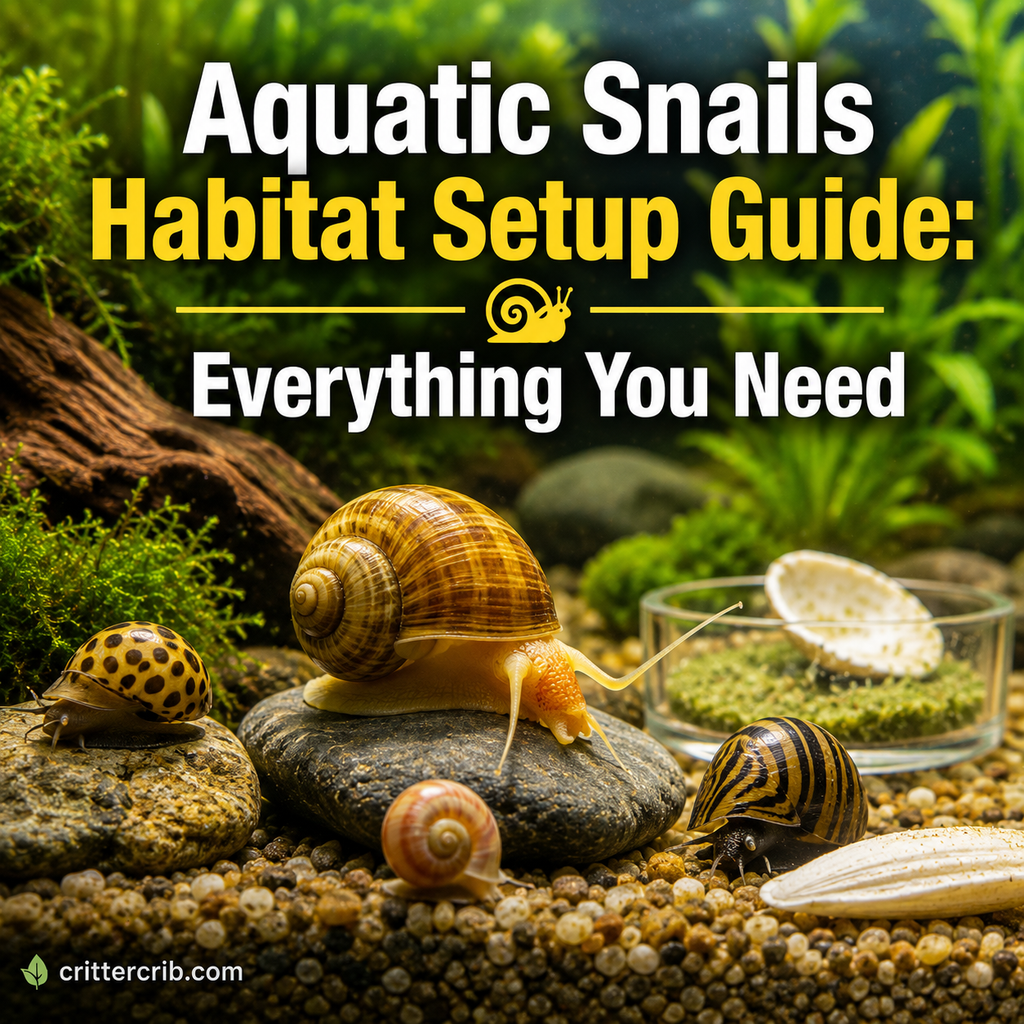
Aquatic snails are some of the most useful—and surprisingly interesting—animals you can add to a freshwater aquarium.
They crawl across the glass, explore plants and driftwood, graze on algae and biofilm, and spend hours searching the tank for food. Some species are colorful enough to become centerpiece animals in their own right.
They’re also commonly misunderstood.
It’s easy to assume an aquatic snail can simply be dropped into any fish tank and left to survive on algae. In reality, snails need stable water conditions, appropriate food, minerals for shell development, safe tank mates, and a habitat suited to their particular species.
The good news is that setting up a healthy aquatic snail habitat isn’t especially complicated.
Once you understand the basics, many popular freshwater snails are relatively straightforward to care for.
Here’s everything you need to set up an aquarium where aquatic snails can thrive.
What Do Aquatic Snails Need in Their Habitat?
A good freshwater snail habitat should provide more than just water and algae.
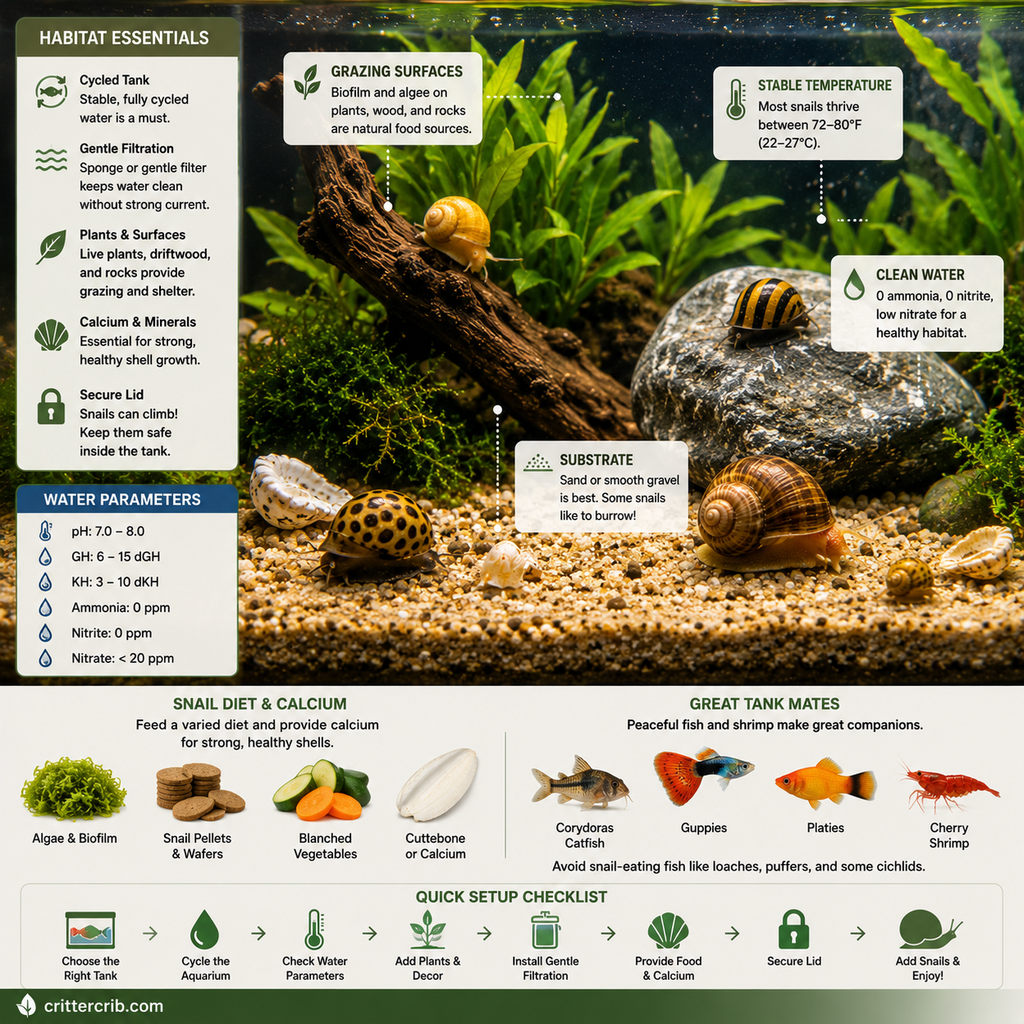
Most commonly kept aquarium snails need:
- A properly cycled freshwater aquarium
- Stable water parameters
- Appropriate temperature
- Adequate mineral content
- A calcium source when necessary
- Gentle to moderate filtration
- Safe substrate and decorations
- Plants or other grazing surfaces
- A balanced diet
- Compatible tank mates
- Protection from escape
- Regular aquarium maintenance
The exact requirements vary by species.
A mystery snail doesn’t necessarily have identical needs to a nerite, rabbit snail, or ramshorn snail.
Before setting up the aquarium, identify which type of snail you plan to keep.
Popular Types of Freshwater Aquarium Snails
Several snail species and groups are commonly found in freshwater aquariums.
Mystery Snails
Mystery snails are popular because of their relatively large size, peaceful nature, and variety of shell colors.
They can be surprisingly active and entertaining to watch.
Unlike some small hitchhiker snails, mystery snails need intentional feeding and shouldn’t be expected to live entirely on leftover fish food and algae.
They also breathe atmospheric air using a siphon, so they need access to the water’s surface.
Nerite Snails
Nerite snails are well known for grazing on algae.
They’re available in several attractive patterns and varieties and generally remain relatively small.
One advantage for freshwater aquarium keepers is that although nerites may lay eggs in freshwater, the young generally require brackish or marine conditions to successfully develop. That means they typically won’t establish exploding populations in a normal freshwater aquarium.
The small white eggs can still appear on rocks, wood, glass, and decorations.
Ramshorn Snails
Ramshorn snails have distinctive coiled shells and are common in planted aquariums.
They may arrive accidentally on plants.
Their populations can increase rapidly when large amounts of food are available.
This isn’t necessarily because the snails are inherently a problem. A sudden population increase often indicates that plenty of uneaten food or organic material is available.
Malaysian Trumpet Snails
Malaysian trumpet snails spend considerable time burrowing through substrate.
They can help stir the upper layers of sand and consume leftover organic material.
Like ramshorns, their population can increase substantially when food is abundant.
Rabbit Snails
Rabbit snails are larger, distinctive freshwater snails with elongated shells.
They generally prefer warmer conditions than some other commonly kept aquarium snails and require enough space to move and forage.
Because they’re relatively large, their waste production and food requirements should be considered when planning the aquarium.
What Size Tank Do Aquatic Snails Need?
There’s no single minimum aquarium size that works for every aquatic snail.
The appropriate size depends on:
- Snail species
- Adult size
- Number of snails
- Other aquarium inhabitants
- Filtration
- Feeding
- Available grazing area
A small group of tiny ramshorn snails has very different space requirements from several adult mystery or rabbit snails.
For larger snails such as mystery snails, 10 gallons or more provides a much more practical starting point than a tiny bowl or jar.
Larger aquariums offer several advantages.
They provide:
- More stable water conditions
- Greater grazing area
- More room for exploration
- Better dilution of waste
- More flexibility with plants and decorations
- Greater stocking options
Remember that snails contribute to the aquarium’s biological load.
They’re sometimes marketed as aquarium cleaners, but they still eat, digest food, and produce waste.
Adding snails doesn’t reduce the number of animals your filtration system needs to support.
Do Aquatic Snails Need a Cycled Tank?
Yes.
Aquatic snails should be kept in a properly established aquarium with functioning biological filtration.
During the aquarium nitrogen cycle, beneficial bacteria develop that process toxic nitrogen waste.
In simplified terms:
- Waste contributes to ammonia.
- Beneficial bacteria convert ammonia into nitrite.
- Other bacteria convert nitrite into nitrate.
- Nitrate is managed through water changes, plant growth, and aquarium maintenance.
For an established snail aquarium:
- Ammonia should be 0 ppm.
- Nitrite should be 0 ppm.
- Nitrate should be kept under control.
Snails can be harmed by poor water quality just like fish and shrimp.
Don’t use them as disposable animals to “cycle” a new aquarium.
A fishless cycle is a safer approach.
What Water Parameters Do Aquatic Snails Need?
There isn’t one perfect set of parameters for every freshwater snail species.
However, many popular aquarium snails benefit from water that contains enough dissolved minerals to support healthy shell development.
In general, you’ll want to monitor:
- Temperature
- pH
- GH (general hardness)
- KH (carbonate hardness)
- Ammonia
- Nitrite
- Nitrate
Many freshwater aquarium snails do better in neutral to moderately alkaline water than in very soft, acidic water.
Why?
Their shells contain calcium carbonate.
Persistently acidic or mineral-poor conditions can contribute to shell erosion and make maintaining healthy shell growth more difficult.
Always research the requirements of your specific snail rather than trying to force every species into one universal parameter range.
What pH Is Best for Aquarium Snails?
Many commonly kept freshwater snails do well with a pH around neutral or somewhat above neutral.
A range of approximately 7.0–8.0 works for many popular species, though individual requirements vary.
More important than chasing a specific number is avoiding inappropriate extremes and sudden changes.
If your water is naturally very soft and acidic, you may need to pay additional attention to mineral availability and shell condition.
Don’t continually add chemicals to raise and lower pH without understanding why the pH is behaving the way it is.
Stable, appropriate water is generally preferable to constant adjustment.
Why Calcium Matters for Aquatic Snails
A snail’s shell isn’t just decoration.
It’s part of the animal’s body and provides protection throughout its life.
Calcium and other minerals are essential for building and maintaining that shell.
A snail with appropriate mineral availability should produce healthy new shell growth.
Possible signs that something needs attention include:
- Pitting
- Excessive shell erosion
- Cracks
- Thin-looking new growth
- Significant deterioration around older shell areas
Some shell damage can’t simply be reversed because the old shell doesn’t regenerate in the same way living tissue does.
The goal is to provide conditions that support healthy new growth and prevent additional deterioration.
How to Provide Calcium for Aquarium Snails
Depending on your water chemistry and snail species, calcium can come from several sources.
Options may include:
- Mineral-rich snail foods
- Calcium-containing vegetables and supplemental foods
- Cuttlebone prepared for aquarium use
- Crushed coral
- Mineral blocks designed for aquarium invertebrates
- Naturally mineral-rich water
Don’t automatically add large amounts of calcium products.
Test your water first.
If GH, KH, and pH are already appropriate, excessive supplementation may be unnecessary and could alter your water chemistry.
The goal is balance, not simply adding as much calcium as possible.
What Temperature Do Aquatic Snails Need?
Temperature requirements depend on the species.
Many commonly kept tropical freshwater snails are comfortable somewhere around 72–80°F (22–27°C).
Mystery and nerite snails commonly fit within typical tropical freshwater aquarium temperatures, while some rabbit snails prefer the warmer end of the spectrum.
Rather than choosing one temperature for “aquatic snails,” research your species and any tank mates.
Temperature also affects metabolism.
In warmer water, snails may:
- Move more quickly
- Eat more
- Grow faster
- Have a faster metabolism
Very warm water can also contain less dissolved oxygen.
A stable temperature appropriate for the species is better than keeping the aquarium unnecessarily hot.
Do Aquatic Snails Need a Heater?
That depends on the snail and your home.
If the room naturally keeps the aquarium within the species’ appropriate temperature range, a heater may not run very often.
However, room temperatures can change significantly between day and night or between seasons.
A thermostatically controlled aquarium heater provides stability.
Consider using one if:
- Your home becomes cool at night.
- Winter temperatures lower the aquarium temperature.
- You use strong air conditioning.
- You’re keeping a warm-water snail species.
- The aquarium temperature fluctuates noticeably.
Use a separate aquarium thermometer to verify the actual water temperature.
Don’t rely entirely on the heater’s settings.
Do Aquatic Snails Need a Filter?
Yes, filtration is strongly recommended for most aquatic snail habitats.
Snails produce waste, and larger species can produce a surprising amount of it.
A filter provides:
- Biological filtration
- Mechanical filtration
- Water circulation
- Surface movement
- Additional surfaces for beneficial bacteria
Suitable options include:
- Sponge filters
- Hang-on-back filters
- Internal filters
- Canister filters
The best choice depends on aquarium size and stocking.
A gentle sponge filter may be sufficient for a small snail-focused aquarium, while a larger community tank may require considerably more filtration.
Make Filter Intakes Snail-Safe
Small snails can sometimes crawl onto or into filter intakes.
Baby snails are particularly vulnerable.
A pre-filter sponge placed over the intake can provide additional protection.
It also creates a bonus grazing surface.
Biofilm and tiny food particles collect on sponge surfaces, and many snails will happily spend time grazing there.
Inspect filters periodically because curious snails can reach surprising places.
What Substrate Is Best for Aquatic Snails?
Aquatic snails can live with several types of aquarium substrate.
Common options include:
- Sand
- Fine gravel
- Smooth aquarium gravel
- Planted aquarium substrates
Avoid extremely sharp materials that could damage soft body tissue.
For burrowing species such as Malaysian trumpet snails, sand or fine substrate allows natural digging behavior.
Larger snails such as mystery snails will spend plenty of time crawling across the bottom, so smooth surfaces are a sensible choice.
Substrate also collects biofilm and tiny bits of food, creating additional foraging opportunities.
Do Aquatic Snails Need Plants?
Live plants aren’t absolutely required for every snail aquarium, but they’re highly beneficial.
Plants provide:
- Grazing surfaces
- Biofilm
- Shelter
- Shade
- Natural structure
- Additional nutrient uptake
- A more interesting environment
Snails frequently spend hours exploring leaves and stems.
Good freshwater aquarium plants can include:
- Java fern
- Anubias
- Java moss
- Cryptocoryne
- Vallisneria
- Water sprite
- Floating plants
Plant compatibility depends partly on the snail species.
Many aquarium snails primarily graze algae, biofilm, dying plant matter, and leftover food rather than destroying healthy plants.
However, some larger or hungrier snails may nibble plants, particularly when insufficient food is available.
Add Driftwood, Rocks, and Other Grazing Surfaces
A snail habitat benefits from structure.
Aquarium-safe driftwood and rocks create additional surfaces where algae and biofilm can develop.
You can also use:
- Smooth caves
- Terracotta aquarium decorations
- Natural stone
- Aquarium-safe wood
- Ceramic shelters
Avoid decorations with extremely sharp edges or tiny openings where a larger snail could become trapped.
Remember that snails explore vertically as well as horizontally.
They’ll crawl over almost anything they can reach.
Biofilm Is Valuable Snail Food
A perfectly spotless aquarium isn’t necessarily the ideal snail habitat.
Biofilm is a thin layer of microorganisms and organic material that naturally develops on submerged surfaces.
To us, it may look like a slightly slimy coating.
To a snail, it’s lunch.
Biofilm develops on:
- Driftwood
- Rocks
- Plants
- Glass
- Filter surfaces
- Decorations
This is one reason mature aquariums are generally better for snails than brand-new sterile setups.
You should still maintain the aquarium.
Just don’t feel obligated to scrub every surface perfectly clean.
What Do Aquatic Snails Eat?
One of the biggest misconceptions about aquarium snails is that they can survive entirely on algae.
Some species are excellent algae grazers, but that doesn’t mean algae provides a complete diet in every aquarium.
Depending on the species, foods can include:
- Algae
- Biofilm
- Sinking snail or invertebrate foods
- Algae wafers
- Appropriate sinking fish foods
- Blanched vegetables
- Decaying plant material
- Other suitable supplemental foods
Larger snails generally need intentional feeding.
Vegetables for Aquarium Snails
Depending on the species, suitable supplemental vegetables may include small portions of:
- Zucchini
- Green beans
- Spinach
- Kale
- Carrot
- Cucumber
Blanching tougher vegetables can make them easier for snails to eat and help them sink.
Remove uneaten vegetables before they begin decomposing heavily and affecting water quality.
Don’t Rely on Leftovers
Calling snails a “cleanup crew” can create the wrong impression.
They’re living animals with nutritional requirements.
Yes, many snails consume leftover food.
Yes, they may eat algae.
Yes, some consume dying plant material.
But they still need enough appropriate food to maintain their bodies and shells.
If your aquarium is extremely clean and algae-free, supplemental feeding becomes even more important.
Don’t Overfeed Either
The opposite mistake is feeding far too much.
Uneaten food decomposes and can contribute to poor water quality.
It can also cause populations of reproducing snails such as ramshorns and Malaysian trumpet snails to increase dramatically.
Feed according to how quickly the food is consumed.
If large amounts remain untouched, you’re probably providing too much.
Remove decomposing leftovers when necessary.
Aquatic Snails Need Access to Oxygen
Most aquarium snails obtain oxygen from the water, air, or a combination depending on their anatomy and species.
Mystery snails, for example, can breathe atmospheric air using a siphon.
They regularly travel to the water’s surface to breathe.
That’s normal.
Good filtration and surface agitation help maintain oxygen exchange throughout the aquarium.
Avoid completely sealing the tank in a way that eliminates appropriate access to air for species that require it.
Why Your Snail Tank Needs a Lid
Aquatic snails are surprisingly good escape artists.
Mystery snails and nerites are especially capable of crawling above the waterline.
A secure aquarium lid helps prevent them from leaving the tank.
Check for:
- Large gaps around filters
- Open feeding holes
- Spaces around cables
- Loose lids
- Open corners
You still need appropriate ventilation.
The goal is a secure aquarium, not an airtight container.
Leave Space Above the Water for Mystery Snails
Mystery snails lay their egg clutches above the waterline.
If you’re keeping them, leaving some appropriate space between the water surface and lid allows this natural behavior.
A completely filled aquarium may prevent females from finding a suitable egg-laying area and increase the risk of escape while they’re searching.
Can Aquatic Snails Live With Fish?
Many can.
Peaceful community fish often coexist with appropriately sized aquarium snails.
However, not every fish is snail-safe.
Some fish may:
- Bite snail antennae
- Harass them
- Attempt to eat small snails
- Crack or attack shells
Known snail-eating fish should obviously be avoided if your goal is keeping snails as pets.
Research every species before combining them.
Even a fish that can’t eat an adult mystery snail may repeatedly nip at its exposed body.
Can Aquatic Snails Live With Shrimp?
Freshwater shrimp and snails are often excellent tank mates when their water requirements overlap.
Both can benefit from:
- Mature aquariums
- Biofilm
- Live plants
- Stable water
- Gentle filtration
- Natural grazing surfaces
They may gather around the same foods without causing serious problems.
The biggest consideration is water chemistry.
Choose shrimp and snail species whose hardness, pH, and temperature requirements are compatible.
Can You Keep Different Snail Species Together?
Often, yes.
Different peaceful freshwater snail species can sometimes share an aquarium when their environmental requirements overlap.
But don’t mix species simply because they’re all snails.
Compare:
- Temperature
- pH
- Hardness
- Adult size
- Diet
- Reproduction
- Space requirements
Also consider how much food is available.
Several large snails in a small aquarium can create considerable competition and waste.
How to Set Up an Aquatic Snail Habitat Step by Step
Once you’ve chosen the snail species, you can build the aquarium around its needs.
1. Choose an Appropriate Aquarium
Select a tank large enough for the adult snail population and any other animals you plan to keep.
When uncertain, more water volume usually makes maintaining stable conditions easier.
2. Add Substrate
Rinse aquarium sand or gravel if the manufacturer recommends it.
Add enough to create a natural-looking bottom and support any plants you’re using.
3. Add Decorations and Plants
Arrange driftwood, rocks, hiding places, and live plants.
Leave open areas where larger snails can move easily.
4. Install the Filter
Choose filtration appropriate for the aquarium’s total biological load.
Add a pre-filter sponge when small snails or shrimp could reach the intake.
5. Install a Heater if Necessary
Set the heater for a temperature appropriate to your snail species and other inhabitants.
Add a separate thermometer.
6. Fill the Aquarium
Use appropriately conditioned freshwater.
If you’re using tap water, treat chlorine or chloramine with a suitable aquarium water conditioner.
7. Cycle the Aquarium
Establish the nitrogen cycle before adding snails.
Use a freshwater test kit to confirm:
- 0 ppm ammonia
- 0 ppm nitrite
- Manageable nitrate
Don’t rely solely on how long the aquarium has been running.
Test the water.
8. Check Hardness and pH
Make sure the water chemistry is appropriate for the species and supports healthy shell development.
If adjustments are necessary, make them thoughtfully and gradually.
9. Add the Snails
Acclimate new snails appropriately to avoid sudden changes in temperature and water chemistry.
Don’t simply dump transport water into the aquarium.
10. Observe Them Closely
New snails may remain closed or inactive temporarily after transportation.
Give them time to adjust.
Monitor their activity, shell condition, feeding, and water parameters during the first several days.
How to Acclimate Aquatic Snails
Snails can be sensitive to sudden water-parameter changes.
When bringing a new snail home, gradual acclimation is generally a sensible approach.
Depending on the species and transport conditions, you can slowly introduce aquarium water to the snail’s transport container before moving it into the tank.
Keep the process reasonable.
There’s no benefit to leaving an animal in deteriorating transport water for an unnecessarily long period.
Once acclimated, transfer the snail without adding unnecessary store water to your aquarium.
How Often Should You Clean a Snail Tank?
There’s no universal schedule.
Maintenance depends on:
- Tank size
- Number of animals
- Feeding
- Filtration
- Plant growth
- Nitrate levels
For many freshwater aquariums, a weekly partial water change is a practical starting point.
During maintenance:
- Test water when appropriate.
- Remove a portion of the aquarium water.
- Vacuum excessive debris from accessible substrate.
- Clean the glass if needed.
- Inspect the filter.
- Add conditioned replacement water at a similar temperature.
- Check the snails and their shells.
Don’t sterilize the aquarium.
Beneficial bacteria and biofilm are important parts of a healthy aquatic ecosystem.
Common Aquatic Snail Habitat Mistakes
Many snail-care problems come from a handful of avoidable mistakes.
Keeping Snails in Tiny Containers
A jar may technically hold water, but that doesn’t make it a good long-term habitat.
More water volume provides greater stability and dilution of waste.
Adding Snails to an Uncycled Aquarium
Snails can be harmed by ammonia and nitrite.
Establish biological filtration first.
Ignoring Water Hardness
Shell health is closely connected to water chemistry and mineral availability.
Very soft or acidic conditions may contribute to shell deterioration in many species.
Assuming Algae Is Enough Food
Some tanks don’t produce enough algae to support their snail population.
Provide an appropriate diet.
Overfeeding
Too much food can damage water quality and fuel rapid reproduction in certain species.
Using Snail-Killing Treatments
Some aquarium medications and pest-control products are dangerous to snails.
Always check whether a product is safe for aquatic invertebrates before adding it to the tank.
Leaving the Aquarium Uncovered
Snails can climb.
A secure lid can prevent an unfortunate journey across your floor.
Adding Incompatible Tank Mates
Fish that nip, crush, or eat snails can turn an otherwise excellent habitat into a stressful environment.
Signs Your Aquatic Snail Is Comfortable
Healthy behavior varies by species, but positive signs often include:
- Regular movement around the aquarium
- Grazing on surfaces
- Interest in appropriate foods
- Normal body extension
- Exploring plants and decorations
- Healthy new shell growth
- Normal resting periods
- Returning to activity after resting
Don’t panic if your snail occasionally remains motionless for a long time.
Snails rest, and some can remain inactive for surprisingly long periods.
Look for patterns rather than judging health based on a single afternoon.
Signs Something May Be Wrong
Potential warning signs include:
- Persistent inactivity combined with other symptoms
- Significant shell erosion
- Cracked or deteriorating shell
- Repeated attempts to escape
- Failure to respond for an unusually long period
- Falling repeatedly without recovering
- Abnormal body appearance
- Sudden deaths among multiple snails
If several animals begin behaving strangely at once, test the water immediately.
Check ammonia, nitrite, nitrate, temperature, pH, and other parameters relevant to your species.
Also review anything recently added to the aquarium, including medications, fertilizers, decorations, plants, and tap water.
How to Tell if an Aquatic Snail Is Dead
This can be surprisingly difficult.
A resting snail may remain completely still and withdrawn into its shell.
Don’t assume it’s dead simply because it hasn’t moved for several hours.
Signs that may indicate a snail has died include:
- The body hanging limply from the shell
- No response over an extended period
- Significant decomposition
- A strong unpleasant odor
If you’re uncertain, carefully remove the snail into a separate container of aquarium water for closer observation.
A dead snail should be removed promptly because decomposition can affect water quality.
Aquatic Snail Habitat Setup Checklist
Before bringing home your snail, make sure you have the essentials.
Aquarium
- Appropriately sized tank
- Secure lid
- Enough surface area for grazing
- Appropriate space above the water when required by the species
Equipment
- Filter
- Snail-safe filter intake
- Thermometer
- Heater if necessary
- Aquarium light if keeping plants
- Freshwater test kit
Water Care
- Water conditioner
- Stable temperature
- Appropriate pH
- Suitable GH and KH
- 0 ppm ammonia
- 0 ppm nitrite
- Controlled nitrate
Habitat
- Smooth substrate
- Live plants
- Driftwood or rocks
- Grazing surfaces
- Safe hiding areas
Food and Shell Health
- Appropriate snail food
- Supplemental foods as needed
- Adequate minerals
- Calcium source if your water and species require one
With those basics in place, you’ll have a much better foundation than simply dropping a snail into an existing aquarium and hoping there’s enough algae.
Frequently Asked Questions About Aquatic Snail Habitats
Do Aquatic Snails Need a Filter?
A filter is strongly recommended.
It supports beneficial bacteria, processes waste, circulates water, and helps maintain a stable aquarium environment.
Do Aquatic Snails Need a Heater?
Some do, depending on species and room temperature.
Many popular aquarium snails prefer tropical or warm freshwater conditions, so a heater can help maintain a stable temperature when the room is too cool.
Do Aquarium Snails Need a Lid?
A lid is highly recommended for species that may climb above the waterline.
Snails can fit through surprisingly small openings, so check around filters, cables, and feeding holes.
Do Aquatic Snails Need Light?
Snails don’t generally require specialized lighting themselves.
However, a regular day-and-night cycle is appropriate, and aquarium lighting supports live plants and algae growth.
Don’t leave aquarium lights on continuously.
Can Aquatic Snails Live Without Plants?
Yes, many species can live without live plants if their other needs are met.
However, plants provide excellent grazing surfaces, cover, and a more natural environment.
Do Aquarium Snails Need Calcium?
Aquatic snails need calcium and other minerals to maintain their shells.
Whether you need to add a dedicated calcium source depends on your water chemistry, diet, and snail species.
Why Is My Snail’s Shell Turning White?
Whitish or eroded areas can sometimes be associated with shell wear, mineral deficiencies, or water that’s too acidic for the species.
Test your pH, GH, and KH and examine whether healthy new shell growth is developing.
Why Does My Snail Keep Leaving the Water?
Some aquatic snails naturally explore above the waterline.
Mystery snails also leave the water to lay eggs.
However, repeated escape attempts can sometimes indicate unsuitable water conditions, so test the aquarium if the behavior suddenly increases.
Can Aquarium Snails Live on Algae Alone?
It’s best not to assume they can.
The amount and nutritional value of algae varies greatly between aquariums. Many snails need supplemental food to maintain healthy growth and shell development.
Final Thoughts
A good aquatic snail habitat isn’t difficult to create, but it should be planned around the animal rather than treating the snail as aquarium-cleaning equipment.
Start with a properly cycled tank.
Provide stable water, appropriate temperature, adequate minerals, filtration, a safe substrate, plants or other grazing surfaces, and enough food for the species you’re keeping. Pay particular attention to shell health, since deteriorating shells can be an early clue that water chemistry or nutrition needs improvement.
And don’t forget the lid.
For an animal that moves at a snail’s pace, an aquatic snail can travel surprisingly far when you’re not looking.
Once the basics are covered, freshwater snails can be rewarding aquarium residents. Give them a mature, stable environment and you’ll get to watch them do what they do best—exploring every corner of the tank, grazing across surfaces, and turning even the smallest patch of biofilm into an all-you-can-eat buffet.