
Pet mice are tiny, but they can be remarkably busy.
Give a mouse a cardboard tube, a pile of nesting material, and somewhere interesting to climb, and you’ll quickly see just how much exploring can fit into such a small animal. Mice naturally spend their time searching for food, digging, climbing, chewing, building nests, and investigating changes in their environment.
That’s why enrichment is such an important part of mouse care.
Good enrichment isn’t about filling a cage with expensive toys. It’s about creating safe opportunities for mice to use their natural behaviors and make choices throughout the day.
From simple cardboard boxes to foraging games and climbing structures, here are some of the best enrichment ideas for keeping pet mice happy, active, and curious.
Why Do Pet Mice Need Enrichment?
A food bowl, water bottle, and hiding place cover some basic needs, but they don’t provide much mental stimulation on their own.
Mice are naturally active and inquisitive animals.
An enriching environment gives them opportunities to:
- Explore
- Forage
- Dig
- Burrow
- Climb
- Chew
- Shred
- Build nests
- Exercise
- Solve simple problems
- Interact socially when appropriately housed
Enrichment also makes the enclosure more interesting from the mouse’s perspective.
Instead of eating from the same bowl and following the same route every day, mice can investigate new smells, objects, pathways, and hiding places.
Start With a Spacious, Interesting Habitat
Before buying toys, look at the enclosure itself.
A cramped cage can’t become a great environment simply because it contains several accessories.
Your mice need enough usable space for normal movement as well as room for:
- Bedding
- Hides
- A suitable exercise wheel
- Food and water
- Climbing opportunities
- Nesting areas
- Foraging
- Toys
Think of the entire enclosure as an enrichment opportunity rather than treating enrichment as something you add afterward.
A well-designed habitat encourages activity naturally.
1. Provide Deep Bedding for Digging
Digging is one of the simplest enrichment activities you can offer.
Rather than covering the bottom of the enclosure with only a thin layer of bedding, provide enough appropriate substrate for mice to dig and create tunnels where your setup allows.
Choose bedding that is:
- Safe for mice
- Low in dust
- Absorbent
- Unscented
- Comfortable for burrowing
You may find that your carefully arranged enclosure looks completely different the next morning.
That’s fine.
The mice are using it.
Add Structure to Burrowing Areas
You can make deep bedding more interesting by partially burying safe objects such as:
- Cardboard tubes
- Small cardboard boxes
- Appropriate tunnels
- Mouse-safe hides
These create starting points for underground pathways and chambers.
Mice may incorporate them into surprisingly elaborate burrow systems.
2. Scatter Feed Instead of Always Using a Bowl
Wild mice don’t find a ceramic bowl conveniently filled with dinner every evening.
They search for food.
You can encourage that behavior by scatter feeding part of your mice’s normal daily food throughout clean bedding.
Start by placing food where it’s relatively easy to find.
Once your mice understand the idea, hide small portions in different areas.
Scatter feeding encourages:
- Movement
- Sniffing
- Digging
- Exploration
- Natural food-searching behavior
Remember to account for scattered food when determining how much you’re feeding.
The goal is to make mealtime more interesting, not accidentally double everyone’s portions.
3. Make a Foraging Box
A simple cardboard box can become a miniature foraging area.
Fill it loosely with suitable materials such as:
- Bedding
- Shredded plain paper
- Hay used as enrichment
- Crumpled paper
Then scatter a portion of your mice’s regular food inside.
They’ll need to sniff, dig, and move material around to find it.
Make sure cardboard is plain and free from staples, tape, plastic coatings, and other unsafe materials.
4. Use Cardboard Tubes
Few enrichment items offer a better value than the humble cardboard tube.
Mice can:
- Run through it
- Hide inside it
- Chew it
- Shred it
- Bury it
- Fill it with bedding
- Incorporate it into a nest
You can also turn a tube into a simple food puzzle.
Place a small amount of regular food inside and loosely fold the ends. Your mice then have to chew or manipulate the cardboard to reach it.
Don’t make the puzzle excessively difficult.
Enrichment should encourage investigation, not frustration.
5. Provide Safe Chewing Materials
Chewing is normal rodent behavior.
Rather than trying to prevent it, provide appropriate things to chew.
Depending on the material and your mice’s needs, options may include:
- Plain cardboard
- Mouse-safe wooden toys
- Suitable untreated wood
- Safe branches
- Commercial rodent chews
Always verify that natural wood or branches are from a species considered safe for mice and haven’t been exposed to pesticides or other chemicals.
Inspect chew items regularly and replace anything that becomes unsafe.
6. Give Mice Plenty of Nesting Material
Nest building is both practical and enriching.
Give your mice suitable materials they can gather, carry, shred, and arrange themselves.
Appropriate options may include:
- Unscented paper-based nesting material
- Torn or shredded plain paper
- Suitable soft paper products designed for small pets
Avoid nesting materials made from long, stringy fibers that could potentially wrap around limbs or cause other problems.
Then let the mice handle the interior decorating.
They may move everything to a completely different part of the enclosure than you intended.
That’s part of the enrichment.
7. Add Tunnels
Mice naturally like moving through covered spaces.
Tunnels can make an enclosure feel much more complex without requiring a huge amount of additional room.
Try using:
- Cardboard tubes
- Commercial mouse-safe tunnels
- Appropriate wooden tunnels
- Cork tunnels
Place some above the bedding and partially bury others.
Connecting hides with tunnels can create multiple pathways through the enclosure.
Occasionally rearrange them to make the environment feel different.
8. Create a Cardboard Maze
Save a few small cardboard boxes and you have the beginnings of a mouse maze.
Cut mouse-sized openings and connect several boxes together.
You can make:
- Multiple entrances
- Dead ends
- Hidden food areas
- Small chambers
- Connected tunnels
Keep the structure secure and make sure there aren’t tight spaces where a mouse could become trapped.
A maze doesn’t have to remain permanently in the enclosure. It can also be used as a supervised enrichment activity in a secure play area.
9. Add Safe Climbing Opportunities
Mice are surprisingly capable climbers.
A flat enclosure wastes an entire dimension of usable space.
Depending on your setup, climbing enrichment might include:
- Ropes designed and positioned safely
- Wooden branches
- Ladders
- Platforms
- Bridges
- Hanging toys
- Cage bars where appropriate
- Cork structures
Create different routes between areas rather than one difficult climbing challenge.
Keep Fall Risk in Mind
More climbing isn’t automatically better.
Avoid creating high, exposed drops onto hard objects.
Position hammocks, platforms, bedding, or other suitable features so a missed step is less likely to result in a serious fall.
Older mice or animals with mobility problems may need easier routes.
10. Choose an Appropriate Exercise Wheel
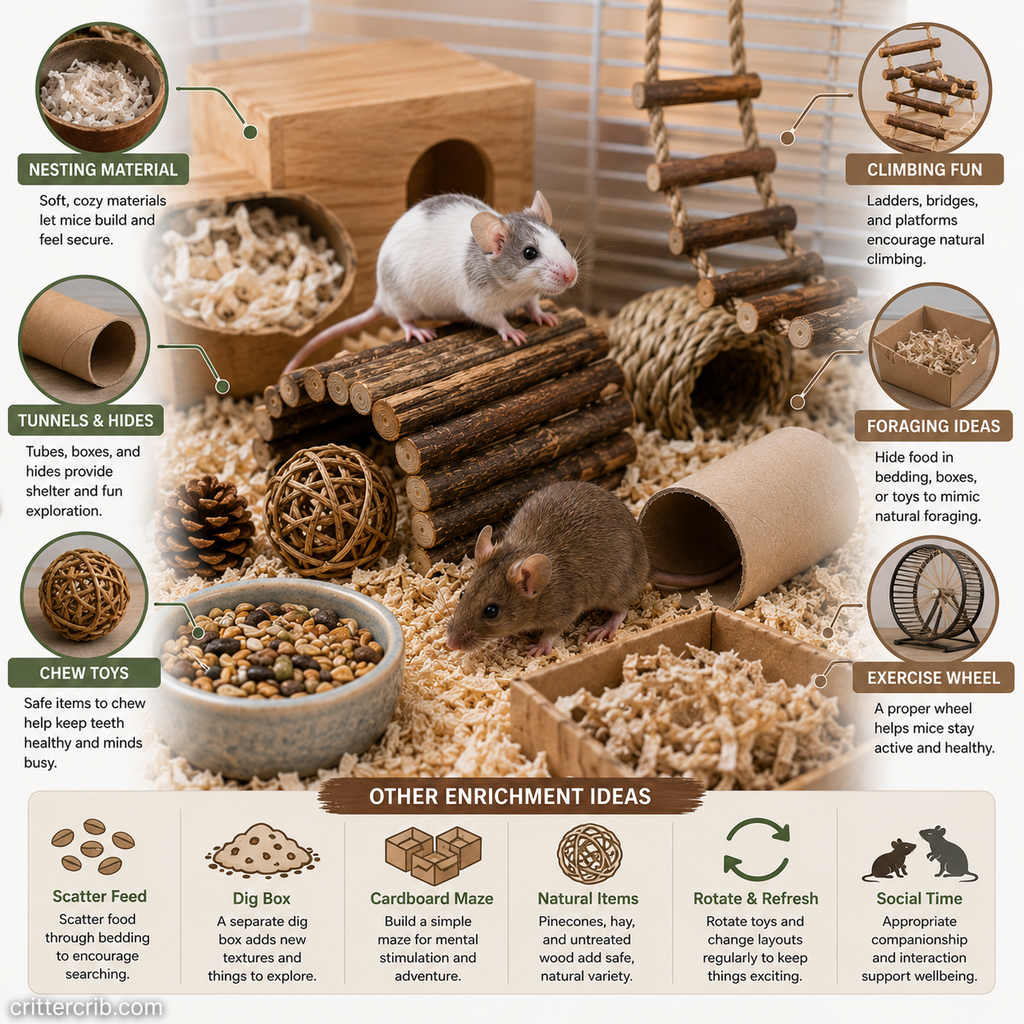
A wheel can provide valuable exercise, particularly during the hours when your mice are most active.
Choose a wheel that is large enough for a mouse to run comfortably without significantly curving its back or tail upward.
The running surface should be solid.
Avoid open wire or mesh running surfaces where feet or limbs could potentially become caught.
Regularly inspect the wheel for:
- Damage
- Sharp edges
- Excessive chewing
- Stability
- Cleanliness
Some mice become dedicated runners.
Others use the wheel less frequently.
That’s why a wheel should be one part of an enriching environment rather than the only exercise opportunity.
11. Add Hammocks and Hanging Hides
Some mice enjoy elevated resting areas.
Hammocks and hanging hides can create additional sleeping spaces while making better use of vertical cage space.
Position them so mice can reach them safely.
Also consider what happens if a mouse falls.
A hammock placed beneath a climbing area can sometimes serve double duty as both a resting spot and a softer intermediate level.
Check fabric items frequently for loose threads and excessive chewing.
Remove anything that becomes hazardous.
12. Make Food Puzzles
Food is a powerful motivator.
You don’t need an elaborate commercial puzzle to make mice work a little for dinner.
Try:
- Folding food inside plain paper
- Hiding food in cardboard tubes
- Placing food beneath lightweight safe objects
- Scattering food through bedding
- Hiding food in several boxes
- Using suitable commercial puzzle feeders
Start easy.
If your mice solve the puzzle immediately, make the next one slightly more challenging.
The activity should reward curiosity.
13. Create a Digging Box
Even if your main enclosure has bedding, a separate digging area can provide a different texture or experience.
A digging box might contain an appropriate mouse-safe substrate specifically chosen for exploration.
Before introducing any new substrate, confirm that it’s safe for mice and isn’t excessively dusty.
Hide a small amount of regular food inside to encourage investigation.
A digging box can be especially useful during supervised playtime outside the main enclosure.
14. Introduce New Textures
Enrichment doesn’t always need to involve a toy.
Different safe textures can make an environment more interesting.
Depending on what is appropriate for mice, you might incorporate:
- Cardboard
- Paper
- Cork
- Wood
- Bedding
- Smooth ceramic surfaces
- Safe natural materials
The important word is safe.
Don’t collect random objects from outdoors and place them directly into an enclosure without knowing what they are or whether they could introduce pesticides, parasites, mold, or toxic materials.
15. Rearrange Part of the Enclosure
A familiar cage can become interesting again with a few changes.
You might:
- Move a tunnel
- Add a new cardboard box
- Change a climbing route
- Move a foraging area
- Add another hide
- Bury an existing tube somewhere new
You don’t need to completely redesign the habitat every week.
In fact, changing everything at once can remove familiar scent cues and nesting areas.
Instead, make smaller changes while keeping important resources easy to find.
16. Rotate Toys
Leaving every toy in the cage permanently can make them part of the background.
Try rotating enrichment items.
Keep a small collection and swap a few periodically.
For example:
- Week one: cardboard maze and climbing bridge
- Week two: foraging box and extra tunnels
- Week three: digging activity and hanging enrichment
- Week four: bring back the maze in a different configuration
An old toy can become interesting again after your mice haven’t seen it for a while.
Rotation also helps prevent the enclosure from becoming overcrowded.
17. Create Multiple Hiding Places
Hides aren’t just sleeping areas.
They give mice control over how exposed they feel and create more pathways to investigate.
Provide several options when space allows.
These might include:
- Wooden houses
- Cardboard boxes
- Cork tunnels
- Ceramic hides
- Buried shelters
Multiple entrances can make some hides especially useful in group housing because one mouse is less likely to block the only exit.
Hiding places can also become part of the mice’s tunnel and nesting systems.
18. Offer Supervised Exploration Outside the Cage
A secure play area can provide a completely different enrichment experience.
Set up a mouse-safe space with:
- Cardboard boxes
- Tunnels
- Hides
- Climbing objects
- Foraging activities
- Familiar bedding or nesting material
Supervise closely.
Mice are tiny, fast, and capable of disappearing into gaps that didn’t look remotely large enough five seconds earlier.
Before playtime, remove access to:
- Electrical cords
- Other pets
- Toxic plants
- Unsafe foods
- Furniture gaps
- Doors
- Vents
- Small objects that could be swallowed
A bathtub or improvised container isn’t automatically safe simply because the walls appear difficult to climb. Evaluate the entire setup carefully.
19. Try Simple Training
Mice can learn.
Short training sessions provide mental stimulation and can also make handling easier.
Using positive reinforcement, mice may learn to:
- Approach your hand
- Come toward a cue
- Step onto a platform
- Touch a target
- Enter a carrier
- Navigate a simple obstacle
Keep sessions short.
Use tiny portions of appropriate food as rewards and account for them as part of the mouse’s diet.
Never punish a mouse for getting something wrong.
If the mouse walks away, the training session is over.
20. Let Mice Shred Things
Sometimes enrichment is destruction.
Plain, safe paper and cardboard give mice something they can physically modify.
They may:
- Tear it
- Chew it
- Drag it
- Hide it
- Build with it
- Carry pieces into their nest
This kind of activity allows the animal to change its own environment rather than simply interacting with objects arranged by you.
That’s a valuable form of enrichment.
21. Encourage Natural Foraging
Scatter feeding is a good starting point, but you can expand the idea.
Place small portions of regular food:
- Under bedding
- Inside tubes
- Behind hides
- On different cage levels
- Inside paper parcels
- In a foraging box
Don’t make every piece of food difficult to access.
The goal is to add opportunities for natural searching behavior while ensuring your mice still receive enough nutrition.
22. Use Scent as Enrichment Carefully
Mice experience much of their world through smell.
Simply introducing a clean cardboard object or rearranging part of the habitat creates new scents to investigate.
You don’t need perfumes, essential oils, or scented bedding.
In fact, heavily scented products may be irritating and should generally be avoided.
Natural scent exploration happens automatically when you provide safe new materials and objects.
23. Provide Social Enrichment
For appropriately housed mice, interaction with compatible companions can be one of the most important forms of enrichment.
Social behavior can include:
- Grooming
- Sleeping together
- Playing
- Exploring together
- Communicating
- Nest building
However, mouse social housing requires some important distinctions.
Female mice are generally social and commonly kept in compatible groups.
Male mice can present more complicated housing considerations because unfamiliar adult males may fight, and appropriate arrangements depend on the individual animals and circumstances.
Never add an unfamiliar mouse directly to an established group without researching safe introductions.
If you’re uncertain about social housing, seek advice from an experienced mouse rescue or veterinarian.
24. Spend Time With Your Mice
Human interaction can also be enriching when the mouse is comfortable with it.
Instead of immediately reaching in and grabbing a mouse, let it approach your hand.
You can:
- Offer a small food reward
- Allow the mouse to sniff your fingers
- Let it climb onto your hand voluntarily
- Practice simple training
- Sit nearby during supervised exploration
Some mice become very comfortable interacting with people.
Others remain more cautious.
Respecting that difference helps keep interaction positive.
Don’t Overcrowd the Cage With Enrichment
There’s a point where “enriched” becomes “cluttered.”
Mice enjoy complex environments, but they still need room to move.
Avoid filling every available inch with accessories.
Instead, aim for a balance between:
- Open movement
- Deep bedding
- Hiding areas
- Climbing
- Foraging
- Nesting
- Exercise
Vertical space can help increase complexity without taking away all the floor area.
Watch Which Activities Your Mice Prefer
Not every mouse loves the same things.
One may spend half the night running on a wheel.
Another may devote that time to carrying tiny pieces of paper from one side of the cage to the other for reasons known only to the mouse.
Watch what your mice choose to do.
Signs an enrichment activity is being used include:
- Chewing
- Digging
- Climbing
- Nest building
- Searching for food
- Repeated exploration
- Moving objects
- Running
- Returning to the activity later
If something is consistently ignored, try something else.
Enrichment is more effective when it matches the animals’ preferences.
Mouse Enrichment Safety Tips
Anything placed in a mouse enclosure should be evaluated with the assumption that it will eventually be climbed, chewed, buried, or shredded.
Before introducing something new:
- Check that the material is non-toxic.
- Remove tape, staples, glue residue, and plastic pieces.
- Avoid excessively dusty materials.
- Check wood species before using natural branches.
- Avoid long loose fibers that could become tangled around limbs.
- Keep climbing areas reasonably safe.
- Check toys for sharp edges.
- Remove damaged accessories.
- Make sure tunnels and openings aren’t dangerously small.
- Supervise unfamiliar out-of-cage activities.
Inspect the enclosure regularly.
A toy that was perfectly safe when new can become unsafe after several nights of determined chewing.
How Often Should You Change Mouse Enrichment?
You don’t need to introduce something new every day.
Permanent enrichment can include:
- Deep bedding
- Hides
- Nesting material
- A wheel
- Climbing structures
- Chewing opportunities
Then rotate smaller activities periodically.
You might introduce a new foraging challenge one day, add a cardboard box a few days later, or rearrange a tunnel during routine maintenance.
Even inexpensive changes can create something new to investigate.
Cheap DIY Mouse Enrichment Ideas
Mouse enrichment doesn’t have to become another expensive pet-supply habit.
Some useful materials may already be in your recycling bin.
Simple ideas include:
- Plain cardboard tubes
- Small cardboard boxes
- Crumpled paper
- Shredded plain paper
- Homemade cardboard mazes
- Food hidden inside folded paper
- Cardboard tunnels
- Foraging boxes
Always remove tape, staples, labels, plastic windows, heavy coatings, and anything else that could be unsafe.
A $20 toy isn’t automatically more enriching than a cardboard box.
Your mice will make that decision.
A Simple Weekly Enrichment Routine
If you’re not sure where to start, keep it simple.
Try a routine like this:
Daily
- Provide appropriate food and fresh water.
- Check the enclosure for safety.
- Make sure chewing and nesting materials are available.
- Observe your mice.
A Few Times Per Week
- Scatter feed part of the normal diet.
- Add a cardboard tube or box.
- Provide a simple food puzzle.
- Offer supervised interaction or exploration.
Periodically
- Rotate toys.
- Rearrange part of the habitat.
- Replace damaged climbing structures.
- Create a new foraging activity.
- Change the layout of tunnels or boxes.
There’s no need to follow a rigid schedule.
Use your mice’s behavior as your guide.
Final Thoughts on Keeping Mice Happy and Active
The best mouse enrichment encourages mice to do what comes naturally.
Let them dig.
Give them cardboard to destroy. Provide tunnels to explore, nesting material to arrange, safe structures to climb, and opportunities to search for food.
A good enclosure doesn’t need to look perfectly organized from a human perspective. In fact, some of the best signs of enrichment are tunnels where you didn’t put them, shredded cardboard everywhere, and a nest that has somehow acquired half the bedding in the cage.
The goal isn’t constant entertainment.
It’s giving your mice choices and opportunities to interact with their environment throughout the day.
Combine a spacious habitat with deep bedding, social interaction where appropriate, exercise, climbing, chewing, nesting, and changing foraging opportunities, and you’ll create an environment that keeps both their bodies and curious little minds busy.