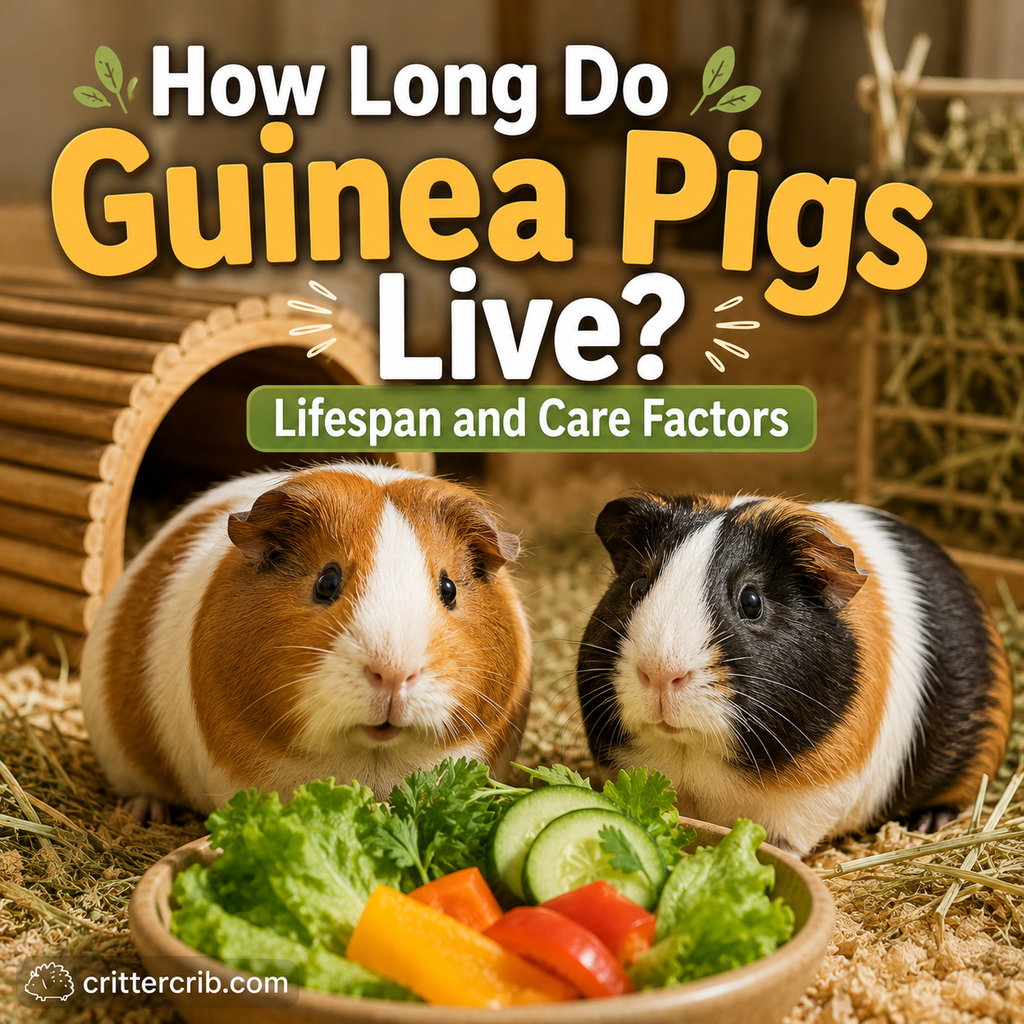
Guinea pigs may not bark, wag their tails, or climb into your lap like some pets, but they’re surprisingly expressive once you learn what to look for.
A guinea pig can tell you quite a bit through sounds, posture, movement, and everyday habits. The excited squeak you hear when opening the refrigerator can mean something completely different from teeth chattering. A guinea pig stretched comfortably across its bedding is sending a very different message from one frozen in place with wide eyes.
Understanding these behaviors makes guinea pig care easier and can help you build a stronger relationship with your pets. More importantly, knowing what’s normal makes it easier to notice when something changes.
This guide explains common guinea pig behaviors, what their different sounds and movements can mean, and when unusual behavior may deserve closer attention.
Understanding Guinea Pig Behavior
Guinea pigs are prey animals. That fact explains a lot about how they behave.
In the wild, being cautious around unfamiliar sights, sounds, and movements can be the difference between escaping a predator and becoming its next meal. Domestic guinea pigs still carry many of those instincts.
That’s why a perfectly healthy guinea pig might:
- Run when you approach
- Hide when startled
- Freeze after hearing an unfamiliar noise
- Prefer covered areas
- Become nervous when picked up
- React strongly to sudden movement
These behaviors don’t necessarily mean your guinea pig dislikes you.
They’re often instinctive responses.
At the same time, guinea pigs are social animals. Once comfortable, many become curious, vocal, playful, and surprisingly good at communicating what they want.
Especially when what they want is food.
Why Do Guinea Pigs Squeak?
Guinea pigs have a surprisingly large vocabulary.
You’ll hear squeaks, whistles, purr-like sounds, chirps, rumbles, and teeth chattering. Some sounds are subtle, while others are impossible to miss from the other side of the house.
Context is important when interpreting guinea pig sounds.
Wheeking
“Wheeking” is probably the sound guinea pig owners recognize most easily.
It’s a loud, high-pitched squeal or whistle commonly associated with excitement and anticipation.
You might hear wheeking when:
- You open the refrigerator
- A food bag rustles
- You approach at feeding time
- Vegetables are being prepared
- Your guinea pigs expect a treat
Guinea pigs can become remarkably good at connecting everyday household sounds with food.
You may eventually discover that opening a bag of salad is impossible to do quietly.
Soft Squeaking and Chutting
Not every guinea pig sound is loud.
Some make quiet squeaks, murmurs, or chutting sounds while exploring their enclosure. These softer vocalizations can accompany relaxed curiosity or social interaction.
Watch the rest of the guinea pig’s body language.
A relaxed animal casually investigating its surroundings is very different from one that appears tense, frightened, or uncomfortable.
What Does Guinea Pig Purring Mean?
A guinea pig’s purr isn’t exactly the same as a cat’s purr.
The meaning can change depending on the pitch, duration, and situation.
A relaxed guinea pig may produce a soft, low sound while being gently petted or resting comfortably.
However, similar vibrating sounds can also occur when a guinea pig is annoyed or reacting to something it doesn’t like.
Pay attention to what happens alongside the sound.
If your guinea pig appears loose and comfortable, that’s different from a guinea pig that becomes stiff, raises its head, moves away, or begins chattering its teeth.
Body language and sound should be interpreted together.
What Does Teeth Chattering Mean?
Teeth chattering is one sound you shouldn’t ignore.
A guinea pig rapidly clicking or chattering its teeth is often communicating irritation, defensiveness, or a warning.
It’s essentially saying:
“Give me some space.”
Teeth chattering may occur during:
- Disagreements between guinea pigs
- Introductions
- Territorial conflicts
- Unwanted handling
- Stressful situations
If two guinea pigs are facing one another while chattering their teeth, monitor the situation closely.
Not every disagreement turns into a fight, but escalating aggression can result in injuries.
Avoid putting your hands directly between fighting guinea pigs. Use a safe barrier or other appropriate method to separate them if necessary.
What Is Rumblestrutting?
Rumblestrutting is one of the more distinctive guinea pig behaviors.
A guinea pig may produce a low rumbling sound while slowly shifting its rear end from side to side.
It can look a little like a tiny dance.
Rumblestrutting is commonly associated with social communication, dominance, and courtship behavior.
You may see it when guinea pigs are:
- Establishing social relationships
- Showing dominance
- Courting another guinea pig
- Responding to hormonal changes
Rumblestrutting by itself isn’t necessarily a problem.
It becomes more concerning if interactions escalate into persistent bullying, fighting, biting, or preventing another guinea pig from accessing food and water.
Why Do Guinea Pigs Popcorn?
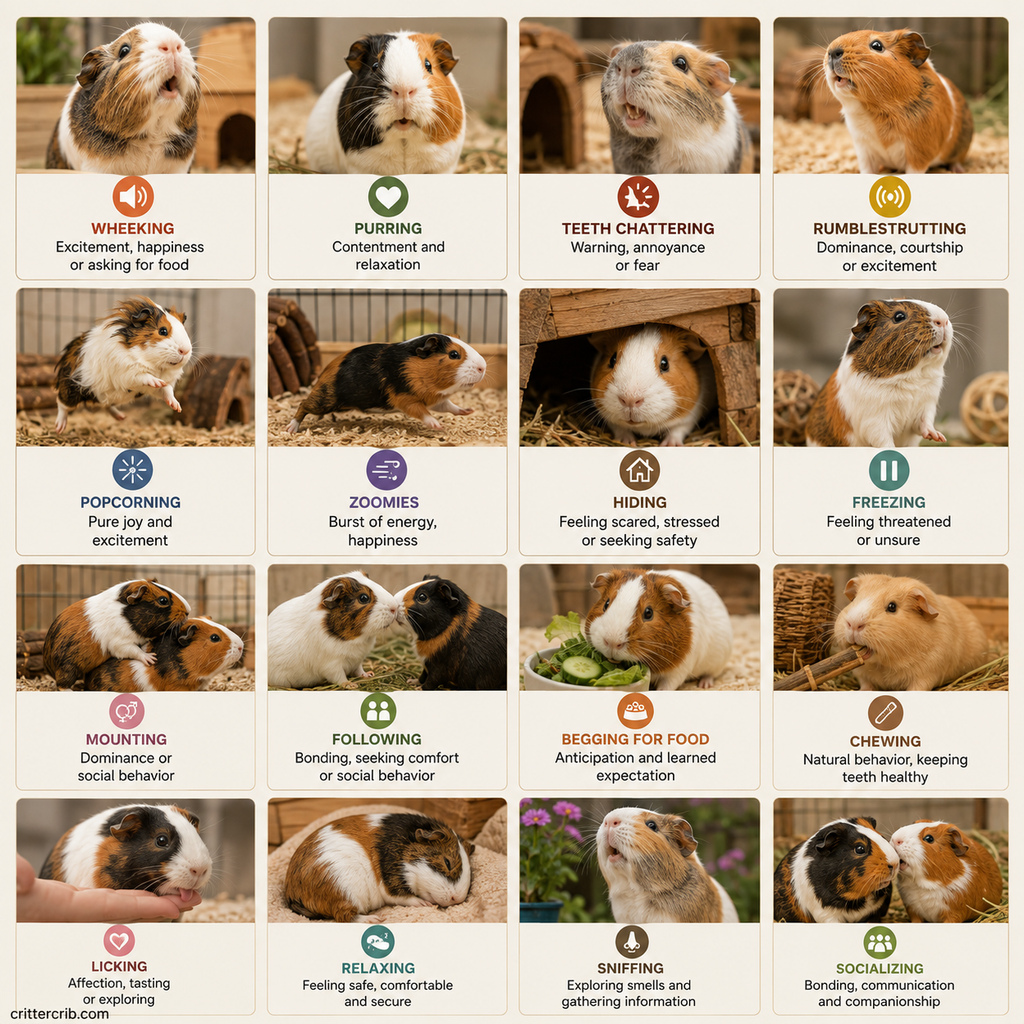
Few guinea pig behaviors are as entertaining as popcorning.
A guinea pig suddenly leaps into the air, twists its body, lands, runs, and perhaps launches itself upward again.
The movement can look so chaotic that first-time owners occasionally wonder whether something is wrong.
Usually, it’s quite the opposite.
What Does Popcorning Mean?
Popcorning is generally associated with excitement and positive energy.
Young guinea pigs tend to do it frequently, although adults can popcorn too.
You might see popcorning after:
- Cleaning and refreshing the enclosure
- Providing fresh hay
- Adding enrichment
- Giving your guinea pigs more room to explore
- Serving a favorite food
- During an energetic period
Some guinea pigs combine popcorning with fast laps around the enclosure.
Enjoy it.
You’ve essentially caught your guinea pig having a very enthusiastic moment.
Why Do Guinea Pigs Run Around Their Cage?
Sudden bursts of running are another common behavior.
Guinea pigs may race around their enclosure, make quick turns, disappear through tunnels, and then do the entire circuit again.
Owners sometimes call these “zoomies.”
Like popcorning, zoomies are commonly associated with energy and excitement.
A spacious enclosure gives guinea pigs room to perform these natural bursts of movement.
If your guinea pigs frequently attempt to run but constantly collide with accessories, it may be worth reconsidering how the enclosure is arranged.
Try to maintain some open pathways rather than filling every available inch with objects.
Why Does My Guinea Pig Freeze?
Freezing is closely connected to a guinea pig’s prey-animal instincts.
When something suddenly seems threatening, staying completely still can be an instinctive response.
Your guinea pig might freeze because of:
- A loud noise
- Sudden movement
- An unfamiliar person
- Another pet nearby
- Something falling
- An unfamiliar smell
- Being placed somewhere new
Usually, the guinea pig begins moving again after determining that the danger has passed.
Should You Pick Up a Frozen Guinea Pig?
Not necessarily.
If your guinea pig is frightened, immediately reaching down and grabbing it may increase its stress.
Give it a moment to assess the situation.
Speak quietly, move slowly, and allow it to retreat into a hide if it wants to.
A guinea pig that frequently appears frightened may benefit from additional hiding areas and a quieter enclosure location.
Why Do Guinea Pigs Hide?
Hiding is normal.
Guinea pigs naturally seek shelter when resting, frightened, or simply looking for privacy.
Every guinea pig enclosure should include multiple places to hide.
Useful options include:
- Wooden houses
- Tunnels
- Fabric hides designed for guinea pigs
- Cardboard boxes
- Covered areas
- Other safe shelters
Ideally, provide enough hiding options that one guinea pig can’t easily control access to all of them.
When Does Hiding Become Concerning?
A guinea pig spending time in a hide isn’t automatically a problem.
What’s more important is whether the behavior has changed.
If a normally outgoing guinea pig suddenly hides almost constantly and also shows changes such as reduced appetite, lethargy, weight loss, or unusual posture, something may be wrong.
Changes from your pet’s normal behavior often tell you more than the behavior itself.
Why Does My Guinea Pig Run Away From Me?
This can feel disappointing to new owners.
You’ve been feeding your guinea pig, cleaning the enclosure, talking gently, and providing treats. Yet when you reach down, your guinea pig runs like you’re a giant eagle.
Don’t take it personally.
Movement from above can trigger a prey animal’s instinct to escape.
Many guinea pigs learn to approach their owners for food while still disliking being picked up.
Those two behaviors aren’t contradictory.
Building Trust With a Guinea Pig
Trust develops through predictable, positive interactions.
Try:
- Spending quiet time near the enclosure.
- Talking softly when approaching.
- Offering vegetables or treats by hand.
- Allowing the guinea pig to approach voluntarily.
- Moving slowly during handling.
- Supporting the entire body when lifting.
- Returning the guinea pig gently to the enclosure.
Avoid chasing your guinea pig around the enclosure for unnecessary handling.
Over time, many guinea pigs become noticeably more confident around familiar people.
Why Does My Guinea Pig Lick Me?
Some guinea pigs lick their owners’ hands or fingers.
It may be part of exploratory behavior, social interaction, or simply an interest in the taste or smell on your skin.
You might have traces of food or salt on your hands that your guinea pig finds interesting.
Either way, licking isn’t usually something to worry about.
If your guinea pig voluntarily remains near you, appears relaxed, and occasionally licks your hand, it’s generally a positive interaction.
Why Does My Guinea Pig Nibble My Fingers?
Gentle nibbling isn’t always aggression.
Guinea pigs investigate their surroundings with their mouths, and a curious guinea pig may lightly nibble a finger.
Sometimes your fingers simply smell like food.
A hard bite is different.
Biting may occur when a guinea pig is:
- Frightened
- In pain
- Feeling trapped
- Being restrained
- Overwhelmed
- Trying to escape
If a normally gentle guinea pig suddenly begins biting during handling, consider whether discomfort or illness could be contributing.
Why Do Guinea Pigs Chew Everything?
Guinea pigs are rodents, and chewing is a fundamental part of their behavior.
Their teeth grow continuously, so they need appropriate opportunities to chew.
You may see your guinea pig chewing:
- Hay
- Wooden accessories
- Cardboard
- Toys
- Hideouts
- Cage-safe items
Hay is especially important because constant chewing helps support normal dental wear while also playing a major role in digestive health.
Provide safe things to chew and regularly inspect accessories for damage.
Why Does My Guinea Pig Chew the Cage Bars?
Occasional bar chewing can happen for several reasons.
Your guinea pig may be:
- Expecting food
- Trying to get your attention
- Bored
- Seeking interaction
- Frustrated
- Investigating its surroundings
Some guinea pigs quickly discover that making noise gets their owner’s attention.
If you immediately deliver vegetables every time the bars rattle, don’t be surprised if your guinea pig trains you remarkably quickly.
Persistent bar chewing, however, can be worth investigating.
Make sure the enclosure provides enough space, hay, companionship, hiding areas, exercise, and enrichment.
Why Do Guinea Pigs Toss Their Heads When Being Petted?
Imagine you’re petting your guinea pig and suddenly it jerks its head upward.
That’s often a fairly clear message.
Your guinea pig may be telling you:
“I’ve had enough.”
Some guinea pigs dislike being touched in particular areas. Others enjoy a short petting session but become irritated when it continues too long.
Pay attention to individual preferences.
A guinea pig doesn’t have to enjoy every type of physical affection to trust you.
Do Guinea Pigs Like Being Held?
Some do. Some tolerate it. Others would rather keep all four feet firmly planted on the ground.
Many guinea pigs become comfortable sitting on a person’s lap once they’re securely supported, even if they dislike the process of being picked up.
That’s an important distinction.
The act of being lifted can trigger prey instincts, while sitting securely against a familiar person may feel completely different.
When holding your guinea pig:
- Support its chest.
- Support its hindquarters.
- Keep it close to your body.
- Avoid sudden movements.
- Stay close to a safe surface.
- Don’t squeeze.
Learn your guinea pig’s signals and end the interaction if it becomes increasingly restless.
What Does It Mean When a Guinea Pig Lies Down?
A relaxed guinea pig may stretch out, tuck its feet beneath itself, or settle comfortably into bedding.
This can be a great sign.
A guinea pig that feels safe enough to relax outside a hide may be demonstrating that it’s comfortable with its surroundings.
Some guinea pigs stretch out dramatically, almost looking as though they’ve melted into the floor.
Context still matters.
Relaxed resting looks different from lethargy.
A comfortable guinea pig should still respond normally when awake, eat regularly, move appropriately, and show interest in its surroundings.
Why Does My Guinea Pig Sleep With Its Eyes Open?
This behavior can surprise new owners.
Guinea pigs may rest or sleep while keeping their eyes partially or fully open.
As prey animals, remaining visually alert has obvious survival advantages.
Don’t assume your guinea pig never sleeps simply because you rarely see its eyes completely closed.
A guinea pig sleeping with closed eyes may be particularly relaxed, but individual behavior varies.
Why Does My Guinea Pig Suddenly Stop Eating?
This isn’t a behavior to simply watch for several days.
Guinea pigs normally spend a significant amount of time eating, particularly hay.
A noticeable reduction in appetite can be associated with dental problems, digestive issues, pain, illness, or other health concerns.
Pay attention to:
- Reduced hay consumption
- Refusing favorite foods
- Difficulty chewing
- Dropping food
- Changes in droppings
- Weight loss
- Drooling
- Unusual posture
- Reduced activity
A guinea pig that stops eating requires prompt veterinary attention.
Because their digestive systems depend on frequent food intake, prolonged appetite loss can become serious.
Why Do Guinea Pigs Eat Their Own Droppings?
Yes, this is normal.
Guinea pigs produce special nutrient-rich droppings called cecotropes that they consume directly.
You may not even notice it happening.
This behavior allows the guinea pig to obtain additional nutrients produced during digestion.
Don’t try to prevent it.
It’s a normal part of guinea pig digestive physiology.
Understanding Guinea Pig Dominance Behavior
Guinea pigs are social animals, but social doesn’t mean they’ll agree about everything.
When guinea pigs establish their relationship, you may observe behaviors such as:
- Rumblestrutting
- Mounting
- Chasing
- Nose raising
- Vocalizing
- Mild nipping
- Following
- Scent marking
Some of this can be normal social negotiation.
Immediately separating guinea pigs every time one mounts or chases another can interfere with their ability to establish a stable relationship.
However, there’s an important difference between dominance behavior and dangerous aggression.
Signs an Interaction May Be Escalating
Watch closely for:
- Persistent teeth chattering
- Lunging
- Aggressive biting
- Serious fighting
- Injuries
- Blood
- One guinea pig being relentlessly attacked
- Preventing another guinea pig from eating or drinking
If an interaction becomes genuinely dangerous, separation may be necessary.
Why Do Guinea Pigs Mount Each Other?
Mounting isn’t exclusively sexual behavior.
Both male and female guinea pigs may mount another guinea pig as part of dominance or social communication.
Occasional mounting within an otherwise stable relationship isn’t necessarily concerning.
Look at the entire interaction.
If both guinea pigs continue eating, resting, exploring, and sharing their environment normally, occasional dominance displays may simply be part of their relationship.
Persistent harassment is different and deserves closer attention.
Why Do Guinea Pigs Raise Their Heads at Each Other?
Two guinea pigs may stand face-to-face and raise their heads.
This can be a dominance display.
Each guinea pig may appear to be trying to position its head higher than the other’s.
It can look oddly formal—almost like a tiny staring contest.
Monitor the interaction, particularly if it’s accompanied by teeth chattering or increasingly aggressive behavior.
Why Does My Guinea Pig Follow Another Guinea Pig?
Following can be perfectly normal social behavior.
Guinea pigs may follow companions:
- While exploring
- When searching for food
- During social interaction
- Because they feel safer together
- As part of courtship or dominance behavior
Young guinea pigs may be particularly inclined to follow an older or more confident companion.
Again, context matters.
Relaxed following is different from relentless chasing that prevents another guinea pig from resting.
Do Guinea Pigs Need Companionship?
Guinea pigs are highly social animals and generally benefit from appropriate companionship with other compatible guinea pigs.
Human attention is valuable, but we can’t completely replace interaction with another member of the same species.
Compatible guinea pigs can:
- Rest together
- Communicate vocally
- Explore together
- Follow one another
- Establish social routines
- Provide reassurance
Successful companionship depends on factors such as personality, sex, available space, introductions, and resource availability.
Providing enough room and duplicate resources can reduce unnecessary conflict.
Why Does My Guinea Pig Beg for Food?
Because it works.
Guinea pigs are extremely good at learning routines.
Your guinea pig may learn:
- When you normally wake up
- When vegetables arrive
- Which door leads to the refrigerator
- What a produce bag sounds like
- When hay gets refilled
- Who in the household gives the best treats
Once those associations form, begging can become impressively specific.
You may walk past the enclosure without a sound, while another family member gets an immediate chorus of wheeks.
Your guinea pigs have figured out who’s worth asking.
Why Does My Guinea Pig Throw Its Food Bowl Around?
Some guinea pigs push, flip, or move their bowls.
This can happen during normal exploration or foraging.
If bowl flipping becomes an everyday hobby, a heavier ceramic bowl may help.
You can also use feeding as enrichment by scattering appropriate portions of food around clean areas of the enclosure rather than putting everything in one location.
Hay should remain readily available.
Why Does My Guinea Pig Dig at Bedding?
Guinea pigs don’t create extensive underground burrow systems like some small mammals, but they may paw, push, rearrange, or burrow into loose bedding and hay.
They may also rearrange blankets or liners if those are part of the enclosure.
Some guinea pigs seem determined to redecorate immediately after you’ve cleaned everything.
That’s okay.
As long as the behavior is safe, allow your guinea pig some control over its environment.
Why Do Guinea Pigs Sniff Everything?
Scent is an important way guinea pigs investigate their surroundings.
A guinea pig may sniff:
- Your hands
- Another guinea pig
- New bedding
- Food
- Toys
- Freshly cleaned areas
- Objects placed in the enclosure
Sniffing a new item before approaching is normal exploratory behavior.
When introducing safe enrichment, give your guinea pigs time to investigate rather than expecting immediate interaction.
Signs of a Relaxed Guinea Pig
Individual personalities vary, but a comfortable guinea pig may:
- Eat openly
- Explore confidently
- Rest outside its hide
- Stretch out comfortably
- Approach familiar people
- Accept food from your hand
- Popcorn
- Perform zoomies
- Groom normally
- Interact calmly with companions
A relaxed guinea pig isn’t necessarily one that constantly wants to be held.
Confidence inside its environment is just as meaningful.
Signs of Stress or Fear
Stress can appear in several ways.
Possible signs include:
- Frequent freezing
- Constant hiding
- Frantic attempts to escape
- Repeated teeth chattering
- Excessive aggression
- Unusual inactivity
- Reluctance to eat while people are nearby
- Persistent nervousness
- Sudden changes in normal behavior
An occasional startled reaction is normal.
Persistent stress deserves investigation.
Consider possible causes such as noise, lack of hiding places, insufficient space, conflict with another guinea pig, excessive handling, other household pets, or frequent disruption of the enclosure.
When Behavior Changes May Signal Illness
One of the biggest benefits of understanding guinea pig behavior is recognizing when something isn’t normal.
Animals can’t explain that they have a toothache or stomach discomfort.
Behavior often provides the first clue.
Pay particular attention to sudden changes in:
- Appetite
- Water consumption
- Activity
- Social interaction
- Vocalization
- Posture
- Grooming
- Droppings
- Movement
- Breathing
- Sleep and resting habits
A normally enthusiastic guinea pig that suddenly ignores its favorite food deserves more attention than a guinea pig that has always been a picky eater.
Know Your Guinea Pig’s Normal
There’s no universal personality that every healthy guinea pig should have.
One may be bold enough to investigate anything you put into the enclosure.
Another may cautiously watch from inside a tunnel for several minutes first.
Both can be perfectly healthy.
What’s valuable is learning what’s normal for your individual pet.
That gives you a baseline.
How to Encourage Positive Guinea Pig Behavior
A good environment allows natural behaviors to happen safely.
You don’t need to constantly entertain your guinea pigs. Instead, give them choices and opportunities.
Provide Enough Space
Guinea pigs need room to run, explore, interact, and move away from each other.
More usable floor space can also make it easier to create separate feeding, resting, and enrichment areas.
Provide Multiple Hides
Hiding shouldn’t be treated as bad behavior.
Give your guinea pigs several safe places where they can retreat.
When housing multiple guinea pigs, hides with more than one entrance can be particularly useful because one animal is less likely to trap another inside.
Keep Hay Available
Hay provides nutrition, supports dental wear, and gives guinea pigs something to forage through throughout the day.
It can also become part of enrichment.
Introduce Variety
You can occasionally rotate:
- Tunnels
- Cardboard boxes
- Safe chewable items
- Foraging activities
- Hide arrangements
You don’t need to completely redesign the enclosure every time.
A little variety is enough.
Maintain a Predictable Routine
Guinea pigs are excellent at recognizing patterns.
Regular feeding, cleaning, and interaction schedules can make their environment feel more predictable.
It will also make you painfully aware of being five minutes late with vegetables.
Frequently Asked Questions About Guinea Pig Behavior
How Can I Tell If My Guinea Pig Is Happy?
Look at the overall pattern rather than a single behavior.
A comfortable guinea pig generally eats normally, explores, rests comfortably, interacts with companions, and shows interest in its environment.
Popcorning and zoomies are particularly obvious signs of excitement, but a calm guinea pig relaxing in the open can also indicate comfort.
Why Does My Guinea Pig Squeak When It Sees Me?
Your guinea pig may have associated you with something positive, especially food.
If you normally provide vegetables or refill hay, your arrival can become a signal that something good is about to happen.
Why Does My Guinea Pig Run Away When I Try to Pick It Up?
Being approached from above can trigger an instinctive escape response.
Even guinea pigs that trust their owners may run when someone tries to pick them up.
Move slowly, avoid chasing unnecessarily, and support the guinea pig securely once lifted.
What Does Guinea Pig Popcorning Look Like?
A popcorning guinea pig suddenly jumps into the air, sometimes twisting or kicking before landing.
The movement can look uncontrolled, but it’s generally associated with excitement and energetic behavior.
Why Is My Guinea Pig Chattering Its Teeth?
Teeth chattering commonly signals irritation, defensiveness, or a warning.
Give the guinea pig space and pay attention to the surrounding situation, particularly if another guinea pig is involved.
Is Rumblestrutting Normal?
Yes. Rumblestrutting can be part of dominance, courtship, or normal social communication.
Watch for escalation rather than assuming the behavior itself is dangerous.
Do Guinea Pigs Recognize Their Owners?
Guinea pigs can learn to recognize familiar people, routines, sounds, and associations.
Many become noticeably more comfortable around their regular caregivers and may approach, vocalize, or beg for food when those people appear.
Why Does My Guinea Pig Stare at Me?
It may simply be watching you.
Your guinea pig could also be anticipating food or trying to determine what you’re doing.
If staring is accompanied by wheeking every time you move toward the kitchen, the mystery probably isn’t difficult to solve.
Learning Your Guinea Pig’s Language
Understanding guinea pig behavior becomes easier with time.
At first, every squeak may sound the same. Eventually, you’ll start noticing patterns.
You’ll recognize the enthusiastic wheek that means vegetables might be coming. You’ll know when a rumble is part of a social interaction, when a guinea pig wants to be left alone, and when an unexpected burst of popcorning means somebody is having a particularly good day.
More importantly, you’ll recognize when something feels different.
That’s one of the most valuable skills a guinea pig owner can develop.
Don’t focus on interpreting every tiny movement as though your guinea pig is speaking in code. Look at the bigger picture: the sound, posture, situation, environment, and your pet’s usual personality.
Give your guinea pigs enough space, companionship, hiding areas, enrichment, good nutrition, and a predictable routine. Then spend time observing them without constantly interfering.
Before long, those strange little squeaks, jumps, rumbles, and stares start making a lot more sense.