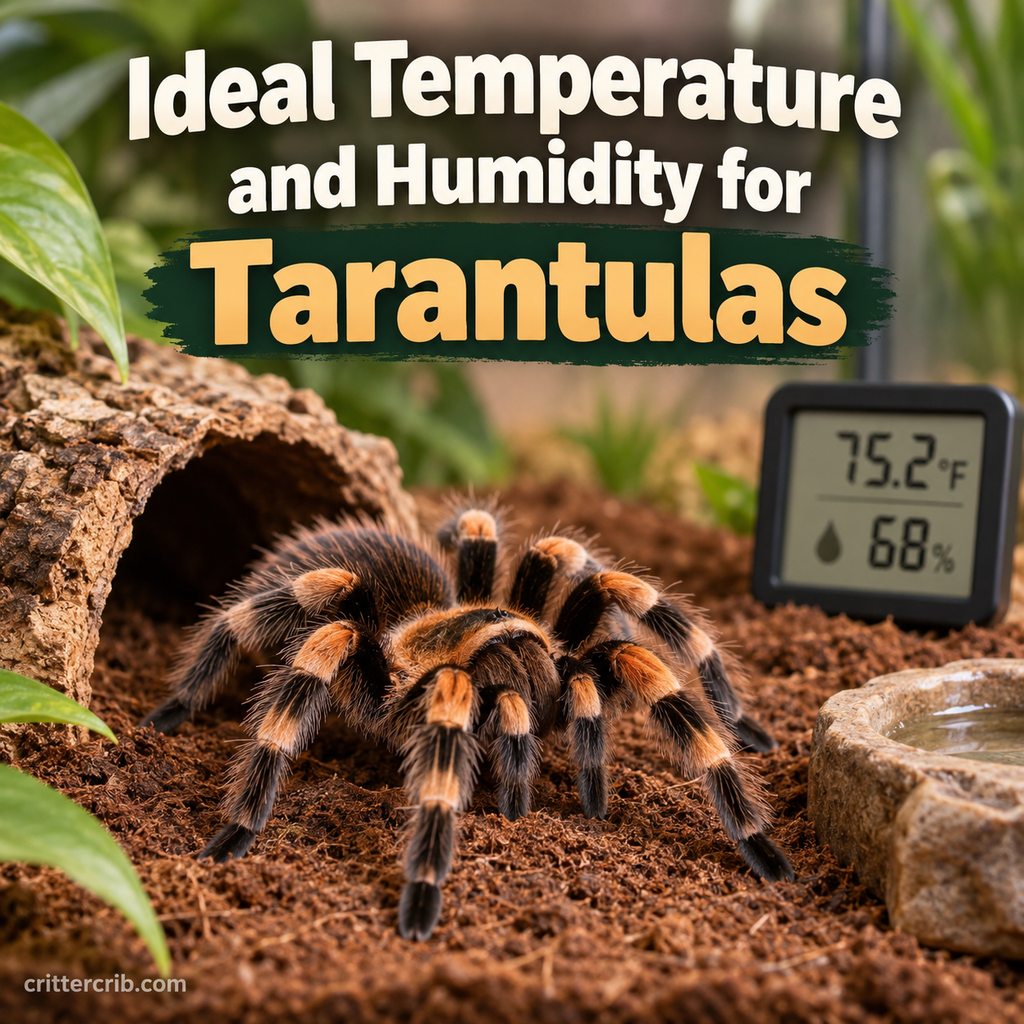
Tarantulas have a reputation for being relatively low-maintenance pets, but their environment still matters. Temperature and humidity affect everything from hydration and activity levels to successful molting, so getting these conditions reasonably right is an important part of tarantula care.
The good news is that most commonly kept tarantulas don’t require complicated climate-control equipment. In many cases, a comfortable room temperature, suitable substrate, access to fresh water, and appropriate ventilation are enough.
However, there isn’t one perfect temperature or humidity level for every tarantula. A desert-adapted species and a tropical rainforest species can have very different needs.
Here’s how to create a safe, stable environment without making tarantula care more complicated than it needs to be.
What Temperature Do Tarantulas Need?
For many commonly kept tarantulas, temperatures of roughly 70–80°F (21–27°C) are generally suitable.
A useful rule of thumb is that if the room feels comfortably warm to you, many pet tarantulas will also be comfortable. Exact requirements vary by species, however, so you should always research the natural habitat and husbandry recommendations for your particular tarantula.
Temperatures don’t need to remain at exactly the same number throughout the day. Small natural fluctuations are generally fine.
More important than maintaining an exact temperature is avoiding prolonged exposure to extremes.
What Happens If a Tarantula Gets Too Cold?
Tarantulas are ectothermic, meaning their body temperature is influenced by their surroundings. When temperatures drop, their metabolism and activity can slow down.
A tarantula kept too cool may:
- Become less active
- Eat less frequently
- Spend more time hiding
- Digest food more slowly
- Grow more slowly
A slightly cooler night isn’t necessarily a problem. The bigger concern is an enclosure that remains excessively cold for extended periods.
If your home regularly becomes colder than the recommended range for your species, you may need to warm the room rather than trying to heat the tarantula directly.
Can Tarantulas Get Too Hot?
Yes. Excessive heat can be more dangerous than many beginners realize.
A tarantula kept in an enclosure that becomes too warm can become dehydrated and stressed. Small enclosures can also heat up surprisingly quickly, particularly when placed near windows, heaters, lamps, or other heat sources.
Never place a tarantula enclosure in direct sunlight.
Even if the room itself feels comfortable, sunlight passing through glass can cause temperatures inside an enclosure to rise rapidly.
Signs that enclosure conditions may be too warm or dry can include unusual restlessness, persistent climbing, or spending excessive time near the water dish. These behaviors can have other causes, though, so don’t rely on behavior alone to diagnose a temperature problem.
Do Tarantulas Need a Heat Lamp?
Most tarantulas kept in a normally heated home do not need a heat lamp.
Heat lamps can create concentrated hot spots and rapidly dry the enclosure. Tarantulas also don’t bask like many reptiles do, so overhead heating usually isn’t necessary.
If additional warmth is genuinely required, heating the room where the tarantula is kept is often safer than applying intense heat directly to a small enclosure.
Any supplemental heating setup should be carefully controlled and monitored to prevent overheating.
Understanding Tarantula Humidity
Humidity is one of the most misunderstood parts of tarantula care.
You’ll frequently see specific percentages recommended online, but maintaining a particular number isn’t always the best way to manage a tarantula enclosure.
Instead, think about the species’ natural environment, substrate moisture, ventilation, and access to drinking water.
Some tarantulas prefer relatively dry conditions, while others require more consistently moist substrate.
The goal isn’t to create a wet enclosure. It’s to provide enough moisture for the species while still allowing adequate airflow.
How Much Humidity Does a Tarantula Need?
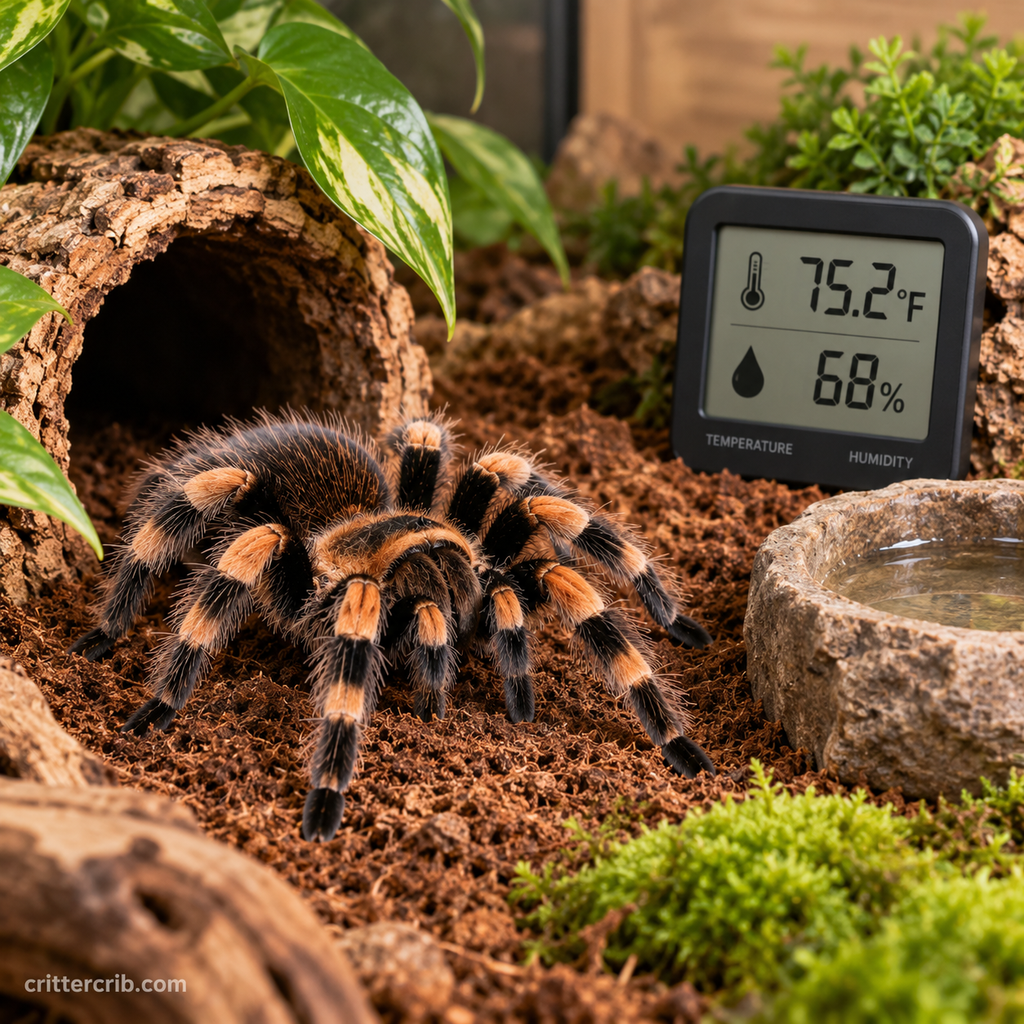
There isn’t a universal humidity percentage that works for every tarantula.
Tarantulas are often broadly grouped into three environmental categories:
Arid and Semi-Arid Tarantulas
Species originating from relatively dry environments generally do best with mostly dry substrate.
For these tarantulas, good husbandry commonly involves:
- Mostly dry substrate
- A consistently available water dish
- Good ventilation
- Occasional moisture in one portion of the enclosure when appropriate
Keeping an arid species constantly damp can create unnecessary problems.
Tropical Terrestrial Tarantulas
Tropical terrestrial species often benefit from somewhat more moisture in the substrate.
Rather than constantly spraying the enclosure, keep an appropriate portion of the substrate slightly moist and allow some evaporation between watering.
Good airflow remains important.
Moisture-Dependent Tropical Species
Some tropical species come from environments where moisture is consistently available.
These tarantulas may require more consistently moist substrate, but moist doesn’t mean swampy.
A properly maintained enclosure should still have ventilation and shouldn’t smell stagnant or have standing water throughout the substrate.
Humidity vs. Substrate Moisture
For many tarantula keepers, substrate moisture is more useful than obsessing over the humidity percentage displayed on a hygrometer.
Humidity readings can change significantly depending on where the sensor is located, how much ventilation the enclosure has, and even the time of day.
The condition of the enclosure tells you more.
Ask yourself:
- Is the substrate appropriate for the species?
- Is it completely dry when the species requires moisture?
- Is it constantly saturated?
- Is there adequate ventilation?
- Does the tarantula always have drinking water?
Looking at the entire environment provides a better picture than chasing a single number.
Should You Mist a Tarantula Enclosure?
Routine heavy misting usually isn’t necessary.
For species that require additional moisture, adding water directly to part of the substrate can provide longer-lasting moisture than repeatedly spraying the enclosure.
You can carefully pour a small amount of water into one area or occasionally overflow the water dish, depending on the species and enclosure setup.
This allows moisture to gradually evaporate from the substrate.
Light misting can sometimes be appropriate, but constantly spraying the enclosure can create an overly wet surface without providing stable moisture deeper in the substrate.
Always Provide Fresh Water
Even tarantulas from relatively dry environments should have access to fresh drinking water.
Use a shallow, appropriately sized water dish and keep it clean and filled.
You may occasionally see advice suggesting that tarantulas obtain all the moisture they need from prey. While prey contributes some hydration, providing a water dish is a simple and important safeguard against dehydration.
Don’t worry if your tarantula fills the dish with substrate or moves it around. Tarantulas have a remarkable ability to redecorate their homes in ways their keepers didn’t request.
Simply clean and refill it as necessary.
Ventilation Is Just as Important as Humidity
Humidity shouldn’t be considered separately from ventilation.
An enclosure can contain plenty of moisture while still providing healthy airflow. Problems arise when excessive moisture combines with poor ventilation.
Stagnant, constantly wet conditions may encourage:
- Mold growth
- Unwanted microorganisms
- Fungus
- Mites or other pests
- Poor enclosure conditions
Many tarantula enclosures benefit from ventilation holes positioned to encourage airflow through the enclosure rather than only at the top.
The exact ventilation setup depends on the enclosure and species.
Temperature and Humidity During Molting
Molting is one of the most vulnerable periods in a tarantula’s life.
Before a molt, a tarantula may stop eating, become less active, darken in appearance, or create a webbed molting area. Some terrestrial tarantulas flip onto their backs when the molt begins.
This is normal behavior.
During this period, environmental stability is particularly important.
Make sure:
- Fresh water is available.
- The enclosure isn’t excessively hot or cold.
- Species-appropriate moisture levels are maintained.
- The tarantula isn’t disturbed unnecessarily.
- Uneaten feeder insects are removed.
Don’t spray water directly onto a molting tarantula in an attempt to increase humidity.
After the molt, give the tarantula time for its new exoskeleton and fangs to harden before offering food again.
How to Measure Enclosure Temperature
A small digital thermometer can make monitoring enclosure temperatures much easier.
Place it where it provides a useful representation of the tarantula’s environment rather than immediately beside a heat source.
If you’re concerned about temperature differences throughout the enclosure, an infrared thermometer can also be useful for checking surface temperatures.
Remember that you’re looking for overall stability rather than trying to maintain an exact temperature every minute of the day.
Do You Need a Hygrometer?
A hygrometer can be useful, particularly while you’re learning how moisture behaves inside a new enclosure.
However, it shouldn’t become the sole measure of whether conditions are appropriate.
An inexpensive hygrometer may not be perfectly accurate, and readings can vary considerably depending on sensor placement.
Use humidity readings as one piece of information alongside:
- Substrate condition
- Ventilation
- Water availability
- Species requirements
- Overall enclosure conditions
For many species, understanding substrate moisture is ultimately more useful than maintaining an exact relative humidity percentage.
Common Temperature and Humidity Mistakes
Beginners often make tarantula care more complicated than necessary. Avoiding a few common mistakes can make enclosure management much easier.
Keeping the Enclosure Too Wet
More humidity isn’t automatically better.
Constantly saturated substrate can create stagnant conditions, particularly for species adapted to drier environments.
Letting the Enclosure Become Bone Dry
The opposite extreme can also cause trouble for moisture-dependent species.
Know whether your tarantula prefers dry, moderately moist, or consistently moist substrate.
Using an Unregulated Heat Source
Heating equipment can create dangerously high temperatures if it isn’t properly controlled.
Never assume a heat source is safe simply because it feels mildly warm from outside the enclosure.
Placing the Enclosure in Direct Sunlight
A glass or plastic enclosure can heat rapidly when exposed to direct sunlight.
Choose a location with stable ambient temperatures and no direct sun.
Chasing an Exact Humidity Percentage
Trying to keep a hygrometer at one exact number can lead to excessive spraying and overly wet conditions.
Focus on species-appropriate husbandry instead.
Forgetting the Water Dish
Fresh water is one of the easiest ways to support proper hydration.
Check the dish regularly, especially during warmer weather.
Creating a Stable Tarantula Environment
You don’t need to constantly adjust the enclosure if you’ve established appropriate conditions.
For most setups, concentrate on a few fundamentals:
- Keep temperatures within a comfortable range for the species.
- Avoid direct sunlight and extreme temperature swings.
- Provide an appropriate substrate depth and moisture level.
- Maintain adequate ventilation.
- Keep fresh water available at all times.
- Monitor conditions periodically.
- Research the specific species you’re keeping.
Stability is generally preferable to repeatedly changing the enclosure in pursuit of perfect thermometer or hygrometer readings.
Different Tarantula Species Have Different Needs
“Tarantula” describes a huge and diverse group of spiders found in habitats ranging from dry scrublands to humid tropical forests.
That’s why generic care recommendations have limits.
Before setting up an enclosure, identify the tarantula by its scientific name whenever possible and research its natural habitat and established captive-care requirements.
Two species sitting beside each other at a pet store may require noticeably different moisture levels.
Knowing exactly what species you’re caring for makes it much easier to provide appropriate conditions.
Frequently Asked Questions
What is the ideal temperature for a tarantula?
Many commonly kept tarantulas are comfortable at approximately 70–80°F (21–27°C), although the ideal range depends on the species. Stable, moderate room temperatures are often sufficient.
What is the ideal humidity for a tarantula?
There isn’t one ideal humidity percentage for all tarantulas. Arid species generally prefer drier substrate, while tropical species may require more moisture. Species-specific substrate moisture, ventilation, and water availability are more useful considerations than targeting a universal percentage.
Do tarantulas need humidity?
Yes, tarantulas require adequate hydration, but that doesn’t mean every enclosure should be humid or wet. The amount of moisture required varies significantly between species.
Do tarantulas need a heat mat?
Usually not if the room remains within an appropriate temperature range. If supplemental heating is necessary, it needs to be carefully controlled so the enclosure doesn’t overheat or dry out.
Should I spray my tarantula with water?
No. Don’t spray your tarantula directly. When additional moisture is needed, it is generally better to manage the substrate and enclosure conditions appropriately.
Should a tarantula have a water bowl?
Yes. Providing a shallow dish of clean, fresh water is recommended even for many species from relatively dry habitats.
Is condensation inside a tarantula enclosure bad?
Occasional light condensation doesn’t automatically indicate a problem, but persistent heavy condensation can suggest that the enclosure is too wet or poorly ventilated. Check the substrate and airflow rather than relying on condensation alone.
Final Thoughts
Getting the ideal temperature and humidity for tarantulas doesn’t have to involve constantly adjusting heaters, spraying the enclosure, or staring at a hygrometer.
For many commonly kept species, moderate room temperatures around 70–80°F, fresh drinking water, appropriate substrate moisture, and good ventilation provide a solid foundation.
The most important point is that tarantula care is species-specific. A dry-environment species shouldn’t be kept like a tropical species simply because both are tarantulas.
Learn where your particular species comes from, recreate the important parts of that environment, and aim for stable conditions rather than perfect numbers. Your tarantula’s enclosure will be easier to maintain—and much more suitable for the animal living in it.