
Hedgehogs aren’t the easiest pets to read.
A dog might wag its tail when it’s excited to see you. A cat may climb onto your lap and start purring. A hedgehog is more likely to communicate through much smaller changes in posture, activity, appetite, and behavior.
Sometimes, the clearest sign that a hedgehog feels comfortable is simply that it stops curling into a defensive ball every time you come near.
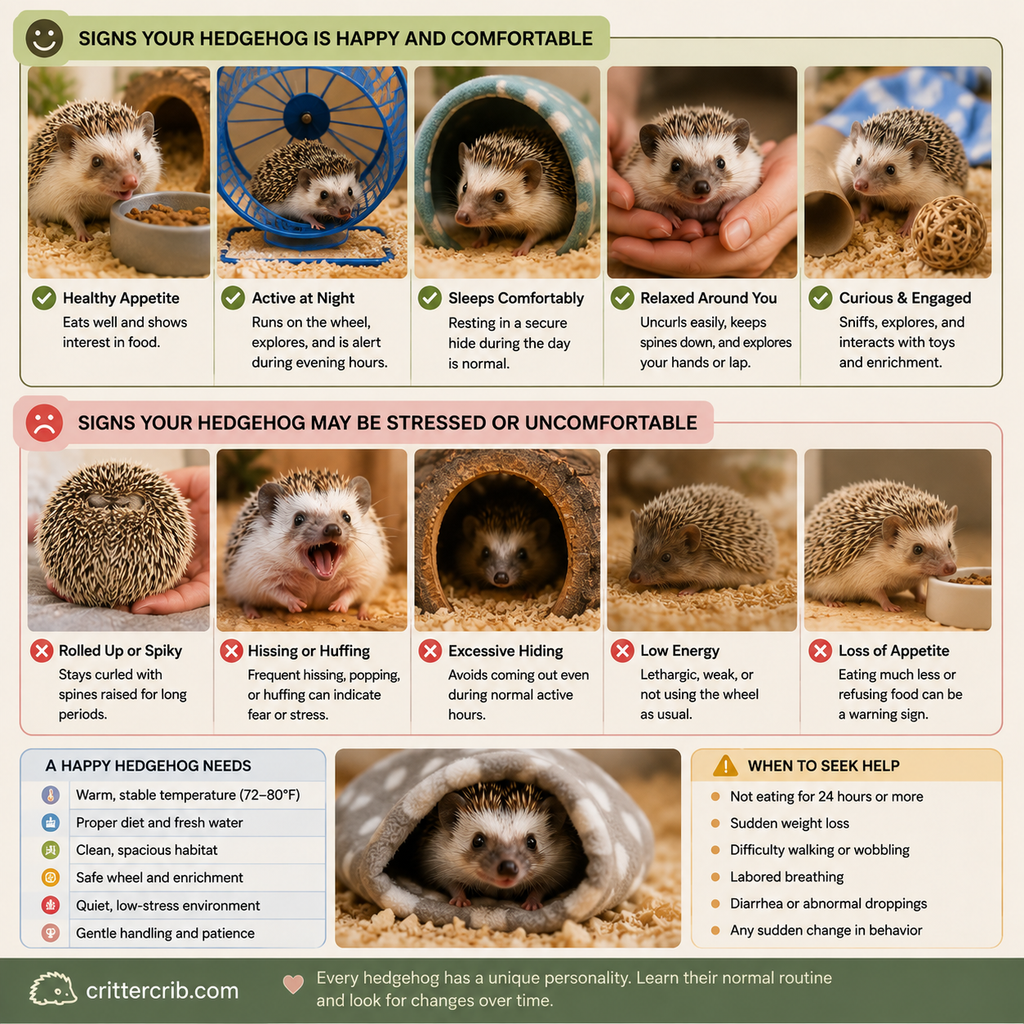
Learning your hedgehog’s normal routine is one of the best ways to understand how it’s feeling. A happy, comfortable hedgehog will generally eat normally, explore during its active hours, use its exercise wheel, sleep comfortably, and gradually become less defensive around familiar people.
Personality matters too. Some hedgehogs become confident explorers fairly quickly, while others remain cautious even after they trust their owners.
Here’s how to recognize signs that your hedgehog is happy and comfortable, along with behaviors that may indicate stress, environmental problems, or illness.
What Does a Happy Hedgehog Act Like?
A comfortable hedgehog generally follows a predictable routine.
Since hedgehogs are nocturnal, much of their activity happens after you’ve gone to bed.
During the evening and nighttime hours, you may notice your hedgehog:
- Exploring its enclosure
- Running on its wheel
- Eating and drinking
- Investigating enrichment
- Moving bedding around
- Sniffing new objects
- Using tunnels and hides
During the day, it will probably spend a considerable amount of time sleeping.
That’s normal.
You shouldn’t expect a healthy hedgehog to be running around all afternoon simply because you’re awake.
Instead, learn when your hedgehog naturally becomes active and judge its behavior according to its usual schedule.
1. Your Hedgehog Has a Healthy Appetite
Regular eating is one of the most useful signs that your hedgehog is doing well.
A comfortable hedgehog should show normal interest in its usual food.
You don’t necessarily need to watch every meal. Because hedgehogs are active at night, much of their eating may happen while you’re sleeping.
Check the food dish each morning so you have a general idea of how much was eaten.
Watch for Changes in Appetite
A sudden reduction in food intake deserves attention.
Possible warning signs include:
- Eating much less than usual
- Refusing food
- Dropping food while eating
- Difficulty chewing
- Losing weight
- Becoming unusually inactive
Appetite can change for many reasons, including stress, dental problems, illness, pain, and environmental temperature.
If your hedgehog stops eating or its appetite decreases significantly, contact a veterinarian experienced with exotic mammals.
2. Your Hedgehog Is Active at Night
A healthy hedgehog can cover a surprising amount of distance overnight.
Many pet hedgehogs spend significant time running on their wheels.
You may not actually see it happen.
Instead, you might wake up to find the wheel has clearly been used, food has disappeared, bedding has moved, and objects aren’t quite where you left them.
Those are signs of normal nighttime activity.
What if My Hedgehog Doesn’t Use Its Wheel?
Not every hedgehog uses a wheel exactly the same amount.
However, a sudden decrease in activity can be meaningful if your hedgehog normally runs frequently.
Check whether:
- The wheel turns freely
- It’s large enough
- The running surface is safe and solid
- Your hedgehog can enter it easily
- The room temperature is appropriate
If nothing has changed in the environment and your normally active hedgehog suddenly becomes lethargic, consider contacting your veterinarian.
3. Your Hedgehog Explores Its Environment
Curiosity is another encouraging sign.
A comfortable hedgehog may sniff around its enclosure, investigate toys, move through tunnels, and explore during supervised out-of-enclosure time.
Some hedgehogs are naturally more adventurous than others.
A cautious hedgehog may stop frequently to sniff the air before moving forward.
That’s fine.
What you’re looking for is a willingness to engage with the environment rather than remaining constantly defensive or inactive.
4. Your Hedgehog Uncurls Around You
Curling into a tight ball is one of a hedgehog’s best-known defensive behaviors.
When frightened, a hedgehog raises its spines and contracts its muscles so its vulnerable face and underside are protected.
A new hedgehog may do this frequently.
As trust develops, you may notice your hedgehog uncurling more quickly after you pick it up.
Eventually, it may remain relatively relaxed in your hands from the beginning.
That’s a significant sign of progress.
Does Hissing Mean My Hedgehog Hates Me?
No.
Hedgehogs may hiss, huff, pop, or raise their spines when they’re nervous or irritated.
This doesn’t mean your hedgehog has decided it dislikes you.
It’s communicating discomfort.
Move slowly and give it time.
Repeated gentle interactions can help your hedgehog learn that being around you doesn’t lead to something frightening.
5. Your Hedgehog Feels Comfortable Exploring You
Once a hedgehog becomes familiar with you, it may begin walking across your hands, lap, or clothing.
It might sniff your fingers, investigate your sleeves, or attempt to climb.
This type of voluntary exploration can be a good sign of trust.
Your hedgehog is choosing to investigate rather than remaining tightly curled.
Some hedgehogs may even settle down on a blanket or lap after exploring.
Others would rather keep moving.
Both personalities can be perfectly normal.
6. Your Hedgehog Sleeps Comfortably
Hedgehogs need a secure place to sleep during the day.
A comfortable hedgehog may spend hours inside:
- A hideout
- A sleep sack
- A tunnel
- A pile of appropriate bedding
- Another dark, sheltered sleeping area
Hiding during sleep doesn’t mean your hedgehog is unhappy.
It’s normal behavior.
In fact, providing a protected sleeping location helps your pet feel secure.
Don’t Constantly Wake Your Hedgehog
Because hedgehogs are nocturnal, repeatedly waking them during the day can interfere with their normal routine.
Whenever possible, schedule handling and playtime during the evening when your hedgehog is naturally beginning to wake up.
You may still need to wake your pet occasionally for cage cleaning, veterinary appointments, or health checks.
Just avoid making daytime disturbances the normal routine.
7. Your Hedgehog Uses Its Wheel Regularly
An appropriate exercise wheel is one of the most important pieces of enrichment in a hedgehog habitat.
A healthy adult hedgehog may spend a surprising amount of time running.
Choose a large wheel with a solid running surface.
Avoid wire or mesh wheels that could trap feet or legs.
The wheel should allow your hedgehog to run comfortably without forcing its back into an unnatural position.
Regular wheel use provides exercise and an outlet for natural nighttime activity.
It’s also a behavior worth monitoring.
If a hedgehog that normally runs every night suddenly stops, pay attention.
8. Your Hedgehog Shows Relaxed Body Language
Hedgehog body language becomes easier to understand once you’ve spent time with your pet.
A comfortable hedgehog may:
- Keep its spines relatively flat
- Walk normally
- Sniff curiously
- Explore your hands
- Uncurl readily
- Eat in your presence
- Move around without constant huffing
- Rest comfortably
A frightened hedgehog may:
- Curl tightly
- Raise its spines
- Huff
- Hiss
- Jump or “pop”
- Try to hide
- Remain defensive when approached
Occasional defensive behavior is normal.
The important question is whether your hedgehog gradually relaxes once it realizes there’s no threat.
9. Your Hedgehog Is Comfortable With Your Scent
Hedgehogs rely heavily on smell.
Over time, your scent becomes familiar.
You can help this process by handling your hedgehog regularly and avoiding strong fragrances immediately before interaction.
Wash your hands with a mild, unscented soap when possible.
This also reduces the chance that your fingers smell like food.
A hedgehog investigating your hand calmly is much different from one immediately curling into a tight ball.
That change may be subtle, but it’s meaningful.
10. Your Hedgehog Maintains Normal Grooming and Appearance
A healthy hedgehog should generally have clean skin, eyes, ears, feet, and spines.
Regularly observe your pet for changes.
Look for:
- Clear, bright eyes
- Normal skin
- Clean ears
- Healthy feet
- Normal movement
- No unusual discharge
- No excessive scratching
- No unexplained spine loss
Some spine loss can occur during normal quilling, particularly in younger hedgehogs.
However, excessive spine loss, irritated skin, bald areas, crusting, or frequent scratching may indicate a problem that requires veterinary attention.
How Do You Know if Your Hedgehog Trusts You?
Trust doesn’t necessarily mean your hedgehog will become cuddly.
Some never do.
Instead, look for changes in how your pet responds to you.
Signs of growing trust may include:
- Uncurling more quickly
- Keeping spines relaxed
- Walking onto your hands
- Exploring your lap
- Taking appropriate food from you
- Remaining active while you’re nearby
- Huffing less frequently
- Sleeping near or on you
- Allowing routine handling
The biggest change is often a reduction in defensive behavior.
A hedgehog that once remained tightly curled for ten minutes might eventually uncurl within seconds.
That’s progress.
How to Help Your Hedgehog Feel Comfortable With You
Trust is built through repeated experiences.
Your hedgehog needs to learn that your voice, scent, and hands are predictable.
Try a simple routine:
- Approach calmly.
- Speak softly before touching your hedgehog.
- Scoop from underneath rather than grabbing from above.
- Support the body with both hands.
- Allow your hedgehog time to uncurl.
- Let it explore your lap or hands.
- Keep interactions calm and consistent.
Don’t punish hissing or curling.
Those are defensive behaviors, not bad behavior.
If your hedgehog curls up, continue supporting it gently and give it time.
Spend Time Together Without Forcing Interaction
Bonding doesn’t always require active handling.
You can place your hedgehog on your lap inside a fleece blanket or sleep sack while you watch television or relax.
The hedgehog gets used to your scent, voice, and movement without being constantly touched.
For nervous animals, this can be a useful middle ground.
Your hedgehog gets to remain partially hidden while learning that being near you is safe.
How Long Does It Take for a Hedgehog to Trust You?
There’s no standard timeline.
Some hedgehogs begin relaxing within days.
Others may need several weeks or months.
Factors include:
- Personality
- Age
- Previous handling
- Breeding and early socialization
- Environment
- Health
- Consistency of interaction
Don’t compare your hedgehog too closely with someone else’s pet.
A video of an extremely relaxed hedgehog sleeping in someone’s lap doesn’t mean yours should immediately behave the same way.
Focus on gradual improvement.
Signs Your Hedgehog May Be Stressed
Stress can look different from ordinary cautious behavior.
Possible signs include:
- Excessive hiding during normal active hours
- Persistent hissing or defensive behavior
- Frequent attempts to escape
- Reduced appetite
- Unusual inactivity
- Repeated biting
- Changes in normal bathroom habits
- Reluctance to explore
- Sudden changes in personality
Consider what has changed recently.
A new enclosure, loud environment, unfamiliar people, excessive handling, another animal nearby, or inappropriate temperature could all contribute.
Persistent behavioral changes may also indicate illness.
Temperature Has a Major Effect on Hedgehog Comfort
Environmental temperature is especially important for pet hedgehogs.
African pygmy hedgehogs, commonly kept as pets, require consistently warm conditions.
A room that’s comfortable for you may sometimes be too cold for your hedgehog.
Many keepers maintain the enclosure around 72°F to 80°F (22°C to 27°C), although individual needs and veterinary recommendations can vary.
The enclosure should be monitored with a reliable thermometer rather than relying entirely on the household thermostat.
Why Cold Temperatures Can Be Dangerous
If an African pygmy hedgehog becomes too cold, it may attempt to enter a torpor-like state often referred to by owners as a hibernation attempt.
This is dangerous for domesticated African pygmy hedgehogs and shouldn’t be encouraged.
Warning signs can include:
- Unusual lethargy
- Feeling cool to the touch
- Difficulty waking
- Wobbling
- Refusing food
- Remaining tightly curled and unresponsive
If you suspect your hedgehog is becoming dangerously cold or attempting to hibernate, warm it gradually and contact an exotic-animal veterinarian promptly.
Don’t Let Your Hedgehog Get Too Hot Either
Warmth is important, but hotter isn’t automatically better.
Your hedgehog should have a comfortable environment without being exposed to excessive heat or direct sunlight.
Signs of overheating may include:
- Lethargy
- Rapid breathing
- Lying unusually flat or stretched out
- Weakness
- Reduced responsiveness
Make sure your heating setup is thermostatically controlled.
Your hedgehog shouldn’t be able to contact dangerously hot equipment or chew electrical cords.
A Comfortable Habitat Supports Happy Behavior
A hedgehog can’t feel secure if its basic environmental needs aren’t being met.
A suitable habitat should provide:
- Adequate floor space
- A large solid-surface exercise wheel
- A secure sleeping hide
- Appropriate bedding
- Fresh water
- Suitable food
- Enrichment
- Stable warmth
- Good ventilation
The enclosure should also be kept clean and dry.
Remove heavily soiled bedding regularly and clean the wheel as needed.
If you’ve owned a hedgehog for more than a few days, you may already know that the wheel can become impressively dirty overnight.
That’s usually evidence that it was being used.
Provide Enrichment
A wheel is important, but it shouldn’t be the only interesting object in the enclosure.
Try providing:
- Tunnels
- Hideouts
- Safe toys
- Digging opportunities
- Foraging activities
- Different safe textures to explore
Rotate some items periodically to create variety.
Don’t completely rearrange everything constantly, especially with a nervous hedgehog.
Familiar scents and hiding places can help your pet feel secure.
Monitor Your Hedgehog’s Weight
Hedgehogs can hide gradual weight changes.
Weighing your pet periodically with a digital kitchen or small-animal scale can help you establish what’s normal.
Record the results.
A consistent trend is more useful than obsessing over small day-to-day fluctuations.
Unexpected weight loss combined with reduced appetite, lethargy, or behavioral changes deserves veterinary attention.
Signs Your Hedgehog May Be Sick Rather Than Unhappy
A hedgehog that suddenly becomes withdrawn isn’t necessarily experiencing an emotional problem.
It may be sick or in pain.
Contact a veterinarian if you notice concerning signs such as:
- Refusing food
- Significant weight loss
- Severe lethargy
- Difficulty breathing
- Persistent diarrhea
- Blood in urine or stool
- Difficulty walking
- Frequent falling or wobbling
- Unusual lumps
- Discharge from the eyes or nose
- Significant skin problems
- Excessive spine loss
- Persistent scratching
- Major behavioral changes
Because hedgehogs are exotic pets, it’s a good idea to locate a veterinarian experienced with them before an emergency occurs.
Common Things That Can Make a Hedgehog Uncomfortable
Sometimes improving your hedgehog’s behavior means changing its environment.
Common sources of discomfort or stress include:
- Temperatures that are too cold
- Excessive heat
- No secure hiding place
- An inappropriate exercise wheel
- Constant loud noise
- Excessive daytime disturbance
- Rough handling
- Being grabbed from above
- Strong fragrances
- Poor cage hygiene
- Lack of enrichment
- Health problems
Look at the entire setup if your hedgehog seems persistently uncomfortable.
Small improvements can make a noticeable difference.
Every Hedgehog Has a Different Personality
One of the easiest mistakes is assuming that a happy hedgehog should behave like someone else’s hedgehog.
Some are naturally outgoing.
They uncurl quickly, investigate everything, and seem determined to climb out of your hands.
Others are cautious.
They may need several minutes before deciding it’s safe to uncurl.
A shy hedgehog can still be perfectly happy.
What matters is whether it shows normal eating, activity, sleeping, exploration, and gradually increasing comfort within its own personality.
How to Tell if Your Hedgehog Is Happy
There isn’t one magical behavior that proves a hedgehog is happy.
Instead, look for a collection of positive signs.
A comfortable hedgehog will generally:
- Eat normally
- Maintain a stable, healthy weight
- Explore during its active hours
- Run on its wheel
- Sleep comfortably during the day
- Show curiosity
- Maintain a healthy appearance
- Gradually relax during handling
- Uncurl around familiar people
- Behave consistently with its normal personality
The most important thing you can do is learn what’s normal for your individual hedgehog.
Maybe yours comes out every evening as soon as it hears you preparing food. Perhaps it spends half the night running on its wheel. Maybe it huffs dramatically whenever you wake it but uncurls thirty seconds later and starts exploring your hands.
Those patterns tell you a lot.
When something suddenly changes, you’ll notice.
Hedgehog happiness can be subtle. Often, it doesn’t look like obvious affection at all.
It looks like a little animal that feels safe enough to eat, sleep, explore, exercise, and eventually lower its defenses around you.
For a naturally cautious prey animal, that’s a pretty meaningful sign of trust.