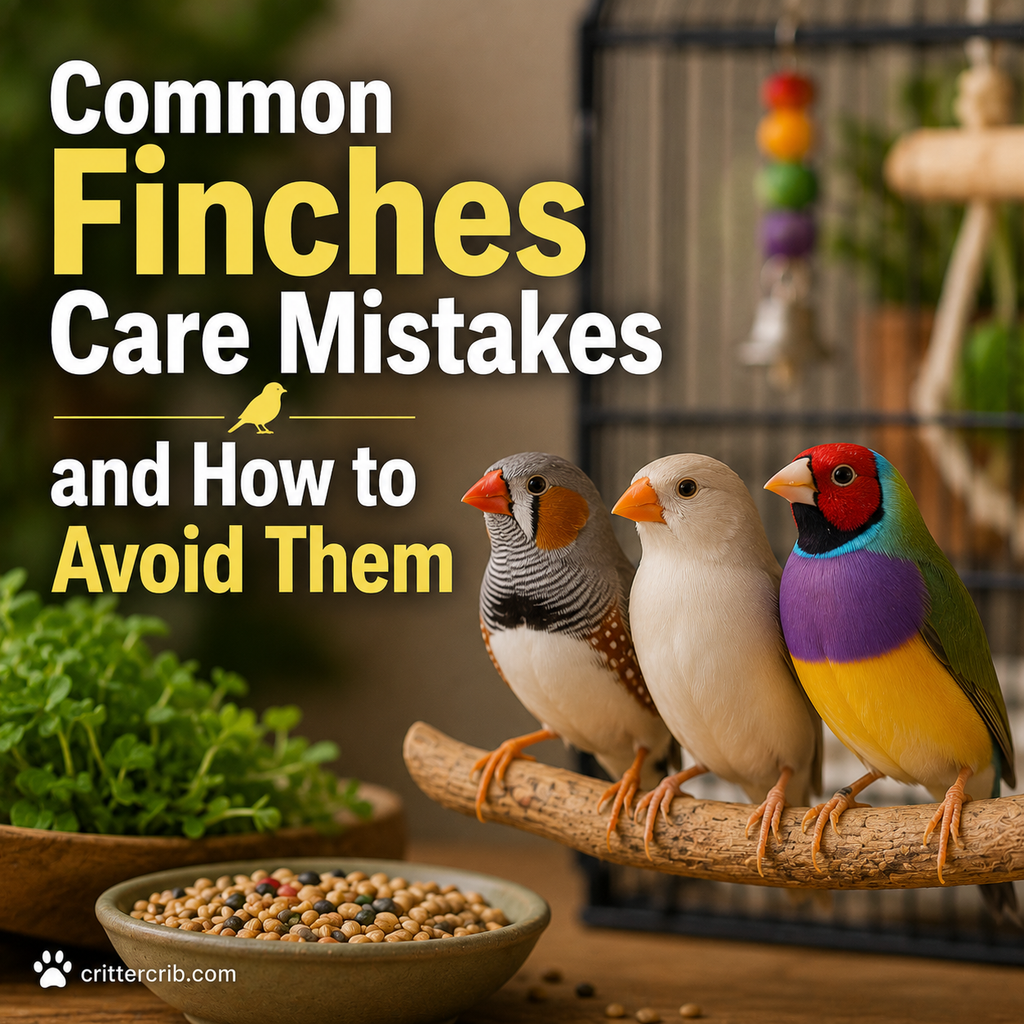
Finches have a reputation for being relatively easy pet birds. They don’t usually demand the same hands-on attention as many parrots, and watching a small group hop, fly, chirp, and interact can be incredibly enjoyable.
But easy doesn’t mean maintenance-free.
Some of the most common finch care mistakes happen because these little birds are treated as decorative cage pets rather than active, social animals with specific needs. A cage that’s too small, an unbalanced diet, poor air quality, or a lack of companionship can all affect their well-being.
The good news is that many problems are preventable.
Whether you’re bringing home your first finches or reviewing your current setup, here are the most common finch care mistakes and what you can do instead.
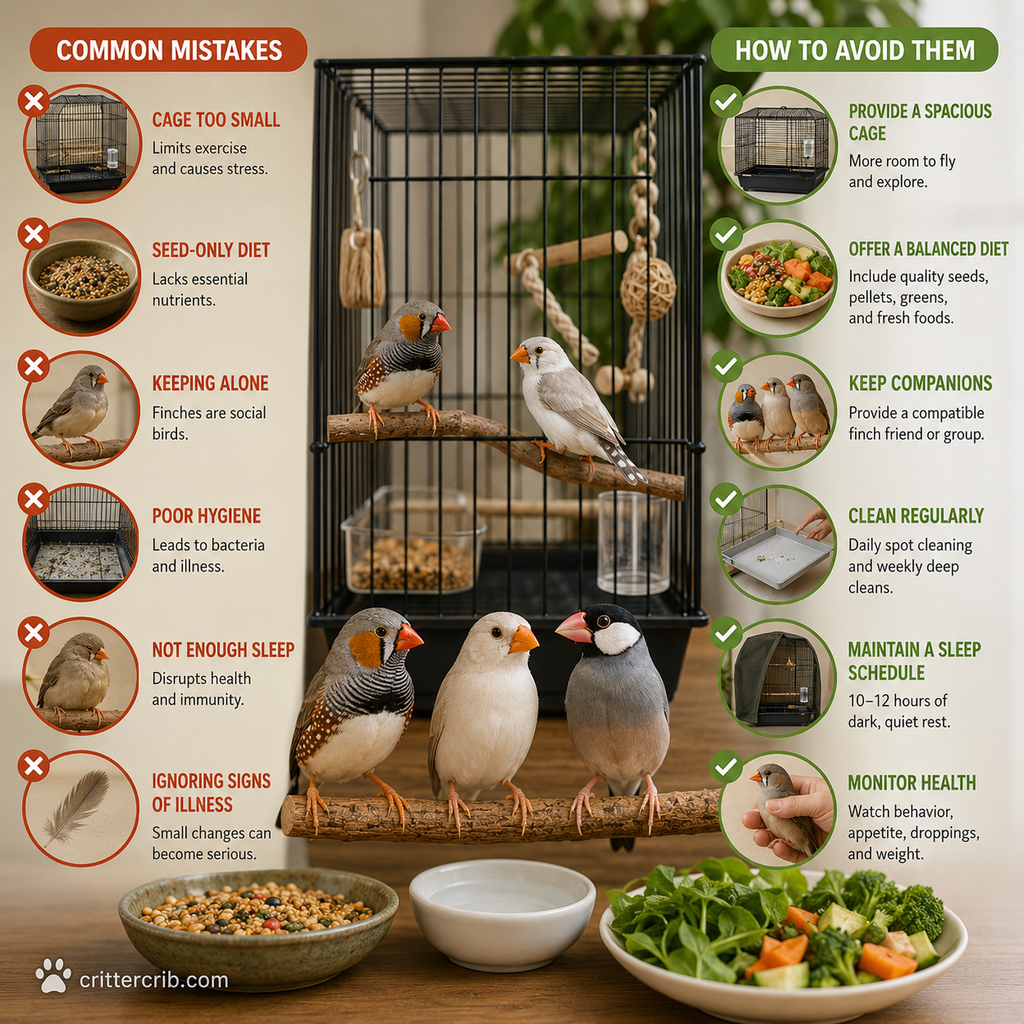
1. Choosing a Cage That’s Too Small
One of the biggest mistakes beginners make is buying a cage based on the size of the bird.
Finches are tiny, so a tiny cage might seem reasonable.
It isn’t.
Finches are active flyers and benefit from moving horizontally between perches. A cramped cage can severely limit their ability to exercise.
What to Do Instead
Choose the largest appropriately designed cage you can reasonably accommodate.
Prioritize width over excessive height. A long flight cage generally provides more useful exercise space than a tall, narrow cage.
The cage should have:
- Safe bar spacing
- Plenty of horizontal movement space
- Secure doors
- Bird-safe materials
- Room for perches without blocking flight paths
- Enough space for every bird to move comfortably
If you’re keeping multiple finches, cage size becomes even more important.
2. Filling the Cage With Too Many Accessories
Once you buy a large cage, it’s tempting to fill it with perches, swings, toys, ladders, dishes, and decorations.
Eventually, you’ve created a beautiful cage with nowhere to fly.
Finches need open space.
What to Do Instead
Think of the center of the cage as a miniature flight path.
Place many perches toward opposite ends so the birds can fly between them rather than simply hopping from one perch to another.
Keep accessories useful and intentional.
A simpler cage with plenty of movement space is often better than an elaborate setup packed with objects.
3. Using Only Smooth Dowel Perches
Many cages include smooth wooden dowels.
They’re inexpensive and easy to clean, but identical dowels shouldn’t be the only surfaces your finches stand on.
Birds spend much of their lives on their feet. Perches with different shapes and diameters allow their feet to rest in different positions.
What to Do Instead
Provide a selection of appropriately sized natural bird-safe branches and other suitable perches.
Aim for variety in:
- Diameter
- Shape
- Texture
- Position
Avoid placing every perch at exactly the same height.
Also avoid putting perches directly above food or water dishes, where droppings can contaminate them.
4. Keeping a Finch Alone Without Enough Social Interaction
Most commonly kept finches are highly social birds.
Unlike a hand-raised parrot that may form a close social relationship with its owner, many finches are more interested in other finches than in being handled by people.
Keeping a social finch completely alone can deprive it of normal companionship.
What to Do Instead
Research the particular finch species you’re considering and its social needs.
Many commonly kept species, including zebra finches and society finches, generally do well with compatible companions.
However, don’t simply put unfamiliar birds together.
Introductions, sex ratios, cage size, species compatibility, and individual personalities all matter.
Provide enough space and resources so birds can move away from one another when they want to.
5. Assuming Every Finch Will Get Along
The opposite mistake is assuming that because finches are social, any combination of birds will live peacefully together.
They won’t.
Finches can compete over:
- Food
- Nesting areas
- Favorite perches
- Mates
- Territory
Some species are more compatible than others, and breeding behavior can change social dynamics.
What to Do Instead
Research compatibility before housing different species or unfamiliar birds together.
Watch for:
- Persistent chasing
- Feather pulling
- Blocking access to food
- Repeated attacks
- A bird hiding constantly
- One bird being driven away from perches
Occasional squabbles aren’t necessarily unusual.
Persistent harassment is different and may require separating birds.
6. Feeding Only Seeds
A bowl filled with seed looks like natural bird food, which makes a seed-only diet an easy mistake to make.
Finches certainly eat seeds.
But relying entirely on a commercial seed mixture may not provide balanced nutrition.
What to Do Instead
Talk with an avian veterinarian about an appropriate diet for your finch species.
Depending on the species, a balanced feeding plan may include:
- An appropriate formulated diet
- Suitable seeds
- Fresh greens
- Bird-safe vegetables
- Other species-appropriate foods
Different finches can have different nutritional requirements, so avoid assuming that one generic “finch food” is perfect for every species.
Fresh drinking water should always be available.
7. Changing the Diet Too Quickly
Learning that a seed-only diet may be inadequate sometimes leads owners to make the opposite mistake.
They throw away the seeds and replace them with pellets overnight.
The birds may not recognize the new food as something they’re supposed to eat.
What to Do Instead
Make dietary changes gradually.
Monitor whether your finches are actually eating rather than simply checking whether food is present in the dish.
Small birds can deteriorate quickly if they stop eating.
If you’re changing a long-established diet, work with an avian veterinarian and monitor body weight when appropriate.
8. Leaving Fresh Food in the Cage Too Long
Fresh greens and vegetables can add variety to the diet, but they don’t stay fresh indefinitely.
Warm, moist food can spoil.
What to Do Instead
Offer reasonable portions and remove perishable foods before they become spoiled or heavily contaminated.
How quickly food needs to be removed depends on what you’re serving and the environmental conditions.
Wash produce before offering it.
Clean fresh-food dishes after use rather than continually adding new food on top of old residue.
9. Not Providing Fresh Water Often Enough
A water dish can look reasonably clean from across the room while containing seed hulls, food particles, droppings, or bathing debris.
Finches may also decide their drinking dish is an excellent bathtub.
What to Do Instead
Provide clean, fresh drinking water every day and replace it sooner whenever it becomes contaminated.
Wash the dish regularly.
If your birds constantly bathe in their drinking water, consider providing a separate bath.
Even then, check the drinking water frequently.
10. Poor Food and Water Bowl Placement
You can clean a dish perfectly and then accidentally position it underneath a favorite perch.
The birds will handle the rest.
What to Do Instead
Look at the cage vertically.
Don’t place food or water directly below areas where birds frequently perch.
Also make sure dishes are positioned where all birds can access them.
In multi-bird cages, more than one feeding location can help reduce competition.
11. Neglecting Cage Cleaning
Finches produce plenty of waste for such small birds.
Seed hulls, feathers, droppings, food scraps, and bath water can accumulate surprisingly quickly.
What to Do Instead
Develop a simple cleaning routine.
Daily tasks might include:
- Refreshing water
- Washing dirty dishes
- Removing spoiled fresh food
- Checking the cage liner
- Cleaning obvious messes
Regularly replace the cage liner and clean dirty perches and accessories.
Periodically perform a deeper cleaning of the cage.
Use bird-safe cleaning methods and avoid exposing your birds to harsh fumes.
12. Using Unsafe Cage Litter
Decorative cage substrates can look attractive, but simple is often better.
Some materials can make it difficult to monitor droppings or may become problematic if ingested.
What to Do Instead
Plain paper makes a practical cage liner.
It’s inexpensive, easy to replace, and lets you see droppings clearly.
Changes in droppings can sometimes provide an early clue that something isn’t right.
13. Keeping Finches in the Kitchen
A kitchen may seem like a social, convenient place for a bird cage.
It’s also full of potential hazards.
Cooking creates heat, steam, smoke, grease, and fumes.
Birds have extremely sensitive respiratory systems.
What to Do Instead
Keep the cage away from cooking areas.
Choose a room with:
- Clean air
- Stable temperatures
- Natural household activity
- Protection from drafts
- Appropriate light
- Quiet nighttime conditions
Your birds should be able to observe household life without being exposed to kitchen hazards.
14. Exposing Finches to Smoke and Strong Fragrances
A cage can be spotless and still be unhealthy if the surrounding air is contaminated.
Potential respiratory irritants and hazards include:
- Cigarette smoke
- Vaping aerosols
- Scented candles
- Incense
- Aerosol sprays
- Strong cleaning products
- Paint fumes
- Essential oil diffusers
- Cooking smoke
- Overheated nonstick cookware
What to Do Instead
Prioritize clean air throughout the home, especially in the room where your birds live.
Don’t spray fragrances or cleaning chemicals around the cage.
Remember that a product smelling pleasant to you doesn’t mean it’s safe for a bird to inhale.
15. Putting the Cage Directly in a Draft
Fresh air is good.
A constant blast from an air-conditioning vent isn’t.
Cages placed directly beside vents, fans, exterior doors, or drafty windows can expose birds to rapid temperature changes.
What to Do Instead
Keep the cage in a location with relatively stable household temperatures.
Avoid direct airflow from:
- Air conditioners
- Heating vents
- Fans
- Drafty windows
- Frequently opened exterior doors
You don’t need to keep healthy finches in an unusually hot room.
Comfortable, stable indoor conditions are more important than constantly trying to make the room warmer.
16. Putting the Cage in Constant Direct Sunlight
Sunlight can make a cage look cheerful, but a cage sitting in strong direct sunlight can heat up surprisingly quickly.
A bird trapped inside can’t simply fly to another tree for shade.
What to Do Instead
Natural daylight is useful, but make sure your birds always have somewhere shaded and comfortable.
Watch how sunlight moves through the room during the day.
A location that’s shaded at 8 a.m. may be in intense sun by noon.
17. Not Giving Finches Enough Sleep
Birds need a consistent day-and-night cycle.
A cage in a room where lights, televisions, conversations, and activity continue late into the night can interfere with rest.
What to Do Instead
Aim for roughly 10 to 12 hours of quiet, darkness, and uninterrupted rest each night for many pet finches.
Maintain a consistent schedule.
If the main room stays active late, consider whether a quieter sleeping location would work better.
18. Trying to Handle Finches Like Parrots
Many finches are primarily birds to observe rather than birds that enjoy being picked up and cuddled.
Repeatedly chasing a finch around the cage to catch it can be extremely stressful.
What to Do Instead
Interact on the bird’s terms.
You can build familiarity by:
- Moving calmly around the cage
- Talking softly
- Keeping a predictable routine
- Offering food and enrichment
- Avoiding unnecessary grabbing
Handling may sometimes be necessary for health care, cage transfers, or emergencies.
Routine forced handling for entertainment generally isn’t necessary.
19. Chasing a Finch Around the Cage
When you do need to catch a finch, repeatedly pursuing it around a large cage can cause panic.
A frightened bird may collide with cage bars or exhaust itself.
What to Do Instead
Learn safe handling techniques before an emergency occurs.
Ask an avian veterinarian to demonstrate how to safely restrain a small bird when necessary.
Minimize the duration of restraint and keep the environment calm.
Never squeeze the bird’s chest, since birds need chest movement to breathe normally.
20. Providing Nesting Materials Without Understanding the Consequences
A cute little nest can seem like an obvious cage accessory.
But providing nests and nesting materials can encourage breeding behavior.
That can introduce additional concerns involving:
- Egg laying
- Territorial behavior
- Fighting
- Chick care
- Nutritional demands
- Reproductive health problems
What to Do Instead
Don’t provide nests simply because they look comfortable.
Most healthy adult finches can sleep on perches.
If you intend to breed finches, research breeding requirements carefully and consult an avian veterinarian about reproductive health and nutrition.
21. Ignoring Chronic Egg Laying
Female finches can sometimes produce eggs even when you aren’t intentionally breeding them.
Repeated egg production can place substantial demands on the bird’s body.
What to Do Instead
If a female is repeatedly laying eggs, discuss the situation with an avian veterinarian.
Don’t simply remove every egg immediately without understanding how that may influence further laying in some birds.
A veterinarian can help you evaluate diet, environmental triggers, calcium status, and reproductive management.
22. Assuming a Quiet Finch Is Just Relaxed
Finches are prey animals and may hide signs of illness.
A bird that becomes unusually quiet isn’t necessarily enjoying a peaceful afternoon.
What to Do Instead
Learn your birds’ normal routines.
Pay attention to changes in:
- Activity
- Appetite
- Vocalization
- Droppings
- Breathing
- Posture
- Weight
- Social behavior
A bird that’s persistently fluffed up, weak, sitting low, or spending unusual amounts of time on the cage floor needs attention.
23. Waiting Too Long to Contact a Veterinarian
Because finches are small and good at hiding illness, waiting several days to “see what happens” can be risky.
Small birds have limited reserves and can decline quickly.
What to Do Instead
Find an avian veterinarian before you have an emergency.
Potential warning signs include:
- Persistent fluffing
- Difficulty breathing
- Tail bobbing with breathing
- Loss of appetite
- Weight loss
- Weakness
- Unusual droppings
- Discharge around the eyes or nostrils
- Difficulty perching
- Sitting on the cage floor
- Sudden behavioral changes
Contact an avian veterinarian promptly when you notice concerning symptoms.
24. Not Monitoring Body Weight
Feathers can hide changes in body condition.
A finch may lose weight before it looks noticeably thinner.
What to Do Instead
Ask your avian veterinarian whether routine weighing is appropriate for your birds and how to do it safely.
A small gram scale can help track trends.
The important thing isn’t comparing your bird with a random number online.
It’s noticing meaningful changes from its normal weight.
25. Assuming Finches Don’t Need Enrichment
Finches may not play with toys exactly like parrots, but that doesn’t mean they should live in a bare cage.
They benefit from opportunities to move, explore, bathe, forage, and interact socially.
What to Do Instead
Provide enrichment appropriate for your species.
Options may include:
- Flight space
- Natural perches
- Bathing opportunities
- Safe swings
- Simple foraging
- Fresh greens
- Visual variety
- Compatible companions
Avoid cluttering the cage.
For finches, space to fly is itself one of the most valuable forms of enrichment.
26. Not Providing Bathing Opportunities
Many finches enjoy bathing regularly.
Watching a group of finches take turns splashing in a bath can also be one of the more entertaining parts of keeping them.
What to Do Instead
Offer a shallow, appropriately sized bird bath with clean water.
Remove it if the water becomes heavily contaminated.
Keep the room comfortably warm while birds dry and avoid exposing wet birds to direct drafts.
27. Letting Other Pets Have Access to the Cage
A cat staring at a finch cage may look harmless.
From the finch’s perspective, there’s a predator sitting outside its home.
Even if the cage prevents direct contact, constant stalking can create stress.
And if the bird escapes, the situation can become dangerous immediately.
What to Do Instead
Keep the cage somewhere dogs and cats can’t:
- Knock it over
- Reach through the bars
- Jump onto it
- Constantly stalk the birds
Never allow direct interaction between finches and predator pets.
Even a small scratch or bite can become a medical emergency.
28. Adding New Birds Without Quarantine
Bringing home a new finch and immediately placing it with your existing birds can expose the entire group to disease.
A bird can appear healthy while carrying an illness.
What to Do Instead
Have new birds evaluated by an avian veterinarian and follow appropriate quarantine procedures before introducing them to established birds.
Quarantine generally involves keeping the new bird in a separate area for a period recommended by your veterinarian.
Use separate equipment and practice good hygiene between groups.
29. Introducing New Finches Too Quickly
Even after health concerns have been addressed, don’t assume birds should immediately share a cage.
What to Do Instead
Introduce birds gradually.
Depending on the species and individuals, this may involve:
- Keeping birds in separate cages.
- Allowing them to become accustomed to one another from a safe distance.
- Moving cages closer gradually.
- Watching behavior carefully.
- Providing a spacious shared environment only when appropriate.
Have a backup cage available in case the birds don’t get along.
30. Assuming “Low Maintenance” Means No Daily Care
Finches don’t generally need hours of direct human interaction.
That’s one reason they appeal to many people.
But they still require daily attention.
What to Do Instead
Every day, check:
- Food
- Water
- Droppings
- Bird activity
- Breathing
- Cage condition
- Room temperature
- General behavior
Spend a few minutes simply observing your birds.
Because finches can hide illness, quiet observation is an important part of responsible care.
A Simple Daily Finch Care Routine
Good finch care doesn’t have to be complicated.
A basic daily routine might look like this:
Morning
- Check every bird
- Refresh drinking water
- Provide appropriate food
- Remove dirty dishes
- Offer fresh foods as appropriate
- Check the cage liner
During the Day
- Observe activity and social behavior
- Check food and water
- Offer bathing opportunities
- Make sure the environment remains comfortable
Evening
- Remove spoiled fresh foods
- Check birds again
- Clean obvious messes
- Prepare the room for quiet sleep
Consistency makes it much easier to notice when something changes.
Frequently Asked Questions About Finch Care Mistakes
Are Finches Easy to Care For?
Finches can be relatively manageable compared with many parrots, but they still need proper housing, nutrition, companionship, cleaning, enrichment, and veterinary care.
They’re not maintenance-free pets.
Can You Keep Just One Finch?
It depends on the species and individual circumstances, but many commonly kept finches are highly social and generally benefit from compatible bird companionship.
Research the needs of your particular species.
Is a Seed-Only Diet Good for Finches?
A seed-only diet may not provide complete nutrition.
Dietary requirements vary by species, so ask an avian veterinarian about an appropriate combination of formulated food, seeds, greens, vegetables, and other suitable foods.
Do Finches Need Toys?
Finches benefit from enrichment, although they may not interact with toys like parrots do.
Flight space, natural perches, bathing, foraging opportunities, swings, fresh greens, and social interaction can all provide stimulation.
How Often Should a Finch Cage Be Cleaned?
Food and water should be checked daily, spoiled food removed promptly, and obvious messes cleaned as needed.
Cage liners should be changed regularly, with deeper cage cleaning performed whenever necessary to maintain sanitary conditions.
Should Finch Cages Be Covered at Night?
A cover isn’t mandatory if the room already provides a quiet, dark, comfortable sleeping environment.
If you use one, maintain adequate ventilation and make sure the material can’t create an entanglement hazard.
Do Finches Need an Avian Veterinarian?
Yes.
Birds have unique anatomy and medical needs, so a veterinarian experienced with avian patients is preferable.
Locate one before an emergency happens.
Why Is My Finch Sitting on the Cage Floor?
A finch spending unusual amounts of time on the cage floor can be a sign of illness or weakness, particularly if accompanied by fluffing, appetite changes, breathing problems, or reduced activity.
Contact an avian veterinarian promptly if the behavior is unusual for your bird.
Final Thoughts
Most common finch care mistakes don’t happen because owners don’t care.
They happen because these tiny birds can look much simpler to keep than they really are.
The biggest misconception is treating a finch like a decorative bird that only needs a small cage, seed, and water.
Finches need space to fly. They need appropriate nutrition, clean water, safe perches, good air quality, regular sleep, enrichment, and—for many species—compatible companionship.
They also need you to pay attention.
You don’t have to handle your finches every day or constantly entertain them. In fact, many finches would much rather interact with other birds while you watch from nearby.
But observing them is important.
Learn which perch each bird prefers. Notice how much they eat, when they sing, how they interact, and what their normal droppings look like. Pay attention when a normally active bird suddenly becomes quiet or when one bird starts avoiding the rest of the group.
Those small changes can matter.
Give your finches enough room, keep their environment clean and safe, provide a balanced lifestyle, and establish a relationship with an avian veterinarian before you need one.
Avoiding a handful of common mistakes can make a significant difference in creating a home where your finches can remain active, comfortable, and healthy.