Guppies are often described as hardy beginner fish, and for good reason. They can adapt to a range of aquarium conditions and generally aren’t as demanding as some tropical species.
Still, hardy doesn’t mean they can thrive in any environment.
Temperature plays an important role in a guppy’s health, activity level, digestion, immune function, and overall comfort. Keeping the water consistently within an appropriate range is one of the simplest things you can do to create a healthy guppy aquarium.
But what about humidity?
If you’ve searched for the ideal temperature and humidity for guppies, there’s an important distinction to understand: guppies live completely underwater, so the humidity of the room isn’t normally a husbandry requirement the way it is for reptiles, amphibians, or certain invertebrates.
For guppies, water temperature and water quality matter far more than air humidity.
Here’s what you need to know about maintaining comfortable, stable conditions for guppies throughout the year.
What Is the Ideal Temperature for Guppies?
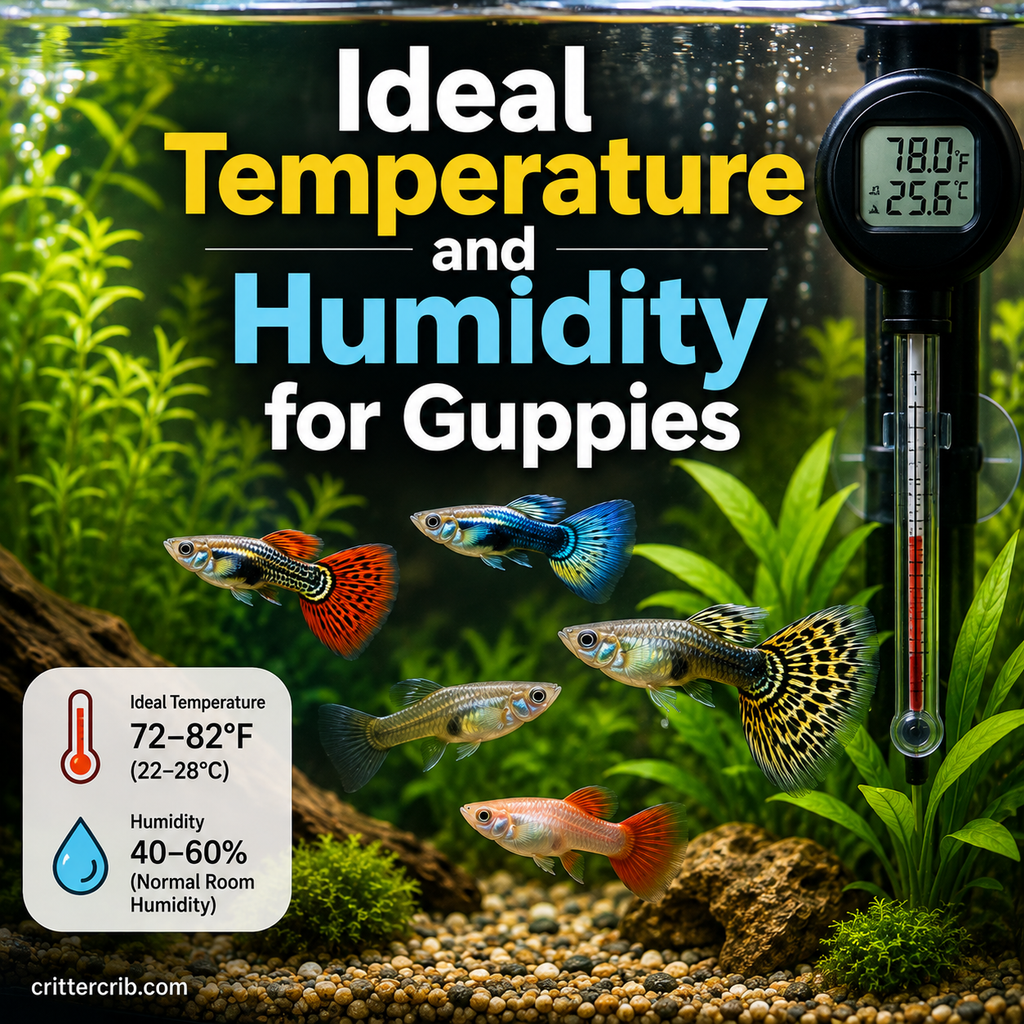
Guppies are tropical freshwater fish and generally do well in water temperatures of approximately 72–82°F (22–28°C).
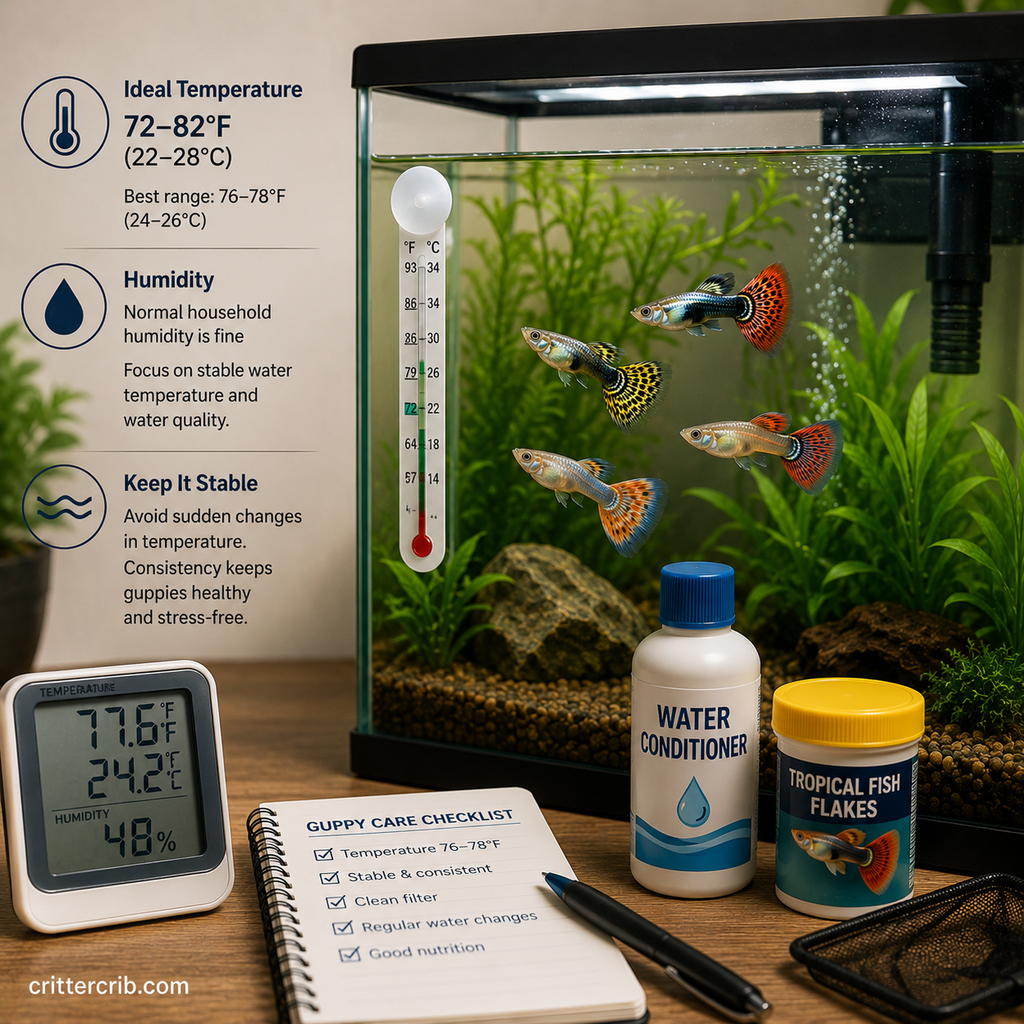
For most home guppy aquariums, aiming for roughly 76–78°F (24–26°C) provides a comfortable middle ground.
That range works well because it avoids pushing the fish toward either end of their temperature tolerance.
A practical target is:
- General acceptable range: 72–82°F (22–28°C)
- Good everyday target: 76–78°F (24–26°C)
- Avoid sudden temperature changes whenever possible
The exact temperature doesn’t need to remain fixed to a tenth of a degree.
What matters more is keeping the aquarium within a suitable range without frequent or dramatic fluctuations.
Why Water Temperature Matters for Guppies
Fish are ectothermic, which means their body temperature is largely influenced by the surrounding environment.
When aquarium water becomes warmer or cooler, a guppy’s metabolism responds accordingly.
Temperature can affect:
- Activity
- Appetite
- Digestion
- Growth
- Reproduction
- Immune function
- Oxygen requirements
- Overall stress
This is why temperature shouldn’t be treated as just another number on an aquarium care sheet.
It affects many aspects of your fish’s daily life.
Warmer Water Speeds Up Metabolism
As water temperature increases within a guppy’s tolerable range, its metabolism generally becomes faster.
You may notice warmer-water guppies appearing more active and eating more readily.
There is a downside to keeping the aquarium unnecessarily warm, though.
Higher temperatures increase metabolic demands while reducing the amount of dissolved oxygen that water can hold. Keeping guppies near the upper edge of their tolerable range all the time isn’t necessarily better simply because they’re tropical fish.
Cooler Water Slows Things Down
As temperatures fall, guppy metabolism slows.
The fish may become less active and show less interest in food.
Moderately cooler temperatures within an appropriate range aren’t automatically dangerous, but prolonged exposure to water that’s too cold can create stress and may make fish more vulnerable to health problems.
The goal isn’t to make the aquarium as warm as possible.
It’s to maintain an appropriate and stable tropical environment.
Do Guppies Need a Heater?
In many homes, yes.
A heater provides consistency.
Your house might stay around 75°F during the afternoon, but that doesn’t mean the aquarium remains at the same temperature overnight. Seasonal weather, air conditioning, open windows, heating systems, and the aquarium’s location can all cause changes.
A thermostatically controlled aquarium heater helps compensate for those fluctuations.
You should especially consider a heater if:
- Your home regularly falls below the desired aquarium temperature
- Room temperatures fluctuate significantly
- You use air conditioning
- The aquarium is near a window
- Winter temperatures noticeably cool the room
- You want more consistent breeding conditions
In an unusually warm climate or a temperature-controlled fish room, a heater may run very little.
Even then, monitoring the water temperature remains important.
What Size Heater Do Guppies Need?
Choose an aquarium heater based on the tank’s water volume and the difference between the room temperature and your desired water temperature.
Manufacturers generally provide recommended aquarium sizes for their heaters.
Common heater sizes include:
- 25 watts
- 50 watts
- 75 watts
- 100 watts
- 150 watts
- 200 watts and larger
Don’t automatically buy the most powerful heater available.
An appropriately sized, reliable heater is a better choice.
For example, a small guppy aquarium may only require a modest heater, while a larger aquarium in a cool room could require considerably more heating capacity.
If you’re uncertain, check the manufacturer’s tank-size recommendations for the specific heater you’re considering.
Always Use an Aquarium Thermometer
A heater’s thermostat shouldn’t be your only source of temperature information.
Use a separate aquarium thermometer.
This allows you to verify the actual water temperature and catch problems such as:
- A malfunctioning heater
- Unexpectedly cold water
- Excessively warm water
- Seasonal temperature changes
- Temperature swings between day and night
Digital thermometers are convenient, while traditional aquarium thermometers can work perfectly well too.
Place the thermometer where it gives you a representative reading rather than directly against the heater.
Get into the habit of glancing at it whenever you feed your fish.
It takes only a second and can help you catch equipment problems early.
Is 78°F Good for Guppies?
Yes.
Around 78°F (26°C) is an excellent general-purpose temperature for many guppy aquariums.
It’s comfortably within their tropical range without being excessively warm.
This temperature can work particularly well for a community aquarium containing other tropical fish with similar temperature requirements.
However, don’t become overly concerned if the aquarium moves slightly above or below 78°F.
A stable temperature of 76°F, for example, is generally preferable to an aquarium repeatedly swinging between much cooler and warmer temperatures.
Is 72°F Too Cold for Guppies?
Around 72°F (22°C) is near the cooler end of a commonly recommended guppy range.
Healthy guppies may tolerate it, particularly when the temperature is stable.
However, if you’re setting up a typical tropical guppy aquarium, there’s usually little reason to intentionally keep the water that cool.
A somewhat warmer target around 76–78°F provides more breathing room if the room temperature drops unexpectedly.
If your aquarium regularly falls below 72°F, consider using or adjusting an aquarium heater.
Is 82°F Too Hot for Guppies?
Approximately 82°F (28°C) is toward the warm end of the typical guppy range.
Guppies can tolerate warm conditions, but continuously maintaining the aquarium at the upper end isn’t usually necessary.
Warm water creates another concern: oxygen.
As water temperature rises, its ability to hold dissolved oxygen decreases. At the same time, a fish’s metabolism and oxygen demand may increase.
If your aquarium becomes unusually warm, watch for signs that your fish may be struggling and make sure there is adequate surface agitation.
Can Guppies Survive Without a Heater?
Sometimes.
If your home naturally maintains the aquarium within an appropriate temperature range throughout the day and night, guppies may not require active heating.
The important number is the water temperature, not what the thermostat on your wall says.
An aquarium can behave differently from the surrounding room depending on:
- Tank size
- Lighting
- Location
- Nearby windows
- Air-conditioning vents
- Sun exposure
- Aquarium equipment
- Day-and-night temperature changes
Instead of deciding that guppies don’t need a heater because you live somewhere warm, measure the aquarium temperature for several days.
Check it in the morning, afternoon, evening, and after the coolest part of the night.
That gives you a much clearer picture.
Temperature Stability Is Just as Important
Beginners often focus on finding the perfect temperature while overlooking stability.
Guppies can tolerate a reasonable range, but sudden changes can be stressful.
Imagine an aquarium sitting at 77°F all week and then suddenly dropping several degrees because of a cold night or a large water change with cool tap water.
The final temperature might still appear to be within a survivable range, but the rapid transition is the problem.
Try to prevent major fluctuations caused by:
- Large water changes with mismatched water temperatures
- Heater failures
- Direct sunlight
- Air-conditioning vents
- Open windows
- Moving the aquarium
- Sudden seasonal weather changes
A stable aquarium environment is generally easier on fish than one that’s constantly changing.
Match Temperature During Water Changes
Water changes are one of the easiest times to accidentally create a temperature swing.
When replacing aquarium water, try to get the new water reasonably close to the temperature of the existing tank water.
It doesn’t have to be laboratory-perfect.
You simply want to avoid dumping a large volume of dramatically colder or hotter water into the aquarium.
Always treat replacement tap water with an appropriate aquarium water conditioner as well.
A thermometer can be helpful when preparing replacement water, particularly during winter when tap water may be much colder.
What Humidity Do Guppies Need?
Guppies don’t require a specific room humidity level.
They live underwater, so environmental humidity isn’t managed for them in the same way it would be for an animal living in a terrarium.
You don’t need to:
- Mist the aquarium
- Install a humidifier for your guppies
- Measure room humidity specifically for the fish
- Maintain tropical rainforest humidity around the tank
A normal household humidity level is generally fine.
What matters to your guppies is the environment inside the aquarium.
That includes water temperature, water chemistry, oxygenation, cleanliness, and overall stability.
Does Room Humidity Affect a Guppy Aquarium at All?
Humidity can indirectly affect an aquarium, but usually not in a way that requires you to manage it specifically for guppy health.
The most noticeable effect involves evaporation.
When indoor air is particularly dry, aquarium water may evaporate faster. Warm water, strong airflow, and an uncovered tank can increase evaporation as well.
This can cause the water level to gradually fall.
Higher humidity may slow evaporation.
Evaporation Doesn’t Remove Waste
This is an important distinction.
When aquarium water evaporates, the water disappears into the air, but many dissolved substances remain behind.
Adding fresh water to replace evaporation is called topping off the aquarium.
A top-off is not the same thing as a water change.
Regular partial water changes are still necessary to manage nitrate and other accumulated substances.
Should a Guppy Tank Have a Lid?
A lid can be useful for several reasons.
Guppies are capable of jumping, so covering the aquarium helps prevent accidental escapes.
A lid can also:
- Reduce evaporation
- Keep dust and debris out
- Help stabilize temperature
- Protect fish from curious pets
- Reduce the chance of objects falling into the aquarium
Don’t seal the aquarium completely airtight.
Normal gas exchange between the water and surrounding air remains important.
Most aquarium lids and hoods are designed with this in mind.
What Happens If Guppy Water Gets Too Cold?
Guppies exposed to excessively cold water may become less active as their metabolism slows.
Possible signs of temperature-related stress can include:
- Reduced activity
- Poor appetite
- Spending unusual amounts of time in one area
- Clamped fins
- Lethargic behavior
- Increased susceptibility to illness
These signs aren’t specific to temperature problems.
Poor water quality, disease, bullying, and other stressors can produce similar behavior.
That’s why checking the thermometer and testing the water are good first steps whenever something seems wrong.
What Happens If Guppy Water Gets Too Hot?
Excessive heat can also cause stress.
You may notice:
- Rapid gill movement
- Increased breathing
- Fish gathering near areas with stronger water movement
- Reduced appetite
- Unusual swimming behavior
- Lethargy
Very warm water contains less dissolved oxygen, which can make overheating particularly dangerous.
If you suspect excessive temperature, confirm it with a thermometer rather than guessing.
How to Cool a Guppy Tank Safely
Hot weather can sometimes push an aquarium above its normal range.
If the water becomes too warm, avoid making drastic temperature changes.
Instead, you can:
- Turn off unnecessary aquarium lights.
- Keep the aquarium away from direct sunlight.
- Improve air circulation in the room.
- Increase surface agitation when appropriate.
- Use a fan to blow across the water’s surface if additional cooling is necessary.
- Monitor the temperature closely.
Removing the aquarium lid temporarily can increase evaporative cooling, but only do this when there’s no risk of fish jumping out, pets accessing the tank, or objects falling into it.
Aquarium cooling fans are another option for homes that regularly become hot.
For severe or persistent heat, an aquarium chiller may be necessary, although that’s rarely required for a typical indoor guppy aquarium.
Avoid Sudden Ice-Cold Changes
Don’t try to rapidly cool an overheated aquarium by performing a huge water change with very cold water.
The sudden temperature drop can create additional stress.
If emergency cooling is necessary, lower the temperature gradually while monitoring the fish.
How to Keep a Guppy Tank Warm During Winter
Winter creates the opposite problem.
If your home becomes considerably cooler at night, make sure the aquarium heater is capable of maintaining your target temperature.
You can also:
- Keep the aquarium away from drafty windows
- Avoid placing it beside exterior doors
- Use an aquarium lid
- Check the thermometer morning and night
- Make sure the heater is appropriately sized
- Keep the tank away from cold exterior walls when practical
If a heater struggles continuously to maintain temperature, it may be undersized for the aquarium or room conditions.
Where You Put the Aquarium Matters
Tank location can have a surprisingly large effect on temperature stability.
Avoid putting your guppy aquarium directly:
- In front of a sunny window
- Under an air-conditioning vent
- Beside a heating vent
- Next to an exterior door
- Against particularly cold windows
- Near equipment that generates significant heat
Direct sunlight is especially troublesome.
Sunlight can heat the aquarium unevenly and encourage excessive algae growth.
A location with relatively stable room conditions makes maintaining the aquarium much easier.
Temperature and Oxygen Levels
Temperature and dissolved oxygen are closely connected.
Cooler water can generally hold more dissolved oxygen than warmer water.
This becomes especially important during hot weather.
Good surface movement helps oxygen enter the water and allows carbon dioxide to escape.
Your filter may provide enough surface agitation on its own.
Depending on the aquarium, you can also use:
- Sponge filters
- Air pumps
- Air stones
- Additional water circulation
Watch the fish rather than assuming more bubbles are automatically necessary.
If guppies suddenly begin gasping near the surface, check both temperature and water quality immediately.
Temperature Doesn’t Replace Good Water Quality
Perfect temperature won’t compensate for poor aquarium maintenance.
Guppies also need healthy water conditions.
For an established aquarium, aim for:
- Ammonia: 0 ppm
- Nitrite: 0 ppm
- Nitrate: kept under control with maintenance
- Stable pH appropriate for guppies
- Consistent temperature
- Adequate oxygenation
Guppies generally prefer moderately hard, neutral-to-alkaline freshwater rather than extremely soft, acidic conditions.
If your fish suddenly appear stressed despite having the correct temperature, test the water.
Ammonia or nitrite can cause serious problems even when the aquarium looks perfectly clean.
Temperature for Guppy Fry
Baby guppies, or fry, also benefit from stable tropical temperatures.
A range around 76–80°F (24–27°C) can work well for raising guppy fry.
Warmer temperatures can increase metabolism and growth rates, but don’t assume hotter is always better.
Fry still need:
- Clean water
- Appropriate food
- Good oxygenation
- Stable water parameters
- Gentle filtration
- Protection from adult fish that may eat them
A sponge filter is commonly used in fry tanks because it provides biological filtration without a powerful intake that could trap tiny fish.
Temperature for Breeding Guppies
Guppies have a reputation for reproducing easily.
They’re livebearers, meaning females give birth to free-swimming young rather than laying eggs.
For breeding groups, temperatures around 76–80°F generally provide suitable conditions.
But temperature alone doesn’t create healthy breeding conditions.
Good nutrition, water quality, appropriate male-to-female ratios, adequate space, and low stress are equally important.
Remember that guppies can reproduce quickly.
Before intentionally breeding them, make sure you have a plan for potentially dozens of fry and the additional aquarium capacity they’ll require.
Do Different Types of Guppies Need Different Temperatures?
Most domestic guppy varieties have broadly similar temperature requirements.
Whether you keep:
- Fancy guppies
- Cobra guppies
- Tuxedo guppies
- Mosaic guppies
- Dumbo ear guppies
- Endler-influenced guppy strains
you’ll generally be working within a similar tropical temperature range.
Individual strains can vary somewhat in hardiness, particularly heavily line-bred fancy varieties.
Rather than trying to adjust temperature based primarily on color or tail shape, focus on obtaining healthy fish and providing stable, high-quality water.
How Often Should You Check the Temperature?
You don’t need to spend all day staring at the thermometer.
A quick daily check is usually sufficient in a stable aquarium.
It’s particularly useful to check:
- During feeding
- After water changes
- During heat waves
- During cold weather
- After installing a new heater
- After a power outage
- When fish behave unusually
If you use a digital thermometer with high- and low-temperature memory, you may also be able to see whether the aquarium fluctuated while you weren’t watching.
Power Outages and Guppy Temperature
Power outages can become a problem because aquarium heaters and filters stop working.
How quickly the water cools depends on the tank size, room temperature, and duration of the outage.
Larger aquariums usually change temperature more slowly than very small ones.
During a cold-weather outage:
- Keep the aquarium covered with its lid.
- Avoid unnecessarily opening the tank.
- Reduce heat loss around the aquarium when safe to do so.
- Monitor the water temperature.
- Avoid feeding heavily while filtration is unavailable.
Never place unsafe heating devices directly against an aquarium.
If outages are common where you live, having an emergency aquarium plan can be worthwhile.
Guppy Temperature and Humidity Checklist
For a typical home guppy aquarium, keep things simple.
Temperature
- Aim for approximately 76–78°F for everyday care.
- Keep the aquarium within roughly 72–82°F.
- Use an aquarium heater when room temperature isn’t consistently adequate.
- Monitor the tank with a separate thermometer.
- Avoid rapid temperature swings.
- Match replacement water reasonably closely during water changes.
Humidity
- Guppies don’t require a specific room humidity.
- There’s generally no need for a humidifier or hygrometer for the fish.
- Dry air may increase aquarium evaporation.
- Replace evaporated water as needed.
- Continue performing regular water changes even when topping off the tank.
Overall Environment
- Maintain 0 ppm ammonia.
- Maintain 0 ppm nitrite.
- Keep nitrate under control.
- Provide appropriate filtration.
- Maintain good surface agitation and oxygenation.
- Keep the aquarium away from direct sunlight and temperature extremes.
Frequently Asked Questions About Guppy Temperature and Humidity
What Is the Best Temperature for Guppies?
For most home aquariums, approximately 76–78°F (24–26°C) is an excellent target.
Guppies can tolerate a broader range, but maintaining a stable middle-range temperature makes everyday care easier.
Can Guppies Live at 70°F?
Guppies may survive cooler temperatures for a period, but 70°F is below the range typically recommended for long-term tropical guppy care.
If your aquarium regularly sits around 70°F, consider adding an appropriately sized heater.
Can Guppies Live at 80°F?
Yes.
80°F is within a suitable range for guppies, although you should maintain good oxygenation and avoid allowing the aquarium to become excessively warm.
Do Guppies Need a Heater at Night?
If the aquarium would otherwise become too cool, yes.
A thermostatically controlled aquarium heater can remain plugged in continuously. It turns heating on and off as necessary to maintain its set temperature.
Don’t manually switch the heater off every night unless the manufacturer’s instructions specifically require something unusual.
What Humidity Level Is Best for Guppies?
There isn’t a specific humidity requirement for guppies because they’re fully aquatic fish.
Normal household humidity is generally fine. Focus instead on water temperature, water chemistry, filtration, and oxygenation.
Does a Guppy Tank Need a Hygrometer?
No.
A hygrometer measures humidity in the air and isn’t normally necessary for keeping guppies.
An aquarium thermometer and freshwater water-testing kit are far more useful.
Should I Keep My Guppy Tank at 78°F?
78°F is a very good temperature for most guppy aquariums.
If your fish are healthy and the temperature remains stable around that level, there’s usually no reason to constantly adjust it.
Final Thoughts
The ideal environment for guppies is easier to maintain than the phrase “temperature and humidity requirements” might make it sound.
For most guppy aquariums, aim for a stable water temperature around 76–78°F, while recognizing that healthy guppies can tolerate a somewhat broader range of roughly 72–82°F.
Use a reliable aquarium heater when necessary and always keep a separate thermometer in the tank so you know what the water is actually doing.
Humidity is much less important.
Because guppies live underwater, you don’t need to recreate tropical humidity around the aquarium or monitor the room with a hygrometer. Normal household humidity is generally fine. Its biggest practical effect will usually be how quickly water evaporates from the tank.
Ultimately, consistency matters more than chasing a perfect number.
Keep the water comfortably warm, avoid sudden temperature swings, maintain good filtration and water quality, and pay attention to how your fish behave. Those basic habits will do far more for your guppies than trying to control every tiny environmental fluctuation.