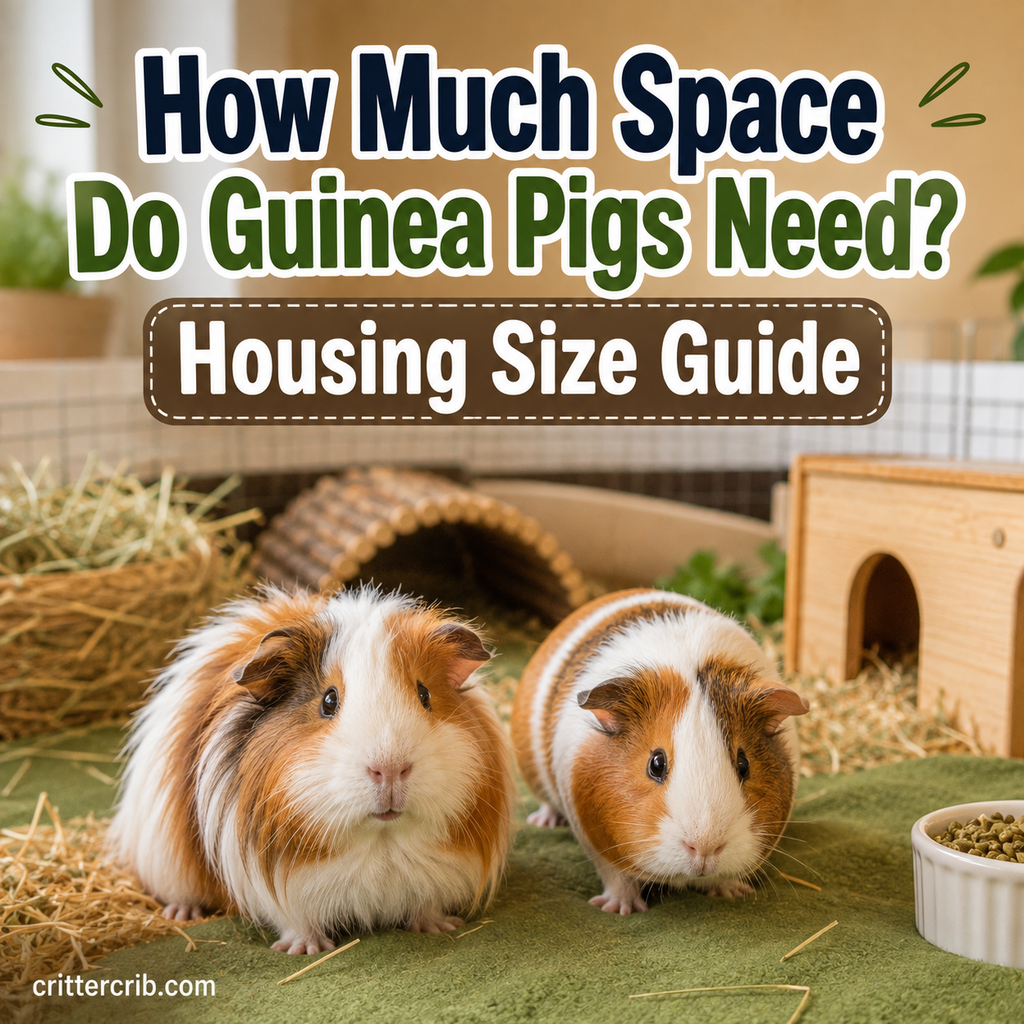
Guinea pigs might be small pets, but their housing needs can surprise new owners. A cage that looks reasonably large in a pet store can quickly feel cramped once you add a hideout, hay, food bowls, water bottles, and two energetic guinea pigs.
Unlike animals that make good use of vertical climbing space, guinea pigs spend almost all their time on the ground. That makes usable floor space especially important.
So, how much space do guinea pigs actually need?
As a general rule, you should provide at least 7.5 square feet of usable floor space for one or two guinea pigs, with larger enclosures strongly preferred. Groups of three or more need progressively more room, and males often benefit from additional space.
But square footage is only part of the story. The shape of the enclosure, number of guinea pigs, layout, and opportunities to exercise all affect how comfortable the habitat will be.
Here’s how to choose an appropriate guinea pig enclosure and make the most of the space you have.
Why Guinea Pigs Need More Space Than You Might Expect
Guinea pigs aren’t built for climbing tall structures. Their natural movement happens primarily across the ground.
They walk, run, forage, investigate their surroundings, retreat into shelters, and sometimes burst into energetic laps around the enclosure.
More floor space allows them to perform these behaviors without constantly running into cage accessories or one another.
Adequate space also makes it easier to create separate areas for:
- Sleeping
- Eating hay
- Drinking
- Exploring
- Hiding
- Resting
- Using the bathroom
This becomes even more important when you keep multiple guinea pigs together.
Two guinea pigs may get along wonderfully and still want some personal space.
Minimum Guinea Pig Cage Size at a Glance
A useful starting point is to think in terms of uninterrupted floor space.
Recommended minimums commonly used for guinea pig housing are:
- One guinea pig: at least 7.5 square feet
- Two guinea pigs: at least 7.5 square feet, although 10.5 square feet or more is preferable
- Three guinea pigs: around 10.5 square feet or larger
- Four guinea pigs: around 13 square feet or larger
Think of these numbers as starting points rather than ideal targets.
If you have room to go larger, your guinea pigs can benefit from it.
Bigger Is Usually Better
Providing more space gives guinea pigs more opportunities to move naturally and makes it easier to design an interesting environment.
Extra room is particularly valuable for:
- Male guinea pigs
- Young, energetic guinea pigs
- Larger groups
- Pairs that occasionally squabble
- Enclosures containing several hides and accessories
A bigger enclosure can also make your job easier because waste is distributed across a larger area rather than concentrated in a tiny cage.
How Much Space Do Two Guinea Pigs Need?
Two guinea pigs should generally have at least 7.5 square feet of usable floor space, but moving up to roughly 10.5 square feet or more is a much better target when possible.
For many owners, two guinea pigs are actually the starting point rather than one.
Guinea pigs are social animals and generally benefit from compatible companionship. That means it’s smart to plan your enclosure around the needs of a pair from the beginning.
An enclosure for two guinea pigs needs enough room for both animals to:
- Move around without constantly crossing paths
- Access food and water
- Retreat to separate hiding places
- Rest comfortably
- Run and explore
- Get away from each other when they want some space
The last point is particularly important.
Being social doesn’t mean wanting to be physically next to another guinea pig every minute of the day.
Do Male Guinea Pigs Need More Space?
Male guinea pigs, often called boars, can benefit significantly from extra room.
Two compatible males may live together successfully, but territorial disagreements can become more likely when resources and space are limited.
Providing more room allows each guinea pig to establish preferred areas without constantly competing for the same location.
For a male pair, aim beyond the bare minimum whenever possible.
You can also reduce competition by providing multiples of important resources, such as:
- More than one hideout
- Multiple hay areas
- More than one water source
- Multiple food access points
The enclosure should also have open pathways that allow one guinea pig to move away from the other.
How Much Space Do Three Guinea Pigs Need?
For three guinea pigs, approximately 10.5 square feet should be considered a starting point, with more space preferred.
Adding a third guinea pig changes the social dynamics of the group.
You aren’t simply squeezing another animal into the same setup. You’re creating an environment where three individuals need room to interact, rest, eat, and avoid each other when necessary.
If you’re planning to expand an existing pair into a trio, consider enlarging the enclosure before introducing the new guinea pig.
How Much Space Do Four Guinea Pigs Need?
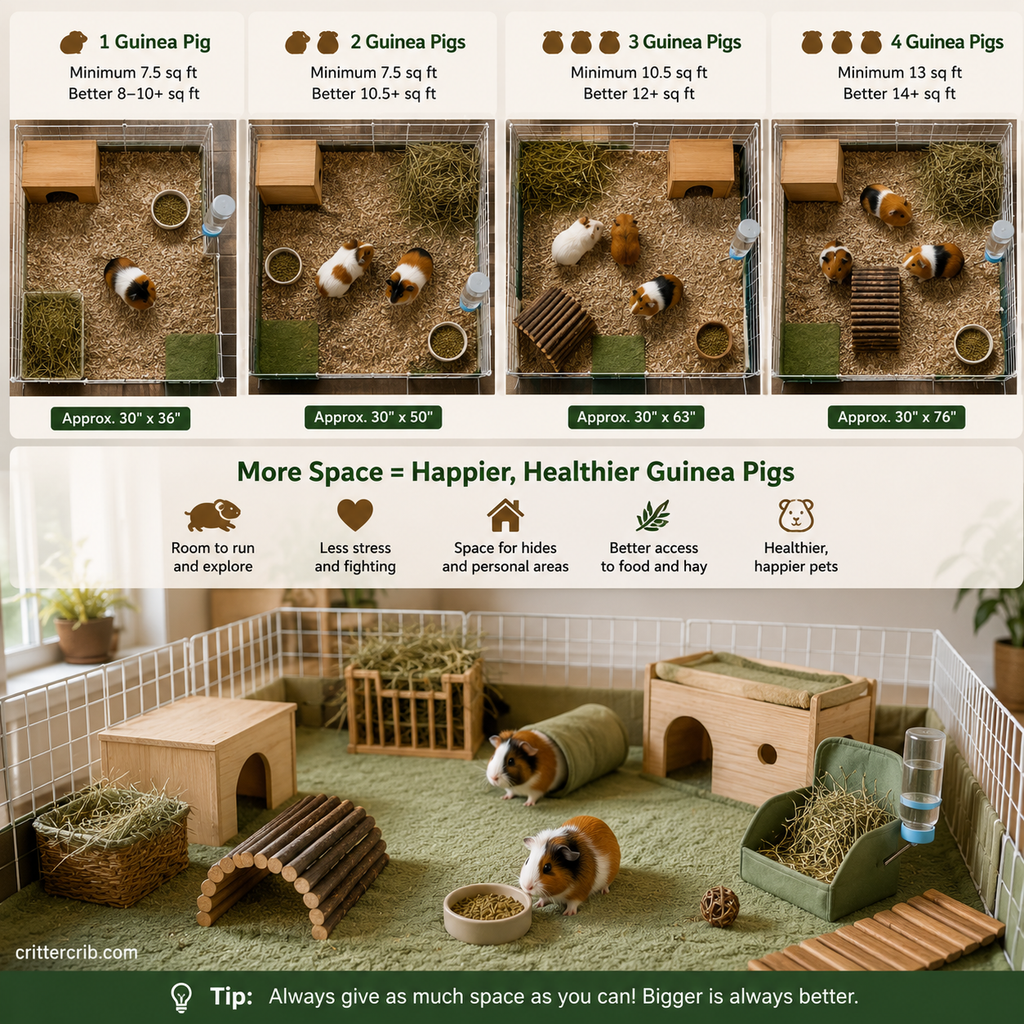
Four guinea pigs should have approximately 13 square feet of floor space or more.
Larger groups can benefit considerably from going beyond minimum recommendations.
You’ll need room not only for the guinea pigs themselves but also for additional:
- Hideouts
- Hay stations
- Water bottles
- Feeding areas
- Resting locations
Crowding four guinea pigs into a habitat originally designed for two can create unnecessary competition and stress.
Plan the enclosure around the final group size rather than trying to fit additional guinea pigs into whatever space happens to be available.
Why Floor Space Matters More Than Cage Height
When comparing enclosures, it’s easy to assume a taller cage automatically provides more living space.
For guinea pigs, that usually isn’t the case.
Guinea pigs aren’t natural climbers. They benefit much more from a long, wide enclosure than a narrow enclosure with several tall levels.
A cage could technically look huge because of its height while providing relatively little usable ground area.
Can Guinea Pigs Use Multiple Levels?
Yes, provided the levels are safely designed.
A loft can add variety and provide useful extra space for hay or resting. However, upper levels shouldn’t be used as a substitute for adequate main floor space.
Ramps should be:
- Wide enough for comfortable movement
- Stable
- Gently inclined
- Equipped with secure footing
- Protected against dangerous falls
Think of a loft as a bonus rather than a way to make an undersized cage acceptable.
Cage Shape Matters Too
Two enclosures can have similar square footage while functioning very differently.
Guinea pigs benefit from long stretches of open floor where they can move freely.
A simple rectangular enclosure is often easier to use effectively than a habitat broken into several tiny compartments.
Try to avoid layouts with excessive obstacles that force guinea pigs through narrow bottlenecks.
Your pets should be able to travel between important areas without repeatedly squeezing past one another.
What Is a C&C Cage?
C&C cages are popular among guinea pig owners because they can provide generous floor space and are relatively easy to customize.
“C&C” generally refers to cubes and coroplast.
Grid panels form the outer structure, while corrugated plastic is commonly used to create the enclosure base.
One advantage is flexibility. Depending on the available space, owners can create larger rectangular enclosures or expand an existing setup.
They’re also relatively easy to rearrange if your guinea pig group changes.
Common C&C Cage Configurations
You may see enclosure sizes described using terms such as:
- 2×3
- 2×4
- 2×5
- 2×6
These refer to the number of grid panels used along each side, not measurements in feet.
The exact dimensions can vary depending on the grids being used, so always calculate the actual interior floor dimensions rather than assuming a particular grid count automatically meets your needs.
Are Pet Store Guinea Pig Cages Big Enough?
Some are, but many traditional starter cages are smaller than ideal for long-term guinea pig housing.
Packaging can also be misleading.
A cage might be marketed for guinea pigs simply because a guinea pig physically fits inside it. That doesn’t necessarily mean it provides enough space for normal daily activity.
Before buying any enclosure, ignore the animal picture on the box and check the actual interior dimensions.
Calculate:
Length × Width = Floor Area
For example, an enclosure with an interior floor measuring 60 inches by 30 inches provides:
60 × 30 = 1,800 square inches
Divide by 144 to convert square inches to square feet:
1,800 ÷ 144 = 12.5 square feet
That tells you far more about the habitat than a label saying it’s suitable for “small animals.”
What Should Go Inside a Guinea Pig Enclosure?
Once you’ve chosen an appropriately sized enclosure, you’ll need to furnish it.
The goal is to provide necessities and enrichment without filling every available inch.
A good setup generally includes:
- Bedding or another appropriate floor covering
- Unlimited access to hay
- Water
- Food dishes as needed
- Hiding places
- Safe chew items
- Open areas for movement
Keep at least part of the enclosure relatively open.
A huge cage packed tightly with accessories can become surprisingly difficult to navigate.
How Many Hideouts Do Guinea Pigs Need?
Provide enough hiding opportunities for every guinea pig.
For a pair, that means having at least two suitable places where they can retreat.
Adding an extra hide can be even better.
Hideouts with more than one entrance are particularly useful in multi-guinea-pig homes because one animal is less likely to become trapped inside by another.
Good options can include:
- Wooden shelters
- Fabric tunnels
- Cardboard boxes
- Guinea pig-safe hideaways
- Covered fleece areas
Make sure anything your guinea pigs chew is made from safe materials.
Food and Hay Areas Take Up Space
Hay is a major part of a guinea pig’s daily life, and its feeding area needs to be considered when planning the enclosure.
A large pile of accessible hay can take up a surprising amount of room.
That’s not necessarily a bad thing.
Guinea pigs often enjoy eating, exploring, and resting near hay.
The important thing is that the feeding setup doesn’t block movement through the entire enclosure.
In larger groups, offering hay in more than one location can also reduce competition.
Where Should You Put the Water?
Water should be easy for your guinea pigs to reach at all times.
For multiple guinea pigs, more than one water source can be useful.
Position bottles or other appropriate water sources so one guinea pig can’t easily control access to all of them.
Check them daily to make sure they’re functioning correctly.
Water bottles can occasionally become blocked or leak, so don’t assume a full bottle automatically means everything is working.
Do Guinea Pigs Need Exercise Outside Their Cage?
A spacious enclosure should provide room for everyday movement, but additional supervised exercise can still be valuable.
A secure floor-time area gives guinea pigs a change of scenery and opportunities to explore.
You can add:
- Tunnels
- Cardboard boxes
- Hay piles
- Safe hiding places
- Simple foraging activities
Always guinea-pig-proof the area first.
Remove electrical cords, unsafe plants, small objects that could be swallowed, gaps behind furniture, and anything else that could cause injury.
Floor Time Doesn’t Replace a Proper Cage
This is an important distinction.
Allowing your guinea pigs out for exercise doesn’t make a tiny permanent enclosure acceptable.
They still spend much of their lives inside their main habitat.
Floor time should supplement adequate housing, not compensate for inadequate housing.
Do Guinea Pigs Need an Exercise Wheel?
No.
Exercise wheels and exercise balls aren’t appropriate substitutes for floor space for guinea pigs.
Their bodies aren’t designed for the curved running posture required by small exercise wheels.
Instead, encourage natural movement by providing enough horizontal space for walking and running.
Tunnels, scattered food, hides, and other enrichment can encourage exploration without forcing the guinea pig’s body into an unnatural position.
How to Encourage Guinea Pigs to Use Their Space
A large enclosure is most useful when there’s something worth exploring.
You can encourage movement by spreading important resources throughout the habitat.
For example, rather than placing everything in one corner, you might put:
- Hay at one end
- Water in another location
- Hideouts in different areas
- Safe forage in several spots
Your guinea pigs then naturally move around while going about their day.
Just make sure resources remain easy to find and access.
Where Should a Guinea Pig Cage Be Located?
The location of the enclosure matters almost as much as what’s inside it.
Guinea pigs generally do best in an indoor area where they can be part of normal household life without being exposed to constant noise or disturbance.
Look for a location that is:
- Away from direct sunlight
- Protected from drafts
- Away from heating and cooling vents
- Free from excessive noise
- Safe from other pets
- Easy for you to access and clean
Avoid putting the enclosure somewhere that’s forgotten or rarely visited.
Regular observation helps you notice changes in eating, drinking, movement, and behavior.
Can Guinea Pigs Live Outdoors?
Outdoor housing introduces additional risks that need careful consideration.
Guinea pigs can be vulnerable to:
- Temperature extremes
- Predators
- Insects
- Damp conditions
- Sudden weather changes
- Escaping
- Reduced daily observation
A setup that appears comfortable during mild weather may become unsafe as temperatures change.
Indoor housing generally makes environmental conditions easier to control and allows you to monitor your guinea pigs more closely.
How Much Space Should Be Left Open?
There’s no exact percentage that works for every enclosure, but your guinea pigs should have clear pathways and open areas where they can move freely.
Watch them using the enclosure.
Can they run from one end to the other?
Can two guinea pigs pass each other without squeezing?
Can each animal reach food and water without being blocked?
Can they retreat into separate areas?
If the answer is no, you may need to rearrange the habitat or increase its size.
Signs a Guinea Pig Cage May Be Too Small
You don’t need to wait for obvious problems before upgrading an undersized enclosure.
Warning signs can include:
- Frequent conflicts between cage mates
- One guinea pig blocking another
- Difficulty creating separate resting areas
- Little room to run
- Constantly crowded pathways
- Food and water areas taking up most of the cage
- Inability to provide enough hides without eliminating open space
Behavior isn’t always a perfect measurement of enclosure quality, but persistent crowding is a good reason to reassess the setup.
Common Guinea Pig Housing Mistakes
Even well-intentioned owners can make housing decisions based on outdated advice or misleading product labels.
Here are several common mistakes to avoid.
Choosing a Cage Based on the Package
Don’t rely solely on manufacturer labels.
Check the actual internal measurements and calculate the available floor space yourself.
Counting Vertical Levels as Main Floor Space
Upper levels can be useful additions, but they don’t replace a sufficiently large main level.
Filling the Cage With Too Many Accessories
Enrichment matters, but so does movement.
If your guinea pigs have to weave through an obstacle course simply to get from one end to the other, consider removing or repositioning some items.
Providing Only One Hide
Multiple guinea pigs should have multiple places to retreat.
This helps reduce competition and gives each guinea pig some control over social interaction.
Assuming Floor Time Makes Up for a Small Cage
A few hours outside the enclosure can’t compensate for spending the rest of the day in cramped housing.
Start with adequate permanent housing and treat floor time as additional enrichment.
Buying for One Guinea Pig When You Plan to Get Two
If you expect to keep a pair, buy or build the enclosure for two from the beginning.
This can save you from replacing a brand-new cage shortly afterward.
How to Measure Your Guinea Pig Cage
Measuring your existing enclosure takes only a few minutes.
You’ll need the usable interior length and width.
Then:
- Measure the interior length in inches.
- Measure the interior width in inches.
- Multiply length by width.
- Divide the result by 144.
The final number is the approximate floor area in square feet.
For example:
72 inches × 30 inches = 2,160 square inches
Then:
2,160 ÷ 144 = 15 square feet
The enclosure provides approximately 15 square feet of floor space.
Don’t include shelves, external storage areas, or inaccessible sections in your main floor-space calculation.
Should You Upgrade to a Larger Guinea Pig Cage?
If you’re debating between two cage sizes and have room for the larger option, the larger enclosure is usually the better long-term choice.
Guinea pigs don’t tend to suffer from having “too much” appropriate floor space.
Additional room gives you greater flexibility to provide:
- More hides
- Larger hay areas
- Separate feeding locations
- Enrichment
- Open running space
It also makes future changes easier if you add another compatible guinea pig.
Frequently Asked Questions About Guinea Pig Cage Size
Is 7.5 square feet enough for two guinea pigs?
Around 7.5 square feet is commonly treated as a minimum starting point for one or two guinea pigs, but more room is preferable.
For two guinea pigs, approximately 10.5 square feet or more provides a better amount of usable floor space when possible.
Male pairs can especially benefit from going larger.
Can two guinea pigs live in a small cage if they get floor time every day?
Daily exercise is beneficial, but it shouldn’t replace an adequately sized permanent enclosure.
Your guinea pigs need enough space to move around comfortably even when they’re not having supervised floor time.
Is a 2×4 C&C cage big enough for two guinea pigs?
A properly constructed 2×4 C&C enclosure is a commonly used setup for a pair of guinea pigs.
However, actual dimensions depend on the grids and construction method.
Measure the usable interior dimensions rather than relying solely on the “2×4” label.
Going larger can be particularly helpful for male pairs.
Do guinea pigs prefer long cages or tall cages?
Long, wide enclosures are generally more useful to guinea pigs than tall cages.
Guinea pigs primarily use horizontal floor space rather than climbing vertically.
A safe upper level can be a nice addition, but the main level should already provide adequate room.
How much space does one guinea pig need?
A single guinea pig should have at least around 7.5 square feet of floor space, with larger housing preferred.
Keep in mind that guinea pigs are social animals, so housing decisions should also consider appropriate companionship rather than simply designing around the smallest possible enclosure for one animal.
How much space do two male guinea pigs need?
For two males, providing more than the basic minimum is strongly recommended.
A larger enclosure gives each male more room to establish his own space and can reduce competition over resources.
Around 10.5 square feet or more is a much better target than trying to stay at the smallest acceptable size.
Can a guinea pig cage be too big?
In a normal indoor home setup, providing additional safe, appropriately furnished floor space generally isn’t a problem.
Make sure your guinea pigs can easily locate food, hay, water, and secure hiding places throughout the enclosure.
A larger habitat should still feel sheltered and comfortable rather than completely exposed.
How big should a guinea pig cage be for four guinea pigs?
Approximately 13 square feet should be considered a starting point for four guinea pigs, with additional room preferred.
Larger groups need space for multiple feeding areas, water sources, hides, and open pathways.
Final Thoughts: Give Guinea Pigs Room to Be Guinea Pigs
So, how much space do guinea pigs need?
For one or two guinea pigs, approximately 7.5 square feet should be viewed as a minimum starting point, while around 10.5 square feet or more is preferable for a pair. Three guinea pigs should have around 10.5 square feet or more, while four should have approximately 13 square feet or more.
Whenever possible, go beyond the minimum.
The best guinea pig enclosure isn’t simply one where your pets physically fit. It should give them enough room to run, forage, eat, hide, rest, and move away from one another when they choose.
Prioritize horizontal floor space over height, avoid overcrowding the habitat with accessories, and provide multiple resources when housing more than one guinea pig.
A few extra feet of enclosure space might not seem significant to us. To an animal that spends most of its life at ground level, it can make a very noticeable difference.