Ball pythons have a reputation for being relatively affordable reptiles, and the snake itself often is.
The enclosure is where the real spending begins.
A typical ball python may cost around $50–$150, while certain morphs can cost several hundred dollars or considerably more. Once you add an appropriately sized enclosure, heating, thermostat, hides, substrate, monitoring equipment, food, and veterinary care, the total cost of getting started can easily reach several hundred dollars.
Then there are ongoing expenses.
The good news is that a healthy adult ball python generally isn’t an especially expensive animal to feed. Once you have a quality enclosure set up correctly, routine monthly costs can be fairly manageable.
Here’s what you should realistically budget before bringing one home.
How Much Does a Ball Python Cost?
For a common captive-bred ball python, expect to see prices starting around $50–$150.
That’s only a general range.
The actual price depends on factors such as:
- Morph
- Genetics
- Age
- Sex
- Breeder
- Availability
- Location
- Feeding history
- Overall health
Common or normal-looking ball pythons tend to be much less expensive than animals carrying desirable combinations of color and pattern mutations.
Some specialized morphs can cost hundreds or thousands of dollars.
If you’re looking for a pet rather than a breeding animal, there’s usually no reason you need to spend that much.
Why Are Some Ball Pythons So Expensive?
Ball python pricing is heavily influenced by genetics.
Selective breeding has produced a huge variety of appearances known as morphs.
These can change:
- Color
- Pattern
- Contrast
- Markings
- Overall appearance
Some genetic combinations are common and inexpensive.
Others are rare, newly developed, difficult to produce, or particularly desirable among breeders and collectors.
That can push prices dramatically higher.
Expensive Doesn’t Mean Healthier
A $1,000 ball python isn’t automatically healthier or easier to care for than a $100 ball python.
You’re generally paying for genetics and appearance.
For a first ball python, health, temperament, feeding history, and responsible breeding are more important than owning a rare morph.
Research Morph Health Before Buying
Not every ball python morph should be chosen based solely on appearance.
Certain genetic traits have been associated with neurological or other health concerns.
The spider morph is one of the best-known examples because it is associated with a neurological condition commonly called “wobble.”
Before buying any morph:
- Learn its genetic name.
- Research known health concerns.
- Ask the breeder about the animal’s history.
- Find out whether it eats consistently.
- Ask what prey it currently accepts.
- Verify the snake appears healthy.
A lower purchase price isn’t a bargain if you’re buying an unhealthy animal.
Breeder vs. Pet Store Prices
You may find ball pythons at:
- Reputable breeders
- Reptile expos
- Specialty reptile stores
- General pet stores
- Reptile rescues
Prices vary considerably.
A reputable breeder can often provide more detailed information about the snake’s:
- Hatch date
- Genetics
- Parents
- Feeding schedule
- Current prey type
- Shed history
- Health
That history can be valuable, especially for a beginner.
How Much Does It Cost to Adopt a Ball Python?
Reptile rescues sometimes have ball pythons available for adoption.
Adoption fees vary but may be lower than purchasing certain snakes from breeders.
Adopting can be a great option if you’re comfortable taking on an animal that may have an unknown or complicated history.
Ask the rescue about:
- Health
- Feeding
- Temperament
- Previous husbandry
- Veterinary history
- Known medical conditions
Don’t assume an adopted snake will necessarily cost less overall.
An animal needing veterinary treatment or enclosure upgrades may require additional spending early on.
Ball Python Setup Cost
For many new owners, the complete habitat costs substantially more than the snake.
A realistic initial setup may fall somewhere around $300–$800 or more, depending on enclosure size, heating method, equipment quality, and how elaborate you make the habitat.
A premium PVC enclosure with high-quality heating, lighting, décor, and monitoring equipment can push the total higher.
Here’s where that money goes.
Enclosure Cost
The enclosure is usually one of the biggest expenses.
Ball pythons need secure housing with enough room to stretch out, move, thermoregulate, and use multiple hides.
For an adult, many keepers use an enclosure around 4 x 2 x 2 feet as a practical baseline.
Depending on material and features, an adult enclosure might cost roughly:
- Basic enclosure: $100–$250
- Quality PVC enclosure: $250–$500+
- Premium/custom enclosure: $500+
Prices vary widely.
Buying an adult-sized enclosure from the beginning may cost more initially but can prevent you from buying several progressively larger habitats.
Heating Equipment
Ball pythons need access to an appropriate warm area and a cooler area.
Heating equipment might include:
- Halogen heat lamp
- Deep heat projector
- Radiant heat panel
- Other suitable reptile heating equipment
The best option depends on enclosure type and design.
Budget approximately $30–$100+ for heating equipment, fixtures, guards, and related components.
Some enclosure systems cost more.
Don’t Skip the Thermostat
Any heat source that requires temperature regulation should be controlled appropriately.
A quality reptile thermostat is one of the most important pieces of equipment in the setup.
Expect roughly:
- Basic thermostat: $30–$60
- Higher-quality reptile thermostat: $100–$200+
Premium models may offer multiple probes, dimming control, alarms, or other safety features.
This isn’t an area where I’d try to save $20 by using unsafe equipment.
Reliable temperature control protects your snake.
Thermometers and Hygrometers
You need to know what’s happening inside the enclosure.
Don’t rely on how warm or humid it feels.
Useful monitoring equipment includes:
- Digital warm-side thermometer
- Digital cool-side thermometer
- Digital hygrometer
- Infrared temperature gun
Budget approximately $30–$80 for a useful set of monitoring tools.
Avoid relying entirely on inexpensive analog dial gauges.
Digital equipment generally gives you more useful information.
Hides
A ball python should have at least two secure hides:
- One on the warm side
- One on the cool side
Additional cover can make the enclosure even more secure.
Ball pythons often prefer snug hides rather than large decorative caves with huge openings.
Basic reptile hides may cost around $10–$30 each.
For two or three hides, budget approximately $20–$80.
You don’t need expensive decorative hides if simpler ones make the snake feel secure.
Water Bowl
Ball pythons need constant access to clean, fresh water.
Choose a bowl that’s:
- Stable
- Easy to clean
- Large enough for the snake to drink comfortably
- Difficult to tip over
Expect to spend approximately $10–$30.
Heavy ceramic or reptile-specific bowls are common options.
Substrate Cost
Common substrate options may include:
- Coconut husk
- Cypress mulch
- Coconut fiber blends
- Other reptile-safe moisture-retaining substrates
A fresh enclosure setup might cost around $20–$50 in substrate depending on enclosure size and depth.
Substrate then becomes an ongoing expense because it needs periodic replacement.
Branches, Plants, and Enrichment
Ball pythons can benefit from a more complex environment than an empty enclosure with two plastic boxes.
Enrichment may include:
- Branches
- Cork bark
- Artificial plants
- Reptile-safe live plants
- Additional hides
- Clutter
- Rocks
- Elevated platforms
You might spend anywhere from $20 to $150+ decorating the habitat.
This category is flexible.
Naturalistic décor can become expensive quickly, but you don’t need to build a museum-quality enclosure on day one.
Prioritize security and usable enrichment.
Lighting Cost
Ball pythons benefit from a consistent day-night cycle.
Some keepers also provide appropriate low-level UVB.
Depending on your setup, lighting may include:
- LED illumination
- UVB fixture
- UVB lamp
- Timer
A complete lighting setup might cost approximately $30–$100+.
UVB lamps also require periodic replacement according to manufacturer recommendations, creating an ongoing cost.
Initial Ball Python Setup Cost Breakdown
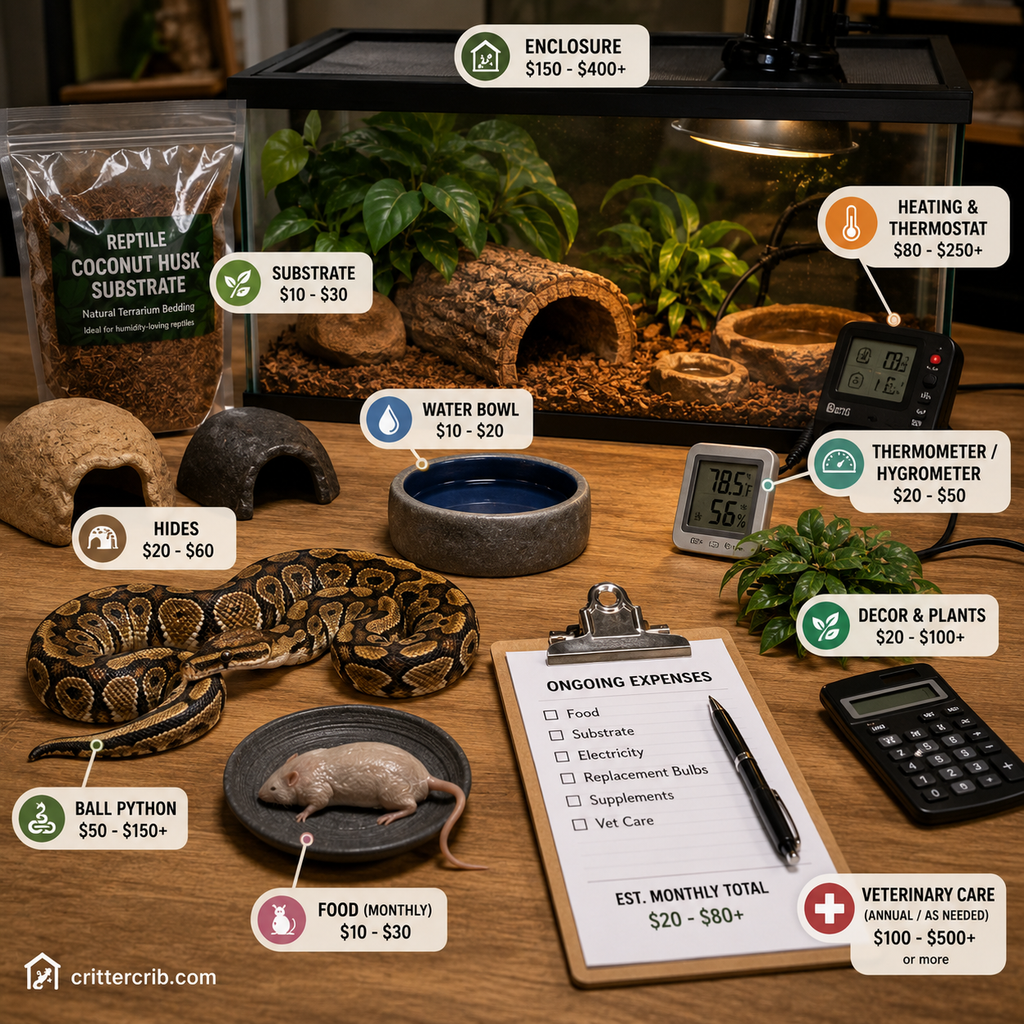
A practical starter budget might look something like this:
- Ball python: $50–$150+
- Adult enclosure: $150–$500+
- Heating equipment: $30–$100+
- Thermostat: $30–$200+
- Thermometers/hygrometer: $30–$80
- Hides: $20–$80
- Water bowl: $10–$30
- Substrate: $20–$50
- Décor/enrichment: $20–$150+
- Lighting/UVB: $30–$100+
That puts a realistic total initial investment somewhere around $390–$1,440+, depending heavily on the snake and equipment you choose.
You can absolutely build a good enclosure toward the lower end of that range.
You can also spend far more.
The important distinction is between saving money through smart shopping and saving money by leaving out necessary equipment.
How Much Does It Cost to Feed a Ball Python?
Food is one of the more affordable ongoing expenses.
Ball pythons eat whole prey, most commonly appropriately sized mice or rats in captivity.
Frozen-thawed rodents are commonly used because they’re convenient to store and eliminate the risk of a live rodent injuring the snake during feeding.
Depending on prey size and where you buy it, you might spend roughly $3–$10+ per meal.
Buying frozen rodents in bulk can reduce the per-meal cost.
How Often Do Ball Pythons Eat?
Feeding frequency depends on:
- Age
- Size
- Body condition
- Prey size
- Health
Young snakes generally eat more frequently than adults.
A healthy adult may eat an appropriately sized meal roughly every 1–3 weeks depending on individual needs and body condition.
That means food costs can be surprisingly modest compared with many other pets.
You might spend around $10–$30 per month on food, although this varies.
Electricity Costs
Heating and lighting run every day.
The exact electricity cost depends on:
- Wattage
- Local electricity rates
- Room temperature
- Enclosure insulation
- Heating equipment
- Lighting equipment
- How often the heat source runs
For one ball python, electricity generally isn’t the largest expense, but it’s worth including in your budget.
An efficient PVC enclosure may retain heat better than a poorly insulated habitat, potentially reducing how hard heating equipment needs to work.
Substrate and Cleaning Costs
Substrate requires periodic replacement.
You’ll also need basic cleaning supplies.
Ongoing supplies may include:
- Substrate
- Paper towels
- Reptile-safe disinfectant
- Trash bags
- Replacement décor as needed
Depending on your setup, you might average $5–$20+ per month when these expenses are spread throughout the year.
Some months you’ll spend almost nothing.
Other months you’ll replace a large amount of substrate at once.
Veterinary Costs
This is the expense that’s easiest to forget.
Ball pythons don’t need vaccines or monthly flea medication, but they can still become sick.
And reptile veterinary care can be expensive.
A routine exotic veterinary examination may cost roughly $60–$150+, depending on location and clinic.
Additional services may include:
- Fecal testing
- X-rays
- Bloodwork
- Medication
- Fluid therapy
- Hospitalization
- Surgery
An unexpected reptile veterinary visit can quickly cost several hundred dollars.
Emergency or specialized treatment may cost much more.
Consider an Emergency Fund
A ball python may cost only $100.
That doesn’t mean a $100 emergency budget is enough.
Consider keeping at least several hundred dollars available for unexpected veterinary expenses.
If possible, building an emergency fund of $500–$1,000 or more gives you more flexibility when something goes wrong.
The exact amount depends on veterinary costs where you live.
Common Ball Python Health Problems That Can Cost Money
Veterinary attention may be necessary for problems such as:
- Respiratory infections
- Mites
- Burns
- Injuries
- Mouth infections
- Persistent shedding problems
- Parasites
- Significant weight loss
- Reproductive complications
Good husbandry can reduce the risk of some problems, but it can’t guarantee your snake will never need veterinary care.
Monthly Cost of Owning a Ball Python
Once the enclosure is fully established, routine costs can be relatively low.
A rough monthly average might look like:
- Food: $10–$30
- Substrate/cleaning: $5–$20
- Electricity: $5–$20+
- Replacement supplies: $0–$10+
That gives a basic ongoing estimate of roughly $20–$80 per month.
Veterinary expenses aren’t included in that estimate.
They occur less predictably but can easily become the largest expense in a particular year.
Annual Cost of Owning a Ball Python
Based on routine expenses, you might spend approximately $250–$900 per year after the initial setup.
That could include:
- Food
- Substrate
- Electricity
- Cleaning supplies
- Replacement bulbs
- Replacement equipment
- Minor habitat upgrades
Add veterinary care separately.
A healthy snake may go a year with few unexpected expenses.
Another snake may require diagnostic testing or treatment that significantly increases the annual total.
First-Year Cost of a Ball Python
The first year is usually the most expensive because you’re purchasing the animal and all of its equipment.
A realistic first-year budget could easily fall around $600–$1,500+.
A premium enclosure, expensive morph, elaborate décor, or veterinary treatment can push that number much higher.
If you’re trying to decide whether you can afford a ball python, budget for the complete first year—not just the price on the snake’s enclosure at the pet store.
Where You Can Save Money
You don’t need to buy the most expensive version of every product.
There are sensible ways to reduce costs.
Buy the Adult Enclosure Early
Instead of purchasing multiple tanks as the snake grows, consider starting with an appropriately designed adult enclosure.
Provide enough cover and hides so a young snake feels secure.
Buy Frozen Rodents in Bulk
Bulk purchasing can significantly reduce the cost per feeder.
Make sure you have appropriate freezer storage.
Use Simple Hides
A $10 hide that makes your ball python feel secure can be more useful than a $50 decorative cave with a huge opening.
The snake doesn’t care about the price tag.
Watch for Reptile Supply Sales
Enclosures, thermostats, lighting, and heating equipment frequently go on sale.
Planning the habitat before buying the snake gives you time to shop carefully.
Choose Functional Décor
Cork, sturdy branches, artificial foliage, and simple clutter can provide excellent enrichment without requiring an expensive themed enclosure.
Where You Shouldn’t Cut Costs
Some savings aren’t worth the risk.
Don’t cut corners on:
- Thermostat
- Safe heating equipment
- Secure enclosure
- Appropriate enclosure size
- Reliable temperature monitoring
- Necessary veterinary care
- Nutritious prey
The cheapest setup isn’t a good deal if you need to replace everything six months later.
Hidden Costs of Ball Python Ownership
Some expenses aren’t obvious when you first see a $75 snake for sale.
Consider:
- Shipping when buying from a breeder
- Reptile expo admission
- Replacement heating equipment
- Replacement thermostats
- Replacement UVB bulbs
- Larger enclosures
- Veterinary diagnostics
- Emergency care
- Moving an enclosure
- Electricity
- Freezer space for rodents
- Pet sitting
Ball pythons can live for decades, so small recurring expenses add up.
How Long Is the Financial Commitment?
Ball pythons are long-lived reptiles.
With proper care, they can commonly live for 20–30 years, and some individuals live even longer.
That makes the total lifetime cost far more important than the initial purchase price.
Even if routine care averages only $400 per year, 25 years would equal:
$10,000 in ongoing care.
That doesn’t include:
- Initial setup
- Major enclosure upgrades
- Emergency veterinary treatment
- Inflation
You won’t pay that all at once, of course.
But it illustrates why a relatively inexpensive snake can still represent a substantial long-term financial commitment.
Is a Ball Python an Expensive Pet?
Compared with many dogs and cats, routine ball python ownership can be relatively inexpensive.
They don’t require:
- Daily feeding
- Grooming appointments
- Flea and tick medication
- Boarding as frequently
- Large quantities of food
However, the upfront enclosure cost is significant.
Veterinary care can also be expensive because reptiles often require an exotic-animal veterinarian.
So ball pythons are better described as having a moderate startup cost and relatively low routine monthly cost.
Questions to Ask Before Buying
Before bringing home a ball python, ask yourself:
- Can I afford an appropriate adult enclosure?
- Can I buy safe heating and a quality thermostat?
- Can I afford several hundred dollars of startup equipment?
- Can I regularly purchase frozen rodents?
- Is there a reptile veterinarian near me?
- Can I handle a $500+ unexpected veterinary bill?
- Do I have room for an adult enclosure?
- Am I prepared to care for the snake for 20–30 years or more?
If the snake itself is affordable but the answers to those questions are no, wait.
Buying the animal should be the last step, not the first.
Frequently Asked Questions
How Much Does a Normal Ball Python Cost?
A common captive-bred ball python may cost around $50–$150, although prices vary by breeder, location, age, sex, and availability.
Morphs can cost considerably more.
How Much Does a Ball Python Setup Cost?
A complete setup can cost roughly $300–$800 or more, with premium adult enclosures and higher-end equipment pushing the total considerably higher.
When the snake itself and all supplies are included, initial costs can easily approach $400–$1,400+.
How Much Does a Ball Python Cost Per Month?
Once the enclosure is established, routine expenses may average roughly $20–$80 per month.
Food, substrate, electricity, and replacement supplies make up most regular expenses.
Veterinary care is additional.
How Much Does It Cost to Feed a Ball Python?
An appropriately sized frozen-thawed rodent may cost roughly $3–$10 or more.
Because adult ball pythons don’t eat every day, monthly food costs are generally modest.
Are Ball Pythons Cheap Pets?
They can be relatively inexpensive to maintain after the initial setup.
However, buying the snake is often the cheapest part.
A quality enclosure, heating, thermostat, hides, substrate, monitoring equipment, and veterinary care can cost substantially more.
Are Expensive Ball Python Morphs Better Pets?
Not necessarily.
Price usually reflects genetics, rarity, and appearance rather than temperament or health.
A healthy common ball python can make just as rewarding a pet as an expensive morph.
Should I Buy a Ball Python Before Setting Up the Enclosure?
No.
Set up the habitat first.
Run the heating equipment, test the thermostat, measure temperatures and humidity, and correct any problems before bringing the snake home.
That also prevents you from rushing into unnecessary purchases.
Final Thoughts
Ball pythons can be surprisingly affordable pets to maintain, but they’re not $100 pets just because the snake costs $100.
The real initial expense is the habitat.
Once you factor in an adult-sized enclosure, heating, thermostat, temperature and humidity monitoring, hides, substrate, water bowl, lighting, and enrichment, expect to spend several hundred dollars before your snake even arrives.
After that, routine expenses are generally much easier to manage.
Food is relatively inexpensive, adults don’t eat every day, and a quality enclosure can last for years.
Veterinary care is the wildcard.
Keeping an emergency fund for reptile veterinary expenses is one of the smartest things you can do financially.
If you’re planning your budget, don’t ask only, “How much does a ball python cost?”
Ask, “How much will it cost to give this snake a good home for the next 20–30 years?”
That’s the number that really matters.