Crested geckos don’t take up much room compared with many pets, but that doesn’t mean they should live in a tiny enclosure.
These geckos are active climbers. They spend much of their time above the ground, moving between branches, plants, vines, and elevated resting spots. Because of that, the shape of a crested gecko enclosure matters almost as much as its overall size.
An adult needs enough vertical and horizontal room to climb, jump, hide, eat, and choose between different areas of the habitat.
So, how much space does a crested gecko actually need?
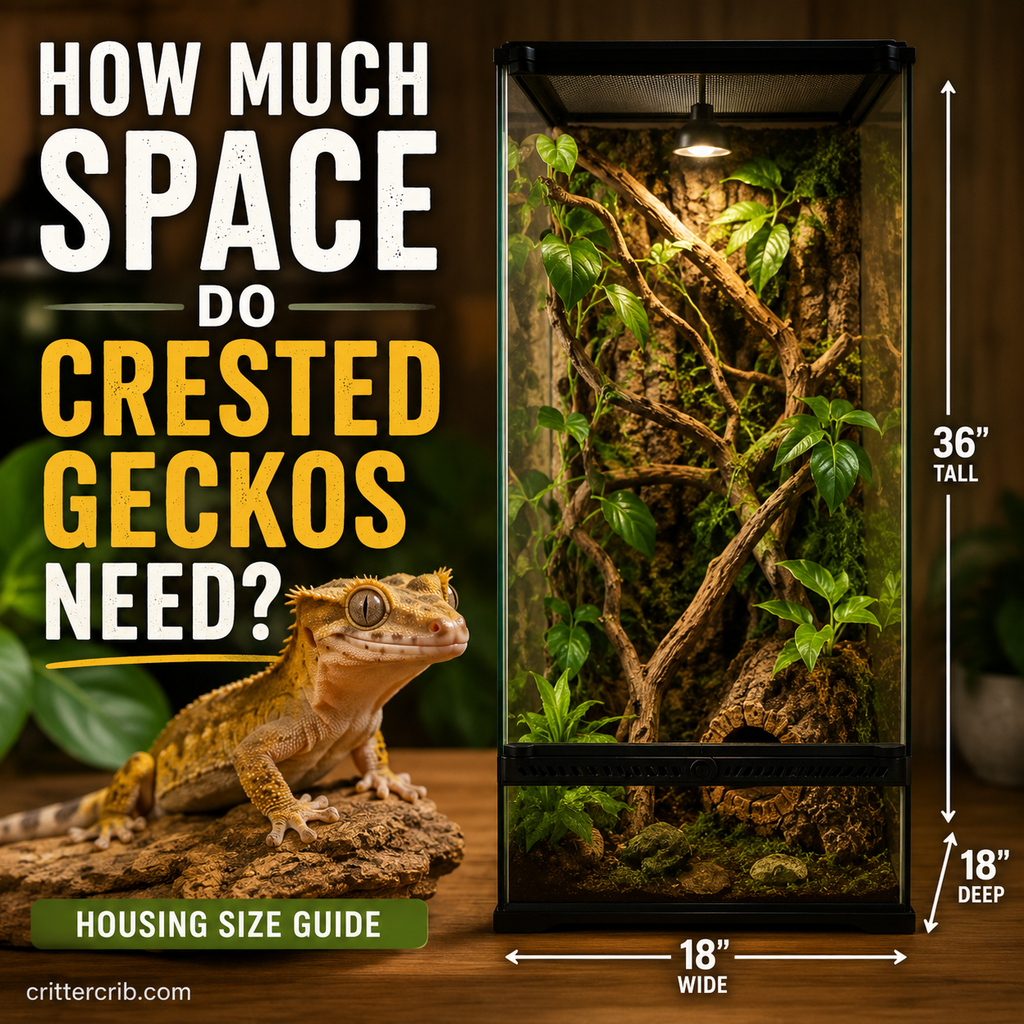
For an adult crested gecko, a tall enclosure around 18 x 18 x 36 inches is a good minimum target. Larger enclosures can be even better when they’re furnished properly. Younger geckos can start in smaller setups, but they should be moved into appropriate adult housing as they grow.
Here’s how to choose the right enclosure size and, just as importantly, make good use of the space inside it.
Crested Gecko Enclosure Size at a Glance
A practical starting point for housing a crested gecko is:
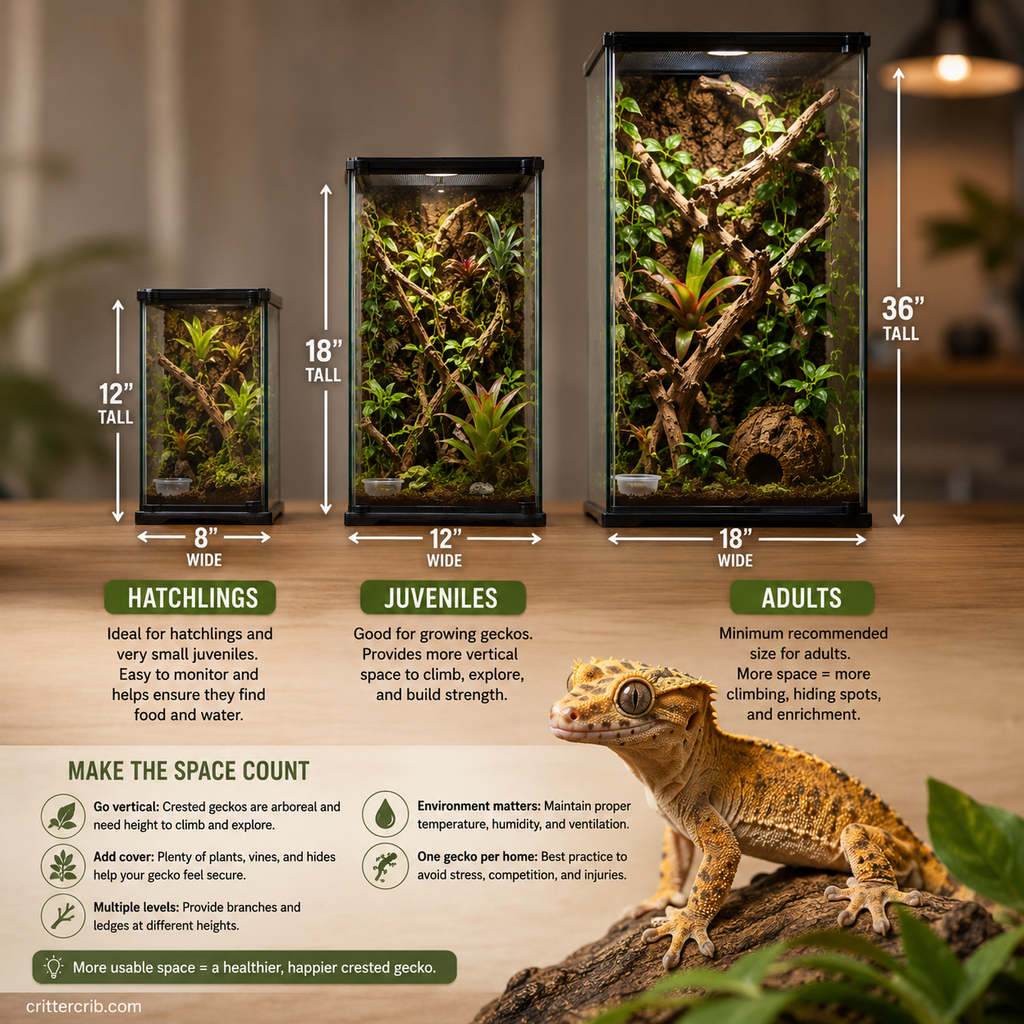
- Hatchlings and very small juveniles: Smaller, easy-to-monitor enclosure
- Growing juveniles: Approximately 12 x 12 x 18 inches or larger, depending on the gecko’s size and development
- Adults: Approximately 18 x 18 x 36 inches or larger
- Orientation: Tall, vertically oriented enclosure
- Housing: One crested gecko per enclosure is the safest general approach
These measurements aren’t a reason to avoid giving your gecko additional space.
If you have room for a larger habitat and can maintain appropriate temperature, humidity, ventilation, and feeding access throughout it, extra usable space gives the gecko more opportunities to move and explore.
Why Crested Geckos Need Vertical Space
Crested geckos are arboreal.
In simple terms, they’re built to spend a lot of time climbing.
Wild crested geckos come from New Caledonia, where they live among vegetation rather than spending their entire lives walking across flat ground.
Their anatomy reflects that lifestyle.
Crested geckos have specialized toe pads that help them grip many surfaces, along with a prehensile tail that can assist with climbing and balance. They can also jump surprisingly well.
A long, low enclosure may technically provide floor area, but it doesn’t take advantage of how a crested gecko naturally uses its environment.
That’s why height is so important.
What Is the Minimum Enclosure Size for an Adult Crested Gecko?
For a typical adult crested gecko, an enclosure around 18 inches wide, 18 inches deep, and 36 inches tall is a sensible minimum starting point.
You’ll sometimes see older care information recommending shorter 18 x 18 x 24-inch enclosures for adults.
While geckos have certainly been kept in enclosures of that size, current husbandry trends increasingly favor providing adults with greater vertical space.
A 36-inch-tall habitat allows much more room for:
- Climbing
- Jumping
- Elevated hides
- Multiple resting areas
- Branch networks
- Dense foliage
- Temperature variation
- Natural exploration
Remember that these dimensions describe the enclosure itself.
The space becomes valuable only when the interior is designed so the gecko can actually use it.
Is a Bigger Crested Gecko Enclosure Better?
Generally, yes — within reason.
There’s a persistent idea in reptile keeping that putting a small animal in a large enclosure will automatically cause stress.
The issue is usually more complicated.
An appropriately designed larger habitat can provide more choices and opportunities for natural behavior. What can make a gecko uncomfortable is being placed in a large, exposed enclosure without enough cover.
Imagine an empty 36-inch-tall glass box with one branch in the middle.
Technically, there’s plenty of space.
Functionally, there isn’t much habitat.
Now imagine the same enclosure filled with overlapping branches, vines, cork, foliage, elevated resting areas, and multiple sheltered routes from the bottom to the top.
That’s a very different environment.
Larger Enclosures Still Need to Be Manageable
Going bigger also means you need to maintain the habitat correctly.
You should still be able to:
- Maintain appropriate temperature
- Manage humidity
- Provide adequate ventilation
- Locate your gecko when necessary
- Monitor its eating and waste
- Reach food and water stations
- Clean the enclosure
- Inspect the animal regularly
A bigger enclosure isn’t automatically better if basic husbandry becomes difficult to maintain.
How Much Space Do Baby Crested Geckos Need?
Baby crested geckos don’t necessarily need to move immediately into a full-size adult enclosure.
Smaller setups can make monitoring easier during the early stages of life.
With a young gecko, you want to be able to confirm that it is:
- Finding its food
- Eating regularly
- Defecating
- Shedding properly
- Maintaining or gaining weight
- Moving normally around the habitat
A smaller juvenile enclosure can make these observations easier.
However, “smaller” shouldn’t mean barren.
Young crested geckos still benefit from climbing structures, hiding opportunities, foliage, and different resting positions.
When Should a Crested Gecko Move Into a Larger Enclosure?
There’s no single birthday when every crested gecko needs an enclosure upgrade.
Growth rates vary.
Instead of relying only on age, look at the gecko’s size, activity, and how effectively it’s using its current enclosure.
Signs that an upgrade may be appropriate include:
- The gecko is becoming large relative to the habitat
- Climbing routes feel cramped
- There isn’t enough room for additional enrichment
- The enclosure can’t support multiple useful resting areas
- The gecko has outgrown the juvenile setup
- You can no longer create a useful range of microenvironments
Planning ahead helps.
If you know you’ll eventually need an adult enclosure, you can purchase and prepare it before the juvenile has completely outgrown its current home.
How Should a Crested Gecko Enclosure Be Oriented?
Choose a vertical enclosure rather than a traditional long aquarium whenever possible.
Front-opening reptile enclosures are particularly convenient.
They allow you to:
- Access elevated decorations more easily
- Replace food
- Mist the enclosure
- Spot-clean
- Handle the gecko
- Maintain plants
- Rearrange climbing structures
Top-opening aquariums can sometimes be converted for arboreal reptiles, but a purpose-built vertical enclosure is often easier to work with.
Front access can also be less disruptive than repeatedly reaching down toward the gecko from above.
How to Make the Entire Enclosure Usable
One of the biggest crested gecko housing mistakes is providing plenty of enclosure volume but very little usable space.
Crested geckos need pathways.
Instead of thinking only about how many decorations fit inside, think about how your gecko will move through them.
Can it travel from the lower enclosure to the top without climbing the glass?
Can it move from one side to the other using branches and plants?
Are there places to stop and rest along the way?
That’s what makes enclosure space functional.
Add Plenty of Climbing Structures
A good crested gecko enclosure should contain climbing opportunities at different heights and angles.
Useful options include:
- Cork bark
- Sturdy branches
- Reptile-safe vines
- Bamboo
- Flexible climbing vines
- Elevated ledges
- Appropriately secured natural wood
Use a mixture of horizontal, diagonal, and vertical structures.
Horizontal resting surfaces are especially valuable.
Although crested geckos are excellent climbers, they shouldn’t have to cling vertically to glass every time they want to rest.
Provide Dense Foliage and Cover
Crested geckos often feel more secure when they have visual cover.
Foliage can be provided with live plants, high-quality artificial plants, or a combination of both.
Try to distribute cover throughout the habitat instead of placing one plant on the enclosure floor.
Useful plant coverage can help create:
- Sheltered sleeping areas
- Visual barriers
- Climbing routes
- Shaded areas
- Different humidity pockets
A gecko should be able to disappear from view when it wants to.
That’s a feature, not a problem.
Don’t Forget the Upper Part of the Enclosure
Owners sometimes decorate the bottom half beautifully and leave the top nearly empty.
For an arboreal gecko, that’s backwards.
The upper portion may become some of the most frequently used real estate in the enclosure.
Provide secure branches, foliage, and resting opportunities near the top while still leaving enough clearance for safe movement.
Observe your gecko after the habitat is established.
Its favorite sleeping spot may tell you a lot about which areas of the enclosure it finds most comfortable.
Provide Elevated Feeding Areas
Crested geckos are commonly fed a commercially prepared complete crested gecko diet.
An elevated feeding ledge can make the food easy to access while encouraging the gecko to use its climbing environment.
Depending on the size of the enclosure, some owners provide more than one feeding location, particularly when establishing a young gecko in a larger habitat.
This can make food easier to locate.
Once you know where your gecko regularly feeds, the setup can be adjusted accordingly.
Does Floor Space Matter for Crested Geckos?
Yes.
Vertical space gets most of the attention because crested geckos are arboreal, but width and depth still matter.
Your gecko doesn’t only move upward.
It also:
- Jumps horizontally
- Travels between branches
- Changes resting positions
- Explores the enclosure
- Descends toward the ground
- Moves around obstacles
That’s why simply buying an extremely tall but very narrow enclosure isn’t ideal.
An 18 x 18-inch footprint gives an adult meaningful horizontal movement in addition to height.
Larger footprints can provide even more options.
Do Crested Geckos Ever Use the Ground?
Yes.
Although they’re arboreal, crested geckos may occasionally descend to the enclosure floor.
You might see one:
- Exploring
- Hunting
- Drinking droplets
- Moving between climbing structures
- Investigating substrate
- Searching for another resting location
Occasional ground activity is normal.
If your gecko suddenly spends nearly all of its time on the floor when it previously preferred elevated areas, however, check the enclosure.
Excessive heat near the top, insufficient cover, poor climbing routes, or other environmental conditions may influence where the gecko chooses to stay.
Temperature Matters When Choosing Enclosure Size
Crested geckos generally prefer moderate temperatures and don’t require the intense basking conditions associated with many desert reptiles.
This makes overheating an important concern.
Larger enclosures can make it easier to provide some environmental variation, but you still need to monitor temperatures throughout the habitat.
Don’t assume that because the room feels comfortable, every part of the enclosure is appropriate.
Use reliable digital thermometers.
Pay particular attention during hot weather, when indoor temperatures may climb significantly.
Humidity and Ventilation in Larger Enclosures
Crested geckos require access to humidity, but their habitat shouldn’t remain soaking wet around the clock.
A normal enclosure should experience a humidity cycle.
Misting may raise humidity, followed by a period in which the enclosure gradually dries.
Adequate ventilation helps prevent stagnant, constantly saturated conditions.
A larger habitat may require adjustments to your misting routine because airflow, plant density, substrate, and enclosure construction all affect how quickly moisture evaporates.
Measure conditions rather than following a misting schedule blindly.
How Many Hides Does a Crested Gecko Need?
There’s no magic number.
Instead of relying exclusively on traditional cave-style hides, create multiple areas where your gecko can feel concealed.
These might include:
- Cork tubes
- Dense plant clusters
- Elevated coconut hides
- Leafy resting areas
- Cork bark
- Covered ledges
Ideally, the gecko should have secure options at several heights.
That way, it doesn’t have to choose between feeling hidden and being in a comfortable part of the enclosure.
Can Two Crested Geckos Share an Enclosure?
The safest general recommendation is to house crested geckos individually.
They don’t need a roommate to live a healthy life.
Housing multiple geckos together introduces additional risks, including:
- Competition for food
- Competition for preferred resting locations
- Stress
- Bites and injuries
- Breeding
- Difficulty monitoring individual food intake
- Difficulty identifying which gecko produced abnormal waste
Two geckos sitting together isn’t necessarily evidence that they’re enjoying each other’s company.
They may simply be competing for the same desirable location.
What About Males?
Adult male crested geckos should not be housed together.
Territorial conflict can lead to serious injuries.
Providing each gecko with its own appropriately sized enclosure removes competition and makes individual care much easier.
Common Crested Gecko Enclosure Size Mistakes
Choosing an enclosure isn’t only about finding the correct number on a care sheet.
Avoid these common mistakes:
- Keeping an adult permanently in a small juvenile enclosure
- Choosing a long, low habitat instead of a tall one
- Providing height without climbing structures
- Leaving large portions of the enclosure empty
- Using too little foliage
- Providing only vertical surfaces and no horizontal resting areas
- Housing multiple geckos together because the enclosure is “big enough”
- Ignoring temperature differences in a larger habitat
- Making food difficult to locate
- Creating an enclosure that’s difficult to clean or monitor
A well-designed enclosure balances space with accessibility and environmental control.
How to Tell Whether Your Crested Gecko Is Using Its Space
You probably won’t watch everything your gecko does.
Much of its activity may happen when the room is dark and you’re somewhere else.
Look for indirect clues.
You may notice:
- The gecko sleeping in different locations
- Droppings in different parts of the enclosure
- Food being eaten from elevated stations
- Plants or vines shifting slightly
- The gecko appearing in new locations after dark
- Regular movement between upper and lower areas
You can also quietly observe the enclosure in the evening.
It’s often surprising how active a crested gecko becomes once the daytime household activity settles down.
Should You Upgrade From an 18 x 18 x 24 Enclosure?
If you already have an adult crested gecko living in an 18 x 18 x 24-inch enclosure, upgrading to something taller is worth considering.
An enclosure around 18 x 18 x 36 inches provides approximately another foot of vertical habitat.
That’s significant for an arboreal animal.
The upgrade gives you room to build a more complex network of branches, foliage, elevated hides, and resting areas.
You don’t necessarily need to discard everything from the previous enclosure.
Many established branches, plants, feeding ledges, and hides can be transferred into the new setup.
What About a Bioactive Crested Gecko Enclosure?
Bioactive habitats can work very well for crested geckos when they’re designed and maintained correctly.
These setups typically combine:
- Live plants
- Natural substrate
- Leaf litter
- Microorganisms
- Cleanup crew species such as springtails and isopods
A larger vertical enclosure provides more room for plants and naturalistic landscaping.
However, “bioactive” doesn’t mean maintenance-free.
You’ll still need to monitor:
- Temperature
- Humidity
- Ventilation
- Plant health
- Waste
- Food
- Water
- Your gecko’s condition
The enclosure should be designed around the animal first and the appearance of the miniature ecosystem second.
Setting Up an Adult Crested Gecko Enclosure
If you’re preparing a new adult habitat, work from the structure outward.
A simple order is:
- Choose an enclosure around 18 x 18 x 36 inches or larger.
- Install appropriate substrate or drainage layers if needed.
- Add major cork and branch structures.
- Create horizontal and diagonal climbing routes.
- Add elevated hiding and resting areas.
- Fill open areas with reptile-safe foliage.
- Install an accessible feeding ledge.
- Add water access as appropriate.
- Set up temperature and humidity monitoring.
- Test the habitat before moving your gecko into it.
Afterward, watch how the gecko actually uses the space.
You may discover that a branch needs repositioning or that an empty area could use additional cover.
A reptile enclosure doesn’t have to remain exactly the way you arranged it on day one.
Is a 12 x 12 x 18 Enclosure Big Enough?
A 12 x 12 x 18-inch enclosure can work as temporary housing for a young crested gecko, depending on its size.
It shouldn’t be considered appropriate permanent housing for a full-grown adult.
As your gecko grows, plan for an upgrade.
Buying the adult enclosure early can sometimes be more economical than purchasing several slightly larger habitats as the animal develops.
Is a 20-Gallon Tank Big Enough for a Crested Gecko?
Gallon measurements aren’t particularly useful for arboreal reptiles because two enclosures with similar volume can have completely different shapes.
A traditional 20-gallon aquarium is typically designed around horizontal floor space rather than vertical climbing space.
For a crested gecko, dimensions matter more than the gallon label.
Focus on:
- Height
- Width
- Depth
- Ventilation
- Accessibility
- Usable climbing space
An enclosure specifically designed for arboreal reptiles is usually a better choice than selecting a conventional aquarium based purely on volume.
Is a 36-Inch-Tall Enclosure Too Big?
For a healthy adult crested gecko, a properly furnished 36-inch-tall enclosure isn’t too large.
The key phrase is properly furnished.
Fill the habitat with enough cover and climbing routes that the gecko can move confidently through the space.
If you’re transitioning a gecko from a much smaller enclosure, monitor its feeding and behavior after the move.
Make sure it can easily locate food and that environmental conditions remain appropriate.
How Much Space Does a Crested Gecko Really Need?
For most adult crested geckos, think of approximately 18 x 18 x 36 inches as a good minimum target rather than an ideal maximum.
More space can provide additional opportunities for climbing, exploration, and environmental choice.
But dimensions are only the beginning.
A tall enclosure with poor furnishings isn’t nearly as useful as one filled with safe branches, foliage, resting platforms, hides, and pathways.
The goal isn’t simply to give your gecko a large box.
It’s to give it a habitat.
Final Thoughts on Crested Gecko Housing Size
Crested geckos are small animals that make surprisingly good use of vertical space.
An adult should have a tall enclosure around 18 x 18 x 36 inches or larger, with enough width and depth for horizontal movement as well as climbing.
Young geckos can begin in smaller, easier-to-monitor habitats and move into larger housing as they develop.
Whatever size you choose, make the interior count.
Use branches at different angles, provide horizontal resting areas, add dense foliage, create multiple secure hiding locations, and make food easy to reach. Monitor temperature and humidity throughout the enclosure rather than assuming conditions are uniform.
A properly designed habitat gives your crested gecko something a smaller, emptier enclosure can’t: choices.
And for an animal that naturally climbs, hides, jumps, and explores, usable space is one of the most valuable forms of enrichment you can provide.