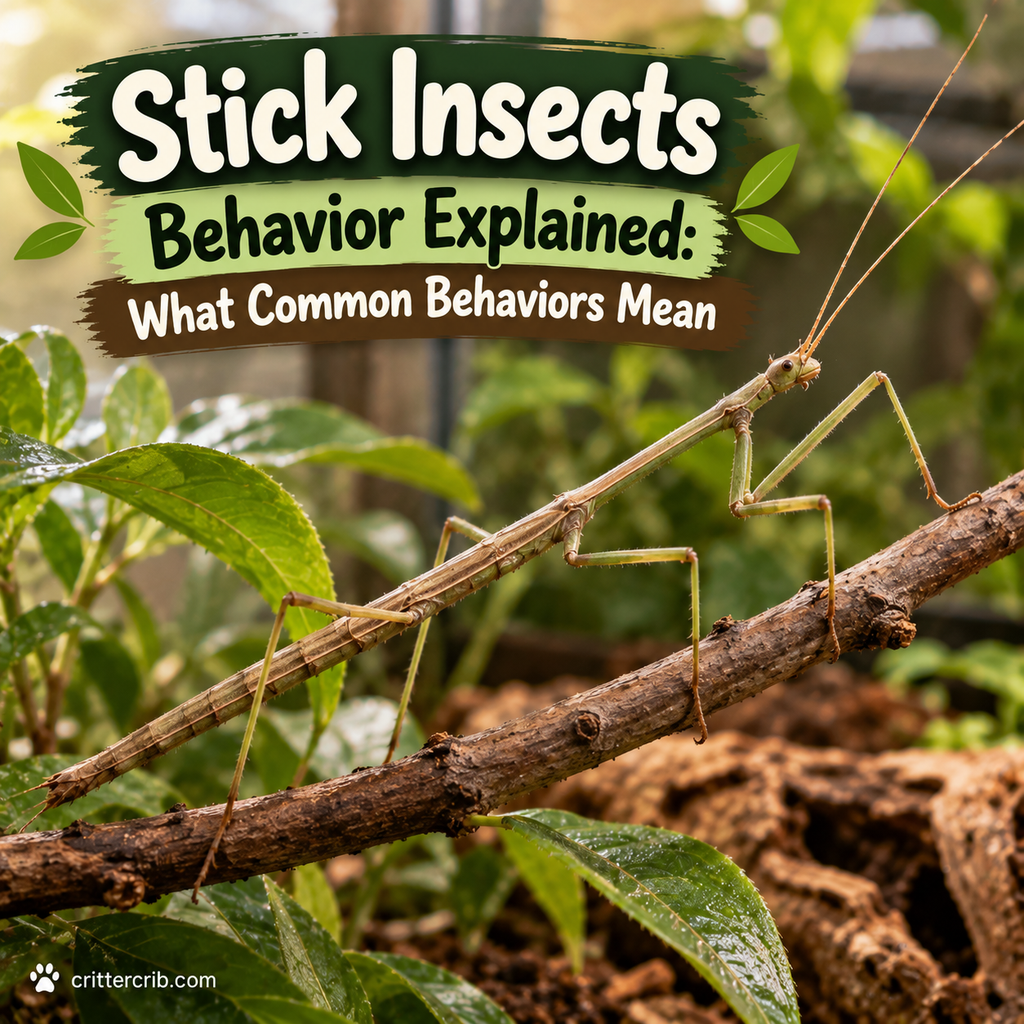
Stick insects can be surprisingly difficult to read.
One minute yours is slowly wandering through its enclosure. The next, it’s completely motionless and looks so much like a twig that you start wondering whether it has moved all day. You may also see it swaying from side to side, hanging upside down, dropping to the ground, or suddenly refusing food.
Most of these behaviors have perfectly normal explanations.
Stick insects, also called walking sticks or phasmids, rely heavily on camouflage and avoidance rather than speed or aggression. Many of their unusual habits make much more sense when you remember that their survival strategy is basically: don’t look like an insect, and don’t attract attention.
Here’s what some of the most common stick insect behaviors mean and when a change in behavior deserves a closer look.
Why Do Stick Insects Stay Still for So Long?
Remaining motionless is one of the most characteristic stick insect behaviors.
In the wild, movement can reveal an otherwise perfectly camouflaged insect to predators. A stick insect sitting still among branches and leaves is much harder to spot.
Pet stick insects retain this instinct.
It’s normal for one to remain in the same position for long periods, particularly during daylight hours.
A motionless stick insect isn’t necessarily:
- Sleeping
- Sick
- Scared
- Dying
- Bored
It may simply be behaving like a stick insect.
Instead of judging its health by activity alone, look at the bigger picture. Is it eating? Does it grip branches normally? Does it become active at other times? Has it recently molted?
Those details tell you much more.
Why Do Stick Insects Sway Side to Side?
The famous stick insect sway can look almost comical.
The insect slowly rocks its body from side to side, sometimes repeatedly.
This behavior is generally associated with camouflage. By swaying, a stick insect may imitate the movement of a twig or leaf being moved by the wind.
The motion can help maintain the illusion that you’re looking at vegetation rather than an animal.
Swaying may also occur while the insect is moving through its surroundings.
If your stick insect starts gently rocking back and forth, there’s usually no reason to stop it.
It’s one of the behaviors that makes phasmids so fascinating to watch.
Why Is My Stick Insect More Active at Night?
Many stick insects are primarily nocturnal.
During daylight hours, staying still and blending into vegetation helps them avoid detection. After dark, they become more active and begin feeding and exploring.
You may notice much more activity in the evening, including:
- Walking around the enclosure
- Climbing
- Feeding
- Moving between leaves
- Exploring the enclosure walls
- Searching for new resting locations
This is why a stick insect can appear to have done absolutely nothing all afternoon while its food plants somehow look considerably more chewed the following morning.
If you want to observe natural activity, check the enclosure after the room becomes quiet and dim.
Why Does My Stick Insect Freeze When I Approach?
Freezing is another defensive behavior.
A large animal suddenly moving toward the enclosure can be interpreted as a potential threat.
Rather than running away, the stick insect may become completely motionless.
This works because its camouflage is most effective when it doesn’t move.
Some species may pull their legs closer to the body or adopt a posture that makes them look even more like a twig.
Give the insect space rather than repeatedly trying to make it move.
Why Does My Stick Insect Drop to the Ground?
Some stick insects respond to danger by suddenly releasing their grip and falling.
This may look alarming in captivity, but dropping can be an effective escape strategy in nature.
A predator searching through branches may lose track of an insect that suddenly disappears into the vegetation below.
After dropping, the stick insect may remain completely still.
Avoid deliberately triggering this behavior.
Repeatedly frightening a stick insect into falling creates unnecessary stress and could potentially cause injury depending on the enclosure.
A well-designed habitat should also avoid hard, sharp objects beneath elevated climbing areas.
Why Does My Stick Insect Play Dead?
Some species use thanatosis, or death-feigning, as a defense.
The insect may become rigid, tuck its legs close to its body, and remain motionless even when disturbed.
To a predator, it may resemble a dead twig rather than edible prey.
If your stick insect suddenly becomes rigid after being handled or frightened, don’t immediately assume it has died.
Place it somewhere safe and leave it undisturbed.
Normal movement may resume once the insect no longer feels threatened.
Why Is My Stick Insect Hanging Upside Down?
Hanging is completely normal for stick insects.
They spend much of their lives climbing through vegetation and are comfortable hanging from branches, leaves, and enclosure surfaces.
However, hanging becomes particularly important during molting.
Stick insects shed their exoskeleton as they grow. During a molt, they usually hang securely and gradually emerge downward from the old skin.
This means vertical space isn’t optional.
It’s an essential part of stick insect housing.
How Can You Tell If a Stick Insect Is About to Molt?
Before molting, a stick insect may behave differently.
Possible signs include:
- Reduced appetite
- Refusing food
- Less activity
- Spending more time hanging
- Changes in body appearance
- Seeking a secure elevated position
Not every stick insect shows obvious pre-molt behavior.
If yours suddenly stops eating but otherwise appears normal, an approaching molt is one possibility.
Don’t try to force it to eat.
Make sure the enclosure has appropriate humidity, ventilation, and plenty of clear vertical space.
What Happens When a Stick Insect Molts?
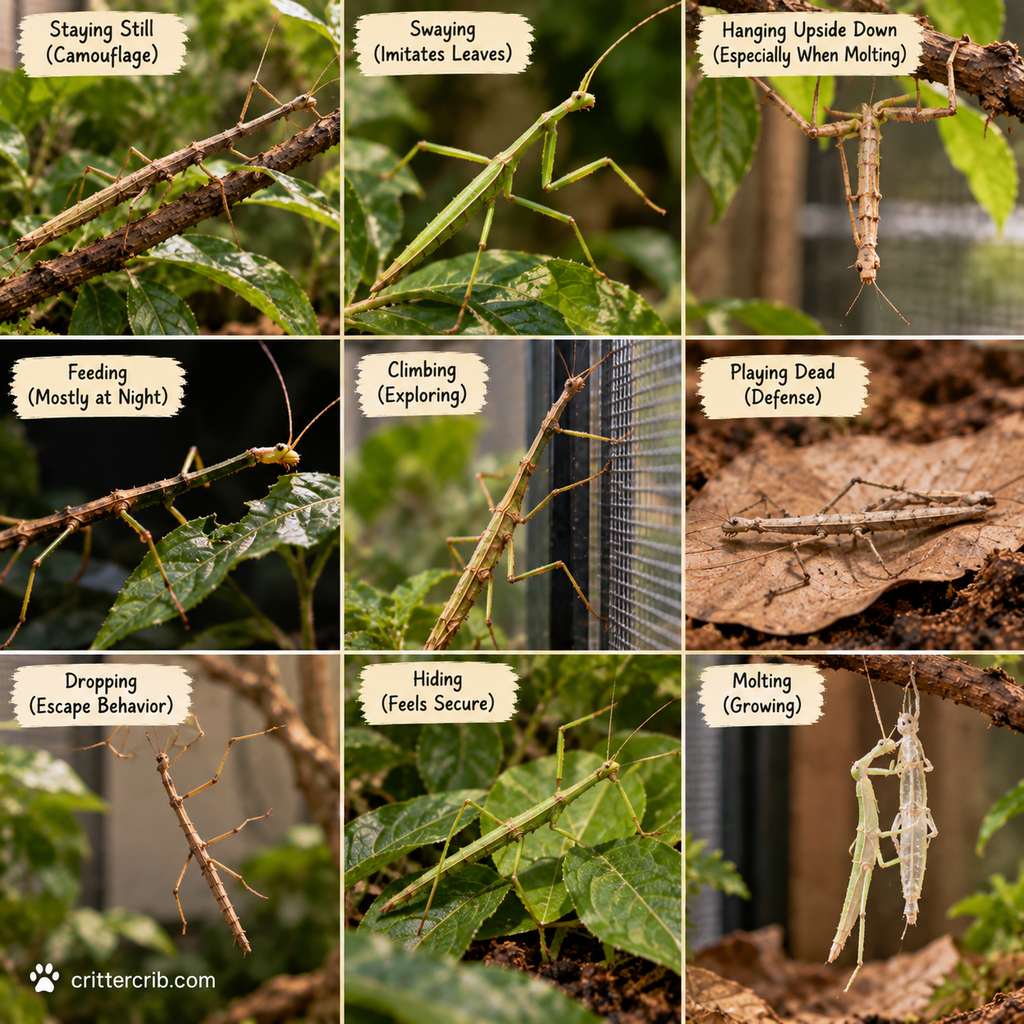
Molting is one of the most vulnerable times in a stick insect’s life.
The insect attaches itself securely and begins working its body out of the old exoskeleton.
It emerges while hanging downward.
Once free, its new exoskeleton is soft and needs time to harden.
The insect may look pale, soft, or slightly different immediately after a molt.
That’s normal.
Don’t Disturb a Molting Stick Insect
Never pull on the old skin or attempt to “help” unless you’re dealing with an exceptional situation and know exactly what you’re doing.
Interference can easily injure the insect.
Also avoid:
- Handling it
- Moving its branch
- Spraying it directly
- Rearranging the enclosure
- Introducing unnecessary disturbances
Let the insect complete the process on its own.
Why Is Vertical Space So Important for Stick Insects?
A stick insect needs enough room beneath itself to completely emerge from its old exoskeleton.
If the enclosure is too short, decorations are in the way, or the insect molts too close to the ground, it may not have enough space.
This can contribute to a mismolt.
A common guideline is to provide an enclosure with at least around three times the insect’s body length in usable height, although requirements vary by species.
More importantly, that height needs to be usable.
A tall enclosure packed completely full of branches isn’t necessarily providing good molting space.
Leave clear areas underneath suitable hanging locations.
Why Is My Stick Insect Eating Its Shed Skin?
Don’t be surprised if your stick insect eats some or all of its old exoskeleton after molting.
This can be normal.
The shed skin contains nutrients that the insect can recover rather than waste.
Unless there’s a husbandry reason to remove it, you don’t necessarily need to rush in and take the exoskeleton away.
Your stick insect may take care of it itself.
Why Isn’t My Stick Insect Eating?
Food refusal can have several explanations.
A stick insect may stop eating because:
- A molt is approaching
- It recently molted
- The food plant is unsuitable
- Leaves have dried out
- Temperature is inappropriate
- The insect is stressed
- The enclosure conditions are unsuitable
- It has reached a different life stage
Start with the simplest possibilities.
Check the food.
Stick insects generally require fresh leaves from suitable host plants. Different species accept different plants, so you need to know what your particular species eats.
Replace old foliage with fresh, safe leaves and monitor the insect.
If a growing nymph stops eating temporarily and begins hanging more than usual, molting may be approaching.
Why Is My Stick Insect Suddenly Eating a Lot?
Growing stick insects need energy.
Between molts, a healthy nymph may consume significant amounts of foliage.
Feeding can also seem more noticeable after the insect has recovered from a molt.
Rather than worrying about an enthusiastic eater, make sure fresh host plants remain available.
Stick insects shouldn’t have to wait for scheduled meals.
Their appropriate food plants should generally be continuously accessible.
Why Is My Stick Insect Walking Around Constantly?
Although stick insects spend a lot of time motionless, periods of exploration are normal.
Walking around can mean the insect is:
- Looking for food
- Searching for a resting place
- Exploring
- Becoming active after dark
- Looking for a mate as an adult
- Responding to changes in the enclosure
Adult males of some species can be particularly active compared with females.
Persistent restless behavior can also be a reason to check husbandry.
Make sure suitable fresh food is available and verify temperature, humidity, ventilation, and enclosure size.
Why Is My Stick Insect Climbing the Enclosure Walls?
Stick insects are built to climb.
They naturally spend their lives on vegetation, so climbing branches, plants, mesh, and enclosure walls is expected.
A stick insect repeatedly climbing upward may simply be looking for an elevated resting position.
This is one reason the top of the enclosure needs appropriate gripping surfaces.
The insect should be able to hang securely when resting or molting.
Make sure ventilation mesh and other surfaces don’t have dangerous gaps where legs could become trapped.
Why Is My Stick Insect Shaking or Jerking?
Not every sudden movement is a problem.
Some stick insects use movements as part of defensive displays.
Depending on the species, a threatened stick insect may:
- Sway
- Kick
- Flash brightly colored wings
- Spread wings
- Produce defensive secretions
- Make sudden movements
- Drop from its perch
However, repeated uncontrolled movements, difficulty gripping, or unusual weakness can indicate a problem.
Observe the entire insect rather than interpreting one brief movement by itself.
Do Stick Insects Bite?
Most commonly kept stick insects aren’t interested in biting people.
Their primary defenses are camouflage and avoidance.
Some larger species, however, may defend themselves using spiny legs or other physical defenses.
Certain species can also release defensive chemicals that may irritate skin or eyes.
This is another reason species identification matters.
A gentle-looking stick insect isn’t automatically a species you should freely handle.
Why Does My Stick Insect Kick?
Kicking can be defensive.
Some species have strong or spiny hind legs that can be used when the insect feels threatened.
If your stick insect repeatedly kicks when you attempt to handle it, take the hint.
Handling isn’t necessary for its health.
Allow the insect to climb onto you voluntarily when handling is appropriate rather than grabbing it around the body.
Can Stick Insects Lose Legs?
Yes.
Stick insects can lose legs because of injury, poor molts, accidents, or defensive responses.
Young stick insects may be able to regenerate some or much of a lost limb over subsequent molts, depending on their age and species.
An adult that has completed its final molt won’t have future molts available for the same regeneration process.
This makes careful handling especially important.
Never pick up a stick insect by a leg.
Why Does My Stick Insect Keep Falling?
An occasional fall doesn’t necessarily mean something is wrong.
Frequent falling deserves attention.
Check whether the insect can grip normally.
Possible problems can include:
- A recent molt
- Injury
- Poor gripping surfaces
- Old age
- Weakness
- Problems associated with a mismolt
- Unsuitable enclosure surfaces
A newly molted stick insect may temporarily be more vulnerable, so avoid disturbing it until its body has hardened.
Keep hard and sharp objects away from areas where falls are likely.
Why Is My Stick Insect Curled Up?
Body position varies by species.
Some stick insects naturally rest in unusual poses that improve their camouflage.
A curled or tucked posture can also occur during defensive behavior.
Look at the circumstances.
If the insect adopts the posture when approached and later returns to normal, defense is a likely explanation.
If it’s unable to move normally, repeatedly falls, or can’t grip, investigate further.
Do Stick Insects Sleep?
Stick insects have periods of inactivity and rest, although it’s better not to think of their behavior as identical to human sleep.
Many remain largely motionless during daylight and become active after dark.
Their daily rhythm reflects both rest and predator avoidance.
A quiet stick insect during the day is usually behaving normally.
Are Stick Insects Social?
Stick insects don’t require companionship in the way social mammals do.
Some species can be kept with others of their own kind when the enclosure is large enough and resources are plentiful.
However, overcrowding can create problems.
Too many insects in a small enclosure can interfere with:
- Molting
- Access to food
- Ventilation
- Cleanliness
- Movement
Even peaceful species need physical space.
Never assume that because stick insects don’t fight, you can keep unlimited numbers together.
Why Are My Stick Insects Crawling on Each Other?
Occasional climbing over one another isn’t necessarily aggression.
In a group enclosure, insects may simply be moving toward food or a preferred perch.
However, frequent crowding may indicate that the enclosure needs more usable space or additional food branches.
Molting insects are especially vulnerable.
Make sure individuals can find secure hanging locations without being constantly disturbed by enclosure mates.
Why Does My Stick Insect Stay Near the Top of the Enclosure?
This is often normal.
Stick insects naturally climb vegetation and may prefer elevated positions.
The top of the enclosure can also provide ideal locations for hanging and molting.
If nearly all individuals constantly crowd one small area, however, check whether something about that location is different.
Consider:
- Airflow
- Temperature
- Humidity
- Light
- Available gripping surfaces
- Food placement
Sometimes the insects are simply choosing the most comfortable part of the enclosure.
Why Does My Stick Insect Hide Behind Leaves?
Camouflage is basically the stick insect’s superpower.
Positioning itself behind or among leaves helps break up its outline and makes it harder to see.
Some species resemble twigs. Others imitate leaves, bark, or dead vegetation.
Don’t assume an insect that spends the day tucked behind foliage is unhappy.
Providing plenty of appropriate plant material and climbing structure allows it to use the behaviors that keep it feeling secure.
How Stress Affects Stick Insect Behavior
Stress can change how a stick insect behaves.
Potential stressors include:
- Excessive handling
- Frequent enclosure disturbance
- Incorrect temperature
- Incorrect humidity
- Poor ventilation
- Lack of appropriate food
- Overcrowding
- Inadequate molting space
- Constant bright light
- Repeated falls
The solution usually isn’t to interact with the insect more.
Instead, verify the habitat and give it a stable environment.
Normal Stick Insect Behavior vs. Warning Signs
Stick insects do plenty of things that look concerning until you understand them.
Common normal behaviors include:
- Remaining still for hours
- Swaying
- Hanging upside down
- Being more active at night
- Dropping when frightened
- Playing dead
- Temporarily refusing food before a molt
- Eating shed skin
- Hiding among foliage
- Climbing toward the top of the enclosure
Behavior deserves closer attention when you see persistent physical difficulty rather than simple inactivity.
Possible warning signs include:
- Repeated inability to grip
- Frequent unexplained falls
- Severe mismolt
- Persistent weakness
- Obvious injury
- Legs positioned abnormally
- Long-term food refusal outside expected molting periods
- Difficulty moving normally
When something seems wrong, start by checking the environment.
Temperature, humidity, ventilation, food quality, enclosure height, and molting space can all influence behavior and health.
How to Encourage Natural Stick Insect Behavior
A good enclosure allows stick insects to behave like stick insects.
Provide Plenty of Vertical Space
Your insect needs room to climb and, more importantly, molt.
Offer Secure Gripping Surfaces
Branches, host plants, and suitable mesh can provide elevated resting and molting locations.
Keep Fresh Host Plants Available
Know which plants your species eats and provide fresh foliage consistently.
Maintain Appropriate Humidity
Humidity affects hydration and successful molting.
Requirements vary by species, so don’t rely on one generic number.
Provide Good Ventilation
Moisture and airflow need to work together.
Avoid creating a stagnant enclosure.
Avoid Constant Handling
Stick insects are better observed than repeatedly handled.
When handling is appropriate, let the insect walk onto your hand rather than grabbing it.
Give Them a Normal Day-Night Cycle
Allow darker nighttime periods so nocturnal species can follow their natural activity patterns.
Frequently Asked Questions About Stick Insect Behavior
Why does my stick insect look dead?
It may simply be motionless or displaying a defensive death-feigning behavior.
Observe it without repeatedly touching or disturbing it.
Why does my stick insect rock back and forth?
Swaying is generally considered a camouflage behavior that can help the insect resemble vegetation moving in the wind.
Is it normal for a stick insect to hang upside down?
Yes. Hanging is normal and is particularly important during molting.
Why has my stick insect stopped eating?
A molt may be approaching, especially in a growing nymph. Also check that you’re providing fresh, appropriate host plants and suitable enclosure conditions.
Should I help my stick insect molt?
Generally, no.
Molting is delicate, and attempting to pull the insect from its old exoskeleton can cause serious injury.
Why is my stick insect active at night?
Many stick insects are nocturnal and naturally become more active and feed after dark.
Can stick insects recognize their owners?
There’s little reason to interpret their behavior as owner recognition in the way we would with a dog or other social pet.
They primarily respond to environmental cues, movement, food, and perceived threats.
Stick Insect Behavior Makes Sense Once You Think Like a Twig
Stick insects can seem like strange pets until you understand what their behavior is designed to accomplish.
They survive by avoiding attention.
That’s why they freeze. It’s why they sway like branches in the wind. It’s why some suddenly drop to the ground or pretend to be dead when frightened.
Even their preference for hanging high in the enclosure serves an important purpose when it’s time to molt.
The best thing you can do is learn what’s normal for your particular species and individual.
Provide fresh host plants, plenty of vertical room, appropriate humidity and ventilation, and secure places to climb. Then spend some time observing rather than interfering.
You may discover that an insect that initially seemed to “do nothing” actually has a surprisingly interesting routine.
You just have to watch on stick insect time.