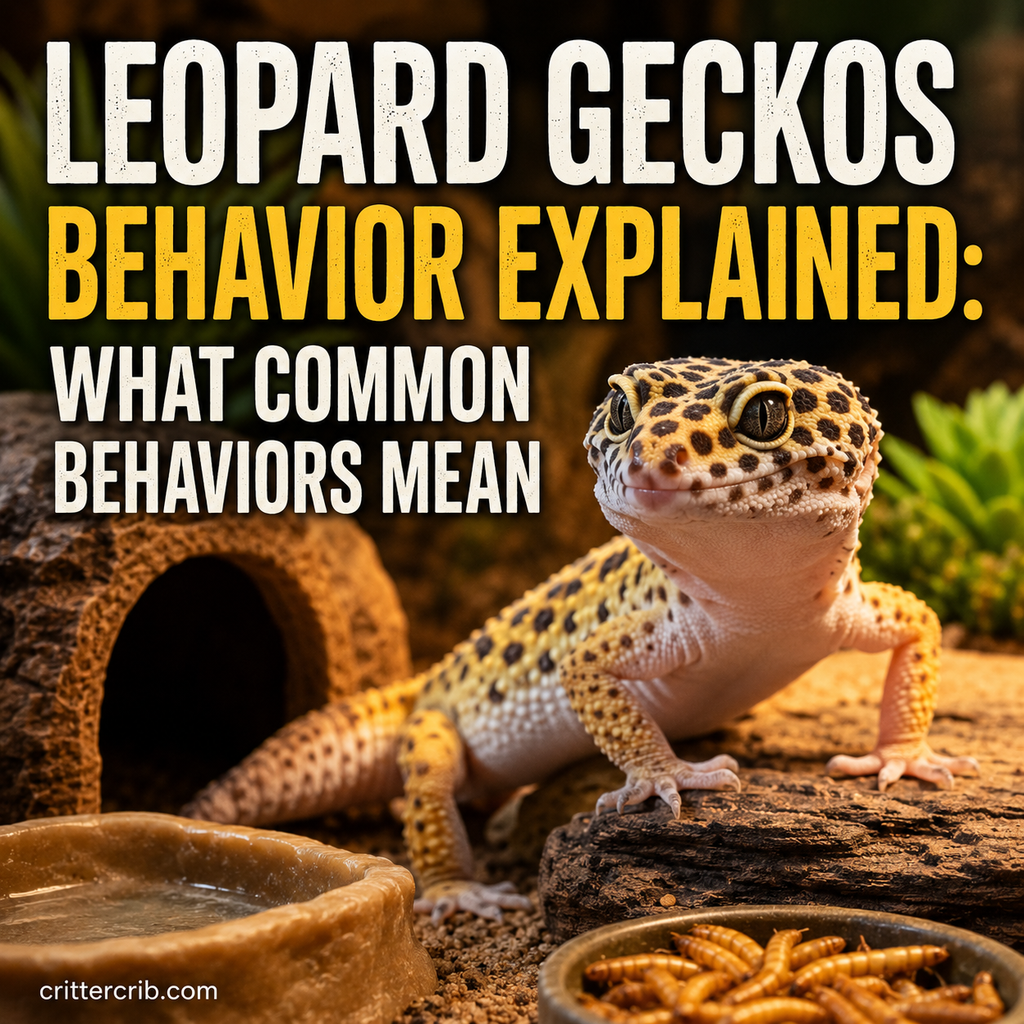
Leopard geckos may be quiet pets, but they communicate more than you might think.
A slow tail wave, sudden burst of digging, refusal to leave a hide, or even a tiny squeak can tell you something about how a leopard gecko is feeling. Some behaviors are completely normal. Others may point to stress, an enclosure problem, or a health issue that deserves attention.
The tricky part for new owners is figuring out which is which.
Once you become familiar with your leopard gecko’s normal routine and body language, its behavior becomes much easier to read. This guide covers common leopard gecko behaviors, what they usually mean, and when a change in behavior may be worth investigating.
Understanding Normal Leopard Gecko Behavior
Leopard geckos are naturally adapted to dry, rocky environments in parts of South and Central Asia. Instead of spending their days constantly moving around in the open, they often remain sheltered and become more active during lower-light periods.
That natural lifestyle explains a lot of what you’ll see in captivity.
A healthy leopard gecko may spend hours inside a hide, emerge to explore the enclosure, hunt, drink, investigate its surroundings, and then disappear again.
Individual personality matters too.
Some leopard geckos are bold and seem interested whenever their owner approaches. Others are cautious and prefer interacting on their own terms.
Rather than expecting every gecko to behave the same way, learn what’s normal for yours.
When Are Leopard Geckos Most Active?
One of the first things new owners notice is that their gecko seems to sleep or hide for much of the day.
That’s usually normal.
Leopard geckos tend to be most active around dusk, dawn, and during periods of lower light. You may see yours become noticeably more active as the enclosure lighting changes and the room becomes quieter.
Typical evening behavior can include:
- Exploring the enclosure
- Moving between warm and cool hides
- Hunting insects
- Drinking
- Digging
- Climbing low decorations
- Watching activity outside the enclosure
If your gecko spends much of the daytime resting, that alone isn’t a reason to worry.
A sudden change from its established activity pattern, however, is worth paying attention to.
Why Does My Leopard Gecko Hide All the Time?
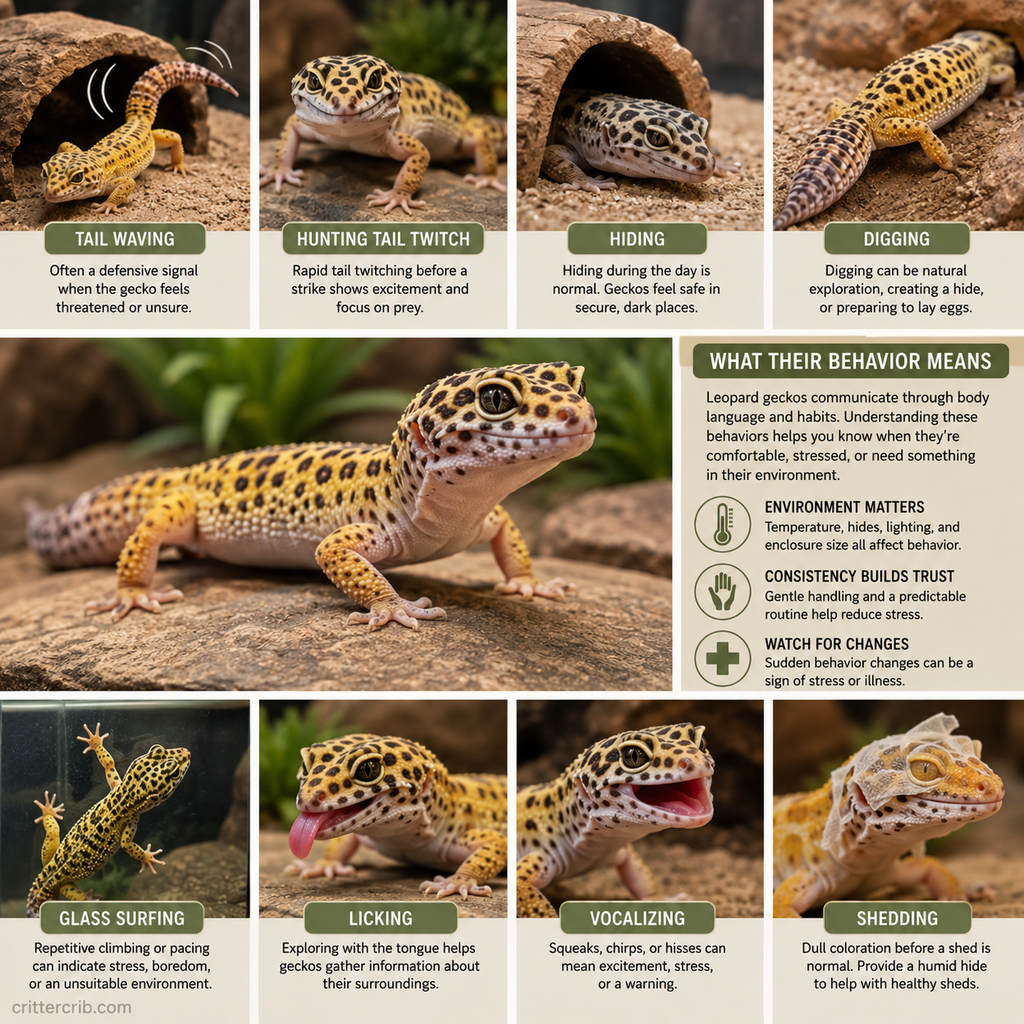
Hiding is one of the most normal leopard gecko behaviors.
These animals naturally seek protected spaces where they feel secure. A leopard gecko sitting inside a hide isn’t necessarily frightened or unhappy.
A good enclosure should provide multiple hiding options.
Ideally, your gecko should have access to:
- A warm hide
- A cooler hide
- A humid hide
This gives it the ability to choose between different temperatures and humidity levels without sacrificing security.
When Excessive Hiding May Be a Concern
Pay closer attention if your leopard gecko suddenly stops emerging when it previously explored regularly.
Possible reasons include:
- A recent move
- Changes to the enclosure
- Excessive handling
- Incorrect temperatures
- Bright or disruptive lighting
- Noise or vibration
- Another pet watching the enclosure
- Shedding
- Seasonal changes
- Illness or discomfort
New leopard geckos may hide extensively during their first days or weeks in a new home.
Give them time to settle rather than repeatedly pulling them from their hiding place.
Why Does My Leopard Gecko Stare at Me?
You walk past the enclosure and notice two little eyes following you across the room.
Is your gecko fascinated by you?
Maybe. But it’s more useful to think of staring as observation rather than assigning a human emotion to it.
Leopard geckos pay attention to movement. Your gecko may associate your presence with food, handling, or activity around its enclosure.
Some learn routines surprisingly well.
If feeding usually happens when you approach in the evening, your gecko may come out and watch you because it has learned what often happens next.
That kind of anticipation is perfectly normal.
Leopard Gecko Tail Wagging and Waving
The tail is an important part of leopard gecko body language.
Different tail movements can mean very different things.
Slow Tail Waving
A leopard gecko may raise its tail and slowly wave it from side to side when it feels threatened or uncertain.
Think of this as a defensive signal.
You may see it when:
- The gecko encounters something unfamiliar
- Another animal is nearby
- It feels cornered
- Handling has made it uncomfortable
- It is introduced to a changed environment
Give the gecko space and identify what may be making it uneasy.
Fast Tail Shaking During Hunting
A completely different tail movement can occur when a leopard gecko becomes excited about prey.
Some geckos rapidly twitch or shake the tip of their tail immediately before striking at an insect.
This is generally normal hunting behavior.
You’ll often see the gecko focus intensely on its target, lower its body, twitch its tail, and then lunge.
Tail Movement Around Other Geckos
Tail movements can also occur during territorial, defensive, or reproductive interactions.
This is one reason body language needs to be interpreted in context rather than treating every tail movement as having a single meaning.
Why Do Leopard Geckos Shake Their Tails Before Eating?
The rapid tail twitch seen during hunting can look dramatic if you’ve never seen it before.
Your gecko may freeze, stare at a cricket or roach, and then begin vibrating the tip of its tail.
Seconds later, it attacks.
This behavior is associated with the excitement and focus of hunting.
It doesn’t usually mean something is wrong.
The important distinction is whether the movement happens specifically while targeting prey or whether the gecko is experiencing uncontrolled shaking or tremors at other times.
Persistent tremors unrelated to hunting can have a very different significance and should not simply be dismissed as normal tail behavior.
Why Does My Leopard Gecko Dig?
Digging is another behavior that can be completely normal.
A leopard gecko may dig to:
- Explore
- Create a more secure resting area
- Adjust its position relative to temperature
- Prepare to lay eggs
- Interact with loose substrate
- Respond to seasonal or reproductive behavior
Occasional digging isn’t necessarily a problem.
Frequent or Frantic Digging
If digging becomes constant or appears frantic, check the enclosure conditions.
Review:
- Warm-side temperature
- Cool-side temperature
- Hide availability
- Humidity
- Substrate
- Lighting
- Enclosure security
- Possible sources of stress
Female leopard geckos may also dig when preparing to lay eggs.
Importantly, females can sometimes produce infertile eggs even if they haven’t recently been housed with a male.
Why Is My Leopard Gecko Climbing?
Leopard geckos are primarily terrestrial, but that doesn’t mean they never climb.
Many happily climb over rocks, cork bark, branches, hides, and other low structures.
Providing safe climbing opportunities can make an enclosure more interesting.
Keep structures stable and avoid creating dangerous falls.
If your gecko repeatedly climbs the glass or attempts to escape, however, look more closely at the enclosure conditions.
What Is Glass Surfing?
Glass surfing refers to repeated movement against the walls of an enclosure, often involving scratching, climbing, or pacing along the glass.
An occasional attempt to climb the wall isn’t unusual.
Constant glass surfing may indicate something needs attention.
Possible causes include:
- Stress
- Reflections
- An enclosure that’s too small or poorly arranged
- Incorrect temperatures
- Lack of hiding places
- Breeding behavior
- A recent environmental change
- Interest in something outside the enclosure
Observe when the behavior happens.
If it occurs every time a feeder insect container appears, for example, food anticipation may be playing a role.
If it continues for long periods regardless of what’s happening around the enclosure, review the habitat more carefully.
Why Does My Leopard Gecko Lick Everything?
Leopard geckos use their tongues to gather information about their environment.
You may see your gecko lick:
- Rocks
- Decorations
- Your hand
- Food dishes
- New enclosure items
- The air or surfaces around an unfamiliar object
This exploratory licking is usually normal.
A gecko that licks your hand isn’t necessarily showing affection in the way a dog might. It may simply be investigating your scent and figuring out what you are.
Why Does My Leopard Gecko Lick Its Eyes?
Unlike many reptiles, leopard geckos have movable eyelids.
They may occasionally lick around their eyes or face as part of normal grooming.
Frequent eye licking combined with squinting, swelling, discharge, or difficulty opening the eye is different.
Those symptoms may indicate irritation, retained shed, debris, infection, or another eye problem that requires veterinary attention.
Leopard Gecko Vocalizations
Leopard geckos aren’t completely silent.
They can make several surprising sounds.
You may hear:
- Squeaking
- Chirping
- Clicking
- Hissing
- Small barking-like sounds
The meaning depends on the situation.
Squeaking and Chirping
Some leopard geckos vocalize when they’re startled, uncomfortable, excited, or interacting with their environment.
Young geckos can be particularly vocal.
An occasional chirp isn’t automatically a problem.
Hissing
Hissing is a clearer defensive signal.
A leopard gecko may hiss when it feels threatened, frightened, or cornered.
If yours hisses during handling, don’t force the interaction. Return it to a secure environment and try again another time.
Why Does My Leopard Gecko Scream?
Yes, leopard geckos can make surprisingly loud defensive sounds.
This is particularly common in frightened juveniles.
A young gecko may scream or produce a loud squeak when it believes a much larger animal — including you — is threatening it.
The sound can be startling, but it doesn’t mean your tiny gecko has suddenly become aggressive.
Give it space.
As the gecko becomes accustomed to its environment and learns that routine interactions aren’t dangerous, defensive vocalizations may become less frequent.
Why Does My Leopard Gecko Close Its Eyes When I Pet It?
This behavior is frequently misinterpreted.
It’s tempting to assume that a leopard gecko closing its eyes while being touched means it’s relaxing and enjoying the attention.
Sometimes a calm gecko may simply rest its eyes.
But closing the eyes can also be an avoidance or stress response.
If the gecko repeatedly closes its eyes specifically when your hand approaches its head or when you touch it, consider whether the interaction is actually welcome.
Look at the rest of its body language.
A comfortable gecko will generally appear loose and calm rather than tense, defensive, or determined to escape.
How Can You Tell If a Leopard Gecko Is Comfortable?
There isn’t one behavior that proves a leopard gecko is “happy.”
Instead, look at the overall pattern.
A comfortable, well-adjusted leopard gecko may:
- Explore regularly
- Move confidently between hides
- Show interest in food
- Hunt normally
- Maintain a healthy body condition
- Rest in different areas of the enclosure
- Investigate its surroundings
- Tolerate appropriate handling
- Display predictable daily activity
One of the best signs is simply consistency.
You learn when your gecko usually emerges, where it likes to rest, how eagerly it eats, and how it responds when you approach.
That baseline makes changes much easier to identify.
Signs of Stress in a Leopard Gecko
Stress can show up in several ways.
Possible signs include:
- Persistent hiding beyond the gecko’s normal pattern
- Frantic glass surfing
- Frequent defensive vocalization
- Repeated attempts to escape
- Defensive tail waving
- Unusual aggression
- Refusing food
- Remaining unusually tense during handling
No single behavior proves that a gecko is stressed.
Look for patterns and consider what recently changed.
Did you rearrange the enclosure? Change the substrate? Introduce new lighting? Handle the gecko more often? Move the enclosure to a noisy room?
Sometimes the explanation is surprisingly simple.
Leopard Gecko Shedding Behavior
Leopard geckos shed their skin regularly, particularly while they’re growing.
Their behavior may change before a shed.
You might notice:
- Duller coloration
- Pale or whitish skin
- Reduced activity
- More time in the humid hide
- Temporary appetite changes
- Increased rubbing against enclosure surfaces
The actual shed may happen quickly enough that you never see much loose skin.
That’s partly because leopard geckos usually eat their shed skin.
Why Do Leopard Geckos Eat Their Shed?
Eating shed skin is normal behavior.
It removes evidence of the shed from their environment and allows the gecko to recover some nutrients.
Don’t be alarmed if the old skin seems to disappear overnight.
Instead, check the gecko afterward for retained shed, particularly around:
- Toes
- Tail tip
- Eyes
- Legs
A properly maintained humid hide can help support normal shedding.
Why Isn’t My Leopard Gecko Eating?
Loss of appetite is one of the behaviors owners worry about most.
Sometimes there’s a harmless explanation.
Appetite may temporarily decrease because of:
- Shedding
- Stress after moving
- Seasonal changes
- Reproductive behavior
- Changes in feeding routine
- Reduced activity
But appetite loss can also occur because of incorrect husbandry or illness.
Check your temperatures first. Leopard geckos rely on appropriate environmental warmth for normal digestion and activity.
Also consider the animal’s weight and overall condition.
A gecko refusing one meal while maintaining its weight and behaving normally is very different from one that hasn’t eaten for an extended period and is visibly losing weight.
Understanding a Leopard Gecko’s Tail
A leopard gecko’s tail serves as an important energy reserve.
A healthy adult typically carries noticeable fat in the tail.
This makes changes in tail condition useful to monitor.
If the tail gradually becomes thinner along with weight loss or reduced appetite, don’t ignore it.
Rather than judging body condition solely by appearance, periodically weighing your leopard gecko with a small digital scale can help you identify gradual changes.
Record the weight so you can compare it over time.
Why Does My Leopard Gecko Drop Its Tail?
Tail dropping is a defense mechanism known as autotomy.
When a leopard gecko feels severely threatened or its tail is grabbed, it can intentionally detach the tail.
The detached tail may continue moving temporarily, potentially distracting a predator while the gecko escapes.
Never pick up a leopard gecko by its tail.
If your gecko drops its tail, keep the enclosure particularly clean and contact a reptile veterinarian if you’re uncertain about wound care or notice signs of infection.
The tail can regrow, but the regenerated tail usually looks different from the original.
Leopard Gecko Handling Behavior
Some leopard geckos become very comfortable with gentle handling.
Others remain more cautious.
Build trust gradually rather than forcing frequent interaction.
A Better Way to Approach Your Gecko
Instead of reaching down and immediately grabbing it:
- Place your hand calmly inside the enclosure.
- Allow the gecko to investigate you.
- Keep movements slow.
- Let it walk onto your hand when possible.
- Support its entire body when lifting.
- Keep early handling sessions short.
Avoid chasing a frightened gecko around the enclosure.
That teaches the animal that your hand predicts something stressful.
Does a Leopard Gecko Recognize Its Owner?
A leopard gecko probably doesn’t understand its relationship with you in the same way a dog or cat might.
However, it can become familiar with routines, scents, sounds, and repeated non-threatening interactions.
A gecko that once hid whenever you approached may eventually emerge when it sees you, walk onto your hand, or wait near the enclosure door around feeding time.
Whether you call that recognition or learned familiarity, it can make interaction with a leopard gecko surprisingly rewarding.
Sleeping in Strange Positions
Leopard geckos occasionally choose resting positions that look uncomfortable to us.
You may find yours:
- Partially hanging out of a hide
- Sleeping with its head against a wall
- Resting with its legs stretched behind it
- Flattened against a warm surface
- Wedged into a narrow space
If the gecko can move normally and otherwise appears healthy, an odd sleeping position usually isn’t something to worry about.
Reptiles aren’t particularly concerned with looking comfortable by human standards.
Why Is My Leopard Gecko Splooting?
“Splooting” is an informal term owners use when a gecko lies flat with its legs stretched outward or behind its body.
It can look almost comically relaxed.
A leopard gecko may adopt this position while resting or warming itself.
In isolation, splooting generally isn’t a problem.
However, a gecko that appears unable to support itself, drags its legs, trembles, or has difficulty walking is showing something very different and should be evaluated.
How Temperature Affects Leopard Gecko Behavior
Temperature has a major influence on reptile behavior.
A leopard gecko kept too cool may become:
- Less active
- Less interested in food
- Slower to digest meals
- More likely to remain hidden
An enclosure that’s excessively warm can also cause abnormal behavior as the gecko continually searches for somewhere cooler.
This is why an appropriate temperature gradient is so important.
Your leopard gecko should be able to move between warmer and cooler areas instead of being forced to remain at one temperature.
Use reliable digital equipment to measure enclosure conditions rather than estimating temperatures by touch.
Seasonal Changes in Behavior
Your leopard gecko’s routine may not remain identical throughout the year.
Changes in daylight, household temperature, reproductive cycles, and other seasonal factors can influence activity and appetite.
Some leopard geckos become less active and eat less during cooler periods.
That doesn’t mean every period of inactivity should automatically be dismissed as seasonal.
Continue monitoring body condition and weight.
Significant weight loss, persistent weakness, or other symptoms warrant closer attention regardless of the time of year.
When Leopard Gecko Behavior May Signal Illness
Behavior is often one of the first things owners notice when something isn’t right.
Contact a reptile veterinarian if behavioral changes occur alongside concerning symptoms such as:
- Significant or continuing weight loss
- Rapid thinning of the tail
- Persistent refusal to eat
- Difficulty walking
- Tremors or uncontrolled shaking
- Swollen joints or limbs
- Persistent diarrhea
- Abnormal feces
- Difficulty shedding
- Swollen or closed eyes
- Discharge from the eyes, nose, or mouth
- Labored breathing
- Severe lethargy
- Inability to use the limbs normally
- Visible injuries
A behavioral change doesn’t diagnose a disease.
It tells you to look more closely.
Keep Track of Your Gecko’s Normal Routine
One of the simplest things you can do is learn your leopard gecko’s baseline behavior.
Pay attention to:
- When it becomes active
- Which hides it prefers
- How frequently it eats
- How enthusiastically it hunts
- How often it sheds
- Its normal weight
- Typical bowel movements
- How it reacts to handling
You don’t need an elaborate spreadsheet.
Even occasional weight records and basic notes can make a difference.
If your gecko suddenly behaves differently, you’ll have something concrete to compare it with.
Common Leopard Gecko Behaviors at a Glance
Here’s a quick reference for some of the behaviors covered in this guide:
- Hiding during the day: Usually normal
- Exploring in the evening: Normal
- Rapid tail twitch before attacking prey: Normal hunting behavior
- Slow tail waving: Often defensive or uncertain behavior
- Licking objects: Normal environmental investigation
- Eating shed skin: Normal
- Digging: Often normal, but context matters
- Occasional climbing: Normal
- Persistent glass surfing: May indicate stress or an environmental issue
- Hissing or screaming: Defensive or frightened behavior
- Closing eyes when touched: Can indicate avoidance or discomfort
- Splooting: Usually normal resting behavior
- Tail dropping: Emergency defensive response
- Sudden prolonged inactivity: Worth investigating
- Tremors or difficulty walking: Not normal and should be taken seriously
The key word is context.
One behavior rarely tells the entire story.
Final Thoughts on Leopard Gecko Behavior
Learning to understand leopard gecko behavior is less about memorizing a dictionary of movements and more about getting to know your individual animal.
A tail twitch during hunting means something very different from uncontrolled shaking. Hiding during the afternoon is different from suddenly refusing to emerge for days. Closing its eyes isn’t automatically proof that your gecko enjoys being petted.
Watch the entire animal and consider what’s happening around it.
Over time, you’ll recognize your leopard gecko’s normal schedule, favorite hiding spots, feeding habits, and reactions to you. Those everyday observations aren’t just interesting — they’re one of the easiest ways to notice when something changes.
Give your leopard gecko an appropriate environment, respect its body language, and allow interaction to develop gradually. You may be surprised by just how much personality such a small reptile can show.