Rabbits may look perfectly content lounging in a cozy corner, but they need much more than food, water, and a comfortable place to sleep. They are curious, intelligent animals with natural instincts to dig, forage, explore, chew, run, and investigate their surroundings.
That is where enrichment comes in.
Rabbit enrichment gives your bunny safe and interesting ways to express these natural behaviors. It can encourage exercise, provide mental stimulation, and make everyday life more interesting. You also do not need to constantly buy expensive rabbit toys. Some of the best enrichment ideas are surprisingly simple.
Whether you have a newly adopted rabbit or simply want to make your current setup more engaging, here are some practical enrichment ideas for keeping rabbits happy and active.
Why Is Enrichment Important for Rabbits?
In the wild, rabbits spend much of their time searching for food, exploring their surroundings, digging, interacting with other rabbits, and staying alert to changes around them.
A pet rabbit does not have to work nearly as hard to find dinner. While that certainly makes life easier, it can also leave a lot of unused time and energy.
Enrichment helps fill that gap.
A good enrichment routine can encourage:
- Physical activity
- Natural foraging behavior
- Digging and chewing
- Exploration
- Problem-solving
- Social interaction
- Mental stimulation
It can also give rabbits appropriate outlets for behaviors that might otherwise be directed toward carpets, furniture, baseboards, or other household items.
The goal is not to keep your rabbit entertained every second of the day. Instead, create an environment where there are opportunities to make choices and engage in normal rabbit behaviors.
1. Create Foraging Opportunities
Foraging is one of the easiest ways to make a rabbit’s daily routine more interesting.
Instead of always placing pellets or rabbit-safe greens directly into a bowl, occasionally make your rabbit search for some of their food.
You can:
- Scatter pellets through clean hay
- Hide a few pellets in different areas of an enclosure
- Place rabbit-safe herbs among piles of hay
- Put food inside a simple cardboard puzzle
- Hide small portions of greens in several safe locations
Start with easy hiding places. Once your rabbit understands the game, you can gradually make the search a little more challenging.
Remember that enrichment foods should generally come from your rabbit’s normal daily diet rather than becoming a source of lots of additional treats.
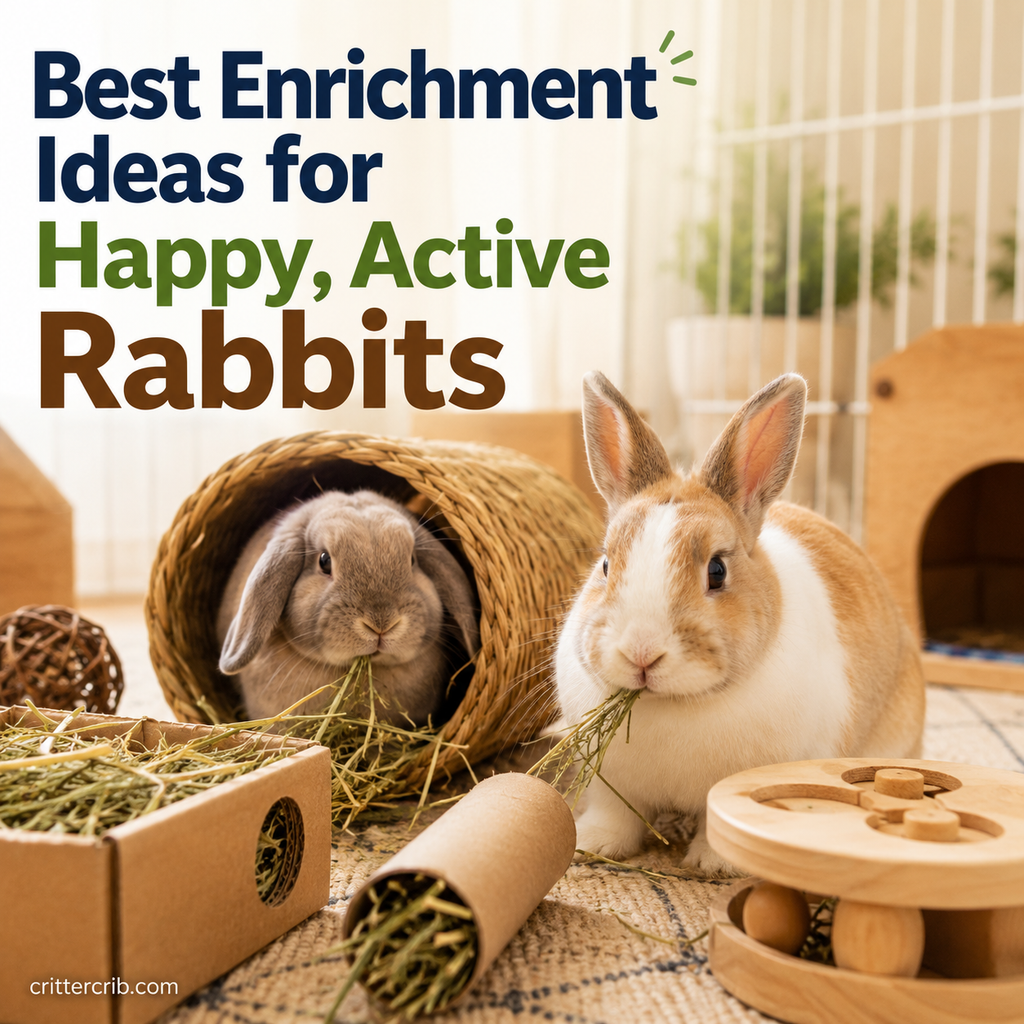
Try a Hay Foraging Box
A cardboard box can become a simple foraging station.
Fill it loosely with hay and hide a portion of your rabbit’s normal pellets or suitable herbs inside. Your rabbit then has to sniff, investigate, and move the hay around to find them.
Make sure the box is plain and free from staples, tape, plastic coatings, or other potentially unsafe materials.
2. Provide Plenty of Safe Chewing Options
Chewing is normal rabbit behavior. Trying to eliminate it entirely usually leads to frustration for both rabbit and owner.
A better strategy is to provide appropriate things to chew.
Depending on what is considered safe for your rabbit, options can include:
- Untreated rabbit-safe wood
- Willow toys
- Woven grass toys
- Plain cardboard
- Hay-based toys
- Rabbit-safe branches or sticks
- Cardboard tubes filled with hay
Rotate different textures to see what your rabbit prefers.
Some rabbits will enthusiastically destroy cardboard within minutes. Others are much more interested in willow or hay-based toys.
Always confirm that wood, branches, plants, and other natural materials are rabbit-safe before offering them.
3. Make a Rabbit Digging Box
Digging is another deeply rooted rabbit behavior.
Unfortunately, your carpet may seem like an excellent digging surface from your rabbit’s perspective.
A designated digging box can provide a more appropriate alternative.
Use a sturdy container large enough for your rabbit to comfortably investigate. Depending on the setup, you can fill it with safe materials such as:
- Shredded plain paper
- Crumpled paper
- Hay
- Pieces of plain cardboard
You can also hide a few pieces of hay or appropriate food inside to encourage exploration.
Supervise your rabbit when introducing a new digging material, especially if you are unsure whether your rabbit will try to eat it.
4. Add Tunnels to Explore
Rabbits naturally enjoy spaces where they can hide and move through cover.
Tunnels can provide both enrichment and a sense of security.
Commercial rabbit tunnels are one option, but large cardboard boxes can also be arranged to create simple passageways.
Try connecting several boxes and cutting rabbit-sized openings between them. Adding more than one entrance or exit can make the structure more interesting while preventing a rabbit from feeling trapped.
Periodically rearrange the tunnel layout to create a “new” environment without having to purchase anything.
5. Build a Cardboard Rabbit Maze
If you have several boxes available, turn them into a miniature rabbit maze.
Cut openings into the sides and connect the boxes in different configurations. Some areas can be open, while others can act as tunnels or hiding spots.
Place hay or another familiar item at different points to encourage exploration.
Keep the design simple at first.
Rabbits should be able to comfortably turn around and exit the maze. Avoid creating narrow areas where your rabbit could become stuck.
6. Introduce Puzzle Feeders
Puzzle feeders are not just for dogs and cats.
Simple food puzzles can encourage rabbits to investigate, push, pull, sniff, and problem-solve.
Rabbit-appropriate puzzles may involve:
- Moving a lightweight object to uncover food
- Searching through hay
- Rolling a suitable treat-dispensing toy
- Opening simple compartments
- Pulling hay from cardboard tubes
Begin with something your rabbit can solve relatively easily.
If a puzzle is too difficult, your rabbit may simply walk away. Once your bunny understands how the game works, you can gradually increase the challenge.
7. Give Your Rabbit Room to Run
Not all enrichment needs to involve toys.
Space itself can be enrichment.
Rabbits need opportunities to move beyond a small enclosure. A properly rabbit-proofed exercise area allows them to run, hop, stretch, explore, and sometimes perform those energetic jumps and twists commonly called “binkies.”
Create an exercise area with:
- Open running space
- Tunnels
- Hiding places
- Toys
- Hay
- Water
- Non-slip flooring
The amount and type of space available will depend on your home, but the important thing is giving your rabbit opportunities for regular movement in a safe environment.
8. Create Platforms and Different Levels
Many rabbits enjoy investigating slightly elevated areas where they can observe their surroundings.
A sturdy platform, low step, or appropriately designed rabbit structure can add another dimension to an otherwise flat living space.
Any elevated area should be:
- Stable
- Easy to access
- Made from safe materials
- Covered with secure, non-slip footing
- Low enough to minimize injury risk
Avoid creating tall climbing structures. Rabbits are powerful jumpers, but they are not built to climb like cats.
9. Provide Hiding Places
A hiding place serves a different purpose from an exercise toy, but it is still an important part of an enriching environment.
Rabbits are prey animals. Having somewhere to retreat can help them feel secure enough to explore the rest of their environment confidently.
Useful hideouts include:
- Cardboard boxes
- Rabbit houses
- Tunnels
- Covered resting areas
Whenever possible, choose hiding spaces with more than one opening. Multiple exits can help a rabbit feel less confined.
A hideout can become even more interesting when you occasionally change its location or connect it to another tunnel or box.
10. Rotate Toys Instead of Offering Everything at Once
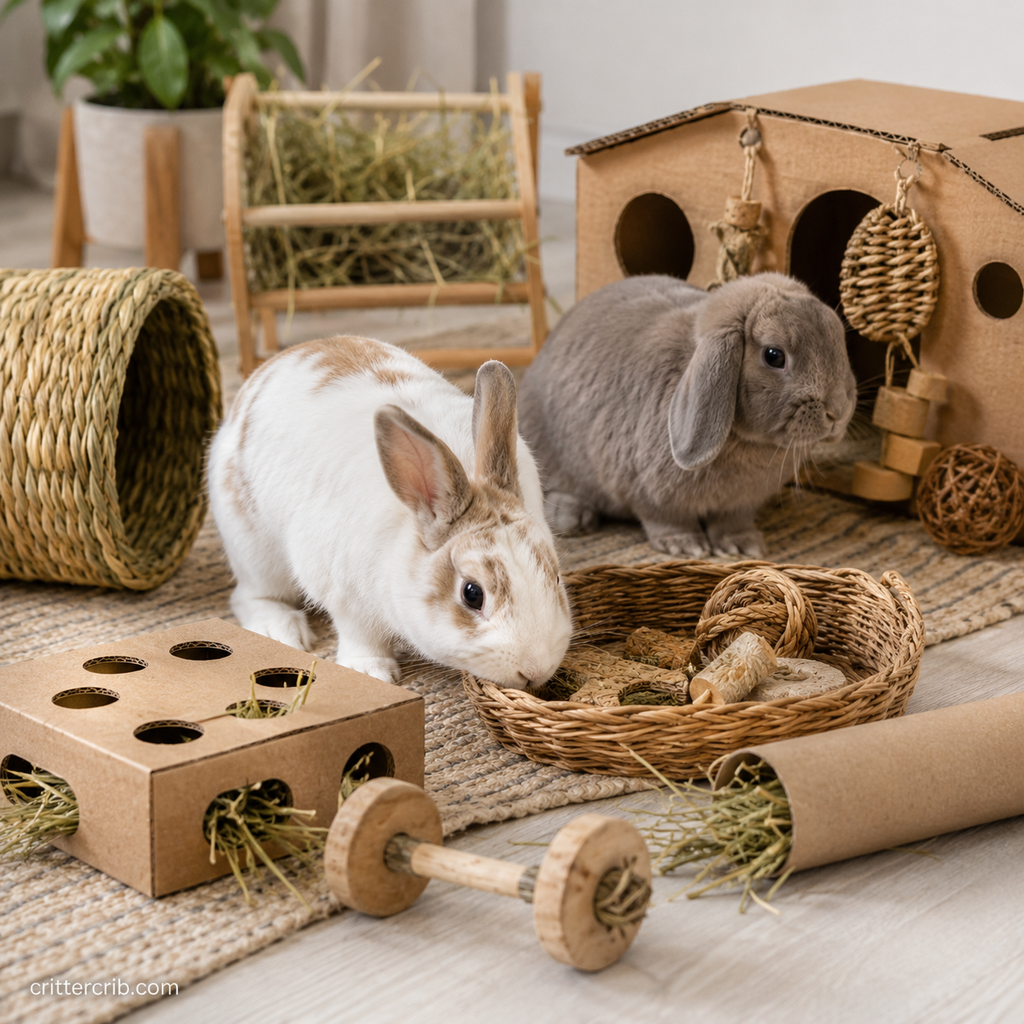
You do not necessarily need dozens of toys available every day.
Rotation can make familiar objects interesting again.
Keep several rabbit-safe enrichment items and periodically swap them.
For example, your rotation might include:
- A cardboard tunnel and willow toy
- A digging box and hay-filled cardboard tube
- A foraging box and puzzle feeder
- A cardboard maze and chew toys
When an old toy returns after being absent for a while, your rabbit may investigate it with renewed interest.
You can also pay attention to which items consistently get ignored. Rabbits have individual preferences, and there is little reason to keep offering an enrichment activity your bunny clearly does not enjoy.
11. Rearrange the Environment Occasionally
Imagine living in a room where absolutely nothing changed for years.
Even with plenty of toys, it could eventually become predictable.
Small environmental changes can encourage rabbits to investigate their surroundings again.
You might move:
- A tunnel
- A cardboard house
- A digging box
- A toy basket
- A low platform
You do not need to completely redesign the enclosure.
A few small changes are often enough to create new paths, smells, and areas to investigate.
However, avoid constantly changing everything at once. Rabbits also appreciate familiar resting areas and predictable access to essentials such as hay, water, and litter boxes.
12. Turn Cardboard Tubes Into Simple Toys
Before throwing away a plain cardboard tube, consider turning it into rabbit enrichment.
One easy option is to loosely fill the tube with hay. Your rabbit can pull the hay out, chew the cardboard, or roll the tube around.
You can also fold the ends of an appropriate tube and place a small portion of your rabbit’s regular food inside, creating a basic food puzzle.
Always remove cardboard if it becomes heavily soiled, wet, or unsafe.
13. Encourage Safe Exploration
Sometimes the best enrichment is simply somewhere new to investigate.
If you have another thoroughly rabbit-proofed room or exercise area, supervised exploration can introduce new smells, layouts, and objects.
Before allowing access, check carefully for hazards such as:
- Electrical cords
- Toxic houseplants
- Small objects that could be swallowed
- Cleaning products
- Accessible medications
- Unsafe furniture gaps
- Open doors
- Other pets
Rabbit-proofing matters because curiosity can quickly turn an ordinary household object into a chewing project.
14. Spend Time Interacting at Your Rabbit’s Level
Enrichment does not always require an object.
Your presence can be part of your rabbit’s environment too.
Instead of immediately picking up your rabbit, try sitting quietly on the floor and allowing your bunny to approach you.
You can offer appropriate food by hand, gently pet your rabbit if they enjoy it, or simply allow them to investigate you.
This gives your rabbit more control over the interaction.
Over time, these calm sessions can become an enjoyable part of the daily routine and help you learn your rabbit’s body language and preferences.
15. Consider the Importance of Rabbit Companionship
Rabbits are social animals, and appropriate companionship can provide a type of enrichment that toys cannot fully reproduce.
Compatible rabbits may spend time resting together, grooming one another, exploring, and interacting throughout the day.
However, rabbits should not simply be placed together and expected to become friends.
Introductions and bonding should be handled carefully, and rabbits should be appropriately spayed or neutered according to veterinary guidance before bonding is attempted.
If you are considering adding another rabbit, research proper bonding procedures and discuss the situation with a rabbit-savvy veterinarian or experienced rabbit rescue.
16. Try Simple Training Sessions
Rabbits can learn more than many people realize.
Short, positive training sessions provide mental stimulation while giving you another way to interact with your rabbit.
Depending on the individual rabbit, you may be able to teach behaviors such as:
- Coming when called
- Touching a target
- Entering a carrier
- Standing briefly on the hind legs
- Moving onto a mat
- Following a simple cue
Keep training sessions short and positive.
Use tiny portions of appropriate food rewards and count them as part of the rabbit’s normal daily intake when necessary.
Training should never involve punishment or forcing a rabbit into position.
17. Make Mealtime More Interesting
A bowl filled with pellets is convenient, but it does not require much effort from your rabbit.
You can occasionally turn part of mealtime into an activity.
For example, divide a measured portion of pellets among several locations:
- Some scattered through hay
- Some inside a puzzle
- Some hidden in a cardboard box
- Some used during a short training session
Your rabbit still receives the appropriate amount of food, but obtaining it becomes a more engaging experience.
Hay should remain readily available rather than being unnecessarily difficult to access.
18. Create a Rabbit-Safe Toy Basket
A shallow container filled with safe objects can become an exploration station.
Depending on your rabbit’s preferences, it might contain:
- Woven grass toys
- Cardboard pieces
- Lightweight rabbit-safe toys
- Hay-filled tubes
- Chew items
Some rabbits enjoy picking objects up and tossing them aside.
Others will carefully investigate each item before deciding which one deserves to be destroyed first.
Either response is perfectly reasonable rabbit behavior.
Watch What Your Rabbit Actually Enjoys
There is no single perfect enrichment routine for every rabbit.
One rabbit may spend an afternoon enthusiastically digging through a box. Another might ignore it completely and spend most of the time rearranging cardboard tubes.
Watch for the activities your rabbit repeatedly chooses.
Signs of engagement may include:
- Sniffing and investigating
- Digging
- Chewing appropriate items
- Tossing toys
- Running through tunnels
- Searching for hidden food
- Returning to the same activity later
Enrichment works best when it matches the individual rabbit rather than simply providing a large collection of toys.
Rabbit Enrichment Safety Tips
Anything placed within reach of a rabbit may eventually be chewed, pushed, tossed, or dug at.
That means enrichment should always be chosen with safety in mind.
Before introducing a new activity:
- Check that materials are non-toxic and rabbit-safe.
- Remove staples, tape, string, plastic, and other hazardous pieces.
- Avoid painted or chemically treated wood unless confirmed safe.
- Make sure openings are large enough to prevent entrapment.
- Keep elevated platforms stable and relatively low.
- Supervise unfamiliar activities.
- Replace toys that become damaged or unsafe.
- Avoid excessive treats during food-based enrichment.
- Confirm that any plants, branches, or natural materials are safe for rabbits.
Pay attention to how your particular rabbit interacts with an object. Something that works well for one rabbit may not be appropriate for another.
How Often Should You Provide Rabbit Enrichment?
Enrichment should be part of a rabbit’s regular environment rather than something reserved for special occasions.
That does not mean you need to invent a new activity every morning.
A practical setup might include permanent basics such as hiding places, hay, chew items, and sufficient exercise space, combined with rotating activities such as puzzles, digging boxes, tunnels, and foraging games.
Even small changes can keep the environment interesting.
You Don’t Need Expensive Rabbit Toys
One of the best things about rabbit enrichment is that creativity often matters more than cost.
A commercial puzzle feeder can be useful, but so can a plain cardboard box filled with hay. A carefully arranged set of cardboard tunnels may entertain some rabbits more than an expensive toy.
Start with your rabbit’s natural behaviors:
- Foraging
- Digging
- Chewing
- Exploring
- Running
- Hiding
- Socializing
Then look for safe ways to encourage those behaviors.
Final Thoughts on Keeping Rabbits Happy and Active
The best rabbit enrichment does more than keep a bunny occupied. It creates opportunities for rabbits to behave like rabbits.
Provide room to move, safe objects to chew, places to hide, opportunities to forage, and activities that encourage curiosity. Rotate some enrichment items occasionally and pay attention to which activities your rabbit actually enjoys.
You do not need an elaborate setup or an endless supply of new toys. A cardboard box, a handful of hay, a tunnel, and a little creativity can go a surprisingly long way.
Most importantly, treat enrichment as an ongoing part of rabbit care. When rabbits have safe opportunities to explore, make choices, exercise, and use their natural instincts, their everyday environment becomes much more interesting.