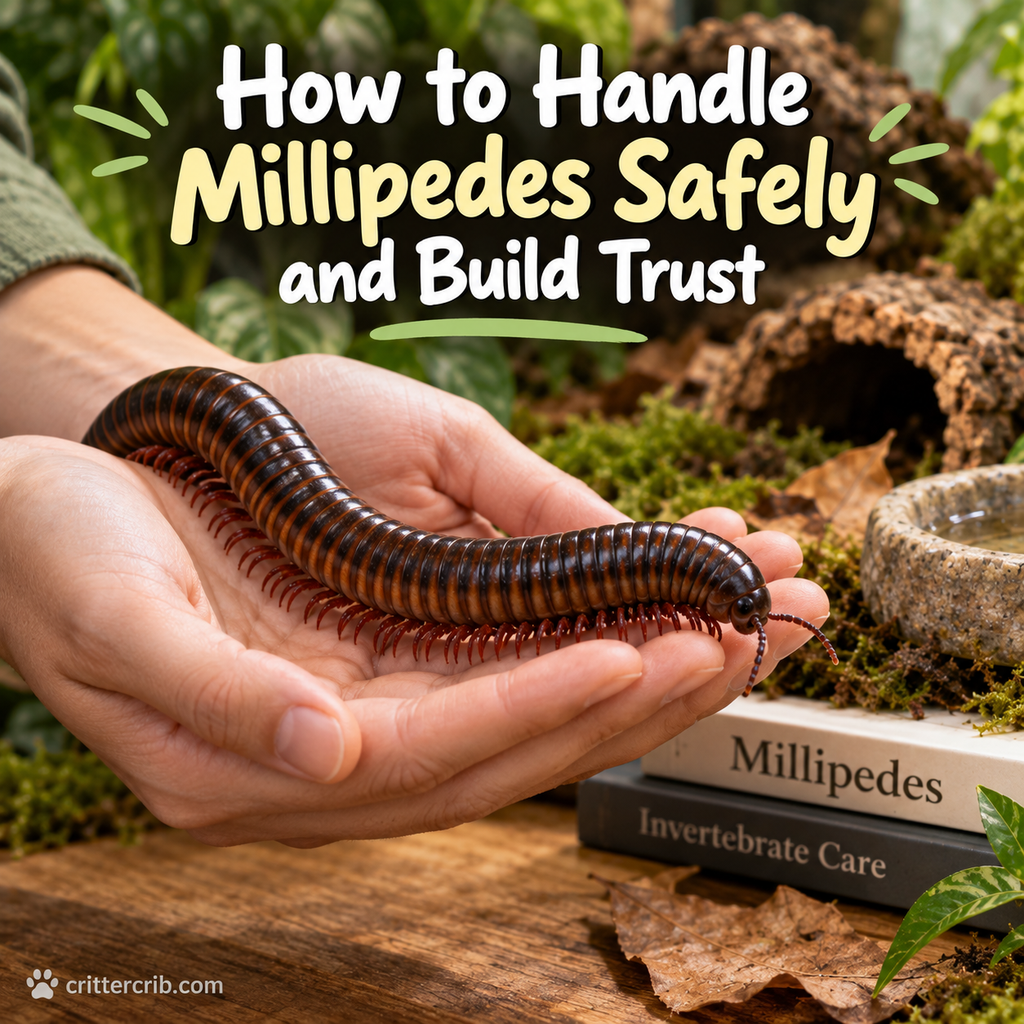
Millipedes are slow-moving, gentle creatures, which is one reason they’ve become popular with people who enjoy unusual pets. Watching dozens—or sometimes hundreds—of tiny legs move in coordinated waves is fascinating, and many commonly kept species can tolerate occasional handling.
But handling a millipede isn’t quite the same as picking up a hamster or letting a gecko climb onto your hand.
Millipedes are delicate invertebrates. They can become stressed, they may release defensive chemicals when frightened, and a fall from your hands can cause a serious injury. Safe handling is less about teaching your millipede to enjoy being held and more about helping it become accustomed to calm, predictable interactions.
If you want to handle your pet millipede, here’s how to do it safely while keeping stress to a minimum.
Can You Handle a Pet Millipede?
Many commonly kept pet millipedes can be handled occasionally.
Large, relatively calm species are especially appealing because they tend to move slowly and are easy to observe while crawling across your hands.
However, handling isn’t something a millipede needs for enrichment or affection.
Millipedes don’t form relationships with people in the same way mammals do. When keepers talk about “building trust,” a more accurate way to think about it is helping the animal become accustomed to your presence and handling routine.
A comfortable millipede may remain active and explore your hands rather than immediately curling into a defensive position.
That’s a good sign.
Are Millipedes Dangerous to Handle?
Most commonly kept pet millipedes aren’t aggressive animals, and they don’t have venomous fangs or stingers.
Their main defense is quite different.
When threatened, many millipedes can release defensive secretions from glands along their bodies. The exact chemicals vary between species.
These secretions can irritate human skin, and contact with the eyes or mouth should be avoided. Some secretions may also temporarily stain the skin.
For that reason, even a calm pet millipede should be handled responsibly.
Wash Your Hands Before Handling a Millipede
Clean hands protect the millipede as much as they protect you.
Our hands can carry substances that aren’t appropriate for a small invertebrate, including:
- Soap residue
- Hand sanitizer
- Lotion
- Sunscreen
- Perfume
- Cleaning products
- Nicotine residue
- Household chemicals
Wash your hands thoroughly and rinse them well before handling.
Make sure no soap residue remains.
Some keepers prefer slightly damp hands when handling millipedes because dry skin can pull moisture from the animal’s body. Your hands shouldn’t be dripping wet—just clean and free of contaminants.
Wash Your Hands After Handling Too
Hand washing after handling is equally important.
Even if your millipede didn’t visibly release a defensive secretion, washing your hands afterward is a good habit.
Avoid touching your:
- Eyes
- Nose
- Mouth
- Face
- Food
until your hands have been washed.
If you notice a secretion on your skin, stop handling the millipede and wash the affected area thoroughly with soap and water.
If material gets into your eyes, rinse them promptly with plenty of clean water and seek medical advice if irritation persists or is severe.
How to Pick Up a Millipede Safely
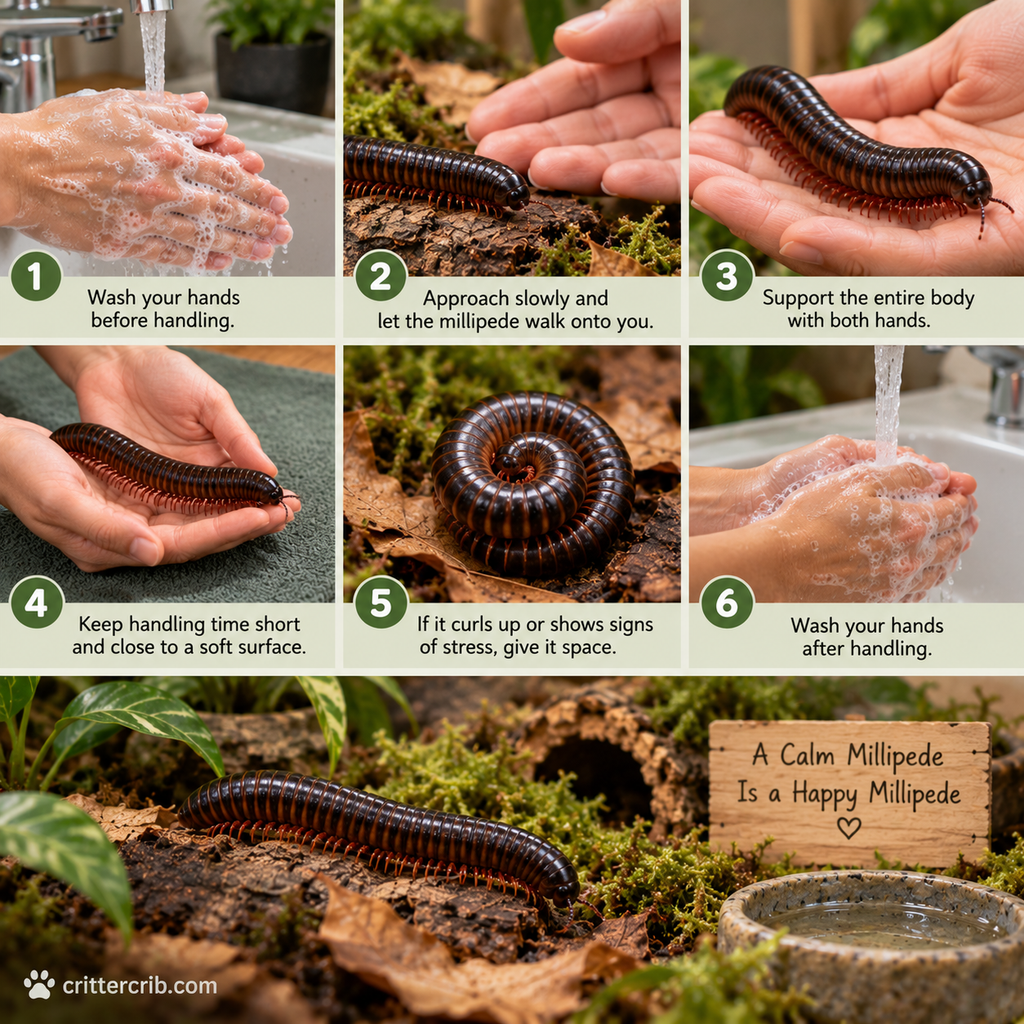
The safest approach is usually to encourage the millipede to walk onto your hand rather than grabbing it.
Move slowly.
Sudden movements can startle an animal that has no idea why a giant creature is reaching into its enclosure.
Step 1: Approach Slowly
Place your hand near the millipede rather than immediately reaching down and picking it up.
Give it a moment to react.
If it begins moving normally, you can gently position your hand in its path.
Step 2: Let the Millipede Walk Onto You
Whenever possible, allow the millipede to crawl onto your hand voluntarily.
You can gently guide it from behind if necessary, but avoid pushing or squeezing.
Step 3: Support the Entire Body
Once the millipede is on your hand, keep your other hand nearby.
Larger millipedes can stretch surprisingly far.
Use both hands to provide a continuous surface as the animal walks.
Step 4: Stay Close to the Ground
This is one of the most important handling rules.
Handle your millipede while sitting on the floor, over a bed, or directly above a soft surface.
Never stand and hold the millipede several feet above the ground.
A fall that seems minor to you can seriously injure a small invertebrate.
Step 5: Let It Move Naturally
Don’t restrain the millipede unless absolutely necessary.
Allow it to walk across your hands at its own pace.
You can place one hand in front of the other to create a continuous path.
Never Pull a Millipede Off a Surface
If your millipede is gripping bark, substrate, or another enclosure decoration, don’t pull it away.
Millipedes have many legs and can hold onto surfaces surprisingly well.
Pulling could injure the legs or body.
Instead, place your hand nearby and gently encourage the millipede to move in that direction.
Patience is safer than force.
How to Tell If a Millipede Is Stressed
Millipedes can’t tell us how they’re feeling, so you need to pay attention to their behavior.
One of the most recognizable defensive behaviors is curling into a tight spiral.
A millipede may curl when it feels threatened, protecting its softer underside inside the coil.
Other possible signs that the interaction should end include:
- Remaining tightly curled for an extended period
- Repeatedly trying to move away
- Sudden unusual movements
- Releasing defensive secretions
- Becoming unusually still after being disturbed
Not every curled millipede is experiencing extreme stress. Curling is a normal defensive behavior.
But if handling repeatedly causes it, give the animal some space.
What Should You Do If Your Millipede Curls Up?
Don’t try to uncurl it.
Place the millipede on a safe surface or gently return it to its enclosure.
Then leave it alone.
Trying to pry open a curled millipede can cause injury and will likely make the situation more stressful.
It may uncurl once it feels secure again.
How Do You Build Trust With a Millipede?
“Trust” with a millipede isn’t the same as trust with a dog, bird, or other socially interactive animal.
You’re really building familiarity and tolerance.
The goal is for your presence to become predictable rather than threatening.
Start With Observation
When you first bring a millipede home, don’t immediately begin handling it every day.
Give it time to settle into the enclosure.
Watch when it becomes active, where it likes to hide, and how it behaves during feeding.
This also gives you a baseline for normal behavior.
Make Your Presence Predictable
Routine can help reduce unnecessary disturbance.
Perform enclosure maintenance calmly and avoid constantly rearranging the habitat.
When you need to add food or water, move slowly.
Over time, routine activity around the enclosure becomes part of the millipede’s environment.
Introduce Your Hand Gradually
Once the millipede has settled in, place your hand near it during an appropriate time when it’s already active.
Don’t chase it.
Let the animal investigate or walk away.
Eventually, you can position your hand so the millipede can walk onto it.
Keep Early Handling Sessions Short
The first few interactions don’t need to last long.
A few minutes is plenty.
Return the millipede to its enclosure while it is still behaving normally rather than waiting until it becomes defensive.
Follow the Millipede’s Behavior
Some individuals tolerate handling better than others.
Don’t force every millipede into the same routine.
If yours consistently curls up or releases defensive secretions whenever you attempt handling, it may be better enjoyed as an observational pet.
That’s perfectly fine.
How Often Should You Handle a Millipede?
There isn’t a required handling schedule.
Millipedes don’t need daily handling.
Occasional short sessions are generally more appropriate than repeatedly removing the animal from its enclosure throughout the day.
The exact frequency should depend on the individual millipede and how it responds.
If your millipede walks calmly across your hands and doesn’t show obvious defensive behavior, occasional handling may be well tolerated.
If it consistently curls up, leave it alone more often.
When You Shouldn’t Handle a Millipede
Sometimes the safest choice is not to handle your millipede at all.
Avoid unnecessary handling when:
- The millipede has recently arrived
- It appears stressed
- It is molting
- You suspect it is preparing to molt
- It has recently been injured
- Your hands have chemicals or lotions on them
- You’re unable to provide a safe handling area
- The millipede repeatedly releases defensive secretions
Molting deserves special attention.
Don’t Handle a Molting Millipede
Molting is a vulnerable period for millipedes.
As they grow, they shed their old exoskeleton and develop a new one. During this process, the new exoskeleton is initially soft.
Many millipedes molt underground, which is one reason adequate substrate depth is so important.
If your millipede disappears beneath the substrate for an extended period, don’t dig it up just to check on it.
It may be molting.
Disturbing a molting millipede can cause serious problems.
Let it emerge on its own.
What If Your Millipede Releases Defensive Fluid?
Stay calm and gently return the millipede to its enclosure.
Don’t punish it, shake it off, or continue handling.
The secretion is a defensive response, so its release is a clear indication that the animal wants the interaction to end.
Wash any exposed skin thoroughly with soap and water.
Keep your hands away from your eyes and face until you’ve washed them.
If irritation develops and doesn’t resolve, seek appropriate medical advice.
Can Children Handle Millipedes?
Children can enjoy observing millipedes, but handling should always be supervised by a responsible adult.
The biggest concerns are both the child’s safety and the millipede’s safety.
Children may accidentally:
- Squeeze the millipede
- Drop it
- Pull it from a surface
- Touch their eyes afterward
- Put their hands near their mouth
- Become frightened if the millipede suddenly curls or secretes defensive chemicals
If a child handles a millipede, have them sit on the floor or another safe surface.
Teach them to keep their hands open and allow the millipede to walk rather than grabbing it.
Hand washing afterward is essential.
Can You Handle Giant Millipedes?
Many large species kept in the pet trade are popular partly because their size makes them easier to observe and handle carefully.
The African giant millipede is a well-known example.
A large millipede still needs gentle treatment.
In fact, its size means you should pay particular attention to supporting the entire body. Don’t allow a long portion of the animal to hang unsupported from your hand.
Use both hands and let the millipede walk naturally between them.
Species identification also matters because defensive secretions vary. Research the particular species you keep rather than assuming all large millipedes are identical.
Should You Wear Gloves When Handling Millipedes?
For routine handling of an appropriate pet species, some keepers use clean bare hands because they can better feel and support the animal.
However, gloves can reduce direct skin contact with defensive secretions.
They may be a sensible choice if you have sensitive skin or are handling an unfamiliar animal.
If you use gloves, make sure they’re clean and free of powders, chemicals, or residues that could harm the millipede.
Regardless of whether you use gloves, avoid touching your face during handling and wash your hands afterward.
Where Is the Safest Place to Handle a Millipede?
Think about what would happen if the millipede suddenly walked off your hand.
If the answer is “it would fall onto a hard floor,” change locations.
Safer options include:
- Sitting on the floor
- Over a low bed
- Over a large table covered with a soft surface
- Directly above the open enclosure
- Inside a secure handling area
Keep other pets away.
A curious cat or dog can turn a calm handling session into an emergency in seconds.
Common Millipede Handling Mistakes
Most handling problems are easy to avoid once you know what to watch for.
1. Grabbing the Millipede
Don’t close your hand around its body.
Let it crawl onto you instead.
2. Handling Too High Above the Ground
Even experienced keepers can accidentally drop an animal.
Keep the distance short.
3. Pulling a Millipede From Something
Never tug at a millipede that’s gripping bark or another surface.
Let it release naturally.
4. Ignoring Defensive Behavior
If the millipede repeatedly curls up or releases defensive secretions, stop the interaction.
5. Handling With Dirty Hands
Lotions, cleaning products, and other residues don’t belong on a millipede.
6. Forgetting to Wash Your Hands Afterwards
Defensive secretions can irritate sensitive areas, particularly the eyes.
7. Digging Up a Hidden Millipede
A buried millipede could be resting or molting.
Leave it alone unless there’s a genuine husbandry reason to intervene.
8. Forcing Interaction to “Tame” the Millipede
More handling doesn’t necessarily produce a calmer millipede.
Work with the animal’s natural behavior instead.
Do Millipedes Like Being Handled?
It’s better not to assume that a millipede enjoys handling.
Unlike domesticated companion animals, millipedes haven’t been bred over generations to seek human interaction.
A millipede calmly walking across your hand is showing that it currently tolerates the situation without obvious defensive behavior.
That’s different from seeking affection.
This distinction actually makes millipedes more interesting.
You aren’t trying to turn one into something it’s not. You’re learning to interact with an unusual animal on its own terms.
Handling vs. Observing Your Millipede
Some of the best experiences with pet millipedes don’t involve handling at all.
A well-designed enclosure lets you observe natural behaviors such as:
- Exploring leaf litter
- Burrowing
- Climbing
- Feeding
- Grooming
- Interacting with the substrate
- Emerging after periods underground
Giving your millipede plenty of substrate, hides, decaying leaves, wood, and other appropriate materials encourages these natural behaviors.
You may discover that simply watching your millipede explore its habitat is more interesting than holding it.
How to Make Handling a Positive Experience
You can’t guarantee that a millipede will enjoy handling, but you can make the experience safer and less stressful.
Keep things simple:
- Wash and thoroughly rinse your hands.
- Choose a safe location close to the ground.
- Approach the millipede slowly.
- Encourage it to walk onto your hand.
- Support its entire body.
- Allow it to move naturally.
- Watch for defensive behavior.
- Keep the session relatively short.
- Gently return it to the enclosure.
- Wash your hands afterward.
Most importantly, don’t force an interaction.
How to Handle Millipedes Safely: The Bottom Line
Millipedes can be fascinating pets to handle occasionally, but gentle treatment matters.
Rather than grabbing your millipede, encourage it to walk onto your hands. Keep it close to a soft surface, support its body, and never pull it away from something it’s gripping.
Pay attention to what the animal is telling you through its behavior.
A millipede that remains active and calmly explores your hands may tolerate occasional handling well. One that repeatedly curls up or releases defensive secretions is telling you it would rather be left alone.
Building “trust” isn’t about taming a millipede or making it affectionate. It’s about becoming a calm, predictable part of its environment and respecting when it doesn’t want to interact.
Do that, and handling can be an interesting part of keeping millipedes without putting unnecessary stress on these remarkable little animals.